
2027 How To Become a Public Health Nurse: Salary & Career Paths

Co-Founder and Chief Data Scientist
Public health nursing is a good fit for nurses who want to prevent illness before it reaches the hospital, improve access to care, and work with communities rather than only individual patients at the bedside. The path can feel confusing because the role sits at the intersection of nursing, prevention, education, epidemiology, social services, and public policy.
This guide explains how to become a public health nurse, what the job involves, how long the process usually takes, where public health nurses work, which degrees and certifications matter, and how to compare education options. It is written for students considering nursing, licensed RNs who want to move into population health, and working nurses thinking about graduate study or leadership roles.
Quick answer: How do you become a public health nurse?
To become a public health nurse, you generally need to become a licensed registered nurse first. That means completing an approved nursing program, commonly a Bachelor of Science in Nursing (BSN), and passing the NCLEX-RN exam. Some employers may consider RNs with an Associate Degree in Nursing (ADN), but many public health roles prefer or require a BSN because the work often includes health education, program planning, community outreach, data-informed prevention, and coordination with public agencies.
- A typical route is BSN → NCLEX-RN → RN licensure → public health, community health, clinic, school, nonprofit, or government experience.
- Public health nurses may work for health departments, schools, nonprofit organizations, community clinics, hospitals, and public health programs.
- Demand for registered nurses, including public health nurses, is projected to grow by 6% from 2023 to 2033.
- What does a public health nurse do?
- How much do public health nurses earn for 2027?
- What are the main responsibilities of a public health nurse?
- Where can public health nurses work?
- What degree is needed to become a public health nurse?
- How long does it take to become a public health nurse?
- What career paths can public health nurses pursue?
- How is a public health nurse different from a community health nurse?
- What should you look for in a public health nursing degree program?
- How do public health nurses keep their skills current?
- Which regions may offer stronger public health nursing opportunities?
- Which certifications are useful for public health nurses?
- What is the job outlook for public health nurses?
- How can the shortest DNP programs support public health nursing advancement?
What does a public health nurse do?
A public health nurse uses nursing training to improve health outcomes across groups of people, neighborhoods, schools, workplaces, and other communities. Instead of focusing only on one patient’s immediate condition, public health nurses look at patterns: who is getting sick, which groups lack access to care, where prevention is failing, and what education or services could reduce risk.
The work may include immunization outreach, infectious disease follow-up, maternal and child health services, chronic disease prevention, emergency preparedness, home visits, wellness screenings, health education, and referrals to community resources. Public health nurses often collaborate with local health departments, school systems, nonprofit agencies, social workers, clinics, and government programs.
A key difference from many hospital roles is the emphasis on prevention. A hospital nurse may care for a patient after a complication occurs. A public health nurse may help design or deliver a program that prevents that complication across an entire community.
| Public health nursing focus | What it looks like in practice | Why it matters |
| Disease prevention | Vaccination education, outbreak monitoring, screenings, and follow-up | Reduces preventable illness and helps detect risks early |
| Health education | Teaching families, students, workers, or community groups about safer health behaviors | Gives people practical information they can use before problems escalate |
| Access to care | Connecting people with clinics, insurance resources, social services, or specialty care | Helps reduce barriers that keep underserved groups from receiving care |
| Community advocacy | Identifying gaps in services and supporting programs that address local needs | Turns frontline nursing observations into broader health improvements |
How much do public health nurses earn for 2027?
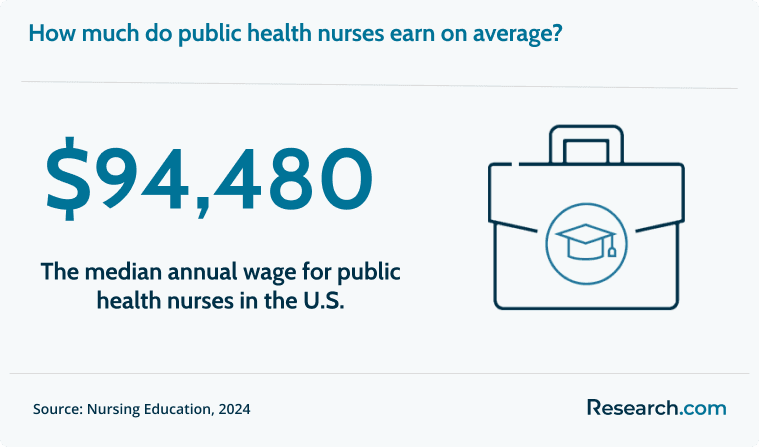
Public health nurses earn an average annual salary of $94,480. Pay can differ widely by state, employer, years of experience, education level, union status, job duties, and whether the role includes leadership, program management, emergency response, epidemiology support, or policy responsibilities.
Location is one of the biggest salary variables. States such as California and New York may offer higher pay because of cost of living, labor market demand, and the size of public health systems. Employer type also matters. A public health nurse employed by a large government agency or healthcare organization may have a different compensation package than a nurse working in a small nonprofit or grant-funded community program.
Education and credentials can also influence earnings. Employers may prefer a BSN for population health roles, and nurses with public health training, leadership experience, or credentials such as the Certified Public Health (CPH) credential may be more competitive for specialized or higher-responsibility positions. Still, salary is never guaranteed by a credential alone; local hiring needs and job scope matter.
| Salary factor | How it can affect earnings |
| State and metro area | Higher-cost regions and areas with stronger public health infrastructure may offer higher wages. |
| Employer type | Government agencies, hospitals, schools, nonprofits, and clinics may differ in salary, benefits, stability, and advancement options. |
| Experience | Entry-level roles usually pay less than positions requiring program leadership, outbreak response, or specialized expertise. |
| Education | A BSN, MSN, MPH, or doctoral degree may help qualify nurses for roles with broader responsibility. |
| Certification | Public health, infection prevention, education, or specialty credentials may strengthen a nurse’s qualifications. |
What are the main responsibilities of a public health nurse?
Public health nurses combine clinical judgment with community-level planning. Their responsibilities vary by employer, but most roles involve prevention, education, coordination, and outreach.
- Health education and wellness promotion: Public health nurses teach individuals and groups about disease prevention, nutrition, medication adherence, reproductive health, vaccination, chronic disease management, and available healthcare services.
- Community outreach and advocacy: They work with populations that may face barriers to care, including low-income families, older adults, school-age children, people experiencing housing instability, and communities with limited access to primary care.
- Disease surveillance and prevention: They may help track infections, support contact follow-up, coordinate screenings, participate in immunization programs, and report trends to public health teams.
- Program planning and evaluation: Public health nurses may help create, manage, or assess programs for maternal health, chronic disease prevention, school wellness, disaster readiness, substance use prevention, or community-based care coordination.
- Care coordination: Many roles involve connecting people to clinics, social services, transportation support, behavioral health resources, insurance assistance, or specialty providers.
- Emergency response support: During outbreaks, natural disasters, or other health emergencies, public health nurses may assist with triage, education, vaccination, shelter health services, or community communication.
If you want help identifying openings that match your preferred care setting, a nurse recruiter may be useful. Research.com also explains nurse recruiter salary considerations and the role recruiters play in connecting nurses with employers.
Where can public health nurses work?
Public health nurses are employed wherever prevention, education, care coordination, and population health services are needed. Some jobs are highly community-facing, while others involve program administration, data review, policy implementation, or coordination across agencies.
- Government health agencies: Local, state, and federal health departments hire public health nurses for immunization programs, communicable disease control, maternal and child health, emergency preparedness, community assessment, and public health policy support.
- Nonprofit organizations: Nonprofits may employ public health nurses in programs focused on HIV prevention, substance use, family health, housing-related health needs, aging services, migrant health, or access to care.
- Schools and educational institutions: Nurses in school settings may provide health education, screenings, chronic condition support, vaccination compliance assistance, mental health referrals, and wellness programming.
- Community health clinics: Clinics serving underserved populations often rely on nurses for direct care, prevention counseling, referrals, follow-up, and coordination with community partners.
- Hospitals and healthcare systems: Some hospitals employ public health nurses in outpatient programs, population health departments, transitional care, community benefit programs, or prevention initiatives for at-risk groups.
If your interest is more focused on one-on-one nursing care in a patient’s residence, home health may be a better fit. To compare the role, see Research.com’s guide on what does a home health nurse do.
| Work setting | Best fit for nurses who want to... | Possible trade-offs |
| Health department | Work on prevention programs, outbreak response, and population-level services | May involve public-sector processes, documentation, and grant-related constraints |
| Nonprofit agency | Serve specific communities or health issues with mission-driven teams | Funding may depend on grants or program cycles |
| School system | Support children, families, health education, and school wellness | Work may follow academic calendars and local school policies |
| Community clinic | Combine direct care with prevention and resource coordination | Caseloads can be complex because patients may face multiple barriers to care |
| Healthcare system | Connect hospital services with prevention, outreach, and population health | Roles may be more structured around system goals and patient metrics |
What degree is needed to become a public health nurse?
The most common educational path is to earn a Bachelor of Science in Nursing (BSN), become licensed as an RN, and then move into public health or community-focused nursing roles. The BSN is often preferred because it includes broader preparation in leadership, evidence-based practice, health assessment, community health, and systems-level thinking.
- Bachelor of Science in Nursing (BSN): A BSN is the strongest standard pathway for public health nursing. The degree typically includes nursing fundamentals, clinical practice, public or community health coursework, health promotion, research, leadership, and population-based care.
- Associate Degree in Nursing (ADN): An ADN can prepare graduates to become RNs in about two years, but public health employers often prefer BSN-prepared nurses. ADN-trained nurses who want broader opportunities can later complete an RN-to-BSN program.
- Graduate education and additional credentials: A public health nurse who wants to move into administration, advanced practice, policy, research, or specialized leadership may consider an MSN, MPH, DNP, or relevant certification. For RNs planning graduate study, an RN to MSN online pathway can help combine continued nursing education with career advancement.
Nurses interested in older adult care, chronic disease management, and advanced clinical roles may also compare online AGNP programs, especially if they want a flexible route into adult-gerontology nurse practitioner preparation.
| Education option | Typical purpose | When it makes sense |
| ADN | Qualifies graduates to pursue RN licensure after completing an approved program and passing the NCLEX-RN | You want the shortest initial route into RN practice and plan to earn a BSN later |
| BSN | Prepares nurses for RN licensure and broader roles in community health, leadership, and prevention | You want to be competitive for public health nursing jobs from the start |
| RN-to-BSN | Helps licensed RNs with an ADN complete bachelor’s-level nursing education | You are already an RN and want stronger qualifications for public health roles |
| MSN or MPH | Builds advanced knowledge in nursing leadership, public health, policy, epidemiology, or program design | You want to lead programs, specialize, teach, manage teams, or influence health systems |
| DNP | Focuses on advanced nursing practice, systems leadership, quality improvement, and evidence-based implementation | You are targeting high-level practice or leadership roles in complex healthcare and public health environments |
How long does it take to become a public health nurse?
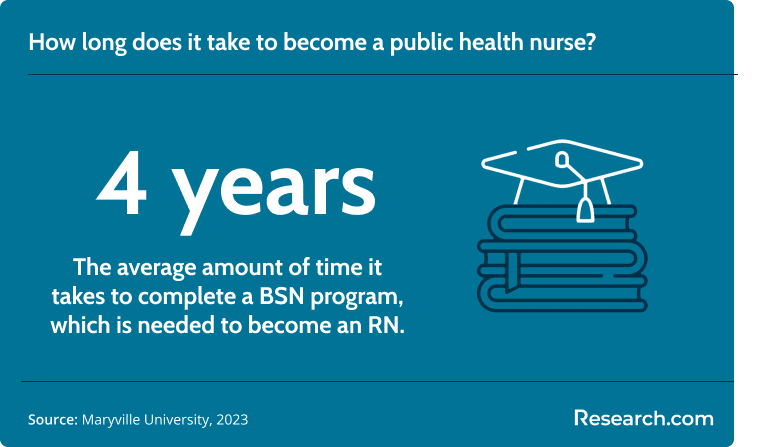
The timeline depends on whether you start with an ADN, a traditional BSN, an accelerated BSN, or prior healthcare experience. A traditional BSN route generally takes about four years before the NCLEX-RN and RN licensure process. An ADN route can take about two years, though many public health employers prefer BSN-prepared applicants.
After licensure, some nurses enter public health directly, while others first gain experience in hospitals, clinics, school health, home health, or community programs. That early clinical experience can be valuable because public health nurses need strong assessment skills, patient education skills, cultural humility, documentation habits, and comfort working with complex health and social needs.
Advanced roles take longer. A Master of Public Health (MPH), Master of Science in Nursing (MSN), or doctoral nursing degree can add two years or more, depending on the program structure and enrollment pace. Graduate education may support roles in public health administration, policy, advanced practice, epidemiology-related work, or program leadership. If you are comparing advanced nursing titles, Research.com explains the distinction between an APRN vs NP.
| Step | What you do | Estimated time based on common routes |
| Complete nursing education | Finish an approved ADN or BSN program | About two years for an ADN or about four years for a BSN |
| Pass the NCLEX-RN | Meet testing and state licensure requirements to become an RN | Varies by exam scheduling and state board processing |
| Build relevant experience | Work in clinical, community, school, public health, or outpatient settings | Varies by employer expectations and career goals |
| Pursue public health roles | Apply for positions in health departments, clinics, nonprofits, schools, or healthcare systems | Can happen after RN licensure, though BSN preparation is often preferred |
| Advance through graduate study or certification | Consider an MSN, MPH, DNP, or specialized credential | Can take two years or more depending on program and enrollment format |
What career paths can public health nurses pursue?
Public health nursing can be an entry point into many healthcare and population health careers. Some nurses remain in direct community-facing roles, while others move into leadership, advanced practice, education, policy, program management, or related clinical professions.
- Registered Nurse (RN) – $86,070: RNs are the core of public health nursing. They may work in public clinics, health departments, schools, nonprofit programs, and outreach services. For career changers who already hold a bachelor’s degree in another field, ABSN online programs may offer a faster route into BSN preparation.
- Licensed Practical Nurse (LPN) / Licensed Vocational Nurse (LVN) – $59,730: LPNs and LVNs provide basic nursing care under RN or physician supervision. They may contribute to community health initiatives, but they usually do not hold the same public health nursing responsibilities as RNs. An LPN to BSN online program can help practical nurses move toward RN-level preparation and broader public health opportunities.
- Physician Assistant (PA) – $130,020: PAs diagnose, treat, order tests, assist with procedures, and manage patient care under their scope of practice. This route requires a master’s degree in physician assistant studies and is a different professional pathway from nursing.
- Emergency Medical Technicians (EMTs) & Paramedics – $44,780: EMTs and paramedics focus on urgent response and pre-hospital care. Some build public health-related careers in disaster preparedness, community paramedicine, outreach, or emergency planning. A paramedic to RN bridge program online may help paramedics transition toward nursing while using their emergency care background.
- Nurse Practitioner (NP) and Nurse Anesthetist – $129,480: NPs diagnose conditions, prescribe medications, manage chronic disease, and provide primary or specialty care. Public health nurses who become NPs may serve communities with limited access to providers or lead clinical services in community health settings.
Public health nursing experience can also support a move into management or administration. Nurses who want to supervise programs, manage budgets, shape policy, or lead public health departments may consider graduate study in public health or healthcare administration. To evaluate that option, review Research.com’s guide to public health administrator salary.
| Career direction | Best for nurses who want... | Education or preparation often involved |
| Public health RN | Community outreach, prevention, education, and care coordination | RN license; BSN commonly preferred |
| Public health program coordinator | Planning, implementing, and evaluating health programs | BSN plus public health experience; graduate study may help |
| Nurse educator | Training nurses, staff, patients, or community groups | Clinical experience; advanced education or educator credential may help |
| Nurse practitioner | More clinical autonomy in primary or specialized care | Graduate nursing education and applicable licensure/certification |
| Public health administrator | Leadership, policy, operations, and population health strategy | Public health nursing experience plus graduate-level preparation may be useful |
The chart below shows the average salary for varying career path for public health nurses:
How is a public health nurse different from a community health nurse?
Public health nursing and community health nursing overlap, but they are not always the same. The simplest distinction is scope. Public health nurses often work at the population level, while community health nurses often work more directly with individuals, families, or smaller groups in a specific local setting.
A public health nurse may help manage an immunization campaign, support communicable disease tracking, analyze community needs, participate in emergency preparedness, or advocate for programs that affect a county, region, or high-risk population. A community health nurse may provide more hands-on services in clinics, schools, outreach programs, or neighborhood-based care settings.
Both roles aim to improve health outcomes and reduce disparities. The difference is usually the balance between systems-level prevention and direct local care. Nurses in either role who want to expand into advanced clinical practice can compare BSN to NP programs as a route toward nurse practitioner preparation.
| Comparison point | Public health nurse | Community health nurse |
| Main focus | Population health, prevention, policy, programs, and systems-level outcomes | Individuals, families, and smaller groups within a local community |
| Common settings | Health departments, government programs, nonprofits, large-scale public health initiatives | Clinics, schools, outreach programs, home visits, community-based services |
| Typical activities | Disease surveillance, immunization campaigns, health education strategy, program planning | Direct education, screenings, referrals, patient support, care coordination |
| Scale of impact | Often countywide, regional, statewide, or population-based | Often neighborhood, clinic, school, family, or patient-centered |
What should you look for in a public health nursing degree program?
Choosing the right nursing program matters because public health nursing requires both RN-level clinical competence and population health preparation. Do not select a program based only on convenience or tuition. First confirm that the nursing program is properly approved for RN licensure in the state where you plan to practice, and check institutional and nursing accreditation status before enrolling.
Strong programs include community health nursing coursework, clinical or practicum experiences, preparation for evidence-based practice, leadership training, health assessment, cultural competence, and exposure to public health systems. If you are already licensed and need a flexible bachelor’s-completion option, compare formats such as the easiest RN-BSN programs, but make sure “easy” does not mean weak clinical support, poor advising, or limited transfer credit review.
| Program factor | Questions to ask before enrolling |
| Accreditation and state approval | Is the nursing program approved for RN licensure, and is the institution properly accredited? |
| Public health coursework | Does the curriculum include community health, population health, epidemiology basics, prevention, and health promotion? |
| Clinical placement support | Will the school help arrange clinical or practicum experiences, or must students find sites independently? |
| Online flexibility | Are online courses asynchronous, synchronous, hybrid, or campus-based, and will the schedule work with employment? |
| Transfer credit policy | How many prior credits will count, and will the school provide a written transfer evaluation? |
| Cost and financial aid | What is the full cost after fees, books, clinical expenses, travel, and technology requirements? |
| Graduate outcomes | What support does the program provide for NCLEX preparation, job placement, advising, and career development? |
How do public health nurses keep their skills current?
Public health practice changes as disease patterns, community needs, health policy, technology, emergency preparedness standards, and evidence-based guidelines evolve. Public health nurses stay current through continuing education, employer training, professional conferences, journals, certification renewal, public health webinars, and cross-training with epidemiology, emergency management, social services, and community partners.
Skills that increasingly matter include data literacy, culturally responsive communication, telehealth familiarity, vaccine education, infection prevention, emergency response coordination, grant-funded program documentation, and the ability to explain complex health information clearly to nonclinical audiences.
Nurses who are still moving toward RN licensure can also use bridge pathways to build credentials more efficiently. For example, Research.com reviews the best 6-month LPN to RN bridge programs online for practical nurses comparing accelerated options.
Which regions may offer stronger public health nursing opportunities?
The best region for a public health nurse depends on more than salary. A strong career environment may include well-funded public health departments, large healthcare systems, community clinics, school health programs, nonprofit networks, emergency preparedness programs, and local demand for preventive services.
Before relocating or applying across state lines, compare cost of living, licensure requirements, union presence, benefits, commute expectations, rural versus urban needs, and whether the role is grant-funded or permanent. Public health nursing work can look very different in a large metropolitan health department than in a rural county with limited providers.
For a broader look at compensation, workplace quality, and location-based nursing considerations, review Research.com’s guide to the best state to work as a nurse.
Which certifications are useful for public health nurses?
Certification is not always required for public health nursing jobs, but it can demonstrate specialized knowledge and help nurses compete for focused roles. The right credential depends on whether you want to work in population health, infection prevention, hospice and palliative care, education, or advanced public health nursing.
- Certified in Public Health (CPH): Offered by the National Board of Public Health Examiners (NBPHE), this credential is designed for professionals who want to show knowledge of public health domains such as epidemiology, environmental health, health policy, program planning, and prevention.
- Certified Hospice and Palliative Nurse (CHPN): This credential may fit nurses serving people with serious illness, terminal conditions, aging-related needs, or vulnerable populations requiring end-of-life support.
- Certified Nurse Educator (CNE): Nurses who teach in academic, clinical, or community settings may use this certification to document teaching expertise.
- Certified Infection Control (CIC): This certification is relevant for nurses working in infection prevention, outbreak response, clinical safety, surveillance, or facility-based public health initiatives.
- Advanced Public Health Nurse (APHN-BC): Offered by the American Nurses Credentialing Center (ANCC), this credential is intended for nurses with advanced preparation in public health nursing and typically requires graduate-level nursing education.
| Certification | Most relevant for | Decision note |
| CPH | Population health, program planning, policy, prevention, and public health systems | Useful when you want to show broad public health knowledge beyond bedside nursing |
| CHPN | Hospice, palliative care, vulnerable populations, and serious illness support | Best if your public health work intersects with end-of-life or chronic illness services |
| CNE | Nursing education, training, academic instruction, or community health teaching | Consider it if teaching is central to your career plan |
| CIC | Infection prevention, outbreak response, surveillance, and clinical safety | Strong fit for roles connected to communicable disease prevention |
| APHN-BC | Advanced public health nursing practice and population-level program leadership | Most appropriate for nurses with graduate-level public health nursing preparation |
What is the job outlook for public health nurses?
The outlook for public health nurses is tied to the broader registered nursing labor market and to ongoing demand for prevention, community care, chronic disease management, and public health preparedness. According to the U.S. Bureau of Labor Statistics (BLS), there were 3,300,100 registered nurses employed in 2023, and employment is projected to reach 3,497,300 by 2033.
That represents 6% projected growth from 2023 to 2033. Public health nurses are especially relevant as communities address aging populations, chronic disease, health disparities, immunization needs, emergency response, and gaps in access to preventive care. However, job availability will still vary by state, local budgets, employer funding, and public health priorities.
| Employment measure | Figure |
| Registered nurses employed in 2023 | 3,300,100 |
| Projected registered nurse employment by 2033 | 3,497,300 |
| Projected growth from 2023 to 2033 | 6% |
The table below illustrates the projected employment growth for registered nurses over the next decade:
Common mistakes to avoid when becoming a public health nurse
- Choosing a program before checking approval and accreditation: Make sure your nursing program meets licensure requirements and has appropriate accreditation before you commit time or money.
- Assuming an ADN will open every public health role: An ADN can lead to RN licensure, but many public health employers prefer BSN-prepared nurses.
- Looking only at tuition: Compare total cost, including fees, books, uniforms, exams, background checks, travel, clinical requirements, and lost work time.
- Ignoring clinical placement details: Online programs can be flexible, but students may still need in-person clinical or practicum experiences.
- Assuming salary averages apply to every job: The average salary of $94,480 is useful for context, but actual pay depends on location, employer, duties, and experience.
- Skipping public health experience: Volunteer work, community clinic experience, school health exposure, or outreach projects can help show genuine interest in population health.
- Waiting too long to understand state licensure rules: Nursing licensure is state-regulated, so requirements can affect where you study, complete clinicals, and work.
Step-by-step roadmap: How to become a public health nurse
- Confirm that nursing is the right foundation. Public health nursing still requires strong nursing judgment, communication, documentation, and patient assessment skills.
- Choose an approved nursing education pathway. Decide whether an ADN, traditional BSN, accelerated BSN, or bridge program fits your background, budget, and timeline.
- Complete required coursework and clinical experiences. Prioritize programs with community health, prevention, health promotion, and population health exposure.
- Pass the NCLEX-RN and obtain RN licensure. You must hold an RN license to practice as a registered nurse.
- Build relevant experience. Look for roles or projects in community clinics, schools, outpatient care, home visiting, health education, immunization programs, or underserved populations.
- Apply for public health nursing positions. Target health departments, nonprofits, schools, clinics, hospitals, and population health programs.
- Consider certification or graduate study when it supports your goals. Credentials such as CPH or graduate degrees such as an MSN, MPH, or DNP can help for leadership, policy, education, or advanced practice roles.
Questions to ask before choosing this career path
- Do I want to focus on prevention and community health, not only acute bedside care?
- Am I comfortable working with people who may face housing, food, transportation, insurance, language, or trust barriers?
- Would I enjoy teaching, outreach, care coordination, documentation, and collaboration with agencies?
- Do I prefer direct patient interaction, program planning, policy work, or a mix of all three?
- Will a BSN be enough for my goals, or will I eventually need an MSN, MPH, DNP, or certification?
- Which employers in my area hire public health nurses, and what degrees do their job postings request?
- Can I afford the program I am considering, and will it meet licensure requirements in my state?
Here’s what graduates have to say about their public health degrees
-
: "
Moving into public health nursing gave my work a different kind of purpose. I now spend my days helping underserved communities understand prevention, connect with services, and make practical health decisions. The work can be demanding, but seeing people gain access to care makes it worth it. – Mitch
"
-
: "
Public health nursing has allowed me to contribute to programs that reach far beyond one exam room. Immunization outreach, health education, and prevention campaigns have shown me how nursing can influence the health of entire populations. – Claire
"
-
: "
After years in clinical care, I wanted a role that combined nursing, advocacy, and education. Public health nursing gave me that balance. I still support individuals, but I also work on the conditions that affect whole communities. – Manuela
"
How can the shortest DNP programs support public health nursing advancement?
A Doctor of Nursing Practice can be useful for nurses who want advanced leadership, systems improvement, policy influence, or high-level practice responsibilities. For public health nurses, DNP training may support work in quality improvement, evidence-based program implementation, executive leadership, community health strategy, and complex population health initiatives.
Accelerated or shorter online DNP formats may appeal to working nurses who already have strong clinical experience and want a more efficient path to doctoral preparation. The trade-off is intensity: shorter programs can require careful time management, strong academic readiness, and reliable clinical or project support. Compare options through Research.com’s guide to the shortest DNP programs before deciding whether an accelerated format fits your schedule and goals.
Key Insights
- Public health nursing is a prevention-focused RN career centered on communities, populations, and access to care rather than only bedside treatment.
- The most common route is to earn a BSN, pass the NCLEX-RN, obtain RN licensure, and gain experience in community or public health settings.
- Public health nurses earn an average annual salary of $94,480, but pay varies by state, employer, experience, education, and job scope.
- Registered nurse employment is projected to grow by 6% from 2023 to 2033, rising from 3,300,100 RNs in 2023 to 3,497,300 by 2033.
- An ADN can lead to RN licensure, but a BSN is often the better choice for public health nursing because many employers prefer bachelor’s-prepared nurses.
- Certifications such as CPH, CIC, CNE, CHPN, and APHN-BC can strengthen qualifications when they match your target role.
- Before enrolling in any program, verify accreditation, state approval, clinical placement support, total cost, transfer credit rules, and whether the curriculum includes community or population health preparation.
- The best public health nursing path depends on your goal: direct outreach, school health, infectious disease work, program coordination, advanced practice, education, or public health leadership.
References:
- Maryville University. (2023). How to Become a Public Health Nurse. https://nursing.maryville.edu
- Nursing Education. (2024). How Much Do Public Health Nurses Make? https://nursingeducation.org
- U.S. Bureau of Labor Statistics. (2024). OOH: Registered Nurses. https://www.bls.gov
Other Things You Should Know About Becoming a Public Health Nurse
To become a public health nurse in 2027, you need at least a Bachelor of Science in Nursing (BSN) degree, followed by passing the NCLEX-RN to obtain a registered nurse (RN) license. Further certifications, like the Certified Public Health (CPH) credential, may enhance career prospects.
The most common duties are disease screening, immunization support, health education, and case management for high-risk groups. Public health nurses also track outbreaks, connect patients to social services, and report data to local or state health departments.





