2027 How to Become a Nurse in South Dakota

Co-Founder and Chief Data Scientist
Becoming a nurse in South Dakota means choosing the right education path, meeting state licensing rules, passing the required national exam, and keeping your license active after you begin practice. The process is manageable, but mistakes—such as enrolling in a program that is not approved for licensure, misunderstanding compact license rules, or overlooking clinical requirements—can delay your start date. This guide explains how to become an LPN, RN, APRN, or related healthcare professional in South Dakota, what credentials each role requires, how online and campus programs compare, and how to make a smart decision about nursing school, cost, career mobility, and long-term advancement.
Quick Answer: How do you become a nurse in South Dakota?
To become a nurse in South Dakota, you generally need to complete a state-approved nursing program, apply to the South Dakota Board of Nursing, pass the NCLEX-PN for practical nursing or the NCLEX-RN for registered nursing, complete any required background check and documentation, and maintain your license through renewal and professional practice requirements. Registered nurses may qualify through an Associate Degree in Nursing or a Bachelor of Science in Nursing, while Licensed Practical Nurses typically complete a practical nursing program that takes about one year.
Key Things You Should Know About Becoming a Nurse in South Dakota
- South Dakota is projected to need an additional 1,000 nurses by 2025 because of an aging population and retirements in the healthcare workforce.
- Registered nurses entering the field in South Dakota earn approximately $63,000 per year, while experienced nurses can make upwards of $80,000 depending on location, employer, and specialization.
- The Bureau of Labor Statistics growth rate projection for registered nursing positions is 7% through 2029, reflecting continued demand for healthcare services and expanded healthcare capacity.
- Future nurses must complete an accredited nursing program, such as an Associate Degree in Nursing or a Bachelor of Science in Nursing, and pass the NCLEX-RN to become licensed as an RN.
- Scholarships, grants, and nursing-specific aid are available in South Dakota, and students should review funding resources before choosing a program.
- Steps to become a nurse in South Dakota
- Education requirements for South Dakota nurses
- Types of nurses who can practice in South Dakota
- South Dakota nursing license requirements
- Available nursing license types in South Dakota
- Nurse Licensure Compact practice in South Dakota
- Practicing nursing without a license in South Dakota
- LPN program options in South Dakota
- Allied healthcare roles related to nursing
- RN-to-BSN online program difficulty
- Nurse practitioner education requirements
- Current state of nursing in South Dakota
- Nursing job outlook in South Dakota
- Starting as a Licensed Vocational Nurse in South Dakota
- Online versus traditional nursing programs
- License renewal and continuing education
- How to choose a nursing school
- How to become a nurse midwife
- Reasons to consider advanced nursing programs
- Career advancement opportunities for nurses
- Telehealth and nursing practice in South Dakota
What are the steps to becoming a nurse in South Dakota?
The path to nursing licensure in South Dakota depends on whether you want to become a Licensed Practical Nurse, Registered Nurse, or Advanced Practice Registered Nurse. The basic sequence is the same: choose an approved program, complete required coursework and clinical training, apply for licensure, pass the correct NCLEX exam, and keep your license in good standing.
- Choose your nursing role. Decide whether your immediate goal is LPN, RN, or APRN practice. LPN programs are usually shorter, while RN and APRN pathways can create broader clinical, leadership, and specialty options.
- Enroll in a state-approved nursing program. South Dakota candidates may qualify through a diploma, associate, or baccalaureate-level program, as long as the program meets Board of Nursing standards. In 2023, the state began expanding scholarship and grant support to help address nursing shortages.
- Complete classroom and clinical requirements. Nursing education includes science, pharmacology, patient assessment, nursing fundamentals, and supervised clinical experiences in healthcare settings.
- Apply to the South Dakota Board of Nursing. Applicants submit the required forms, pay the fee, and provide documentation such as education records and exam eligibility materials.
- Pass the NCLEX. RN candidates take the NCLEX-RN, while practical nursing candidates take the NCLEX-PN. Results are typically available within ten days.
- Meet background and documentation requirements. Applicants should be prepared for fingerprinting, identity verification, and any required disclosures.
- Maintain your license after approval. Once licensed, nurses must follow renewal rules, practice standards, and continuing professional expectations set by the South Dakota Board of Nursing.
In the United States, about half of recently licensed registered nurses have an Associate Degree in Nursing, which remains a common entry point into RN practice. However, many employers increasingly value the BSN, especially for leadership, public health, specialty, and hospital-based roles.
South Dakota’s nursing workforce includes over 18,000 licensed nurses, and new graduates can find opportunities across hospitals, long-term care facilities, clinics, home health, rural healthcare organizations, and specialty practices. Nurses who are considering future specialization may also want to review how compensation differs in advanced practice roles, including psychiatric nurse practitioner salary in private practice.
| Step | What to do | Why it matters |
| 1. Pick a role | Choose LPN, RN, APRN, or a related healthcare role. | Your role determines your program length, exam, scope of practice, and career options. |
| 2. Verify program approval | Confirm that the nursing program is accepted for South Dakota licensure. | An unapproved program can prevent or delay licensure. |
| 3. Complete training | Finish required nursing courses and supervised clinical hours. | Clinical preparation is required for safe patient care and exam eligibility. |
| 4. Apply for licensure | Submit your application, documents, background materials, and fee. | The Board must approve your eligibility before licensure is issued. |
| 5. Pass NCLEX | Take the NCLEX-PN or NCLEX-RN. | The exam confirms entry-level nursing competency. |
| 6. Renew and develop professionally | Track renewal dates, practice requirements, and continuing learning needs. | Licensure is not a one-time task; it must remain active and compliant. |
What are the educational requirements for becoming a nurse in South Dakota?
South Dakota nursing education requirements vary by license level. LPN candidates typically complete a practical nursing certificate or diploma program, while RN candidates complete either an Associate Degree in Nursing or a Bachelor of Science in Nursing. In 2022, there were 3,172,500 registered nurses employed in the US, making nursing one of the largest healthcare professions.
Licensed Practical Nurse education
To become an LPN, you must complete a state-approved practical nursing program. These programs are commonly offered through technical schools, community colleges, and vocational institutions, and they typically take about one year. Coursework usually emphasizes basic nursing care, medication administration, anatomy and physiology, patient safety, and supervised clinical practice.
Registered Nurse education
- Associate Degree in Nursing: This two-year pathway is commonly available through community colleges and prepares graduates to sit for the NCLEX-RN.
- Bachelor of Science in Nursing: This four-year degree is offered by colleges and universities and may provide stronger preparation for public health, leadership, research, specialty practice, and graduate study.
- State-approved nursing program: Whether you choose an ADN or BSN, the program must be approved by the South Dakota Board of Nursing or by an equivalent nursing board in another state.
The ADN can be a practical and lower-cost route into RN practice, while the BSN may offer advantages for long-term mobility. Students who want hospital roles, leadership tracks, graduate nursing education, or advanced practice should compare BSN options early, even if they begin with an ADN.
| Pathway | Typical length | Best for | Key trade-off |
| LPN program | About one year | Students who want a faster route into bedside care | Scope of practice and advancement options are more limited than RN roles. |
| ADN | Two-year program | Students seeking an efficient RN pathway | Some employers may prefer or require a BSN for certain roles. |
| BSN | Four-year program | Students planning for leadership, specialty, or graduate nursing | Usually takes longer and may cost more than an ADN route. |
| Graduate nursing degree | Varies by program | RNs pursuing APRN, educator, leadership, or specialty roles | Requires prior RN preparation and additional advanced clinical or academic work. |
If you are weighing nursing against travel assignments later in your career, comparing the state-by-state travel nurse salary can help you understand how earnings may vary by region and assignment type.
What types of nurses can legally practice in South Dakota?
South Dakota recognizes several nursing and nursing-adjacent roles, each with its own education, exam, supervision, and scope-of-practice requirements. Understanding the differences matters because “nurse” is a regulated professional title, and duties that are appropriate for one credential may not be allowed under another.
- Registered Nurses: RNs assess patients, coordinate care, educate patients and families, administer medications, document clinical information, and collaborate with physicians and other healthcare professionals. RN candidates must graduate from an approved nursing program and pass the NCLEX-RN.
- Licensed Practical Nurses: LPNs provide direct basic nursing care under the supervision of RNs, physicians, or other authorized providers. They typically complete a state-approved practical nursing program and pass the NCLEX-PN. About 54,400 openings for licensed practical and licensed vocational nurses are projected each year, on average, over the decade.
- Advanced Practice Registered Nurses: APRNs include Nurse Practitioners, Clinical Nurse Specialists, Certified Registered Nurse Anesthetists, and Certified Nurse Midwives. APRNs must complete graduate-level nursing education, hold national certification in their specialty area, and meet state requirements for advanced practice.
- Certified Nursing Assistants: CNAs are not licensed nurses, but they are essential members of patient care teams. They complete state-approved training and pass a competency exam to work in South Dakota.
| Role | Typical preparation | Primary responsibilities | Best fit for |
| CNA | State-approved training and competency exam | Assisting with daily care, mobility, hygiene, and basic patient support | Students exploring healthcare before committing to nursing school |
| LPN | Practical nursing program and NCLEX-PN | Basic nursing care, vital signs, medication support, and patient monitoring | Students seeking a shorter licensed nursing pathway |
| RN | ADN or BSN and NCLEX-RN | Assessment, care planning, medication administration, education, and coordination | Students who want broader clinical responsibility and advancement potential |
| APRN | Graduate nursing degree, RN license, and specialty certification | Advanced assessment, diagnosis, treatment planning, prescribing where permitted, and specialty care | Experienced RNs pursuing advanced clinical authority |
What are the licensing requirements for nurses in South Dakota?
South Dakota nursing licensure is designed to verify that applicants have completed approved education, passed the appropriate national exam, and meet professional and legal standards for safe practice. Requirements differ by license type, but most applicants should expect to provide education verification, NCLEX results, an application fee, and background check materials.
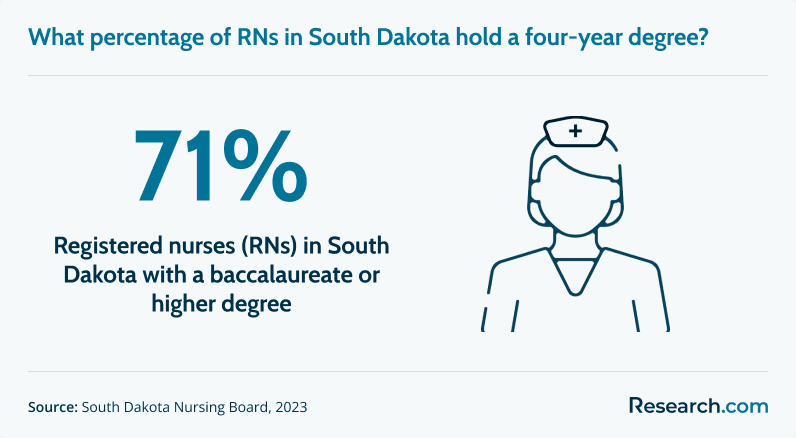
In 2023, 71% of RNs in South Dakota held a baccalaureate or higher degree, while most LPNs were prepared through a diploma, certificate, or associate degree pathway.
- Approved education: RN applicants usually qualify through an Associate Degree in Nursing or Bachelor of Science in Nursing. LPN applicants generally complete an approved practical nursing program.
- NCLEX passage: RN candidates take the NCLEX-RN, and LPN candidates take the NCLEX-PN. The exam is used to evaluate entry-level readiness for safe nursing practice.
- Background check: Applicants must complete required background screening, which includes fingerprinting through approved channels. Fingerprinting costs typically range from $30 to $50.
- Application and fee: Candidates submit a licensure application to the South Dakota Board of Nursing. The application fee is currently $100 for RNs and $50 for LPNs.
Before applying, candidates should confirm that their school will submit transcripts or completion verification in the format required by the Board. Graduates from out-of-state or online programs should be especially careful to verify approval before enrollment, not after graduation.
What types of nursing licenses are available in South Dakota?
The two main entry-level nursing licenses in South Dakota are the Registered Nurse license and the Licensed Practical Nurse license. Advanced practice nurses pursue additional recognition based on graduate education and specialty certification. From 2020 to 22, the licensed practical nurse population increased by 3.2%, and the registered nurse population increased by 5.3%.
- Registered Nurse license: RNs provide comprehensive nursing care, including patient assessment, nursing diagnosis, care planning, medication administration, coordination, and education. Candidates usually complete an ADN or BSN and pass the NCLEX-RN.
- Licensed Practical Nurse license: LPNs deliver practical nursing care under appropriate supervision. Common duties include monitoring vital signs, assisting with activities of daily living, supporting medication administration, and observing changes in patient condition. Candidates complete a practical nursing program and pass the NCLEX-PN.
- Advanced Practice Registered Nurse authorization: APRNs build on RN licensure with graduate education, national certification, and specialty preparation in areas such as nurse practitioner practice, nurse anesthesia, nurse midwifery, or clinical nurse specialist practice.
Both RN and LPN applicants in South Dakota may need to document recent nursing activity. Applicants must show at least 140 hours of nursing experience within the past year or 480 hours over the last six years.
Students who want a healthcare role but are not ready for nursing school may also explore administrative or revenue-cycle pathways. A useful starting point is learning what to know about free online medical billing and coding courses.
Can a Compact nurse practice in South Dakota?
Yes. South Dakota participates in the Nurse Licensure Compact, which allows eligible nurses with a multistate license to practice in South Dakota and other compact states without applying for a separate single-state license for each compact state. This is especially useful for nurses who work across borders, travel nurses, telehealth nurses, and healthcare systems that serve patients in multiple states.
As of 2022, South Dakota had 2,674 actively licensed practical nurses and 19,680 actively licensed registered nurses.
- Multistate license requirement: A nurse must hold a valid multistate license to use compact privileges in South Dakota.
- Residency matters: Multistate licensure is tied to a nurse’s primary state of legal residence. Documentation can include items such as a driver’s license or voter registration.
- Moving to another compact state: A nurse who relocates to a different compact state must apply for licensure in the new state within 60 days of the move.
- South Dakota laws still apply: Nurses practicing in South Dakota must follow South Dakota nursing laws and rules, even if their license was issued by another compact state.
- Telehealth is included: Compact practice can apply to remote care, but nurses must still comply with the laws of the state where the patient is located.
For nurses planning to move from clinical practice into operations, leadership, or healthcare administration, graduate management programs may be worth comparing. One related option is reviewing accelerated executive MHA programs in healthcare administration.
Can you practice as a nurse without a license in South Dakota?
No. You cannot legally practice as a nurse in South Dakota without the appropriate license or authorization. Nursing is a regulated profession because nurses make clinical judgments, administer medications, monitor patient status, and perform duties that can directly affect patient safety.
Unlicensed nursing practice can lead to penalties such as fines, legal consequences, disciplinary barriers, and possible denial of future licensure. It can also create serious risk for patients, employers, and the individual performing unauthorized duties.
If you want healthcare experience before becoming a licensed nurse, consider a role such as CNA, patient care technician, medical assistant, unit clerk, or another supervised support position. Students entering nursing from another field may also compare online nursing programs for non nurses to find pathways designed for career changers.
A practical way to avoid licensure problems is to ask every school and employer three questions: Does this role require a license? Does this program meet South Dakota licensing requirements? Will my clinical experience count toward the credential I want?
-
: "
One South Dakota nurse described the licensing process as stressful but clarifying: preparing for the NCLEX made the responsibility of the profession feel real, and receiving the license confirmed that she could serve patients legally, safely, and confidently in her community.
"
What are the best options for LPN programs in South Dakota?
The best LPN program for you is not necessarily the closest or cheapest one. It should be state-approved, prepare students for the NCLEX-PN, provide reliable clinical placements, publish clear cost information, and offer support for students who are balancing school with work or family responsibilities. Flexible formats can be helpful, but practical nursing still requires hands-on clinical training.
Students comparing online LPN programs in South Dakota should confirm how the program handles labs, simulations, clinical sites, faculty access, and exam preparation. Online coursework may improve convenience, but licensure depends on completing approved practical and clinical requirements.
What allied healthcare roles can complement a nursing career in South Dakota?
Allied healthcare experience can help future nurses build patient-care confidence, understand clinical workflows, and work more effectively with interdisciplinary teams. CNA, medical assistant, pharmacy technician, medical billing and coding, and health information roles can be useful stepping stones, especially for students who want healthcare exposure before investing in a nursing degree.
Pharmacy knowledge can be particularly valuable for nurses because medication safety, dosage review, patient education, and provider communication are central to clinical practice. Students interested in a separate but related licensed healthcare profession can review how to become a licensed pharmacist in South Dakota.
How challenging is the transition from RN to BSN online?
An online RN-to-BSN program can be manageable for working nurses, but it is not effortless. The challenge usually comes from balancing assignments, discussion deadlines, research projects, leadership coursework, and professional responsibilities. Nurses who already have strong time-management habits often adjust more easily than those expecting a self-paced program with minimal structure.
Before enrolling, ask whether the program offers part-time pacing, asynchronous coursework, writing support, transfer credit review, and clinical or practicum requirements that can be completed near your workplace. For a deeper look at workload and expectations, review how hard RN to BSN online programs are.
What are the nurse practitioner education requirements in South Dakota?
To become a nurse practitioner in South Dakota, you must first become a licensed RN, complete an accredited graduate nursing program, meet advanced clinical training requirements, obtain national certification in your population or specialty area, and satisfy the state’s APRN requirements. NP preparation is more advanced than RN education and includes assessment, diagnosis, pharmacology, pathophysiology, evidence-based practice, and supervised advanced clinical experiences.
Applicants should expect competitive admissions standards, prerequisite review, clinical hour requirements, and certification exams after graduation. For a focused breakdown of the process, see the guide to nurse practitioner education requirements in South Dakota.
What is the state of nursing in South Dakota?
Nursing in South Dakota is shaped by workforce demand, rural access needs, population aging, and the need to replace retiring professionals. The state’s healthcare system includes urban hospitals, rural clinics, long-term care facilities, home health services, tribal and community health settings, and specialty practices. That mix creates opportunities, but it also means nurses should think carefully about geography, commute, shift expectations, and clinical setting.
Reports continue to highlight that the demand for nurses in South Dakota is increasing, with healthcare employers working to strengthen recruitment and retention. New nurses may find strong need in rural communities and long-term care, while experienced nurses may pursue specialty, leadership, travel, or advanced practice roles.
South Dakota also appeals to some nurses because living costs are lower than in many other states. The cost of living in South Dakota is approximately 10% lower than the national average, which may help offset salaries that differ from higher-cost metropolitan markets.
| Factor | What it means for nursing students and nurses |
| Rural healthcare demand | Nurses willing to work outside major population centers may find meaningful opportunities and broader responsibilities. |
| Aging population | Demand may remain strong in hospitals, rehabilitation, long-term care, home health, and chronic disease management. |
| Education expectations | ADN graduates can enter RN practice, but BSN completion may improve long-term advancement options. |
| Compact licensure | Eligible nurses can practice across compact states, which supports mobility and telehealth work. |
| Cost of living | Lower living costs can improve affordability, but students should still compare debt, wages, and local job availability. |
What is the job outlook for nursing in South Dakota?
The nursing job outlook in South Dakota is generally positive because healthcare organizations continue to need RNs, LPNs, APRNs, and support staff in hospitals, nursing care facilities, clinics, home health, and rural care settings. According to the U.S. Bureau of Labor Statistics, employment for registered nurses in South Dakota is projected to grow by approximately 10% from 2020 to 2030, which is faster than the national average.
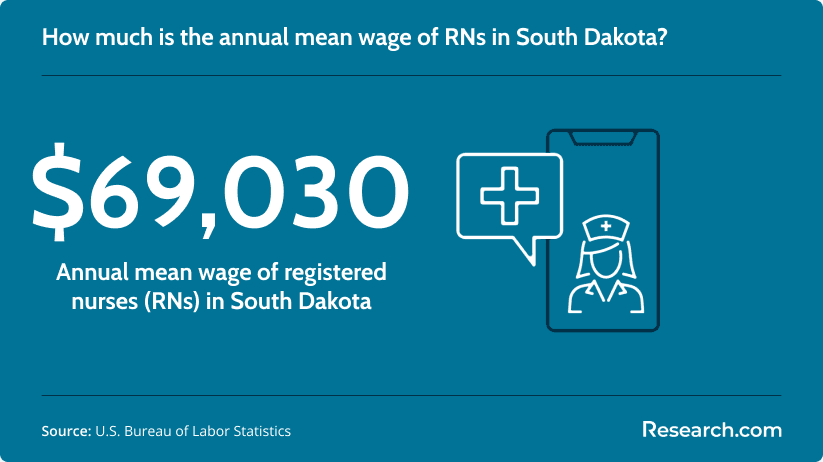
Registered nurses in South Dakota earn an average annual salary of around $62,000, or about $29.81 per hour. Top-paying industries include nursing care facilities, general medical and surgical hospitals, and home healthcare services.
Compensation varies significantly by credential and specialization. Nurse anesthetists are among the highest-paid nursing professionals, with average salaries exceeding $150,000 annually, while licensed practical nurses typically earn around $45,000 per year.
Career mobility often improves when nurses add education or credentials. LPNs who want RN-level responsibilities can compare affordable online LPN to RN programs, while RNs interested in leadership, public health, or graduate study may consider RN-to-BSN or advanced nursing options.
How can I start my career as a Licensed Vocational Nurse in South Dakota?
South Dakota commonly uses the title Licensed Practical Nurse rather than Licensed Vocational Nurse, but the LVN search term is often used by students comparing practical nursing careers across states. To start this pathway, choose a state-approved practical nursing program, complete classroom and clinical training, apply for licensure, and pass the NCLEX-PN.
Because state terminology and licensing rules can differ, students should review specific guidance on how to become an LVN in South Dakota and verify whether a program uses LPN or LVN language when describing eligibility.
How do online nursing programs in South Dakota compare to traditional programs?
Online nursing programs can be a good fit for students who need scheduling flexibility, live far from campus, or are already working in healthcare. Traditional campus programs may offer more face-to-face structure, immediate lab access, and in-person peer support. The best choice depends on your learning style, clinical placement needs, technology comfort, and ability to stay organized.
| Factor | Online or hybrid nursing program | Traditional campus program |
| Schedule flexibility | Often better for working adults and students with family responsibilities | Usually follows fixed class and lab schedules |
| Clinical training | Must still be completed in approved healthcare settings | Often coordinated through established local clinical partners |
| Student support | Depends heavily on advising, online tutoring, and faculty responsiveness | May provide easier in-person access to faculty, labs, and classmates |
| Self-discipline required | High, especially in asynchronous courses | Moderate to high, with more built-in structure |
| Best for | Independent learners who need flexibility | Students who prefer in-person instruction and scheduled routines |
When comparing formats, do not judge quality by delivery mode alone. Accreditation, state approval, clinical placement support, NCLEX preparation, faculty credentials, and student outcomes matter more. A useful starting point is reviewing the best online nursing programs in South Dakota.
What are the ongoing licensing renewal and continuing education requirements in South Dakota?
Nursing licensure does not end after the NCLEX. South Dakota nurses must maintain active credentials by following renewal rules, practice standards, and any continuing competency requirements that apply to their license type. Requirements can change, so nurses should confirm deadlines and accepted activities directly with the South Dakota Board of Nursing before each renewal cycle.
Good renewal habits include saving proof of practice hours, keeping continuing education records, updating your address with the Board, checking renewal reminders early, and documenting certifications or specialty training. For current guidance, review the requirements for nursing licensure in South Dakota.
What should you look for when choosing a nursing school in South Dakota?
Choosing a nursing school should be a licensing and career decision, not just an admissions decision. A program must prepare you for the credential you want, fit your budget, provide clinical access, and support your success through the NCLEX and first job search.
| Question to ask | Why it matters |
| Is the program approved for South Dakota nursing licensure? | Approval is essential for exam eligibility and licensing. |
| What is included in the total cost? | Tuition alone may not include fees, uniforms, supplies, testing, background checks, transportation, or books. |
| Where are clinical placements located? | Clinical site distance and scheduling can affect work, commuting, and graduation timing. |
| How does the program prepare students for the NCLEX? | Exam support can influence readiness and confidence. |
| Can credits transfer into a BSN or graduate program later? | Transfer policies matter if you plan to advance beyond your first credential. |
| What support is available for working students? | Advising, tutoring, flexible scheduling, and faculty access can affect completion. |
Students who want to compare options in one place can begin with the best nursing schools in South Dakota, then verify details directly with each institution before applying.
How can I become a nurse midwife in South Dakota?
To become a nurse midwife in South Dakota, you generally need to become an RN first, gain appropriate clinical experience, complete an accredited graduate program in nurse-midwifery, pass the required national certification exam, and meet South Dakota’s advanced practice licensure requirements. Nurse midwives provide reproductive, prenatal, birth, postpartum, and primary care services within their scope of practice.
This path is best for nurses who want advanced clinical responsibility and a strong focus on women’s health, pregnancy, childbirth, and family-centered care. For a step-by-step explanation, review how to become a nurse midwife in South Dakota.
Why choose advanced nursing programs in South Dakota?
Advanced nursing programs can help South Dakota RNs move into higher-responsibility roles such as nurse practitioner, nurse midwife, clinical specialist, nurse anesthetist, educator, administrator, or population health leader. These pathways can be especially relevant in rural and underserved communities where access to primary and specialty care may be limited.
Advanced practice preparation expands clinical decision-making through graduate coursework in assessment, pharmacology, diagnosis, evidence-based practice, healthcare policy, and supervised specialty care. Nurse Practitioners, for example, may conduct advanced assessments, order or interpret diagnostic tests, manage treatment plans, and prescribe medications where state law permits.
RNs comparing graduate options should evaluate accreditation, certification eligibility, clinical placement assistance, faculty experience, cost, online format, and specialty alignment. A practical next step is reviewing the best NP programs in South Dakota and confirming whether each program supports the population focus you want.
What do nurses say about working in South Dakota?
-
: "
“I stayed in South Dakota nursing because the community connection is strong. In smaller facilities, you often know your patients beyond a single shift, and that makes the work feel personal. Scholarships and repayment support also helped make school more realistic for me.” Mandy
"
-
: "
“Nursing here has given me stability and purpose. Rural areas need healthcare professionals, and the team-based culture means nurses, providers, and support staff rely on each other closely. The lower cost of living has also made it easier to build a life outside work.” Mark
"
-
: "
“South Dakota nursing opened more doors than I expected. Continuing education, workshops, mentorship, and a close professional network helped me keep growing. It feels meaningful to practice in a state where nurses can have a visible impact.” Sally
"
What are the career advancement opportunities for nurses in South Dakota?
Nurses in South Dakota can advance by changing settings, earning higher degrees, adding specialty certifications, moving into leadership, or pursuing advanced practice. The right move depends on your starting credential, years of experience, preferred patient population, and willingness to return to school.
- LPN to RN: Practical nurses can pursue bridge programs to qualify for RN roles and broader clinical responsibilities.
- RN to BSN: ADN-prepared RNs can complete a BSN to strengthen leadership, public health, and graduate school readiness.
- Specialty certification: Experienced nurses may specialize in areas such as critical care, emergency nursing, oncology, geriatrics, pediatrics, or case management.
- Graduate nursing: RNs can pursue NP, nurse midwife, CRNA, clinical nurse specialist, educator, or leadership roles through advanced education.
- Management and administration: Nurses with leadership skills may move into charge nurse, nurse manager, director, quality improvement, or healthcare operations roles.
Practical nurses who want to understand advancement options and compensation patterns can review this LPN career salary guide before choosing the next credential.
How is telehealth transforming nursing practices in South Dakota?
Telehealth is changing how South Dakota nurses communicate with patients, monitor chronic conditions, coordinate care, and support rural communities. Nurses may assist with virtual visits, remote patient monitoring, triage, patient education, documentation, and follow-up care across distance-based platforms.
This shift requires comfort with digital tools, privacy rules, documentation standards, remote assessment limits, and interdisciplinary communication. Telehealth does not reduce the need for clinical judgment; it changes how that judgment is applied when the patient is not physically in the room.
Nurses who are interested in the administrative side of digital healthcare may also benefit from understanding billing, coding, and documentation workflows. A related pathway is learning how to become a medical biller and coder in South Dakota.
Common mistakes to avoid when becoming a nurse in South Dakota
| Mistake | Why it can hurt you | Better approach |
| Choosing a school without checking approval | You may finish coursework that does not qualify you for licensure. | Confirm Board approval and accreditation before applying. |
| Looking only at tuition | Fees, supplies, transportation, testing, and lost work hours can change the true cost. | Compare total program cost and financial aid options. |
| Assuming online means fully remote | Nursing programs require hands-on clinical training. | Ask where labs and clinical placements happen. |
| Ignoring transfer credit policies | Poor transferability can make future BSN or graduate study more expensive. | Ask whether credits apply to RN-to-BSN or advanced programs. |
| Counting on a specific salary | Pay varies by role, location, employer, shift, and experience. | Use salary figures as planning estimates, not guarantees. |
| Forgetting license renewal obligations | An expired or noncompliant license can interrupt employment. | Track renewal deadlines and keep documentation organized. |
Key Insights
- South Dakota nurses must complete approved education, pass the correct NCLEX exam, meet Board of Nursing requirements, and maintain an active license.
- LPN programs offer a faster entry point, while ADN and BSN pathways prepare students for RN licensure and broader career mobility.
- A BSN is not the only way to become an RN, but it may help with advancement, leadership, specialty roles, and graduate nursing admission.
- South Dakota’s participation in the Nurse Licensure Compact supports multistate practice, but nurses must still follow South Dakota laws when caring for patients in the state.
- Online nursing programs can be convenient, but students must verify clinical placement support, licensure eligibility, and program approval before enrolling.
- Advanced nursing programs can open doors to nurse practitioner, nurse midwife, leadership, education, and specialty practice roles, especially in communities with high healthcare access needs.
- The smartest nursing school choice balances approval, cost, clinical access, NCLEX preparation, transfer options, student support, and your long-term career plan.
Related Articles for Nearby States
- 2027 How to Become a Nurse in North Dakota
- 2027 How to Become a Nurse in Nebraska
- 2027 How to Become a Nurse in Minnesota
- 2027 How to Become a Nurse in Wyoming
- 2027 How to Become a Nurse in Iowa
- 2027 How to Become a Nurse in Montana
- 2027 How to Become a Nurse in Colorado
- 2027 How to Become a Nurse in Kansas
- 2027 How to Become a Nurse in Wisconsin
- 2027 How to Become a Nurse in Missouri
References:
- nursinglicensure.org (2020). Nursing License Requirements in SD: Become a Nurse in South Dakota.
- South Dakota Board of Nursing (2024). LPN and RN License Procedures.
- trustedhealth.com (n.d.). South Dakota Nurse Licensing Guide.
- U.S. Bureau of Labor Statistics (2023). Occupational Outlook Handbook - Nurse Anesthetists, Nurse Midwives, and Nurse Practitioners.
Other Things You Need to Know About Nursing in South Dakota
In 2027, the most critical skill for nurses to develop in South Dakota is adaptability. As healthcare continues to evolve with advances in technology and patient care protocols, being adaptable allows nurses to efficiently integrate new methods while maintaining patient-centered care standards.
When considering a career in nursing in South Dakota, many prospective students may wonder if an accelerated nursing program is a viable option. Accelerated nursing programs are designed for individuals who already hold a bachelor's degree in another field and wish to transition into nursing. These programs typically last 12 to 18 months, allowing students to earn a Bachelor of Science in Nursing (BSN) in a condensed timeframe.
Graduates from accelerated programs often report feeling well-prepared for the workforce, as these programs are rigorous and focus on essential nursing competencies. However, the fast-paced nature of these programs can be challenging, requiring strong time management and study skills.
The financial aspect of pursuing an accelerated nursing program in South Dakota is also worth considering. While tuition for these programs can be higher than traditional nursing degrees, the potential for a strong ROI is notable. Graduates can often secure employment shortly after completing their program, which can offset initial educational costs.
Becoming a nurse in South Dakota requires not only a solid educational foundation but also effective preparation for licensure and professional development.
- Enrolling in NCLEX preparation courses can significantly enhance your chances of passing the National Council Licensure Examination (NCLEX). Many institutions in South Dakota offer these courses, which provide comprehensive reviews of nursing content and test-taking strategies. For example, the South Dakota Board of Nursing lists several approved programs that can help you prepare effectively.
- Effective time management is essential for balancing study, work, and personal commitments. Creating a structured study schedule that allocates specific times for review, practice tests, and relaxation can help you stay organized and reduce stress.
- Joining professional organizations such as the South Dakota Nurses Association (SDNA) can provide networking opportunities, access to continuing education, and resources for career advancement. Membership often includes access to workshops, conferences, and mentorship programs that can enhance your professional development.