2027 Fastest Executive MHA (Master’s in Healthcare Administration) Programs

Co-Founder and Chief Data Scientist
Choosing a fast Executive Master of Health Administration is usually not about earning another credential for its own sake. It is about whether you can move into a stronger healthcare leadership role without leaving the workforce for several years. For experienced clinicians, department managers, operations leads, and healthcare professionals who already understand the industry, an Executive MHA can provide focused graduate training in finance, policy, operations, workforce management, quality improvement, and executive decision-making.
The need for capable healthcare administrators remains clear. U.S. healthcare administrative systems ranked last in efficiency among 11 high-income countries in one study (Statista, 2021), and hospital leaders continue to report pressure from staffing shortages, rising costs, regulatory demands, and technology change. A fast Executive MHA is designed for professionals who want to address those problems from a leadership position while continuing to work.
This guide explains how the fastest Executive MHA programs compare, what they cost, how long they take, how they differ from MBA healthcare tracks, what admissions committees usually expect, and how to judge whether the degree is worth the investment for your career.
Quick Answer: What Is the Fastest Executive MHA Path?
The fastest Executive MHA programs can be completed in about 12 months, although many take 12 to 18 months and some extend to 21 or 24 months depending on course load, residency requirements, and whether students choose a full-time or part-time pace. These programs are best suited for working healthcare professionals who already have relevant experience and want graduate-level leadership preparation without a traditional two- to three-year MHA timeline.
- A fast Executive MHA can shorten the path to healthcare leadership roles while allowing many students to keep working full time.
- Most accelerated EMHA programs use online or hybrid delivery, though some include campus residencies, executive sessions, or in-person intensives.
- With an EMHA, a hospital administrator can earn as much as $67,000 to $114,000 yearly (PayScale, 2024).
- 2027 List of the Fastest Executive MHA Programs
- What is an Executive MHA program?
- What are the key skills gained in Executive MHA programs?
- How long does it take to get an Executive MHA program?
- Is an EMHA better than an MBA in Healthcare Management?
- What are the admission requirements for the fastest Executive MHA programs?
- What courses are typically included in the fastest Executive MHA programs?
- How much do the fastest Executive MHA programs cost?
- What types of financial aid are available for Executive MHA students?
- How to choose the best Executive MHA program?
- Are Executive MHA programs accredited and why does it matter?
- What jobs can you get with an Executive MHA?
- What is the ROI of an Executive MHA program?
- Can an Executive MHA Complement a Career in Pharmacy Administration?
- What is the job market for graduates with an Executive MHA?
- How to make the most of your executive MHA program
- What career support and networking opportunities do Executive MHA programs provide?
- What are fast-track executive MHA programs for career changers?
- What challenges might you face during an Executive MHA program?
- How can an Executive MHA program equip you for crisis management in healthcare?
- How can an Executive MHA program be integrated with emerging healthcare technologies?
- What distinct advantages do accelerated online programs offer for healthcare leaders?
2027 List of the Fastest Executive MHA Programs
How we evaluated the programs
Research.com builds degree lists using a documented methodology and cross-checks program information with education datasets and institutional sources where available. For this list, we considered information from the Integrated Postsecondary Education Data System (IPEDS), Peterson’s database, including its Distance Learning Licensed Data Set, College Scorecard, and the National Center for Education Statistics (NCES). Students should still confirm tuition, format, residency requirements, and accreditation status directly with each school before applying.
| School | Program length | Format and focus | Cost information | Credits | Accreditation listed |
| Louisiana State University Online | 12 months | Healthcare Administration; seven-week courses for working professionals preparing for middle and upper management roles | $415.80 per credit | 30 | Association to Advance Collegiate Schools of Business (AACSB) |
| University of Minnesota | 12–24 months | Healthcare Administration; online coursework with an in-person kickoff each semester and a capstone project | $1,632 per credit | 42 | Commission on Accreditation of Healthcare Management Education (CAHME) |
| Weber State University | 16 months | Healthcare Administration; fully online with an optional on-campus format and full- or part-time options | $35,000 flat rate tuition for the four-semester total program | 39 | CAHME |
| University of Cincinnati | 18–21 months | Fast Track and Extended Track (8 semesters); fully online, asynchronous, seven-week courses | $754 per credit for residents; $769 per credit for nonresidents | 40 | CAHME |
| University of California, San Francisco | 12–21 months | Healthcare Administration; MS in Healthcare Administration and Interprofessional Leadership for clinical and non-clinical professionals | $5,073 per course | 36 | Western Association of Schools and Colleges (WASC) Senior College and University Commission (WSCUC) |
| University of Iowa | 12–24 months | Healthcare Administration; face-to-face courses on the Iowa City and Des Moines campuses | $1,250 per credit | 45 | CAHME |
| Briar Cliff University | 12 months | Healthcare Administration; accelerated MHA available online and on campus with collaborative applied work | $497 per credit | 36 | Higher Learning Commission (HLC) |
| Saint Joseph's University | 24 months | Organization, Development and Leadership (ODL); dual program with Master of Health Informatics; online, campus, or hybrid options | $1,216 per credit | 36 | Middle States Commission on Higher Education (MSCHE) |
| University of North Carolina, Wilmington | 12 months | Healthcare Administration; competency-based, fully online, accelerated, seven-week asynchronous courses | $309.74 per credit for residents; $1,152.85 per credit for nonresidents | 48 | CAHME |
| Western Governors University | 12 months | Healthcare Administration; online, flexible, mentor-supported program with a personalized degree plan | $4,955 per six-month term estimated tuition cost | 34 | Northwest Commission on Colleges and Universities (NWCCU) |
Program notes for faster decision-making
- Louisiana State University Online: The program uses seven-week sessions and includes subjects such as Organizational Behavior, Law and Ethics, Finance, and Strategic Management in healthcare. Students should expect at least 30 hours a week for coursework and study.
- University of Minnesota: The curriculum includes topics such as Private Purchasers of Health Care, Innovation of Health Care Services, and Quality Improvement and Patient Safety. Students usually take no more than two courses at a time and spend 10 to 15 hours each week studying.
- Weber State University: Courses include Accounting and Finance Principles for Healthcare Managers, Health Policy and Economics, and Health Informatics. Students may also choose a study abroad elective.
- University of Cincinnati: The program includes two introductory courses, nine core courses, and a two-part capstone. It emphasizes quality improvement, interprofessional team leadership, and cultural competency.
- University of California, San Francisco: UCSF’s MS-HAIL program covers healthcare finance, policy, systems, leadership, evidence-based practice, and improvement science. Most coursework is online, but the program includes three on-campus sessions.
- University of Iowa: Students complete one face-to-face course at a time and participate in experiential learning, including annual visits to exemplary healthcare organizations and a practicum project with local executives.
- Briar Cliff University: The curriculum addresses global healthcare systems, financial management, and legal and regulatory issues, and includes collaborative work with students in nursing, physical therapy, and kinesiology.
- Saint Joseph’s University: The program focuses on ethical leadership, diversity, social justice, organizational development, health policy, and population health topics through small, interactive classes.
- University of North Carolina, Wilmington: Students start with a personalized gap analysis assessment and can access faculty research, international travel, case competitions, and applied learning experiences.
- Western Governors University: The curriculum emphasizes quality improvement, culturally relevant care, professionalism, technology, ethical practice, and a capstone project tied to healthcare leadership problems.
Key Findings
- Many Executive MHA programs are shorter than traditional MHA pathways, which often take two to three years; accelerated EMHA options may be completed within 12 to 18 months.
- Human resources managers earn $154,740, while medical and health services managers take home $134,440 annually.
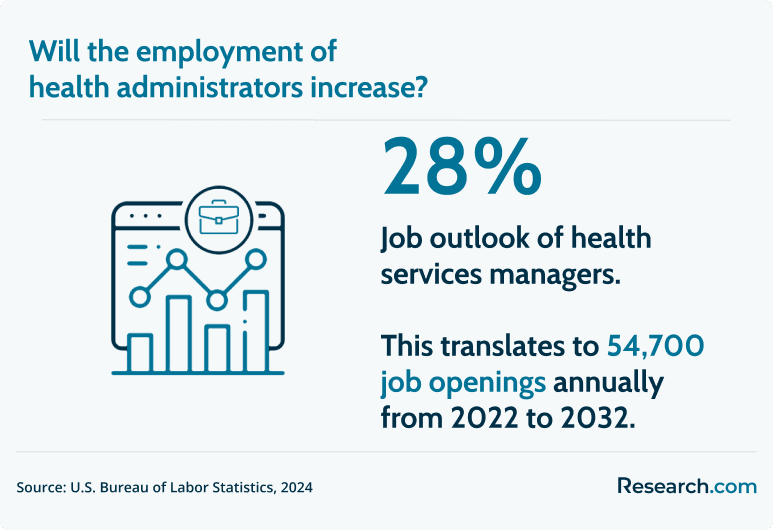
- Employment for medical and health services managers is projected to increase by 28% from 2022 to 2032.
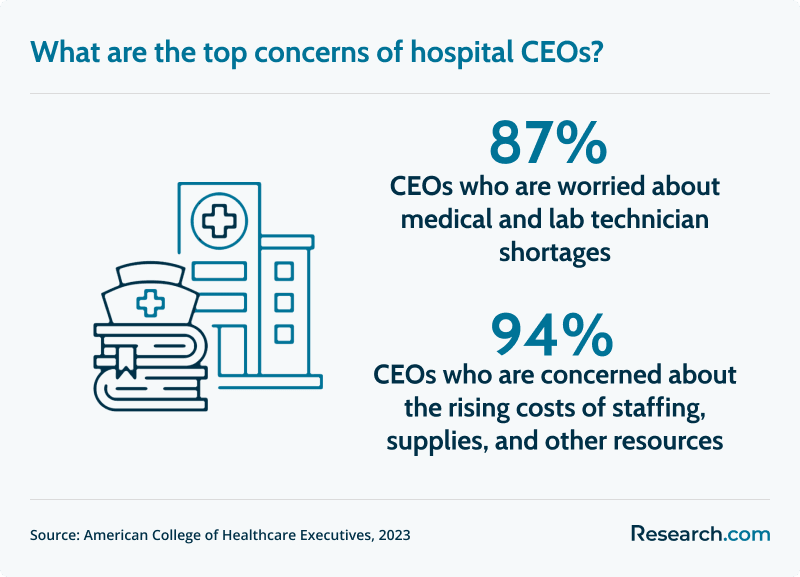
- Community hospital CEOs identified the shortage of medical and lab technicians (87%) and rising staffing and supply costs (94%) as critical issues.
- Only 48% of employers believed work-life balance was among the top three factors for job seekers, while 78% of healthcare workers identified work-life balance as crucial.
What is an Executive MHA program?
An Executive MHA is a graduate healthcare administration degree built for professionals who already have work experience and want to move into higher-level leadership, operations, strategy, or executive roles. Unlike an entry-level graduate program designed for students with limited healthcare exposure, an EMHA assumes that students can connect coursework to real workplace problems.
The curriculum usually emphasizes healthcare finance, policy, legal and ethical issues, organizational behavior, operations management, data-informed decision-making, population health, quality improvement, and strategic leadership. Many programs are online or hybrid because the target student is often employed full time, although some programs require campus visits, executive weekends, or in-person cohort sessions.
Executive MHA programs also tend to prioritize applied learning. Instead of only studying theory, students may work through case studies, leadership simulations, consulting-style projects, residencies, or capstones that address real operational challenges in healthcare organizations.
Common responsibilities of healthcare administrators
- Recruit, train, supervise, and evaluate healthcare staff
- Coordinate the daily operations of hospitals, clinics, departments, or service lines
- Manage budgets, billing processes, payroll-related planning, and financial performance
- Develop strategic plans that guide organizational growth and service delivery
- Help organizations comply with federal, state, and local healthcare regulations
- Lead quality improvement initiatives aimed at patient outcomes and service consistency
- Support emergency planning, public health response, and operational continuity during crises
The leadership burden is not theoretical. A survey by the American College of Healthcare Executives (ACHE, 2023) reported that community hospital CEOs named workforce and financial challenges as their leading concerns, including the shortage of medical and lab technicians (87%) and rising staffing and supply costs (94%). EMHA coursework is meant to prepare leaders to make decisions under exactly these kinds of constraints.
What are the key skills gained in Executive MHA programs?
Executive MHA programs are designed to strengthen the leadership skills that healthcare organizations need most: managing people, allocating resources, improving quality, interpreting policy, and using data without losing sight of patient care.
| Skill area | What students learn | Why it matters in healthcare leadership |
| Strategic leadership | How to guide teams, set priorities, evaluate trade-offs, and lead through organizational change | Healthcare leaders must make decisions that affect patient access, staff capacity, budgets, and long-term service goals. |
| Healthcare policy, law, and ethics | How regulations, patient rights, confidentiality, compliance, and ethical decision-making shape administrative work | Administrative decisions can carry legal, financial, and clinical consequences. |
| Finance and budgeting | How to read financial data, plan budgets, manage risk, and align resources with organizational priorities | Rising staffing and supply costs make financial judgment essential for senior roles. |
| Data analysis and technology adoption | How to use analytics, informatics, automation, and digital systems to support better operations | Healthcare organizations increasingly rely on data to improve patient flow, quality measures, staffing, and compliance. |
| Communication and conflict resolution | How to work with clinicians, executives, boards, patients, vendors, and community stakeholders | Administrators often mediate competing priorities between quality, cost, access, and workforce well-being. |
| Operations and quality improvement | How to improve workflows, patient care processes, safety initiatives, and organizational performance | Operational leadership directly affects patient experience, staff productivity, and service reliability. |
If cost is your biggest barrier, reviewing the most affordable online MHA programs can help you compare lower-cost options before committing to an executive-format degree.
How long does it take to get an Executive MHA program?
Executive MHA programs commonly take 12 to 18 months, while some run 21 or 24 months based on pacing, credit load, in-person requirements, and whether the school offers an extended track. Traditional MHA programs often take two to three years because they may include longer internships, broader foundational coursework, and a structure designed for students with less professional experience.
The accelerated pace is possible because Executive MHA students usually bring workplace knowledge into the classroom. Programs can move faster when students already understand healthcare settings, professional roles, terminology, and organizational pressures.
| Program pace | Typical fit | Trade-off |
| 12-month Executive MHA | Experienced professionals who can handle a demanding academic load while working | Fastest completion, but less schedule flexibility and heavier weekly workload |
| 12–18 month Executive MHA | Working professionals seeking speed with somewhat more manageable pacing | Still accelerated, but may require careful planning around job and family obligations |
| 21–24 month Executive MHA | Professionals who want executive-level coursework without compressing every requirement | Longer time to completion, but often easier to balance with full-time employment |
| Traditional MHA | Students with limited healthcare experience or those who want a more extended graduate experience | More time in school, but may include deeper foundational preparation and internship opportunities |
Is an EMHA better than an MBA in Healthcare Management?
An Executive MHA is usually the stronger fit if your goal is healthcare-specific leadership. An MBA in Healthcare Management may be better if you want broader business mobility across healthcare and non-healthcare industries. Neither degree is automatically “better”; the right choice depends on your career target, professional background, and whether you want specialized healthcare administration training or a wider business credential.
| Comparison point | Executive MHA | MBA in Healthcare Management |
| Primary focus | Healthcare systems, operations, policy, ethics, quality, finance, and executive leadership | General business management with healthcare-related electives or concentration courses |
| Best for | Clinicians, healthcare managers, department leaders, and administrators who plan to stay in healthcare | Professionals who want healthcare leadership options but also value portability into consulting, operations, finance, or other business sectors |
| Curriculum emphasis | Healthcare law, ethics, informatics, quality improvement, policy, population health, and healthcare operations | Marketing, strategy, accounting, finance, supply chain, analytics, and management with some healthcare specialization |
| Career flexibility | Highly relevant for hospitals, health systems, public health organizations, payer organizations, and healthcare services | Useful in healthcare and in adjacent or separate industries, including consulting and corporate leadership |
| Student profile | Often designed for mid-career healthcare professionals with leadership experience | Often suited to students with business backgrounds or those seeking a broader management education |
Some coursework overlaps with management-focused graduate study, including organizational behavior and human capital topics similar to what students may see in an online masters degree in human resources. The difference is that the EMHA applies those concepts directly to healthcare staffing, compliance, patient care operations, and service delivery.
What are the admission requirements for the fastest Executive MHA programs?
Fast Executive MHA programs are selective because the pace can be intense. Schools want evidence that applicants can handle graduate-level work, contribute professional insight to cohort discussions, and apply leadership concepts in real healthcare settings.
| Requirement | What it usually shows | What to check before applying |
| Bachelor’s degree from an accredited institution | You meet the baseline graduate admissions requirement | Whether the school requires specific prerequisite coursework |
| Official transcripts | Your academic record and degree completion history | Whether all colleges attended must send transcripts directly |
| Cumulative GPA of 3.0+ on a 4.0 scale | Academic readiness for graduate coursework | Whether applicants with a 2.5 or 2.8 GPA may be considered |
| Minimum one to three years of experience in healthcare management/administrative positions | Professional preparation for executive-level discussion and applied assignments | Whether the program expects five or eight years of experience for stronger applicants |
| GRE/GMAT scores | Standardized evidence of graduate readiness where required | Whether test scores are waived for experienced professionals |
| Letters of recommendation | External validation of leadership ability, work ethic, and professional potential | Whether recommenders should be supervisors, executives, faculty, or clinical leaders |
| Personal statement | Your goals, motivation, and fit with healthcare leadership | Whether the school asks about community involvement or healthcare contributions |
| Resume or CV | Your career progression, responsibilities, and leadership experience | Whether administrative, clinical, military, nonprofit, or public health experience is acceptable |
| Admissions interview | Your communication skills, readiness, and fit with the cohort model | Whether the interview is required for all applicants or only finalists |
| English proficiency for international students | Ability to complete graduate study in English | Which exams and score thresholds are accepted |
A health-related bachelor’s degree is not always required, but applicants with healthcare coursework or experience may have fewer gaps to close. If you come from a non-healthcare field, ask whether prerequisite courses, bridge modules, or foundational healthcare systems courses are required before the executive sequence begins.
What courses are typically included in the fastest Executive MHA programs?
Accelerated EMHA curricula concentrate on the subjects administrators use in high-stakes healthcare environments. The exact course names vary, but the core themes are consistent: manage resources, lead teams, use evidence, understand policy, improve quality, and make defensible decisions.
- Healthcare Information Technology: Covers how digital systems support care delivery, administrative efficiency, data security, and patient outcomes.
- Healthcare Ethics and Law: Examines patient rights, confidentiality, compliance, professional responsibility, and legal risk in healthcare organizations.
- Quality and Performance Improvement: Focuses on methods for improving care quality, safety, workflow, and organizational performance.
- Health Economics: Studies resource allocation, cost-effectiveness, market behavior, and financial pressures within healthcare systems.
- Public Health: Connects healthcare administration to population health, community health, prevention, and systems-level outcomes, topics also found in the cheapest online MPH programs.
- Strategic Planning and Marketing: Explores organizational positioning, communication, stakeholder analysis, and planning concepts that may overlap with content in affordable online public relations programs.
- Capstone Project: Requires students to apply program learning to a practical leadership, operations, quality, finance, or strategy problem.
Technology is becoming especially important in EMHA coursework. In Philips’ Future Health Index study (2024), 92% of healthcare leaders indicated that automation could free up time for healthcare professionals and mitigate staff shortages by streamlining administrative duties.
For healthcare administrators, the practical question is no longer whether technology affects operations. It is whether leaders can evaluate automation, AI-supported workflows, informatics tools, telehealth systems, and electronic health records in ways that improve efficiency without weakening patient safety, privacy, equity, or staff trust.
How much do the fastest Executive MHA programs cost?
Executive MHA tuition varies widely by institution, residency status, delivery format, credit count, and fee structure. According to the National Center for Education Statistics, average graduate tuition and fees in A.Y. 2021-22 were $12,596 at public institutions and $29,931 at private nonprofit institutions (NCES, 2023). Executive MHA students may see costs in that general range, but some programs may charge as much as $60,000 to $80,000.
When comparing programs, do not look only at the advertised per-credit price. A lower per-credit tuition can still result in a higher total cost if the program requires more credits, mandatory fees, travel, residencies, technology charges, or extended enrollment.
| Cost factor | Why it changes the total price | Question to ask |
| Per-credit tuition | Programs charge different rates, and resident and nonresident tuition may vary | What is the full tuition cost for all required credits? |
| Flat-rate tuition | Some programs charge a total program amount instead of billing only by credit | Does the flat rate include fees, materials, technology, and residencies? |
| Credit requirements | Programs on this list range from 30 to 48 required credits | How many credits are required to graduate, and are electives extra? |
| Residency or campus sessions | Travel, lodging, meals, and time away from work can increase real cost | How many in-person sessions are required? |
| Program length | Longer programs may increase fees or opportunity costs | Can I finish at my intended pace without additional charges? |
| Employer support | Tuition reimbursement can substantially reduce out-of-pocket cost | Will my employer cover part of the degree, and are there service obligations? |
Executive MHA programs may cost less than many MBA options. On average, MBA programs cost $232,985 (Business Because, 2023). Although students can find an MBA under 10k, many MBA programs, particularly at highly recognized business schools, can be significantly more expensive.
What types of financial aid are available for Executive MHA students?
Executive MHA students often pay for graduate school through a mix of personal funds, employer support, loans, scholarships, and institutional aid. If affordability is your main concern, start by comparing affordable online masters in healthcare administration options before selecting an executive-format program.
- Institutional aid: Schools may offer scholarships, grants, assistantships, or tuition discounts for eligible graduate students.
- Private grants and scholarships: Healthcare associations, foundations, and professional groups may support students pursuing administration or leadership roles, including organizations such as the Association of University Programs in Health Administration (AUPHA) or the Commission on Accreditation of Healthcare Management Education (CAHME).
- Student loans: Federal Direct Unsubsidized Loans and Federal Grad PLUS Loans may help cover up to the cost of attendance depending on eligibility. Private student loans are another option but should be compared carefully.
- Fellowships: Some awards provide funding tied to research, leadership, service, or organizational commitments.
- Work-study programs: Eligible students may be able to earn income through part-time work while enrolled.
- Employer tuition reimbursement: Many healthcare employers help pay for graduate education, often in exchange for continued employment after completion.
- State initiatives: Some state programs offer support for healthcare workers, particularly when service in underserved areas is involved.
How to choose the best Executive MHA program?
The best Executive MHA is not simply the fastest or the cheapest. It is the program that fits your career goal, schedule, budget, experience level, and preferred learning style while offering credible training in healthcare leadership.
| Selection factor | Why it matters | Red flag |
| Accreditation | Accreditation helps signal that the school or program has met external quality standards | The school cannot clearly explain its institutional or programmatic accreditation |
| Program format | Online, hybrid, and campus formats affect flexibility, networking, travel, and time management | The schedule is advertised as flexible but includes required sessions you cannot attend |
| Curriculum | Courses should match your target role in operations, finance, policy, quality, informatics, or executive leadership | The curriculum is vague or does not include applied healthcare administration work |
| Faculty experience | Faculty with healthcare leadership backgrounds can connect theory to practical decision-making | The program provides little information about faculty qualifications or industry experience |
| Career support and alumni network | Executive programs are often valuable because of relationships, mentorship, and leadership opportunities | Career services appear generic and not focused on healthcare leadership roles |
| Total cost and aid | Tuition, fees, travel, and lost time all affect return on investment | The school highlights tuition but does not provide a clear total cost estimate |
| Capstone, practicum, or residency | Applied projects help students turn coursework into career-relevant evidence of leadership ability | The program has few opportunities to solve real healthcare problems |
Accreditation can also overlap across management fields. For example, some business-oriented programs, including affordable online project management degree programs, may involve business accreditation considerations. For an EMHA, however, healthcare-specific relevance matters just as much as general management credibility.
Workforce issues should also influence your choice. Indeed’s Pulse of Healthcare Report (2024) found a disconnect between employers and healthcare workers regarding burnout, job dissatisfaction, and job fulfillment. For example, only 48% of employers believed work-life balance was among the top three factors for job seekers, while 78% of healthcare workers identified work-life balance as crucial.
That gap matters because healthcare administrators do not only manage budgets and compliance. They also shape staffing models, workplace culture, retention strategies, and the conditions under which clinicians and staff deliver care.
Are Executive MHA programs accredited and why does it matter?
Yes, many Executive MHA programs are accredited either through institutional accreditation, programmatic accreditation, or both. Accreditation matters because it gives students, employers, and financial aid providers a way to evaluate whether a school or program has been reviewed against recognized standards.
For healthcare management education, CAHME accreditation is especially relevant because it focuses on healthcare management programs. Institutional accreditors, such as regional accreditors, evaluate the broader college or university. AACSB applies to business schools and business-related programs. The right accreditation signal depends on the program type and the credential you plan to earn.
| Accreditation type | What it evaluates | Why students should care |
| Institutional accreditation | The overall college or university | Often affects credit transfer, financial aid eligibility, and broad institutional credibility |
| CAHME accreditation | Healthcare management education quality, curriculum, outcomes, and industry relevance | Helpful for students seeking healthcare administration leadership roles |
| AACSB accreditation | Business school quality and management education standards | Relevant when the program is housed in or closely tied to a business school |
Before enrolling, verify accreditation on the school’s website and through the accreditor’s directory. If you are still comparing accessible programs, reviewing online MHA degree programs can help you understand how admissions flexibility and program quality differ.
What jobs can you get with an Executive MHA?
An Executive MHA can support advancement into roles that require healthcare knowledge, operational judgment, financial awareness, and leadership experience. It is not a guarantee of promotion, but it can help experienced professionals compete for roles that require graduate-level preparation.
| Role | What the role does | How an EMHA helps |
| Hospital Administrator | Manages facility operations, staffing, budgets, compliance, and service delivery | Builds skills in healthcare finance, operations, policy, quality improvement, and leadership |
| Healthcare Consultant | Advises organizations on strategy, efficiency, performance improvement, and operational redesign | Provides frameworks for analyzing healthcare systems and recommending practical changes |
| Clinical Director | Oversees departments, programs, staff coordination, and service-line performance | Strengthens administrative, budgeting, communication, and quality management skills |
| Chief Operations Officer (COO) | Directs daily operations and supports strategy, efficiency, care quality, and patient satisfaction | Develops executive-level decision-making and cross-functional leadership capacity |
| Healthcare IT Manager | Supports secure patient data systems and technology-enabled care delivery | Adds administrative context for informatics, technology integration, compliance, and workflow improvement |
Some graduates strengthen their profiles with additional credentials based on their target role. Depending on your career plan, options may include an affordable medical billing and coding certification, Certified Professional in Healthcare Risk Management (CPHRM), or Certified Medical Manager (CMM). The best add-on credential is the one that fills a specific gap in your experience, not the one that simply adds letters after your name.
The salary chart below shows potential compensation associated with healthcare administration and related leadership positions.
What is the ROI of an Executive MHA program?
The return on investment for an Executive MHA depends on tuition, fees, employer reimbursement, how quickly you finish, whether you continue working, and whether the degree helps you move into a higher-responsibility role. A faster program can improve ROI if it reduces time in school and helps you apply new skills immediately at work.
However, ROI should not be judged only by salary. For many healthcare professionals, the value also includes access to executive networks, stronger leadership credibility, better preparation for administrative decision-making, and eligibility for roles that prefer or require graduate education.
| ROI factor | Positive sign | Risk to watch |
| Program cost | Total cost is manageable or partly covered by employer reimbursement | Tuition is high and the school does not provide transparent fee information |
| Completion speed | The program can be completed in 12 to 18 months without leaving work | The workload forces you to reduce hours or delay completion |
| Career alignment | The curriculum matches your next role in operations, strategy, finance, quality, or executive leadership | The degree is too broad or too specialized for your actual career plan |
| Applied learning | Capstones, residencies, and projects can be tied to real healthcare problems | Assignments do not produce work you can discuss with employers |
| Network strength | The cohort, alumni network, and faculty connections support leadership advancement | The program offers limited interaction despite being marketed as executive-level |
Some healthcare professionals compare EMHA ROI with more clinically specialized or longer educational pathways, including programs associated with the cheapest pharmacy schools. The right comparison is the pathway that matches your target role: administrative leadership, clinical practice, pharmacy leadership, public health, informatics, or business management.
Can an Executive MHA Complement a Career in Pharmacy Administration?
Yes. An Executive MHA can be useful for professionals working in or alongside pharmacy administration because medication services involve budgeting, safety, compliance, workflow design, staffing, patient outcomes, and coordination with clinical teams. A pharmacy leader who understands both clinical service delivery and organizational management may be better prepared to improve medication management systems, control costs, and support patient safety initiatives.
The degree can also help non-pharmacist administrators work more effectively with pharmacy departments. Understanding the professional pathway, including how many years to become a pharmacist, can make collaboration more realistic because administrators gain context about the training, responsibilities, and constraints pharmacy professionals bring to the organization.
What is the job market for graduates with an Executive MHA?
The job market for healthcare administrators is supported by long-term demand for healthcare services, the aging population, policy complexity, staffing challenges, and the need for efficient operations. According to the U.S. Bureau of Labor Statistics (BLS, 2024), employment of medical and health services managers will increase by 28% from 2022 to 2032.
The BLS identifies the aging Baby Boomer population as one driver of demand because increased healthcare utilization requires more effective management of facilities, departments, systems, and services. Hospitals and other healthcare organizations also need administrators who can respond to healthcare reforms, policy changes, quality expectations, workforce shortages, and technology adoption.
An Executive MHA can position experienced professionals for this environment by strengthening skills in leadership, finance, operations, data use, quality improvement, and strategic planning. Still, outcomes depend on prior experience, local labor markets, employer needs, networking, and the student’s ability to translate graduate work into measurable workplace impact.
If an Executive MHA does not match your goals, timeline, or budget, consider whether another graduate or professional pathway would serve you better. For example, you may want broader business finance training, planning and development work, or a clinical nursing pathway instead.
- budget-friendly online finance degrees
- cheapest online urban planning programs
- accelerated MSN programs online
How to make the most of your executive MHA program
The value of an Executive MHA depends heavily on how you use it. Because these programs move quickly, passive participation is not enough. Students should enter with specific goals and a plan for applying coursework immediately.
- Define your target role before the first course. Decide whether you are aiming for operations, finance, quality, consulting, informatics, service-line leadership, or executive administration.
- Connect coursework to your current workplace. When possible, use assignments and projects to analyze real problems your organization faces.
- Build relationships deliberately. Faculty, classmates, alumni, and guest speakers can become mentors, references, collaborators, or future hiring contacts.
- Use the capstone strategically. Choose a topic that demonstrates leadership, data use, financial reasoning, and measurable improvement.
- Keep your employer informed. If appropriate, discuss your coursework with supervisors and look for stretch assignments that align with your studies.
- Protect your schedule. Accelerated programs require consistent time blocks, especially if you are working full time.
- Track outcomes. Keep examples of projects, presentations, process improvements, and leadership results that can strengthen your resume and interviews.
What career support and networking opportunities do Executive MHA programs provide?
Strong Executive MHA programs often provide value beyond course content. Career services may include resume reviews, executive coaching, interview preparation, leadership workshops, healthcare job boards, alumni panels, and access to employer or industry events.
The cohort model can also be important. In a well-designed executive program, classmates are not just fellow students; they are working professionals who bring experience from hospitals, clinics, payer organizations, consulting, public health, health IT, military healthcare, nonprofits, and other settings. Those relationships can expand your view of the industry and create long-term professional connections.
Accelerated professional programs in other healthcare fields, such as the PharmD accelerated program, show how fast pathways can be most valuable when they combine academic speed with structured career development, mentorship, and professional networking.
What are fast-track Executive MHA programs for career changers?
Fast-track Executive MHA programs can work for career changers, but they are usually easier for applicants who already have healthcare exposure. Many EMHA programs are built around the assumption that students understand healthcare organizations from experience, so applicants from outside the field should look carefully for bridge courses, healthcare systems foundations, or admissions pathways designed for non-healthcare professionals.
Career changers should ask whether the program includes introductory coursework in healthcare policy, ethics, terminology, payment systems, compliance, and care delivery models. Without that foundation, an accelerated executive curriculum may feel too compressed.
If speed is the priority, compare EMHA options with 1-year MHA programs. A one-year MHA may offer a better fit for some career changers because it can provide focused healthcare administration training without assuming extensive prior leadership experience in the industry.
What challenges might you face during an Executive MHA program?
The biggest challenge is balancing graduate school with work, family, and leadership responsibilities. Accelerated EMHA programs compress readings, projects, group work, discussions, and applied assignments into a short timeline, so falling behind can quickly become stressful.
| Common challenge | Why it happens | Better strategy |
| Underestimating weekly workload | Accelerated courses move quickly and often require substantial independent work | Block study time before the term begins and protect it like a work commitment |
| Choosing a program only because it is fast | Speed can distract from curriculum quality, support, accreditation, and fit | Compare outcomes, faculty, capstone structure, and total cost alongside length |
| Ignoring in-person requirements | Some online programs still require campus sessions, residencies, or kickoff events | Confirm travel expectations, dates, and extra costs before enrolling |
| Weak connection to career goals | Students may complete assignments without building evidence for promotion or job search | Use projects to produce measurable examples of leadership and operational improvement |
| Limited healthcare background | Career changers may lack context for advanced executive coursework | Consider foundational study through a healthcare administration degree online or bridge coursework if needed |
How can an Executive MHA program equip you for crisis management in healthcare?
Healthcare crises can include public health emergencies, staffing shortages, cybersecurity disruptions, supply chain failures, financial shocks, regulatory changes, natural disasters, and sudden patient surges. Executive MHA programs can prepare leaders for these situations by teaching structured decision-making, risk assessment, communication, resource allocation, and continuity planning.
Useful crisis-focused coursework may include case studies, simulations, scenario planning, quality and safety analysis, emergency operations, ethics, and interdepartmental coordination. The strongest programs help students practice how to make decisions when information is incomplete and consequences are high.
Some professionals also pursue faster hands-on healthcare credentials to understand frontline realities more directly. For example, a medical assistant certification accelerated program may provide practical exposure to patient-facing workflows that can inform administrative decision-making.
How can an Executive MHA program be integrated with emerging healthcare technologies?
Healthcare administrators are increasingly expected to understand the operational impact of electronic health records, telemedicine, automation, AI-supported tools, analytics platforms, cybersecurity, remote monitoring, and digital patient engagement. An Executive MHA should not turn administrators into software engineers, but it should help them evaluate technology from a leadership perspective.
That means asking practical questions: Does the technology improve access or create new barriers? Does it reduce administrative burden or shift work to clinicians? How will it affect privacy, compliance, staffing, training, patient safety, equity, and cost? What data will leaders use to judge whether implementation is successful?
Health informatics is one of the most relevant specialization areas for EMHA students who want to lead digital transformation. Informatics combines healthcare, information systems, analytics, and management. Students who want deeper technical preparation may consider health informatics certificate online programs that can complement an Executive MHA.
As healthcare organizations adopt more AI, data analytics, automated workflows, and digital care models, leaders who can connect technology decisions to operations, finance, compliance, and patient outcomes may be better positioned for senior management roles.
What distinct advantages do accelerated online programs offer for healthcare leaders?
Accelerated online Executive MHA programs offer three main advantages: speed, flexibility, and immediate workplace application. Students can often continue working, apply assignments to current healthcare problems, and complete the degree faster than a traditional pathway.
The online format can be especially useful for healthcare professionals with unpredictable schedules, leadership responsibilities, or limited access to campus-based programs. However, online does not always mean easy. The best accelerated programs use structured discussion, faculty feedback, case analysis, applied projects, and cohort interaction to keep students engaged.
If you are comparing fast healthcare leadership pathways, reviewing accelerated online degrees in healthcare administration can help you evaluate whether an EMHA, traditional MHA, bachelor’s-completion pathway, or another healthcare administration credential best matches your timeline.
Common Mistakes to Avoid When Choosing an Executive MHA
| Mistake | Why it can hurt you | What to do instead |
| Choosing only the shortest program | A 12-month program may be too compressed if you cannot manage the workload | Compare weekly study expectations, course length, and support services |
| Looking only at tuition | Fees, travel, residencies, books, and time away from work can change total cost | Request a full cost-of-attendance estimate |
| Skipping accreditation checks | Accreditation can affect credibility, financial aid, and employer confidence | Verify institutional and programmatic accreditation directly |
| Assuming all online programs are fully remote | Some online EMHA programs include required campus sessions | Ask about residencies, orientations, intensives, and travel dates |
| Ignoring career services | Executive programs should help with advancement, not just coursework | Ask about alumni access, mentorship, leadership coaching, and job support |
| Assuming salary outcomes are guaranteed | Pay depends on role, location, employer, experience, and market conditions | Use salary data as one input, not a promise |
Questions to Ask Before Applying
- Is the program designed for my experience level, or does it assume more healthcare leadership background than I have?
- Can I realistically complete the program while working full time?
- What is the total cost, including tuition, fees, travel, technology, and materials?
- Is the program accredited, and by whom?
- Does the curriculum match my target role in operations, finance, quality, policy, consulting, informatics, or executive leadership?
- How many hours per week do successful students usually spend on coursework?
- Are there required campus visits, residencies, live sessions, or synchronous meetings?
- What capstone, practicum, or applied leadership project will I complete?
- What career support is available specifically for healthcare administration students?
- Will my employer provide tuition reimbursement, schedule flexibility, or project opportunities tied to the degree?
Key Insights
- The fastest Executive MHA programs can take about 12 months, but the best choice is the program that matches your workload capacity, career goal, and budget—not simply the shortest option.
- An EMHA is most valuable for professionals who plan to stay in healthcare leadership and want specialized training in operations, finance, policy, quality improvement, and executive decision-making.
- An MBA in Healthcare Management may offer broader business mobility, while an Executive MHA usually provides deeper healthcare administration focus.
- Accreditation, total cost, capstone quality, career support, and employer relevance should carry as much weight as program length.
- Healthcare leadership demand is supported by strong projected growth for medical and health services managers, but individual salary and promotion outcomes are never guaranteed.
- Technology, automation, staffing shortages, work-life balance concerns, and rising costs make modern healthcare administration more complex, increasing the need for leaders who can make data-informed and people-centered decisions.
References:
- Business Because. (2023, August 10). Cost of MBA report 2023. https://www.businessbecause.com/news/mba-cost/6978/mba-cost
- Indeed. (2024). Pulse of healthcare 2024 report. https://www.indeed.com/job-search-services/careers-in-care
- National Center for Education Statistics. (2023, May). Average and percentiles of graduate tuition and required fees in degree-granting postsecondary institutions, by control of institution: Academic year 1989-90 through 2021-22. Digest of Education Statistics. https://nces.ed.gov/programs/digest/d22/tables/dt22_330.50.asp
- PayScale. (2024, March 16). Average hospital administrator salary. https://www.payscale.com/research/US/Job=Hospital_Administrator/Salary
- Statista. (2021, August). Administrative efficiency ranking of the United States' health system compared to ten other high-income countries in 2021. https://www.statista.com/statistics/1290426/health-care-system-administrative-efficiency-ranking-of-select-countries
- U.S. Bureau of Labor Statistics. (2024, April 17). Medical and health services managers. Occupational Outlook Handbook. https://www.bls.gov/ooh/management/medical-and-health-services-managers.htm
Other Things You Should Know About the Fastest Executive MHA
Yes, if they meet the 12 months of full-time management experience required by the Professional Association of Health Care Office Management. The Certified Medical Manager exam is administered by PAHCOM, and candidates must also hold an approved associate, bachelor’s, or graduate degree.
Yes, many of the fastest Executive MHA programs in 2027 require applicants to have relevant work experience in the healthcare industry, typically 3-5 years, as part of the admission criteria to ensure readiness for advanced study in healthcare management.
A minimum GPA of 3.0 on a 4.0 scale is often required for admission into fast-track Executive MHA programs in 2027. Some programs may have higher requirements, especially for competitive slots, but this is a common baseline expectation.