
2027 What Can You Do with a Master’s in Healthcare Administration?

Co-Founder and Chief Data Scientist
A master’s in healthcare administration is designed for people who want to move from frontline, entry-level, or midlevel healthcare work into management roles that shape how care is delivered, financed, staffed, and measured. The decision matters because healthcare organizations are under pressure to manage costs, improve patient outcomes, comply with regulations, adopt new technology, and operate with limited clinical and administrative talent.
This guide explains what an MHA can realistically do for your career in 2026. You will learn which jobs commonly require or prefer this degree, how salaries vary by role and experience, which industries hire MHA graduates, how the degree compares with an MBA in healthcare management, and what to evaluate before enrolling in a program. The goal is not to sell the degree—it is to help you decide whether it fits your career goals, budget, timeline, and preferred work setting.
Quick answer: What can you do with a master’s in healthcare administration?
A master’s in healthcare administration can prepare you for leadership and operations roles in hospitals, health systems, insurance companies, long-term care facilities, public health agencies, consulting firms, pharmaceutical companies, and nonprofit healthcare organizations. Common roles include medical and health services manager, hospital administrator, healthcare consultant, health insurance manager, nursing home administrator, public health administrator, and health policy analyst.
- An MHA is most useful for professionals who want healthcare-specific leadership training rather than a general business degree.
- Medical and health services managers earn an average salary of $110,680 per year, according to the U.S. Bureau of Labor Statistics.
- Employment for medical and health services managers is projected to grow 29% from 2023 to 2033, much faster than the average for all occupations.
- Is a master’s in healthcare administration worth it for career growth in 2026?
- What jobs can you get with a master’s in healthcare administration?
- What industries hire professionals with an MHA degree?
- What does a healthcare administrator do each day?
- What is the average salary for professionals with MHA degrees?
- How does an MHA compare with an MBA in healthcare management?
- How long does it take to complete an MHA degree?
- Can certifications strengthen a healthcare administration career?
- How are emerging technologies changing healthcare administration?
- Which skills matter most for healthcare administration success?
- How should administrators prepare for AI, analytics, and digital health?
- How does program affordability affect long-term career value?
- Which healthcare administration roles offer the highest salaries?
- How can interdisciplinary study improve healthcare leadership?
- What challenges are shaping healthcare administration today?
- What should you look for in an accelerated healthcare administration program?
- How does experience affect healthcare administration salaries?
- Is there strong demand for healthcare administrators?
- How can networking and professional development advance your career?
- What labor market signals should MHA students watch?
Is a master’s in healthcare administration worth it for career growth in 2026?
A master’s in healthcare administration can be worth it if your target roles involve managing departments, leading healthcare operations, overseeing budgets, improving quality metrics, or moving into executive decision-making. The degree is especially relevant for professionals who already work in healthcare and want to shift from clinical, administrative, public health, insurance, or operations roles into higher-level management.
The value of an MHA depends on your starting point. If you already have healthcare experience, the degree can help formalize your leadership training and make you more competitive for roles that require knowledge of healthcare finance, policy, compliance, quality improvement, and organizational strategy. If you are new to healthcare, the degree can still be useful, but you may need internships, fellowships, administrative residency experience, or entry-level management work to translate the credential into a leadership position.
An MHA is not the only graduate pathway into healthcare leadership. Some students compare it with public health, nursing, business, or health informatics programs. If you are exploring broader population health routes with potentially more accessible admissions options, Research.com’s guide to the easiest MPH programs to get into may help you compare alternatives before committing to an MHA.
| Choose an MHA if you want to... | Consider another path if you want to... |
| Lead departments, service lines, clinics, hospitals, or health systems | Work mainly in epidemiology, community health, or public health research |
| Build expertise in healthcare operations, compliance, finance, and quality improvement | Keep your career options open across industries outside healthcare |
| Move toward roles such as hospital administrator, health services manager, or healthcare consultant | Continue in direct clinical practice and pursue advanced clinical authority |
| Understand the business side of patient care delivery | Focus primarily on laboratory science, counseling, teaching, or policy research |
What jobs can you get with a master’s in healthcare administration?
MHA graduates often compete for roles that sit between clinical care, business operations, policy, finance, compliance, and patient experience. The best job for you depends on your previous experience, whether you prefer working inside a care facility or in an external advisory role, and whether you are more interested in operations, strategy, policy, or finance.
| Career path | What the role usually involves | Average salary |
| Medical and Health Services Manager | Coordinates healthcare facility operations, staffing, budgets, regulatory compliance, and service quality across hospitals, clinics, nursing homes, or outpatient settings. | $110,680 per year |
| Hospital Administrator | Oversees hospital operations, patient services, finances, staffing priorities, and organizational performance for a medical facility or department. | $110,278 per year |
| Healthcare Consultant | Analyzes healthcare organizations and recommends improvements in cost control, workflows, care delivery, strategy, and operational performance. | $105,401 per year |
| Health Insurance Manager | Manages insurance operations such as claims processes, policy administration, compliance, provider relations, and cost-management initiatives. | $129,745 per year |
| Nursing Home Administrator | Leads long-term care facilities by supervising staff, resident services, budgets, quality standards, and regulatory requirements. | $121,986 per year |
| Health Policy Analyst | Researches healthcare systems, evaluates policy proposals, prepares reports, and supports decision-making for agencies, nonprofits, or private organizations. | $96,920 per year |
| Public Health Administrator | Manages community health programs, public health initiatives, grants, partnerships, and implementation of health policies. | $96,205 per year |
Students interested in public health administration should compare MHA and MPH options carefully. If cost is a major factor, reviewing the cheapest MPH programs online can help you understand whether a public health degree might be a better-priced route for your goals.
The most competitive candidates usually combine the MHA with relevant healthcare experience. For example, a nurse, clinic coordinator, billing supervisor, public health worker, or insurance operations specialist may use the degree to move into higher-responsibility management roles faster than someone entering healthcare with no industry background.
What industries hire professionals with an MHA degree?
MHA graduates are not limited to hospitals. The degree is used across the healthcare economy, including organizations that deliver care, pay for care, regulate care, research treatments, advise healthcare businesses, or expand access to services.
- Hospitals and healthcare systems: Large hospitals and regional health systems employ healthcare administrators to manage departments, improve workflows, oversee budgets, monitor quality goals, and coordinate regulatory compliance.
- Government and public health agencies: Agencies such as the Centers for Disease Control and Prevention, the Department of Health and Human Services, and state or local health departments need leaders who can manage programs, interpret regulations, and support public health operations.
- Health insurance companies: Payers hire professionals who understand claims, member services, provider networks, compliance, utilization management, and the financial relationship between insurers and healthcare providers.
- Pharmaceutical and biotechnology companies: These employers may use healthcare administration expertise in project management, regulatory coordination, market access, clinical operations, and business strategy for new therapies or medical technologies.
- Consulting firms: Healthcare consultants support hospitals, medical groups, insurers, and health technology companies with strategy, efficiency, compliance, cost reduction, and digital transformation projects.
- Nonprofit healthcare organizations: Organizations such as the Red Cross, the World Health Organization, community health nonprofits, and access-focused organizations hire administrators to manage funding, programs, partnerships, and service delivery.
How to choose the right industry after an MHA
| If you prefer... | Look closely at... | Why it may fit |
| Fast-paced operational work | Hospitals, clinics, outpatient networks | You will work near patient care and solve daily staffing, process, and quality problems. |
| Policy, population health, or public service | Government agencies and nonprofits | You can focus on access, prevention, regulation, and community-level health outcomes. |
| Finance, data, and risk | Health insurance companies | These roles often involve cost analysis, claims systems, compliance, and payer-provider strategy. |
| Project-based problem solving | Consulting firms | You may work across multiple clients and learn how different healthcare organizations operate. |
| Product development and commercialization | Pharmaceutical and biotechnology companies | You can connect healthcare operations knowledge with regulatory, business, and clinical development needs. |
What does a healthcare administrator do each day?
Healthcare administrators help healthcare organizations function safely, efficiently, legally, and financially. Their daily work varies by setting, but the role usually involves coordinating people, budgets, policies, performance metrics, and patient service priorities. For a deeper role overview, Research.com’s guide on what does a healthcare administrator do explains common responsibilities in more detail.
- Staffing and operations: Administrators coordinate schedules, support department leaders, resolve workflow issues, and make sure clinical and administrative teams have the resources needed to operate.
- Compliance and risk management: They monitor policies, documentation, safety procedures, privacy practices, and regulatory requirements to reduce legal, financial, and patient-safety risks.
- Budgeting and financial oversight: They review expenses, analyze reports, plan department budgets, negotiate with vendors, and look for cost savings that do not weaken care quality. Professionals who enjoy this compliance-heavy side of healthcare may also explore the internal audit career path.
- Patient experience and quality improvement: Administrators track wait times, satisfaction feedback, care coordination issues, and quality metrics so teams can improve service delivery.
- Communication with executives and stakeholders: They translate operational needs into strategic recommendations for boards, senior leaders, physicians, insurers, community partners, and department heads.
Common mistake: assuming healthcare administration is only “office work”
Many roles involve meetings, budgets, data, and policy review, but healthcare administration is also people-intensive. Administrators must handle conflict, explain changes to clinical teams, respond to patient concerns, and make decisions under pressure. The work can be rewarding, but it is rarely detached from the realities of patient care.
What is the average salary for professionals with MHA degrees?
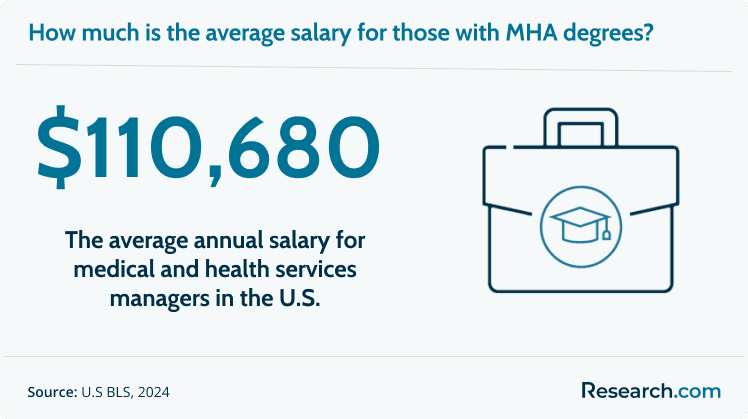
The U.S. Bureau of Labor Statistics reports an average salary of $110,680 per year for medical and health services managers, a common occupational category for MHA graduates. Actual pay can be higher or lower depending on job title, employer type, location, facility size, experience, and whether the role includes executive responsibility.
Salary should not be evaluated by degree alone. Employers typically look at your healthcare experience, leadership track record, ability to manage budgets, understanding of regulations, and familiarity with systems such as electronic health records, revenue cycle processes, quality measures, and performance dashboards.
| Factor | How it can affect MHA salary |
| Experience level | Professionals who have managed teams, budgets, or clinical operations usually compete better for higher-paying roles. |
| Employer size | Large hospital systems, insurers, consulting firms, and pharmaceutical companies may offer more senior roles than small facilities. |
| Specialization | Healthcare finance, analytics, compliance, operations improvement, insurance, and consulting can strengthen earning potential. |
| Geography | Compensation varies by region, local labor market, cost of living, and employer demand. |
| Leadership scope | Executive and multi-site leadership roles generally carry more responsibility and higher pay than single-department roles. |
How does an MHA compare with an MBA in healthcare management?
An MHA and an MBA in healthcare management can both lead to healthcare leadership roles, but they are built for different career strategies. The key distinction is specialization. An MHA focuses deeply on the healthcare system, while an MBA provides broader business training with some healthcare concentration. If you are still comparing terminology and program focus, Research.com’s explanation of the difference between healthcare management and healthcare administration can help clarify your options.
| Category | Master’s in Healthcare Administration | MBA in Healthcare Management |
| Main focus | Healthcare delivery, hospital operations, policy, compliance, quality improvement, and healthcare finance | General business management, finance, marketing, strategy, and leadership with healthcare-related electives or concentration courses |
| Best fit | Students committed to healthcare administration, hospital leadership, long-term care, public health administration, or health system operations | Students who want business flexibility across healthcare, consulting, insurance, pharmaceuticals, or non-healthcare industries |
| Career direction | Facility leadership, department management, health services management, healthcare operations, public health administration | Healthcare consulting, business development, operations, finance, strategy, product management, or executive management |
| Trade-off | More healthcare-specific, but less portable outside the healthcare sector | More flexible across industries, but may provide less depth in healthcare regulation and care delivery systems |
Students comparing healthcare leadership with broader business administration options may also find this BBA and BSBA degree program comparison useful for understanding how business-focused credentials differ by structure and emphasis.
How long does it take to complete an MHA degree?
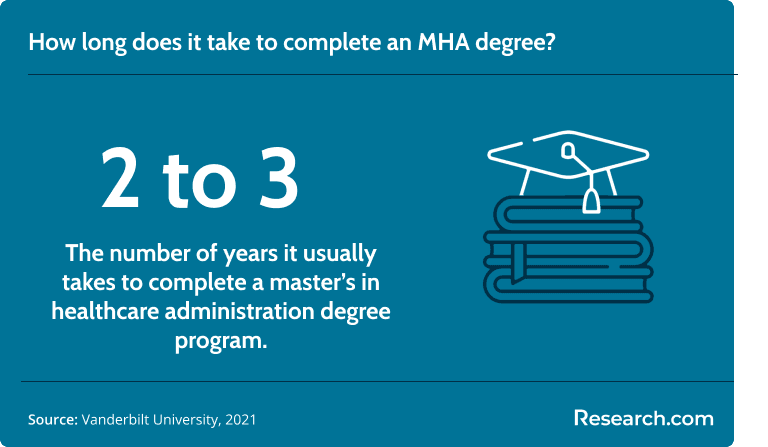
Program length depends on enrollment pace, delivery format, transfer policies, internship or residency requirements, and whether the program includes a capstone or thesis. A traditional full-time MHA program typically takes around two to three years. Accelerated options may take 12 to 18 months, while part-time programs for working professionals may take three to four years.
| Program format | Typical timeline | Best for |
| Full-time MHA | Two to three years | Students who can focus primarily on graduate study and may want internship or residency opportunities. |
| Accelerated MHA | 12 to 18 months | Students with strong time management skills who want to finish quickly and can handle an intensive course load. |
| Part-time MHA | Three to four years | Working professionals who need to balance school with employment, family responsibilities, or military service. |
| Executive or online MHA | Varies by program | Experienced professionals who need flexible scheduling, asynchronous coursework, or limited campus visits. |
| Dual-degree pathway | Often longer than a single degree | Students seeking broader credentials such as an MHA-MBA combination. |
Before enrolling, ask whether the program requires an internship, administrative residency, thesis, or capstone project. These experiences can add time, but they may also strengthen your resume if you lack management experience.
Can certifications strengthen a healthcare administration career?
Certifications can make sense when they fill a specific skills gap. An MHA may teach leadership, policy, finance, and healthcare operations, but employers may still value targeted proof of technical knowledge in areas such as revenue cycle management, compliance, billing, coding, analytics, quality improvement, or long-term care administration.
For example, professionals who work closely with claims, documentation, reimbursement, or revenue cycle teams may benefit from training connected to a medical billing and coding certification online. The key is to choose credentials that support your target role, not to collect certificates without a career plan.
When a certification may be worth pursuing
- You are changing specialties and need proof of job-specific knowledge.
- Your employer requires or prefers a credential for promotion.
- You want to move into compliance, revenue cycle, analytics, quality, or long-term care administration.
- You lack hands-on experience in a technical area that appears often in job postings.
How are emerging technologies changing healthcare administration?
Healthcare administrators increasingly work with digital health tools, telemedicine operations, data analytics, artificial intelligence, patient portals, cybersecurity concerns, and electronic health record workflows. The administrator’s job is not usually to build the technology, but to evaluate whether tools improve access, efficiency, safety, documentation, staffing, and patient outcomes.
AI and analytics can support scheduling, demand forecasting, documentation review, fraud detection, patient outreach, and performance measurement. However, administrators must also consider privacy, bias, transparency, staff training, cybersecurity, and regulatory compliance. Technology decisions in healthcare carry operational and ethical consequences.
Students who want a broader view of diagnostic and clinical technology education can review programs such as diagnostic medical sonography programs online, especially if they are comparing administrative leadership with allied health career paths.
Which skills matter most for healthcare administration success?
Successful healthcare administrators combine business judgment with healthcare-specific knowledge and strong interpersonal skills. Technical knowledge matters, but so does the ability to lead teams that may include physicians, nurses, finance staff, compliance officers, IT professionals, and community partners.
| Competency | Why it matters | How to build it |
| Healthcare finance | Administrators must understand budgets, reimbursement pressures, staffing costs, and resource allocation. | Take finance-heavy electives, work with budget reports, and seek projects tied to revenue cycle or cost control. |
| Regulatory and compliance knowledge | Healthcare organizations face strict requirements related to safety, privacy, documentation, billing, and quality. | Study policy, compliance, and risk management; consider specialized training when your role requires it. |
| Operations improvement | Leaders are expected to reduce delays, improve workflows, and support better care coordination. | Participate in process improvement, quality improvement, or patient experience projects. |
| Communication | Administrators must translate strategy into action for clinical and nonclinical teams. | Practice presenting data, writing executive summaries, and leading cross-functional meetings. |
| Data literacy | Performance dashboards, quality metrics, and analytics increasingly shape management decisions. | Build comfort with healthcare data, reporting tools, and evidence-based decision-making. |
For professionals who want specialized documentation and reimbursement knowledge, Research.com also reviews certified medical billing and coding schools. This type of training is most useful when it supports a role in compliance, claims, revenue cycle, or health information operations.
How does program affordability affect long-term career value?
Cost matters because an MHA is a career investment, not just an academic credential. A higher-priced program is not automatically a better choice, and a cheaper program is not automatically a poor one. The better question is whether the program’s cost, accreditation, curriculum, employer reputation, career support, and alumni outcomes align with your career goal.
Students should evaluate tuition alongside fees, books, technology costs, travel requirements, residency costs, lost work hours, and interest on loans. If your goal is broader public health leadership rather than facility administration, an affordable online public health degree may be another route to compare.
Questions to ask before choosing an MHA program
- Is the institution properly accredited?
- Does the curriculum match my target role in operations, finance, policy, consulting, insurance, or long-term care?
- Are internships, residencies, or capstone projects available?
- What career services are offered to online and part-time students?
- Can I use transfer credits, employer tuition assistance, scholarships, or military benefits?
- What is the total cost, not just tuition?
- Do graduates work in the types of healthcare organizations I want to enter?
Which healthcare administration roles offer the highest salaries?
The highest-paying healthcare administration jobs usually require more than a degree. They tend to involve large budgets, enterprise-wide strategy, regulatory accountability, personnel leadership, and measurable responsibility for financial and operational outcomes. MHA graduates who build deep experience in operations, finance, consulting, pharmaceuticals, insurance, or executive leadership may be better positioned for these roles.
Clinicians considering executive healthcare leadership may also compare administrative degrees with advanced clinical pathways. For example, nurses evaluating doctoral preparation can review the most affordable DNP programs to decide whether a clinical leadership or administrative leadership route fits better.
| High-paying role | Primary responsibility | Average salary |
| Chief Executive Officer (CEO) – Healthcare | Leads the overall strategy, operations, financial performance, and organizational direction of a hospital, health system, or large healthcare organization. | $151,302 per year |
| Chief Operations Officer (COO) – Healthcare | Manages daily operations across departments and works with executives and clinical leaders to improve performance and care delivery. | $151,203 per year |
| Medical and Health Services Manager | Coordinates healthcare services, staffing, budgets, compliance, and operations in facilities such as hospitals, clinics, and nursing homes. | $110,680 per year |
| Pharmaceutical Project Manager | Oversees projects tied to drug development, regulatory coordination, cross-functional teams, and commercialization timelines. | $154,411 per year |
| Nursing Home Administrator | Runs long-term care facilities by managing staff, budgets, resident care standards, compliance, and facility operations. | $121,986 per year |
These salaries are averages, not guarantees. Executive compensation can vary widely by organization size, geography, performance expectations, and prior leadership experience.
How can interdisciplinary study improve healthcare leadership?
Healthcare administrators make better decisions when they understand more than budgets and staffing charts. Knowledge of biology, public health, data analytics, behavioral health, ethics, law, technology, and clinical workflows can improve how leaders evaluate care models, quality initiatives, staffing needs, and patient safety risks.
Students with a science background may bring useful context to healthcare operations. If you are comparing science-focused education with administration, Research.com’s guide to accelerated online biology programs can help you understand another academic route. Similarly, a biology bachelor degree online may support students who want a scientific foundation before moving into healthcare management, public health, or graduate study.
What challenges are shaping healthcare administration today?
Healthcare administrators are dealing with a difficult mix of workforce shortages, cost pressure, regulatory complexity, digital transformation, cybersecurity risk, and changing patient expectations. Many organizations must improve access and quality while also managing reimbursement pressure, staffing constraints, and technology implementation.
- Workforce pressure: Administrators must support recruitment, retention, scheduling, burnout reduction, and team communication.
- Cost control: Leaders need to manage expenses without weakening patient care or staff capacity.
- Regulatory complexity: Compliance expectations affect privacy, documentation, billing, safety, and quality reporting.
- Digital transformation: Telehealth, analytics, AI, and electronic systems can improve efficiency but require training, governance, and cybersecurity safeguards.
- Patient expectations: Patients increasingly expect convenience, transparency, shorter wait times, and better communication.
What should you look for in an accelerated healthcare administration program?
Accelerated programs can be attractive because they shorten the path to graduation, but speed should not be your only criterion. A shorter program is useful only if it still provides rigorous healthcare administration training, qualified faculty, relevant projects, student support, and career preparation.
When reviewing an accelerated healthcare administration degree online, look for evidence that the program covers healthcare finance, law and ethics, quality improvement, operations, leadership, data-informed decision-making, and strategic management. Also confirm whether the schedule is realistic for your work and family responsibilities.
Common mistakes when choosing an MHA program
| Mistake | Better approach |
| Choosing based only on tuition | Compare total cost, accreditation, curriculum, career support, flexibility, and fit with your target role. |
| Assuming online means easier | Check weekly workload, synchronous meeting requirements, group projects, exams, and practicum expectations. |
| Ignoring accreditation and institutional reputation | Verify the school’s accreditation and ask how employers in your region view the program. |
| Skipping experience-building opportunities | Look for internships, administrative residencies, capstones, employer projects, or practicum experiences. |
| Assuming the degree guarantees an executive job | Build leadership experience, measurable accomplishments, professional references, and specialized skills. |
| Choosing a program without checking transfer and credit policies | Ask whether prior graduate credits, military training, or professional coursework can reduce time or cost. |
How does experience affect healthcare administration salaries?
Experience is one of the biggest salary differentiators in healthcare administration. Employers pay more for professionals who have already managed teams, handled budgets, improved workflows, led compliance initiatives, negotiated with stakeholders, or delivered measurable operational results.
Early-career graduates may begin in coordinator, analyst, assistant administrator, department manager, or fellowship roles. Over time, professionals who show results can move into director, administrator, vice president, COO, or CEO positions. Specialized experience in finance, data analytics, compliance, insurance operations, consulting, or pharmaceutical project management can also improve competitiveness for higher-paying roles.
Healthcare leadership also overlaps with adjacent fields. Professionals comparing administration with behavioral health leadership can review what jobs can you get with a marriage and family therapy degree. Those considering a move into advanced nursing may also explore the easiest direct entry MSN programs as an alternative route into clinical or administrative leadership.
Practical steps to increase your value after an MHA
- Target roles that build measurable management experience, even if they are not executive roles immediately.
- Volunteer for projects involving budgets, quality improvement, compliance, patient experience, or data reporting.
- Develop a specialty such as healthcare finance, operations improvement, revenue cycle, health policy, long-term care, or analytics.
- Track outcomes from your work, such as reduced wait times, improved scheduling, better compliance performance, or budget savings.
- Build relationships with clinical leaders, finance teams, compliance officers, and senior administrators.
Is there strong demand for healthcare administrators?
Yes. The labor market outlook for healthcare administrators is strong based on BLS projections for medical and health services managers. Employment in this field is projected to grow 29 percent from 2023 to 2033, much faster than the average for all occupations. In 2023, approximately 562,700 individuals were employed as medical and health services managers. By 2033, employment is expected to reach 723,300.
This growth reflects continued demand for healthcare services, the needs of an aging population, expanding healthcare organizations, and the complexity of managing modern care delivery. Some healthcare administration roles also appear alongside other highest-paying medical jobs, particularly when they involve executive responsibility, large systems, or specialized industries.
Demand does not mean every graduate will immediately receive a high-paying leadership offer. The strongest candidates usually combine education, healthcare experience, leadership ability, technical knowledge, and a clear understanding of the segment they want to enter.
How can networking and professional development advance your healthcare administration career?
Networking matters because many leadership opportunities depend on trust, references, organizational visibility, and awareness of openings before they are widely advertised. MHA students and graduates should build professional relationships with faculty, alumni, preceptors, healthcare executives, association members, recruiters, and colleagues across clinical and administrative departments.
Professional development also helps administrators stay current as regulations, technology, reimbursement models, staffing pressures, and patient expectations change. Conferences, webinars, employer training, association memberships, fellowships, and targeted certifications can all support advancement when they align with a specific career goal.
If you are comparing leadership opportunities by compensation and specialization, Research.com’s guide to healthcare administration jobs can help you review roles that may fit your long-term plan.
Action plan for prospective MHA students
- Define your target setting: hospital, clinic, insurance, consulting, public health, long-term care, pharmaceuticals, or nonprofit healthcare.
- Compare MHA, MBA in healthcare management, MPH, MSN, DNP, and health informatics options before applying.
- Verify accreditation, total cost, schedule, faculty background, and career support for every program on your list.
- Ask whether the program includes internships, residencies, capstones, employer projects, or alumni networking.
- Review job postings in your target market to identify preferred experience, software skills, certifications, and salary patterns.
- Build healthcare experience while studying if you do not already have it.
- Choose electives and projects that match your desired role rather than taking the easiest available courses.
Key Insights
- An MHA is best suited for people who want healthcare-specific leadership training for roles in operations, finance, compliance, quality improvement, policy, consulting, insurance, or executive administration.
- Medical and health services managers earn an average salary of $110,680 per year, but compensation depends heavily on experience, employer type, location, specialization, and leadership scope.
- The field has strong projected demand: employment for medical and health services managers is expected to grow 29 percent from 2023 to 2033, from approximately 562,700 jobs in 2023 to 723,300 by 2033.
- An MHA is not interchangeable with an MBA in healthcare management. Choose an MHA for healthcare depth; choose an MBA if you want broader business flexibility across industries.
- Program choice affects ROI. Compare accreditation, total cost, curriculum, flexibility, practical experience, career services, and employer reputation—not tuition alone.
- Technology, analytics, telehealth, compliance, cybersecurity, and workforce pressures are changing the administrator’s role, so graduates need both leadership skills and data-informed decision-making ability.
- The degree can open doors, but it does not guarantee an executive role. The strongest career outcomes usually come from combining the MHA with relevant experience, measurable achievements, networking, and targeted specialization.
Resources:
- Glassdoor. (2025). Salary: Healthcare Consultant in United States 2025. https://www.glassdoor.com
- U.S. Bureau of Labor Statistics. (2024). Occupational Outlook Handbook: Medical and Health Services Managers. https://www.bls.gov
- Vanderbilt University. (2021). How Long Does It Take to Get a Masters in Healthcare Management? https://business.vanderbilt.edu
- ZipRecruiter. (2025). Salary: Hospital Administrator (Mar, 2025) United States. https://www.ziprecruiter.com
Other Things You Should Know About What You Can Do with a Master’s Degree in Healthcare Administration
In 2027, individuals with a Master’s in Healthcare Administration can pursue non-clinical roles such as hospital administrator, healthcare consultant, policy analyst, or health services manager. These roles involve strategic planning, policy development, and overseeing healthcare operations to improve efficiency and quality.
Key skills for a Master's in Healthcare Administration in 2027 include leadership, financial management, healthcare policy understanding, strategic planning, and data analysis. The program often focuses on these to prepare students for diverse roles like hospital administration, insurance management, and healthcare consultancy.
Look for programmatic accreditation from the Commission on Accreditation of Healthcare Management Education, or CAHME. In 2027, CAHME-accredited programs are the standard benchmark for healthcare administration degrees and are often preferred by employers and used to judge curriculum quality.


