
2027 What is a Healthcare Administrator? Roles & Responsibilities

Co-Founder and Chief Data Scientist
Healthcare administrators keep hospitals, clinics, nursing facilities, physician practices, public health agencies, and health systems running. If you are considering this career, the hard part is not understanding that the job is “management.” The real decision is whether you want to lead people, budgets, compliance, technology, patient access, and operational change in a highly regulated healthcare environment where mistakes can affect both finances and patient care.
This guide explains what healthcare administrators do, where they work, what education and credentials are commonly expected, how salaries vary by role, and how current workforce shortages, financial pressure, telehealth, data systems, and compliance demands are reshaping the profession. It is designed for students comparing healthcare administration programs, career changers evaluating management roles in healthcare, and working professionals deciding whether an MHA, MBA, certification, or specialization is worth pursuing.
Quick Answer: Is Healthcare Administration a Good Career Path?
Healthcare administration can be a strong career path for people who want to combine business, leadership, operations, and healthcare service delivery. Most roles require at least a bachelor’s degree in healthcare administration, business administration, or a related field, while senior leadership positions often prefer or require a master’s degree such as an MHA or MBA. The work can be demanding because administrators handle staffing, budgets, regulations, technology, patient experience, and organizational performance, but it can also offer clear advancement paths across hospitals, outpatient care, long-term care, insurance, consulting, public health, and health information management.
| Decision Point | What It Means for You |
| Minimum education | A bachelor’s degree is commonly expected for entry-level administrative and management roles. |
| Advanced roles | An MHA, MBA, or related graduate degree is often preferred for director, executive, and system-level leadership positions. |
| Licensing | Some states require nursing home administrators to hold a license; requirements vary by state and role. |
| Best fit | This career fits people who can manage people, processes, data, budgets, compliance, and patient-focused goals at the same time. |
| Main trade-off | The field offers advancement potential, but healthcare operations can involve long hours, urgent decisions, regulatory pressure, and complex staffing challenges. |
Key Things You Should Know Before Becoming a Healthcare Administrator
- Education matters: Many employers look for a bachelor’s degree in healthcare administration, business administration, public health, health information management, or a related field. Graduate study can improve access to senior roles.
- Experience is valuable: Administrative internships, residencies, clinic operations roles, billing experience, department coordination, or healthcare project work can make a candidate more competitive.
- Certifications can help: Credentials from professional organizations such as the American College of Healthcare Executives (ACHE) may strengthen your profile, especially when combined with relevant experience.
- Specialization affects your path: Healthcare finance, compliance, human resources, health informatics, long-term care, revenue cycle, quality improvement, and public health administration lead to different day-to-day responsibilities.
- Leadership is not optional: Administrators need to communicate clearly, resolve conflict, interpret data, manage budgets, and guide teams through change.
- Regulations shape the job: HIPAA, Medicare and Medicaid rules, accreditation standards, labor laws, safety policies, and state requirements are part of routine administrative decision-making.
- Technology is central: EHR systems, telehealth platforms, cybersecurity, analytics, interoperability, and remote patient monitoring increasingly influence administrative strategy.
- Work-life balance varies: A hospital leadership role may involve emergencies and after-hours demands, while some outpatient, consulting, insurance, or public health roles may offer more predictable schedules.
- Compensation depends on responsibility: Salary potential varies by role, location, employer size, education, specialization, and years of experience.
- The job market is tied to healthcare demand: Workforce shortages, an aging population, and pressure to improve efficiency continue to increase the need for skilled healthcare operations leaders.
- What does a healthcare administrator do in 2027?
- Where do healthcare administrators work?
- What education, training, and licensing do healthcare administrators need?
- How do healthcare administrators manage staff and workforce challenges?
- How do healthcare administrators handle budgets and revenue?
- What regulations and legal issues affect healthcare administration?
- How important are technology, EHRs, data, and cybersecurity?
- How do administrators improve quality and patient experience?
- How do administrators lead strategy and organizational change?
- What continuing education options help healthcare administrators advance?
- What trends are changing healthcare administration?
- What career paths and salaries are common in healthcare administration?
- How can professionals find higher-paying healthcare administration opportunities?
- How can business skills improve healthcare operations?Salary strategy overviewCareer path details
- How can administrators build compensation models that retain staff?
- What risk management strategies matter most?
- How can an online public health degree support healthcare administrators?
- How can cross-disciplinary education strengthen healthcare leadership?Public health educationRisk management planningCompensation designHealthcare administration salaries
What is a healthcare administrator and what are their core duties for 2027?
A healthcare administrator is a management professional responsible for organizing the business, staffing, financial, regulatory, and operational functions of a healthcare organization. Unlike clinicians, administrators usually do not diagnose or treat patients. Their job is to make sure the organization has the people, systems, policies, funding, technology, and processes needed to deliver care safely and efficiently.
The role can look different in a small physician practice than in a large hospital system. In a clinic, one administrator may oversee scheduling, billing, hiring, patient complaints, vendor contracts, and compliance. In a hospital, responsibilities may be divided among department managers, finance leaders, quality officers, HR directors, operations executives, and health information managers.
- Operations management: Coordinating daily workflows, patient volume, appointment access, department capacity, supply needs, and facility readiness.
- Staff coordination: Aligning nurses, physicians, technicians, administrative employees, billing teams, and department leaders around shared goals.
- Policy execution: Translating organizational policies into daily procedures that staff can follow consistently.
- Records oversight: Supporting accurate administrative, operational, billing, and patient information management.
- Facility management: Helping maintain a safe, clean, accessible, and compliant care environment.
- Resource planning: Deciding how to use staff time, equipment, supplies, rooms, and technology without wasting limited resources.
- Communication: Acting as a connection point among clinical teams, patients, families, vendors, insurers, regulators, and executives.
- Problem resolution: Responding to bottlenecks, staffing gaps, patient complaints, technology failures, billing problems, or quality concerns.
- Quality monitoring: Tracking performance indicators tied to safety, service, efficiency, access, compliance, and outcomes.
Students often confuse healthcare administration with healthcare management. The two fields overlap, but administration tends to emphasize organizational operations, policy, compliance, systems, and leadership, while management may focus more narrowly on team or department performance. A detailed comparison of healthcare management vs healthcare administration can help you decide which degree path better matches your goals.
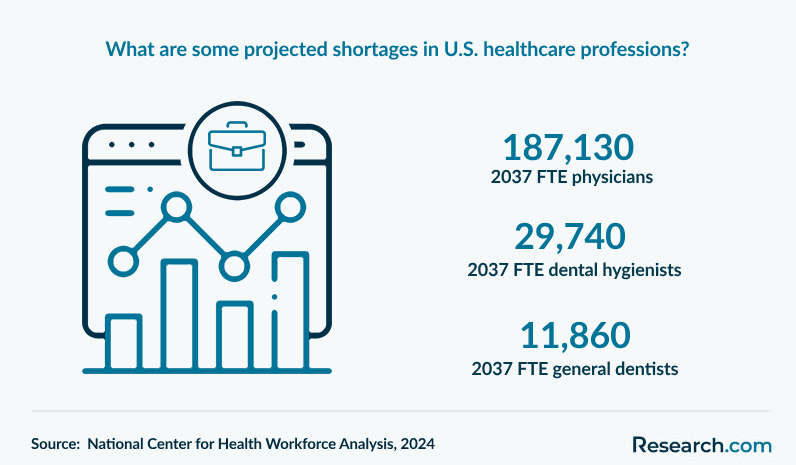
Healthcare administrators are becoming even more important as the U.S. health system faces workforce constraints. According to the National Center for Health Workforce Analysis in 2024, the United States is projected to face significant healthcare professional shortages by 2037. Specifically, there is an estimated shortage of 187,130 full-time equivalent (FTE) physicians across all physician specialties, with non-metro areas expected to experience more severe shortages than metro areas. The country is also projected to have a shortage of 29,740 FTE dental hygienists and 11,860 FTE general dentists by 2037. These projections, shown in the graphic below, underscore why workforce planning, care access, scheduling efficiency, and retention are now core administrative priorities.
What are the different types of healthcare administration roles and settings?
Healthcare administration is not one job. It is a broad career family with roles in hospitals, clinics, long-term care, insurance, government, consulting, public health, and health technology. The best setting for you depends on whether you prefer fast-paced operations, finance, policy, people management, data systems, community health, or executive leadership.
| Role or Setting | Typical Focus | Best Fit for Someone Who Wants To |
| Hospital administrator | Department coordination, compliance, staffing, budgets, patient flow, and executive strategy | Work in a complex, high-volume environment with many stakeholders |
| Clinic manager | Scheduling, front-office operations, billing coordination, patient access, and staff supervision | Lead day-to-day operations in an outpatient or physician practice setting |
| Nursing home administrator | Long-term care operations, resident services, staffing, safety, compliance, and family communication | Manage residential care and understand state licensing expectations |
| Medical practice manager | Business functions for a physician group, including revenue cycle, staffing, vendors, and patient service | Combine small-business operations with healthcare administration |
| Health information manager | Health records, privacy, coding systems, data quality, EHR workflows, and information governance | Work at the intersection of healthcare, data, compliance, and technology |
| Public health administrator | Community health programs, grants, policy implementation, outreach, and population health | Support health improvement beyond individual patient care |
| Healthcare consultant | Operational analysis, strategy, performance improvement, financial review, and technology implementation | Solve problems for multiple organizations and work on project-based engagements |
| Healthcare project manager | Implementation timelines, budgets, stakeholder coordination, and change management | Lead defined initiatives such as EHR upgrades, facility changes, or process redesign |
| Department manager | Specific service lines such as radiology, surgery, emergency services, or outpatient programs | Become an expert in one operational area before moving into broader leadership |
| Ambulatory care administrator | Outpatient centers, access, scheduling, patient throughput, and care coordination | Manage non-hospital services that increasingly shape healthcare delivery |
If you are comparing graduate options, it may help to review affordable online Masters in Healthcare Administration programs and then match the curriculum to the type of setting you want to enter.
What are the education and licensing requirements for healthcare administrators?
Most healthcare administration careers begin with a bachelor’s degree, but the level of education you need depends on the role. Entry-level coordinator, office manager, and assistant administrator positions may be accessible with undergraduate preparation and relevant experience. Director-level, executive, consulting, and system leadership roles often favor candidates with graduate education and a track record of measurable operational results.
| Credential or Requirement | Why It Matters | When It Is Most Useful |
| Bachelor's degree | Provides foundational knowledge in healthcare systems, management, finance, ethics, and communication | Entry-level administrative, coordinator, office manager, or assistant management roles |
| Master's degree such as MHA or MBA | Builds advanced leadership, finance, strategy, analytics, and organizational management skills | Director, executive, consulting, and competitive leadership positions |
| Relevant coursework | Prepares students for healthcare law, finance, information systems, quality improvement, and policy work | Any role involving compliance, operations, budgeting, or systems management |
| Internship or administrative residency | Creates hands-on experience in real healthcare settings and helps build professional references | Students moving directly from school into healthcare administration |
| Professional certification | Signals commitment to the field and may support advancement when paired with experience | Mid-career professionals and leaders seeking stronger credentials |
| State licensing | May be mandatory for nursing home administrators depending on the state | Long-term care and skilled nursing facility leadership |
| Continuing education | Keeps administrators current on regulations, technology, quality standards, and leadership practices | Required or strongly recommended throughout a healthcare administration career |
| Specialized training | Builds expertise in HIPAA, risk management, revenue cycle, health informatics, or quality improvement | Professionals targeting specialized roles or promotions |
Students pursuing advanced roles often compare MHA and MBA options. An MHA usually focuses more directly on healthcare systems, policy, quality, compliance, and healthcare operations. An MBA may be better for those who want broader business training in finance, strategy, analytics, or executive management. If cost is a major factor, review cheapest MHA programs while also checking accreditation, faculty experience, internship access, and employer reputation.
How long does it take to become a healthcare administrator?
The timeline varies by education level and career goal. A bachelor’s degree is the typical starting point. Students aiming for senior leadership may then complete a master’s degree, gain supervised administrative experience, pursue certification, and build several years of management experience. People already working in healthcare may move faster if they have clinical, billing, operations, HR, or project management experience that translates into administrative roles.
Questions to ask before choosing a healthcare administration program
- Is the program designed for healthcare administration, healthcare management, public health, business, or health informatics?
- Does the curriculum include finance, healthcare law, quality improvement, data analytics, leadership, and health information systems?
- Are internships, practicums, residencies, or employer-connected projects available?
- Does the program support working adults through online, evening, part-time, or accelerated options?
- Will the degree help with licensing requirements if you plan to work in nursing home administration?
- What kinds of employers hire graduates from the program?
- How transparent is the school about tuition, fees, transfer credits, graduation requirements, and student support?
How does a healthcare administrator manage human resources and staff?
Workforce management is one of the most difficult parts of healthcare administration. Administrators must recruit and retain qualified employees, build schedules that protect patient access, support professional development, address burnout, maintain labor law compliance, and respond to staffing shortages without sacrificing quality or safety.
- Recruitment and hiring: Identifying staffing needs, writing job descriptions, screening candidates, and selecting people who fit both the role and the care environment.
- Training and development: Coordinating onboarding, compliance training, leadership development, and skill-building opportunities.
- Performance management: Setting expectations, reviewing performance, coaching employees, and documenting improvement plans when needed.
- Conflict resolution: Addressing disagreements among staff, patients, families, and departments before they harm morale or service delivery.
- Scheduling: Balancing patient demand, employee availability, overtime limits, budget constraints, and coverage requirements.
- Employee relations: Listening to concerns, improving communication, and supporting a respectful workplace culture.
- Compensation and benefits: Working with HR and finance teams to maintain competitive, sustainable pay and benefits structures.
- Onboarding: Helping new employees understand workflows, expectations, technology, policies, and team culture.
- Labor compliance: Ensuring employment practices follow applicable federal and state labor laws.
- Retention planning: Reducing avoidable turnover through recognition, career ladders, training, better scheduling, and manager accountability.
The scale of healthcare employment makes this responsibility especially important. In February 2025, the healthcare sector added 52,000 jobs, closely aligning with the average monthly gain of 54,000 jobs observed over the preceding 12 months. Ambulatory healthcare services increased by 26,000 jobs, hospitals added 15,000 jobs, and nursing and residential care facilities gained 12,000 jobs. This staffing environment also affects occupations covered in the CNA job outlook, because administrators must plan for frontline care teams as well as administrative and clinical leadership roles.
How does a healthcare administrator handle financial management and budgeting?
Healthcare administrators do not need to be accountants in every role, but they must understand how money moves through a healthcare organization. Financial decisions influence staffing levels, patient access, facility investments, technology upgrades, payer contracts, and the organization’s ability to keep services available.
- Budget planning: Creating annual or departmental budgets that align staffing, equipment, supplies, and growth plans with available revenue.
- Revenue cycle management: Monitoring registration, coding, claims, billing, collections, denials, and reimbursement workflows. Professionals who want this specialization may benefit from affordable medical billing and coding certification courses.
- Cost control: Finding ways to reduce waste, improve purchasing, manage overtime, streamline processes, and use resources more efficiently.
- Financial reporting: Reviewing performance reports so leaders can identify revenue gaps, cost overruns, productivity issues, and service-line trends.
- Capital investment: Helping evaluate purchases such as equipment, software, facility upgrades, and new service lines.
- Financial compliance: Supporting accurate billing, documentation, accounting controls, and regulatory expectations.
- Vendor contracts: Negotiating or reviewing agreements with suppliers, service providers, consultants, and technology partners.
- Grants and fundraising: Supporting funding efforts in nonprofit, public health, academic, or community-based healthcare settings.
- Audits: Preparing for internal or external review of financial records, billing practices, or operational controls.
- Forecasting: Estimating future revenue, demand, staffing costs, and investment needs so leaders can plan ahead.
| Financial Area | Administrative Question to Ask |
| Staffing | Are staffing levels safe, affordable, and aligned with patient volume? |
| Billing and collections | Where are claims delayed, denied, undercoded, or written off unnecessarily? |
| Supplies and vendors | Can contracts, purchasing, or inventory controls reduce waste without harming care? |
| Technology | Will the system improve efficiency, compliance, patient access, or data quality enough to justify the cost? |
| Service lines | Which programs are financially sustainable, mission-critical, or in need of redesign? |
What compliance, regulations, and legal issues must a healthcare administrator address?
Healthcare is one of the most regulated sectors in the U.S. Administrators must understand legal and compliance responsibilities even when lawyers, compliance officers, privacy officers, or clinical leaders handle specialized tasks. The administrator’s role is to make sure policies are implemented, staff are trained, documentation is accurate, and problems are escalated quickly.
- HIPAA compliance: Protecting patient health information and ensuring privacy and security practices are followed.
- Medicare and Medicaid rules: Maintaining processes that support compliant participation in federal reimbursement programs.
- Accreditation standards: Preparing for expectations from organizations such as The Joint Commission when applicable.
- State health regulations: Meeting facility, staffing, reporting, licensing, and operational rules that vary by state.
- Labor laws: Supporting lawful hiring, scheduling, wage, leave, safety, and workplace practices.
- Risk management: Identifying operational, clinical, financial, reputational, and technology risks before they cause harm.
- Patient safety standards: Coordinating protocols that reduce errors, infections, delays, and preventable adverse events.
- Medical malpractice exposure: Supporting documentation, communication, reporting, and quality processes that reduce liability risk.
- Ethics: Promoting fair, transparent, patient-centered decisions when resources, access, or competing priorities are involved.
- Environmental and waste regulations: Ensuring proper handling of hazardous materials, medical waste, and facility safety practices.
- Emergency preparedness: Maintaining plans for disasters, cybersecurity events, staffing disruptions, supply shortages, and public health emergencies.
Common compliance mistakes to avoid
| Mistake | Better Approach |
| Assuming compliance is only the legal department’s responsibility | Build compliance into workflows, training, documentation, audits, and manager accountability. |
| Training staff once and never refreshing procedures | Schedule recurring training and update policies when regulations, technology, or workflows change. |
| Ignoring small documentation gaps | Treat documentation issues as early warning signs for billing, quality, or liability problems. |
| Choosing technology without privacy review | Evaluate security, access controls, vendor obligations, and data handling before implementation. |
| Assuming online education always meets licensing needs | Check state licensing rules directly if you plan to become a nursing home administrator or pursue another regulated role. |
What is the role of technology and information management in healthcare administration?
Technology is now a core administrative function, not a side project. Healthcare administrators often help select, implement, maintain, and improve systems that affect clinical documentation, patient scheduling, billing, reporting, telehealth, cybersecurity, analytics, and communication. A poorly managed system can slow clinicians down, frustrate patients, weaken billing, and increase compliance risk.
- Electronic health record management: Supporting EHR workflows, user adoption, documentation quality, access controls, and reporting needs.
- Data security and privacy: Protecting sensitive health information through policies, training, access management, and incident response planning. Leaders who need stronger technical knowledge may consider online cybersecurity courses.
- Telehealth implementation: Managing virtual care platforms, scheduling processes, patient communication, billing workflows, and provider adoption.
- Health information systems: Using administrative and clinical data systems to support reporting, quality improvement, compliance, and planning.
- Data analytics: Turning operational, financial, and patient data into decisions about staffing, access, quality, and resource use.
- Cybersecurity: Reducing exposure to ransomware, unauthorized access, phishing, data loss, and system downtime.
- Technology integration: Coordinating new tools with existing systems so staff do not have to duplicate work or manage conflicting data.
- IT infrastructure oversight: Working with technical teams to maintain reliable networks, devices, help desk support, and downtime procedures.
- Remote patient monitoring: Supporting programs that collect patient data outside traditional in-person visits.
- Mobile health tools: Evaluating apps and patient-facing platforms for usability, privacy, equity, and workflow fit.
How does a healthcare administrator improve patient experience and quality?
Administrators influence patient experience even when they never provide direct clinical care. Appointment availability, wait times, phone access, billing clarity, discharge processes, facility conditions, care coordination, interpreter services, patient complaints, and staff morale all affect how patients experience care.
- Patient satisfaction measurement: Collecting survey feedback and using it to identify service problems rather than treating scores as a public relations metric.
- Quality improvement programs: Supporting structured initiatives that reduce variation, improve outcomes, and strengthen safety.
- Feedback channels: Creating clear ways for patients and families to report concerns, ask questions, and receive responses.
- Patient advocacy: Protecting patient rights and making sure administrative processes do not create unnecessary barriers.
- Care coordination: Improving handoffs between departments, providers, facilities, and community resources.
- Access improvement: Reducing delays through better scheduling, staffing analysis, referral management, and telehealth when appropriate.
- Communication improvement: Helping teams provide clearer instructions, billing explanations, follow-up plans, and service recovery.
- Patient education: Supporting materials and workflows that help patients understand care plans and manage their health.
- Error reduction: Encouraging systems that make mistakes less likely and easier to detect.
- Personalized service: Designing processes that respond to different patient needs, languages, access barriers, and care preferences.
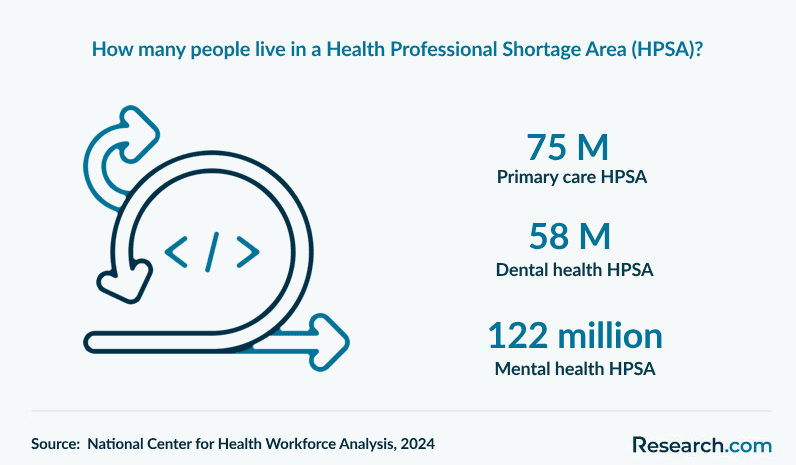
Access is a major quality issue. According to the National Center for Health Workforce Analysis as of June 14, 2024, approximately 75 million people live in a primary care Health Professional Shortage Area (HPSA), 58 million people live in a dental health HPSA, and 122 million people live in a mental health HPSA. Rural communities are especially affected by the uneven distribution of the healthcare workforce. These figures, shown in the graphic below, explain why administrators increasingly focus on scheduling redesign, telehealth, workforce planning, referral networks, and community partnerships.
How does a healthcare administrator engage in strategic planning and organizational leadership?
Strategic planning turns daily operations into long-term direction. Healthcare administrators help decide which services to grow, which processes to redesign, which technologies to adopt, how to prepare for workforce shortages, and how to balance financial sustainability with patient and community needs.
- Goal setting: Translating the organization’s mission into measurable priorities for access, quality, finance, workforce, and patient experience.
- Organizational development: Adjusting reporting structures, workflows, staffing models, and decision-making processes to improve performance.
- Change management: Helping teams adopt new policies, technologies, service lines, or care models with less disruption.
- Leadership development: Preparing supervisors, managers, and clinical leaders to communicate clearly and manage teams effectively.
- Market analysis: Studying demand, competition, payer changes, patient demographics, and service gaps before making strategic decisions.
- Stakeholder engagement: Involving staff, patients, families, community partners, board members, and executives in planning.
- Performance measurement: Using key indicators to monitor whether strategy is producing better results.
- Innovation support: Testing new care delivery, staffing, technology, and quality improvement approaches.
- Team building: Reducing silos between departments so patient care and operations work together.
- Vision communication: Explaining why change is happening and what success should look like.
- Resource planning: Anticipating future needs for employees, equipment, capital, facilities, and digital infrastructure.
Students who want stronger business foundations may also compare broader administration degrees. Understanding the BBA vs BS in Business Administration distinction can clarify how different undergraduate business programs approach leadership, analytics, and organizational strategy.
What are the continuing education opportunities for healthcare administrators?
Continuing education helps healthcare administrators keep pace with changing regulations, digital tools, reimbursement models, workforce pressures, and patient expectations. Useful options include graduate certificates, professional association training, ACHE-related learning, short courses in finance or analytics, compliance workshops, leadership programs, and specialized training in revenue cycle, risk management, quality improvement, public health, or health informatics.
Not every course needs to lead to a degree. Short, targeted training can be valuable when an administrator needs immediate skills in a specific area, such as cybersecurity, HIPAA, data dashboards, telehealth operations, or billing workflows. Cross-training can also improve decision-making. For example, administrators who want a better understanding of diagnostic service delivery may review clinical education pathways such as an 8-month ultrasound tech program online, not necessarily to become clinicians, but to better understand staffing, equipment, workflow, and patient access issues in imaging services.
What are the future trends and challenges facing healthcare administrators?
Healthcare administration is being reshaped by financial pressure, workforce shortages, digital transformation, patient expectations, value-based care, and growing demand for mental health, primary care, and community-based services. Administrators who can manage change, interpret data, protect privacy, and lead people through uncertainty will be better positioned than those who rely only on traditional management routines.
- Telehealth expansion: Administrators must decide which virtual services are sustainable, compliant, accessible, and clinically appropriate.
- Data analytics and AI: Leaders are expected to use data to improve operations, but they also need guardrails for privacy, bias, accuracy, and accountability. Professionals interested in deeper analytics training can explore cheapest online Masters in Data Analytics options.
- Cybersecurity risk: Patient data, connected devices, and system uptime require stronger security planning.
- Value-based care: Organizations increasingly focus on outcomes, coordination, prevention, and cost control rather than volume alone.
- Healthcare reform: Policy and reimbursement changes can quickly affect budgets, compliance, and access.
- Aging population: Demand for chronic disease management, long-term care, home-based services, and care coordination continues to influence planning.
- Workforce shortages: Recruitment, retention, burnout prevention, and role redesign are now strategic priorities.
- Patient empowerment: Patients expect clearer communication, digital access, transparent billing, and involvement in decisions.
- Cost containment: Administrators must improve efficiency without reducing quality or access.
- Interoperability: Health information systems need to exchange accurate data across providers and care settings.
- Personalized medicine: New treatment approaches can require updated workflows, data systems, and reimbursement planning.
- Mental health integration: Primary care and behavioral health coordination is increasingly important.
- Regulatory complexity: More rules mean stronger compliance systems and staff training are necessary.
- Community health focus: Prevention, social needs, and population health are becoming more central to strategy.
- Remote work management: Administrators may supervise hybrid teams in billing, coding, scheduling, analytics, or support functions.
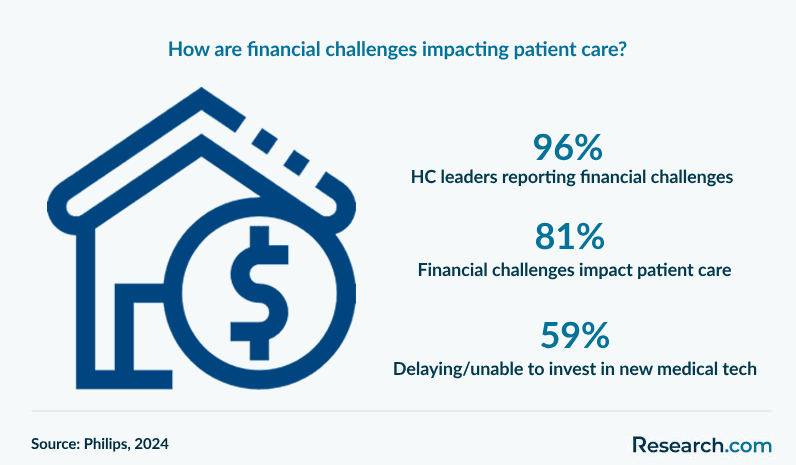
Financial pressure is one of the clearest challenges. According to a 2024 report by Philips, 96% of healthcare leaders report that their organizations are experiencing financial difficulties. In the same report, 81% say financial challenges are directly affecting patient care, and 59% are either delaying or unable to invest in new or more advanced medical equipment and technologies. These statistics, shown in the figure below, highlight why healthcare administrators need strong budgeting, prioritization, technology assessment, and operational redesign skills.
What are the typical career paths and salaries for healthcare administrators?
Healthcare administration careers usually progress from coordination and office-level responsibilities to department management, specialized leadership, and executive decision-making. Advancement is not automatic. Employers typically look for a combination of education, healthcare experience, measurable results, leadership ability, and knowledge of finance, compliance, technology, or quality improvement.
| Career Stage | Example Roles | Typical Focus |
| Entry-level | Administrative assistant, department coordinator, medical office manager | Scheduling, records, patient communication, billing support, office workflows, and supervisor support |
| Mid-level management | Clinic manager, hospital department head, health information manager | Team supervision, budgets, process improvement, compliance, reporting, and operational performance |
| Senior leadership | Hospital CEO, chief operating officer, chief financial officer | Strategy, system performance, financial sustainability, governance, service-line growth, and executive decision-making |
| Consulting | Healthcare operations consultant, revenue cycle consultant, implementation advisor | Advising organizations on performance improvement, technology, strategy, compliance, or financial operations |
| Public or nonprofit administration | Public health administrator, nonprofit program director, government healthcare manager | Community health, grants, policy, access programs, population health, and public service delivery |
| Specialized administration | Long-term care administrator, health informatics leader, healthcare project manager | Role-specific leadership in regulated facilities, data systems, or major organizational projects |
- Entry-level roles: Administrative assistants, medical office managers, and department coordinators often build the first layer of healthcare operations experience.
- Mid-level management: Clinic managers, department heads, and health information managers supervise teams and manage performance targets.
- Senior leadership: Hospital CEOs, COOs, and CFOs oversee major strategic, operational, and financial decisions. Finance-focused leaders may find value in accelerated finance degree online programs.
- Consulting: Experienced administrators may advise organizations on operations, technology implementation, compliance, revenue cycle, or strategy.
- Academic roles: Some professionals move into teaching, research, or university-based health administration programs.
- Government roles: Public agencies need administrators for public health programs, healthcare policy implementation, and system oversight.
- Nonprofit organizations: Community clinics, foundations, and mission-driven health organizations need leaders who can manage programs and funding.
- Insurance companies: Health plans hire administrators for operations, provider relations, quality, claims, and network management.
- Long-term care administration: Nursing homes and assisted living facilities require leaders who understand resident care, compliance, staffing, and family communication.
- Health informatics: Administrators can specialize in health data, EHR systems, privacy, reporting, and information governance.
- Project management: Healthcare project managers lead technology rollouts, construction projects, process redesign, and cross-department initiatives.
- Salaries: Entry-level salaries may start around $50,000, while senior executives can earn upwards of $200,000 or more annually, depending on experience, location, and organization size.
- Geographic differences: Pay is often higher in metropolitan areas and regions with higher costs of living.
- Education impact: Advanced degrees such as an MHA or MBA can support access to higher-responsibility roles.
- Certification benefits: Professional credentials may improve marketability, especially when paired with relevant accomplishments.
Salary data varies significantly by title and responsibility. Graduates with healthcare administration training may pursue roles with different compensation levels: Clinical Managers earn an average of $82,546 annually, Medical Office Managers in Maryland average $89,422, and Medical Billing Managers average $95,870. Nursing Home Administrators at Clearview Healthcare Management average $126,478. Health Information Management Specialists average $168,404, while Hospital Administrators show the highest listed average salary at $281,703. For readers comparing broader management outcomes, this context can complement information on how much can you make with a management degree. The graphic below illustrates how compensation generally rises as responsibility, specialization, and strategic authority increase.
These figures should be viewed as role-specific examples rather than guaranteed outcomes. Your earnings will depend on location, employer type, education, experience, certifications, negotiation, and the scale of the organization you manage.
What strategies can help uncover lucrative opportunities in healthcare administration?
Higher-paying healthcare administration roles usually require more than a degree. They often reward professionals who can solve expensive problems: reducing turnover, improving revenue cycle performance, leading technology adoption, managing service-line growth, protecting compliance, and improving patient throughput. To find stronger opportunities, compare salary benchmarks by title and region, join professional associations, build relationships with healthcare recruiters, track high-demand specialties, and document measurable outcomes from your work.
- Target roles tied to financial performance, technology transformation, compliance risk, or multi-site operations.
- Build a portfolio of results, such as reduced denials, improved scheduling access, stronger retention, or successful system implementation.
- Use informational interviews to understand which employers are growing and which specialties are understaffed.
- Compare compensation by responsibility level rather than job title alone, because titles vary widely across organizations.
- Review high paying jobs in healthcare administration to understand how seniority and specialization can affect earnings potential.
How can healthcare administrators integrate business acumen to optimize operational performance?
Business acumen helps administrators connect patient care goals with financial reality. Healthcare leaders must understand margins, productivity, staffing models, payer contracts, capital planning, service-line performance, vendor costs, and operational bottlenecks. The goal is not to treat healthcare like a generic business; it is to use business tools responsibly so the organization can deliver safer, more accessible, and more sustainable care.
Administrators can improve performance by tracking key metrics, building dashboards, using financial forecasts, comparing service-line demand, involving clinicians in process redesign, and testing changes before scaling them. Students who want broader business preparation may compare fast online business degree programs accredited with healthcare-specific programs to decide whether general business or healthcare-focused coursework better fits their goals.
Here’s What Graduates Have to Say About Their Healthcare Administrator Careers
-
: "
Healthcare administration gave me a way to improve care without working at the bedside. When a scheduling process becomes smoother or a department communicates better, patients feel the difference. Anya
"
-
: "
The field keeps changing, which is exactly why I enjoy it. Each week brings a new staffing, technology, financial, or quality challenge that requires practical leadership. Kaelen
"
-
: "
This career lets me use business skills for a purpose that feels meaningful. The decisions are complex, but they can improve both the organization and the patient experience. Rhys
"
How can healthcare administrators design competitive compensation models to attract and retain talent?
Compensation strategy affects hiring, turnover, morale, overtime, patient access, and budget stability. Healthcare administrators should benchmark pay regularly, compare local labor markets, evaluate hard-to-fill roles, review internal equity, and coordinate compensation with career development, scheduling flexibility, benefits, and recognition programs.
A strong compensation model does not rely only on base pay. It may include shift differentials, retention incentives, tuition support, certification support, leadership pathways, flexible scheduling, wellness resources, and transparent promotion criteria. For operational wage planning, administrators can use role-specific data such as how much do medical billing and coding make to understand expectations in billing, coding, and revenue cycle positions.
What are the most effective risk management strategies for healthcare administrators?
Risk management in healthcare administration covers far more than insurance. Administrators must anticipate operational disruptions, privacy incidents, compliance failures, staffing shortages, billing errors, patient safety issues, vendor failures, emergency events, and reputational damage. The best approach is proactive: identify risks early, assign owners, train staff, monitor indicators, and practice response plans before a crisis occurs.
| Risk Area | Practical Strategy |
| Patient safety | Use reporting systems, root-cause analysis, staff training, and quality improvement processes. |
| Data privacy | Maintain access controls, cybersecurity training, audit logs, vendor review, and incident response procedures. |
| Revenue cycle | Monitor denials, coding accuracy, documentation quality, and billing compliance. |
| Staffing | Track turnover, vacancy rates, overtime, burnout indicators, and critical coverage gaps. |
| Regulatory compliance | Schedule audits, update policies, document training, and escalate issues promptly. |
| Emergency preparedness | Test plans for disasters, cyber incidents, supply disruption, staffing shortages, and facility interruptions. |
Administrators working in revenue cycle or documentation-heavy environments can strengthen risk awareness by learning how billing and coding systems operate. Resources such as the best accredited medical billing and coding schools online can help identify education pathways that support stronger documentation, compliance, and reimbursement knowledge.
How does an online public health degree empower healthcare administrators?
An online public health degree can help healthcare administrators move beyond facility-level operations and understand population health, epidemiology, prevention, policy, program evaluation, and community health needs. This training is especially useful for professionals who work in public agencies, community clinics, nonprofit health organizations, rural health programs, behavioral health integration, or health equity initiatives.
For administrators, public health education can improve decision-making around access, outreach, emergency preparedness, chronic disease programs, social determinants of health, and partnerships with schools, employers, local governments, and community organizations.
What benefits does cross-disciplinary education offer to healthcare administrators?
Healthcare administrators rarely solve problems with healthcare knowledge alone. Strong leaders often combine healthcare operations with business, finance, technology, data analytics, human resources, public health, communication, and project management. Cross-disciplinary education can help administrators understand complex organizations, lead different types of teams, and adapt strategies from other fields without losing sight of healthcare ethics and patient needs.
For example, business coursework can improve budgeting and strategy, technology coursework can strengthen digital transformation projects, public health coursework can improve population-level planning, and management coursework from other fields can add useful perspectives on team performance. Even a program such as a cheap sports management online degree may offer lessons in team leadership, operations, event coordination, and performance management that can complement healthcare-focused training when applied thoughtfully.
Common Mistakes to Avoid When Planning a Healthcare Administration Career
| Common Mistake | Why It Can Hurt You | Smarter Move |
| Choosing a degree only because it is inexpensive | Low tuition does not guarantee strong curriculum, support, employer recognition, or career fit. | Compare cost together with accreditation, outcomes, faculty experience, internships, and student services. |
| Ignoring licensing rules | Some state-regulated roles, especially nursing home administration, may have specific requirements. | Check the licensing board in the state where you plan to work before enrolling. |
| Assuming a master’s degree guarantees promotion | Employers still value experience, results, leadership ability, and specialized knowledge. | Pair graduate study with projects, internships, measurable outcomes, and networking. |
| Overlooking finance and data skills | Modern healthcare leaders are expected to understand budgets, dashboards, reimbursement, and performance metrics. | Choose electives or certificates in analytics, revenue cycle, finance, or health informatics. |
| Relying only on rankings | Rankings may not reflect your career goals, schedule, state requirements, or employer network. | Use rankings as one input, then evaluate program fit, cost, flexibility, and outcomes. |
| Underestimating the stress of healthcare operations | Administrators often manage urgent staffing, compliance, financial, and patient service problems. | Develop conflict resolution, communication, resilience, and change management skills early. |
Key Insights
- Healthcare administration is a leadership career, not just an office role: Administrators manage staffing, budgets, compliance, technology, patient experience, and organizational strategy.
- Education should match your target role: A bachelor’s degree may support entry-level opportunities, while MHA, MBA, public health, informatics, finance, or compliance training can help with specialized and senior positions.
- Workforce shortages make administration more important: By 2037, the U.S. is projected to face a physician shortage of 187,130 FTEs, plus shortages of 29,740 FTE dental hygienists and 11,860 FTE general dentists.
- Access challenges are widespread: 75 million people live in primary care HPSAs, 58 million in dental health HPSAs, and 122 million in mental health HPSAs, increasing the need for administrators who can improve staffing, scheduling, and care coordination.
- Financial pressure directly affects care decisions: Philips reported that 96% of healthcare leaders face financial challenges, 81% say those challenges directly affect patient care, and 59% are delaying or unable to invest in new medical technology.
- Healthcare employment continues to expand: In February 2025, the healthcare sector added 52,000 jobs, including 26,000 in ambulatory services, 15,000 in hospitals, and 12,000 in nursing and residential care facilities.
- Salary potential varies by responsibility: Listed averages include $82,546 for Clinical Managers, $89,422 for Medical Office Managers in Maryland, $95,870 for Medical Billing Managers, $126,478 for Nursing Home Administrators at Clearview Healthcare Management, $168,404 for Health Information Management Specialists, and $281,703 for Hospital Administrators.
- The strongest candidates combine credentials with results: Employers value degrees and certifications, but advancement usually depends on demonstrated success in operations, finance, compliance, technology, quality improvement, or people leadership.
References:
- Bureau of Labor Statistics. (2025, March 7). The employment situation — February 2025 (U.S. Department of Labor, News Release USDL-25-0427). Bureau of Labor Statistics.
- National Center for Health Workforce Analysis. (2024, November). State of the U.S. health care workforce, 2024. Health Resources and Services Administration. Bureau of Health Workforce.
- Philips. (2024). Future Health Index 2024: Better care for more people. Philips.
- Salary.com. (2025). Clinical Manager Salary in the United States. Salary.com.
- Salary.com. (2025). Hospital Administrator Salary in the United States. Salary.com.
- Salary.com. (2025). Health Information Management Specialist Salary. Salary.com.
- Salary.com. (2025). Medical Billing Manager Salary in the United States. Salary.com.
- Salary.com. (2025). Medical Office Manager Salary in Maryland. Salary.com.
- Salary.com. (2025). Nursing Home Administrator Salary at Clearview Healthcare Management. Source: Salary.com.
Other Things You Should Know About Healthcare Administrators
Certified healthcare administrators may require the Certified Healthcare Administrative Professional credential. This certification, issued by the American Hospital Association, verifies proficiency in healthcare management roles. Requirements typically include relevant work experience and passing an exam.
A master’s degree is not legally required for every healthcare administrator role, but many employers prefer an MHA, MPH, MBA, or MPA for senior positions. Entry-level administrative jobs often accept a bachelor’s degree plus relevant internships, while leadership roles may require several years of hospital or clinic experience.


