
2027 How to Become a Medical Transcriptionist

Co-Founder and Chief Data Scientist
Medical transcription is the healthcare documentation role that turns dictated clinical notes into accurate written records. If you are detail-oriented, comfortable with medical language, and interested in remote or administrative healthcare work, it can be an accessible way to enter the field without pursuing a long clinical degree.
The career is changing, however. Speech recognition, electronic health records, and AI-assisted documentation have reduced some traditional typing work, while increasing demand for people who can review, edit, format, and verify clinical documents with strong accuracy. This guide explains how to become a medical transcriptionist, what training is worth considering, how long it takes, what you can earn, and how to make the career more resilient in a technology-driven healthcare environment.
Quick answer: How do you become a medical transcriptionist?
To become a medical transcriptionist, you typically need a high school diploma or GED, training in medical terminology and healthcare documentation, strong typing and editing skills, and familiarity with transcription software and electronic health records. Many employers prefer applicants who complete a certificate, diploma, or associate degree program. Certification is not always mandatory, but credentials such as the Registered Healthcare Documentation Specialist (RHDS) or Certified Healthcare Documentation Specialist (CHDS) can strengthen your resume.
Key things to know before choosing this career
- Medical transcription is no longer only about typing from dictation. Many roles now involve reviewing speech-recognition drafts, correcting errors, formatting reports, and protecting patient privacy.
- Training can take a few months to two years, depending on whether you choose a short certificate, associate degree, online course, self-study route, or employer-based training.
- In 2023, the average salary of a medical transcriptionist was $37,060 per year. The lowest 10% earned less than $27,190, and the highest 10% earned more than $52,880.
- Employment in medical transcription is forecast to fall by 4% from 2022 to 2032, so career flexibility matters. Pairing transcription with coding, billing, health information, compliance, or administrative skills can improve your long-term options.
- Remote work is possible, but it requires secure technology, disciplined time management, reliable internet access, and strict compliance with patient privacy rules.
- How to become a medical transcriptionist
- Education requirements for medical transcriptionists
- How long medical transcription training takes
- Medical transcriptionist salary
- Education pathways compared
- Certifications and credentials
- Career paths for medical transcriptionists
- Job outlook and growth prospects
- Medical transcription specialties
- How to advance your career
- Other specialized fields to explore
- How to future-proof your transcription career
- How to finance medical transcription training
- Adding medical assisting skills
- Transitioning from transcription to medical coding
- Using emerging technologies to stay competitive
- Medical certificate programs that may pay well
- Regulatory and privacy considerations
- Advancing from transcription to healthcare administration
- Diversifying beyond medical transcription
- Interdisciplinary studies that can support transcription work
- Transitioning from transcription to pharmacy
- Adding nutrition expertise
- Using biology studies to improve documentation accuracy
- Common pitfalls in medical transcription
- How to choose a medical transcription training program
- Remote work as a medical transcriptionist
- Future trends in medical transcription
- Fast ways to enhance healthcare credentials
- How advanced online degrees can support healthcare career growth
How to become a medical transcriptionist
A medical transcriptionist listens to dictated notes from physicians, nurses, and other healthcare professionals and converts them into written medical reports. Depending on the employer, the work may include transcribing new dictation, editing speech-recognition output, checking terminology, formatting documents, and ensuring the record is clear, complete, and compliant with documentation standards.
The basic path is straightforward: build medical vocabulary, learn healthcare documentation formats, develop fast and accurate keyboarding skills, practice with real or simulated dictation, and apply for entry-level transcription or documentation roles. If you are comparing healthcare support careers, this path is different from direct-care roles such as home health aide work, where learning how to get an HHA certificate may be more relevant.
As of 2022, there were 49,000 medical transcriptionists in the U.S. based on data from the Bureau of Labor Statistics, of which 2.16% were employed by business support services firms.
| Step | What to do | Why it matters |
| 1. Confirm the role fits you | Review the work style: focused listening, editing, medical terminology, confidentiality, and computer-based documentation. | The job rewards accuracy and concentration more than speed alone. |
| 2. Meet the minimum education requirement | Complete a high school diploma or GED if you have not already done so. | This is the usual baseline for entry-level training and employment. |
| 3. Complete targeted training | Choose a certificate, diploma, associate degree, online course, or structured self-study plan. | Employers often prefer applicants who understand anatomy, terminology, report types, and documentation standards. |
| 4. Build a work sample and accuracy record | Practice with different accents, specialties, audio quality levels, and report formats. | Hiring tests often measure accuracy, formatting, and knowledge of medical language. |
| 5. Consider certification | Evaluate RHDS or CHDS if they match your experience level and goals. | Certification can help demonstrate competence, especially when competing for remote or specialized roles. |
| 6. Apply strategically | Look for roles with hospitals, clinics, transcription vendors, business support services, and health information departments. | Different employers offer different levels of stability, benefits, flexibility, and productivity expectations. |
Education requirements for medical transcriptionists
The minimum requirement is usually a high school diploma or GED, but that alone may not be enough for many employers. Medical transcription requires familiarity with anatomy, physiology, pharmacology terms, diagnostic procedures, healthcare abbreviations, documentation formats, and privacy expectations.
Medical transcriptionists typically require postsecondary education, such as a certificate or diploma. Among medical transcriptionists in 2023, 35% have an associate degree. Employer expectations vary, but the most common education options are certificate programs and associate degree programs.
- Certificate or diploma programs: These programs focus on job-specific preparation, including medical terminology, anatomy and physiology, healthcare documentation, transcription technology, grammar, editing, and medical ethics. Many can be completed in less than a year.
- Associate degree programs: These usually take longer but may provide broader preparation through general education courses, health information coursework, and deeper exposure to healthcare systems. They typically take two years to complete.
- Self-study or employer training: This route may work for people who already have strong typing, grammar, editing, and medical terminology knowledge, but it can be harder to prove readiness without formal training or work samples.
If you want a short healthcare credential rather than a full degree, it may also be useful to compare medical transcription with 12-month certificate programs that pay well in related healthcare support fields.
How long does it take to become a medical transcriptionist?
The timeline depends on your starting point. Someone with healthcare experience and strong typing skills may need only focused transcription practice, while a beginner may need a full certificate or associate degree program to learn medical language, documentation standards, and transcription software.
| Path | Typical time commitment | Best for | Main trade-off |
| Short online course | A few months, depending on pace | Learners who already have strong grammar, typing, and study habits | May provide less instructor feedback or career support |
| Certificate or diploma | Six months to one year | Students who want structured, job-focused preparation | Quality varies, so program evaluation is important |
| Associate degree | Two years | Learners who want broader healthcare education or future transfer options | Usually requires more time and may cost more |
| Self-study | Varies widely | Experienced healthcare workers or highly disciplined learners | Harder to verify skills to employers without a credential or portfolio |
| On-the-job training | Employer-dependent | Applicants who can pass typing, grammar, and terminology screens | Not always available, especially for remote roles |
Even after training, expect a learning curve. Speed improves with repeated exposure to medical specialties, physician dictation styles, audio issues, and employer-specific formatting rules.
Medical transcriptionist salary
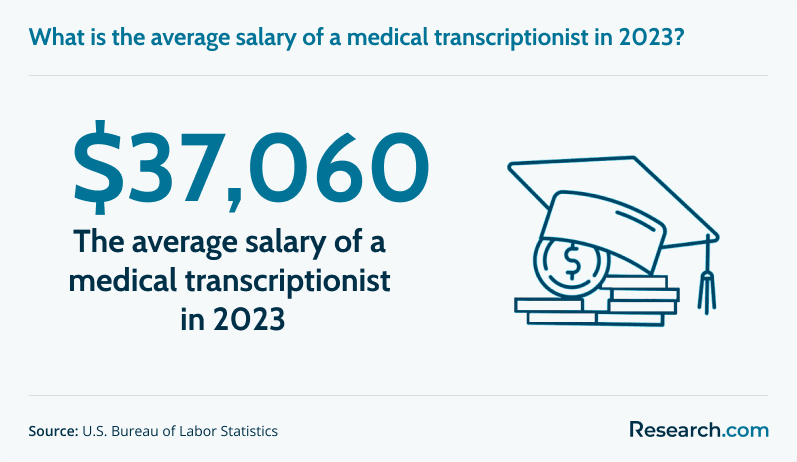
In 2023, the average salary of a medical transcriptionist was $37,060 per year. The lowest 10% earned less than $27,190, and the highest 10% earned more than $52,880.
Your actual pay may differ based on location, employer type, production expectations, experience, specialization, remote versus on-site work, and whether you are an employee or independent contractor. Workers in high-cost labor markets may see different pay levels than those in smaller cities or rural areas, but salary should never be assumed without reviewing current job postings and compensation details.
| Factor | How it can affect earnings | What to check before accepting a role |
| Employment status | Employees may receive benefits; contractors may have more flexibility but may need to cover taxes, insurance, software, and equipment. | Ask whether the role is W-2 employment or contract work. |
| Pay structure | Some roles pay hourly, while others may use production-based rates. | Confirm how productivity is measured and whether editing speech-recognition drafts is paid differently. |
| Specialty knowledge | Complex specialties may reward transcriptionists who understand advanced terminology and report formats. | Ask whether specialty experience is required or paid at a higher rate. |
| Remote work requirements | Remote roles may require secure equipment, quiet workspace, and reliable internet. | Clarify who pays for software, hardware, headset, foot pedal, and security tools. |
| Benefits | Health insurance, retirement plans, paid time off, and training support can change total compensation. | Compare total compensation, not just hourly or annual pay. |
Education pathways compared
Medical transcription training is available through community colleges, vocational schools, technical schools, online providers, and sometimes employers. In 2022, at least 6,080 medical transcriptionists completed an associate degree while 4,765 have a high school degree or equivalent.
If cost and flexibility are major concerns, start by comparing program format, total price, accreditation or institutional recognition, transfer options, and student support. Research.com’s guide to affordable online colleges can help you think through cost and online learning trade-offs beyond tuition alone.
| Pathway | Advantages | Limitations | Best fit |
| Community college | Structured curriculum, possible academic advising, and broader healthcare coursework | May take longer and follow a fixed academic calendar | Students who want support, transfer options, or a recognized local institution |
| Vocational or technical school | Practical, career-focused training that may be shorter than a degree | Program quality and employer recognition can vary | Learners who want a direct path into transcription or documentation work |
| Online course | Flexible scheduling and access from home | May offer limited live feedback, networking, or supervised practice | Working adults and caregivers who need flexible study time |
| Self-study | Lowest structure and potentially lower cost | No built-in credential, instructor feedback, or formal career services | People with healthcare experience and strong independent learning skills |
| On-the-job training | Earn while learning if available | Employers may prefer trained applicants and may not offer extensive instruction | Applicants with excellent typing, grammar, and medical vocabulary foundations |
Certifications and credentials for medical transcriptionists
Certification is not required for every medical transcription job, but it can help show employers that you understand healthcare documentation and can meet professional standards. It may be especially useful for applicants seeking remote work, specialty transcription, quality review, or advancement.
The Association for Healthcare Documentation Integrity (AHDI) offers two main certifications:
- Registered Healthcare Documentation Specialist (RHDS): This credential is designed for medical language specialists who transcribe dictation by physicians and other healthcare providers. It validates foundational healthcare documentation knowledge and skills.
- Certified Healthcare Documentation Specialist (CHDS): This credential is intended for medical language specialists with at least two years of acute care transcription experience. It recognizes more advanced healthcare documentation expertise.
These credentials are earned through exams and require continuing education for renewal. Before paying for any certification prep course, verify whether employers in your target market request or prefer that credential.
If you are comparing short credentials across healthcare, you may also want to review easiest certifications to get that pay well. If your long-term plan involves leadership or graduate education, compare transcription credentials with broader options such as affordable online masters programs.
Career paths for medical transcriptionists
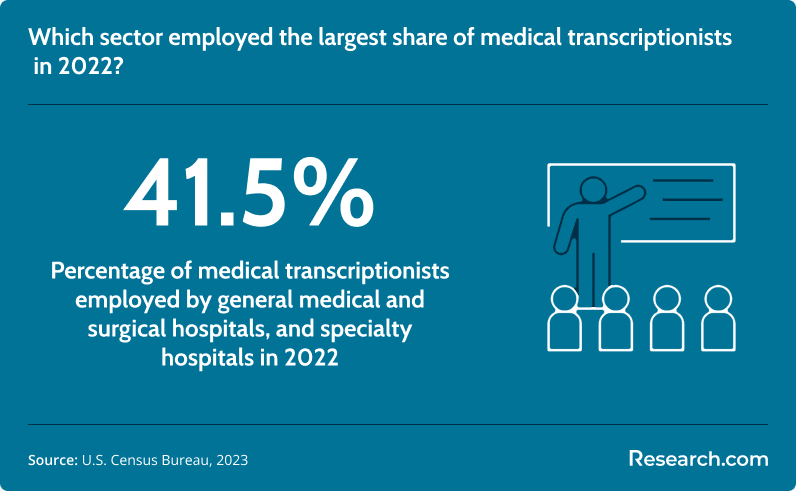
Medical transcriptionists work in several settings. In 2022, general medical and surgical hospitals, and specialty hospitals employed the largest share of medical transcriptionists at 41.5%.
| Career setting | What the work may involve | Who it suits |
| Independent contractor | Completing transcription or editing assignments for one or more clients, often remotely | People who value flexibility and can manage taxes, benefits, deadlines, and client communication |
| Medical transcription company | Handling documents for different providers, specialties, or facilities through a vendor workflow | Transcriptionists who want steady document volume and exposure to different report types |
| Hospital or clinic | Supporting clinical documentation within a healthcare facility or health system | Workers who prefer more structured employment, possible benefits, and closer connection to care teams |
| Specialized transcription | Focusing on areas such as cardiology, orthopedics, radiology, legal transcription, or forensic transcription | Experienced transcriptionists who want deeper subject matter expertise |
| Quality assurance or supervisor role | Reviewing transcription accuracy, training staff, auditing documentation, and improving workflows | Professionals with strong judgment, leadership skills, and consistent accuracy |
Some transcriptionists add adjacent credentials from online certifications that pay well or move toward leadership with options such as the cheapest MHA programs.
Job outlook and growth prospects for medical transcriptionists
Employment in medical transcription is forecast to fall by 4% from 2022 to 2032. This decline is largely connected to speech recognition technology, electronic health record templates, and automation that can handle parts of the transcription workflow. Nonetheless, around 8,100 positions are expected to become available annually, mainly to fill vacancies left by departing workers.
This does not mean the field has disappeared. It means the strongest candidates are often those who can do more than type. Employers may value transcriptionists who can edit AI-generated drafts, identify inconsistencies, understand specialty terminology, protect patient data, and work accurately within health information systems.
For professionals who enjoy healthcare data and technology, transcription can also be a stepping stone toward analytics, informatics, or data-focused roles. If that direction interests you, compare the field with programs such as the cheapest data science masters online. You can also review an external discussion of the job outlook for medical transcriptionists for another industry perspective.
Can you specialize in a particular medical field as a medical transcriptionist?
Yes. Specialization can make you faster, more accurate, and more useful to employers that handle complex documentation. Specialty transcription requires deeper familiarity with procedures, medications, tests, abbreviations, and report formats in a specific clinical area.
- Cardiology: Documentation related to heart conditions, tests, procedures, and treatments.
- Oncology: Reports involving cancer diagnoses, staging, therapies, medications, and follow-up care.
- Orthopedics: Notes focused on bones, joints, muscles, injuries, surgeries, and rehabilitation.
- Neurology: Documentation related to the brain, spinal cord, nerves, neurological testing, and related conditions.
- Radiology: Imaging reports involving X-rays, CT scans, MRIs, and other diagnostic studies.
If you want a specialty with strong documentation overlap, medical billing and coding can be a practical add-on. Compare options through affordable medical billing and coding programs online.
How to advance your career as a medical transcriptionist
Career advancement usually comes from adding one of three things: specialization, quality assurance expertise, or a complementary healthcare credential. Because automation is changing entry-level transcription, it is wise to build skills that employers still need human judgment to perform.
- Move into editing and quality assurance: Learn to review speech-recognition output, audit reports, spot inconsistencies, and coach other transcriptionists.
- Specialize in a clinical area: Cardiology, oncology, radiology, orthopedics, and neurology can require more advanced vocabulary and interpretation.
- Add coding or billing knowledge: If you already understand medical documentation, accredited coding training may be a logical next step. Start by reviewing medical coding accredited programs.
- Stay current with technology: Follow webinars, conferences, and employer training on electronic health records, speech recognition, AI-assisted documentation, and data security. You can also review external coverage of future trends in medical transcription.
- Prepare for supervisory work: Build skills in workflow management, documentation standards, staff training, and compliance.
- Use remote work strategically: Remote roles can offer flexibility, but the strongest candidates can show reliability, secure work practices, and consistent quality.
What other specialized fields can medical transcriptionists explore?
Medical transcription can be a foundation for several healthcare-adjacent careers because it builds familiarity with medical language, documentation, provider workflows, and patient records. Some professionals stay close to documentation through coding, billing, health information, or clinical documentation improvement. Others choose a larger career pivot that requires additional education.
For example, transcriptionists interested in hereditary conditions, research documentation, or clinical genetics may explore advanced study such as masters in genetics. This is a much larger academic commitment than transcription training, so it makes sense only if your goals extend beyond documentation into genetics-related research, clinical support, or counseling pathways.
How to future-proof your medical transcription career
The best way to protect your career is to avoid relying on typing speed alone. Build a broader documentation skill set that includes medical editing, EHR navigation, privacy compliance, terminology research, quality assurance, and AI-assisted documentation review.
| Risk | Why it matters | Career-protection move |
| Speech recognition reduces basic typing volume | Automated tools can produce rough drafts quickly. | Become skilled at editing, verifying, and improving machine-generated documentation. |
| Employers want broader health information skills | Documentation work increasingly overlaps with coding, billing, compliance, and data quality. | Add training in medical coding, billing, health information, or healthcare informatics. |
| Remote competition can be high | Remote roles often attract many applicants. | Use certification, specialty experience, and strong work samples to stand out. |
| Privacy expectations are strict | Transcriptionists handle sensitive patient information. | Learn HIPAA principles, secure file handling, access control, and employer privacy protocols. |
If you plan to move beyond transcription into broader clinical or administrative work, it may help to compare long-term pathways with the highest paying medical jobs.
How can you finance medical transcription training?
Before enrolling, calculate the full cost of training. Tuition is only one part of the price. You may also need books, software, headset, foot pedal, exam fees, technology fees, and certification renewal costs.
- Ask whether the school offers payment plans, scholarships, grants, or employer partnerships.
- Confirm whether the program is eligible for financial aid before assuming aid is available.
- Compare total program cost, not just monthly payment size.
- Ask whether books, software, and exam preparation are included.
- Check refund rules and withdrawal deadlines before signing an enrollment agreement.
If you are comparing healthcare documentation programs with financial aid options, review medical billing and coding online courses with financial aid as a related alternative.
How can medical assisting training support a transcription career?
Medical assisting training can help transcriptionists who want more direct exposure to clinical workflows. It may strengthen understanding of patient encounters, vital signs, procedures, front-office operations, and provider communication. That broader context can improve documentation accuracy and open doors to roles that combine administrative and clinical support.
This path is most useful if you want to work in clinics, physician offices, or hybrid administrative roles. If your goal is strictly remote documentation, medical assisting may be less directly aligned than coding or health information training. To compare low-cost options, review the cheapest online medical assistant program guide.
Can medical transcriptionists benefit from transitioning to medical coding?
Yes. Medical coding is one of the most logical transitions because transcriptionists already work with diagnoses, procedures, provider language, and medical records. Coding requires separate training because coders translate documentation into standardized codes for billing, reimbursement, reporting, and compliance.
This path may be a good fit if you enjoy rules, detail, documentation review, and healthcare data. It may be less appealing if you prefer narrative writing and flexible transcription work. Learn more about the role and compensation considerations in Research.com’s guide to medical coder pay.
How can medical transcriptionists use emerging technologies to enhance their careers?
Technology is not only a threat to transcription; it is also a skill area. Employers may need people who can work accurately with speech recognition, EHR templates, secure document platforms, AI-assisted note generation, and quality review systems.
- Practice editing machine-generated drafts instead of only typing from scratch.
- Learn common EHR documentation workflows and templates.
- Understand secure file transfer, password practices, and access controls.
- Track common errors produced by speech recognition tools, especially medication names and similar-sounding terms.
- Explore healthcare informatics or data quality concepts if you want to move into health information roles.
If you are exploring more advanced clinical education and digital health environments, you may also compare options such as online pharmacy programs.
What are the best medical certificate programs that pay well?
Medical transcription is one short healthcare training option, but it is not the only certificate-based path. If your goal is faster entry into healthcare with room to grow, compare transcription with certificates in medical coding, billing, phlebotomy, medical assisting, and diagnostic support fields.
For transcriptionists, the most practical add-on credentials are often medical coding and billing because they build on existing knowledge of medical documentation. Certifications such as Certified Professional Coder (CPC) or Certified Billing and Coding Specialist (CBCS) may improve career options in revenue cycle and health information roles.
To compare faster healthcare credentials, review medical certificate programs that pay well. Use salary data carefully, though: pay depends on role, employer, geography, experience, and certification requirements.
Regulatory and privacy considerations for medical transcriptionists
Medical transcriptionists work with sensitive patient information, so privacy compliance is central to the job. You may handle diagnoses, medications, procedures, test results, and personal identifiers. Mistakes in confidentiality can create legal, ethical, and employment consequences.
- Follow HIPAA rules and employer privacy policies.
- Use only approved devices, networks, software, and storage systems.
- Do not download or save patient files outside approved platforms.
- Protect passwords and use multi-factor authentication when required.
- Keep your workspace private, especially when working remotely.
- Report suspected data exposure according to employer procedures.
If you want to broaden your healthcare skills while learning more about patient-facing workflows, compare options such as accelerated medical assistant programs.
Advancing from medical transcription to healthcare administration
Medical transcription can prepare you for administrative healthcare work because it builds documentation discipline, medical vocabulary, attention to detail, and familiarity with provider workflows. To move into healthcare administration, however, you usually need broader preparation in operations, finance, compliance, leadership, and health policy.
Why consider healthcare administration?
Healthcare administration focuses on the business and operational side of care delivery. Roles may involve coordinating staff, managing budgets, supporting compliance, improving workflows, and helping departments run efficiently. It may fit transcriptionists who want leadership responsibility without moving into direct clinical care.
Education pathways for advancement
Depending on your background and target role, you may consider a healthcare administration certificate, bachelor’s degree, or master’s degree. Working professionals who already hold a bachelor’s degree may compare accelerated options such as a one year online masters in healthcare administration.
Transferable skills from transcription
- Accuracy: Careful documentation habits support compliance and administrative recordkeeping.
- Medical terminology: Understanding provider language helps with communication across clinical and nonclinical teams.
- Technology use: Experience with transcription platforms and electronic health records can support healthcare operations and health information work.
- Confidentiality: Familiarity with patient privacy expectations is valuable in administrative roles.
Diversifying career opportunities beyond medical transcription
If you like healthcare documentation but want stronger advancement options, consider related roles such as health information specialist, medical coder, medical biller, clinical documentation improvement assistant, healthcare data assistant, quality assurance reviewer, or administrative coordinator.
Advanced education may be useful for larger career changes. For example, 1 year masters programs USA may appeal to professionals who already have a bachelor’s degree and want to move into healthcare leadership, analytics, or technology-focused roles. Before enrolling, confirm that the degree matches the jobs you want, not just the fastest timeline.
Can interdisciplinary studies enhance transcription expertise?
Interdisciplinary study can help when it directly supports the documents you transcribe. For example, musculoskeletal knowledge can improve understanding of orthopedic, rehabilitation, and movement-related notes. A kinesiology degree online may be relevant if you plan to work with sports medicine, physical therapy, rehabilitation, or orthopedic documentation.
Use this strategy selectively. A full degree may be unnecessary if your goal is only to improve terminology in one specialty; shorter continuing education may be enough.
Is transitioning from medical transcription to pharmacy a viable career path?
Pharmacy is a major career pivot, not a simple add-on to transcription. Your transcription background may help with medical terminology, documentation, and attention to detail, but pharmacy requires extensive education in pharmacology, patient safety, dosage, drug interactions, and legal responsibilities.
If you are serious about this path, research prerequisites, licensure expectations, clinical training, and pharmacist qualifications before committing. The transition can be worthwhile for the right student, but it requires a much deeper academic and clinical investment than transcription training.
How can nutrition expertise support a healthcare documentation career?
Nutrition knowledge may be useful for transcriptionists who frequently handle primary care, endocrinology, cardiology, gastroenterology, bariatrics, or preventive care documentation. It can help you understand diet-related terminology, lab references, and care plans more accurately.
If you want to move beyond documentation into nutrition counseling or patient education, review the education and credential steps for becoming a nutritionist. Requirements can vary by role and location, so check the rules for your target career path.
How can biology studies improve medical transcription accuracy?
Biology coursework can strengthen your understanding of anatomy, physiology, pathology, and disease processes. That knowledge can help you recognize context, catch terminology errors, and make better judgment calls when reviewing difficult dictation.
A full biology degree is usually more than a transcriptionist needs for entry-level work, but it may support future goals in research, healthcare education, laboratory fields, or clinical programs. If that broader pathway interests you, compare an affordable online bachelor's degree in biology.
Common pitfalls in medical transcription and how to avoid them
Medical transcription errors can affect record quality, billing, clinical communication, and patient safety. Most mistakes are preventable with better training, careful workflows, and realistic job expectations.
| Common mistake | Why it causes problems | Better approach |
| Choosing a program without checking credibility | A weak program may not prepare you for employer tests or real dictation. | Ask about curriculum, instructor qualifications, practice materials, outcomes, and employer recognition. |
| Focusing only on typing speed | Fast typing does not compensate for terminology, grammar, formatting, or accuracy problems. | Build listening, editing, research, and quality review skills. |
| Ignoring speech-recognition editing | Many workflows now involve correcting drafts rather than typing every word from scratch. | Practice editing machine-generated text and spotting clinical errors. |
| Assuming remote work is easy | Remote transcription requires security, productivity, concentration, and self-management. | Prepare a private workspace, secure equipment, and a reliable schedule. |
| Using unapproved tools for patient data | Copying patient information into unsafe tools can violate privacy rules. | Use only employer-approved software and follow HIPAA-related procedures. |
| Relying on rankings or marketing claims alone | Programs may advertise flexibility without providing enough practice or support. | Compare curriculum, costs, completion expectations, refund policies, and career services. |
Some professionals deepen clinical understanding through advanced programs such as the best PharmD programs USA, but that level of study is appropriate only for those pursuing a pharmacy career, not for routine transcription advancement.
What should you look for in a medical transcription training program?
A good training program should prepare you for the work employers actually assign today: medical editing, transcription accuracy, EHR-aware documentation, privacy compliance, and technology-supported workflows.
- Curriculum depth: Look for medical terminology, anatomy, physiology, pharmacology vocabulary, healthcare documentation formats, grammar, editing, and privacy standards.
- Realistic practice: The program should include dictated audio, varied accents, specialty reports, and feedback on accuracy.
- Technology training: Ask whether students practice with transcription software, speech-recognition editing, and electronic documentation workflows.
- Instructor expertise: Instructors should understand current healthcare documentation practices, not only old-style dictation.
- Career support: Ask about resume help, employer connections, job-search support, and graduate outcomes.
- Total cost transparency: Confirm what is included and what costs extra.
If you are comparing several healthcare certificates, Research.com’s guide to healthcare certification programs can help you evaluate program types and outcomes.
Can you work remotely as a medical transcriptionist?
Yes, many medical transcriptionists work remotely, especially for transcription vendors or healthcare organizations with secure digital workflows. Remote work can be a major advantage, but it is not the same as casual work-from-home typing. You must protect patient data, meet productivity expectations, follow formatting rules, and maintain accuracy without direct supervision.
- Use a private workspace where patient information cannot be seen or overheard.
- Maintain secure internet access and employer-approved devices.
- Clarify whether equipment and software are provided or self-funded.
- Ask how productivity, turnaround time, and quality scores are measured.
- Confirm whether the position is employee-based or contract-based.
If you are exploring broader online healthcare education while preparing for remote work, compare options carefully; even programs such as the easiest nursing schools with high acceptance rates may have in-person clinical requirements that differ greatly from transcription training.
Future trends that will shape medical transcription
The future of medical transcription is likely to center on documentation quality, technology fluency, and compliance. Basic transcription volume may continue to be affected by automation, but human review remains important when dictation is unclear, terminology is complex, or records require careful quality control.
- AI-assisted documentation: Transcriptionists may increasingly review and correct AI-generated or speech-recognition notes.
- More emphasis on quality assurance: Employers may value workers who can audit accuracy and reduce documentation errors.
- Integration with EHR workflows: Understanding templates, structured data, and provider documentation habits can improve employability.
- Privacy and cybersecurity expectations: Remote documentation work must meet strict patient information safeguards.
- Career blending: Transcription may overlap more with coding, billing, health information, clinical documentation improvement, and administration.
If you want to move toward administrative roles, compare educational timelines through healthcare administration how many years of school.
Key findings
- As of 2022, there were 49,000 medical transcriptionists in the U.S. based on data from the Bureau of Labor Statistics, of which 2.16% were employed by business support services firms.
- Among medical transcriptionists, 35% have an associate degree in 2023.
- In 2023, the average salary of a medical transcriptionist was $37,060 per year. The lowest 10% earned less than $27,190, and the highest 10% earned more than $52,880.
- At least 6,080 medical transcriptionists completed an associate degree while 4,765 have a high school degree or equivalent in 2022.
- General medical and surgical hospitals and specialty hospitals employed the largest share of medical transcriptionists at 41.5% in 2022.
How can you rapidly enhance your healthcare credentials?
If you already have transcription experience, the fastest credential upgrades are usually those that build on documentation knowledge. Medical billing, medical coding, EHR training, privacy compliance, and clinical documentation improvement can be more directly useful than unrelated degrees.
Short courses can be helpful, but choose carefully. A very fast program should still include enough practice, assessment, and employer-relevant content to justify the cost. If coding and billing interest you, compare options such as medical billing and coding certification online fast.
How can advanced online degrees support a healthcare career?
An advanced online degree can help if your goal is to move beyond transcription into healthcare administration, informatics, analytics, education, public health, pharmacy, or another professional track. It is not necessary for most entry-level transcription roles, so the decision should be based on your long-term career target and return on investment.
Before enrolling, confirm accreditation, total cost, transfer rules, practicum or clinical requirements, licensure implications, and whether graduates qualify for the roles you want. To compare broader online healthcare pathways, review medical degrees online.
What graduates say about medical transcription training
-
: "
The program helped me move from memorizing terms to understanding how medical language appears in real reports. That made complex dictation much less intimidating. Cindy
"
-
: "
I chose an online format because I needed flexibility around work and family. The most useful parts were instructor feedback and repeated practice with different report types. Sean
"
-
: "
The training was demanding, especially anatomy and terminology, but it gave me the confidence to work independently and produce accurate documentation. Milette
"
Key insights
- Medical transcription can be an accessible healthcare documentation career, but the strongest candidates prepare for editing, quality review, EHR workflows, and privacy compliance—not just typing.
- A certificate or diploma is often the most direct route, while an associate degree may be better if you want broader healthcare education or future transfer options.
- Certification is optional for many jobs, but RHDS and CHDS can help demonstrate documentation competence and may support advancement.
- The field faces employment pressure from speech recognition and AI, so pairing transcription with coding, billing, health information, compliance, or administrative skills can improve long-term flexibility.
- Before enrolling in training, compare total cost, curriculum quality, practice opportunities, technology coverage, career support, and employer recognition.
- Remote transcription is possible, but it requires secure systems, privacy discipline, strong self-management, and consistent accuracy.
References:
- ONET OnLine. (n.d.). Summary for Medical Transcriptionist.
- U.S. Bureau of Labor Statistics. (2024). Medical transcriptionists.
- Zippia (n.d.). Medical transcriptionist: Education requirements and courses.
Other Things You Should Know About Becoming a Medical Transcriptionist
In 2027, while certification isn't mandatory, earning credentials like the Registered Healthcare Documentation Specialist (RHDS) or Certified Healthcare Documentation Specialist (CHDS) from the Association for Healthcare Documentation Integrity (AHDI) can boost job prospects. These require passing specific exams and demonstrating proficiency in medical transcription.
To become a medical transcriptionist in 2027, you will need strong listening skills, attention to detail, and proficiency in medical terminology. Additionally, excellent typing speed and accuracy, command over language and grammar, and familiarity with transcription software are essential for success in this field.


