Best Direct-Entry MSN Programs in Texas: Online & Campus for 2027

Co-Founder and Chief Data Scientist
If you already have a bachelor’s degree in another field and want to become a nurse in Texas, a direct-entry MSN can shorten the transition compared with starting over in a traditional undergraduate nursing pathway. The decision is still significant: programs are intensive, clinical hours must be completed in person, and total tuition can be substantial. Texas also has a large nursing workforce, with the Texas Board of Nursing reporting a 15% growth in the nursing workforce over the past five years.
This guide explains how direct-entry MSN programs in Texas work, who qualifies, how online and campus formats differ, what admissions committees look for, how much programs may cost, and what career outcomes graduates can pursue. It is designed for career changers comparing accelerated nursing options and trying to decide whether this pathway is worth the time, cost, and workload.
Quick Answer: Is a Direct-Entry MSN in Texas Worth Considering?
A direct-entry MSN in Texas can be a practical route for non-nursing bachelor’s degree holders who want to become registered nurses and possibly move into leadership, education, public health, informatics, or advanced graduate nursing roles later. Most full-time programs take about 2 to 3 years, or roughly 24 to 36 months, and average total tuition generally falls between $45,000 and $90,000. The best fit is usually an accredited program that clearly explains clinical placement support, NCLEX-RN preparation, prerequisites, total fees, and whether the MSN track matches your long-term career goal.
Key Benefits of Direct-Entry MSN Programs in Texas
- They are built for career changers. Direct-entry MSN programs allow students with a non-nursing bachelor’s degree to complete nursing preparation at the graduate level rather than earning a second bachelor’s degree first.
- Online options can make the transition more manageable. Flexibility matters because 60% of nursing students work while studying, and online coursework may help students balance employment, family responsibilities, and school.
- Campus programs can offer more built-in clinical access. Texas has 250,000+ registered nurses, and campus-based programs often rely on established hospital, clinic, and community partnerships for supervised learning.
- Accelerated pathways can move students into nursing faster. Texas’ nursing demand grows 15% faster than the national average, so programs that combine foundational and graduate nursing education may appeal to students who want a quicker entry point.
- The degree can support multiple career directions. Graduates commonly begin with RN licensure and may later move toward clinical leadership, nurse education, population health, informatics, or post-master’s specialization.
- Who is eligible for a direct-entry MSN program in Texas?
- How do online direct-entry MSN programs compare to campus programs in Texas?
- What are the admission requirements for direct-entry MSN programs in Texas?
- What courses are included in a direct-entry MSN program in Texas?
- How does clinical experience differ between online and campus direct-entry MSN programs?
- How long does it typically take to complete a direct-entry MSN in Texas?
- How much does a direct-entry MSN program cost in Texas?
- What financial aid options do direct-entry MSN students have in Texas?
- What jobs can graduates of direct-entry MSN programs get in Texas?
- How much do direct-entry MSN graduates earn in Texas?
Who is eligible for a direct-entry MSN program in Texas?
Direct-entry MSN programs are intended for students who hold a bachelor’s degree in a field other than nursing and want to enter the nursing profession through an accelerated graduate pathway. Nearly half of applicants to direct-entry MSN programs nationally are career changers, which reflects how common it is for adults with prior academic and professional experience to move into nursing.
These programs usually combine entry-level nursing preparation with master’s-level coursework. Students are expected to build the clinical foundation needed for RN licensure while also developing graduate-level skills in leadership, evidence-based practice, healthcare systems, and population health.
| Student profile | Why a direct-entry MSN may fit | What to confirm before applying |
| Non-nursing bachelor’s graduate | The program is designed for students who already completed undergraduate study but do not hold RN licensure. | Check whether your degree is from a regionally accredited institution and whether your prerequisites are complete. |
| Career changer seeking a faster nursing route | Accelerated sequencing can reduce the need to complete a separate BSN before graduate nursing study. | Ask how the program prepares students for NCLEX-RN eligibility and whether the MSN focus aligns with your target role. |
| Professional interested in leadership or specialized nursing later | Graduate coursework can support future movement into education, clinical leadership, public health, or post-master’s certificates. | Confirm whether the program itself leads to the specialty you want or whether additional education will be required. |
A direct-entry MSN is not the right choice for every career changer. If your immediate goal is simply to become an RN at the lowest possible cost, an ADN or accelerated BSN may be worth comparing. If your long-term goal is advanced practice, it is also important to understand how MSN, DNP, and nurse practitioner pathways differ. For example, this guide on the difference between DNP and FNP preparation can help you map the next step beyond initial nursing licensure.
How do online direct-entry MSN programs compare to campus programs in Texas?
Online and campus direct-entry MSN programs can both prepare students for nursing practice, but they differ in structure, scheduling, clinical coordination, and the type of support students receive. Enrollment in online nursing programs has risen by over 30% in recent years, which shows that many students are looking for more flexible ways to complete didactic coursework. However, “online” does not mean fully remote: clinical requirements still take place in approved healthcare settings.
| Factor | Online direct-entry MSN programs | Campus direct-entry MSN programs |
| Best for | Students who need more control over study time because of work, family, or location constraints. | Students who prefer in-person instruction, structured schedules, and frequent face-to-face interaction. |
| Course delivery | Lectures, discussions, assignments, and exams are commonly delivered through an online learning platform. | Classes, labs, simulations, and meetings are usually held on campus according to a fixed schedule. |
| Clinical training | Students complete in-person clinical hours at approved sites, often near where they live when the program allows it. | Clinical placements are commonly arranged through local partnerships near the school. |
| Student support | Support may include virtual office hours, online advising, discussion boards, and remote faculty check-ins. | Support often includes in-person faculty access, campus labs, peer study groups, and direct networking. |
| Main trade-off | More flexibility, but students may need stronger self-management and may have to be proactive about clinical logistics. | More structure and direct access, but less schedule flexibility and possible relocation or commuting costs. |
Online Programs
- Course quality should be equivalent when the program is properly accredited. The format may differ, but the nursing competencies, clinical expectations, and licensure preparation should be clearly aligned with professional standards.
- Flexibility is the main advantage. Students can often review lectures and complete assignments around other responsibilities, but success depends on consistent study habits and time management.
- Clinical work remains hands-on. Even when theory courses are online, students still complete supervised patient-care experiences at approved sites.
- Faculty interaction is more intentional. Instead of quick in-person conversations after class, online learners may rely on scheduled video meetings, email, learning platforms, and virtual discussion.
- Employers focus heavily on licensure, accreditation, and clinical readiness. The delivery format matters less when the program is accredited and the graduate can demonstrate safe, competent practice.
On-Campus Programs
- Campus learning can be more immersive. Students may have easier access to simulation labs, faculty, classmates, and structured skills practice.
- Schedules are usually less flexible. Fixed class, lab, and clinical times can help students stay organized but may create conflicts for those who need to work.
- Clinical placement may be more centralized. Campus programs often have established relationships with nearby hospitals, clinics, and community agencies.
- Peer networking can happen naturally. Study groups, lab partners, and campus events may be easier to build into daily life.
- The format may suit students who want close supervision. Learners who are new to healthcare may value frequent in-person feedback during early skills development.
Students considering specialized nursing careers should also look beyond the MSN format and ask what additional training may be required. For example, those interested in integrative or specialty care can compare future options such as functional medicine nurse practitioner preparation after completing the foundational nursing pathway.
What are the admission requirements for direct-entry MSN programs in Texas?
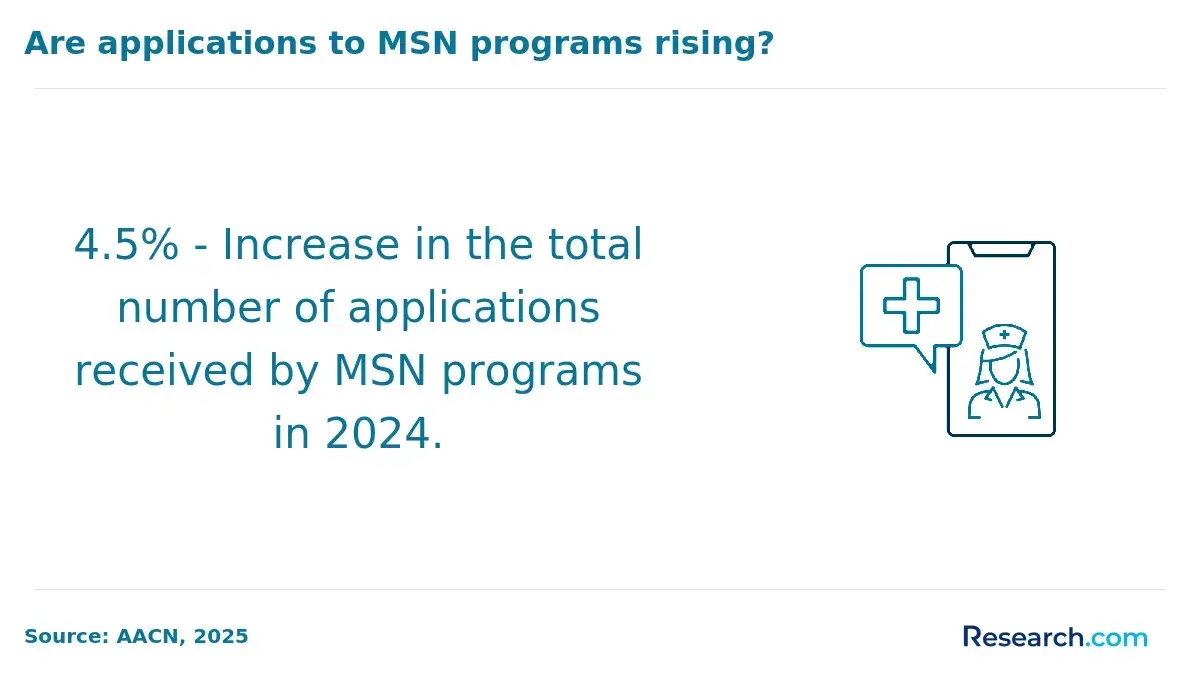
Admission standards vary by school, but Texas direct-entry MSN programs generally look for evidence that applicants can handle accelerated science coursework, graduate-level expectations, and the demands of clinical nursing. Some nursing programs in Texas have reported over a 30% increase in applicants, so preparation matters.
| Requirement | What it usually means | How to strengthen your application |
| Prior bachelor’s degree | Applicants typically need a bachelor’s degree from a regionally accredited institution, usually in a non-nursing field. | Submit transcripts early so the school can evaluate transfer credits and prerequisites. |
| GPA | Many programs expect a cumulative GPA of around 3.0 or higher. | If your overall GPA is weaker, strong recent science grades may help show readiness. |
| Prerequisite courses | Common prerequisites include anatomy, physiology, microbiology, chemistry, statistics, and human growth and development. | Complete required courses with a grade of C or better and verify expiration rules for older science credits. |
| Standardized tests | Some programs may request GRE scores, especially when they want more evidence of academic preparation. | Confirm whether the GRE is required, optional, waived, or only recommended for certain applicants. |
| Recommendations | Programs often ask for two to three letters from people who can speak to academic ability, professionalism, service, or healthcare exposure. | Choose recommenders who can provide specific examples rather than general praise. |
| Healthcare or volunteer experience | Experience is not always required, but it can show that you understand patient care environments. | Consider shadowing, volunteering, CNA work, clinic support roles, or community health service before applying. |
Questions to ask admissions offices before applying
- Does the program accept applicants with no healthcare background?
- Which prerequisite courses must be completed before admission, and which can be in progress?
- Are online lab sciences accepted, or must labs be completed in person?
- How does the program evaluate applicants with an older bachelor’s degree?
- What NCLEX-RN preparation is built into the curriculum?
- Does the MSN track qualify graduates for the role they want, or is a post-master’s certificate needed later?
If your long-term goal is adult-gerontology acute care, nurse practitioner preparation, or another specialized graduate role, compare direct-entry MSN outcomes with later certificate or doctoral options. Research.com’s overview of the best rated adult gerontology acute care nurse practitioner program options can help you understand what additional training may look like after entry into nursing.
What courses are included in a direct-entry MSN program in Texas?
A direct-entry MSN curriculum must do two jobs at once: teach non-nurses the fundamentals of safe patient care and introduce graduate-level nursing concepts. Students should expect a demanding sequence that combines classroom learning, simulation, clinical practice, research, and leadership content.
| Course area | What students learn | Why it matters |
| Foundational nursing sciences | Anatomy, physiology, microbiology, and related science concepts that explain how the body functions. | These courses support clinical reasoning and help students understand patient conditions. |
| Health assessment | Patient histories, physical assessment techniques, documentation, and recognition of abnormal findings. | Nurses must identify changes in patient status and communicate findings accurately. |
| Pharmacology and pathophysiology | Medication principles, disease processes, therapeutic effects, adverse reactions, and safety considerations. | Medication administration and disease management are central to nursing practice. |
| Clinical practice and simulation | Skills practice, patient-care scenarios, supervised rotations, and application of nursing procedures. | Students move from theory to real-world care while developing confidence and safety habits. |
| Nursing leadership and management | Team coordination, quality improvement, healthcare policy, communication, and systems thinking. | MSN graduates may be expected to contribute to care coordination and unit-level improvement. |
| Evidence-based practice and research | How to evaluate research, use data, and apply current evidence to improve care. | Graduate-prepared nurses should be able to support decisions with credible evidence. |
| Population and community health | Public health, prevention, health education, disparities, and care for diverse communities. | Texas programs often prepare students to work across hospitals, clinics, schools, and community settings. |
| Advanced nursing concepts | Ethics, advanced clinical judgment, complex care issues, and preparation for graduate-level roles. | These courses connect entry-level nursing with broader MSN-level responsibilities. |
How to evaluate the curriculum before enrolling
- Ask where NCLEX-RN preparation appears in the program and whether review resources are included.
- Review the number and type of clinical experiences, not just the course titles.
- Check whether the MSN concentration matches your career plans.
- Find out how simulation is used and whether you must travel to campus for labs or intensives.
- Confirm whether the curriculum meets Texas licensure expectations and whether it supports licensure in other states if you may move.
How does clinical experience differ between online and campus direct-entry MSN programs?
Clinical experience is one of the most important parts of a direct-entry MSN because it is where students learn to deliver care under supervision. No matter how coursework is delivered, nursing students must complete hands-on training in approved settings to build patient-care judgment and prepare for licensure.
| Clinical factor | Online program experience | Campus program experience |
| Placement process | Students may complete clinicals near home, but they should ask whether the school secures sites or expects students to help identify them. | Schools often place students through existing relationships with nearby healthcare facilities. |
| Simulation | Programs may combine virtual simulation, remote activities, and required in-person skills sessions. | Students usually use campus simulation labs with direct faculty observation. |
| Faculty oversight | Support may involve remote check-ins, site coordination, clinical preceptors, and scheduled evaluations. | Students often receive more immediate in-person guidance from faculty or clinical instructors. |
| Scheduling | Some flexibility may be available, but clinical sites still operate on healthcare schedules. | Rotations are commonly assigned in structured blocks with less individual control. |
| Student responsibility | Online learners may need to be highly organized about documentation, placement deadlines, and communication. | Campus learners may have more centralized instructions and direct access to staff support. |
Clinical placement questions that can prevent problems later
- Who is responsible for finding clinical sites: the school, the student, or both?
- Are clinical placements guaranteed within Texas?
- Can students complete clinicals in rural or underserved communities?
- Will the program approve clinical sites outside the immediate campus area?
- Are travel, background checks, immunizations, uniforms, drug screening, and liability insurance included in tuition or billed separately?
- What happens if a clinical site cancels or cannot accept students?
-
: "
Students should treat clinical placement policies as a major decision factor, not a minor detail. A flexible online format can become stressful if the student is responsible for finding sites without enough support.
"
How long does it typically take to complete a direct-entry MSN in Texas?
Most full-time direct-entry MSN programs in Texas take about 2 to 3 years to complete, or roughly 24 to 36 months. Accelerated options may move closer to 2 years, while part-time or extended formats can take longer. Your actual timeline depends on prerequisites, course load, clinical scheduling, and whether the program runs continuously or includes longer breaks.
| Timeline factor | How it affects completion time | What to check |
| Prerequisites | Missing science or statistics courses can add time before you start the nursing sequence. | Ask whether prerequisites must be finished before admission or before enrollment. |
| Full-time enrollment | Full-time students usually move through the program more quickly but have less room for outside work. | Request a term-by-term plan so you can see weekly expectations. |
| Accelerated structure | Accelerated programs compress coursework and clinicals into a more intensive schedule. | Find out whether summer terms, evening clinicals, or weekend requirements are included. |
| Part-time option | Part-time study can help working students but usually extends graduation. | Confirm whether the program actually offers part-time sequencing for direct-entry students. |
| Clinical availability | Limited clinical site capacity can affect scheduling and progression. | Ask how the school handles placement shortages or delayed rotations. |
Before committing, compare the program calendar with your work and family responsibilities. Direct-entry MSN programs are often more intense than students expect because they combine foundational nursing education, graduate coursework, skills labs, exams, and clinical hours in a short period.
How much does a direct-entry MSN program cost in Texas?
The average total tuition for direct-entry MSN programs in Texas generally falls between $45,000 and $90,000. Tuition is only one part of the real cost, though. Students should also budget for prerequisite courses, clinical fees, lab fees, technology fees, books, supplies, uniforms, background checks, commuting, and possible lost income if they reduce work hours.
| Cost factor | Why it matters | How to compare programs |
| Program length | More terms and credit hours usually increase total tuition and fees. | Compare total program cost, not only cost per credit. |
| Delivery format | Online programs may reduce commuting or housing costs, while campus programs may provide more direct access to labs and facilities. | Ask for a full cost breakdown for online, hybrid, and campus study. |
| Clinical and lab fees | Skills labs, simulations, and clinical requirements can create extra charges. | Confirm whether these fees are included in published tuition estimates. |
| Residency status | Texas residents may pay less at some public institutions than out-of-state students. | Verify resident and nonresident rates before applying. |
| Technology fees | Online learners may pay for learning platforms, virtual simulation, and digital resources. | Ask whether technology fees are charged each term or one time. |
| Prerequisite coursework | Missing prerequisites can add tuition costs before the MSN begins. | Identify lower-cost accredited ways to complete prerequisites if the school allows them. |
How to estimate your return on investment
- Calculate total tuition and mandatory fees.
- Add living expenses, commuting, supplies, and clinical-related costs.
- Estimate income you may lose if you reduce work hours.
- Compare expected monthly loan payments with realistic starting salaries in your target area.
- Ask the school for NCLEX-RN pass rate information, graduation rates, job placement support, and typical roles for recent graduates.
- Do not assume the highest salary range will apply immediately after graduation.
What financial aid options do direct-entry MSN students have in Texas?
Many direct-entry MSN students use multiple funding sources because graduate nursing programs can be expensive. Around 80% of graduate nursing students take advantage of some form of financial aid, and career changers should begin planning before they apply so they understand loan limits, scholarship deadlines, service obligations, and repayment options.
| Funding option | How it works | Best for |
| Federal financial aid | Students may use FAFSA to access Federal Direct Unsubsidized Loans and Graduate PLUS Loans. | Students who need predictable graduate loan options and flexible repayment structures. |
| State-based aid | Texas programs may include grants or loan repayment opportunities connected to workforce needs. | Students willing to work in underserved, rural, or shortage areas when required. |
| Scholarships and grants | Nursing associations, schools, employers, and community organizations may offer awards based on merit, need, background, or career goals. | Students who want to reduce borrowing and can meet application deadlines. |
| Employer tuition assistance | Some healthcare employers help pay tuition in exchange for continued employment or a service commitment. | Students already working for a healthcare organization or planning to work while studying. |
| Loan repayment and forgiveness programs | Programs such as the National Health Service Corps Loan Repayment and state-specific nurse loan forgiveness plans may reduce debt for qualifying service. | Graduates committed to high-need communities and willing to meet program requirements. |
Practical steps to reduce borrowing
- Submit the FAFSA as early as possible for the academic year you plan to enroll.
- Ask each school for a complete cost of attendance, not just tuition.
- Search for nursing scholarships before admission deadlines, because some awards require early applications.
- Compare employer tuition assistance policies carefully, including repayment clauses if you leave the job.
- Use lower-cost prerequisite options only if the MSN program confirms they will be accepted.
- Borrow based on the role you are likely to enter first, not only the advanced role you may pursue later.
What jobs can graduates of direct-entry MSN programs get in Texas?
Graduates of direct-entry MSN programs commonly pursue RN licensure first by taking the NCLEX-RN. After becoming licensed, they can work in direct patient care and may move into leadership, education, informatics, public health, or specialized graduate roles depending on the program focus, employer requirements, experience, and any additional certification needed.
| Career path | Typical responsibilities | Important requirement or consideration |
| Registered Nurse (RN) | Provide bedside or outpatient care, administer medications, monitor patients, document care, and educate patients and families. | Graduates must qualify for and pass the NCLEX-RN to become licensed. |
| Clinical Nurse Leader (CNL) | Coordinate care for patient groups, support quality improvement, and help improve outcomes within healthcare teams. | RN licensure is required, and some employers may prefer clinical leadership certification. |
| Public Health Nurse | Support disease prevention, community education, vaccination programs, school health, and outreach services. | Public health certificates or community health experience may strengthen job prospects. |
| Informatics Nurse Specialist | Work with electronic health records, clinical data, documentation workflows, and healthcare technology projects. | Additional informatics training is often useful or required. |
| Nurse Educator | Teach nursing students, train clinical staff, design learning materials, and mentor learners. | RN licensure is required, and some roles require teaching experience, certification, or post-master’s preparation. |
| Nurse Manager | Oversee nursing teams, staffing, quality initiatives, budgets, and day-to-day unit operations. | Employers often expect clinical experience before moving into management. |
Students should be careful not to assume that every direct-entry MSN automatically qualifies them for nurse practitioner practice. Some programs prepare students for RN licensure and generalist graduate nursing roles, while others may require additional post-master’s study for advanced practice. If psychiatric-mental health nursing is your long-term goal, you can compare later options such as the best rated shortest online PMHNP certificate programs.
How much do direct-entry MSN graduates earn in Texas?
Direct-entry MSN graduates in Texas usually earn between $65,000 and $90,000 per year, though earnings depend on licensure, role, location, employer type, shift differentials, experience, and specialty. New graduates should use salary ranges as planning tools rather than guarantees.
| Role | Reported salary range in Texas | What can influence pay |
| Registered Nurse (RN) | $60,000 to $85,000 annually | Experience, hospital system, specialty unit, shift, and whether the job is in a large metro area such as Houston or Dallas. |
| Clinical Nurse Leader | $75,000 to $95,000 annually | Employer type, clinical setting, leadership responsibilities, and certification preferences. |
| Nurse Manager | $80,000 to $110,000 per year | Years of clinical experience, size of the unit, leadership scope, and metropolitan versus rural location. |
| Nurse Educator | $70,000 to $100,000 annually | Academic institution, clinical training role, experience, and additional teaching credentials. |
Pay can increase over time as nurses gain clinical experience, earn certifications, take on leadership duties, or complete additional specialty education. Students comparing future psychiatric nursing pathways may also want to review the ranking of most affordable online psychiatric nurse practitioner programs to understand cost-conscious options after initial nursing preparation.
What Graduates of Direct-Entry MSN Programs in Texas Say About Their Degree
Graduate feedback often points to the same themes: direct-entry MSN programs can be demanding, but they may offer a structured way for motivated career changers to enter nursing without completing a separate undergraduate nursing degree first. Students also tend to describe clinical placement quality, faculty support, and schedule flexibility as major factors in their satisfaction.
- Kevin described his on-campus Texas direct-entry MSN experience as clinically intensive and mentorship-focused. He later applied his nursing education in a school setting at Westlake Elementary, where understanding children’s health needs and Texas-specific community concerns became central to his work.
- Aisha found that an online direct-entry MSN allowed her to keep working and manage family responsibilities while changing careers. She emphasized that flexibility helped her complete the transition, but she still needed discipline and strong organization to succeed.
- Diego chose a hybrid format because it combined online theory with in-person clinical learning. After graduation, he worked at Harmony Middle School and used culturally responsive approaches to support student health and wellness.
Common Mistakes to Avoid When Choosing a Texas Direct-Entry MSN
| Mistake | Why it can hurt you | Better approach |
| Choosing a program without checking accreditation | Accreditation affects licensure preparation, employer confidence, and future education options. | Confirm institutional accreditation and nursing program accreditation before applying. |
| Looking only at tuition | Fees, travel, supplies, prerequisites, and lost work hours can change the real cost. | Compare the full cost of attendance and ask for all mandatory fees in writing. |
| Assuming online means no campus or clinical travel | Many online or hybrid programs still require in-person labs, intensives, or clinical rotations. | Ask exactly where and when in-person requirements occur. |
| Ignoring clinical placement policies | Clinical delays can affect graduation and licensure timing. | Find out who secures placements and what support is available if a site falls through. |
| Assuming every MSN leads to nurse practitioner practice | Some direct-entry MSN programs are generalist pathways, not advanced practice programs. | Match the program track to the licensure or certification you eventually want. |
| Relying only on rankings or marketing language | A highly visible program may not be the best fit for your location, budget, schedule, or career plan. | Use rankings as one input, then verify outcomes, costs, support, and licensure alignment. |
How to Choose the Right Direct-Entry MSN Program in Texas
- Clarify your goal first. Decide whether you mainly want RN licensure, leadership preparation, public health, education, informatics, or a future advanced practice pathway.
- Verify accreditation and licensure alignment. Confirm that the program prepares graduates for the NCLEX-RN and meets Texas requirements.
- Compare clinical support. Ask whether the school places students, approves sites near home, or requires students to locate preceptors.
- Review prerequisite rules. Check required courses, minimum grades, expiration policies, and whether online science labs are accepted.
- Calculate total cost. Include tuition, fees, supplies, travel, lost income, and prerequisite coursework.
- Ask about outcomes. Request information on graduation rates, NCLEX-RN preparation, employment support, and common first jobs for graduates.
- Evaluate the schedule honestly. Accelerated nursing education is difficult to combine with full-time work, especially during clinical terms.
- Plan your next credential if needed. If you want a nurse practitioner or specialty role, determine whether the direct-entry MSN is enough or whether you will need another certificate or degree.
Current Trends Affecting Direct-Entry MSN Students in Texas
- More career changers are entering nursing. Direct-entry pathways are attractive because they recognize prior bachelor’s-level education while still requiring full nursing preparation.
- Online and hybrid learning are now common decision factors. Flexibility can expand access, but students must still complete in-person clinical training.
- Clinical placement capacity remains important. As interest in nursing programs grows, students should evaluate how each school manages clinical site availability.
- Employers are emphasizing readiness, not just credentials. Graduates need strong patient-care skills, communication, teamwork, documentation ability, and adaptability with healthcare technology.
- AI and digital health tools are changing nursing workflows. Nurses increasingly interact with electronic health records, clinical decision-support systems, telehealth tools, and data-driven quality initiatives, making informatics and technology comfort more valuable.
Related Articles for Nearby States
- Best Direct-Entry MSN Programs in Louisiana: Online & Campus for 2027
- Best Direct-Entry MSN Programs in Oklahoma: Online & Campus for 2027
- Best Direct-Entry MSN Programs in Arkansas: Online & Campus for 2027
- Best Direct-Entry MSN Programs in New Mexico: Online & Campus for 2027
- Best Direct-Entry MSN Programs in Kansas: Online & Campus for 2027
- Best Direct-Entry MSN Programs in Missouri: Online & Campus for 2027
- Best Direct-Entry MSN Programs in Colorado: Online & Campus for 2027
- Best Direct-Entry MSN Programs in Mississippi: Online & Campus for 2027
- Best Direct-Entry MSN Programs in Tennessee: Online & Campus for 2027
- Best Direct-Entry MSN Programs in Arizona: Online & Campus for 2027
References
- Top Direct-Entry Master’s in Nursing (MSN) Programs https://nurse.org/education/direct-entry-msn-programs/
- Frequently Asked Questions (FAQ) https://online.txst.edu/degrees/healthcare/msn/faq/
- Direct-Entry Master’s in Nursing (MSN) Programs https://nursinglicensemap.com/nursing-degrees/masters-in-nursing/direct-entry-programs/
- Pros and Cons of Direct Entry NP Programs? - Student Nurse Practitioner https://allnurses.com/pros-cons-direct-entry-np-t693750/
- Technical Schools in Houston: Tuition & Financial Aid Programs | Texas Health School https://ths.edu/financial-aid/
- Best Direct-Entry MSN Programs Near San Antonio TX | 2025 https://www.registerednursing.org/articles/direct-entry-msn-programs-san-antonio-texas/
- Direct-Entry Master of Science in Nursing - TLU https://acceleratednursing.tlu.edu/demsn/
- UTA Online Nursing Programs https://academicpartnerships.uta.edu/healthcare-nursing-online-programs/
- MSN Education https://www.ttuhsc.edu/nursing/masters/education/default.aspx
- MSN - Direct Entry https://www.herzing.edu/nursing/msn-direct-entry
Key Insights
- A direct-entry MSN in Texas is mainly for students with a non-nursing bachelor’s degree who want an accelerated graduate-level route into nursing.
- Most full-time programs take about 2 to 3 years, or 24 to 36 months, but prerequisites, clinical scheduling, and enrollment intensity can change the timeline.
- Average total tuition generally falls between $45,000 and $90,000, so students should compare full cost of attendance rather than tuition alone.
- Online programs can improve flexibility, but clinical training is still completed in person at approved healthcare sites.
- Accreditation, NCLEX-RN preparation, clinical placement support, and licensure alignment are the most important quality checks.
- Graduates often begin as RNs and may later move into clinical leadership, nurse education, public health, informatics, management, or post-master’s specialty pathways.
- Salary ranges are useful for planning, but outcomes are not guaranteed; location, experience, employer, certification, and role all affect earnings.
- The best program is not simply the fastest or cheapest option. It is the one that fits your career goal, budget, learning style, clinical needs, and long-term licensing plan.
Other Things You Should Know About The Best Direct-Entry MSN Programs in Texas
Top direct-entry MSN programs in Texas, such as those at the University of Texas and Baylor University, provide extensive clinical experience through partnerships with local hospitals and clinics, ensuring students can apply theoretical knowledge in real-world healthcare settings.
The best direct-entry MSN programs in Texas for 2027 are typically accredited by the Commission on Collegiate Nursing Education (CCNE) or the Accreditation Commission for Education in Nursing (ACEN), ensuring the programs meet high academic and professional standards.
Texas direct-entry MSN programs usually require supervised clinical placements in approved settings, with students completing rotations in adult health, pediatrics, mental health, and community care. Programs must also follow Texas Board of Nursing standards, and placement sites often require immunization records, background checks, and drug screening before clinicals begin.
Admission requirements for the top direct-entry MSN programs in Texas for 2027 typically include a bachelor's degree in any field, a minimum GPA of 3.0, completion of prerequisite courses, valid GRE scores, letters of recommendation, a personal statement, and, in some cases, relevant healthcare experience.