2027 Best Online MSN to PhD Bridge Programs

Co-Founder and Chief Data Scientist
Earning a PhD is a monumental achievement for any nurse, but the path from an MSN can feel particularly obscured. As a career and education expert, I know firsthand the difficulties professionals face in seeking clear, reliable program information. Many websites present a complex mix of details, and it's easy to get sidetracked by inaccurate costs, confusing curriculum descriptions, or the subtle but critical differences between PhD and DNP degrees.
This guide is designed to cut through that noise. My goal is to provide a comprehensive, straightforward resource to help you identify the best online MSN to PhD bridge programs in the USA, ensuring you make a decision that aligns perfectly with your scholarly and professional aspirations.
What are the benefits of completing an online MSN to PhD bridge program?
- Career Advancement: Equips nurses for influential positions in academia, research, and healthcare leadership, advancing them beyond direct patient care roles.
- Earning Potential: Graduates often earn significantly more than those with only an MSN, particularly in specialized or leadership roles, with six-figure salaries being common.
- Flexible Learning: Online formats enable working nurses to pursue a terminal degree without relocating or leaving their jobs, offering convenience and work-life balance.
What can I expect from an online MSN to PhD bridge program?
- Intensive Research Focus: The program centers on nursing research, theory, and scholarly inquiry, preparing students to contribute original knowledge to the field.
- Advanced Coursework: Students take doctoral-level courses in research methods, biostatistics, ethics, and nursing theory.
- Mentorship and Collaboration: Programs include personalized faculty mentorship and offer collaborative research opportunities across disciplines.
- Dissertation Requirement: The degree culminates in a dissertation—an original research project defended before a committee.
- Broadening of Scope: Students shift their focus from clinical work to impacting healthcare policy, education, and the advancement of nursing science.
Where can I work with an online MSN to PhD degree?
- Academic Institutions: Serve as a professor, researcher, or academic leader, educating future nurses and shaping nursing curricula.
- Research Institutions: Lead studies in hospitals, universities, or pharmaceutical companies to influence patient care and health outcomes.
- Healthcare Systems: Take on senior executive roles such as Chief Nursing Officer or Director of Nursing to guide strategy and policy.
- Government Agencies: Contribute to public health policy and research at federal, state, or local agencies.
- Consulting Firms: Provide expertise to healthcare organizations, advising on operations, outcomes, and clinical best practices.
How much can I make with an online MSN to PhD degree?
- Academic Roles: Nursing faculty typically earn between $80,000 and $140,000, based on institution type, location, and experience.
- Nurse Researchers: Those in research roles can earn around $90,000, with top professionals exceeding $100,000 annually.
- Leadership Positions: Executive roles like VP or Director of Nursing can offer salaries ranging from $100,000 to over $160,000.
- Best Online MSN to PhD Bridge Programs for 2027 List of Programs
- What is the average cost of an online MSN to PhD bridge program? Program Cost
- What are the financial aid options for an online MSN to PhD bridge program? Financial Aid
- What are the prerequisites for enrolling in an online MSN to PhD bridge program? What are the prerequisites for enrolling in an online MSN to PhD bridge program?
- What courses are typically in an online MSN to PhD bridge program? What courses are typically in an online MSN to PhD bridge program?
- What types of specializations are available for PhD in nursing graduates? Specializations
- How do you choose the best online MSN to PhD bridge program? How do you choose the best online MSN to PhD bridge program?
- What career paths are available for graduates of online MSN to PhD bridge programs? Career Paths
- How much can I earn with an online MSN to PhD bridge program? Salaries
- What accreditation standards should I consider for online MSN to PhD bridge programs? What accreditation standards should I consider for online MSN to PhD bridge programs?
- What is the job market like for graduates of an online MSN to PhD bridge program? Job Market
- What are some current and future trends in nursing PhDs? What are some current and future trends in nursing PhDs?
- What is the return on investment for an online MSN to PhD bridge program? What is the return on investment for an online MSN to PhD bridge program?
Best Online MSN to PhD Bridge Programs for 2027
An online MSN to PhD bridge program is designed for nurses who already hold a Master of Science in Nursing and want to move into research, faculty, policy, or senior scholarly leadership roles. This is not the same decision as choosing a practice-focused DNP. A PhD in nursing is primarily about generating new evidence, leading research, publishing scholarship, mentoring future nurses, and influencing healthcare systems through data and theory.
This guide is for MSN-prepared nurses comparing online and hybrid PhD in nursing options, especially those who need flexibility while continuing to work. You will learn which programs offer MSN-to-PhD pathways, how costs and credit requirements differ, what admission committees look for, what careers are realistic after graduation, and how to evaluate whether the degree is worth the time and financial commitment.
Quick Answer: What Is the Best Online MSN to PhD Bridge Program?
The best online MSN to PhD bridge program depends on your research interests, faculty match, budget, residency requirements, and preferred pace. Strong options include research-focused nursing PhD programs from The University of Texas at Tyler, Walden University, UTHealth, Michigan State University, Rush University, Wilkes University, University of Arizona, University of Central Florida, University of Cincinnati, and Vanderbilt University. Before applying, confirm accreditation, dissertation support, faculty expertise, total cost, and whether required campus visits fit your schedule.
How do we rank schools?
Because doctoral study requires a major investment of money, time, and professional energy, Research.com evaluates programs using transparent data sources and a structured ranking methodology. Our analysis considers publicly available institutional and program information from sources such as:
- the IPEDS database
- Peterson's database, including its Distance Learning Licensed Data Set
- the College Scorecard database
- the National Center for Education Statistics
Rankings should be used as a starting point, not as the only reason to choose a doctoral program. At the PhD level, the strongest program is usually the one where your research goals align closely with faculty expertise and available dissertation support.
Online MSN to PhD Bridge Programs Compared
| School | Program format and focus | Credits or completion requirement | Best fit |
| The University of Texas at Tyler | Online PhD in Nursing with individualized research planning | 60 credits for the MSN-PhD track | Nurses seeking a research-intensive public university option |
| Walden University | Online PhD in Nursing with multiple specialization areas | 106 quarter credits | Working nurses who want flexible online study and customizable focus areas |
| UTHealth | Mixed face-to-face and online PhD in Nursing | 66 credits | Nurses who want theory-driven research training connected to healthcare systems |
| Michigan State University | Hybrid, full-time, or part-time PhD in Nursing | Minimum 66 doctoral-level credits | Students interested in symptom science, health promotion, or health services research |
| Rush University | Primarily online Nursing Science PhD with required campus visits | 67 credits | Applicants seeking close faculty mentoring in a selective research environment |
| Wilkes University | Part-time online PhD in Nursing | 17 Courses (9 terms) | MSN-prepared nurses who need a structured part-time doctoral pathway |
| University of Arizona | MS-PhD pathway with individualized plan of study | 64 credits | Research-focused nurses who want a full-time pathway with a minor requirement |
| University of Central Florida | Online PhD in Nursing with required onsite intensives | MSN-to-PhD track: minimum 63 credits beyond MSN | Working professionals comfortable with annual campus intensives |
| University of Cincinnati | PhD in Nursing with faculty mentorship and optional nurse educator certificate | 64 credits | Nurses interested in research plus educator preparation |
| Vanderbilt University | Full-time nursing science PhD with limited campus visits | 72 credits | Students seeking intensive faculty-guided research training at a major research university |
1. The University of Texas at Tyler
The University of Texas at Tyler offers an online PhD in Nursing for nurses preparing to become nurse scientists, faculty members, and research leaders in healthcare organizations. The program emphasizes qualitative research, quantitative research, scholarly writing, publication, and dissertation development under faculty supervision.
Students learn how to identify gaps in nursing literature, develop researchable questions, and complete original doctoral work that can contribute to nursing science. The program also connects advanced scholarship with service-learning opportunities, allowing students to apply research knowledge in broader community and healthcare contexts.
The school offers a BSN-PhD track requiring 72 credit hours and designed for four years of full-time study, along with an MSN-PhD track requiring 60 credit hours. Students must pass a proficiency examination before advancing to candidacy and enrolling in dissertation hours. The program is intended to prepare graduates to conduct culturally responsive research and contribute to policy conversations connected to nursing and global health.
- Program Length: Generally 3–5 years
- Tracks/Concentrations: Individualized plan of study based on research interests
- Tuition Cost: Resident: $928/credit; Non-resident: $8,714/credit
- Required Credits to Graduate: 60 credits
- Accreditation: Commission on Collegiate Nursing Education (CCNE)
2. Walden University
Walden University offers a PhD in Nursing for nurses who want to teach, conduct research, or contribute new knowledge to the profession. Its online format is built for students who need to balance doctoral coursework with employment and other responsibilities.
The curriculum allows students to shape their studies around selected areas of interest. Available specializations include Healthcare Administration, Interdisciplinary Health, Leadership, Nursing Education, and Population Health. Walden offers both a BSN to PhD track and an MSN to PhD track, and its DNP bridge option may allow eligible students to apply previous doctoral-level work toward the PhD.
The faculty are 100% doctorally prepared and bring research expertise as well as nursing experience. Academic residencies give students structured opportunities to engage with faculty, connect with peers, and refine their identity as doctoral scholars.
- Program Length: Typically 4–5 years (full-time)
- Tracks/Concentrations: Customizable—students may focus on research, leadership, education, or other aspects of nursing science
- Tuition Cost: $805 per quarter credit hour for coursework
- Required Credits to Graduate: 106 quarter credits
- Accreditation: Commission on Collegiate Nursing Education (CCNE)
3. The University of Texas Health Science Center at Houston (UTHealth)
The University of Texas Health Science Center at Houston, through the Cizik School of Nursing, offers a PhD in Nursing that prepares nurse scientists to conduct research and lead within healthcare systems. The program integrates nursing theory, empirical inquiry, and practice-oriented research.
The degree is delivered through a combination of face-to-face and online learning and can be pursued full time or part time. Students develop the ability to synthesize theory and evidence from nursing and related fields, design clinical and population-based studies, and use research to advance health and healthcare delivery.
The curriculum also emphasizes dissemination, collaboration, policy awareness, and the social, ethical, and cultural dimensions of nursing scholarship. This makes the program a fit for nurses who want to connect rigorous research with healthcare system improvement.
- Program Length: Usually 3–5 years (full-time)
- Tracks/Concentrations: Customizable based on student's research interests
- Tuition Cost: Resident: $291/credit; Non-resident: $1,156/credit
- Required Credits to Graduate: 66 credits
- Accreditation: Commission on Collegiate Nursing Education (CCNE)
4. Michigan State University
The PhD in Nursing at Michigan State University is designed for nurses who want to develop as scientists and improve healthcare through research and evidence-based practice. The College of Nursing offers full-time, part-time, and hybrid options, with plans of study shaped around each student's research direction.
MSU organizes its nursing research around three areas: Health Promotion and Illness Prevention, Symptom Science and Management, and Health Services Research. Students take core courses in biostatistics, quantitative methods, research translation, the scientific basis of nursing knowledge, and intervention design for improved health outcomes.
Students interested in academic careers may also pursue the optional College of Nursing Certification in College Teaching Program, which includes preparation in curriculum design, academic instruction, and clinical teaching.
- Program Length: Four years (full-time); six years (part-time)
- Tracks/Concentrations: Health Promotion and Illness Prevention, Symptom Science and Management, and Health Services Research
- Tuition Cost: Resident: $937.25/credit; Non-resident: $1,773.756/credit
- Required Credits to Graduate: Minimum 66 doctoral-level credits
- Accreditation: Commission on Collegiate Nursing Education (CCNE)
5. Rush University
Rush University offers an online Nursing Science PhD through its College of Nursing for students preparing for research-centered careers. The program can be completed full time or part time and admits a selective group of students to support close mentorship with faculty research advisors.
The curriculum combines research methods, theory, role development, and supporting coursework connected to the student's area of inquiry. Although most coursework is online, students must attend an on-campus orientation at the beginning of the program and complete later campus visits.
Rush considers applicants from several backgrounds, including nurses with bachelor's or master's degrees and non-nurses with graduate preparation in a health-related field. Graduates may pursue independent research roles, lead clinical research programs, or move into senior academic positions.
- Program Length: 3-5 years
- Tracks/Concentrations: Health behavior research, aging, parenting programs, intimate partner violence, metabolomics, etc.
- Tuition Cost: $1,436/credit
- Required Credits to Graduate: 67 credits
- Accreditation: Commission on Collegiate Nursing Education (CCNE)
6. Wilkes University
The online Doctor of Philosophy in Nursing from Wilkes University is a part-time, research-focused doctoral program for nurses who need to continue managing professional and personal obligations while pursuing a terminal degree.
The curriculum develops doctoral-level understanding of nursing theory, healthcare issues, research funding, qualitative analysis, and quantitative analysis. Students are expected to build the methodological and scholarly foundation needed to conduct independent research.
Completion requires a comprehensive dissertation supported by a dedicated chairperson. Graduates are prepared to integrate empirical and theoretical literature in ways that can influence nursing education, clinical practice, policy, and leadership. Faculty research interests include leadership, culture, practice, disease management, and policy. Admission criteria include a Master's degree in nursing with a 3.0 GPA, an unencumbered RN license, a letter of intent, a current resume, and two recommendations from graduate-level nurses or faculty who can speak to the applicant's potential.
- Program Length: 3 years (on average)
- Tracks/Concentrations: Individually developed research interests in nursing science
- Total Tuition Cost: $49,632
- Required Credits to Graduate: 17 Courses (9 terms)
- Accreditation: Commission on Collegiate Nursing Education (CCNE)
7. University of Arizona
The University of Arizona offers a Doctor of Philosophy in Nursing for master's-prepared nurses who are ready to pursue nurse scientist roles. Its MS-PhD pathway is structured as a three-year, full-time program, with early coursework emphasizing nursing science and related disciplines through an individualized plan of study.
The program includes a nursing major, coursework tied to the student's substantive research area, scientist and academic role preparation, core courses, advanced research methods, and dissertation work. Students must also complete a minor, which may be in nursing or in another field such as anthropology or psychology.
Students are expected to defend the dissertation successfully within five years after completing the oral and written comprehensive examination. Applicants with a master's degree in another health discipline who want to pursue the nursing PhD are encouraged to contact the PhD program director for guidance.
- Program Length: 3-5 years
- Tracks/Concentrations: Customizable in clinical, academic, or industry research
- Total Tuition Cost: Resident: $71,208; Non-resident: $128,970
- Required Credits to Graduate: 64 credits
- Accreditation: Commission on Collegiate Nursing Education (CCNE)
8. University of Central Florida
The University of Central Florida (UCF) offers an online PhD in Nursing for students preparing to become research scientists and leaders in nursing. The program focuses on conceptual, methodological, and ethical research that contributes to nursing and healthcare knowledge.
The curriculum and dissertation are designed to prepare graduates to add to the body of nursing science through original research. UCF offers two online pathways: a BSN to PhD track requiring a minimum of 72 credit hours beyond the bachelor's degree and an MSN to PhD track requiring a minimum of 63 credit hours beyond the master's degree.
Both pathways can be completed part time and are intended for working professionals. However, students should plan for two multiple-day onsite intensives each year on the UCF campus. Graduates may pursue faculty roles at research-focused universities, nursing research leadership positions in healthcare systems, or executive roles with a research emphasis.
- Program Length: 4-5 years
- Tracks/Concentrations: Nurse educator, nursing simulation, leadership (MSN, separate tracks; PhD is research career-focused)
- Tuition Cost: $327.32 per credit (in-state); $1,234.15 per credit (out-of-state)
- Required Credits to Graduate: MSN-to-PhD track: minimum 63 credits beyond MSN
- Accreditation: Commission on Collegiate Nursing Education (CCNE)
9. University of Cincinnati
The University of Cincinnati offers a PhD in Nursing for students who want to advance nursing science and practice through close faculty mentorship. The program provides a scholarly environment with funding opportunities, small cohorts, research advising, and interprofessional collaboration through the Academic Health Center and university community.
Applicants must hold a bachelor's degree in nursing or a master's degree and demonstrate the potential to generate new knowledge related to nursing or healthcare. The program is especially relevant for students whose interests match the expertise of available faculty advisors.
Students may add a nurse educator certificate requiring only four online courses. This option can help future academic leaders build teaching skills and may make students eligible for the Nurse Faculty Loan Program.
- Program Length: Typically 3–5 years, full-time or part-time
- Tracks/Concentrations: Tailored to candidate research/interest areas with faculty mentorship
- Tuition Cost: Ohio Resident: Part Time – $836/credit; Full Time – $8,359/semester; Metro Resident (KY or IN): Part Time – $861/credit; Full Time – $8,609/semester; Non-Resident: Part Time – $1,423/credit; Full Time – $14,228/semester
- Required Credits to Graduate: 64 credits
- Accreditation: Commission on Collegiate Nursing Education (CCNE)
10. Vanderbilt University
Vanderbilt University offers a nursing science doctoral program for students preparing for research and academic careers in universities, healthcare organizations, and public or private healthcare sectors. The program emphasizes multidisciplinary biobehavioral research and the advancement of nursing science.
Instruction uses both face-to-face and online technology-supported formats, with limited on-campus visits. Vanderbilt organizes research around signature areas such as Acute and Chronic Illness and Maternal Child Health. Students participate weekly in intensive research experiences connected to faculty projects, giving them exposure to varied research designs and analytic methods.
The program admits students for full-time study only. From admission through completion, students work closely with faculty mentors who guide their academic and research development. Degree requirements include advanced coursework, a qualifying examination, and a dissertation with a public oral defense.
- Program Length: Four years (full-time)
- Tracks/Concentrations: Acute and chronic illness, data science, palliative care, mother-infant-child health
- Tuition Cost: $2,057/credit
- Required Credits to Graduate: 72 credits
- Accreditation: Commission on Collegiate Nursing Education (CCNE)
MSN-to-PhD pathways are academically demanding and are not comparable to the easiest doctoral programs. The rigor is part of the value: graduates are expected to design original studies, defend their findings, publish, teach, and contribute to the scientific base of nursing.
What is the average cost of an online MSN to PhD bridge program?
The total cost of an online MSN to PhD bridge program depends on tuition structure, residency status, required credits, university fees, travel for intensives, and how long the dissertation takes. These programs are not automatically less expensive than other online PhD programs; the final cost depends on the program's credit requirements and how efficiently you progress through candidacy and dissertation work.
| Cost category | What to expect | Why it matters |
| Per-credit tuition | In-state tuition can range from approximately $300 to $800 per credit hour, while out-of-state tuition often falls between $800 and $1,500 per credit hour. | A lower per-credit rate may not mean a lower total cost if the program requires more credits. |
| Total in-state tuition | For an entire program, in-state tuition can range from $20,000 to $50,000, depending on the total credit hours required, typically 50-80+ credits. | Public universities may be more affordable for residents, but fees and residency rules vary. |
| Total out-of-state tuition | Out-of-state students might expect to pay anywhere from $40,000 to over $100,000 for the full program. | Some online programs charge separate distance-learning rates, so verify the actual billing model. |
| Mandatory fees | Technology, administrative, program, and residency-related fees may apply. | Fees can materially change the true cost of attendance. |
| Course materials | Textbooks, research software, statistical tools, and other materials can add several hundred to a few thousand dollars over the program. | Research-heavy programs may require specialized software or database access. |
| Residency costs | Online programs may still require travel, lodging, meals, and time away from work for campus intensives. | Residencies can affect both your budget and schedule. |
| Dissertation phase | Delayed dissertation completion may lead to added credit hours or continuous enrollment fees. | The longer the dissertation takes, the more the degree may cost. |
Before enrolling, request a full cost-of-attendance estimate from each school. Ask whether tuition changes during dissertation enrollment, whether online students pay out-of-state rates, and whether campus visits are required every year.
What are the financial aid options for an online MSN to PhD bridge program?
Doctoral nursing students may qualify for several funding sources, but availability varies widely by school, enrollment status, employer, and research area. Start early, because scholarships, assistantships, and faculty-funded research positions often have separate deadlines from program admission.
- Federal Student Loans: Eligible U.S. citizens and permanent residents may apply for federal direct unsubsidized loans. These loans accrue interest while you are enrolled but may offer repayment protections that private loans do not.
- Institutional Scholarships and Grants: Universities may provide awards for doctoral nursing students based on merit, financial need, research alignment, or commitment to faculty and research careers.
- Nursing Organization Scholarships: Groups such as the American Association of Colleges of Nursing (AACN) and specialty nursing associations may offer funding for advanced nursing education.
- Research Assistantships: Some PhD programs provide tuition support, stipends, or both in exchange for work on faculty research projects.
- Teaching Assistantships: Students preparing for academic careers may support courses, labs, grading, or instructional activities in return for financial support.
- Employer Tuition Reimbursement: Hospitals, health systems, universities, and government employers may help pay for doctoral study when the degree supports organizational goals.
- Doctoral Grants: Foundations and public agencies may fund research tied to nursing science, public health, health equity, chronic disease, or healthcare systems.
- Military Benefits: Veterans and active-duty service members may be able to use education benefits such as the GI Bill.
- Private Loans: Private education loans can fill funding gaps, but they usually have less flexible repayment terms and may carry higher interest rates.
- Payment Plans: Some universities allow students to spread tuition payments across a term rather than paying the full balance upfront.
Complete the FAFSA if you plan to use federal aid, and ask each program whether PhD students commonly receive assistantships, tuition remission, research stipends, or dissertation funding. A program with higher tuition may become more affordable if it offers meaningful doctoral funding.
What are the prerequisites for enrolling in an online MSN to PhD bridge program?
Admission to an MSN-to-PhD pathway is selective because the program requires strong writing, statistical reasoning, research readiness, and long-term commitment. Most schools evaluate both your academic preparation and your fit with available faculty mentors.
| Requirement | Typical expectation | How to strengthen your application |
| Graduate nursing degree | A Master of Science in Nursing from a nationally accredited program, commonly CCNE or ACEN accredited. Applicants without a nursing bachelor's background may first need pathways such as direct entry MSN programs for non-nurses online. | Show how your MSN preparation connects to your intended research area. |
| GPA | Many programs require a cumulative GPA of 3.0 or higher in graduate coursework, while more competitive programs may expect 3.5 or higher. | Explain any academic weaknesses and highlight strong performance in research, theory, and statistics courses. |
| RN license | A current, active, unencumbered U.S. RN license is commonly required. | Confirm whether the school has state authorization or licensure-related restrictions for your location. |
| GRE scores | Some programs are GRE optional, while others still require scores, usually from the last five years. | Check each program's current policy before spending time or money on testing. |
| Recommendations | Programs often request two to three letters from graduate faculty, supervisors, or nurse researchers. | Choose recommenders who can discuss your research potential, writing ability, and persistence. |
| Statement of purpose | You will usually need an essay explaining your goals, research interests, and reasons for pursuing a PhD. | Name specific faculty whose research aligns with yours, but avoid forcing a match that is not real. |
| CV or resume | Schools review professional experience, presentations, publications, leadership, teaching, and research exposure. | Use an academic CV format if you have scholarly work to highlight. |
| Interview | Many programs interview finalists to assess readiness and faculty fit. | Be prepared to discuss a possible research question and why it matters to nursing science. |
| Statistics preparation | A graduate-level statistics course with a minimum grade, often B or higher, may be required or expected. | Refresh statistics skills before starting doctoral research methods courses. |
| Faculty alignment | Programs look for applicants whose interests match faculty expertise and available mentorship. | Review faculty publications before applying and contact admissions if you are unsure about fit. |
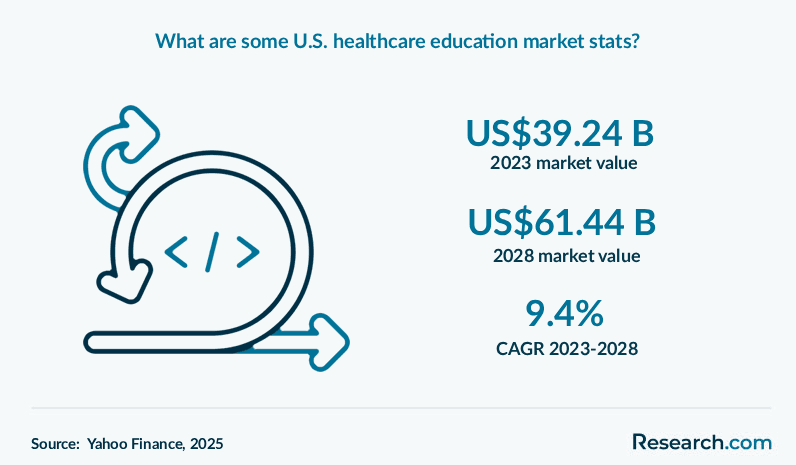
The U.S. healthcare education market, valued at $39.24 billion in 2023, is projected to reach $61.44 billion by 2028, growing at a 9.4% CAGR, as shown in the graphic below. This growth is tied to continued shortages across healthcare professions, including nursing, primary care, and geriatrics, as well as investment in technology-supported learning tools such as VR, AR, mobile apps, and online courses.
Universities and academic health centers continue to play a central role because they train much of the healthcare workforce through accredited education and residency pathways. E-learning is expanding quickly because it gives working professionals more flexibility, while academic education remains a major segment due to established university infrastructure and increased integration of digital tools.
What courses are typically in an online MSN to PhD bridge program?
An MSN-to-PhD curriculum moves beyond advanced clinical preparation and focuses on scholarship, theory, research design, data analysis, and knowledge dissemination. Courses vary by university, but most programs build toward comprehensive exams, candidacy, dissertation proposal approval, research execution, and final defense.
- Philosophy of Nursing Science: Examines how nursing knowledge is developed, evaluated, and applied within different philosophical traditions.
- Advanced Research Methods: Covers qualitative, quantitative, and mixed-methods designs used to answer nursing and healthcare research questions.
- Biostatistics/Advanced Statistics: Develops the ability to analyze healthcare data and interpret statistical findings in research literature.
- Nursing Theory and Conceptual Models: Explores theoretical frameworks that guide nursing inquiry and dissertation development.
- Health Policy and Advocacy: Connects research evidence to policy decisions affecting care delivery, access, quality, and nursing practice.
- Ethical Conduct of Research: Reviews responsible research conduct, human subjects protections, data integrity, and regulatory expectations.
- Grant Writing and Funding: Teaches students how to develop research proposals and seek funding for scholarly work.
- Scientific Writing and Dissemination: Builds skills in manuscript preparation, conference presentations, peer review, and publication strategy.
- Dissertation Seminar/Research Practicum: Supports students through literature review, proposal writing, data collection, analysis, and defense.
- Electives/Specialization Courses: Allow students to deepen expertise in the area connected to their dissertation and career goals.
Compared with ADN to MSN bridge programs, MSN-to-PhD coursework is more theoretical, methodological, and research-intensive. Students should expect extensive reading, scholarly writing, statistics, faculty feedback, and independent work.
What types of specializations are available for PhD in nursing graduates?
In a nursing PhD, specialization usually refers to a research focus rather than a clinical practice concentration. Your area of focus shapes your dissertation, publications, faculty mentorship, grant opportunities, and future role in academia, policy, or healthcare research.
| Research focus | What it examines | Potential career connection |
| Health Promotion and Disease Prevention | Strategies that improve population health and reduce chronic disease risk | Public health research, community health scholarship, prevention programs |
| Chronic Illness Management | Care models and outcomes for people living with long-term conditions | Clinical research, health systems research, patient outcomes work |
| Vulnerable Populations | Health disparities affecting underserved and at-risk groups | Health equity research, policy, nonprofit or public sector roles |
| Healthcare Systems and Outcomes Research | Care delivery, quality improvement, safety, and system performance | Healthcare administration, research leadership, consulting |
| Nursing Education Research | Teaching methods, curriculum design, learning outcomes, and faculty development | Nursing faculty roles, academic leadership, curriculum evaluation |
| Biobehavioral Research | Relationships among biological processes, behavior, and health outcomes | Interdisciplinary research, academic science, translational research |
| Palliative Care and End-of-Life Research | Support, decision-making, symptom management, and family needs in serious illness | Palliative care research, clinical program evaluation, policy work |
| Global Health Nursing Research | International health issues, cultural context, and sustainable interventions | Global health organizations, academic research, international partnerships |
| Informatics and Technology in Healthcare | Use of data, digital systems, and technology to improve care | Digital health research, informatics leadership, analytics roles |
| Health Policy Research | How policy affects access, workforce, nursing practice, and public health | Policy analysis, advocacy organizations, government agencies |
If you want a doctoral degree focused more directly on advanced clinical practice than research, compare PhD options with shortest MSN to DNP program pathways before committing.
Research-focused doctoral nursing education remains important, but enrollment has declined. According to the American Association of Colleges of Nursing Schools, enrollment in research-focused doctorate programs decreased overall from 2015 to 2024, as shown in the graph below.
Enrollment began at 5,030 in 2015, declined to 4,910 in 2016, and fell again to 4,630 in 2017. It increased slightly to 4,690 in 2018 and 4,620 in 2020, but then continued downward to 4,470 in 2021, 4,380 in 2022, 4,240 in 2023, and 4,220 in 2024. This pattern suggests fewer students are entering research-focused doctoral nursing programs even as healthcare systems need more evidence-generating nurse scientists.
The decline matters because nursing science depends on researchers who can study workforce challenges, patient safety, aging, chronic illness, health equity, education models, and system-level care improvements.
How do you choose the best online MSN to PhD bridge program?
Choosing a nursing PhD is less about finding the easiest or most convenient option and more about finding the right research environment. Even if you are also considering clinical MSN pathways such as online PNP MSN programs, a PhD decision should be guided by faculty mentorship, research fit, dissertation support, and long-term career goals.
| Factor to evaluate | Questions to ask | Why it affects your outcome |
| Accreditation | Is the nursing program accredited by CCNE or ACEN, and is the institution regionally accredited? | Accreditation affects quality assurance, employer recognition, funding, and academic credibility. |
| Faculty expertise | Which faculty publish in your area of interest, and are they accepting doctoral students? | Faculty fit is one of the strongest predictors of dissertation direction and research productivity. |
| Format | Is coursework synchronous, asynchronous, hybrid, full time, or part time? | The format determines whether you can realistically continue working while enrolled. |
| Residency requirements | How often must students come to campus, and what costs are involved? | Travel requirements can affect finances, family responsibilities, and work schedules. |
| Dissertation support | Are statistical consulting, writing support, research design help, and dissertation seminars available? | Weak dissertation support can delay completion and increase total cost. |
| Funding | Are assistantships, tuition waivers, scholarships, or faculty grant opportunities available? | Funding can significantly change the return on investment. |
| Outcomes | Where do graduates work, publish, teach, or receive grants? | Graduate outcomes reveal whether the program supports your intended career path. |
| Technology and library access | Do online students receive full access to databases, research software, librarians, and technical support? | Doctoral research requires stronger infrastructure than ordinary online coursework. |
| Time to completion | How long do students typically take, including dissertation? | Published program length may not reflect the actual time needed to finish. |
Common mistakes to avoid when choosing a program
- Choosing by tuition alone: A low tuition rate can become expensive if dissertation support is weak or completion takes longer than expected.
- Ignoring faculty fit: A strong university is not enough if no faculty member can mentor your topic.
- Assuming online means no travel: Many online PhD programs require orientations, intensives, research meetings, or dissertation-related visits.
- Relying only on rankings: Rankings help narrow options, but they do not replace direct program comparison.
- Overlooking state authorization: Online program availability may differ by state, so confirm eligibility before applying.
- Underestimating the dissertation: Coursework is only part of the program; dissertation completion requires sustained research, writing, and faculty approval.
What career paths are available for graduates of online MSN to PhD bridge programs?
Graduates of online MSN-to-PhD bridge programs are prepared for research, academic, leadership, policy, and scholarly roles rather than routine clinical advancement. Some nurses enter doctoral study after completing specialty preparation such as the best online pediatric nurse practitioner graduate certificate programs, then use the PhD to study clinical, educational, or systems-level problems.
- Nurse Scientist/Researcher: Designs and conducts original studies that improve nursing knowledge, patient outcomes, and evidence-based practice.
- University Professor/Faculty: Teaches nursing students, mentors graduate researchers, develops curricula, and maintains a program of scholarship.
- Chief Nursing Officer (CNO)/Healthcare Administrator: Leads nursing strategy, workforce planning, quality initiatives, and organizational decision-making.
- Health Policy Analyst: Studies policy effects and advises agencies, think tanks, advocacy organizations, or healthcare systems.
- Clinical Research Coordinator/Director: Oversees research operations, clinical trials, protocols, compliance, and study teams.
- Public Health Researcher: Investigates population-level health trends and evaluates interventions.
- Consultant: Advises organizations on research design, evidence implementation, quality improvement, or strategic planning.
- Grant Reviewer/Program Officer: Reviews proposals, manages research programs, and supports funding decisions.
- Writer/Editor for Scholarly Publications: Helps develop, evaluate, or disseminate nursing research through journals, books, and professional publications.
- Nurse Ethicist: Studies and advises on ethical challenges in healthcare delivery, research, and organizational practice.
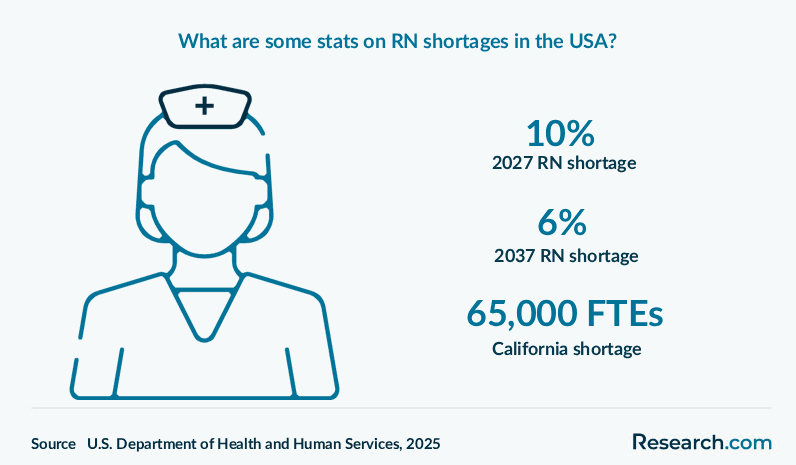
Projections from the U.S. Department of Health and Human Services indicate that the United States will continue to face shortages of registered nurses (RNs) through 2037. A national RN shortage of 10% is expected in 2027, decreasing to 6% by 2037, equal to a deficit of 207,980 full-time equivalent (FTE) RNs. These estimates, shown in the graphic below, assume current patterns in attrition, graduation, and workforce participation continue.
By 2037, North Carolina and Washington are expected to have the largest RN shortages at 22%, equivalent to 28,850 and 18,940 FTEs, respectively. Maryland follows with a projected 20% shortage (13,590 FTEs), while South Carolina (11,860 FTEs), Michigan (21,290 FTEs), and New Mexico (3,920 FTEs) are each projected to face 19% shortages. Oklahoma (8,120 FTEs) and California (65,000 FTEs) are projected at 18%, while Idaho (3,590 FTEs) and Georgia (18,990 FTEs) are both projected at 17%.
For licensed practical nurses (LPNs), projections vary sharply by state, from an 80% shortage in Maine (20% adequacy) to a 17% oversupply in West Virginia (117% adequacy). These differences show why nurse researchers and policy leaders are needed to study workforce distribution, education capacity, and regional supply problems.
How much can I earn with an online MSN to PhD bridge program?
A PhD in nursing can support higher-level research, education, and leadership roles, but earnings vary by position, employer, region, academic rank, grant funding, and years of experience. Compared with general MSN salary ranges, PhD-prepared nurses may qualify for roles with broader influence, though academic research careers may start lower than executive leadership roles.
- Nurse Scientist/Researcher: Average salaries typically range from $90,000 to $120,000 annually, with experienced researchers commanding higher figures.
- Assistant Professor (Nursing): Entry-level academic positions often start around $80,000 to $100,000, growing with tenure and experience.
- Associate/Full Professor (Nursing): Experienced professors can earn between $100,000 and $150,000+, especially at larger universities or those with research grants.
- Chief Nursing Officer (CNO): Salaries for CNOs can range from $110,000 to over $200,000, depending on the size and type of healthcare organization.
- Health Policy Analyst: Compensation for these roles can vary widely but generally falls between $80,000 and $130,000, influenced by the employing agency or organization.
- Director of Nursing Research: Positions leading research initiatives within healthcare systems or institutions typically offer salaries from $100,000 to $150,000.
- Postdoctoral Research Associate: Early-career PhDs pursuing further research training might earn between $50,000 and $70,000, often with benefits and mentorship opportunities.
- Consultant (Healthcare/Nursing): Independent consultants with a PhD can set their own rates, with income depending on expertise, reputation, project scope, and client base.
According to 2025 PayScale data shown in the graph below, postdoctoral research associates typically earn an average of $55,837.
Nursing instructors earn an average salary of $56,401. Assistant professors of nursing average $59,920, while assistant professors in postsecondary or higher education overall earn $69,174.
A family nurse practitioner (NP) has an average salary of $81,138.
Associate professors of nursing average $89,739, and associate research scientists earn around $94,573.
Directors of clinical services average $94,576, while clinical project leaders earn approximately $95,571.
Clinical nurse specialists (CNS) typically earn $101,188, and nurse practitioners (NP) average $104,247.
Healthcare consultants earn an average of $104,816, while deans of nursing average $109,432.
Advanced practice registered nurses (APRNs) average $116,046. Directors of nursing average $120,700, and nursing managers average $137,623.
Directors of professional services earn around $141,985, while chief operating officers (COO) or chief nursing officers (CNO) report the highest average listed at $182,326.
The pattern is clear: research and academic roles may begin at more modest salary levels, while senior administrative and executive roles tend to pay more. However, compensation should not be the only reason to pursue a PhD. The degree is best suited to nurses who want to produce research, teach at advanced levels, lead scholarly initiatives, or shape policy and systems through evidence.
What accreditation standards should I consider for online MSN to PhD bridge programs?
Accreditation is one of the first items to verify before applying. At minimum, confirm that the university is institutionally accredited and that the nursing program holds recognized nursing accreditation, commonly through CCNE or ACEN. Accreditation helps ensure that the program meets accepted standards for curriculum, faculty qualifications, student support, outcomes, and academic integrity.
Also review whether the program publishes clear information about dissertation expectations, faculty research areas, student support, graduate outcomes, and required campus experiences. If you are comparing nursing pathways across degree levels, resources such as BSN accelerated online degrees can help you understand how accreditation and program quality considerations apply across nursing education.
What is the job market like for graduates of an online MSN to PhD bridge program?
The job market for nursing PhD graduates is shaped by faculty shortages, demand for evidence-based healthcare, workforce pressures, health equity priorities, and the need for nurse researchers who can evaluate new models of care. Some nurses combine research preparation with specialty or practice interests, including pathways such as the DNP pediatric primary care nurse practitioner specialty, but the PhD itself remains a research doctorate.
- Nurse faculty demand: Nursing schools need doctorally prepared educators who can teach, mentor, conduct research, and support graduate education.
- Need for nurse scientists: Healthcare systems depend on research to improve outcomes, evaluate interventions, and implement evidence-based practice.
- Leadership opportunities: Organizations may seek PhD-prepared nurses for research strategy, quality, policy, and system-level decision-making roles.
- Aging and chronic illness: Complex care needs create demand for research on long-term conditions, family caregiving, symptom management, and care delivery.
- Telehealth and technology: Digital health tools create research questions about access, outcomes, implementation, safety, and patient experience.
- Health equity: Research on disparities, social determinants of health, and access to care remains a major priority.
- Multiple employment settings: Graduates may work in universities, hospitals, research institutes, government agencies, nonprofits, foundations, and healthcare companies.
Many nurses also strengthen administrative preparation with credentials such as a graduate certificate in nursing leadership online. This can be useful for PhD-prepared nurses who want to lead teams, manage research programs, or move into policy and organizational roles.
What are some current and future trends in nursing PhDs?
Nursing PhD education is changing as healthcare becomes more data-driven, interdisciplinary, technology-enabled, and equity-focused. Future nurse scientists will need strong methodological skills as well as the ability to collaborate across disciplines and communicate research to decision-makers.
- Interdisciplinary Research: More studies now involve collaboration with medicine, public health, engineering, informatics, psychology, economics, and social sciences.
- Big Data and AI Integration: Nursing researchers are increasingly expected to understand large datasets, artificial intelligence, machine learning, and predictive analytics.
- Precision Health: Research is expanding around interventions tailored to individual differences in genetics, environment, behavior, and lifestyle.
- Health Equity and Social Determinants of Health: More doctoral research focuses on structural, social, economic, and environmental factors that shape outcomes.
- Translational Science: Programs are placing more emphasis on moving research findings into clinical practice, policy, education, and healthcare operations.
- Global Health Initiatives: Nursing researchers are addressing health challenges across international settings and cultural contexts.
- Digital Health and Telehealth Research: Virtual care, remote monitoring, mobile health, and digital interventions are creating new research priorities.
- Advanced Methodologies: Implementation science, comparative effectiveness research, mixed methods, and complex systems modeling are increasingly relevant.
- Policy Influence: PhD-prepared nurses are positioned to translate evidence into policy recommendations at local, national, and international levels.
- Mentorship and Leadership Development: The next generation of nurse scientists will need preparation not only to conduct research but also to mentor students and build research teams.
According to the National Council of State Boards of Nursing's 2025 report, "Results of the 2024 National Nursing Workforce Study," the proportion of male nurses increased from 8% to 11% from 2015 to 2022, then decreased slightly to 10% by 2024.
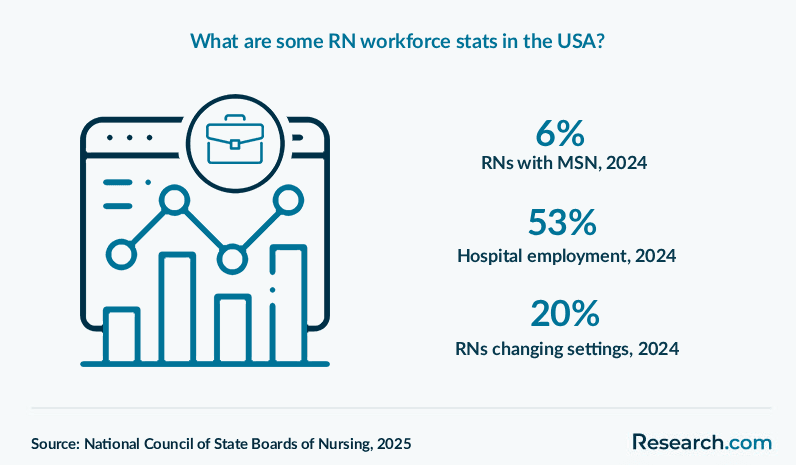
Racial diversity among registered nurses also increased between 2022 and 2024. The share of respondents identifying as White or Caucasian declined from 80% to 77%, while the share of Black or African American RNs increased from 6% to 9%. Educational attainment also rose from 2015 to 2024, with RNs initially prepared with a Bachelor of Science in Nursing (BSN) increasing from 39% to 46%, and those with a Master of Science in Nursing (MSN) increasing from 3% to 6%.
Hospitals remained the main work setting for 53% of RNs in 2024, a 4.2% decrease from 2022. Median pretax annual RN earnings increased to $88,000 in 2024 from $80,000 in 2022.
More RNs also reported changing employment settings in 2024, with 20% making a change compared with 16% in 2022. Together, these data point to a nursing workforce that is becoming more diverse, more educated, and more mobile across employment settings.
What is the return on investment for an online MSN to PhD bridge program?
The ROI of an online MSN-to-PhD bridge program should be measured in more than salary alone. The degree can support higher-level academic, research, policy, and leadership roles, but it also requires years of coursework, dissertation work, tuition, fees, and opportunity cost. A strong ROI is more likely when the program offers good faculty fit, funding opportunities, efficient dissertation support, and outcomes that match your career goals.
To evaluate ROI, compare total tuition, fees, travel costs, lost work time, available financial aid, time to completion, and expected career path. Review alumni placements, publication opportunities, research infrastructure, and whether graduates secure faculty roles, postdoctoral positions, grants, or leadership appointments. If your goal is a faster or more practice-oriented credential, compare the PhD with other nursing pathways, including easiest RN to BSN degree programs online for earlier-stage advancement or DNP pathways for clinical leadership.
Here's What Graduates Say About Their Online MSN to PhD Bridge Programs
- : "My online MSN-to-PhD program let me keep working while I developed a research agenda in community health. The strongest part was the mentorship. Faculty feedback, online discussion, and virtual research support helped me feel connected even from a distance. — Myrna"
- : "The program helped me move from bedside practice into nursing scholarship with a focus on health equity. It was demanding, but the structure pushed me to contribute to real research sooner than I expected. It changed how I see my future in nursing. — Darius"
- : "I chose my program because of its interdisciplinary research focus, and that turned out to be the right decision. Faculty and peer support helped me build confidence, understand funding pathways, and see how nursing research can drive innovation. — Renzo"
Key Insights
- An MSN-to-PhD bridge is best for nurses who want research, faculty, policy, or scholarly leadership careers. If your primary goal is advanced clinical practice, compare PhD programs with DNP options before applying.
- Faculty fit matters more than brand name alone. Your dissertation, publications, and research development depend heavily on finding mentors whose work aligns with your interests.
- Online does not always mean fully remote. Several programs require orientations, intensives, campus visits, or research-related meetings, so include travel in your cost and schedule planning.
- Total cost depends on more than tuition. Fees, residency travel, dissertation delays, software, books, and continuous enrollment can change the real price of the degree.
- Accreditation is non-negotiable. Confirm institutional accreditation and recognized nursing program accreditation before applying.
- Research-focused doctorate enrollment has declined, but the need for nurse scientists remains important. Nursing needs researchers who can address workforce shortages, health disparities, technology, aging, chronic illness, and care quality.
- Salary outcomes vary widely. Executive and administrative roles often pay more than early academic roles, while research careers may offer long-term influence through grants, publications, teaching, and policy impact.
- The strongest ROI comes from alignment. Choose a program that matches your research goals, offers dissertation support, provides funding options, and has graduates working in the kinds of roles you want.
References:
- American Association of Colleges of Nursing. (2025, June 17). Schools of nursing enrollment increases across most program levels, signaling strong interest in nursing careers. American Association of Colleges of Nursing.
- National Council of State Boards of Nursing. (2025). Results of the 2024 National Nursing Workforce Study. National Council of State Boards of Nursing.
- Payscale. (2025, June 20). Doctor of Philosophy (PhD) degree salary in the United States. PayScale.
- U.S. Department of Health and Human Services, Health Resources and Services Administration, Bureau of Health Workforce. (2024, November). Nurse workforce projections, 2022–2037. U.S. Department of Health and Human Services.
- Yahoo Finance. (2025, April). Global U.S. healthcare education market to reach US$61.44 billion by 2028, up from US$39.24 billion in 2023 at 9.4% CAGR. Yahoo Finance.
Other Things You Should Know About Online MSN to PhD Bridge Programs
In 2027, academic requirements for enrolling in an MSN to PhD bridge program online typically include a Master’s degree in Nursing (MSN), a competitive GPA, and often an active RN license. Some programs may also require standardized test scores, a professional resume, and letters of recommendation.
Yes. Many 2027 online MSN to PhD bridge programs allow up to 12 to 24 semester credits of prior MSN coursework to transfer after faculty review. Schools usually require a minimum graduate GPA, often 3.0, and only accept courses that match the research doctorate curriculum.