
2027 How to Become an Art Teacher in Indiana: Requirements & Certification

Co-Founder and Chief Data Scientist
Becoming an art teacher in Indiana means more than being skilled at drawing, painting, design, or digital media. You need the right degree, a state-approved teacher preparation pathway, classroom experience, required exams, a background check, and an Indiana teaching license. You also need to understand how art fits into Indiana’s K-12 curriculum, how school hiring works, and what salary and advancement options realistically look like.
This guide is for aspiring art educators, college students comparing teacher preparation programs, career changers considering art education, and licensed teachers who want to add or expand an arts-related specialization. It explains the Indiana art teacher pathway from education to licensure, shows how to evaluate job opportunities, and highlights practical steps that can help you build a sustainable teaching career.
Quick answer: How do you become an art teacher in Indiana?
To become an art teacher in Indiana, you typically need to earn a bachelor’s degree in art education or a closely related field, complete a state-approved educator preparation program, finish supervised student teaching, pass the required Indiana educator assessments for art and core competencies, complete fingerprinting and background checks, and apply for an Indiana teaching license through the Indiana Department of Education. After licensure, you must continue professional development to keep your license active.
Key things to know before choosing this career path
- Indiana has reported shortages in art education roles, and some districts continue to have difficulty filling visual arts teaching positions. This can create openings for well-prepared candidates, especially those willing to work in high-need districts or teach across multiple grade levels.
- The average salary for art teachers in Indiana hovers around $50,000 annually. Your actual pay can vary by district, school type, years of experience, degree level, and local salary schedule.
- The Bureau of Labor Statistics projects a steady demand for art educators, with a growth rate of about 4% over the next decade. This points to moderate stability rather than guaranteed rapid expansion.
- Indiana’s cost of living is approximately 10% lower than the national average, but local costs can differ sharply. Housing in urban areas such as Indianapolis may affect how far an art teacher salary goes.
- Art teachers who add skills in digital media, inclusive instruction, curriculum design, or community arts programming may have more flexibility than candidates who prepare only for traditional studio-based instruction.
- Steps to become an art teacher in Indiana
- Education requirements for Indiana art teachers
- Certification and licensing process
- Student teaching, internships, and classroom experience
- Indiana visual arts standards and curriculum expectations
- Job market, salary, and hiring outlook
- Continuing education and professional development
- Classroom management and teaching methods for art classrooms
- Additional guidance for future Indiana art teachers
- Career advancement and specialization options
- Using online education to strengthen qualifications
- Moving into related education careers
- Resources for new Indiana art teachers
- Mentorship and networking opportunities
- Building community partnerships for stronger art programs
- How state policy affects art education careers
- Expanding into related subject areas Policy considerations Community partnerships
- Digital tools for art instruction
- Private school opportunities for art teachers
- Typical timeline to become established
- Inclusive strategies for diverse learners
- Work-life balance for Indiana art teachers Inclusive teaching Career timeline Digital tools Community impact Other considerations
Steps to become an art teacher in Indiana
The path to an Indiana art teaching career is structured, but it is manageable if you plan each requirement early. The main goal is to prove two things: you understand visual art deeply enough to teach it, and you can manage learning in a real K-12 classroom.
| Step | What you need to do | Why it matters |
| Earn the right degree | Complete a bachelor’s degree in art education or a closely related field. | Indiana expects licensed teachers to have formal preparation in both content knowledge and teaching practice. |
| Complete educator preparation | Enroll in a state-approved teacher preparation program that includes art methods, pedagogy, classroom observation, and student teaching. | This connects your artistic training with instructional planning, assessment, and classroom management. |
| Pass required exams | Complete the required art and core competency assessments, which may include assessments such as the National Evaluation Series (NES) or Praxis. | Assessments verify readiness in reading, writing, mathematics, and visual arts content knowledge. |
| Prepare your application materials | Build a resume, gather transcripts and test scores, complete background check requirements, and organize an art portfolio if requested by a program, school, or employer. | Strong documentation helps you move smoothly through licensure and hiring. |
| Apply for licensure | Submit your Indiana teaching license application through the state’s licensing system. | You must hold the appropriate license before teaching in most public school positions. |
| Keep learning after hire | Complete professional development and renewal requirements throughout your teaching career. | Indiana teachers must maintain their credentials and keep up with changing curriculum, technology, and instructional practices. |
A bachelor’s degree remains the usual starting point. Programs in art education are designed to develop studio ability, art history knowledge, design awareness, and teaching skill. Candidates often strengthen their applications by showing supervised classroom experience, youth arts leadership, museum education work, summer arts camp teaching, or volunteer experience with children.
An art portfolio can also help, even when it is not the only deciding factor. A strong portfolio should show technical range, creative thinking, and an ability to explain artistic choices. For teaching roles, it can also be useful to include lesson plans, student teaching reflections, or examples of age-appropriate projects.
Indiana institutions such as Indiana University Bloomington and Purdue University are among the options students may review when comparing art education preparation pathways. If you are still exploring helping professions beyond classroom teaching, this guide to becoming a child life specialist may help you compare another student-centered career.
Education requirements for becoming an art teacher in Indiana
Indiana art teachers need preparation in two areas: visual arts and education. Studio talent alone is not enough. Schools expect teachers to design lessons, assess learning, support different ability levels, meet state standards, and maintain safe classroom routines around art materials and equipment.
- Bachelor’s degree: A bachelor’s degree in art education is the most direct route. A closely related art degree may also be useful if paired with an approved educator preparation pathway.
- Teacher preparation program: Candidates should complete a state-approved program that includes teaching methods, educational psychology, classroom management, assessment, and supervised field experiences.
- Art coursework: Common areas include drawing, painting, ceramics, sculpture, design, art history, criticism, aesthetics, and contemporary media. The exact course mix depends on the institution.
- Pedagogy coursework: Art teachers need to learn how to teach creative process, not simply assign projects. Courses should prepare candidates to write objectives, differentiate instruction, critique student work fairly, and connect art to culture and history.
- Accreditation: Choosing a regionally accredited college or university is essential. Accreditation affects licensure eligibility, transferability, graduate school options, and employer confidence.
- Subject matter competency: Prospective teachers must demonstrate that they know the subject they plan to teach. This is usually shown through assessments, coursework, clinical performance, and sometimes portfolio review.
- Advanced degrees: A master’s degree is not always required for entry-level teaching, but it may support higher-level licensure options such as the Accomplished Practitioner License and can strengthen long-term advancement prospects.
Which degree path makes the most sense?
| Path | Best for | Main advantage | Important caution |
| Bachelor’s in art education | Students who know they want to teach K-12 visual art | Usually the most direct route to educator preparation and student teaching | Confirm that the program is approved for Indiana licensure |
| Bachelor’s in studio art plus teacher preparation | Students who started in fine arts and later decided to teach | Can provide deep artistic training | May require extra education courses or a post-baccalaureate pathway |
| Master’s in education or art education | Licensed teachers seeking advancement or career changers with prior degrees | Can strengthen credentials and support leadership or curriculum roles | Check whether the program leads to initial licensure if you are not already licensed |
| Alternative or transition-to-teaching pathway | Career changers with substantial prior education | May shorten the route for qualified candidates | Requirements vary, so verify eligibility with the Indiana Department of Education |
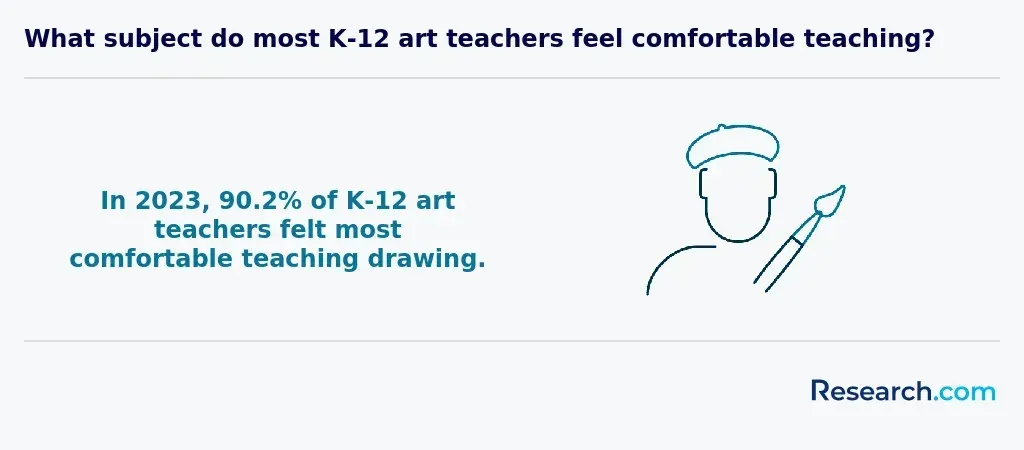
One useful way to evaluate readiness is to look at what K-12 art teachers actually teach. In 2023, 90.2% of K-12 art teachers surveyed were most comfortable teaching drawing, as shown in the graphic below.
If you are comparing art education with other student support roles, it may also be helpful to review career options in special education, where creativity, communication, and individualized instruction are also valuable.
The best education path is the one that fits your starting point. A high school senior, a studio art major, a paraprofessional, and a working artist may all need different routes to reach the same Indiana teaching license.
Certification and licensing process for an Indiana art teacher
Licensure is the formal step that allows you to teach in Indiana public schools. The process verifies your degree, preparation program, assessments, and background clearance.
- Complete an approved preparation route: Candidates usually begin by earning a bachelor’s degree in art education or a related field from an accredited institution and completing a state-approved educator preparation program.
- Finish student teaching: Your preparation program should include supervised classroom practice, where you plan lessons, teach students, receive feedback, and demonstrate professional readiness.
- Pass required assessments: Candidates must pass the Indiana CORE Assessments for Educators, including the content area test connected to art education.
- Complete fingerprinting and background checks: Indiana requires background screening for prospective teachers to support student safety and school compliance.
- Submit the license application: Applicants use the Indiana Department of Education’s online licensing system and provide required documentation, such as transcripts, test results, program verification, and background check information.
- Budget for fees: Licensing costs include application-related fees that can range from $35 to $100, depending on the type of license sought.
- Plan for renewal: After earning a license, teachers must complete continuing education or professional growth requirements to remain eligible to teach.
Questions to ask before applying for licensure
- Is my educator preparation program approved for Indiana licensure?
- Have I completed the correct content-area assessment for visual arts?
- Do I have official transcripts and program completion verification ready?
- Have I completed fingerprinting and background check requirements?
- Do I understand the renewal rules before accepting a long-term teaching position?
Student teaching, internships, and classroom experience for art teachers in Indiana
Teaching experience is one of the most important parts of preparation because art classrooms are active, materials-based learning environments. Teachers must manage movement, tools, supplies, cleanup, collaboration, critique, and student expression at the same time.
- Student teaching is required: Indiana candidates typically complete a student teaching placement lasting 15 weeks under the supervision of a licensed mentor teacher.
- University placements are valuable: Many Indiana universities, including Indiana University and Purdue University, connect teacher candidates with local schools for supervised fieldwork and student teaching.
- Professional associations can help: The Indiana Art Education Association offers networking and professional resources that can help candidates identify learning opportunities.
- Experience strengthens certification readiness: Certification preparation generally includes coursework, observation, practice teaching, and direct feedback from experienced educators.
- Alternative experience can build confidence: Community art programs, workshops, summer camps, substitute teaching, tutoring, and youth arts volunteering can help future teachers practice instruction before full-time employment.
- Reflection matters: The strongest candidates do not simply complete hours. They learn to revise lessons, respond to student needs, manage supplies, and assess creative work with clear criteria.
Some future art teachers also consider broader education and arts-related work. If you want to compare classroom teaching with other roles, review this overview of education career pathways.
The arts field itself is broad. According to Statista (2024), the global art market saw significant fluctuations between 2019 and 2023. The market was valued at $64.4 billion in 2019 but dropped to $50.3 billion in 2020. It then rebounded in 2021 to $65.9 billion and continued to grow, reaching $67.8 billion in 2022. By 2023, the market slightly decreased to $65 billion. Overall, while the market declined in previous years, it recovered strongly, with only a minor drop in 2023. These figures are shown in the graph below.
Indiana standards and curriculum requirements for teaching art
Indiana visual arts instruction is guided by state academic standards. These standards help teachers design lessons that go beyond making attractive projects. Students are expected to create, analyze, interpret, connect, and discuss art in historical, cultural, and personal contexts.
- Indiana Academic Standards: The Indiana Academic Standards for Visual Arts provide the framework for what students should learn across grade levels. Teachers use these standards to plan lessons, evaluate student growth, and align classroom activities with statewide expectations.
- Creation and critique: Art education in Indiana should include hands-on production as well as discussion, interpretation, and evaluation of art.
- Historical and cultural context: Students should learn how art reflects communities, periods, identities, and ideas. This helps them see art as part of society rather than an isolated classroom activity.
- Curriculum balance: Strong programs include art production, art history, criticism, aesthetics, vocabulary, and reflection.
- K-12 progression: Curriculum should build over time, helping students move from foundational skills in early grades toward more complex visual problem-solving and self-expression in later grades.
- Local adaptation: Teachers must align with state standards while also responding to district priorities, available resources, student interests, and community context.
- Lifelong arts literacy: The goal is not only to train future artists. A strong visual arts curriculum helps students communicate, observe carefully, solve problems creatively, and understand diverse perspectives.
What should a strong Indiana art curriculum include?
| Curriculum component | What students practice | Why it matters |
| Studio production | Drawing, painting, design, sculpture, ceramics, printmaking, or digital art | Students develop technique, persistence, experimentation, and creative decision-making. |
| Art history | Learning about artists, periods, movements, and cultural traditions | Students understand that art reflects human experience and social context. |
| Critique | Discussing process, intention, composition, technique, and meaning | Students learn how to give and receive feedback respectfully. |
| Aesthetics | Exploring questions about beauty, meaning, purpose, and interpretation | Students build reasoning skills and learn that art can invite multiple perspectives. |
| Reflection | Writing or speaking about artistic choices and learning progress | Students connect creative work to thinking, identity, and improvement. |
Teachers who want to expand into specialized student support areas may also explore graduate options such as a more affordable online master’s in speech pathology, especially if they are interested in communication, accessibility, or interdisciplinary school services.
Job market and salary expectations for art teachers in Indiana
The Indiana art teacher job market can be promising but uneven. Some districts report shortages or hard-to-fill openings, while others receive many applicants for a small number of art positions. Hiring depends heavily on district budgets, enrollment, arts program priorities, retirements, and whether schools offer full-time or shared art roles.
| Career factor | What the available figures show | How to interpret it |
| Average pay | The average salary for an art teacher in Indiana hovers around $50,000 per year. | This is a planning benchmark, not a guarantee. District salary schedules determine actual pay. |
| Urban salary example | Art teachers in urban areas like Indianapolis may earn upwards of $55,000. | Urban pay may be higher, but living costs and workload can also differ. |
| Rural salary example | Some rural districts may offer salaries closer to $45,000. | Lower pay may be offset by lower living costs, smaller communities, or different class structures. |
| Cost of living | Indiana’s cost of living is approximately 10% lower than the national average. | Statewide affordability helps, but local housing and transportation costs still matter. |
| Long-term demand | The Bureau of Labor Statistics projects demand growth of about 4% over the next decade. | Expect steady demand, but prepare for competition in districts with strong arts programs. |
Benefits can matter as much as salary. Public school positions may include health insurance, retirement plans, paid time off, and negotiated working conditions, but packages differ by district. Private schools, charter schools, and arts-focused schools may use different compensation structures.
One Indiana teacher described the trade-off this way: “I graduated from a local program at Ball State University, and while I was excited about teaching, I had to weigh the salary against my passion for art.” She added, “In my district, the pay was decent, but I often wondered if it was enough to sustain a family.” For her, “The joy of inspiring students outweighed the financial concerns, but it was a tough decision.”
That tension is real. Art teaching can be deeply meaningful, but it should still fit your financial goals, debt level, family needs, commute, and long-term career plan.
Arts and design careers outside K-12 teaching also show wide income differences. As per the Bureau of Labor Statistics (BLS, 2024), special effects artists and animators top the earnings chart among arts and design professions, with a median income of $106,500 annually. Fashion designers rank second with $99,060, followed by industrial designers at $79,290. Interior designers earn $76,250, and set and exhibit designers $62,510. Graphic designers, however, earn the lowest median pay of $58,910. These are shown in the graph below. In general, arts roles that require specialized technical skills often show stronger earning potential.
Professional development and continuing education for Indiana art teachers
Professional development is not optional for a long-term teaching career. It helps art teachers renew licenses, stay aligned with Indiana standards, learn new technologies, improve classroom management, and respond to changing student needs.
- Professional organizations: State and local arts education groups offer workshops, conferences, lesson resources, and peer networks for art educators.
- Museum-based learning: Newfields provides educator professional development opportunities that can help teachers earn Professional Growth Plan (PGP) points for license renewal.
- University programs: Indiana University Bloomington and other institutions may offer graduate coursework, workshops, or technology-focused learning for educators.
- License renewal requirements: Indiana art teachers may renew by earning six semester hours from accredited institutions or by accumulating PGP points through approved professional growth activities.
- Practical workshops: Useful topics include curriculum mapping, critique methods, inclusive art instruction, classroom routines, grant writing, digital media, and assessment rubrics.
- Arts organizations: Arts for Learning Indiana and the Herron School of Art and Design are examples of organizations that support educators through programming, partnerships, and learning opportunities.
- Community resources: Local foundations, arts councils, libraries, museums, and cultural organizations may offer materials, grants, visiting artists, or exhibition opportunities.
- Reflective practice: Peer review, mentoring conversations, and classroom observation can help teachers improve how they support students, especially learners with disabilities or different language backgrounds.
If you are interested in expanding your education skills beyond visual arts, online library science graduate programs can provide another route into instructional support, information literacy, and school-based learning services.
Classroom management and teaching methods for Indiana art teachers
Art classrooms require a different management style than lecture-based rooms. Students move around, use tools, share supplies, collaborate, talk about personal ideas, and work at different speeds. Effective art teachers build routines that protect creative freedom without allowing chaos.
- Set clear studio routines: Teach procedures for entering the room, getting materials, using tools, cleaning stations, storing work, and transitioning between activities.
- Keep students actively engaged: Well-paced demonstrations, choice-based projects, short conferences, and visible progress goals can reduce off-task behavior.
- Reinforce what you want to see: Teacher attention shapes behavior. Publicly noticing preparation, effort, safe tool use, and respectful critique can strengthen positive habits.
- Create a supportive environment: Students take creative risks when they feel seen and respected. This is especially important in art, where personal expression may feel vulnerable.
- Differentiate instruction: Offer varied entry points, adaptive tools, visual instructions, modified timelines, and alternative ways to show learning.
- Use motivation wisely: Student exhibitions, digital portfolios, artist statements, classroom galleries, and recognition of growth can encourage pride and persistence.
- Collaborate with colleagues: Other art educators can share supply systems, rubric designs, project sequences, and strategies for managing large classes.
- Balance accountability and encouragement: Students should understand expectations, but discipline should not shut down experimentation or self-expression.
- Build belonging: Include artists, materials, and themes that reflect different cultures, communities, identities, and experiences.
- Teach critique respectfully: Students need sentence stems, norms, and examples so feedback remains useful rather than personal or dismissive.
Common art classroom challenges and better responses
| Challenge | Weak response | Better response |
| Students rush through projects | Simply telling them to “try harder” | Use process checkpoints, sketchbook planning, peer feedback, and revision requirements. |
| Supplies disappear or are damaged | Removing all choice from the room | Create labeled stations, inventory routines, student jobs, and clear tool-use expectations. |
| Students say they are “bad at art” | Ignoring the comment or offering vague praise | Teach growth language, show examples of revision, and assess effort, process, and problem-solving. |
| Critiques become uncomfortable | Avoiding critique altogether | Model respectful feedback and use structured prompts focused on choices, evidence, and questions. |
| Different skill levels in one class | Assigning the same outcome for every student | Differentiate by material, complexity, theme, support level, or final format. |
What else should aspiring art teachers in Indiana know?
Art teaching is part of the broader Indiana educator system. Before committing to this path, learn how state licensure, school hiring, district salary schedules, background checks, and educator preparation programs work. This broader guide on how to become a teacher in Indiana can help you understand the statewide process before focusing specifically on visual arts.
Career advancement and specialization opportunities for Indiana art teachers
Art teachers can build careers that extend beyond a single classroom role. Some remain master classroom teachers, while others move into curriculum leadership, school administration, digital media instruction, museum education, community arts, or interdisciplinary student support.
- Art therapy-related interests: Teachers who want to connect creativity with social-emotional support may explore art therapy coursework or certification pathways, while noting that therapy roles have separate professional requirements.
- Digital media: Schools increasingly value teachers who can teach digital art, design, animation, photography, and portfolio development.
- Art history and cultural studies: Teachers who deepen this area can build stronger interdisciplinary lessons and support humanities-focused programs.
- Department leadership: Experienced teachers may become art department chairs, fine arts coordinators, or curriculum leads.
- Administration: Some teachers pursue a Master’s in Education, Principal’s License, or related leadership credential to move into school administration.
- Curriculum development: Teachers can contribute to district curriculum maps, state-level committees, assessment design, or arts advocacy work.
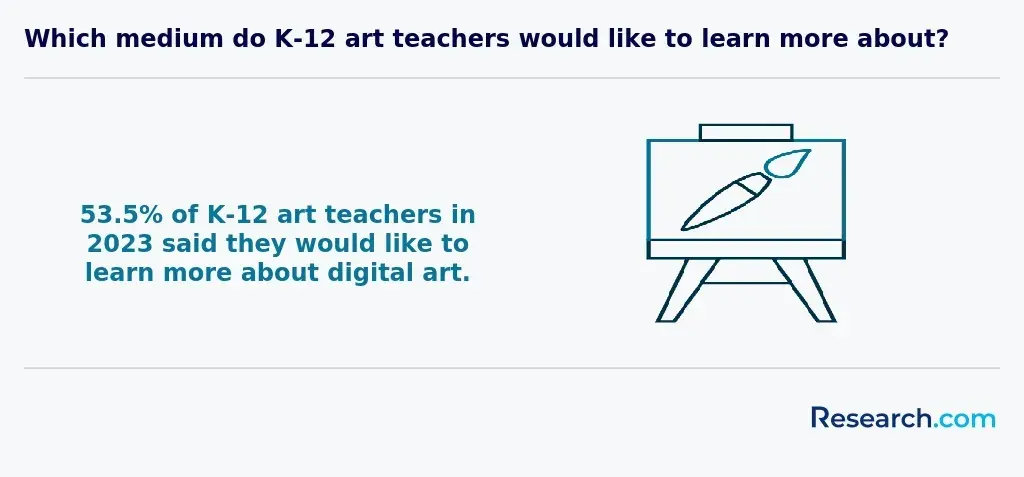
In 2023, 53.5% of K-12 art teachers said that they would like to learn more about digital art, as shown in the figure below. That interest reflects a practical reality: digital tools are now part of how many students create, publish, and understand visual culture.
| Specialization | How it can help | Best next step |
| Digital art and media | Prepares students for contemporary design, animation, and visual communication | Take workshops in digital drawing, portfolio platforms, photography, or animation tools. |
| Curriculum leadership | Lets teachers shape learning goals across grade levels or schools | Build experience with standards alignment, assessment, and teacher collaboration. |
| Art therapy-related study | Supports interest in social-emotional learning and creative expression | Research separate counseling or therapy credential requirements before changing roles. |
| Community arts education | Connects schools with museums, nonprofits, murals, exhibitions, and local artists | Develop partnerships and document student outcomes from community-based projects. |
| School administration | Opens pathways into leadership, scheduling, staffing, and policy implementation | Consider graduate education and administrative licensure requirements. |
One Indiana teacher described a specialization shift after completing a program at Ball State University in Muncie: “After graduation, I realized my strongest interest was in art therapy.” She explained that she pursued additional certification and later began leading workshops for teachers across the state. Her experience shows that art education can lead to broader professional roles when teachers intentionally build new expertise.
How can art teachers in Indiana enhance their qualifications through online education?
Online education can help Indiana art teachers add credentials, update instructional methods, and learn new tools without leaving a current classroom role. Flexible coursework may be especially useful for teachers who need graduate credits, PGP-related learning, or training in digital media, assessment, inclusive teaching, or curriculum design. If you are comparing remote preparation options, review Research.com’s guide to an online teaching degree to understand how online programs differ in format, cost, accreditation, and career fit.
Can art teachers in Indiana transition into related educational careers?
Art teachers develop transferable skills in communication, lesson design, youth development, assessment, creative programming, and community engagement. Those skills can support transitions into museum education, arts administration, curriculum development, academic advising, instructional coaching, library services, or nonprofit arts education. If you are considering a school-based role outside the art classroom, this guide on how to become a librarian in Indiana offers one related path that still values instruction, resource curation, and student support.
Resources and support for new art teachers in Indiana
New art teachers should not try to build their programs alone. Indiana has state agencies, professional associations, colleges, museums, arts organizations, and peer communities that can help with lesson planning, funding, standards alignment, and professional growth.
- Indiana Art Education Association: The Indiana Art Education Association offers professional development, networking, advocacy, and access to experienced art educators across the state.
- Indiana Department of Education: The Indiana Department of Education provides state guidance, licensing information, standards, and educator resources.
- Universities and colleges: Local teacher preparation programs may offer alumni networks, mentorship, job fairs, graduate coursework, and supervising teacher connections.
- Online teaching platforms: Sites such as Teachers Pay Teachers and Artsonia can provide lesson ideas, digital galleries, and examples of classroom-ready resources, though teachers should still align materials with Indiana standards.
- Social media communities: Indiana teacher groups and art educator forums can be useful for quick advice about supplies, projects, job postings, and classroom routines.
- Indiana Arts Commission: The Indiana Arts Commission offers grants and funding opportunities that may support arts education projects and community partnerships.
- Statewide conferences: Conferences such as the IAEA Annual Conference give teachers access to workshops, vendor resources, peer learning, and leadership opportunities.
- District supports: School districts may provide curriculum guides, professional learning communities, mentor teachers, evaluation support, and local standards alignment documents.
Common mistakes to avoid
| Mistake | Why it can hurt you | Better approach |
| Choosing a program without checking accreditation and Indiana approval | You may complete coursework that does not lead smoothly to licensure. | Confirm accreditation and licensure alignment before enrolling. |
| Looking only at tuition | Fees, supplies, travel for student teaching, testing, and application costs can change the total cost. | Compare total estimated cost, financial aid, transfer credits, and required materials. |
| Assuming every online program leads to Indiana licensure | Some programs are designed for another state or for professional development only. | Ask the program directly whether it meets Indiana initial licensure requirements. |
| Waiting too long to prepare for exams | Testing delays can slow down licensure and hiring. | Build exam preparation into your final year of educator preparation. |
| Building a portfolio only around personal artwork | Schools also want evidence that you can teach, organize learning, and support students. | Include lesson plans, assessment examples, student teaching reflections, and age-appropriate project samples when appropriate. |
| Relying only on rankings or reputation | A well-known school may not be the best fit for your budget, schedule, location, or licensure goal. | Compare approval status, placement support, student teaching access, cost, and graduate outcomes. |
Mentorship and networking opportunities for art teachers in Indiana
Mentorship can shorten the learning curve for new art teachers. A strong mentor can help with supply ordering, classroom layout, project pacing, cleanup systems, grading rubrics, parent communication, and district expectations. Professional associations, local arts organizations, school districts, and university alumni networks are good places to find these connections.
Networking also helps teachers stay aware of job openings, exhibition opportunities, grant deadlines, and new instructional strategies. Interdisciplinary conversations can be useful as well. For example, reviewing how to become a middle school math teacher in Indiana can give art teachers a broader view of how other subject areas approach standards, assessment, and adolescent learning.
Building community connections to strengthen art education
Community partnerships can make an art program more visible, relevant, and resilient. Art teachers can collaborate with local artists, museums, galleries, libraries, cultural centers, universities, businesses, and nonprofit organizations to bring authentic creative experiences into the classroom.
Partnerships may include visiting artist talks, public murals, student exhibitions, museum field trips, portfolio reviews, donated materials, community design projects, or local art fairs. These experiences help students see art as part of civic life rather than a separate school assignment.
Teachers can also connect with fellow educators through local forums and associations such as the Indiana Art Education Association. For new educators who want to better understand the K-12 teaching landscape, this guide on how to become an elementary school teacher in Indiana can provide useful context about grade-level expectations and state-specific preparation.
How current policies influence art education careers in Indiana
Art education careers are shaped by funding decisions, graduation requirements, curriculum standards, teacher licensure rules, staffing priorities, and district-level budget choices. When funding is tight, arts programs may face pressure; when communities and districts prioritize arts education, teachers may see stronger program support.
Indiana art teachers should monitor updates from the Indiana Department of Education, local school boards, professional associations, and arts advocacy organizations. Staying informed helps teachers respond to curriculum changes, protect program quality, and document the value of visual arts instruction. Teachers considering related arts education roles may also review how to become a music teacher in Indiana to compare another fine arts teaching pathway.
Can Indiana art teachers expand their subject expertise?
Yes. Art teachers can strengthen their careers by connecting visual arts with history, literature, media studies, technology, cultural studies, design, and social-emotional learning. Interdisciplinary teaching helps students understand how images shape memory, identity, communication, and public life.
Teachers who enjoy historical analysis, museums, archives, or culturally grounded lessons may consider how to become a history teacher in Indiana. Even if they remain in art education, studying history can improve lesson depth and help students connect artwork to time, place, and social context.
Using digital tools to improve art teaching effectiveness
Digital tools can expand what students create and how teachers assess learning. Art teachers may use digital portfolios, drawing tablets, animation software, photography tools, online critique boards, virtual museum collections, slideshow demonstrations, and collaborative design platforms.
The goal is not to replace traditional art materials. The strongest programs combine hands-on media with digital creation, visual research, documentation, and presentation. Teachers who want to improve digital communication across subjects may also find useful comparisons in this guide on how to become an English teacher in Indiana, especially around literacy, feedback, and student expression.
Can art teachers in Indiana explore private school opportunities?
Private schools can offer another route for art educators. Some provide smaller class sizes, more flexible curriculum design, faith-based or mission-driven environments, or specialized arts programming. However, pay structures, benefits, licensure expectations, and job security may differ from public schools.
Before accepting a private school role, ask about curriculum autonomy, supply budgets, exhibition expectations, class load, planning time, benefits, and whether the school expects or prefers state licensure. For a deeper look at this pathway, review how to become a private school teacher in Indiana.
How long does it take to establish a career as an art teacher in Indiana?
The timeline depends on your starting point. A first-time college student usually needs the time required to complete a bachelor’s degree, finish educator preparation, complete student teaching, pass exams, and apply for licensure. A career changer with prior college credits may move faster or may need additional coursework, depending on their background.
Becoming established can take longer than becoming licensed. New teachers often need time to learn district systems, build a curriculum sequence, organize supplies, develop classroom routines, and become known in the school community. Additional credentials or graduate study can extend the timeline but may also improve long-term opportunities. For a broader timeline discussion, see this guide to how long it takes to become a teacher.
Inclusive strategies for supporting diverse learners in art classrooms
Inclusive art teaching means designing lessons so students with different abilities, language backgrounds, sensory needs, cultural experiences, and confidence levels can participate meaningfully. Art can be especially powerful for students who communicate well visually, but access still requires intentional planning.
- Use visual directions, demonstrations, and step-by-step examples.
- Offer adaptive tools, alternative materials, or modified processes when needed.
- Provide choices in subject matter, medium, scale, or final presentation.
- Use rubrics that value process, effort, problem-solving, and reflection, not only technical polish.
- Collaborate with special education teachers, English learner specialists, counselors, and families.
- Include artists and visual traditions from many cultures and communities.
- Create critique norms that protect dignity and encourage constructive feedback.
Teachers who want to deepen this area can learn from pathways related to special education teacher certification in Indiana, especially around accommodations, individualized supports, and collaborative teaching.
Is work-life balance a challenge for Indiana art teachers?
Work-life balance can be difficult for art teachers because the job often includes lesson planning, supply preparation, cleanup systems, grading, exhibitions, after-school events, community partnerships, and emotional support for students. New teachers may also spend extra time building projects and organizing materials from scratch.
Helpful strategies include reusing and improving strong lesson sequences, creating student jobs for cleanup, setting realistic exhibition schedules, collaborating with other teachers, documenting supply needs early, and protecting planning time. Peer networks and wellness-focused professional development can also reduce isolation. Educators considering alternative early-childhood teaching roles may find useful comparisons in this guide on how to become a kindergarten teacher in Indiana.
What do graduates say about becoming an art teacher in Indiana?
-
: "
Teaching art in Indiana helped me connect with students in ways that did not always happen in more traditional academic settings. The work is not only about making artwork. It is also about helping students build confidence, think critically, and find their own voice. Joanna
"
-
: "
I have appreciated the support for arts education in many Indiana schools. Access to resources and community encouragement has made it easier to design meaningful lessons and help students see creativity as something valuable. Ray
"
-
: "
Becoming an art teacher in Indiana gave me a professional community I did not expect. Other educators have shared ideas, materials, and encouragement, and those relationships have made my students’ experiences stronger. Sofia
"
Key Insights
- Indiana art teachers generally need a bachelor’s degree, a state-approved educator preparation program, student teaching, required assessments, background checks, and an Indiana teaching license.
- As of 2023, Indiana has reported a significant increase in the demand for art teachers, with a projected growth rate of 10% over the next decade.
- According to the Indiana Department of Education, the average salary for an art teacher in Indiana is approximately $53,000 per year.
- Recent data indicates that only 25% of art education graduates in Indiana secure teaching positions within their first year after graduation.
- In 2023, Indiana's teacher shortage areas included visual arts, highlighting a critical gap in educational resources.
- The Indiana Arts Commission reported that schools with dedicated art programs see a 20% increase in student engagement and academic performance.
- Digital art is an important professional development area: 53.5% of K-12 art teachers in 2023 said that they would like to learn more about digital art.
- Drawing remains a core comfort area for many teachers: in 2023, 90.2% of K-12 art teachers surveyed were most comfortable teaching drawing.
- The global art market saw significant fluctuations between 2019 and 2023. The market was valued at $64.4 billion in 2019 but dropped to $50.3 billion in 2020. It then rebounded in 2021 to $65.9 billion and continued to grow, reaching $67.8 billion in 2022.
- By 2023, the market slightly decreased to $65 billion. Overall, while the market declined, it recovered strongly, with only a minor drop in 2023.
- The best candidates prepare beyond minimum licensure by building classroom experience, a teaching-focused portfolio, digital media skills, inclusive teaching strategies, and community partnerships.
- Before enrolling in any program, verify accreditation, Indiana licensure alignment, student teaching placement support, total cost, testing requirements, and transfer credit policies.
References
- Arts for Learning Indiana. (2022, May 25). Teacher and administrator resources. Arts for Learning Indiana.
- Art Teacher Education. (2014, September 4). Indiana art teacher certification and employment requirements. Art Teacher Education.
- Indiana State Government. (2024). Fine arts and visual arts guidance. Indiana State Government.
- Indiana State University. (2014, August 11). Art education all grade (BS). Indiana State University.
- Indiana University Bloomington. (2024). Education programs and resources. Indiana University Bloomington.
- Indiana University Bloomington. (2024). Art education program information. Indiana University Bloomington.
- Meet the Masters. (2023, February 14). Indiana elementary art curriculum for K-8 schools. Meet the Masters.
- Newfields. (2024). Professional development for educators. Newfields.
- Purdue University Fort Wayne. (2024). Standards and their role in education. Purdue University Fort Wayne.
- Teachers of Tomorrow. (2023, March 22). Step-by-step guide to becoming an art teacher. Teachers of Tomorrow.
Other Things You Should Know About Becoming an Art Teacher in Indiana
Aspiring art teachers in Indiana must pass the Praxis II Art: Content Knowledge test for certification. This test assesses a candidate's understanding of art making, art criticism, art history, and aesthetics. It is a critical step in the Indiana teacher certification process.
Indiana art teachers need an Indiana teaching license with an approved visual arts content area endorsement or licensure code for the grade level they teach. The license is issued by the Indiana Department of Education and requires meeting state preparation, testing, and background-check requirements.


