2027 How to Become an Art Teacher in Georgia: Requirements & Certification

Co-Founder and Chief Data Scientist
If you want to teach visual art in a Georgia school, the central decision is not simply whether you love art. You need to know which degree pathway qualifies you for certification, which exams and background checks apply, how student teaching works, and how to turn your studio skills into a strong classroom practice. This guide explains the practical route to becoming an art teacher in Georgia, including education requirements, certification steps, classroom preparation, salary considerations, professional development, and advancement options.
The goal is to help aspiring teachers, career changers, and current educators understand what to do next without relying on scattered or outdated information. You will learn how to compare preparation programs, avoid common certification mistakes, evaluate job opportunities, and build a career that combines creative practice with effective teaching.
Quick answer: How do you become an art teacher in Georgia?
To become an art teacher in Georgia, you typically need a bachelor’s degree in art education or a closely related field, completion of a Georgia Professional Standards Commission-approved teacher preparation program, supervised student teaching, passing scores on the required Georgia Assessments for the Certification of Educators, a criminal background check with fingerprinting, and an application for certification through the Georgia Professional Standards Commission. Public school art teachers generally prepare to teach visual arts across pre-kindergarten through 12th grade, depending on the certificate and assignment.
Key points to know before you start
- Georgia has reported unmet demand for arts educators in multiple districts. According to the Georgia Department of Education, there were approximately 1,200 unfilled teaching positions in the arts as of the 2023 school year.
- Art teacher pay in Georgia depends heavily on district salary schedules, experience, credentials, and location. As of 2023, typical annual salaries were reported in the $45,000 to $60,000 range, with an average near $50,000.
- Teaching positions for art educators in Georgia were projected to grow by 10% over the next decade, supported by continued attention to arts education in schools and community programs.
- Georgia’s cost of living index was reported at 92.5 compared with the national average of 100, which can make some regions more affordable for teachers than higher-cost states.
- The fastest path is usually a state-approved undergraduate art education program, but career changers may need to ask the Georgia Professional Standards Commission or a preparation provider about alternative certification options.
- How can you become an art teacher in Georgia?
- What education do Georgia art teachers need?
- What is the Georgia art teacher certification process?
- How much teaching experience do aspiring art teachers need?
- What standards and curriculum requirements apply to Georgia art classes?
- What is the job market and salary outlook for Georgia art teachers?
- What continuing education options are available for art teachers?
- What classroom management and teaching methods work well in art rooms?
- What practical steps can help aspiring art teachers build a stronger career path?
- What advancement paths and specializations are available?
- How can art teachers use STEM and interdisciplinary strategies?
- What support resources are available to new Georgia art teachers?
- How can early childhood teaching knowledge help art teachers?
- How can art teachers evaluate private school roles in Georgia?
- Why does mentorship matter for new art teachers?
- How can art teachers use special education strategies?
- How can art and music teachers collaborate in Georgia schools?
How can you become an art teacher in Georgia?
The most direct route to becoming a Georgia art teacher is to complete a state-recognized educator preparation program in art education, meet testing and background check requirements, and apply for certification through the Georgia Professional Standards Commission. The process is manageable when you treat it as a sequence rather than a single application.
| Step | What you need to do | Why it matters |
| Choose the right degree pathway | Earn a bachelor’s degree in art education or a related field that includes teacher preparation. Examples cited in Georgia include the Bachelor of Fine Arts in Art Education from Georgia Southern University and the Bachelor of Science in Art Education from the University of North Georgia. | Your degree and preparation program must support eligibility for Georgia teacher certification. |
| Complete supervised fieldwork | Finish required school-based experiences, including student teaching under the guidance of an experienced educator. | Student teaching helps you practice lesson planning, assessment, studio safety, and classroom management before leading your own classes. |
| Pass required assessments | Take the Georgia Assessments for the Certification of Educators for art education and any other assessments required for your pathway. | The state uses these exams to verify that candidates have the content knowledge and professional readiness expected of certified educators. |
| Apply for certification | Submit your certification application through the Georgia Professional Standards Commission after meeting degree, testing, background check, and preparation requirements. | Certification is generally required for public school teaching roles in Georgia. |
| Prepare job materials | Create a teaching resume, gather references, and build a portfolio that shows both artistic ability and teaching practice. | Schools want evidence that you can make art, teach art, manage materials, assess student work, and support diverse learners. |
| Plan for renewal | Track professional learning requirements and certificate renewal timelines. | Georgia educators must keep certification active, and renewal usually depends on continued professional learning. |
A strong teaching portfolio should include more than finished artwork. Add sample lesson plans, student teaching reflections, assessment rubrics, classroom procedures for supplies and cleanup, examples of differentiated instruction, and a short statement explaining your teaching philosophy. Principals often need to see that you can run a safe, organized, standards-aligned art classroom, not only that you are a talented artist.
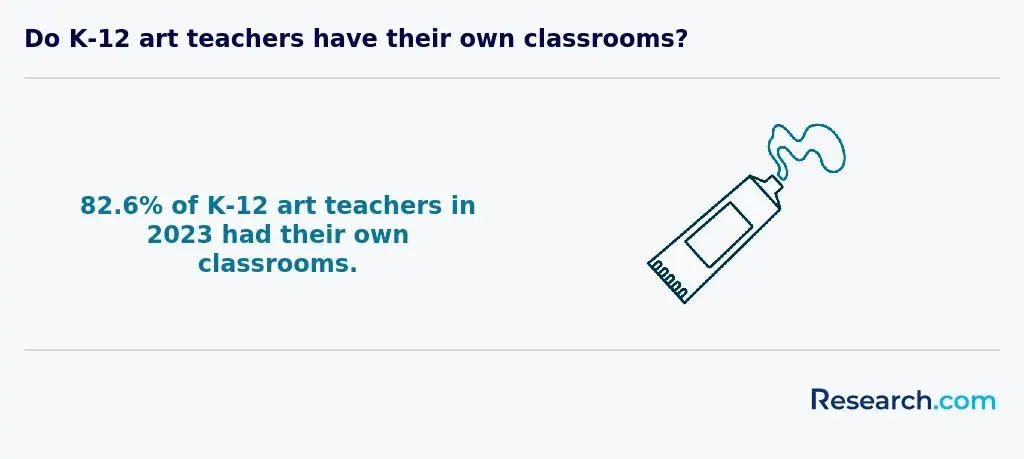
Many K-12 art teachers do have dedicated art rooms, but this is not guaranteed in every school. A 2023 survey found that 82.6% of K-12 art teachers had their own classroom, as shown below.
What education do Georgia art teachers need?
Georgia art teachers generally need a bachelor’s degree and completion of an approved educator preparation program. For most first-time teachers, the best-fit degree is art education because it combines studio work, art history, child development, teaching methods, assessment, and supervised classroom experience.
- Bachelor’s degree: A bachelor’s degree in art education or a closely related area is the usual starting point. Students should confirm that the program is designed for teacher certification in Georgia, not only for general studio art training.
- Art and education coursework: Preparation commonly includes drawing, painting, ceramics, design, digital media, art history, curriculum planning, educational psychology, teaching methods, and assessment.
- Educator preparation program: Candidates should complete a program recognized by the Georgia Professional Standards Commission. This is especially important because not every art-related degree leads to teacher certification.
- Accredited institution: Attending an appropriately accredited college is important for certification eligibility, graduate study, financial aid, and transferability. Students comparing online options can review general accreditation considerations through resources such as nationally accredited online colleges, while also verifying Georgia-specific teacher preparation approval.
- GACE content assessment: Prospective art teachers must demonstrate content knowledge through the required Georgia Assessments for the Certification of Educators.
- Program examples: Georgia State University, the University of Georgia, Kennesaw State University, Georgia Southern University, and the University of North Georgia are among the institutions referenced for art education preparation in the state.
| Program type | Best for | Important caution |
| Bachelor’s in art education | First-time college students who want the most direct certification-aligned route | Confirm the program includes approved teacher preparation and student teaching. |
| Bachelor’s in studio art plus teacher preparation | Students who already have strong studio interests but still need educator preparation | A studio art degree alone may not meet certification requirements. |
| Post-baccalaureate or alternative route | Career changers with an existing bachelor’s degree | Requirements vary, so candidates should confirm eligibility with the Georgia Professional Standards Commission and the provider. |
| Graduate education pathway | Certified teachers seeking additional credentials or advancement | Graduate study may support career growth but does not automatically replace initial certification requirements. |
Students exploring multiple teaching fields may also compare related education paths, including online physical education classes. However, a program in another teaching specialty will not automatically qualify someone to teach visual art unless it meets Georgia’s art education certification requirements.
What is the Georgia art teacher certification process?
Certification is the formal state process that allows qualified educators to teach in Georgia public schools. For art teachers, the process usually includes education, testing, background clearance, and an application through the Georgia Professional Standards Commission.
- Complete a qualifying degree and preparation program. Most candidates earn a bachelor’s degree in art education or a related field from an accredited institution and complete supervised student teaching.
- Pass the required GACE assessments. Candidates must complete the relevant Georgia Assessments for the Certification of Educators (GACE), including the art education content assessment and any additional assessment required by their route.
- Complete a criminal background check. Georgia requires fingerprinting and background screening through the appropriate state and federal channels, including the Georgia Bureau of Investigation and the Federal Bureau of Investigation.
- Pay required fees. Fingerprinting and background check costs can vary, but candidates should expect to pay around $50 to $75 for fingerprinting. The certification application fee is approximately $100.
- Submit the certification application. Once education, testing, and clearance requirements are complete, candidates apply through the Georgia Professional Standards Commission.
- Maintain the certificate. Georgia educators must renew certification every five years, which may require professional learning, coursework, or other approved development activities.
- Review reciprocity if certified elsewhere. Teachers who already hold certification in another state may be able to use Georgia’s reciprocity process, but they may still need to satisfy state-specific conditions, including testing.
Because certification rules, forms, and fees can change, candidates should verify details directly through the Georgia Professional Standards Commission before enrolling in a program, registering for exams, or submitting an application.
How much teaching experience do aspiring art teachers need?
Teaching experience is one of the most important parts of art teacher preparation because art classrooms involve distinctive challenges: shared supplies, studio safety, drying and storage space, varied skill levels, and projects that can become messy or highly individualized. Fieldwork helps candidates learn how to teach creativity within a structured classroom environment.
- Student teaching is required for traditional preparation. The Georgia Professional Standards Commission expects candidates in approved programs to complete supervised student teaching, often for a full semester.
- A minimum of 12 weeks of student teaching may be required. Candidates should confirm the exact placement length with their program because requirements can depend on the preparation route.
- Field experiences should include real lesson delivery. Observing is useful, but candidates also need practice introducing projects, demonstrating techniques, managing materials, guiding critiques, and assessing student work.
- Internship searches should start early. Local school districts, community art programs, university education departments, Teach Georgia, and the Georgia Art Education Association may be useful places to identify placements or early-career opportunities.
- Alternative experience can strengthen applications. Volunteering in schools, assisting with community art programs, teaching summer camps, or supporting museum education can help candidates build confidence and references.
To get more value from student teaching, set goals with your mentor teacher during the first week. Ask to practice classroom routines, supply distribution, cleanup procedures, grading with rubrics, critique facilitation, accommodations, and family communication. Keep written reflections because they can later become portfolio evidence.
Students who are considering flexible education-related roles outside a traditional art classroom can also review broader alternative education careers. Joining a professional association such as the National Art Education Association can also help new educators find resources, professional networks, and examples of strong art teaching practice.
Supply funding is another practical issue new teachers should understand. Around 17.2% of K-12 art teachers reported having an annual art supply budget of $1,000 to $1,499, as shown below.

What standards and curriculum requirements apply to Georgia art classes?
Georgia visual arts instruction is guided by the Georgia Standards of Excellence for fine arts. These standards organize learning around the major artistic processes of creating, presenting, responding, and connecting. In practice, that means art teachers are expected to help students make artwork, explain artistic choices, interpret visual culture, and connect art to personal, historical, cultural, and interdisciplinary contexts.
- Content knowledge: Teachers need enough background in art history, media, critique, design principles, and studio processes to teach both foundational skills and conceptual thinking.
- Standards-aligned planning: Lessons should connect projects to Georgia’s grade-level expectations rather than functioning only as crafts or isolated activities.
- Multiple media: Georgia art programs may include drawing, painting, sculpture, ceramics, printmaking, digital design, photography, mixed media, and art history, depending on grade level, facilities, and course offerings.
- Assessment: Effective art assessment usually combines process, craftsmanship, creativity, reflection, critique participation, and standards-based objectives.
- Cross-curricular learning: Art can connect naturally with history, science, technology, language arts, and math when projects are designed intentionally.
- Reflection and critique: Students should learn to discuss artwork respectfully, revise ideas, and use visual evidence to support interpretations.
| Art standard area | What it looks like in class | Teacher planning question |
| Creating | Students generate ideas, experiment with materials, revise work, and complete original pieces. | What artistic problem will students solve, and what skills will they practice? |
| Presenting | Students prepare artwork for display, explain choices, and consider audience. | How will students share or curate their work? |
| Responding | Students analyze, interpret, and evaluate artwork using visual evidence. | How will students discuss art beyond saying whether they like it? |
| Connecting | Students relate art to culture, history, identity, technology, and other subjects. | What larger idea or real-world connection gives the project meaning? |
Educators who want to broaden their school-based expertise may compare other education and student-support fields, such as an inexpensive online speech pathology degree. That type of program is not a substitute for art teacher certification, but it illustrates how specialized training can support work with diverse learners.
What is the job market and salary outlook for Georgia art teachers?
The art teacher job market in Georgia varies by region, district budget, school level, and whether a school maintains a full-time visual arts program. Urban and growing metropolitan districts may offer more openings, while rural districts may have fewer art-specific roles or combine assignments across schools.
| Compensation factor | What candidates should know |
| Reported salary range | As of 2023, Georgia art teacher salaries were commonly reported between $45,000 and $60,000 annually. |
| Average pay estimate | The average salary for art teachers in Georgia was reported around $50,000 per year. |
| Location differences | Art teachers in urban areas such as Atlanta may earn upwards of $55,000, while teachers in some rural areas may see salaries closer to $45,000. |
| Benefits | Public school compensation often includes health insurance, retirement plans, paid time off, and professional development opportunities. |
| Cost of living | Georgia’s cost of living index was reported at 92.5 compared with the national average of 100, so local affordability should be reviewed alongside salary. |
Do not evaluate an art teaching job only by base salary. Compare the district salary schedule, benefits, commute, planning time, class size, budget for materials, access to a dedicated classroom, support from administrators, and whether the school values arts programming. A position with a slightly lower salary but stable support, adequate supplies, and strong mentoring may be better for a first-year teacher than a higher-paying role with limited resources.
One Georgia educator described the trade-off this way: “After completing my program at Georgia State University, I worried about starting pay. Once I looked closely at benefits, school support, and the number of art openings near Atlanta, the decision became clearer. The cost of living still mattered, but the opportunity to build a creative classroom made the role worthwhile.”
Art education is also connected to a broader creative economy. Statista (2024) reported that the global art market was valued at $64.4 billion in 2019, declined to $50.3 billion in 2020, rebounded to $65.9 billion in 2021, increased to $67.8 billion in 2022, and then dipped to $65 billion in 2023. The chart below shows that change over time.
What continuing education options are available for art teachers?
Professional learning matters because art teachers must keep up with curriculum standards, student needs, new media, digital tools, assessment practices, and certification renewal requirements. Continuing education can also help teachers move into leadership, advanced coursework, gifted education, special education collaboration, or digital arts instruction.
- Georgia Department of Education: Fine arts educators may access professional learning communities, webinars, curriculum resources, and in-person training opportunities connected to visual arts and other fine arts areas.
- Woodruff Arts Center: The Woodruff Arts Center has offered professional development, school partnerships, and arts integration opportunities that can help teachers strengthen instruction.
- Savannah College of Art and Design: SCAD has provided educator programs, including Advanced Placement Institute offerings for AP art and design subjects and forums for educators.
- Continuing education credits: Teachers should track professional learning carefully because renewal expectations can depend on certification status, district requirements, and Georgia Professional Standards Commission rules.
- Professional organizations: State and national arts education groups can provide lesson ideas, conferences, advocacy updates, and peer networks.
- Related graduate study: Some teachers pursue graduate education to expand their credentials, shift into leadership, or specialize in adjacent school-based fields. For example, educators comparing school library pathways can explore online MLS degree programs.
The best professional development is not always the most expensive. New teachers should prioritize training that solves real classroom problems: managing clay and paint materials, adapting lessons for students with disabilities, building standards-based rubrics, using digital design tools responsibly, or preparing students for portfolio reviews.
What classroom management and teaching methods work well in art rooms?
Art classrooms require management systems that are more specific than general classroom rules. Students may be using scissors, clay tools, paint, digital equipment, cameras, printmaking supplies, or shared storage areas. Effective art teachers create routines that protect instructional time and make creative work possible.
| Strategy | How to apply it in an art classroom |
| Teach routines explicitly | Model how students enter, collect materials, clean tables, store unfinished work, label artwork, and transition to critique. |
| Use visual directions | Post steps, examples, vocabulary, and cleanup checklists so students can work independently. |
| Design engaging projects | Connect assignments to student interests, cultural context, choice, and meaningful artistic problems rather than copying a sample exactly. |
| Differentiate materials and expectations | Offer modified tools, alternative formats, advanced challenges, or adjusted timelines when students need support or enrichment. |
| Use positive reinforcement | Recognize responsible material use, thoughtful risk-taking, focused work habits, and respectful critique language. |
| Build relationships | Learn students’ interests and provide feedback that respects both their creative intent and their need for skill development. |
| Assess process and product | Grade planning, experimentation, revision, reflection, and final work so students understand that art learning is not only about natural talent. |
Social-emotional learning also fits naturally in art education. Students can use visual work to explore identity, communicate feelings, collaborate, and learn constructive feedback. The key is to maintain a classroom culture where expression is encouraged but expectations remain clear.
What practical steps can help aspiring art teachers build a stronger career path?
Aspiring art teachers should first understand Georgia’s general teacher preparation rules, then narrow their planning to visual arts certification. A broader overview of how to become a teacher in Georgia can help candidates understand state-level expectations before selecting an art-specific route.
- Confirm certification alignment before enrolling. Ask whether the program leads to Georgia art education certification and includes student teaching.
- Build a portfolio throughout college. Save artwork, process photos, lesson plans, rubrics, unit plans, teaching reflections, and examples from field experiences.
- Practice teaching different age groups. Elementary art teaching differs from middle and high school instruction, especially in classroom management, skill sequencing, and developmental expectations.
- Learn digital art tools. Schools increasingly value teachers who can connect traditional media with digital design, photography, animation, or portfolio platforms.
- Document accommodations and differentiation. Hiring teams may ask how you support English learners, gifted students, students with disabilities, and students with limited prior art experience.
- Network before graduation. Attend art education events, connect with mentor teachers, ask about district hiring timelines, and monitor school district postings.
- Compare total job quality. Review pay, benefits, supplies, class schedule, travel between schools, curriculum support, and administrator expectations.
What advancement paths and specializations are available?
Art teaching can lead to several career directions beyond the first classroom role. Some teachers remain in the classroom and deepen their practice, while others move into leadership, curriculum work, specialized instruction, or creative industry connections.
- Department leadership: Experienced teachers may become fine arts department chairs, grade-level leaders, or instructional mentors.
- School administration: Teachers interested in broader leadership may pursue additional credentials, such as leadership certification, through Georgia universities or approved programs.
- Curriculum development: Art educators can help write district pacing guides, revise visual arts units, create assessment tools, or align courses to state standards.
- Digital media specialization: Teachers with skills in digital art, photography, animation, design, or portfolio development may support expanding technology-based art courses.
- Gifted or special education endorsement: Additional training can help art teachers serve students with advanced creative ability or students who need accommodations.
- Arts integration: Some teachers collaborate across subjects to connect visual arts with science, history, literature, technology, or math.
One Georgia teacher described her advancement path this way: “I began as a high school art teacher in Athens after studying at the University of Georgia. A leadership program helped me move into curriculum development within two years, and that role let me shape visual arts instruction beyond my own classroom.”
For candidates comparing art teaching with other creative careers, salary patterns differ widely across the arts and design sector. Based on information from the Bureau of Labor Statistics (BLS, 2024), special effects artists and animators had a median annual salary of approximately $106,500. Fashion designers had a median income of $99,060, industrial designers earned around $79,290, interior designers earned $76,250, set and exhibit designers earned $62,510, and graphic designers earned $58,910. The highest-paying arts and design roles were generally concentrated in specialized and technical fields.
How can art teachers use STEM and interdisciplinary strategies?
Art teachers can strengthen lessons by connecting visual design with problem-solving, measurement, technology, engineering habits, and scientific observation. This approach is often described as STEAM because it adds the arts to STEM learning. A strong STEAM lesson still teaches visual art standards; it simply uses design thinking, experimentation, iteration, and evidence-based reflection to deepen the work.
- Use perspective drawing to connect art with geometry and spatial reasoning.
- Have students design prototypes, revise them, and explain how form affects function.
- Connect color theory with light, perception, or digital display technology.
- Use data visualization projects to help students turn information into visual communication.
- Discuss copyright, authorship, and responsible use when students use digital tools or AI-assisted resources.
Teachers who want more formal preparation in quantitative instruction may consider whether an online math education degree aligns with their career goals. For most art teachers, however, shorter professional development in design thinking, digital media, or STEAM lesson planning may be the more direct choice.
What support resources are available to new Georgia art teachers?
New art teachers should not try to build every lesson, rubric, supply system, and classroom routine alone. Georgia offers several formal and informal support channels that can help teachers shorten the learning curve.
- Georgia Art Education Association: GAEA can help teachers access workshops, professional networks, standards-related resources, and a community of visual arts educators.
- District mentorship: Many districts pair first-year teachers with experienced educators who can help with lesson pacing, classroom systems, grading, and school procedures.
- Georgia Department of Education resources: State curriculum pages, fine arts guidance, instructional materials, and assessment tools can help teachers align lessons with expectations.
- University workshops: Colleges with art education programs may host training sessions, lectures, and networking events for teachers.
- Online teacher communities: Platforms such as Teachers Pay Teachers, Artsonia, and educator social media groups may provide adaptable lesson ideas, though teachers should still check quality and alignment.
- Georgia Council for the Arts: Grant opportunities may help schools support arts programming, materials, visiting artists, or community-based projects.
- State and national conferences: Conferences can expose new teachers to current practice, advocacy efforts, vendor resources, and peer-tested strategies.
How can early childhood teaching knowledge help art teachers?
Art teachers who work with younger students benefit from understanding early childhood development, motor skills, play-based learning, language development, and age-appropriate assessment. These skills help teachers design lessons that are creative without being developmentally unrealistic. Candidates who want a deeper understanding of this age group can review early childhood teaching certification requirements and pathways, while remembering that early childhood certification is separate from art education certification.
How can art teachers evaluate private school roles in Georgia?
Private schools can offer a different teaching environment from public schools. Some may have smaller classes, specialized arts programming, more curricular flexibility, or unique community expectations. However, certification requirements, salary schedules, benefits, contract terms, and workload can vary significantly by school.
Before accepting a private school position, ask whether the school requires Georgia certification, how art curriculum is approved, what supply budget is available, whether there is a dedicated art room, how student work is displayed, and how professional development is funded. Teachers interested in this route can compare expectations using Research.com’s guide on how to become a private school teacher in Georgia.
Why does mentorship matter for new art teachers?
Mentorship can make the difference between surviving the first year and building a sustainable teaching practice. New art teachers often need help translating college coursework into daily routines, especially when managing multiple grade levels, limited planning time, large classes, and shared materials.
A useful mentor can help a new teacher sequence units, choose age-appropriate media, handle cleanup efficiently, communicate with parents, prepare for observations, and respond to student behavior without shutting down creativity. Mentors can also explain local district expectations, grading systems, professional learning requirements, and available arts resources.
Teachers who want to understand how mentorship functions in other grade-level settings may also review how to become an elementary school teacher in Georgia, especially if they expect to teach younger students.
How can art teachers use special education strategies?
Inclusive art teaching means planning for students with different communication needs, sensory needs, physical abilities, attention levels, language backgrounds, and learning profiles. Art teachers should collaborate with special education teachers, read individualized education plans carefully when applicable, and adapt tools or expectations without removing the core art objective.
- Offer adaptive tools such as modified grips, larger paper, alternative scissors, or digital options.
- Break demonstrations into shorter steps with visual examples.
- Provide choices in materials when sensory needs affect participation.
- Use peer collaboration carefully so support does not become dependence.
- Assess the intended skill or concept rather than penalizing students for disability-related barriers.
Teachers who want deeper preparation can explore special education teacher certification in Georgia and discuss endorsement or collaboration options with their district.
How can art and music teachers collaborate in Georgia schools?
Art and music teachers can build powerful interdisciplinary projects when collaboration is planned around shared learning goals. Students might create album art for original compositions, design stage sets for performances, explore rhythm through pattern and repetition, or study cultural movements that shaped both visual and musical expression.
Successful collaboration requires shared timelines, clear assessment responsibilities, and projects that respect both disciplines. Art should not become decoration for music, and music should not become background noise for art. Teachers who want to understand the music educator pathway can review how to become a music teacher in Georgia.
Common mistakes to avoid when becoming an art teacher in Georgia
| Mistake | Why it causes problems | Better approach |
| Choosing a studio art degree without checking certification alignment | A strong art degree may not include teacher preparation or student teaching. | Ask the program whether it leads to Georgia art education certification before enrolling. |
| Focusing only on tuition | A cheaper program may cost more later if credits do not transfer or certification requirements are missing. | Compare accreditation, approval status, field placements, exam support, and total cost. |
| Waiting too long to prepare for GACE exams | Testing delays can postpone certification and hiring. | Ask your program when to register, what content to review, and how retakes affect your timeline. |
| Building an art-only portfolio | Schools also need proof that you can teach and manage a classroom. | Include lesson plans, student teaching evidence, rubrics, and classroom procedures. |
| Ignoring supply and room conditions during interviews | Art teaching depends on materials, storage, cleanup systems, and safe workspaces. | Ask about budgets, ordering timelines, shared spaces, kilns, digital tools, and display areas. |
| Assuming online coursework automatically meets Georgia requirements | Online programs vary widely in approval, field placement support, and certification alignment. | Verify Georgia Professional Standards Commission recognition and local student teaching arrangements. |
| Relying only on rankings or reputation | A highly visible school may not be the best fit for your certification route, budget, or location. | Use rankings as one input, then confirm outcomes, placement support, and state approval. |
Questions to ask before choosing an art education program
- Does this program lead directly to Georgia art education certification?
- Is the educator preparation program approved for Georgia candidates?
- What GACE exams do graduates need to pass, and what support is provided?
- How long is student teaching, and where are placements typically located?
- Can I complete fieldwork near where I live if part of the program is online?
- What percentage of graduates find teaching positions in Georgia schools?
- How much studio coursework is included compared with education coursework?
- Will I graduate with a teaching portfolio, not only an artist portfolio?
- What are the total costs, including fees, materials, testing, travel, and certification?
- How does the program prepare teachers for digital art, inclusive classrooms, and classroom management?
What do graduates say about becoming an art teacher in Georgia?
Teaching visual art in Georgia has been deeply meaningful for me. Community support and a curriculum that makes space for creativity have helped both my students and my own teaching practice grow. Susie
One reason I enjoy teaching here is the attention given to arts education. Grants and local resources have helped us offer experiences such as gallery visits and workshops with practicing artists. Billy
The professional community among Georgia art teachers has been a major strength. Sharing lesson ideas, classroom systems, and resources with other teachers has made me more effective and less isolated. Malorie
Key findings from the available data
- The Georgia Professional Standards Commission requires prospective art teachers to hold at least a bachelor’s degree in art education or a related field.
- As of 2023, approximately 80% of art education programs in Georgia were reported as accredited.
- The U.S. Bureau of Labor Statistics reported the median annual wage for art teachers in Georgia at around $54,000, with variation by experience, location, and school district.
- In 2023, the Georgia Professional Standards Commission reported more than 1,200 art teachers employed in Georgia public schools.
- Candidates must pass the Georgia Assessments for the Certification of Educators exam to obtain certification in art education.
- Recent data showed an approximately 85% pass rate for the GACE Art Education test.
- The Georgia Professional Standards Commission mandates that educators complete at least 10 professional learning units every five years to maintain certification.
- The global art market was valued at $64.4 billion in 2019, dropped to $50.3 billion in 2020, rose to $65.9 billion in 2021, reached $67.8 billion in 2022, and declined slightly to $65 billion in 2023.
- Special effects artists and animators had the highest median salary among the cited arts and design roles at approximately $106,500 per year.
- Fashion designers had a median income of $99,060, industrial designers earned around $79,290, interior designers earned $76,250, set and exhibit designers earned $62,510, and graphic designers earned $58,910.
- A 2023 survey found that 82.6% of K-12 art teachers had their own classroom.
- Around 17.2% of K-12 art teachers reported an annual art supply budget of $1,000 to $1,499.
Related Articles for Nearby States
- 2027 How to Become an Art Teacher in South Carolina: Requirements & Certification
- 2027 How to Become an Art Teacher in Florida: Requirements & Certification
- 2027 How to Become an Art Teacher in Alabama: Requirements & Certification
- 2027 How to Become an Art Teacher in Tennessee: Requirements & Certification
- 2027 How to Become an Art Teacher in North Carolina: Requirements & Certification
- 2027 How to Become an Art Teacher in Mississippi: Requirements & Certification
- 2027 How to Become an Art Teacher in Kentucky: Requirements & Certification
- 2027 How to Become an Art Teacher in Virginia: Requirements & Certification
- 2027 How to Become an Art Teacher in Louisiana: Requirements & Certification
- 2027 How to Become an Art Teacher in West Virginia: Requirements & Certification
References:
- Art Teacher EDU. (1991, July 1). Georgia Art Teacher Certification and Job Requirements. Art Teacher EDU.
- Georgia Department of Education. (2024). Fine Arts. Georgia Department of Education.
- Georgia Professional Standards Commission. (2023, August 15). GaPSC Rule 505-3-.01 requirements and standards for approving educator preparation providers and educator preparation programs. Georgia Professional Standards Commission.
- Georgia Southern University. (2024, July 10). Art & Design Courses. Georgia Southern University.
- Georgia Standards. (2024). Fine Arts Georgia Standards of Excellence (GSE). Georgia Standards.
- Georgia State University. (2020, September 11). Art Education (B.F.A.). Georgia State University.
- Savannah College of Art and Design. (2024). Educator programs. Savannah College of Art and Design.
- University of Georgia. (2024). Art Education Certification Program. University of Georgia.
- University of North Georgia. (2024). Art Education (B.S.). University of North Georgia.
- Woodruff Arts Center. (2017, February 16). Education Programs. Woodruff Arts Center.
Key Insights
- The most reliable path to becoming an art teacher in Georgia is a certification-aligned art education degree with supervised student teaching.
- Before enrolling, confirm that the program is recognized for Georgia teacher preparation; a general studio art degree may not be enough.
- Certification usually requires GACE testing, fingerprinting, a background check, and an application through the Georgia Professional Standards Commission.
- A strong job application includes both an artist portfolio and a teaching portfolio with lesson plans, rubrics, reflections, and classroom systems.
- Salary should be evaluated alongside benefits, location, supply budgets, classroom space, mentorship, and district support for arts education.
- New teachers should prioritize classroom routines, inclusive instruction, standards alignment, and professional networks to build a sustainable career.
Other Things You Should Know About Becoming an Art Teacher in Georgia
To become an art teacher in Georgia in 2027, you need a bachelor's degree in art education or a related field. You must also complete a state-approved teacher preparation program and pass the Georgia Assessments for the Certification of Educators (GACE) exams specific to art content.
In 2027, a bachelor's degree is essential for becoming an art teacher in Georgia. You must complete a state-approved teacher preparation program alongside your degree, typically a Bachelor of Arts in Art Education, to qualify for certification and begin your teaching career.
To become a certified art teacher in Georgia in 2027, you must earn a bachelor's degree in art education or a related field, pass the GACE Art Education assessment, complete a state-approved educator preparation program, and apply for certification with the Georgia Professional Standards Commission.