2027 Online Digital Photography Degrees That Help Build Studio Photography Skills

Co-Founder and Chief Data Scientist
Choosing an online digital photography degree is really a studio-readiness decision: will the program help you light, direct, edit, critique, and present professional-quality images? The U.S. Bureau of Labor Statistics reports a May 2024 median annual wage of $42,520 for photographers, but income varies widely by niche, business model, and portfolio quality.
This guide is for students comparing online photography degrees, career changers, and working creatives who want stronger studio skills. You will learn how programs differ, what they cost, which schools to evaluate, and how to choose a degree that fits your goals.
Key Things You Should Know
- Online studio-focused photography degrees usually combine digital capture, lighting, post-production, visual storytelling, critique, portfolio development, and business coursework rather than only camera operation.
- According to the BLS, photographers had a May 2024 median annual wage of $42,520, while the occupation is projected to grow 3% from 2024 to 2034, making portfolio strength and specialization important.
- College Board 2024-25 data shows published tuition and fees averaged $11,610 for in-state public four-year colleges and $43,350 for private nonprofit four-year colleges, so transfer credit, equipment costs, and financial aid can change the real price significantly.
What is an online digital photography degree and how does it build studio skills?
An online digital photography degree is an undergraduate or graduate program that teaches image-making through digital cameras, lighting systems, editing software, visual communication, and professional portfolio development. At the associate and bachelor's levels, the goal is usually to prepare students for entry-level photography work, freelance practice, content production, or further study. At the master's level, the emphasis often shifts toward advanced artistic practice, research, critique, teaching preparation, and a cohesive body of work.
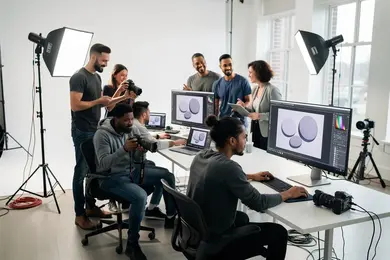
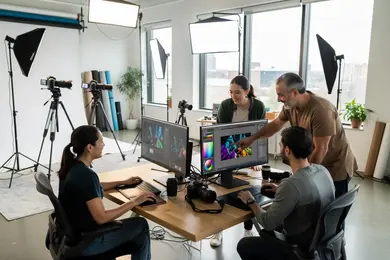
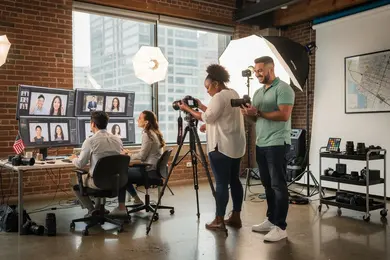
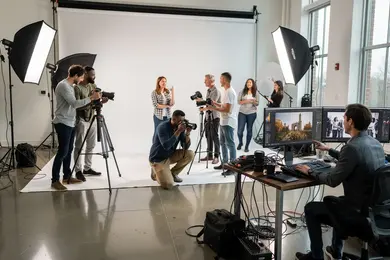
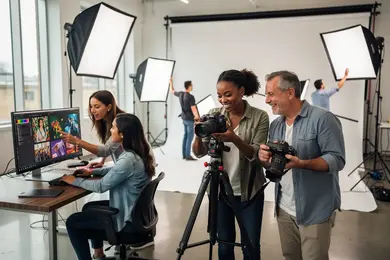
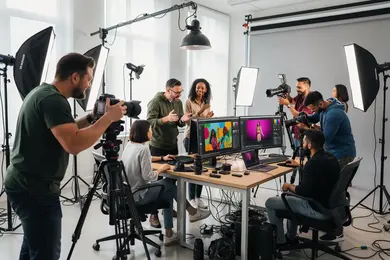
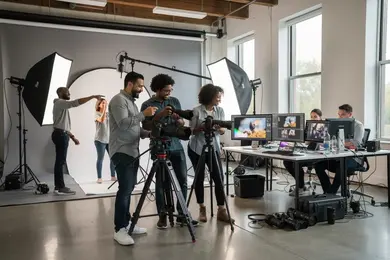
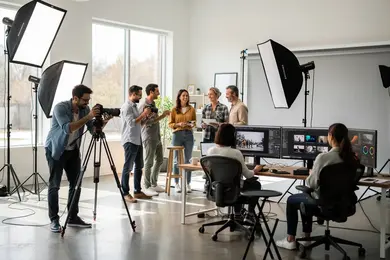
"Studio photography skills" refer to the controlled production skills used when the photographer shapes the image rather than simply reacting to natural conditions. These include lighting design, exposure control, posing, tethered capture, color management, backdrop selection, set styling, product placement, client direction, and post-production workflow. A strong online program does not require students to be on campus every week to practice these skills; instead, it uses structured assignments, critique, remote faculty feedback, equipment guidance, and portfolio reviews to help students build a studio process where they live.
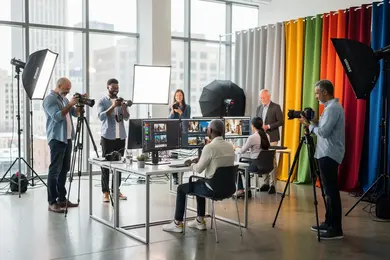
The best fit is usually a student who can practice independently and document progress. Online studio photography can work well if you have access to a small home setup, rented studio time, a workplace media space, or a local community studio. It is less ideal for students who need daily in-person equipment supervision, want constant access to large cyclorama walls or specialized commercial lighting bays, or learn best through hands-on campus labs.
Students commonly choose one of several degree levels. The table below summarizes how each credential usually supports studio photography goals and when it makes sense.
| Degree level | Typical length | Best fit | Studio-skill focus | Decision note |
| Certificate | Several months to one year | Beginners or working creatives adding a specific skill | Camera basics, lighting fundamentals, editing workflow | Useful for targeted upskilling, but it may not carry the same weight as a degree for some employers or graduate programs. |
| Associate degree | About two years full time | Students seeking an affordable entry point or transfer pathway | Introductory studio lighting, digital editing, composition, portfolio basics | Often practical for career starters, especially if credits transfer into a bachelor's program. |
| Bachelor's degree | About four years full time | Students seeking broader preparation for commercial, editorial, or creative roles | Advanced lighting, portraiture, product photography, concept development, business practices, portfolio review | Usually the most comprehensive undergraduate option for building both technical and professional readiness. |
| Master's degree or MFA | Two to three years | Advanced artists, educators, and professionals refining a creative voice | Graduate critique, thesis work, advanced studio practice, exhibition preparation | Best for students who already have a portfolio and need advanced mentorship rather than basic camera training. |
A degree is not the only route into photography, but it can provide structure that self-teaching often lacks. Students who benefit most are those who want repeated critique, deadlines, a professional portfolio, and exposure to both creative and business expectations.
How do online digital photography programs compare with campus-based options for studio training?
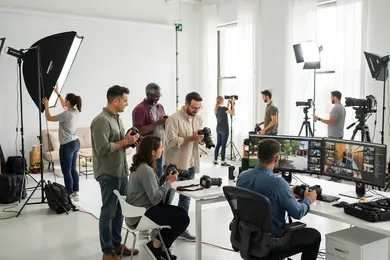
Online and campus photography programs can both build studio skills, but they do so differently. Campus programs offer immediate access to shared studios, lighting labs, darkrooms, print facilities, and peer collaboration. Online programs offer flexibility, often making it easier for students to keep working, shoot in real client environments, and build a studio setup gradually.
The right choice depends on your learning style, local resources, schedule, and budget. The table below compares the trade-offs that matter most for studio-focused students.
| Factor | Online digital photography degree | Campus-based photography degree | Which may be better? |
| Studio access | Usually depends on home equipment, rentals, workplace space, or local studios | Often includes campus lighting studios, print labs, and equipment cages | Campus may be stronger if you need frequent access to large shared facilities. |
| Schedule flexibility | Often asynchronous or hybrid, which helps working adults | Requires scheduled studio blocks, critiques, and lab time | Online may be stronger if you need to balance work, family, or freelance assignments. |
| Critique format | Digital submissions, recorded feedback, live video critique, peer boards | In-person critique with prints, test shoots, and studio demonstrations | Campus may suit students who need live physical critique; online may suit students comfortable presenting digitally. |
| Equipment costs | Students may need to buy or rent more gear independently | Some equipment may be loaned through the school | Campus can reduce gear pressure, but online students can build equipment they keep after graduation. |
| Professional context | Assignments can be completed in local markets with real clients or models | Assignments often use campus peers, labs, and school spaces | Online can be practical for students already networking locally. |
Online learning is strongest when the program clearly explains required gear, provides lighting demonstrations, uses detailed rubrics, and offers meaningful critique. A weak online program may rely too heavily on readings and discussion boards without enough image production, revision, and faculty feedback.
Campus learning is strongest when students will actively use the facilities. Paying more for a campus program may not make sense if you rarely use the studios, cannot attend open lab hours, or plan to work in a niche that can be practiced from a home studio. Conversely, an online program may be frustrating if you do not have space to shoot, cannot afford basic lighting equipment, or need frequent in-person troubleshooting.
Which accredited schools offer online digital photography degrees focused on studio photography?
Accreditation should be one of the first filters when comparing online photography degrees. Institutional accreditation matters for federal financial aid eligibility, transfer credit, employer recognition, and graduate school options. Programmatic art accreditation, such as recognition from the National Association of Schools of Art and Design where applicable, can add another quality signal, but it is not the only marker of a reputable photography program.
The schools below are examples of accredited U.S. institutions that have offered online or substantially online photography-related degrees with digital imaging, studio practice, portfolio, or visual media components. Program titles, delivery formats, tuition, and curriculum requirements can change, so students should confirm details directly with each school before applying.
| School | Example online photography-related degree | Accreditation signal to verify | Studio-relevant strengths to look for | Best-fit student |
| Southern New Hampshire University | BA in Digital Photography | Institutional accreditation through the New England Commission of Higher Education | Digital capture, lighting, media communication, image editing, portfolio development | Students seeking a flexible bachelor's program with broad digital photography training. |
| Arizona State University | Online BFA in Art with a digital photography emphasis or photography-related pathway, depending on current catalog offerings | Institutional accreditation through the Higher Learning Commission | Fine art context, digital imaging, critique, concept development, portfolio-building | Students who want a university art-school environment in an online format. |
| Academy of Art University | Online photography degrees at multiple levels, depending on current offerings | Institutional accreditation through WASC Senior College and University Commission; program-specific art accreditation should be verified | Commercial photography, studio lighting, fashion, product, portrait, and portfolio work | Students seeking an art-and-design school model with multiple photography pathways. |
| Savannah College of Art and Design | Online photography or related visual communication programs through SCADnow, depending on current offerings | Institutional accreditation through the Southern Association of Colleges and Schools Commission on Colleges | Creative direction, editorial imagery, critique, professional presentation, visual branding | Students interested in a design-school environment and professional creative industries. |
| Rocky Mountain College of Art + Design | Online photography or commercial photography-related offerings, depending on current catalog availability | Institutional accreditation through the Higher Learning Commission | Digital workflow, commercial image-making, portfolio, studio assignments | Students who want an art-focused online program with applied visual media training. |
Do not choose a school only because it uses the phrase "digital photography." Read the course descriptions. A studio-focused degree should include repeated assignments in lighting, portraiture, product or commercial photography, editing, critique, and portfolio sequencing. If a program focuses mostly on art history, theory, or general media studies, it may still be valuable, but it may not provide the studio repetition needed for commercial portrait, product, or brand photography.
Students should also distinguish institutional accreditation from short-course marketplace certificates. Many short courses can teach useful skills, but they usually do not replace an accredited degree if your goal includes transfer credit, graduate admission, federal aid, or a bachelor's credential.
What courses and technical skills are taught in studio-focused online photography curricula?
A strong studio-focused online photography curriculum teaches students to make deliberate images under controlled conditions. The program should move from camera control and composition into lighting, image editing, client-oriented production, visual storytelling, and professional presentation.
Most programs organize learning around repeated production cycles: plan the shoot, capture images, edit selects, receive critique, revise, and present the final work. The courses below are especially important because they connect technical skill with portfolio outcomes.
- Digital camera operation and exposure: Students learn aperture, shutter speed, ISO, lens choice, depth of field, file formats, and shooting consistency.
- Studio lighting: Coursework should cover continuous light, strobes, modifiers, light ratios, reflections, shadows, gels, white balance, and safe equipment handling.
- Portrait photography: Students practice posing, expression, subject direction, skin tone management, backdrop selection, and lighting setups for individuals and groups.
- Product and commercial photography: Assignments may include reflective objects, packaging, tabletop sets, food styling, e-commerce images, and brand-aligned visual campaigns.
- Digital post-production: Students build workflows in editing and retouching software, including color correction, masking, compositing, sharpening, file export, and non-destructive editing.
- Color management and printing: Strong programs explain monitor calibration, color spaces, proofing, print preparation, and differences between screen and print output.
- Visual storytelling and concept development: Students learn how to plan a shoot around a message, audience, mood board, client brief, or creative theme.
- Portfolio and professional practices: Courses cover sequencing, website presentation, pricing basics, contracts, usage rights, client communication, and self-promotion.
Technical tools are changing quickly. AI-assisted editing, automated masking, generative fill, background extension, and batch culling can speed up post-production, but they do not replace lighting judgment, art direction, ethics, or client communication. Students should look for programs that teach both software efficiency and responsible image practices, especially when images are used in journalism, advertising, portraiture, or product representation.
Photography also overlaps with other visual fields. A student interested in interactive entertainment, for example, might compare imaging, lighting, and visual storytelling coursework with a video game designer degree to decide whether their stronger interest is still-image production, game art, or broader digital design.
The most important outcome is not a transcript filled with course names; it is a portfolio that shows repeatable skill. By graduation, studio-focused students should be able to explain why they chose a lighting setup, how they solved production problems, what editing decisions they made, and how the final image serves a client or creative goal.
What admission requirements do online digital photography degree programs typically have?
Admission requirements vary by school and degree level. Many undergraduate online photography programs are designed for broad access, while selective art schools or BFA programs may require a portfolio. Graduate programs are usually more portfolio-driven because applicants are expected to show an existing creative practice.
The table below shows common requirements by credential level. Use it to anticipate what you may need before applying and to avoid losing time on incomplete applications.
| Program type | Common academic requirements | Portfolio expectations | Other likely requirements | Preparation tip |
| Certificate | High school diploma or equivalent may be required, depending on the provider | Often not required for beginner certificates | Basic camera access and software access | Ask whether certificate credits can apply to a later degree. |
| Associate degree | High school diploma, GED, or transfer credits | Usually optional or limited for open-access programs | Transcripts, placement information, technology requirements | Prioritize schools with clear transfer pathways into bachelor's programs. |
| Bachelor's degree | High school diploma or transfer credits; GPA standards vary | May be required for BFA or art-school admission | Personal statement, transcripts, possible resume, software and equipment list | Prepare 10 to 20 strong images that show range, control, and potential. |
| Master's degree or MFA | Bachelor's degree from an accredited institution | Usually required and highly important | Artist statement, letters of recommendation, resume, statement of purpose | Show a coherent body of work rather than unrelated snapshots. |
Applicants should treat equipment requirements as part of admission planning, not an afterthought. A program may expect students to have a DSLR or mirrorless camera with manual controls, a reliable computer, editing software, storage drives, and eventually lighting equipment. If the school does not publish a clear equipment list, ask before enrolling.
Portfolio requirements can feel intimidating, but they are also useful. A portfolio review helps the school evaluate readiness, and it helps you understand whether the program's expectations match your current skill level. For studio photography, include images that show controlled light, intentional composition, technical clarity, and the ability to revise or direct a subject.
Common admission mistakes include applying without checking accreditation, assuming all credits will transfer, ignoring technology requirements, and submitting a portfolio that shows only one type of image. A better approach is to contact admissions and the department, ask whether faculty review portfolios, and request examples of successful student work or capstone expectations.
How long do online digital photography degrees take and what do they cost?
Program length depends on degree level, transfer credits, enrollment intensity, and whether the school uses traditional semesters or accelerated terms. A full-time associate degree often takes about two years, while a bachelor's degree usually takes about four years for first-time students. Transfer students with prior general education credits may finish faster. Graduate photography programs commonly take two to three years, especially when they include a thesis or final exhibition.
Cost is more variable than many students expect because tuition is only one part of the budget. College Board's 2024-25 national figures put average published tuition and fees at $11,610 for in-state public four-year institutions and $43,350 for private nonprofit four-year institutions. These are sticker prices, not necessarily net prices after grants, scholarships, employer aid, or transfer credits, but they show why comparing total cost matters.
When estimating the real cost of an online studio photography degree, include the following categories rather than looking only at tuition.
- Published tuition and mandatory fees for the full program
- Camera body, lenses, tripod, memory cards, storage drives, and backup systems
- Lighting gear such as strobes or continuous lights, modifiers, stands, triggers, reflectors, and backdrops
- Editing software subscriptions, calibration tools, and computer upgrades
- Printing, portfolio website, domain, cloud storage, props, models, studio rental, and travel for shoots
- Graduation, transcript, technology, proctoring, and course material fees
Here are typical price-related benchmarks students should use as a starting point when comparing schools.
- $11,610: average published tuition and fees for in-state students at public four-year colleges in 2024-25, according to College Board
- $30,780: average published tuition and fees for out-of-state students at public four-year colleges in 2024-25, according to College Board
- $43,350: average published tuition and fees for private nonprofit four-year colleges in 2024-25, according to College Board
Online students should also ask whether tuition is charged per credit, per term, or as a flat rate. A low per-credit price can become expensive if the program requires many credits that do not transfer. A higher tuition program may be more affordable in practice if it accepts more transfer credits, includes software access, or offers strong institutional aid.
Students considering advanced creative study after a bachelor's degree may also compare photography master's options with a master of fine arts online, especially if their long-term goals include teaching, gallery practice, or a major independent body of work.
To reduce costs, start with transfer-credit evaluation, apply for federal student aid if eligible, ask about departmental scholarships, consider used gear, rent specialized equipment before buying it, and build a home studio gradually. Avoid taking on debt for a program that cannot clearly explain curriculum, critique access, career support, or portfolio outcomes.
What studio photography careers can graduates pursue with an online digital photography degree?
Graduates of online digital photography degree programs can pursue studio, commercial, editorial, content, and freelance roles. The degree itself does not automatically place someone into a specific job; employers and clients usually evaluate a combination of portfolio quality, technical reliability, communication skills, speed, niche experience, and business professionalism.
Studio photography careers often blend image-making with client service and production management. The table below outlines common career paths and what students should build in their portfolios for each one.
| Career path | Typical responsibilities | Portfolio evidence to build | Work setting |
| Portrait photographer | Photograph individuals, families, executives, performers, graduates, or personal branding clients | Controlled lighting, posing, expression, skin tone handling, consistent retouching | Independent studio, mobile studio, corporate settings, schools, agencies |
| Commercial product photographer | Create images for e-commerce, catalogs, packaging, advertising, and brand campaigns | Clean product lighting, reflective-object control, color accuracy, styled sets | Brand studios, agencies, retailers, freelance studios |
| Fashion or beauty photographer | Work with models, stylists, makeup artists, designers, and creative directors | Model direction, lighting variety, editorial concepts, team collaboration | Studios, agencies, magazines, brands, freelance production teams |
| Photo editor or digital imaging technician | Select, retouch, color-correct, manage files, and prepare images for delivery | Before-and-after editing samples, color consistency, workflow documentation | Studios, agencies, media companies, in-house creative teams |
| Content creator or visual media specialist | Produce photography for websites, social media, campaigns, internal communications, and brand libraries | Campaign sets, product and people imagery, short-form visual storytelling | Corporate marketing teams, nonprofits, universities, small businesses |
| Studio manager or production assistant | Manage equipment, schedules, clients, assistants, files, and studio logistics | Production notes, lighting diagrams, behind-the-scenes documentation, project coordination | Commercial studios, rental studios, creative agencies |
Students who want salaried employment should build more than a beautiful portfolio. Hiring teams often want evidence that a photographer can meet deadlines, follow briefs, name and archive files properly, collaborate with marketing teams, and adapt images for multiple platforms. Freelancers need these same skills plus pricing, contracts, invoicing, licensing, and client management.
Some students discover that they like visual media but prefer adjacent roles. For example, a sports-oriented student may enjoy photography on media days but prefer statistics, performance analysis, or broadcasting research; reading about what do sports analysts do can clarify whether the better fit is image production or sports data work.
Graduates can improve career readiness by specializing. Strong studio niches include headshots, product photography, food photography, cosmetics, jewelry, school portraits, medical or dental marketing images, personal branding, and content libraries for small businesses. Specialization helps clients understand what you do and makes it easier to price your services around repeatable value.
What are typical salaries and earning potential for studio photographers in the United States?
Photography income varies more than many degree fields because many professionals are self-employed, project-based, part-time, or niche-specific. The BLS reported a May 2024 median annual wage of $42,520 for photographers in the United States. That figure is useful as a national baseline, but it should not be read as a guaranteed outcome for degree graduates or freelance studio owners.
Studio photographers may earn through hourly wages, day rates, package pricing, retainers, licensing, print sales, product contracts, or employment salaries. A portrait photographer in a small local market, an in-house e-commerce photographer, and a commercial advertising photographer may all fall under the broad photography umbrella while having very different income patterns.
The table below explains how earning potential tends to differ by work model. It does not predict individual income, but it helps students understand why business skills matter as much as camera skills.
| Work model | How photographers are usually paid | Main income drivers | Risk level |
| Entry-level studio employee | Hourly wage or salary | Technical reliability, speed, customer service, editing consistency | Lower business risk, but less pricing control |
| In-house brand or e-commerce photographer | Salary or contract pay | Volume production, product accuracy, workflow efficiency, collaboration with marketing | Moderate risk; depends on employer demand and industry |
| Freelance portrait photographer | Session fees, packages, print sales, licensing, retainers | Local marketing, client experience, referrals, pricing strategy, repeat bookings | Higher risk because income depends on sales and client pipeline |
| Commercial studio photographer | Day rates, project fees, usage licensing, agency contracts | Specialized portfolio, production scale, client relationships, rights management | Higher risk but potentially stronger upside for established specialists |
| Photo editor or retoucher | Hourly, salary, or project-based editing fees | Software speed, quality control, color consistency, industry specialization | Moderate risk; AI tools may change workflows but not eliminate quality review needs |
Students should evaluate salary potential through the lens of their target niche. If your goal is a salaried creative-team role, look for programs with internships, employer projects, and career services. If your goal is freelance studio ownership, prioritize business coursework, portfolio critique, client communication, licensing, and marketing assignments.
Location also matters. Large markets may offer more commercial and advertising work, but they can also have higher competition and studio costs. Smaller markets may have less agency work but more opportunity for relationship-based portrait, school, event-adjacent, and small-business branding services. A practical ROI calculation should compare program cost with the specific revenue model you plan to pursue.
What is the job outlook and industry demand for studio photography professionals?
The BLS projects employment of photographers to grow 3% from 2024 to 2034, which is close to a modest-growth outlook rather than a high-growth boom. For students, this means the field is viable but competitive. A degree can help, but the stronger advantage usually comes from a polished portfolio, technical dependability, specialization, and business discipline.
Demand for studio photography is being shaped by several current trends. E-commerce brands need consistent product images. Small businesses need ongoing website and social media content. Professionals need headshots and personal branding images. At the same time, smartphone cameras, stock imagery, and AI-assisted image tools have made low-end image production more competitive.
Students should understand where human studio photographers still provide strong value. These areas are harder to replace because they require trust, direction, physical production, and context-specific judgment.
- Client-facing portrait sessions that require posing, expression coaching, lighting, and a comfortable studio experience
- Product photography where accurate color, texture, scale, reflections, and brand consistency affect sales
- Commercial shoots that require coordination among stylists, models, art directors, marketing teams, and clients
- Brand content libraries that need repeatable visual systems across people, products, locations, and campaigns
- Retouching and image quality control where ethical, legal, or brand standards matter
AI is changing post-production more quickly than capture. Tools can remove backgrounds, extend canvases, generate variations, and accelerate masking, but clients still need photographers who can produce original assets, manage subjects, control lighting, and deliver files that meet commercial specifications. Students should avoid programs that ignore AI completely, but they should also be cautious of programs that treat software shortcuts as a replacement for image-making fundamentals.
The outlook is strongest for graduates who can solve business problems, not just take attractive images. A studio photographer who can help a retailer standardize product images, help executives look credible online, or help a brand produce a repeatable visual campaign is more employable than someone with a general portfolio and no clear market fit.
How can students evaluate and choose a reputable online studio photography degree program?
Choosing a program should start with fit, not rankings alone. A reputable online studio photography degree should be accredited, transparent about costs, clear about equipment, rich in critique, and aligned with the type of photography you want to practice. The best program for a future product photographer may not be the best program for a fine art portraitist or a student planning graduate school.
Use the following steps to compare programs in a practical order. This sequence helps you avoid enrolling based on marketing language before confirming quality, affordability, and career alignment.
- Verify institutional accreditation through the school's accreditor and federal recognition sources before discussing tuition or applying.
- Match the curriculum to your goal by looking for lighting, portrait, product, editing, critique, portfolio, and professional-practice courses.
- Ask for the complete equipment list and estimate the cost of cameras, lenses, lighting, software, printing, storage, and studio rentals.
- Review faculty portfolios to see whether instructors have experience in the studio, commercial, fine art, editorial, or digital niche you want.
- Request examples of student portfolios, capstone projects, exhibitions, or senior thesis work to evaluate actual outcomes.
- Confirm how critique works online, including whether feedback is live, recorded, written, peer-based, faculty-led, or portfolio-review-based.
- Ask how transfer credits are evaluated and whether prior college credits can shorten the program.
- Compare net price after grants, scholarships, employer aid, military benefits, or transfer credit rather than relying only on sticker tuition.
- Check career support, including internships, alumni networks, freelance business training, resume help, portfolio reviews, and employer connections.
- Read withdrawal, refund, technology, and academic progress policies before signing enrollment documents.
Several red flags should make students pause. Be cautious if a school will not clearly identify its accreditation, pressures you to enroll immediately, cannot provide course-level details, gives vague answers about equipment, or promises specific salary outcomes. Photography careers are too portfolio- and market-dependent for any school to guarantee earnings.
It can also help to compare photography with other design disciplines. For example, students who want spatial design, architectural visualization, or built-environment studios may find that an online bachelor of architecture aligns better with their long-term goals than a photography degree, even though both fields rely on visual composition and critique.
A good final test is to ask: "Will this program help me produce a portfolio that matches the clients, employers, or graduate programs I want?" If the answer is unclear, keep researching. The right online digital photography degree should make your next step more concrete, not more confusing.
Other Things You Should Know About Digital Photography
Yes, you can complete studio photography assignments from a small apartment in 2027. Many online programs emphasize creativity and resourcefulness, encouraging students to adapt their space. Affordable backdrops, lighting, and compact equipment are recommended, making small-space studios feasible for educational purposes.
A degree is better if you want structured critique, transfer-eligible credits, a recognized credential, and a guided portfolio process. Short courses may be better if you only need one skill, such as flash lighting or retouching, and do not need a formal credential.
Most programs require a DSLR or mirrorless camera, a tripod, editing software such as Adobe Lightroom, and access to basic studio lighting. Some courses also expect a speedlight, reflector, and at least 16 GB of computer RAM for editing large image files.
References
- ONLINE COURSES https://www.captureone.com/en/learn/courses
- Photography Course Toronto: Online Training vs In-Person School Comparison https://www.canadianphotographyschool.ca/blog/photography-course-toronto-online-vs-inperson-comparison/
- Which fields can I work in post pursuing an online photography course? https://www.careers360.com/question-can-you-name-some-popular-digital-photography-experts-across-the-globe
- How an Online Photography Course Works https://www.nyip.edu/photo-articles/photography-tutorials/how-an-online-photography-course-works
- Top Online Photography Classes 2025 for Photographer Career — about photography https://aboutphotography.blog/blog/top-online-photography-classes-2025-for-photographer-career
- Top 5 reasons to study a photography degree online https://www.falmouth.ac.uk/news/top-5-reasons-study-photography-degree-online
- Online Photography Degrees | Photography Programs & Courses https://www.onlinecolleges.net/degrees/photography/
- Online Photography Courses | 5 Star Courses Worldwide | The School of Photography https://www.theschoolofphotography.com/online-photography-courses
- How to Choose the Right Photography Program https://nossi.edu/how-to-choose-the-right-photography-program/