2027 Early Childhood Teaching Certification and Requirements

Co-Founder and Chief Data Scientist
Early childhood teaching certification is the credential pathway that helps educators qualify to teach infants, toddlers, preschoolers, kindergarten students, and early elementary learners, depending on state rules and job setting. The challenge is that certification is not one-size-fits-all. Requirements can change by state, employer, age group, school type, and whether you want to work in a public school, private preschool, Head Start program, childcare center, or specialized early learning setting.
This guide is for prospective teachers, childcare workers, career changers, paraprofessionals, and current early childhood educators who want a clearer path to certification. You will learn what certification means, when it is required, how it differs from broader K-12 licensure, what credentials are commonly accepted, what salary and job outlook data show, and how to choose a practical route without wasting time or money.
Quick answer: What do you need to become certified in early childhood education?
To become a certified early childhood teacher, you usually need education in early childhood education or child development, supervised classroom experience, a background check, and a state-approved credential or teaching license. Public school roles commonly require state licensure, while private preschools and childcare centers may accept a Child Development Associate credential, an associate degree, a bachelor’s degree, or relevant experience, depending on state and employer policy.
Key things to know before you choose a certification path
- Certification requirements vary by state, so the correct first step is to check the rules for the state where you plan to teach.
- The demand for preschool teachers is expected to grow by 4% from 2023 to 2033.
- Many credentials require renewal, continuing education, or professional development after you begin teaching.
- Public preschool, kindergarten, and early elementary roles generally have stricter licensure requirements than private childcare or preschool positions.
- The best credential for you depends on your target age group, employer type, budget, timeline, and long-term career goals.
- What is early childhood teaching certification?
- What ages are included in early childhood education?
- How is early childhood certification different from K-12 licensure?
- What is the average salary for early childhood teachers for 2027?
- Is early childhood certification worth it?
- Can you teach preschool without certification?
- What jobs can you get with early childhood education certification?
- How can early childhood educators move into higher-level roles?
- What are the requirements to become an early childhood teacher?
- Which early childhood teaching certifications are available?
- How can advanced degrees support career growth affordably?
- Can leadership degrees help early childhood educators advance?
- What is the job outlook for early childhood teachers?
- How do you renew an early childhood teaching certification?
- What financial aid may help pay for certification?
- Can online educational leadership degrees improve classroom and program impact?
- What non-classroom careers can early childhood educators pursue?
- How can networking and mentorship strengthen an early childhood career?
What is an early childhood teaching certification, and why is it required?
An early childhood teaching certification is a professional credential showing that an educator has met required standards to teach young children, often from birth to age eight. Depending on the state and work setting, this credential may be a CDA credential, a state teaching license, an early childhood endorsement, a Montessori credential, or another approved qualification.
Certification matters because early childhood teaching is not simply child supervision. Teachers guide language development, early literacy, math readiness, motor skills, emotional regulation, social behavior, classroom routines, and family communication. States and employers use certification requirements to verify that teachers understand child development, safety practices, instructional planning, assessment, and ethical responsibilities.
Certification is often legally required for public school preschool, kindergarten, and early elementary roles. It may also be required by Head Start programs, accredited childcare centers, and employers that must meet state licensing standards. Educators who want to combine classroom work with family support, child welfare, or community services may also consider related pathways such as the easiest BSW online programs, although a social work degree is not a substitute for state teacher licensure.
What certified early childhood teachers do day to day
- Design developmentally appropriate lessons: Teachers plan activities that build early literacy, communication, number sense, motor skills, creativity, and social-emotional growth.
- Use play as an instructional tool: Young children learn through guided play, exploration, stories, songs, movement, manipulatives, and structured routines.
- Track learning and development: Teachers observe children, document progress, maintain portfolios, and adjust instruction based on developmental milestones and individual needs.
- Partner with families: Communication with parents and caregivers may include conferences, daily updates, newsletters, behavior notes, and home learning suggestions.
- Maintain safe learning environments: Early childhood educators supervise indoor and outdoor activities, manage transitions, follow health procedures, and respond to safety concerns.
- Support independence and social skills: Teachers help children practice sharing, listening, self-care, emotional regulation, problem-solving, and respectful peer interaction.
| Certification question | Why it matters | What to check |
| Where do you want to teach? | Public schools, private preschools, childcare centers, and Head Start programs may require different credentials. | State education agency rules and employer job postings. |
| What age group do you want to serve? | Infant-toddler care, preschool, kindergarten, and early elementary teaching may fall under different credential categories. | Approved age or grade bands for the credential. |
| Do you want a long-term teaching career? | Entry-level childcare work may require less formal education, but advancement often depends on credentials and degrees. | Licensure, degree, renewal, and continuing education requirements. |
| Will you move states? | Teacher licensure is state-based, and reciprocity is not automatic in every case. | Transferability, reciprocity rules, and additional testing requirements. |
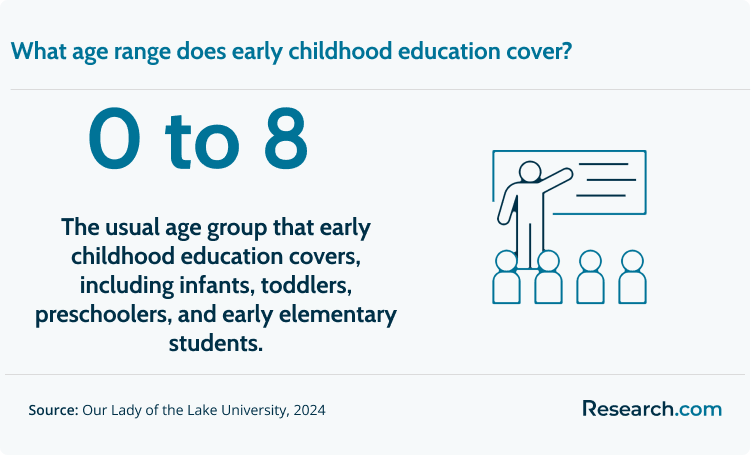
What age range does early childhood education cover?
Early childhood education usually refers to the period from birth to age eight. This includes infants, toddlers, preschool children, kindergarten students, and children in the early elementary grades, commonly through third grade.
The exact age or grade span depends on state definitions, employer requirements, and the credential itself. Many early childhood teaching licenses focus on Pre-K–3 because that range aligns with foundational literacy, numeracy, social-emotional development, and school readiness. Some childcare credentials are more focused on infants, toddlers, or preschool settings, while public school licensure may extend into kindergarten and early elementary classrooms.
If your goal is to enter the workforce quickly, short credential programs may help you build job-ready skills. Research.com’s guide to short certificate programs that pay well can help you compare faster training options, but you should still verify whether any certificate meets early childhood rules in your state.
| Age group | Common setting | Main teaching focus |
| Birth to toddler years | Infant-toddler programs, childcare centers, Early Head Start | Attachment, language exposure, sensory development, routines, safety, and caregiver communication. |
| Preschool years | Preschools, childcare centers, Head Start, public Pre-K | School readiness, social skills, early literacy, early math, play-based learning, and self-help skills. |
| Kindergarten to third grade | Public and private elementary schools | Reading foundations, writing, math, science exploration, classroom routines, and age-appropriate assessment. |
How does early childhood certification differ from K-12 teaching credentials?
Early childhood certification prepares teachers to work with young children during a highly developmental stage, while K-12 credentials cover broader grade levels and often emphasize academic subject instruction. The biggest difference is not only the age group. It is the teaching approach. Early childhood educators rely heavily on play, observation, family engagement, developmental screening, and social-emotional support.
| Category | Early childhood certification | K-12 teaching credential |
| Typical age or grade range | Birth to age eight, often Pre-K–3. | Elementary, middle, or high school, depending on license area. |
| Primary focus | Development, early learning, play-based instruction, safety, and family partnership. | Grade-level standards, academic subjects, classroom management, and assessment. |
| Common coursework | Child development, early literacy, observation, curriculum for young children, family engagement, and inclusive practice. | Pedagogy, subject methods, assessment, classroom management, and grade-band specialization. |
| Common exams | Praxis Early Childhood Education exam or state-specific early childhood tests. | Praxis Core, Praxis Subject Tests, or other state-required licensure exams. |
| Teaching environment | Preschool classrooms, childcare centers, Head Start, kindergarten, and early elementary grades. | Elementary, middle, and high school classrooms. |
Understanding child behavior also requires knowledge of both individual development and social context. For educators comparing related disciplines, Research.com’s explanation of sociology vs psychology can clarify how social systems and human behavior shape learning.
How much is the average salary for early childhood teachers for 2027?
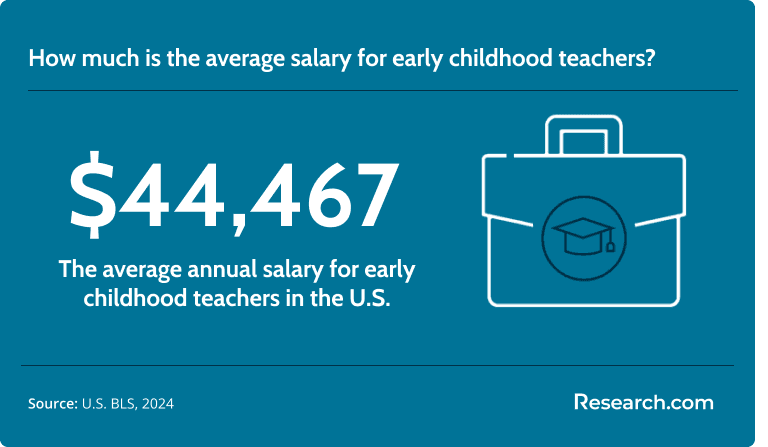
Early childhood teacher pay varies widely by state, city, employer, education level, licensure status, and years of experience. According to our research, the estimated total pay for an early childhood teacher is $47,032 per year, with an average base salary of $44,467 per year.
Salary data should be treated as a planning estimate, not a guarantee. A teacher working in a public school district may have a different salary structure than a teacher in a private preschool, childcare center, or nonprofit early learning program. Benefits, contract length, union agreements, local funding, and required credentials can also affect total compensation.
What affects early childhood teacher salaries?
- Location: Pay often reflects local cost of living, state funding, district budgets, and demand for qualified educators.
- Experience: Teachers with stronger classroom records, specialized skills, and longer work histories may qualify for higher pay or leadership roles.
- Work setting: Public schools and well-funded private programs may offer different salary and benefits structures than smaller childcare centers.
- Education level: A bachelor’s or master’s degree may improve eligibility for licensed teaching roles or advancement opportunities.
- Certification area: Specialized credentials, endorsements, or knowledge of what types of certifications are there for teachers can help educators choose pathways that match higher-responsibility roles.
| Salary factor | Why it matters | Question to ask before accepting a role |
| Base pay | The posted salary may not include benefits, contract length, or unpaid breaks. | Is this a full-year, school-year, hourly, or salaried position? |
| Benefits | Health insurance, retirement contributions, paid leave, and tuition support can change total compensation. | What benefits are included, and when do they begin? |
| Credential requirements | Some employers pay more for licensed teachers or degree holders. | Does pay increase after certification, licensure, or degree completion? |
| Advancement path | Lead teacher, mentor teacher, curriculum specialist, and director roles may offer higher pay. | What is the promotion structure for early childhood staff? |
What are the benefits of getting certified in early childhood education?
Early childhood certification can be worth it if you want better access to teaching jobs, eligibility for licensed settings, stronger classroom preparation, and clearer advancement options. It is especially important for anyone who wants to teach in public preschool, Head Start, kindergarten, or early elementary environments where credential rules are stricter.
- More employment options: Certified educators can qualify for roles that are closed to applicants without approved credentials.
- Stronger professional credibility: Certification signals that you have completed training in child development, safety, instruction, and assessment.
- Potential for higher earnings: Certification may support access to better-paid roles, although salary depends on employer, location, education, and experience.
- Better preparation for classroom realities: Coursework and supervised practice help teachers manage routines, behavior, family communication, and developmental differences.
- Clearer long-term career path: Credentials can support movement into lead teacher, specialist, mentor, director, or public school roles.
- Compliance with state or employer rules: In many settings, certification is not optional. It is a condition of employment.
If you are still deciding whether teaching fits your goals, reviewing the personal and professional reasons to become a teacher can help you compare motivation, workload, compensation, and career stability before committing to a credential program.
| Certification may be a good fit if... | You may want another route if... |
| You want to teach in public preschool, kindergarten, or early elementary grades. | You only want short-term childcare work and do not plan to advance. |
| You want a portable professional credential within your state’s education system. | You are unsure which state or age group you want to work with. |
| You want access to lead teacher or program leadership roles. | You need the fastest possible entry into employment and can start in an assistant role. |
| You want formal training in child development and early learning methods. | You prefer a related career in child services, family support, or youth programs rather than classroom teaching. |
Can you teach preschool without a certification?
In some settings, yes. Whether you can teach preschool without certification depends on your state, the type of program, the funding source, and the employer’s licensing requirements. Some private preschools, childcare centers, and faith-based programs may hire assistant teachers or preschool teachers without state teaching licensure, especially if applicants have experience, childcare training, an associate degree, or coursework in early childhood education.
Public preschool programs, Head Start, and accredited early learning centers are more likely to require a recognized credential, such as the Child Development Associate (CDA) credential, a bachelor’s degree in early childhood education, or state licensure. If you are considering overlapping roles in early elementary education, Research.com’s guide on how to become a kindergarten teacher explains another common pathway that may require formal licensure.
Teaching without certification can help you gain experience, but it may limit pay, promotion options, and access to public school jobs. A practical strategy is to begin in an assistant or aide role while completing the credential needed for lead teacher or licensed positions.
Teaching preschool with and without certification
| Path | Possible roles | Main advantage | Main limitation |
| Without certification | Assistant teacher, childcare worker, aide, private preschool staff member. | Faster entry into the field and a chance to gain experience. | Fewer public school options and limited advancement in many settings. |
| With CDA or equivalent credential | Preschool teacher, Head Start staff member, childcare lead teacher, center-based educator. | Recognized preparation for early childhood work. | May not meet public school licensure requirements. |
| With state teaching license | Public Pre-K teacher, kindergarten teacher, early elementary teacher, licensed lead teacher. | Broader access to regulated school-based roles. | Usually requires more education, testing, and supervised experience. |
What other jobs can you get with an early childhood education certification?
An early childhood education certification can lead to classroom, leadership, specialist, and program support roles. Your options depend on your credential level, degree, state rules, and experience.
- Preschool Teacher: Preschool teachers work with children typically aged 3 to 5 and focus on school readiness, social skills, early literacy, and foundational math. The average salary for a preschool teacher is $37,130 per year.
- Kindergarten Teacher: Kindergarten teachers support children around 5 to 6 years old as they begin formal elementary learning. The average salary for a kindergarten teacher is around $63,670 per year. It varies by location and experience but generally aligns with elementary school teacher salaries.
- Special Education Teacher: Special education teachers support young children with learning, mental, emotional, or physical disabilities. Some educators also explore art therapy masters programs to understand creative therapeutic approaches, although art therapy credentials are separate from teacher licensure. The average salary for a special education teacher in preschool settings is approximately $65,910 per year.
- Childcare Center Director: Directors oversee daily operations, staffing, compliance, family communication, budgets, and program quality. The average salary for a childcare center director is around $54,963 per year.
- Early Childhood Education Specialist: Specialists may develop curriculum, coach teachers, support program evaluation, and help improve early learning practices. The average salary for an early childhood education specialist is approximately $53,675 per year.
These salaries vary by geography, employer, experience, credential level, and job responsibilities. The chart below shows the average salary for occupations similar or related to early childhood education teaching:
How can I advance my career in early childhood education?
Career growth in early childhood education usually comes from one of four moves: earning a higher credential, specializing in a high-need area, moving into leadership, or building expertise in curriculum and program improvement. A teacher might begin as an assistant, become a lead teacher, earn state licensure, move into public Pre-K or kindergarten, and later pursue director, instructional coach, or specialist roles.
Advanced study can help if it is connected to a clear career goal. For example, an online master's in education may be useful for educators who want deeper preparation in instruction, curriculum design, assessment, or teacher leadership while continuing to work.
| Career goal | Credential or experience to consider | Best for |
| Become a lead preschool teacher | CDA credential, associate degree, bachelor’s degree, or state-approved early childhood credential. | Assistant teachers and childcare workers seeking more responsibility. |
| Teach in public school settings | Bachelor’s degree, teacher preparation program, exams, and state licensure. | Educators targeting Pre-K, kindergarten, or early elementary classrooms. |
| Work with children with disabilities | Early childhood special education coursework, endorsement, or licensure. | Teachers interested in intervention, inclusion, and individualized supports. |
| Move into administration | Leadership experience, director credentials, graduate study, and management training. | Educators who want to supervise staff, budgets, compliance, and program quality. |
| Become a curriculum or training specialist | Advanced coursework in curriculum, coaching, assessment, and adult learning. | Teachers who want to support other educators and improve program outcomes. |
What are the requirements to become an early childhood teacher?
The requirements to become an early childhood teacher depend on the state and role, but most pathways include education, supervised experience, background checks, and a credential or license. Before enrolling in a program, compare its requirements with the exact job title you want.
- Education: Many roles require coursework or a degree in early childhood education, child development, elementary education, or a related field. Flexible options such as online colleges with open enrollment may help working adults begin college-level study, but accreditation and state approval still matter.
- Certification or licensure: Requirements may include a CDA credential, state teaching license, early childhood endorsement, Praxis exam, or state-specific test.
- Field experience: Teacher preparation programs often include practicum hours, student teaching, supervised classroom work, or internships.
- Background checks: Early childhood educators typically must complete criminal background checks, child abuse clearances, fingerprinting, and health-related screenings.
- Professional development: Many states and employers require ongoing training to keep credentials active and maintain safe, current practice.
Step-by-step path to early childhood certification
- Choose your target role: Decide whether you want childcare, preschool, Head Start, public Pre-K, kindergarten, special education, or program leadership.
- Check state requirements: Review the credential rules for the state where you plan to work before choosing a school or training program.
- Select an approved program: Confirm that the program is accredited and accepted for the credential or license you need.
- Complete required coursework: Focus on child development, early literacy, family engagement, assessment, safety, and inclusive teaching.
- Gain supervised experience: Complete practicum, internship, or student teaching requirements in an approved early childhood setting.
- Pass required exams: Take Praxis or state-specific exams if your credential pathway requires them.
- Submit your application: Provide transcripts, test scores, background check results, fees, and documentation required by the licensing body.
- Plan for renewal: Track continuing education deadlines and professional development requirements from the beginning.
What certifications can I get for early childhood teaching?
Early childhood educators can pursue several credentials, but the right choice depends on your state, work setting, and long-term plan. Unlike unrelated professional credentials such as accounting certifications for beginners, early childhood credentials must be evaluated against education agency and childcare licensing requirements.
| Credential | What it is commonly used for | Best fit |
| Child Development Associate (CDA) Credential | A nationally recognized credential from the Council for Professional Recognition, often used in childcare, preschool, and Head Start settings. | Educators seeking an entry-level or widely recognized early childhood credential. |
| Associate or bachelor’s degree with state teaching license | A degree-based pathway that may lead to Pre-K–3 or Pre-K–6 licensure, depending on state rules. | Educators who want to teach in public school or licensed lead teacher roles. |
| Montessori Certification | Training for educators who want to teach in Montessori environments, often through organizations such as AMS or AMI. | Teachers seeking Montessori-specific classroom preparation. |
| National Board Certification Early Childhood Generalist | An advanced professional certification through the National Board for Professional Teaching Standards (NBPTS). | Experienced teachers who want advanced recognition of accomplished practice. |
| Early Childhood Special Education Certification | A credential or endorsement for working with young children who have disabilities or developmental delays. | Educators interested in inclusion, intervention, and specialized services. |
How to choose the right certification
- If you want the fastest entry: Look at CDA or assistant teacher pathways, then build toward a degree if needed.
- If you want public school eligibility: Choose a state-approved teacher preparation program leading to licensure.
- If you want to work in Head Start: Check current Head Start and employer-specific credential requirements before enrolling.
- If you want to specialize: Consider early childhood special education, bilingual education, literacy, or infant-toddler training.
- If you want leadership: Plan for experience, administrative training, and possibly graduate education.
How can I advance my career with cost-effective advanced degree options?
An advanced degree can help early childhood educators move into leadership, curriculum, administration, or policy-related roles, but it is not automatically the best investment for every teacher. Before enrolling, compare total cost, accreditation, state approval, transfer credit policies, schedule flexibility, and whether the degree aligns with a specific promotion path.
Educators considering doctoral-level leadership or administration roles may review cheapest online EdD programs as part of a cost comparison. The key is to avoid choosing a program only because it is inexpensive. A low-cost program still needs to be credible, properly accredited, and relevant to your target role.
Can advanced leadership degrees enhance early childhood education careers?
Leadership degrees can be useful for early childhood educators who want to manage programs, supervise teachers, design curriculum systems, lead community initiatives, or influence policy. These roles require more than classroom skill. They often involve budgeting, compliance, staff development, family partnerships, data use, and organizational change.
An online PhD in organizational leadership may appeal to educators interested in research, executive leadership, or systems-level work. However, it may not be necessary for lead teacher or center director roles. Compare the degree’s outcomes with your actual career target before committing to doctoral study.
What is the job outlook for early childhood teachers?
The employment outlook for preschool teachers is projected to grow 4 percent from 2023 to 2033, about as fast as the average for all occupations. Employment is expected to rise from 528,500 preschool teachers in 2023 to 551,800 by 2033.
Demand is supported by continued interest in early learning and preschool preparation. Public funding for preschool programs may also influence hiring, although opportunities vary by state and local budget. Over the decade, approximately 61,400 job openings for preschool teachers are expected each year, with many openings resulting from workers leaving the field, retiring, or moving into other occupations.
Early childhood educators who want a long-term leadership path may eventually compare teacher leadership, director, and school administrator requirements. Research.com’s guide to school principal certification requirements can help educators understand how school leadership credentials differ from early childhood teaching credentials.
The chart below shows the employment projection numbers for preschool teachers in 2023 and 2023:
What should you ask before choosing an early childhood certification program?
A certification program should be evaluated for fit, not just convenience. The wrong program can delay licensure, create transfer problems, or leave you with credits that do not meet state rules.
| Question | Why it matters |
| Is the program approved for my state and credential goal? | State approval is essential if you need licensure for public school or regulated roles. |
| What age or grade band does the credential cover? | A preschool credential may not qualify you for kindergarten or early elementary teaching. |
| Does the program include supervised field experience? | Many certification routes require practicum, internship, or student teaching hours. |
| What exams will I need to pass? | Testing requirements affect timeline, preparation, and total cost. |
| What is the full cost beyond tuition? | Books, fees, background checks, exams, transportation, and lost work time can add up. |
| Will credits transfer to a higher degree later? | Transfer policies matter if you plan to move from a certificate to an associate, bachelor’s, or graduate program. |
| Does online study meet field placement rules? | Online coursework may be flexible, but in-person classroom experience is often still required. |
How can I renew and update my early childhood teaching certification?
Most early childhood credentials are not permanent without renewal. Renewal may require continuing education, professional development hours, updated background checks, renewal fees, or evidence of active teaching experience. Exact rules vary by state and credential type.
Do not wait until the renewal deadline to check requirements. Keep records of completed training, certificates, transcripts, and employer verification. If you move to another state, review whether your credential transfers or whether you need additional coursework, exams, or an application review. For state-specific guidance, Research.com’s teacher requirements resource can help you begin comparing rules.
What financial aid options are available for early childhood education certification?
Financial aid for early childhood certification may include institutional scholarships, state grants, federal student aid for eligible degree programs, employer tuition reimbursement, workforce development funding, and professional association scholarships. Availability depends on the school, program type, student eligibility, and whether the credential is offered through an accredited institution.
Before borrowing, calculate the total cost of the credential against the roles it can realistically help you obtain. If you are exploring advanced degree options later, resources such as 2 year Ed.D programs online can help you compare accelerated formats, but speed should not outweigh accreditation, fit, and career relevance.
Ways to reduce certification costs
- Ask employers whether they reimburse CDA, degree, or licensure expenses.
- Choose programs with transfer pathways if you plan to continue into a degree.
- Compare tuition, fees, exam costs, background check costs, and required materials.
- Use community college pathways when they meet state requirements and transfer cleanly.
- Avoid programs that cannot clearly document accreditation, approval, or licensure alignment.
Can an online degree in educational leadership improve my teaching impact?
An online leadership degree can help experienced educators strengthen program planning, teacher coaching, data-informed decision-making, family engagement systems, and school improvement work. It may be especially useful for teachers who want to become directors, coordinators, instructional coaches, or administrators while continuing to work.
However, online leadership degrees should be chosen carefully. Confirm whether the program is designed for classroom leadership, school administration, childcare leadership, policy work, or doctoral preparation. If your goal is administrative advancement, an online degree in educational leadership may provide a flexible path, but you should verify whether it meets any licensure or endorsement requirements in your state.
What alternative career pathways can I pursue with my early childhood education certification?
Early childhood certification can support more than classroom teaching. Experienced educators may move into curriculum support, family engagement, early intervention coordination, childcare licensing support, nonprofit program work, parent education, resource development, or children’s services.
Some educators also combine early learning expertise with adjacent fields. For example, knowledge of children’s literature, learning resources, and literacy programming may overlap with pathways described in Research.com’s guide to jobs you can get with a library science degree. This does not replace teacher certification, but it may help educators think creatively about literacy, media, and community learning roles.
How can professional networking and interdisciplinary mentorship boost my early childhood education career?
Networking helps early childhood educators learn about job openings, credential changes, professional development, classroom strategies, and leadership opportunities. Strong mentors can also help teachers avoid common career mistakes, such as choosing the wrong credential, delaying renewal, or moving into leadership before building enough classroom experience.
Mentorship does not have to come only from early childhood teachers. Program directors, special educators, social workers, librarians, literacy specialists, and administrators can all provide useful perspectives. Educators interested in literacy-rich community roles may also explore what a career in library science involves, especially if they enjoy children’s programming, reading development, and family learning events.
What emerging trends are reshaping early childhood teacher certification?
Early childhood certification is being shaped by several practical shifts: growing use of classroom technology, stronger attention to social-emotional learning, greater demand for inclusive practices, increased focus on family engagement, and continued pressure to improve compensation and retention in early learning roles. Technology can support documentation, parent communication, assessment, and classroom management, but it does not replace developmentally appropriate interaction with children.
Some educators are also building broader skill sets across education, social services, child development, literacy, and community programming. A bachelor of interdisciplinary studies degree may be useful for students who want cross-disciplinary preparation, but those seeking licensed teaching roles must still verify state educator certification requirements.
Common mistakes to avoid
- Choosing a program before checking state rules: A credential that works in one state or setting may not qualify you in another.
- Focusing only on tuition: Exams, background checks, books, practicum requirements, transportation, and time away from work affect total cost.
- Assuming online automatically means easier: Online coursework may be flexible, but field placements, exams, and deadlines can still be demanding.
- Ignoring accreditation and approval: A program should clearly state whether it is accredited and whether it leads to the credential you need.
- Assuming certification guarantees a salary: Pay depends on location, employer, role, experience, education, and funding.
- Waiting too long to plan renewal: Missing renewal requirements can disrupt employment or delay advancement.
- Choosing an advanced degree without a career goal: Graduate study can help, but only when it connects to licensure, leadership, specialization, or measurable career advancement.
Key Insights
- Early childhood teaching certification is state-specific, so your first step should be checking the requirements where you plan to work.
- Early childhood education typically covers birth to age eight, but credentials may focus on different age or grade bands.
- Public preschool, kindergarten, and early elementary jobs usually require more formal licensure than many private childcare or preschool roles.
- The estimated total pay for an early childhood teacher is $47,032 per year, with an average base salary of $44,467 per year, but compensation varies by employer, location, credentials, and experience.
- Preschool teacher employment is projected to grow 4 percent from 2023 to 2033, rising from 528,500 employed preschool teachers in 2023 to 551,800 by 2033.
- The best certification path depends on your target role: CDA for many childcare and preschool pathways, state licensure for public school teaching, and specialized credentials for Montessori, special education, or advanced professional recognition.
- Before enrolling, confirm accreditation, state approval, field placement requirements, exam requirements, transfer options, renewal rules, and total cost.
Resources:
- Glassdoor. (2025). Salary: Early Childhood Teacher in the United States 2025. https://www.glassdoor.com
- National University. (n.d.). Early Childhood Education vs. Elementary Education. https://www.nu.edu
- U.S. Bureau of Labor Statistics. (2024). Occupational Outlook Handbook: Preschool Teachers. https://www.bls.gov
- ZipRecruiter. (2025). Salary: Early Childhood Education Specialist. https://www.ziprecruiter.com
Other Things You Should Know About Early Childhood Teaching Certification and Requirements
Most states require a fingerprint-based criminal background check before issuing early childhood certification. Many also require a child abuse and neglect registry check, and some require a federal FBI screening. Results must usually be cleared before the license is approved or renewed.
In 2027, aspiring early childhood educators must complete a bachelor's degree in Early Childhood Education and pass a state-specific certification exam. Additionally, candidates must undergo a background check and obtain supervised teaching experience through accredited programs or internships.