
2027 Reasons to Become a Teacher

Co-Founder and Chief Data Scientist
Choosing teaching today requires a realistic view of both sides of the profession. Many future educators are drawn to the idea of helping students grow, but they also hear concerns about pay, burnout, classroom behavior, workload, and teachers leaving the field. Those concerns are valid: NCES data from 2024 showed that 8% of public school teachers and 12% of private school teachers left the profession.
Still, teaching remains a meaningful and practical career path for the right person. Schools continue to need qualified educators, the profession offers multiple advancement routes, and classroom work is changing through online learning, AI tools, international teaching, and specialized credentials. This guide explains the strongest reasons to become a teacher in 2025, what the career really offers, where the challenges are, and how to decide whether teaching fits your goals.
Quick Answer: Is Teaching Still Worth Considering?
Yes—teaching can still be a worthwhile career if you value purpose-driven work, steady public-service employment, student impact, and long-term professional growth. It is not the best fit for someone seeking fast salary growth, low emotional labor, or a routine desk job. The strongest candidates are people who enjoy communication, patience, structure, creativity, and continuous learning.
- Median teacher salaries in 2025 are $63,680 for elementary teachers, $65,220 for high school teachers, and $84,380 for postsecondary teachers.
- K-12 employment is projected to decline by 1%, but more than 170,000 openings are still expected each year.
- Among newer teachers, 67% say their work is fulfilling, the highest satisfaction rate across experience levels.
- AI tools, adaptive platforms, digital classrooms, and virtual instruction are changing how teachers plan, assess, and support students.
- Teaching can lead to international school roles, online instruction, tutoring, ESL work, leadership, curriculum design, and higher education careers.
- The skills teachers build—leadership, communication, organization, conflict resolution, and coaching—transfer well beyond the classroom.
- What are the strongest reasons to become a teacher?
- Is teaching a stable career for 2027?
- How much do teachers make for 2027?
- How does teaching compare with other education careers?
- Can teachers work internationally or online?
- What parts of teaching feel most rewarding?
- Should you earn a master's degree in teaching?
- What certification rules apply by state?
- How can specialized online degrees strengthen teaching expertise?
- Can a doctoral degree in education improve career options?
- How serious is teacher burnout, and how can it be managed?
- How can educational leadership training change your career path?
- What transferable skills do teachers develop?
- What classroom technologies are teachers using now?
- How can UX design improve digital learning?
- Can organizational leadership training expand a teacher's influence?
- Can an MFA in creative writing support better teaching?
- How do mentorship and professional networks help teachers advance?
- What steps do you take to become a teacher?
What are the strongest reasons to become a teacher?
Teaching attracts people who want their work to matter every day. Pew Research Center data shows that newer teachers are especially likely to report meaning in their jobs: 67% of teachers with five years or less of experience say they find their work fulfilling often or extremely often. That does not mean teaching is easy. It means many educators still find the purpose of the work strong enough to make the challenges worthwhile.
The best reasons to become a teacher are not only emotional. They include career stability, flexible pathways, subject specialization, leadership opportunities, and the chance to build skills that remain useful even if you later move into another education-related role.
1. Teaching gives daily work a clear purpose
Teachers see the results of their work in real time: a student finally understanding a skill, gaining confidence, reading more fluently, solving a difficult problem, or planning for college or a career. In 2024, 56% of public school teachers said they often or very often found their work fulfilling, and that figure rose to 67% among teachers with five years or less of experience.
2. Schools still need qualified educators
Even when overall employment projections are flat or slightly declining, districts still hire teachers every year because educators retire, change schools, move into leadership, or leave the profession. Shortages are often more pronounced in areas such as math, science, special education, bilingual education, rural districts, and some urban school systems.
3. Teaching can offer stronger employment continuity than many private-sector jobs
Public education is tied to an essential community function. While budgets, enrollment, and policy changes can affect hiring, schools cannot simply eliminate the need for instruction. Public school roles may also come with structured salary schedules, benefits, retirement systems, union representation in some states, and clearer employment procedures than many private-sector positions.
4. The career has multiple advancement routes
Teachers do not have to remain in the same classroom role forever. Experienced educators can become department chairs, instructional coaches, curriculum specialists, principals, online instructors, teacher mentors, education consultants, or college faculty. Some choose short credentials or affordable online graduate certificate options to build expertise without committing immediately to a full graduate degree.
5. The school calendar can support predictable planning
Teaching is demanding during the academic year, and many educators work beyond contract hours. Still, the schedule is often more predictable than roles requiring frequent evening, weekend, or travel commitments. Holidays, school breaks, and summer schedules can help some teachers plan family time, graduate study, travel, or additional income opportunities.
6. Teachers build meaningful relationships with students
A major reason many educators stay is the connection they form with students. Teachers often become trusted adults who provide academic help, encouragement, consistency, and guidance. Pew Research Center reported in 2024 that 22% of teachers wanted the public to understand how much they care about their students.
7. Teaching keeps you learning
Curriculum standards, learning science, technology, assessment methods, student needs, and classroom tools continue to change. Good teachers keep refining their practice. That ongoing learning can be intellectually rewarding for people who enjoy mastering content and improving how they explain it.
8. Teaching can lead to global and remote work
Educators may work in international schools, English-language programs, online K-12 schools, tutoring platforms, virtual colleges, or corporate training. These options can appeal to teachers who want travel, location flexibility, or a career that extends beyond a traditional district classroom.
9. Teaching develops skills that employers value in many fields
Teachers plan, present, coach, document progress, manage conflict, analyze performance, adapt quickly, and communicate with many audiences. Those abilities are useful in training, consulting, human resources, nonprofit leadership, instructional design, educational technology, and management.
10. Education technology is creating new ways to teach
AI-supported tutoring, adaptive learning software, learning management systems, virtual platforms, and interactive assessment tools are changing classroom practice. Teachers who use these tools thoughtfully can personalize instruction, reduce some administrative tasks, and prepare students to use technology responsibly.
| Reason to Teach | Best Fit For | Reality Check |
| Purpose and student impact | People motivated by helping others grow | Progress can be slow, and results are not always immediate |
| Job continuity | Those who value structured public-service work | Hiring strength depends on state, district, grade level, and subject area |
| Career growth | Educators interested in leadership, coaching, or curriculum | Advanced roles often require graduate study or additional credentials |
| Schedule predictability | People who prefer an academic-year rhythm | Planning, grading, meetings, and family communication can extend work hours |
| Technology-driven teaching | Teachers who enjoy experimenting with digital tools | Technology requires judgment, training, and careful classroom management |
Is teaching a stable career for 2027?
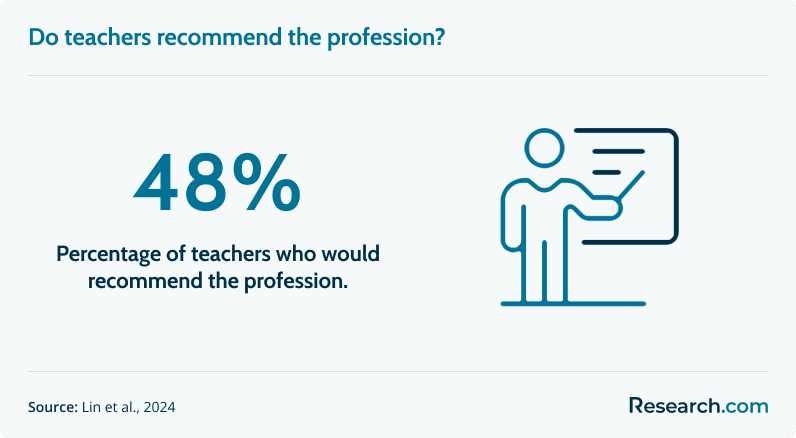
Teaching remains relatively stable for 2027, but stability varies by subject, state, district funding, grade level, and credential area. The most realistic answer is this: K-12 employment is not projected to grow broadly, yet schools will still need large numbers of teachers each year to replace workers who retire, transfer, or leave the field.
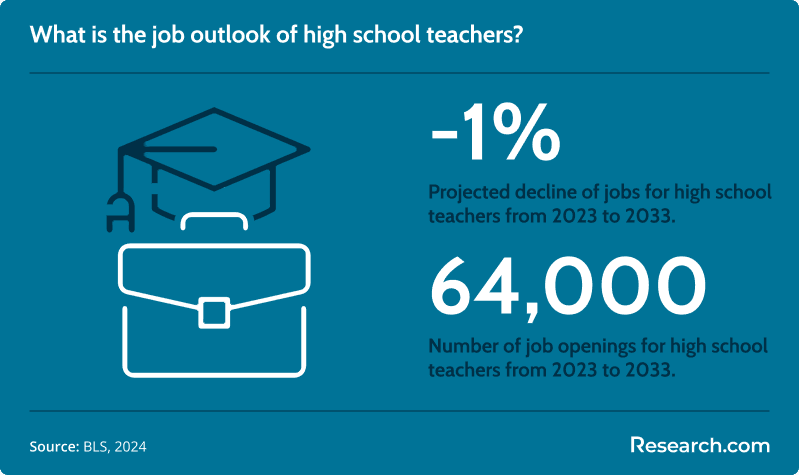
- K-12 openings remain substantial: BLS data published in 2024 projects a 1% decline in employment for kindergarten, elementary, and high school teachers from 2023 to 2033. Even with that decline, the labor market still includes 106,500 openings per year for elementary teachers and 64,000 openings per year for high school teachers. These openings largely reflect replacement hiring rather than expansion.
- Higher education has a stronger growth projection: Postsecondary teaching is projected to grow 8% from 2023 to 2033, with about 118,900 new postsecondary teacher openings each year. This path can be attractive for educators who want to teach advanced subjects, conduct research, or work with adult learners.
- Subject area matters: Teachers in hard-to-staff fields such as STEM, special education, and bilingual education may find stronger opportunities than candidates in oversupplied subjects or regions.
- Location can change the outlook: Rural and urban districts may have more difficulty filling positions than suburban districts with high applicant volume. State funding, enrollment trends, and certification rules also influence hiring.
- Credentials can improve resilience: Advanced training can help educators move into leadership, curriculum, administration, or college-level instruction. Some teachers consider the fastest EdD online options when they want a practice-focused doctorate while continuing to work.
| Teaching Path | Stability Factors | When It May Be a Good Choice |
| Elementary education | Large annual replacement hiring; employment projected to decline by 1% for kindergarten, elementary, and high school teachers | You enjoy broad instruction, younger learners, and long-term classroom relationships |
| High school teaching | 64,000 openings per year for high school teachers | You want to teach a specific subject and work with adolescents preparing for college, careers, or trades |
| Special education, STEM, or bilingual education | Often identified as high-need areas | You want a credential area that may offer stronger hiring opportunities in many districts |
| Postsecondary teaching | Projected to grow 8% from 2023 to 2033, with about 118,900 openings annually | You are willing to pursue graduate study and may accept a longer pathway into full-time roles |
How much do teachers make for 2027?
Teacher pay for 2027 depends heavily on grade level, state, district, years of service, union or contract structure, credentials, and whether the role is in a public, private, charter, online, or postsecondary setting. The broad salary range cited for teachers is $47,989 to $84,380, but that range does not capture every local pay scale or benefit package.
The 2024 BLS median salary figures are:
- Elementary school teachers, except special education: $63,680
- High school teachers: $65,220
- Postsecondary teachers: $84,380
For a broader all-teacher figure, 2025 Zippia data lists the average salary for all teachers at $47,989. This helps explain why early-career teachers or teachers in lower-paying regions may earn below BLS median figures, while experienced educators in higher-paying districts can earn more.
Entry-level teachers commonly earn between $30,000 and $50,000 annually, depending on the state and district. After 10 or more years, salaries often move above $75,000, especially for educators in math, science, special education, advanced-degree roles, or higher-paying regions. Some top earners exceed $100,000, particularly when graduate education, leadership responsibilities, or senior salary steps are involved.
Pay also differs by employer type. Public schools often have clearer salary schedules and benefits. Private schools may pay less than public schools. Charter school compensation varies widely. New York, California, and Massachusetts offer the highest pay, while rural areas generally pay less.
| Role or Career Stage | Salary Figure Stated | What to Consider |
| All teachers | $47,989 | Reflects Zippia's 2025 average salary figure and may include lower-paid or early-career roles |
| Elementary school teachers | $63,680 | BLS 2024 median for elementary school teachers, except special education |
| High school teachers | $65,220 | BLS 2024 median; subject area and district pay schedules matter |
| Postsecondary teachers | $84,380 | BLS 2024 median; graduate education is usually required |
| Entry-level teachers | $30,000 to $50,000 | State, district, certification area, and school type strongly affect starting pay |
| Experienced teachers | Often above $75,000 after 10 or more years | Advanced degrees, hard-to-staff subjects, and leadership duties can increase earnings |
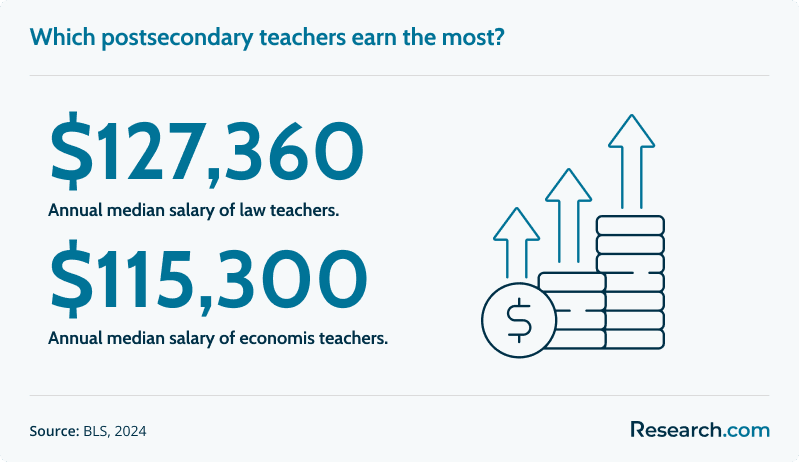
The chart below lists the median annual salary of select teacher occupations, as reported by the BLS in 2024.
How does teaching compare with other education careers?
Teaching is only one way to build a career in education. If you like helping people learn but are unsure about classroom management, grading, parent communication, or state testing pressures, it is worth comparing teaching with adjacent roles before choosing a degree or certification pathway.
- School administration: Principals and instructional coordinators often earn higher pay, commonly $80,000 to $110,000 annually. These positions focus on leadership, staffing, curriculum, school operations, and compliance. They usually require advanced degrees and previous education experience.
- School counseling: Counselors support students with academic, career, social, and personal concerns. The median salary is $61,710, and a master's degree in counseling or psychology is often required. The work can be meaningful but may involve large caseloads and emotionally complex situations.
- Library and information careers: A library science degree can prepare graduates for school librarian, archivist, or information specialist roles. BLS data places school librarian earnings around $64,370 annually. These roles may involve less daily classroom management and more research, literacy, media, and information access work.
- Corporate training and instructional design: Education-minded professionals who prefer adult learners or business settings may choose corporate training. Instructional designers create training materials and can earn $70,000 to $90,000 annually. Remote work may be more common in this path than in traditional K-12 teaching.
- Higher education: Postsecondary teachers have a median salary of $84,380 annually. College teaching can involve research, specialized courses, advising, and publication expectations. Many roles require a master's or doctoral degree, and some faculty begin with adjunct or contract work before finding more secure positions.
| Career Option | Best For | Main Trade-Off |
| K-12 teacher | People who want direct student impact and daily instruction | Workload, classroom management, and emotional labor can be significant |
| School administrator | Educators who want broader leadership influence | Less direct teaching and more responsibility for operations and personnel |
| School counselor | People focused on student support and development | High caseloads and sensitive student issues may create stress |
| School librarian or media specialist | Professionals interested in literacy, research, and information access | Roles may be limited depending on district staffing and budgets |
| Instructional designer | Educators who want to build learning materials outside K-12 classrooms | May require portfolio development, software skills, or corporate experience |
| Postsecondary teacher | Subject specialists who want to teach adults or college students | Graduate education and early-career contract roles may be part of the path |
Can teachers work internationally or online?
Yes. Teaching can extend beyond a local classroom through international schools, ESL programs, virtual K-12 schools, online tutoring, college courses, and corporate training. Educators interested in English-language instruction often start by reviewing online ESL teaching certification and requirements because ESL roles can open doors to both remote and overseas opportunities.
- Teaching abroad: International schools, private language centers, government programs, and overseas institutions hire teachers in many countries. China, South Korea, Spain, and the UAE are often associated with demand for English teachers. Some employers require a teaching license, while others accept TEFL or TESOL certifications. Compensation packages may include housing or travel stipends, but requirements and benefits vary by employer and country.
- Online K-12 teaching: Accredited virtual schools hire certified teachers for structured online classes. These roles may include scheduled instruction, grading, family communication, and benefits similar to traditional teaching, depending on the employer.
- Virtual tutoring: Teachers may work independently or through platforms such as VIPKid, Tutor.com, and Wyzant. Tutoring can be flexible, but income depends on hourly rates, subject demand, schedule availability, and client volume.
- Online college teaching and corporate training: Postsecondary instructors may teach online college courses, while companies hire trainers to create and deliver employee learning programs. These roles often require graduate study, specialized experience, or technical training design skills.
| Flexible Teaching Option | Typical Requirements | Best Fit |
| International school teaching | Often a teaching license and classroom experience | Certified teachers who want to live and work abroad |
| ESL teaching | May require TEFL or TESOL certification; some roles require a degree | Teachers interested in language instruction and cross-cultural work |
| Online K-12 teaching | Usually state certification for public or accredited programs | Educators who want structured remote teaching |
| Virtual tutoring | Subject expertise; certification may help but is not always required | Teachers seeking flexible supplemental or freelance income |
| Online higher education | Often a master's or doctoral degree | Subject experts who want to teach adult learners |
What parts of teaching feel most rewarding?
Many people researching how long it takes to become a teacher are not only asking about the timeline. They are also asking whether the effort leads to meaningful work. For many educators, the answer comes from moments that are difficult to measure but hard to forget.
- The breakthrough moment: A student struggles for days or weeks, then suddenly understands a concept. That shift can make the preparation and patience feel worthwhile.
- Student confidence: Teachers often watch students move from “I can’t do this” to solving problems, reading independently, presenting ideas, or applying to college.
- Long-term influence: Former students sometimes return years later to thank a teacher for encouragement, structure, or belief at a critical time.
- Support beyond academics: Teachers may help students navigate stress, family instability, social challenges, or low confidence. For some students, school provides essential consistency.
- Personal growth: Teaching requires patience, flexibility, reflection, and humility. Many educators grow as communicators, mentors, and leaders because of the work.
Should you earn a master's degree in teaching?
A master's degree in teaching can make sense if it supports a clear goal: higher salary placement, state requirements, subject specialization, instructional improvement, or advancement into leadership or curriculum roles. It may not be necessary immediately if your state allows entry with a bachelor's degree and teacher preparation program, but many educators eventually consider graduate study for long-term growth.
Online options can help working teachers continue their education without leaving the classroom. If cost is the main concern, compare programs carefully and review options such as the cheapest master's in education before committing.
What certification rules apply by state?
Teacher licensure is state-specific. Requirements can include an approved preparation program, student teaching, content exams, pedagogy exams, background checks, renewal credits, and continuing education. A license that works in one state may not automatically qualify you in another, so you should confirm the rules before choosing a program.
Use teaching degree requirements as a starting point to understand exams, credential levels, renewal expectations, and state-by-state differences.
How can specialized online degrees strengthen teaching expertise?
Specialized degrees can help teachers deepen content knowledge, move into new subject areas, or build stronger interdisciplinary lessons. For example, a teacher who wants to strengthen historical analysis, research assignments, or social studies instruction might explore an accredited online history degree. The best choice depends on whether the program aligns with your teaching license, district salary schedule, and long-term career direction.
Can a doctoral degree in education improve career options?
A doctoral degree in education, including an EdD, can help experienced educators move toward district leadership, curriculum strategy, faculty roles, policy work, or organization-wide improvement. It is usually most valuable when you already know the kind of influence you want beyond your own classroom. If affordability is a priority, compare tuition, dissertation requirements, transfer policies, and program length when reviewing the most affordable EdD programs.
How serious is teacher burnout, and how can it be managed?
Burnout is one of the most important realities to consider before becoming a teacher. The work can include emotional strain, long planning hours, large class sizes, difficult student needs, parent communication, testing pressure, and administrative demands. Burnout does not mean teaching is a poor career; it means teachers need sustainable habits and supportive work environments.
- Set boundaries early: Teachers who define work hours, grading routines, email limits, and personal time are more likely to sustain their energy.
- Use mentorship and peer support: New teachers benefit from experienced colleagues who can share classroom routines, parent communication templates, pacing strategies, and behavior management approaches.
- Consider role flexibility: If a traditional classroom becomes overwhelming, related options such as tutoring, curriculum development, instructional coaching, online teaching, or teacher training may provide a better fit.
- Track small wins: Student growth is not always dramatic. Noticing incremental progress can help teachers remember why the work matters.
- Keep learning, but be strategic: Professional development should solve real classroom problems, not add unnecessary workload. Some educators explore creative writing programs online to strengthen communication, storytelling, and lesson design.
| Common Burnout Risk | Better Strategy |
| Trying to grade everything in depth | Use rubrics, targeted feedback, peer review, and formative checks |
| Answering messages at all hours | Communicate response windows and keep consistent boundaries |
| Planning every lesson from scratch | Use curriculum resources, collaborate with teams, and revise over time |
| Working in isolation | Find mentors, grade-level teams, professional groups, or instructional coaches |
| Ignoring signs of exhaustion | Adjust workload, seek support, and consider role changes before burnout becomes severe |
The chart below lists the top reasons why public school teachers voluntarily moved to other schools, as reported by the NCES in 2024.
How can educational leadership training change your career path?
A master's degree in educational leadership is designed for educators who want influence beyond one classroom. These programs often focus on school improvement, supervision, curriculum planning, education law, data-informed decision-making, and organizational change. Teachers who want to become assistant principals, principals, department leaders, instructional coaches, or program directors may find this pathway useful.
Before enrolling, compare licensure alignment, fieldwork requirements, cost, and whether the credential meets administrative requirements in your state. A good starting point is reviewing best educational leadership master's programs online.
What transferable skills do teachers develop?
Teaching builds a portfolio of skills that can be used in education and beyond. Even educators who eventually move out of the classroom often carry valuable experience into training, consulting, advising, management, communications, and program development. Some use those skills in an educational consultant career path.
- Public speaking: Teachers explain ideas to groups every day, which translates well to training, presentations, sales, consulting, and leadership.
- Time management: Lesson planning, grading, meetings, deadlines, and student support require constant prioritization.
- Conflict resolution: Teachers mediate disagreements, communicate with families, and manage classroom dynamics.
- Adaptability: A lesson may need to change quickly based on student understanding, technology issues, or unexpected classroom needs.
- Mentoring and coaching: Teachers help learners set goals, practice skills, reflect on progress, and improve performance.
- Writing and communication: Educators write lesson plans, reports, emails, feedback, rubrics, and documentation for different audiences.
- Emotional intelligence: Teachers learn to read group dynamics, respond to frustration, and support people with different needs.
What classroom technologies are teachers using now?
Teachers in 2027 use technology to plan lessons, personalize practice, assess learning, communicate with families, and manage classroom materials. The strongest teachers do not use technology simply because it is new. They use it when it improves learning, saves time, increases accessibility, or gives students better feedback.
- AI-supported tutoring and explanation tools: Tools such as ChatGPT can help students generate explanations or practice questions, but teachers must teach ethical use, source checking, academic honesty, and critical thinking.
- Interactive learning platforms: Kahoot! and Nearpod can make review, polling, and participation more engaging. Teachers still need to balance screen time and ensure activities support learning goals.
- Virtual and augmented reality: VR and AR can make science, history, geography, and technical concepts more immersive, though cost and access can limit adoption.
- Learning management systems: Google Classroom and Canvas help organize assignments, grades, feedback, materials, and communication. The challenge is keeping systems clear rather than overwhelming students.
- Automated grading tools: AI-based grading can reduce some workload, but it may not fully evaluate creativity, reasoning, writing nuance, or complex problem-solving.
Technology is now part of teaching, but credentialing still comes first for most public school roles. Candidates should understand how to get a teaching credential before building a long-term classroom technology plan.
How can UX design improve digital learning?
User experience design can help teachers and instructional designers build online materials that are easier to navigate, more accessible, and more engaging. UX principles are useful when creating digital lessons, organizing learning management systems, designing quizzes, reducing student confusion, and improving online course flow. Educators who want to strengthen this skill set can review best online UX design programs.
Can organizational leadership training expand a teacher's influence?
A doctorate in organizational leadership may fit educators who want to lead large-scale initiatives, manage complex teams, influence policy, or improve systems across schools, districts, nonprofits, or education companies. This path is different from classroom-focused graduate study because it emphasizes organizational behavior, strategic planning, change management, and decision-making.
Can an MFA in creative writing support better teaching?
A creative writing MFA can help teachers improve storytelling, writing instruction, feedback methods, curriculum design, and interdisciplinary projects. It may be especially useful for English teachers, writing instructors, literacy specialists, and educators who want to teach creative writing or build stronger writing-centered lessons. To understand possible academic and career uses, review creative writing MFA degree careers.
How do mentorship and professional networks help teachers advance?
Strong teachers rarely grow alone. Mentors, professional learning communities, subject-area associations, online educator groups, and district networks can help teachers solve classroom problems faster, find leadership opportunities, learn new tools, and avoid isolation. Networks can also point educators toward specialized professional development, graduate study, and cost-conscious options such as affordable masters of fine arts online programs when those programs match a teacher's goals.
What steps do you take to become a teacher?
The path to becoming a teacher usually includes a degree, teacher preparation, supervised classroom experience, state certification, and job applications. The exact requirements depend on the state, grade level, subject area, and school type.
- Earn a bachelor's degree: Most aspiring teachers complete an education major or a subject-area degree with teacher preparation. Students looking for a shorter timeline sometimes compare the fastest bachelor degree online programs, but they should confirm that any program meets teacher licensure requirements.
- Complete an approved teacher preparation program: Preparation programs typically include methods courses, classroom observation, and student teaching. Career changers may qualify for alternative certification in some states.
- Pass required exams and background checks: Public school teachers generally need state licensure, which may require content exams, pedagogy exams, fingerprinting, and other state-specific steps.
- Apply for certification: Certification rules differ by state. Private schools may have different expectations, and some may not require the same public school license.
- Consider graduate study if it supports your goals: Some states require a master's degree after initial licensure, while other teachers pursue graduate programs for salary advancement, specialization, or leadership roles.
- Apply to schools strategically: Compare districts by mentoring support, class size, planning time, salary schedule, benefits, curriculum resources, leadership culture, and turnover patterns.
Common Mistakes to Avoid Before Choosing Teaching
- Choosing a program without checking state approval: A degree alone may not qualify you for licensure if the program is not accepted by your state.
- Looking only at tuition: Fees, testing costs, student teaching requirements, commuting, technology, and lost work hours can change the real cost.
- Assuming every online program leads to certification: Some online education degrees are not designed for initial licensure.
- Ignoring transfer credit policies: Transfer rules can affect cost and graduation timeline, especially for career changers or community college students.
- Relying only on rankings: Program fit, accreditation, licensure alignment, field placement quality, and student support matter more than rank alone.
- Assuming salary outcomes are guaranteed: Pay depends on district contracts, state funding, experience, credentials, and local salary schedules.
Questions to Ask Before Enrolling in a Teacher Preparation Program
| Question | Why It Matters |
| Is the program approved for teacher licensure in my state? | State approval determines whether the degree can lead to certification |
| What exams will I need to pass? | Testing requirements affect cost, timeline, and preparation |
| How is student teaching arranged? | Field placement quality can shape your confidence and employability |
| Can I transfer previous credits? | Transfer credit can reduce time and tuition |
| Does the program support career changers? | Adult learners may need flexible scheduling and alternative pathways |
| What are the local hiring outcomes? | District relationships and placement support can affect job search success |
Teaching has several entry points, but the safest pathway is the one that matches your state's licensure rules and your long-term career goals. For students comparing education careers, that planning process is one of the most important reasons to study the profession carefully before enrolling.
Here's What Graduates Have to Say About Becoming a Teacher
-
: "
I did not expect to build my career in special education, but once I began working with my students, I knew I had found the right place. Each small breakthrough reminds me why the work matters. Teaching has made me more patient, creative, and grounded, and my students continue to motivate me every day. — Amir
"
-
: "
Teaching high school math showed me that confidence can change everything. Some students started the year believing algebra was impossible for them, and later they were explaining problems to classmates. Watching that transformation made the hard days worth it. — Helena
"
-
: "
I wanted a career that would let me experience the world, and teaching English gave me that chance. In South Korea, I built relationships across cultures, learned a new language, and helped students become more confident in their own. Teaching opened doors for them and for me. — Zachary
"
References
- Bureau of Labor Statistics (BLS). (2024a). Elementary, Middle, and High School Principals. Occupational Outlook Handbook. BLS.
- Bureau of Labor Statistics (BLS). (2024b). High School Teachers. Occupational Outlook Handbook. BLS.
- Bureau of Labor Statistics (BLS). (2024c). Kindergarten and Elementary School Teachers. Occupational Outlook Handbook. BLS.
- Bureau of Labor Statistics (BLS). (2024d). Librarians and Library Media Specialists. Occupational Outlook Handbook. BLS.
- Bureau of Labor Statistics (BLS). (2024e). Postsecondary Teachers. Occupational Outlook Handbook. BLS.
- Bureau of Labor Statistics (BLS). (2024f). School and Career Counselors and Advisors. Occupational Outlook Handbook. BLS.
- Lin, L., Parker, K., & Horowitz, J. M. (2024). Job satisfaction among K-12 teachers. Pew Research Center.
- National Center for Education Statistics (NCES). (2024). Teacher Turnover: Stayers, Movers, and Leavers. Preprimary, Elementary, and Secondary Education. NCES.
- Schaeffer, K. (2024). Key facts about public school teachers in the U.S. Pew Research Center.
Key Insights
- Teaching is still a strong career option for people who want meaningful work, but it should be chosen with a realistic understanding of workload, pay, certification rules, and burnout risk.
- K-12 employment is projected to decline by 1%, yet annual openings remain large because schools need replacements for teachers who retire, move, or leave the field.
- Salary depends heavily on location, employer type, experience, grade level, and credentials; median figures range from $63,680 for elementary teachers to $84,380 for postsecondary teachers.
- The best teaching opportunities often come from strategic choices: high-need subjects, strong preparation programs, state-approved licensure pathways, and supportive districts.
- Teaching can lead to many other roles, including administration, counseling, library science, instructional design, tutoring, international education, online teaching, and consulting.
- Before enrolling in a program, confirm state approval, certification outcomes, student teaching arrangements, transfer credit rules, and total cost—not just tuition.
Other Things You Should Know About Becoming a Teacher
In 2027, aspiring teachers typically need a bachelor's degree in education and a valid teaching license, which often requires passing the PRAXIS or an equivalent examination. Requirements may vary by state or country, so checking with local education authorities is advisable.
Most states require a supervised student-teaching placement of about 12 to 16 weeks before licensure, often totaling 300 to 600 hours. The placement is usually part of an accredited teacher-preparation program and must be completed under a licensed classroom teacher and university supervisor.


