2027 How Long Does It Take to Become a Teacher?

Co-Founder and Chief Data Scientist
Becoming a teacher is not a single fixed timeline. The route can take about four years for a traditional bachelor’s degree pathway, one to two years for some career changers who already have a bachelor’s degree, or five to six years for candidates who add graduate study before entering the classroom. The right path depends on your state, grade level, subject area, prior college credits, and whether you need initial licensure, an endorsement, or an advanced credential.
This guide explains how long it takes to become a teacher for 2027, what degree options lead to licensure, where alternative certification fits, how state rules affect timing, and what costs and job-search realities to expect. It is designed for high school students planning a teaching career, college students choosing a major, career changers with non-education degrees, and current educators considering graduate or leadership pathways.
Quick Answer: How Long Does It Take to Become a Teacher?
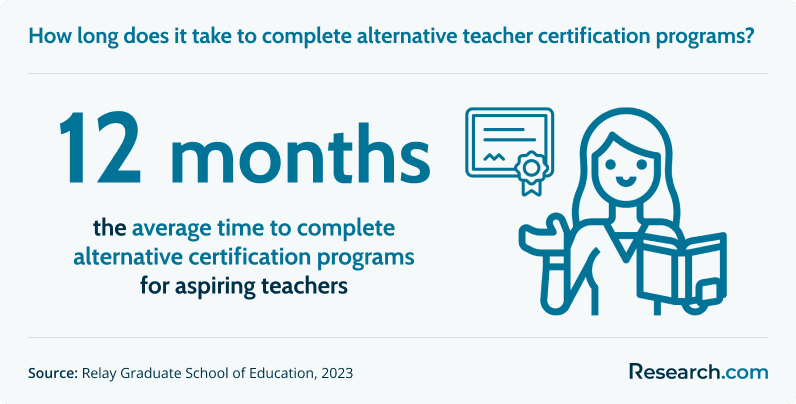
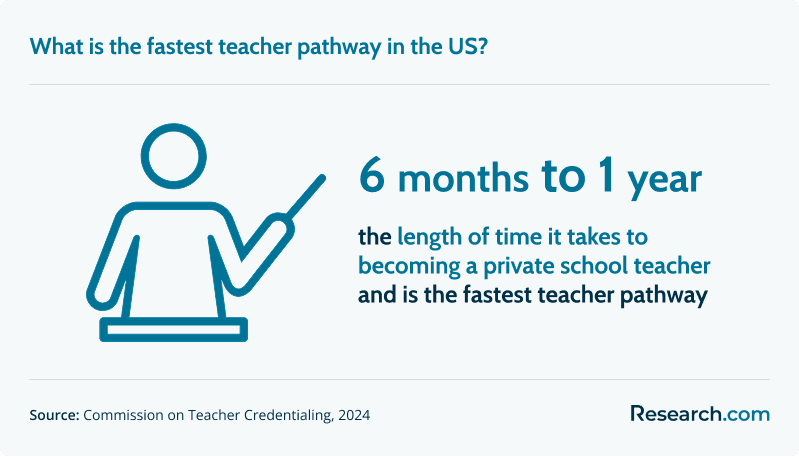
Most aspiring K-12 teachers should plan for about four years if they complete a bachelor’s degree in education followed by state licensure. Candidates who already hold a bachelor’s degree in another field may qualify for alternative certification and begin teaching in as little as one to two years, depending on state rules. Teachers who complete both a bachelor’s and master’s degree before entering the profession may spend five to six years preparing. Student teaching commonly lasts between 12 and 16 weeks, and licensure processing after graduation may take a few weeks to several months.
Key Things You Should Know About Education Programs
- Graduate education is common among teachers. About 51% of public and secondary school teachers hold a master’s degree, although many states do not require one for a first teaching license.
- The traditional undergraduate path usually takes four years. A bachelor’s degree in education remains the most common route for future K-12 teachers because it combines academic coursework, pedagogy, field experience, and student teaching.
- Licensure rules can add time after graduation. Some states require specific exams, background checks, applications, endorsements, or extra coursework before issuing a full teaching license.
- Accelerated and alternative routes can shorten the process. Fast-track teacher preparation options may reduce training time by up to 50% for eligible candidates, especially those who already have a bachelor’s degree.
- Clinical practice is part of most licensure routes. Student teaching typically lasts between 12 and 16 weeks and gives candidates supervised classroom experience before independent teaching.
- How long does it take to become a teacher for 2027?
- What degree do you need to become a teacher?
- How long does it take to earn a bachelor’s degree in education?
- Can you become a teacher without an education degree?
- How long does teacher licensure take after graduation?
- What are the fastest ways to become a teacher?
- Does your teaching subject change the timeline?
- How do teacher certification rules differ by state?
- Should teachers consider a dissertation-free doctorate in education?
- How can you avoid delays in the teaching credential process?
- How can advanced leadership education support career growth? Credential process checklist
- Can online educational leadership programs help teachers move up?
- What alternative careers can teaching certification support?
- How can advanced degrees affect teacher pay?
- Can an affordable master’s in history help classroom teachers?
- How much does it cost to become a teacher?
- How long does it take to get hired after certification?
How long does it take to become a teacher for 2027?
For 2027, the most common timeline to become a licensed teacher is about four years because most candidates complete a bachelor’s degree in education before applying for state certification. That timeline can be shorter for career changers who already have a bachelor’s degree and qualify for an alternative certification route. It can be longer for candidates who study part time, change majors, need extra endorsements, or complete a master’s degree before applying for classroom roles.
The main steps usually include completing a state-approved educator preparation program, finishing student teaching, passing required exams, submitting a licensure application, and clearing background checks. Some online and hybrid programs can make the process more flexible, especially for working adults. If affordability is a major concern, comparing the most affordable online education degree programs can help you find options that may lower tuition while still supporting licensure goals.
| Pathway | Typical timeline | Best fit | Key trade-off |
| Bachelor’s degree in education | About four years | First-time college students who want a standard licensure route | Comprehensive preparation, but it usually takes longer than alternative certification |
| Alternative certification after a non-education bachelor’s degree | One to two years in some programs | Career changers and subject-matter professionals | Faster entry, but requirements vary sharply by state and subject |
| Bachelor’s degree plus master’s degree | Five to six years | Candidates seeking stronger credentials before entering or advancing in teaching | More education can support advancement, but it increases time and cost |
| Emergency or provisional license | Can allow earlier classroom entry where permitted | Candidates in shortage areas or high-need districts | Temporary authorization usually comes with deadlines for exams, coursework, or full licensure |
What degree do you need to become a teacher?
Most public school teaching roles require at least a bachelor’s degree and state licensure. The exact degree depends on the grade level, subject, and state. Elementary education candidates often major in education, while secondary teachers may major in a content area such as English, mathematics, science, or history and complete a teacher preparation sequence.
- Bachelor’s degree in education. This is the standard undergraduate route for many K-12 teachers. It usually includes child development, instructional methods, assessment, classroom management, subject teaching methods, fieldwork, and student teaching.
- Non-education bachelor’s degree plus certification. Candidates who studied another field may enter teaching through an alternative certification or post-baccalaureate program if they meet state and subject requirements.
- Master’s degree in education or teaching. A master’s degree is not always required for initial entry, but many educators pursue one for professional growth, advanced endorsements, leadership preparation, or salary schedule movement where districts recognize graduate credits.
- Associate degree for support roles. An associate degree in education may support work as a paraprofessional, teacher assistant, or early childhood support professional, but it typically does not qualify someone for full K-12 teacher licensure.
- Doctoral degree in education. A PhD or EdD is generally more relevant for administration, policy, research, higher education, district leadership, or executive-level education roles than for initial classroom licensure.
Before choosing a degree, verify whether the program is approved for teacher preparation in the state where you plan to teach. If you are already licensed or planning to strengthen your credentials, an online master's in education or teaching may be worth comparing for cost, flexibility, and career alignment.
How long does it take to get a bachelor’s degree in education?
A bachelor’s degree in education typically takes four years of full-time study. The program usually includes general education courses, a teaching major or concentration, methods courses, field observations, and a semester of student teaching. However, not every student finishes in exactly four years. Part-time enrollment, changing majors, missing prerequisite courses, limited student-teaching placement availability, or transferring credits can change the timeline.
According to the National Center for Education Statistics (NCES), 44% of first-time bachelor's degree recipients in the 2015–16 academic year completed their degree within 48 months or less after initial enrollment. That means a four-year plan is common, but students should still ask each college about actual completion rates, transfer policies, course sequencing, and when student teaching can be scheduled.
If you want early classroom exposure while completing your degree, review the steps to become a substitute teacher. Substitute teaching requirements vary by state and district, but the experience can help future teachers confirm whether the classroom environment is a good fit.
| Factor | How it can affect completion time | What to ask before enrolling |
| Full-time vs. part-time study | Part-time students usually need more semesters to finish degree and fieldwork requirements. | Can the program be completed part time without delaying student teaching? |
| Transfer credits | Accepted credits can shorten the degree, but rejected credits may force students to retake courses. | Will the school complete a written transfer evaluation before enrollment? |
| Student teaching placement | Placements are often tied to specific semesters and district availability. | When do placements occur, and who arranges them? |
| Licensure exams | Failed or delayed exams can postpone certification even after graduation. | Which exams are required, and when should students take them? |
Can you become a teacher without an education degree?
Yes. Many states allow people with a bachelor’s degree in a non-education field to become teachers through alternative route certification. NCES reported that in the 2015-16 school year, approximately 18% of public school teachers used alternative route certification programs. These routes are often designed for career changers, military veterans, industry professionals, and graduates with strong subject-area knowledge.
Alternative programs usually require some combination of content testing, pedagogy coursework, supervised teaching, mentoring, and state application steps. Some candidates teach while completing requirements, while others complete coursework and field experience before becoming the teacher of record. Before choosing this route, compare your state’s teaching certification requirements so you understand whether the pathway leads to the license, grade level, and subject you want.
Alternative certification is especially relevant in high-demand areas such as career or technical education, natural sciences, foreign languages, English as a second language, mathematics, and special education. The advantage is speed. The risk is assuming that any program will qualify you in any state. Always confirm state approval before paying tuition or fees.
How long does it take to get a teaching license after graduation?
After graduation, teacher licensure may take a few weeks to several months. The timing depends on the state agency, whether your educator preparation program has submitted the proper recommendation, whether your exam scores are complete, and whether your background check and application materials are accurate. Graduates should review how to get a teaching certificate by state before their final semester so they do not miss deadlines.
State timelines can be very specific. For example, the Illinois State Board of Education requires candidates to apply for licensure within 12 months of program completion and register their license within six months of issuance. Alternative certification candidates may follow a different calendar because some programs allow them to teach while completing final licensure conditions.
| Licensure step | Possible timing issue | How to reduce delays |
| Program completion verification | Your college may need to recommend you to the state before you can be licensed. | Ask the certification office when recommendations are submitted. |
| Required exams | Testing windows, score reporting, or retakes can delay approval. | Take required exams early enough to allow for retesting if needed. |
| Background check | Fingerprinting and processing times vary by state and vendor. | Complete background check steps as soon as your program allows. |
| Application accuracy | Missing documents or incorrect forms can push your file back. | Use a checklist and keep copies of every submission. |
What are the fastest ways to become a teacher?
The fastest route depends on what education you already have. A high school graduate usually cannot skip the bachelor’s degree requirement for full K-12 teaching licensure, but a college graduate may be able to use an alternative or post-baccalaureate route. Speed should not be the only factor. A faster program still needs to be state-approved, credible to employers, and aligned with the subject and grade level you want to teach.
- Alternative certification programs. These routes are built for candidates with a bachelor’s degree outside education and may allow teaching while certification requirements are completed.
- Post-baccalaureate teacher certification. These programs focus on licensure coursework and clinical practice after a candidate has already earned a bachelor’s degree.
- Teach for America and similar programs. Select programs place candidates in high-need schools while they work toward certification under program and state rules.
- Emergency and provisional licenses. Some states and districts use temporary licenses when staffing needs are urgent, but candidates must usually complete additional steps to remain eligible.
- Online certification coursework. State-approved online options can make coursework more accessible for working adults. When researching programs, make sure an accredited online teacher certification program actually meets licensure requirements in your state.
| Fast-track option | When it makes sense | When to be cautious |
| Alternative certification | You already have a bachelor’s degree and want to teach in a shortage or high-need area. | The program is not clearly approved by the state where you plan to teach. |
| Post-baccalaureate certification | You need a structured licensure sequence without completing a second full bachelor’s degree. | The program does not provide strong placement or exam preparation support. |
| Emergency or provisional license | A district has an urgent need and the state allows temporary authorization. | You are not prepared for classroom responsibility or do not understand the deadline for full licensure. |
| Accelerated bachelor’s program | You have transferable credits and can handle a heavier academic pace. | Compressed coursework makes fieldwork, work obligations, or exam preparation unrealistic. |
Does subject specialization affect how long it takes to become a teacher?
Yes. The grade level and subject you choose can change both the coursework and the licensure steps. Elementary education programs often prepare candidates across multiple subject areas, while secondary teachers generally need deeper preparation in one content area. Some endorsements, such as special education, ESL, or advanced STEM subjects, may require additional tests, clinical hours, or specialized coursework.
- STEM and special education. Mathematics, science, and special education pathways may require subject exams or added endorsements. If you are considering this area, review the special education teaching certification process before choosing a program.
- Secondary education. High school teachers often need content-area preparation plus teacher education coursework, which can make planning more complex than a general elementary route.
- Foreign language and ESL. Candidates may need language proficiency assessments, ESL coursework, or bilingual education requirements, depending on the state.
- Advanced subject teaching. Some schools prefer or require stronger graduate-level preparation for specialized or advanced courses, especially in competitive districts.
- High-need subject alternatives. Some states create expedited routes for shortage areas, but candidates still need to meet state standards for full certification.
Choose your specialization only after checking the exact endorsement requirements in the state where you want to work. A program that prepares elementary teachers may not prepare secondary science teachers, and an initial license may not automatically include special education, ESL, or bilingual authorization.
How does certification vary by state?
Teacher certification is state-regulated, so two candidates with similar degrees may face different requirements depending on where they apply. Most states require a bachelor’s degree, an approved preparation program, supervised teaching experience, passing exam scores, and a background check. However, each state decides which exams count, how many field hours are required, which endorsements are available, and how licenses are renewed.
- Testing requirements. Some states use Praxis exams, while others use state-specific assessments or additional performance-based measures.
- Coursework rules. States may require specific classes in reading instruction, special education, child development, English learner instruction, or subject methods.
- Student teaching expectations. Required supervised experience can differ by program type, grade band, and state agency rules.
- Reciprocity policies. A license from one state may transfer more easily to another state under reciprocity agreements, but additional testing or coursework may still be required.
- Renewal requirements. Many states require professional development, graduate credits, continuing education, or evidence of effective teaching to keep a license active.
If you may move after graduation, compare reciprocity rules before enrolling. If you plan to teach young children or move into early childhood leadership, the most affordable online master's degree in early childhood education options may help you compare advanced programs that fit continuing education or career development needs.
Is a dissertation-free doctorate in education the right step for my career?
A dissertation-free doctorate in education may make sense for experienced educators who want advanced leadership training without following a traditional dissertation model. These programs often emphasize applied projects, organizational improvement, research use in practice, and leadership problem-solving. They are not usually necessary for initial teacher licensure, but they may be relevant for educators pursuing district leadership, higher education administration, consulting, or senior instructional roles.
Before enrolling, confirm accreditation, project requirements, faculty expertise, time to completion, and whether the degree is recognized for your intended career goal. If you are comparing accelerated doctoral options, review this guide to a doctorate in education online no dissertation.
What strategies can ensure a smooth teaching credential process?
The best way to avoid credential delays is to treat licensure as a checklist that begins before graduation, not after. Choose a state-approved program, meet regularly with the certification office, schedule exams early, document fieldwork, and confirm that your student teaching placement matches the license you want.
- Start with state approval. Do not assume that a national online program automatically qualifies you for your state license.
- Ask for a written licensure map. The program should be able to show required courses, exams, fieldwork, deadlines, and application steps.
- Track documents. Keep copies of transcripts, test scores, background checks, observation logs, and program completion forms.
- Prepare for exam retakes. Build extra time into your plan in case you need another testing date.
- Confirm endorsement alignment. Make sure your program leads to the grade band and subject area you actually want to teach.
For a more detailed walkthrough, use this resource on how to get teaching credential.
How can advanced leadership education accelerate my teaching career?
Advanced leadership education can help experienced teachers move into roles such as department chair, instructional coach, curriculum leader, assistant principal, principal, program director, or district administrator. These programs usually focus on leadership theory, organizational decision-making, policy, supervision, curriculum improvement, and data-informed planning.
This path is most useful after you have classroom experience and a clear goal beyond initial teaching. If your interest is broader organizational leadership rather than only school administration, compare whether an online doctorate in organizational leadership fits your career direction.
How can online educational leadership programs advance my teaching career?
Online educational leadership programs can be practical for licensed teachers who want to keep working while preparing for leadership responsibilities. The main advantage is flexibility. The main caution is licensure alignment: if the program is meant to lead to principal or administrator certification, verify that it meets your state’s requirements before enrolling.
When comparing programs, look for supervised internship requirements, administrator licensure outcomes, district partnerships, faculty experience, and total cost. To begin comparing lower-cost options, review the cheapest online educational leadership programs.
Can my teaching certification lead to alternative career opportunities?
Yes. Teacher preparation develops skills that transfer beyond the classroom, including lesson design, communication, assessment, public speaking, training, coaching, documentation, and program coordination. Licensed teachers may move into curriculum development, instructional design, academic advising, education technology, corporate training, nonprofit education, school administration, education consulting, or library and information roles.
If you enjoy research support, information organization, literacy services, and student learning resources, you may also want to explore careers in library science. The best alternative path depends on whether you want to stay in schools, work with adult learners, design learning materials, or move into management.
How does pursuing an advanced degree impact teaching compensation?
An advanced degree can improve compensation in some districts, but it is not a guaranteed salary increase everywhere. Many public school systems use salary schedules that reward graduate credits, master’s degrees, doctoral degrees, years of experience, or advanced certifications. Other employers may weigh subject shortages, leadership responsibilities, location, and union or district agreements more heavily.
Before investing in graduate school, ask your district how salary lanes work, whether the degree must be in education or your subject area, and whether tuition assistance is available. Advanced credentials can also support moves into specialized roles outside traditional classroom teaching. For example, educators interested in information management can compare career outcomes discussed in this guide to masters in library and information science salary.
Can an Affordable Master's in History Enhance My Teaching Career?
An affordable master’s in history may benefit social studies and history teachers who want deeper subject knowledge, stronger research skills, and more advanced curriculum design ability. It may also be useful for teachers who want to teach dual enrollment courses, pursue department leadership, or strengthen content expertise for upper-level instruction. However, it should be evaluated against state endorsement rules and district salary policies before enrollment.
If cost is a major factor, compare the cheapest online master degree history options and confirm whether the program’s format, accreditation, and coursework align with your teaching goals.
How much does it cost to become a teacher?
The cost of becoming a teacher depends on the pathway. A traditional bachelor’s degree usually costs more overall than a certification-only program because it includes four years of undergraduate study. Alternative certification may cost less for candidates who already have a degree, but candidates still need to budget for exams, applications, background checks, materials, and possible unpaid or lower-paid clinical teaching time.
- Bachelor’s degree tuition. The average annual cost for in-state tuition at a public four-year university is approximately $9,750, while private universities average around $38,421 per year.
- Teacher certification exams. Licensure exams, including Praxis exams where required, typically cost between $90 and $200 per test.
- Alternative certification programs. Some programs can range from $4,662 to $4,778, depending on the number of required content certification exams.
- Continuing education and renewal. Many states require ongoing professional development, and costs vary depending on provider, course format, and renewal rules.
- Graduate education and advanced credentials. Master’s degree tuition varies by school and format; the National Board Certification process costs a total of $1,900.
| Cost category | Why it matters | How to control the cost |
| Tuition and fees | This is usually the largest expense, especially for bachelor’s and master’s programs. | Compare public, online, transfer-friendly, and employer-supported options. |
| Certification exams | Multiple tests or retakes can add up. | Use official study guides and schedule exams early enough to avoid rushed retakes. |
| Student teaching | Full-time placements may reduce your ability to work. | Ask whether paid residency, paraprofessional-to-teacher, or district partnership options exist. |
| Licensure applications | Applications, background checks, and fingerprinting create additional expenses. | Budget for state fees before your final semester. |
| Graduate study | Advanced degrees can support advancement but add tuition costs. | Confirm salary schedule benefits, scholarships, tuition reimbursement, or loan forgiveness eligibility. |
Financial aid, scholarships, district partnerships, loan forgiveness programs, and employer tuition assistance may reduce out-of-pocket costs. Do not compare programs based only on tuition. Also review licensure outcomes, accreditation, transfer credit rules, completion timelines, and job placement support.
How long does it take to find a teaching job after certification?
Some newly certified teachers find jobs within a few months, especially when they apply during peak hiring periods and are open to high-need schools or shortage subjects. Others may take longer because hiring depends on local budgets, retirements, enrollment trends, district needs, and the candidate’s subject area.
According to the U.S. Bureau of Labor Statistics (BLS), employment of high school teachers is projected to decline by 1% from 2023 to 2033. Even with that decline, approximately 64,000 openings for high school teachers are projected each year, mainly because workers transfer to other occupations or leave the labor force. The broader job outlook for teachers over the next 10 years can vary by state, grade level, and specialization.
- Apply early. Many districts begin posting roles before the school year ends.
- Be flexible by location. Rural districts, urban districts, and fast-growing regions may have different hiring needs.
- Highlight shortage-area strengths. STEM, special education, ESL, bilingual education, and career or technical education can improve prospects in some markets.
- Build experience before graduation. Substitute teaching, tutoring, paraprofessional work, and student teaching recommendations can strengthen applications.
- Prepare a complete portfolio. Include lesson plans, assessment samples, classroom management philosophy, certification status, and references.
What are the longest and shortest timelines for becoming a teacher?
The shortest and longest timelines depend largely on your starting point. Someone who already has a bachelor’s degree may move through an alternative route quickly, while a first-time college student pursuing graduate credentials will need more time.
Shortest Timeline
- Alternative certification programs. Candidates who already hold a bachelor’s degree in a non-education field may be able to complete certification requirements in as little as one year, depending on state rules and program design.
- Accelerated bachelor’s degree programs. Students with transfer credits or heavy course loads may finish an education degree faster than the traditional four years if the institution offers an accelerated format.
Longest Timeline
- Bachelor’s plus master’s degree. Completing both degrees before or during entry into teaching can extend preparation to approximately six years.
- Specialized fields requiring advanced preparation. Some teaching or education roles, especially those tied to higher education, administration, advanced subject instruction, or specialized services, may require graduate study and additional experience.
Common Mistakes That Delay Future Teachers
- Choosing a program without checking state approval. A degree alone may not qualify you for licensure if the program is not recognized by your state.
- Focusing only on tuition. A cheaper program may cost more in the long run if credits do not transfer, licensure support is weak, or student teaching is hard to arrange.
- Assuming online programs work in every state. Online coursework can be legitimate and convenient, but licensure approval is still state-specific.
- Waiting too long to take exams. Testing delays and retakes can push licensure past hiring season.
- Ignoring endorsement requirements. Special education, ESL, bilingual education, and secondary subjects often have extra requirements.
- Relying only on rankings. Rankings can help narrow options, but licensure outcomes, placement quality, accreditation, and cost matter more for becoming a teacher.
Questions to Ask Before Choosing a Teacher Preparation Program
- Is the program approved for teacher licensure in the state where I plan to teach?
- Which license, grade band, and subject endorsement does the program lead to?
- How long do full-time and part-time students usually take to complete the program?
- When does student teaching occur, and who arranges the placement?
- What exams are required, and what support is available for test preparation?
- What is the total cost, including fees, exams, background checks, and materials?
- Can transfer credits, prior learning, or work experience shorten my timeline?
- Does the program offer job placement support, district partnerships, or mentorship?
- If the program is online, how are local field experiences and student teaching handled?
- Will the degree or credits qualify for district salary advancement or license renewal?
What Graduates Have to Say About Their Education Programs
"I had spent years in a corporate role and wanted to move into work that felt more connected to my community. A four-year return to school was not realistic, so I chose an accelerated certification pathway. I was able to begin teaching within 18 months. The program was demanding, but the flexible structure made the career change possible." - Amanda
"Cost was my biggest worry when I decided to become a teacher. I chose an affordable online education program that allowed me to keep working while I completed my classes. Scholarships and part-time classroom experience helped me finish without debt, and I earned my teaching license within a year after graduation." - Mackie
"Special education took more preparation than I expected. My program included extra certifications and additional classroom experience, which added two years to my plan. It was challenging, but I left feeling ready to support students with different learning needs, and I had multiple job offers after graduation." - Liam
Key Insights
- The standard teaching timeline is about four years. Most future teachers complete a bachelor’s degree in education and then apply for state licensure.
- Career changers may have a faster route. If you already have a bachelor’s degree, alternative certification or post-baccalaureate programs may reduce the timeline to one to two years in some states.
- State rules determine the final licensure timeline. Exams, background checks, student teaching, endorsements, and application processing can add weeks or months after graduation.
- Graduate degrees are common but not always required for entry. NCES data show that 51% of public and secondary school teachers hold a master’s degree, but many teachers begin with a bachelor’s degree and pursue graduate study later.
- Subject choice matters. Special education, STEM, ESL, bilingual education, and secondary content areas may involve extra coursework, tests, or endorsements.
- Costs vary widely by pathway. In-state public four-year tuition averages approximately $9,750 per year, private universities average around $38,421 per year, exams typically cost between $90 and $200 per test, and alternative certification examples range from $4,662 to $4,778.
- Do not enroll before verifying licensure alignment. The most important question is whether the program leads to the specific license, grade level, and subject endorsement required in your state.
- Hiring speed depends on the market. BLS projects high school teacher employment to decline by 1% from 2023 to 2033, but approximately 64,000 openings are projected each year because of workforce exits and transfers.
References:
- Education Data. (2024, 26 December). Average cost of college. educationdata.org
- National Board for Professional Teaching Standards. (2025). Paying for certification. nbpts.org
- Teachers of Tomorrow. (2023, 17 July). How many years of college does it take to become a teacher? teachersoftomorrow.org
- Teachworthy. (2025). Alternative teacher certification pricing. teachworthy.org
- US Bureau of Labor Statistics. (2024, 29 August). High school teachers. bls.gov
Other Things You Should Know About Education Programs
Most states require a fingerprint-based criminal background check before student teaching or clinical placement. The school district or teacher-preparation program usually submits the clearance to the state education department, and processing can take 1 to 8 weeks depending on the state and the FBI review.
Aspiring teachers in 2027 must complete exams such as the Praxis Core Academic Skills for Educators. Specific requirements vary by state, but passing these exams is generally essential for teacher certification in the U.S.