
2027 What Can I Do With a Master’s in Library Science?

Co-Founder and Chief Data Scientist
A Master’s in Library Science is no longer only a credential for people who want to work behind a reference desk. It is a graduate degree for professionals who want to organize information, help people find trustworthy sources, manage digital collections, preserve records, support research, and build systems that make knowledge easier to access. For some careers, especially librarian roles in academic, public, school, and specialized libraries, the MLS is often the required professional qualification. For other careers, it can be a strong bridge into archives, data curation, knowledge management, user experience, research analysis, and digital asset management.
This guide explains what you can do with a master’s in library science, how the degree fits into the current labor market, which roles offer the strongest salary potential, and how to choose the right academic or career path. It is written for prospective MLS students, current library workers considering graduate school, career changers, and MLS graduates who want to use their training beyond traditional library settings.
Quick answer: What can you do with a master’s in library science?
With a Master’s in Library Science, you can work as an academic librarian, public librarian, library media specialist, digital archivist, law librarian, data curator, information architect, corporate research analyst, knowledge manager, or digital content manager. The best path depends on whether you want a public-facing role, a research-heavy role, a technology-focused job, or a leadership position in information services.
Key things to know before pursuing a master’s in library science
- A Master’s in Library Science is the standard graduate credential for many professional librarian jobs in the U.S., especially in academic, public, school, and specialized library systems.
- The degree can also support careers outside libraries, including digital archiving, information architecture, data management, UX-related content organization, corporate research, and knowledge management.
- Librarians and library media specialists earn an average annual salary of around $64,370, but compensation varies widely by role, location, employer type, and technical specialization.
- What jobs can you get with a master’s in library science for 2027?
- Is a master’s in library science worth it for career growth?
- How long does it take to earn a master’s degree in library science?
- Are there non-traditional careers for library science graduates?
- How much can you earn with a master’s in library science?
- How is digital library work different from traditional library work?
- What skills do you build in a master’s in library science program?
- What is the job outlook for library science graduates?
- What trends are changing library science careers?
- What challenges do library science professionals face now?
- How does library science connect to data management and analytics?
- What certifications pair well with a master’s in library science?
- Can additional education strengthen an MLS degree?
- How can dual degree programs expand MLS career options?
- Should you choose an accelerated master’s program in library science?
- How can you finance a Master’s in Library Science?
- What should you compare when choosing an MLS program?
- Can an affordable online bachelor’s degree prepare you for an MLS?
- What career support should an MLS program offer?
- How can ongoing professional development improve your MLS career?
- Other questions about getting a master’s degree in library science
What jobs can you get with a master’s in library science for 2027?
A master’s in library science can lead to public service, education, research, archives, legal information, business intelligence, and digital product roles. The most traditional jobs are still in libraries, but many MLS graduates now work wherever organizations need professionals who can structure information, evaluate sources, manage records, and improve access to knowledge.
| Career path | Typical work setting | Best fit for students who want to... | Average annual salary |
| Academic Librarian | Colleges and universities | Support research, teach information literacy, and manage scholarly resources | $65,193 |
| Public Librarian | City, county, and community libraries | Serve local communities, run programs, and help patrons access information | $64,190 |
| Library Media Specialist | K-12 schools | Work with students and teachers while supporting curriculum and digital literacy | $64,370 |
| Digital Archivist | Libraries, museums, universities, agencies, and private organizations | Preserve electronic records, multimedia, and born-digital collections | $76,639 |
| Information Architect | Technology, UX, digital product, and consulting teams | Organize digital content so users can find information more easily | $132,080 |
| Corporate Research Analyst | Business, finance, consulting, technology, and research organizations | Turn research and data into insights for business decisions | $112,982 |
| Data Curator | Academic, scientific, technology, and corporate data environments | Manage datasets, metadata, repositories, and data quality | $72,627 |
| Law Librarian | Law schools, courts, law firms, and government agencies | Support legal research using statutes, case law, journals, and legal databases | $87,528 |
Academic Librarian
Academic librarians help college students, faculty members, and researchers use scholarly information effectively. Their work can include reference consultations, database instruction, collection development, research guides, open-access support, and digital scholarship projects. Many also specialize by discipline, such as health sciences, law, business, humanities, or STEM.
Average Salary: $65,193
Public Librarian
Public librarians work directly with communities. They help patrons find books and digital resources, teach basic technology skills, support literacy programs, assist with job search tools, and organize events for children, teens, adults, and older residents. This path is a strong fit for MLS graduates who enjoy public service and community engagement.
Average Salary: $64,190
Library Media Specialist
Library media specialists usually work in K-12 schools. They manage school library collections, teach students how to evaluate information, collaborate with teachers, and help integrate digital tools into instruction. This role blends librarianship, education, technology support, and student learning.
Average Salary: $64,370
Digital Archivist
Digital archivists protect and organize digital materials such as electronic records, images, audio, video, websites, research files, and institutional documents. They use metadata standards, preservation workflows, digital repositories, and archival software to keep materials discoverable and usable over time. Students interested in archival work may also benefit from historical training, such as the most affordable online history degree options, because historical context can improve archival description and interpretation.
Average Salary: $76,639
Information Architect
Information architects design the structure behind websites, apps, intranets, and digital systems. They build taxonomies, organize content, improve navigation, and help users locate information without confusion. MLS graduates who enjoy digital systems, user behavior, content strategy, and UX research may find this path especially attractive.
Average Salary: $132,080
Corporate Research Analyst
Corporate research analysts collect, verify, organize, and interpret information that helps companies make strategic decisions. They may work on market research, competitor monitoring, policy analysis, customer insights, or industry reports. MLS graduates who want to pair research expertise with leadership or policy work may also compare advanced options such as the best online PhD in public administration programs.
Average Salary: $112,982
Data Curator
Data curators make datasets easier to preserve, understand, cite, and reuse. They may create metadata, check data quality, manage repositories, document data sources, and support researchers or analysts who rely on accurate information. This path is a practical match for MLS students who like structured systems and digital research environments.
Average Salary: $72,627
Law Librarian
Law librarians help attorneys, judges, students, and legal researchers navigate complex legal information. They manage print and electronic legal collections, train users on specialized databases, and support research involving statutes, regulations, case law, and legal commentary. This work also overlaps with legal support roles, so readers exploring the legal field may find it useful to review how to become a paralegal.
Average Salary: $87,528
Is a master’s in library science worth it for career growth?
A master’s in library science can be worth it if your target jobs require the credential, if you want to move into professional librarian roles, or if you plan to specialize in archives, digital information, research services, or knowledge organization. The degree is especially important for many positions that specify an American Library Association (ALA)-accredited MLS as a hiring requirement.
The degree is less likely to be worth the cost if you are unsure about your career direction, if you choose a program without checking accreditation and employer expectations, or if you expect the degree alone to guarantee a high salary. MLS outcomes depend heavily on specialization, experience, location, and the type of employer.
| An MLS may be worth it if... | You may want another path if... |
| You want to become a professional librarian in a public, academic, school, or specialized library. | You mainly want a general technology job and do not need graduate-level information science training. |
| Your desired employers list an ALA-accredited MLS as a required or preferred qualification. | You are looking for the fastest route into entry-level IT, administrative, or data support work. |
| You want to build expertise in research support, digital preservation, metadata, archives, or information access. | You are not ready to compare tuition, financial aid, field experience, and likely salary outcomes. |
| You plan to use internships, assistantships, certificates, or specialized coursework to build a focused portfolio. | You expect the degree to replace the need for technical, teaching, public service, or project experience. |
For students drawn to technical work but not certain about graduate school, it can help to compare MLS outcomes with shorter or more technical paths. For example, those asking what can I do with an associate's degree in computer science may find that IT support, web development, or network administration offers a different route into information-focused work.
How long does it take to earn a master’s degree in library science?
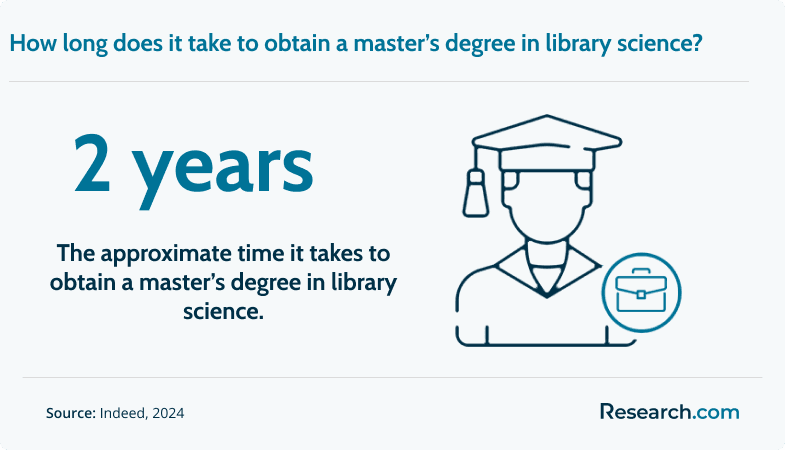
Most full-time MLS students complete the degree in 1.5 to 2 years. Programs commonly require 36 to 42 credit hours, which can often be finished across 3 to 4 semesters. Part-time students, especially those working while enrolled, may need 3 to 4 years depending on course load and program structure.
Some schools offer online, hybrid, evening, and accelerated formats. Accelerated options may take as little as 12 to 18 months, but they often require a heavier workload and less scheduling flexibility. Before choosing a faster option, ask whether you can realistically manage courses, fieldwork, employment, and family responsibilities at the same time.
| Study format | Typical timeline | Best for | Trade-off |
| Full-time | 1.5 to 2 years | Students who can prioritize graduate study | Faster completion but less room for full-time work |
| Part-time | 3 to 4 years | Working adults and students with major outside commitments | More flexible but delays graduation |
| Accelerated | 12 to 18 months | Students with strong time management and a clear goal | Compressed pace and heavier weekly workload |
| Online or hybrid | Varies by course load | Students who need geographic or scheduling flexibility | Requires self-direction and careful review of fieldwork options |
MLS students considering corporate research, data, or analytics roles may also want to compare adjacent career outcomes such as business analytics salary trends. Students still deciding between fields can also review the highest paid business majors to understand how business-oriented degrees differ from library and information science pathways.
Are there non-traditional careers for library science graduates?
Yes. MLS graduates can work in many roles that do not have “librarian” in the job title. The common thread is information: finding it, evaluating it, organizing it, preserving it, protecting it, and making it usable for a specific audience.
- Data Analyst: MLS graduates with quantitative skills can move into roles that involve collecting, cleaning, organizing, and interpreting data. Their training in classification, source evaluation, and documentation can be useful in business, healthcare, finance, education, and research settings.
- Knowledge Manager: Knowledge managers help organizations capture internal expertise and make it easier for employees to find policies, reports, training materials, procedures, and institutional knowledge. This role is common in large companies, consulting firms, government agencies, and nonprofits.
- Digital Content Manager: Digital content managers organize and maintain websites, digital collections, knowledge bases, blogs, social media assets, and marketing materials. MLS training is useful because content needs structure, metadata, governance, and a clear user experience.
- Healthcare Information Specialist: Healthcare information specialists help clinicians, researchers, nurses, and public health teams access reliable medical literature and evidence-based resources. Students interested in healthcare information environments may also compare 1 year online MSN programs, where access to current clinical research is central to advanced nursing practice.
| Non-traditional path | MLS strength used | Additional skill that may help |
| Data Analyst | Information organization, documentation, source evaluation | Spreadsheet tools, statistics, SQL, visualization |
| Knowledge Manager | Taxonomies, repositories, information access | Change management, internal communications, enterprise software |
| Digital Content Manager | Metadata, content structure, searchability | Content strategy, analytics, CMS platforms |
| Healthcare Information Specialist | Research support, database searching, evidence evaluation | Medical terminology and health information systems |
How much can you earn with a master’s in library science?
Salary outcomes for MLS graduates depend on job title, location, years of experience, employer type, technical specialization, and leadership responsibilities. According to our research, those with a master’s degree in library science can expect an average annual salary of around $65,193. That figure is a useful benchmark, but it should not be treated as a guaranteed outcome.
- Location: Pay is often higher in metropolitan areas and regions with higher living costs, though expenses may also be higher.
- Industry: Corporate, technology, healthcare, legal, and specialized information roles may pay more than some traditional library positions.
- Experience: Supervisory work, advanced subject expertise, and years of professional experience can increase earning potential.
- Role type: Technical and specialized positions such as information architect, corporate research analyst, digital archivist, and data curator may offer higher compensation than generalist roles.
- Education and certifications: Focused credentials in archives, digital preservation, project management, or data work can strengthen your profile. Students comparing flexible graduate options can review online master’s in library science programs.
Academic librarians typically earn an average salary of $65,193 per year, while public librarians earn about $64,190. Library media specialists, who usually work in K-12 settings, earn around $64,370. Digital archivists earn an average salary of $76,639, while information architects report a much higher average salary of $132,080. Corporate research analysts earn an average of $112,982, and data curators earn an average of $72,627. The chart below compares library science salary outcomes across selected career paths.
How is digital library work different from traditional library work?
Digital and traditional libraries share the same broad mission: helping people access useful, reliable information. The difference is in the format, tools, workflows, and user experience. Traditional libraries focus more on physical collections and in-person services, while digital libraries emphasize electronic access, metadata, digital preservation, and platform usability.
| Area | Digital library work | Traditional library work |
| Collections | E-books, online journals, digital archives, databases, multimedia, datasets | Books, periodicals, physical media, local collections, print reference materials |
| Core tools | Repositories, metadata systems, content management platforms, discovery tools | Catalogs, circulation systems, shelving systems, physical collection workflows |
| User access | Remote access through websites, databases, authentication systems, and search interfaces | In-person browsing, lending, reference desks, events, and physical spaces |
| Daily emphasis | Digital preservation, licensing, accessibility, metadata, usability, platform troubleshooting | Community service, collection management, programming, circulation, patron support |
Resource format and preservation
Digital library professionals manage materials that may never exist in print, including institutional records, digitized manuscripts, e-books, datasets, and multimedia files. Their work often involves file formats, storage systems, backups, migration plans, metadata, and rights management. Traditional library professionals still use technology, but they also spend significant time organizing and circulating physical materials.
Technology and user support
Digital library roles generally require stronger technical comfort. Staff may troubleshoot access problems, manage online collections, test discovery systems, and improve search experiences. Traditional library roles usually involve more face-to-face service, including reference help, workshops, circulation, reader advisory, and community programming.
Access and user experience
Digital libraries are designed for users who may access resources from home, campus, work, or a mobile device. Search quality, authentication, interface design, accessibility, and download options matter. Traditional libraries offer something digital platforms cannot fully replace: physical spaces for study, community connection, events, and direct staff interaction.
Salary also varies by setting. Librarians and library media specialists working in elementary and secondary schools earn an average salary of $68,450. Those working in state colleges and universities earn around $66,260. Librarians working in local government, excluding education and hospitals, earn around $60,770, while those in web search portals and archives earn an average annual salary of $59,730. The chart below shows median annual wages for librarians and library media specialists in top U.S. industries.
What skills do you build in a master’s in library science program?
An MLS program teaches students how to manage information across formats, audiences, and systems. The strongest programs combine theory with applied work in research, user services, digital tools, ethics, and collection management.
- Information organization: Students learn how to classify, catalog, describe, and arrange information in print, digital, and multimedia formats using established systems such as Dewey Decimal and Library of Congress Classification.
- Research and evaluation: MLS coursework strengthens the ability to find, assess, compare, and synthesize information from academic databases, public sources, archives, and specialized collections.
- Digital literacy: Students learn to work with electronic databases, e-books, discovery platforms, digital archives, metadata tools, and content management systems.
- Data management: MLS training can include data curation, preservation, documentation, repository management, and the responsible handling of structured information.
- Information retrieval: Students study how users search for information and how systems can be designed to improve search results, indexing, taxonomy, and discoverability.
- Project management: Library and information work often involves migrations, digitization projects, collection reviews, exhibits, system implementations, and service improvements, all of which require planning and coordination.
- Ethics, privacy, and access: MLS programs examine intellectual freedom, privacy, copyright, licensing, data protection, accessibility, and equitable access to information.
| Skill area | Where it is used | Why employers value it |
| Metadata and cataloging | Libraries, archives, repositories, digital asset systems | Makes information searchable, consistent, and easier to reuse |
| Research support | Universities, law firms, corporations, healthcare organizations | Improves decision-making and reduces misinformation risk |
| Digital preservation | Archives, museums, institutions, government agencies | Protects long-term access to important digital materials |
| User services | Public libraries, schools, academic libraries, information centers | Connects users with the right resources and training |
| Information governance | Corporate, legal, healthcare, and government settings | Supports compliance, accountability, and organized records |
What is the job outlook for library science graduates?
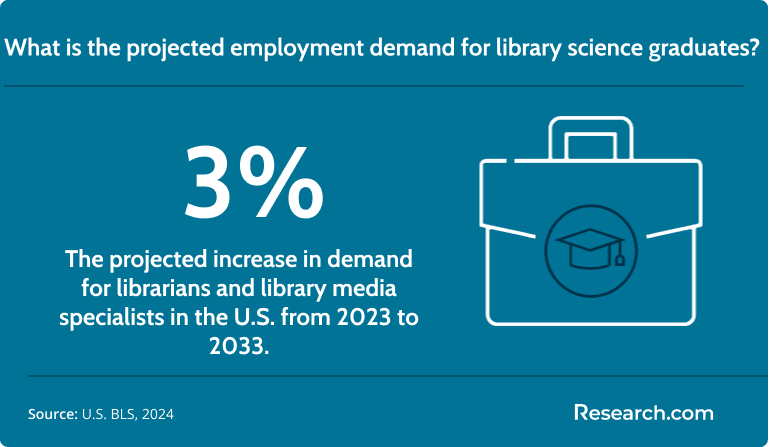
The employment outlook for library science graduates is stable but not uniform across every role. Employment demand is expected to increase by three percent from 2023 to 2033, which means there will be about 13,300 openings for librarians and library media specialists in the U.S. This is about as fast as the average for all occupations.
That overall figure does not tell the whole story. Traditional librarian roles remain important, but competition can vary by region and employer. At the same time, organizations continue to need professionals who can manage digital records, preserve electronic materials, support research workflows, and improve access to information. MLS graduates with technical skills, digital preservation experience, teaching ability, data literacy, or subject specialization may have broader options than graduates who rely only on the general degree.
What trends are changing library science careers?
Library science careers are being shaped by digital collections, artificial intelligence, data management, online learning, open access, and stronger expectations around privacy and accessibility. These trends do not eliminate the need for librarians and information professionals. Instead, they change the tools and skills employers expect.
- AI-assisted search and discovery: Search tools and databases increasingly use automation, recommendations, and machine learning features. MLS professionals still play a critical role in evaluating quality, bias, transparency, and source credibility.
- Digital preservation: More institutions need people who can protect born-digital records, digitized collections, research data, and multimedia assets.
- Open educational resources and scholarly communication: Academic libraries increasingly support publishing, copyright guidance, open access, and affordable learning materials.
- User experience in information systems: Libraries and organizations want platforms that are easier to search, navigate, and understand.
- Interdisciplinary credentials: Students are combining library science with technology, data, education, history, public administration, and business. Some learners begin with flexible pathways such as an accelerated bachelor’s degree before moving into graduate study.
What challenges do library science professionals face now?
Modern library science professionals must manage changing technology while protecting the values that make libraries and information services trustworthy. They are expected to support digital access, teach users how to evaluate information, manage privacy risks, maintain inclusive collections, and adapt to new platforms with limited time and budgets.
| Challenge | Why it matters | Practical response |
| Rapid technology change | Systems, platforms, and user expectations shift quickly | Build ongoing training into your career plan |
| Data privacy and security | Libraries and information centers handle sensitive user and institutional information | Learn privacy practices, data governance, and ethical information use |
| Misinformation and source quality | Users need help evaluating credibility in crowded information environments | Strengthen instruction, media literacy, and research consultation skills |
| Budget pressure | Libraries often must do more with limited staffing and resources | Develop grant writing, assessment, project management, and partnership skills |
| Balancing old and new formats | Many organizations still manage both physical and digital collections | Learn hybrid workflows instead of focusing only on one format |
Professionals who need targeted upskilling may compare flexible options such as degrees to get online, especially when they want to add technology, management, or specialized industry knowledge without stepping away from work for an extended period.
How does library science connect to data management and analytics?
Library science and data management overlap because both fields depend on structure, description, retrieval, preservation, and responsible access. MLS graduates may not automatically become data scientists, but their training can be highly relevant to data stewardship, repository management, metadata creation, documentation, and research data services.
- Data curation and organization: Library science professionals apply classification and description principles to help datasets remain understandable and discoverable.
- Metadata management: Metadata gives context to data, making it easier to search, interpret, cite, and reuse.
- Data preservation: MLS training can support long-term access through backup planning, migration, repository workflows, and preservation standards.
- Information retrieval: Search strategies, indexing, controlled vocabularies, and query design all influence how effectively users find data.
- Data analysis support: Some MLS graduates use data tools to identify patterns, build reports, or support researchers and decision-makers.
What certifications pair well with a master’s in library science?
Additional credentials can help MLS graduates demonstrate specialization, especially in archives, digital assets, project management, school libraries, data, or leadership. Certifications are most valuable when they match a clear career goal. Before enrolling, check whether employers in your target role actually request or recognize the credential. Students comparing the broader academic route can also review what a library science degree includes.
| Certification | Best for | How it can help |
| Certified Archivist (CA) | Archivists, records professionals, museum and government information workers | Shows expertise in managing and preserving archival records |
| Certified Digital Asset Manager (CDAM) | Digital library, media, publishing, marketing, and content repository roles | Signals knowledge of digital asset organization and preservation |
| Project Management Professional (PMP) | Library managers, systems leads, digitization coordinators, and team supervisors | Demonstrates project leadership and planning ability |
| Certified Library Media Specialist (CLMS) | K-12 school library professionals | Supports roles that combine library services, instruction, and curriculum support |
- Certified Archivist (CA): The Certified Archivist credential, offered by the Certified Archivists (ACA), is designed for professionals who work with historical records, archives, and long-term preservation.
- Certified Digital Asset Manager (CDAM): This credential focuses on organizing and preserving digital files, multimedia, e-books, and other digital assets.
- Project Management Professional (PMP): The PMP credential, offered by the Project Management Institute, may benefit MLS graduates who lead projects, teams, migrations, or large-scale service initiatives.
- Certified Library Media Specialist (CLMS): This credential supports professionals working in school library settings. In the U.S., there are 142,200 librarians and library media specialists employed as of 2023.
What MLS graduates say about the degree
-
: "
"My Master’s in Library Science changed how I think about information work. I learned to manage digital archives, evaluate sources, and use research skills in a corporate information role where better data supports better decisions." - Lena
"
-
: "
"The program connected theory with daily practice. As a public librarian, I use what I learned in user services, organization, and community programming to build resources that people actually use." - Caitlyn
"
-
: "
"Graduate study helped me become a stronger researcher and leader. Courses in digital preservation, ethics, and academic librarianship prepared me for a field that keeps changing." - Charles
"
Can additional education strengthen an MLS degree?
Yes, but only when the additional credential fills a real gap. MLS graduates do not need to collect degrees for the sake of it. The right add-on should make you more competitive for a specific role, such as digital archivist, data curator, health sciences librarian, law librarian, information architect, or library administrator.
Shorter academic pathways can be useful when they add practical technical or subject-area knowledge. For example, an accelerated associates degree may help some students build foundational skills before moving into more specialized work in digital archiving, data curation, or information architecture. The key is to choose education that supports your target job description, not just another credential.
How can dual degree programs expand MLS career options?
Dual degree programs can make sense for MLS students who want to combine information expertise with another professional field. Common pairings include business, law, education, public administration, history, technology, and communications. The added degree can support leadership roles, subject-specialist librarian positions, corporate research jobs, legal information work, or academic careers.
| MLS pairing | Potential career advantage | Best fit |
| MLS + business-related degree | Management, budgeting, strategy, and organizational leadership | Future library directors, knowledge managers, corporate researchers |
| MLS + technology-related degree | Systems, data, digital platforms, and information architecture | Digital librarians, data curators, information architects |
| MLS + education-related degree | Instruction, curriculum support, and student learning | School librarians and library media specialists |
| MLS + history-related degree | Archival context, preservation, and historical interpretation | Archivists, museum information professionals, special collections librarians |
Should you choose an accelerated master’s program in library science?
An accelerated MLS can be a good option if you already know your career target, can handle intensive coursework, and want to enter or advance in the field quickly. It may be less suitable if you need time for internships, networking, part-time work, or exploration across specialties.
Before choosing a compressed format, ask how many courses you must take at once, whether field experience is included, how advising works, and whether the program is accredited. Students who want a shorter graduate timeline can compare options such as a one year masters program, but speed should not outweigh program quality or career fit.
How can you finance a Master’s in Library Science?
Financing an MLS requires looking beyond listed tuition. Compare total program cost, fees, books, technology requirements, travel for any in-person components, and the income you may give up if you reduce work hours. Then review scholarships, grants, assistantships, employer tuition reimbursement, payment plans, and federal loan options.
- Ask each school whether MLS students qualify for scholarships, graduate assistantships, or department-specific awards.
- Check whether your current employer offers tuition reimbursement or professional development funding.
- Compare part-time enrollment with full-time enrollment to see which option best balances cost, work, and completion time.
- Review aid eligibility carefully if you are choosing an online program. Researching FAFSA approved online colleges can help online learners understand federal aid access.
- Estimate return on investment using realistic salary expectations for your target role and location.
What should you compare when choosing an MLS program?
The right MLS program should match your career goal, budget, learning format, and specialization needs. Do not choose based only on convenience or name recognition. Accreditation, curriculum, field experience, faculty expertise, career support, and alumni outcomes all matter.
| Program factor | Why it matters | Questions to ask |
| Accreditation | Many librarian jobs prefer or require an ALA-accredited MLS | Is the program currently accredited, and does that accreditation match my target jobs? |
| Specializations | Focus areas can shape your career options | Does the program offer archives, school librarianship, digital libraries, data, or academic librarianship? |
| Practical experience | Employers often value applied experience | Are internships, practicums, assistantships, or project-based courses available? |
| Online flexibility | Format affects scheduling and access | Are courses synchronous, asynchronous, hybrid, or campus-based? |
| Career services | Career support can help you turn the degree into employment | Does the school offer resume help, employer events, alumni mentoring, and library-specific job support? |
| Total cost | Tuition alone does not show affordability | What are the full costs after fees, books, aid, and possible travel? |
Students comparing flexible degree formats may also find it helpful to review the easiest online degree to get, not because an MLS should be chosen for ease, but because online learning structure and academic workload can vary significantly across programs.
Can an affordable online bachelor’s degree prepare you for an MLS?
Yes. An affordable undergraduate degree can be a practical foundation for future MLS study if it helps you build research, writing, communication, technology, and analytical skills without taking on unnecessary debt. MLS programs typically do not require one specific undergraduate major, so students can come from English, history, education, communications, information technology, social sciences, business, computer science, or related fields.
Choosing a cheapest bachelors degree option may help reduce the total cost of your education before graduate school. The important point is not simply choosing the lowest tuition; it is choosing an accredited undergraduate path that prepares you to succeed in graduate-level research and information work.
What career support should an MLS program offer?
Strong career support can make a major difference, especially for students changing careers or pursuing specialized roles. Look for programs that offer library-specific advising, internship connections, resume and portfolio support, interview preparation, job boards, alumni networking, and employer partnerships.
- Ask whether career advisors understand library and information science roles, not just general graduate employment.
- Look for internships or practicums in your intended setting, such as academic libraries, public libraries, archives, schools, law libraries, or digital repositories.
- Find out whether alumni work in the roles you want.
- Ask whether students receive help building portfolios for digital projects, metadata work, exhibits, instruction materials, or research guides.
- Consider whether related training, including online certificates that pay well, could add useful skills for your target role.
How can ongoing professional development improve your MLS career?
Library and information careers change as technology, research practices, user needs, and privacy expectations change. Continuing education helps MLS graduates stay current and move into more specialized or senior roles. This can include workshops, webinars, professional conferences, vendor training, archives institutes, data courses, management training, or industry-specific certificates.
The best professional development plan starts with your target role. A digital archivist may prioritize preservation systems and metadata. A school library media specialist may need instructional technology and curriculum support. A corporate researcher may focus on analytics, competitive intelligence, and business databases. Professionals who want to diversify into another sector can compare focused credentials such as medical certificate programs that pay well, especially when the added training supports a clear career transition.
Common mistakes to avoid when planning an MLS career
| Mistake | Why it can hurt you | Better approach |
| Choosing a program without checking accreditation | Some employers require or prefer an ALA-accredited MLS | Confirm accreditation before applying and compare it with job postings in your target field |
| Focusing only on tuition | Fees, books, technology, travel, and lost work hours can change the real cost | Calculate total cost of attendance and expected financing options |
| Assuming the MLS guarantees a specific salary | Pay varies by role, location, employer, experience, and specialization | Research salaries for your exact job title and region |
| Skipping practical experience | Employers often want evidence that you can apply MLS skills | Complete internships, assistantships, projects, or volunteer work in your target setting |
| Ignoring technology skills | Digital systems are central to many library and information jobs | Build skills in metadata, databases, repositories, content systems, or data tools |
| Relying only on rankings | A highly visible program may not be the best fit for your goals or budget | Compare curriculum, outcomes, support, cost, flexibility, and specialization options |
Key Insights
- A master’s in library science is most valuable when it is tied to a specific goal, such as academic librarianship, public librarianship, school media, archives, digital libraries, legal research, data curation, or knowledge management.
- Most full-time students finish an MLS in 1.5 to 2 years, while part-time students may need 3 to 4 years. Accelerated formats can take 12 to 18 months but require careful workload planning.
- Salary varies substantially. Librarians and library media specialists earn around $64,370 per year, while specialized roles such as information architect and corporate research analyst report higher average salaries.
- The employment demand for librarians and library media specialists is expected to grow by 3% from 2023 to 2033, with about 13,300 openings in the U.S.
- Technical skills matter. MLS graduates with experience in metadata, digital preservation, data management, information systems, research support, and user experience may have broader career options.
- Program choice is a career decision. Accreditation, field experience, specialization, cost, online flexibility, and career services should all be evaluated before enrolling.
- Additional certifications and professional development can help, but they should support a defined career target rather than simply add more credentials.
Other questions about getting a master’s degree in library science
What undergraduate degree is best for a master’s in library science?
MLS programs usually do not require one specific undergraduate major. Strong preparation can come from English, history, education, information technology, communications, social sciences, business, computer science, or related fields. The best undergraduate background is one that develops research ability, writing, critical thinking, technology comfort, and an interest in how people use information.
Can I become a digital archivist with a library science degree?
Yes. A Master’s in Library Science can prepare you for digital archivist roles, especially if you choose coursework in archival studies, digital preservation, metadata, records management, and digital repositories. Experience with archival software, content management systems, digitization workflows, and preservation standards can improve your competitiveness. A credential such as Certified Archivist (CA) may also strengthen your profile for archive-focused positions.
Can an MBA help advance my library science career?
Yes, an MBA can be useful if your goal is leadership, administration, budgeting, strategic planning, or corporate information work. Library directors, department heads, knowledge managers, and information services leaders often need skills in management, finance, operations, and organizational strategy. An MLS plus an MBA can be especially relevant for professionals who want to combine information expertise with business leadership.
Should I pursue a Ph.D. after my master’s in library science?
A Ph.D. may be worthwhile if you want to teach at the university level, conduct advanced research, publish scholarship, or pursue high-level academic or policy roles in library and information science. It is usually not necessary for most public, academic, school, or special library positions, where the MLS and relevant professional experience are more important. Choose a Ph.D. only if your goals require research-intensive doctoral training.
Resources:
- Glassdoor. (2025). How much does a law librarian make? https://www.glassdoor.com/Salaries/law-librarian-salary-SRCH_KO0,13.htm
- Indeed Editorial Team. (2024). Library Science Master's Degree: What Are the Benefits? https://www.indeed.com/career-advice/career-development/masters-in-library-science
- U.S. Bureau of Labor Statistics. (2024). Occupational Outlook Handbook: Librarians and Library Media Specialists. https://www.bls.gov/ooh/education-training-and-library/librarians.htm
- ZipRecruiter. (2025). Academic Librarian Salary. https://www.ziprecruiter.com/Salaries/Academic-Librarian-Salary
Other Things You Should Know About What to Do With a Master’s in Library Science
In 2027, MLIS graduates play a key role in digital libraries by managing digital collections, ensuring metadata accuracy, and advancing open access initiatives. Their expertise in digital curation and user experience design is crucial for building accessible and user-friendly digital library platforms.
In 2027, MLIS graduates play crucial roles in educational institutions as academic librarians, digital resource managers, and information literacy educators. They support students and faculty by managing digital libraries, providing research assistance, and enhancing information technology integration in curriculum development.
Yes, many public, academic, and school library jobs prefer or require a master’s from an ALA-accredited program. In 2027, the American Library Association remains the main accrediting body in the United States, and employers often use that accreditation to screen candidates for professional librarian posts.


