
2027 Associate Degree in Social Work (ASW) Guide

Co-Founder and Chief Data Scientist
An associate degree in social work is often the first college credential people consider when they want to work in social services but are not yet ready to commit to a bachelor’s or master’s program. It can help you qualify for support roles in case management, community outreach, behavioral health, child and family services, residential programs, and nonprofit agencies. It can also reduce the cost of a future bachelor’s degree if your credits transfer well.
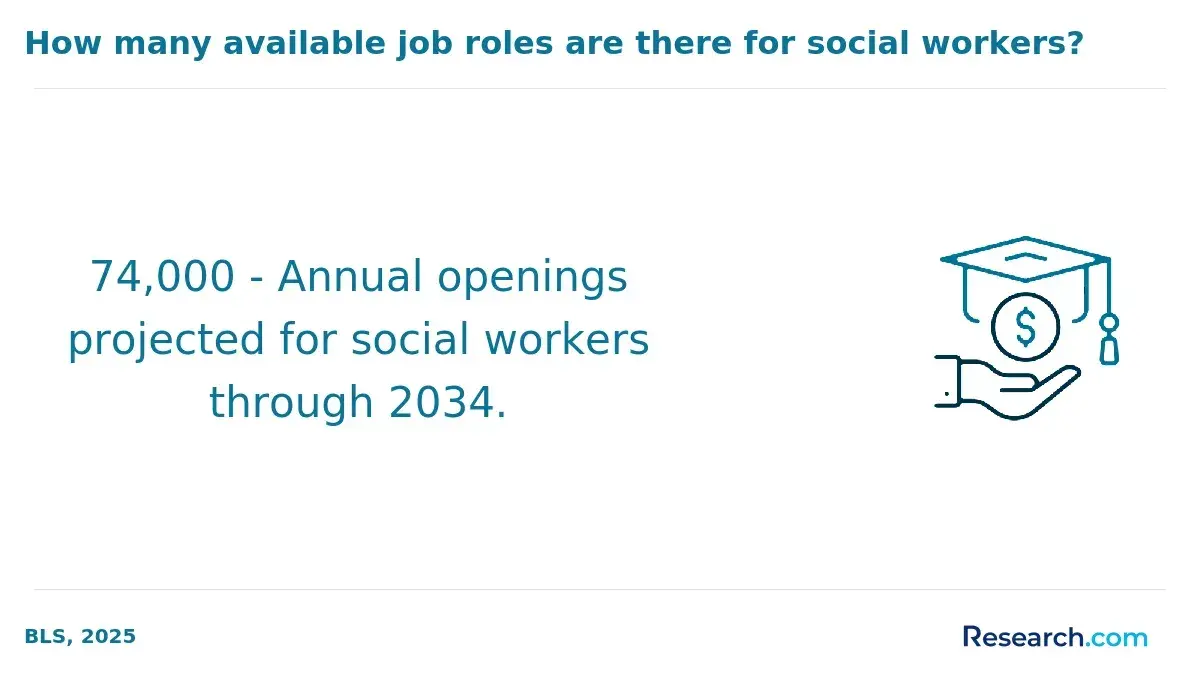
This guide explains what an associate degree in social work covers, what jobs it can support, how much it may cost, when it is worth pursuing, and when a different path may be better. It also covers accreditation, fieldwork, licensing limits, program selection, career growth, and practical questions to ask before enrolling. According to the United States Bureau of Labor Statistics (US BLS), employment of social workers is projected to grow by 6% from 2024 to 2034 (US BLS, 2025), but an associate degree alone does not qualify graduates for every social work role. Understanding that distinction is essential before you choose a program.
Students interested in people-focused support roles may also compare social work with related paths such as behavioral psychology careers, counseling support, human services, and community health. The right choice depends on whether you want to enter the workforce quickly, transfer to a bachelor’s program, pursue licensure later, or specialize in areas such as mental health, addiction, child welfare, or aging services.
Quick Answer: Is an Associate Degree in Social Work Worth It?
An associate degree in social work can be worth it if you want an affordable entry point into human services or plan to transfer into a bachelor’s degree in social work. It is best for students seeking assistant-level or support roles, such as social work assistant, case aide, residential counselor, mental health technician, or community outreach worker. However, it is not enough for most licensed social worker roles, independent counseling positions, or clinical practice. Those typically require a bachelor’s, master’s, supervised experience, and state licensure.
| Best Fit | Use Caution If | Better Alternative |
| You want to start in social services without immediately paying for a four-year degree. | You expect to become a licensed clinical social worker after only two years of study. | Plan for a bachelor’s degree followed by an MSW pathway, including options such as the best online masters degree in social work. |
| You want transferable credits that can apply to a future bachelor’s program. | You choose a school without checking transfer agreements or accreditation. | Compare articulated transfer pathways and regionally accredited institutions. |
| You want hands-on exposure to social service agencies before choosing a specialization. | You need a high-paying role immediately after graduation. | Consider whether a bachelor’s, certificate, or employer-sponsored training route better matches your income goals. |
Associate Degree in Social Work Table of Contents
- What is an associate degree in social work?
- Cost of Associate Degree in Social Work
- 2027 Best Associate’s Degree in Social Work
- Can I complete an associate degree in social work in 6 months online?
- Can an Associate Degree in Social Work Lead to Macro-Level Social Work Opportunities?
- How Can an Associate Degree in Social Work Propel Career Advancement?
- Associate Degree in Social Work Jobs
- Associate Degree in Social Work Requirements
- What are the licensing and certification requirements for ASW graduates?
- How does an Associate Degree in Social Work differ from other human services degrees?
- What to Look for in an Associate Degree in Social Work Program
- What internship or fieldwork opportunities are available during an associate degree in social work program?
- How Can You Transition from an ASW to Advanced Social Work Degrees?
- What are the career advancement options after an associate degree in social work?
- How Can Networking and Mentorship Enhance Your ASW Career Growth?
What is an associate degree in social work?
An associate degree in social work is a two-year undergraduate program that introduces students to social welfare systems, human behavior, social problems, helping skills, ethics, diversity, advocacy, and community resources. Many programs are housed in community colleges and may award an Associate of Arts, Associate of Science, or Associate of Applied Science. Some programs use “social work” in the title, while others are structured as human services or social work and human services programs.
The degree is usually designed for one of two purposes. The first is workforce preparation for entry-level support roles in agencies, nonprofits, schools, residential facilities, behavioral health programs, or community organizations. The second is transfer preparation for students who intend to continue into a bachelor’s program or a broader set of social work degrees.
Core courses often include introduction to social work, psychology, sociology, case management, crisis response, communication, cultural competence, social policy, ethics, and field experience. Programs that emphasize transfer usually include more general education and liberal arts coursework. Programs that emphasize employment may include more applied courses and practicum requirements.
What can you do with an associate degree in social work?
With an associate degree in social work, you can pursue support-level roles that involve helping clients access services, documenting needs, assisting licensed professionals, coordinating resources, supporting outreach programs, and working with individuals or families in supervised settings. You may work in mental health clinics, child welfare organizations, shelters, senior service agencies, rehabilitation centers, schools, community programs, or government-funded service providers.
The degree also develops skills that transfer beyond social work. Communication, documentation, active listening, empathy, problem-solving, and crisis awareness are useful in education, healthcare support, nonprofit administration, corrections, customer advocacy, and public service. In fact, in 2025, over 9% of social work graduates worked as elementary or middle school teachers (BLS, 2025).
| Skill Area | How ASW Students Use It | Where It Applies |
| Client communication | Listening, asking clear questions, documenting concerns, and explaining resources. | Case aide roles, outreach, residential care, schools, healthcare support. |
| Case management basics | Helping clients identify needs, follow service plans, and connect with community agencies. | Human services, child and family support, nonprofit programs. |
| Crisis response awareness | Recognizing urgent concerns and escalating them to qualified professionals. | Mental health programs, shelters, substance abuse services, residential settings. |
| Cultural competence | Working respectfully with clients from different backgrounds, identities, and life circumstances. | Nearly all social service and public-facing roles. |
| Ethical judgment | Understanding confidentiality, boundaries, mandated reporting, and professional conduct. | Social work support roles and future bachelor’s or MSW training. |

Cost of Associate Degree in Social Work
The cost of an associate degree in social work depends on the school type, residency status, course load, delivery format, fees, books, transportation, technology needs, and whether you live independently while enrolled. Community colleges are usually the lowest-cost option, especially for in-state students. Private institutions can cost much more, so students should compare total cost rather than tuition alone.
Before enrolling, ask whether the program’s credits transfer into a bachelor’s degree, whether fieldwork has extra costs, whether online students pay additional technology fees, and whether financial aid can be used for part-time attendance. A low sticker price is helpful only if the program supports your next step.
How much does it cost to get an associate degree in social work?
In the U.S., in-state students seeking a two-year course at a public community college can expect to pay from $4,150 to $5,110, while out-of-state students have to pay higher tuition at $8,784 to 10,941. On the other hand, students attending private universities spend a total of $45,000 per academic year (The College Board, 2025).
| Type of Institution | In-State | Out-of-State |
| Public | $4,150 to $5,110 | at $8,784 to 10,941 |
| Private | $45,000 | $45,000 |
What costs should you budget beyond tuition?
- Books and course materials: Social science and human services courses may require textbooks, case study materials, software access, or assessment tools.
- Field placement expenses: Students may need transportation, background checks, immunization records, drug screening, liability insurance, or professional attire.
- Technology fees: Online and hybrid programs may charge platform, proctoring, or student service fees.
- Lost work hours: Practicum placements and daytime classes can reduce work availability, especially for adult learners.
- Transfer costs: If credits do not transfer cleanly, students may pay to repeat coursework later.
Is an associate degree in social work worth it?
An ASW can be a smart investment when it lowers the cost of a bachelor’s degree, helps you test your interest in social services, or qualifies you for an entry-level role that builds experience. It is especially useful for students who want to work while continuing their education.
The degree is less likely to meet your goals if you expect immediate access to licensed social work titles, therapy positions, or advanced case management roles. Those paths usually require additional education and credentialing. Students who already know they want clinical practice should map the full route from associate degree to bachelor’s, MSW, supervised hours, and state licensure before enrolling.
| Goal | Does an ASW Help? | What to Do Next |
| Enter social services quickly | Yes, for assistant and support roles. | Choose a program with fieldwork and local agency partnerships. |
| Become a licensed social worker | Only as an early step. | Plan to complete a bachelor’s or master’s degree, depending on state requirements. |
| Work in clinical counseling | Not by itself. | Research MSW, counseling, psychology, and licensure pathways before choosing a major. |
| Lower the cost of a four-year degree | Yes, if credits transfer. | Use formal transfer agreements and confirm course equivalency in writing. |
| Specialize in aging, child welfare, mental health, or addiction | Partly. | Select electives, certificates, or field placements aligned with that population. |
2027 Best Associate’s Degree in Social Work
Research.com reviewed reliable public information to identify institutions offering strong associate-level social work or closely related human services programs for the 2024. The review considered factors such as academic quality, enrollment patterns, affordability, online delivery, and other relevant indicators. Use the list below as a starting point, then verify tuition, transfer pathways, field placement requirements, and accreditation directly with each school before applying.
1. Georgia Military College
The social work associate degree at Georgia Military College introduces students to social work practice, available services, treatment-related needs, agency relationships, the National Association of Social Workers’ Code of Ethics, and the role of the Council on Social Work Education (CSWE). The curriculum is intended to help students understand generalist social work responsibilities and the environments where social work practice occurs. Students may study in person, online, or through a hybrid format.
- Program Length: Two years
- Tracks/concentrations: Careers in Social Work; Self-Awareness and Professional Development; Introduction to Social Work
- Careers in Social Work
- Self-Awareness and Professional Development
- Introduction to Social Work
- Cost per year: $13,230 to $14,406
- Required credits to graduate: 90 to 95 quarter hours
- Accreditation: Southern Association of Colleges and Schools Commission on Colleges (SACSCOC)
2. Northampton Community College
The Associate in Arts in Social Work (A.A.) at Northampton Community College (NCC) prepares students for settings focused on social justice, human dignity, family support, and community well-being. The program is offered at the Bethlehem and Monroe campuses in PA and online. Its mix of social work and liberal arts coursework can support transfer into a bachelor’s program, making it a practical option for students who want to complete the first two years at a lower-cost institution before continuing their education.
- Program Length: Four semesters
- Tracks/concentrations: Psychology; History; English; Biology
- Psychology
- History
- English
- Biology
- Cost per credit: $169 (in-state), $494 (out-of-state)
- Required credits to graduate: 60 credits
- Accreditation: Middle States Commission on Higher Education (MSCHE)
3. Columbus State Community College
The Associate of Applied Science in Social Work & Human Services at Columbus State Community College emphasizes workforce readiness through coursework and practicum experiences. The program prepares students for certification and credentialing through two state boards and can lead to roles such as case manager, chemical dependency counselor assistant, or social work assistant. Students may also pursue short-term certificates in addiction studies, advanced mental health, and human services assistance.
- Program Length: Two years
- Tracks/concentrations: Addiction Studies; Mental Health; Human Services
- Addiction Studies
- Mental Health
- Human Services
- Cost per credit: $172.93 (in-state), $353.70 (out-of-state)
- Required credits to graduate: 61 credit hours
- Accreditation: Higher Learning Commission (HLC)
4. Columbia College of Missouri
The Associate of Science in Human Services at Columbia College gives students a foundation for working with individuals, families, groups, and communities while studying diversity, helping methods, and social policy. Graduates may pursue support roles in residential care, rehabilitation, government agencies, and nonprofit organizations, or continue into a bachelor’s program in human services or a related field.
- Program Length: 16 weeks
- Tracks/concentrations: Counseling Theories And Methods; Case Management; Family Therapy; Social Psychology
- Counseling Theories And Methods
- Case Management
- Family Therapy
- Social Psychology
- Cost: $375
- Required credits to graduate: 60 credits
- Accreditation: HLC
5. Rio Salado College
The Associate in Arts, Emphasis in Social Work at Rio Salado College is built for students planning to transfer into a bachelor’s degree in social work. The program represents the first two years of a four-year baccalaureate pathway and may help students move efficiently toward later MSW study. After completing additional education, graduates may pursue areas such as Policy Administration, Clinical/Psychotherapy, and Community Practice.
- Program Length: Two years
- Tracks/concentrations: Cultural Diversity in the U.S.; Introduction to Human Communication; Introduction to Ethics
- Cultural Diversity in the U.S.
- Introduction to Human Communication
- Introduction to Ethics
- Cost per credit: $97 per credit hour (in-state); $145.50 per credit hour (out-of-state)
- Required credits to graduate: 60 to 64 credits
- Accreditation: HLC
Can I complete an associate degree in social work in 6 months online?
A true associate degree normally requires far more coursework than most students can complete in 6 months, but accelerated online options may help students move faster if they already have transfer credits, prior learning credits, military credits, or a very flexible schedule. Be careful with any program that promises a full associate degree in 6 months without explaining credit requirements, accreditation, transferability, and workload.
Accelerated programs can be useful for disciplined learners who can manage compressed terms, frequent assignments, and limited breaks. They are not ideal for students who need extensive academic support, have unpredictable work schedules, or want a slower pace for fieldwork and skill development. If speed is a priority, compare legitimate best associate degree in 6 months online options and confirm whether the credits apply to future social work or human services degrees.
Can an Associate Degree in Social Work Lead to Macro-Level Social Work Opportunities?
An associate degree can introduce the community systems, advocacy, social policy, and organizational awareness that support macro-level social work, but it is not usually enough for policy, program leadership, research, or systems-change roles. Macro-level work often involves designing programs, analyzing community needs, influencing policy, managing agencies, or coordinating large-scale interventions.
ASW graduates who want broader impact should use the degree as a foundation, then pursue a bachelor’s degree, targeted certificates, supervised experience, and eventually graduate education if required for their goals. Entry-level outreach, community engagement, data support, and program assistant roles can provide valuable exposure to macro practice. Students interested in this direction can learn more about macro level social work and compare it with direct-service careers before selecting electives or transfer programs.
How Can an Associate Degree in Social Work Propel Career Advancement?
An ASW can help career advancement by giving students early field exposure, relevant vocabulary, supervised practice experience, and a credential that may support entry-level employment. The key is to treat the associate degree as part of a longer plan rather than a final destination, especially if your target role requires licensure, independent judgment, or clinical responsibility.
Many graduates advance by transferring into a bachelor’s program, earning specialized certificates, building experience in child welfare or mental health, or continuing toward graduate education. Those comparing long-term options may also review affordability-focused graduate pathways such as the cheapest online masters in social work, especially if clinical, supervisory, or leadership roles are part of the plan.
| Career Stage | Typical Step | Why It Matters |
| During the ASW | Choose fieldwork and electives tied to your preferred population. | Early experience helps you decide between child welfare, mental health, aging services, addiction, or community work. |
| After graduation | Apply for support roles and document measurable responsibilities. | Experience can strengthen future bachelor’s or MSW applications. |
| Transfer stage | Enter a bachelor’s program with maximum credit transfer. | Efficient transfer reduces repeated courses and total cost. |
| Advanced stage | Consider an MSW or specialized credential if required. | Many advanced, clinical, and supervisory roles require higher credentials. |
Associate Degree in Social Work Jobs
An associate degree in social work can lead to entry-level jobs in social services, behavioral health support, outreach, residential care, and case management assistance. These jobs typically involve supervised responsibilities. You may help clients complete forms, locate services, follow treatment or service plans, attend appointments, access transportation, or connect with food, housing, healthcare, education, or crisis resources.
It is important to read job postings carefully. Some employers use titles such as “case manager” or “social services coordinator” broadly, while others require a bachelor’s degree, licensure, or several years of experience. Search by both “social work assistant” and “human services” titles to find more realistic ASW-level opportunities.
Is social work in high demand?
Demand for social workers and social service professionals is influenced by aging populations, behavioral health needs, substance use treatment, child and family services, homelessness, poverty, healthcare coordination, and school-based support. Students interested in addiction services may also compare ASW roles with careers in substance abuse. In 2025, 399,900 social workers were employed as child, family, and school social workers (US BLS, 2025).
According to a 2025 systematic review by Bennett et al. titled "Evolution of Social Work Competencies in Integrated Health Systems: A Longitudinal Analysis," published in The Journal of Health and Social Care Systems, social workers have become important connectors between clinical outcomes and the social determinants of health.
- : ""The 2025 analysis reveals that the integration of social workers’ competencies now centers on three modernized pillars: digital health navigation, trauma-informed advocacy, and cross-sector data synthesis. Social workers were specifically highlighted as the primary drivers of health equity in discharge planning and the management of high-acuity chronic conditions. However, the study also noted emerging challenges, specifically digital burnout among staff and the continued 'siloing' of social data within electronic health record systems (Bennett et al., 2025).""
What jobs can you get with an associate degree in social work?
- Case Aide or Social Work Assistant: Supports licensed social workers by helping with intake, documentation, client follow-up, referrals, and resource coordination. These roles may involve observing assessments or helping clients complete service-related tasks.
- Community Outreach Worker: Works with nonprofits, local agencies, shelters, clinics, or public programs to connect residents with services. Duties may include outreach events, education sessions, referrals, and community needs identification.
- Residential Counselor: Provides structure and support in group homes, treatment facilities, youth programs, or residential care settings. Responsibilities may include monitoring residents, supporting treatment plans, documenting behavior, and assisting with group activities.
- Mental Health Technician: Assists mental health teams in hospitals, clinics, crisis programs, or behavioral health facilities. Work may include monitoring clients, supporting daily routines, observing behavior, and assisting with therapeutic activities under supervision.
- Case Manager: Helps clients identify needs, access benefits, schedule services, and coordinate care. Some case manager roles require only an associate degree, while others require a bachelor’s degree or licensure, so job requirements should be reviewed carefully.
| Job Title | Common Work Settings | Important Limitation |
| Social work assistant | Government agencies, nonprofits, family service organizations. | Usually works under licensed or senior staff. |
| Community outreach worker | Community centers, health programs, advocacy groups, shelters. | May require evening, weekend, or field-based work. |
| Residential counselor | Group homes, treatment centers, youth facilities, elder care settings. | May involve shift work and crisis situations. |
| Mental health technician | Psychiatric units, clinics, behavioral health programs. | Clinical decision-making remains with licensed professionals. |
| Case manager | Healthcare, social services, reentry programs, housing agencies. | Degree requirements vary widely by employer and state. |
What kind of salary can I earn with an associate degree in social work?
In 2025, the median annual wage for social workers was $61,330 (US BLS, 2025). Actual pay for ASW graduates depends on job title, employer, location, experience, union status, shift requirements, and whether the role requires additional credentials. Associate-level support jobs may pay less than licensed social worker roles, especially at the start of a career.
Entry-level positions typically offer lower salaries, while more advanced positions may offer higher salaries. For instance, child, family, and school social workers earned an average of $58,570 in 202, while local government social workers earned an average of $65,920 (US BLS, 2025). For a deeper look at pay patterns, see Research.com’s guide to community social worker salary rates.
Associate Degree in Social Work Requirements
Admission requirements for associate degree programs are usually accessible, but they still vary by college. Some programs are open admission, while others require placement testing, prerequisite courses, background checks, or separate approval before students can enter fieldwork. If your goal is transfer, confirm both admission requirements and degree-completion requirements before enrolling.
Admission Requirements
- High School Diploma or Equivalent. Most programs require applicants to hold a high school diploma or General Education Development (GED) certificate. This verifies basic academic preparation for college-level reading, writing, and social science coursework.
- Minimum GPA. Many schools set a minimum GPA requirement, often 2.0 or higher on a 4.0 scale. GPA standards may be different for general college admission, program admission, scholarships, and transfer pathways.
- Prerequisite Courses. Some programs require or recommend introductory psychology, sociology, human services, English composition, or college readiness courses before students begin major coursework.
- Other Requirements. Depending on the institution, applicants may need recommendations, a personal statement, standardized test scores, an interview, placement testing, background screening, or documentation required for fieldwork sites.
Skill Requirements
- Effective communication. Social service workers need to listen carefully, explain resources clearly, write accurate notes, and communicate respectfully with clients, coworkers, supervisors, and partner agencies.
- Critical thinking. Students must learn how to identify client needs, recognize risk factors, compare available services, and respond appropriately within the limits of their role. According to Zippia, 9.2% of community support workers have crisis intervention as part of their resumes (Zippia, 2025).
- Ethical decision-making. ASW students should understand confidentiality, professional boundaries, mandated reporting, informed consent, documentation standards, and the importance of working within supervision.
- Cultural competency. Social service roles involve people with different cultural backgrounds, identities, languages, beliefs, family systems, disabilities, and lived experiences. Students need the humility and practical skills to adapt support respectfully.
What are the licensing and certification requirements for ASW graduates?
Licensing rules are set by states, and an associate degree alone usually does not qualify graduates for licensed social worker or clinical social worker roles. Many entry-level human services and social service assistant positions do not require licensure, but they may require background checks, agency training, CPR certification, mandated reporter training, or employer-specific credentials.
Graduates should check their state licensing board before assuming a job title is legally available. Terms such as “social worker,” “licensed social worker,” and “clinical social worker” may be regulated. Roles involving counseling, diagnosis, psychotherapy, independent case decisions, or clinical treatment typically require more education, supervised hours, and exams.
Those aiming for advanced practice or leadership may eventually consider graduate and doctoral options. For example, students interested in higher-level professional recognition can explore a DSW affordable program online after completing the required earlier degrees and experience.
How does an Associate Degree in Social Work differ from other human services degrees?
An associate degree in social work typically emphasizes social work values, direct service, advocacy, client systems, case management, ethics, and community resources. Other human services degrees may overlap substantially but can be broader, focusing on counseling support, rehabilitation, family services, nonprofit work, corrections, aging services, or general helping professions.
The biggest difference is usually the student’s next step. If you want to transfer into a Bachelor of Social Work program, a social work-focused associate degree with strong transfer agreements may be the better fit. If you want broader social service employment and are not committed to social work licensure, a human services associate or bachelor’s pathway may work well. Students comparing broader options can review a cheap human services bachelors degree online and related social science majors such as a sociology major.
| Program Type | Main Focus | Best For |
| Associate degree in social work | Introductory social work practice, ethics, advocacy, and client support. | Students planning social work transfer or supervised service roles. |
| Associate degree in human services | Broad helping-profession preparation across agencies and populations. | Students who want flexible entry-level social service options. |
| Bachelor’s degree in social work | Professional social work preparation, policy, research, practice, and field education. | Students seeking stronger career options and possible licensure pathways. |
| Master of Social Work | Advanced practice, specialization, leadership, and clinical preparation depending on program track. | Students targeting clinical, supervisory, policy, or advanced practice roles. |
What to Look for in an Associate Degree in Social Work Program
Choosing an ASW program should be a practical decision, not just a search for the lowest tuition or fastest schedule. The best program for you is the one that supports your next step: employment, transfer, specialization, or long-term licensure. Compare programs using accreditation, fieldwork, transfer agreements, faculty support, cost, scheduling, and local employer connections.
Available Specializations
Associate programs may not offer formal concentrations, but many include electives or field placements related to study of gerontology, mental health, child and family services, addiction counseling, community outreach, or human services administration. Choose electives based on the population you want to serve and the bachelor’s program you may later enter.
Accreditation
Accreditation affects credit transfer, financial aid eligibility, employer confidence, and graduate school options. At minimum, confirm that the college is institutionally accredited by a recognized accreditor. If you plan to transfer into a social work bachelor’s program, ask whether the associate curriculum aligns with the receiving school’s requirements. The Council for Social Work Education (CSWE) is the primary accreditor for social work education programs in the United States, so students planning professional social work education should understand how CSWE accreditation applies at the bachelor’s and master’s levels.
Student:Teacher Ratio
Class size matters in social work education because students need feedback on writing, interviewing, ethics, documentation, and field readiness. Programs with smaller classes may offer more interaction, but the ratio should be evaluated alongside advising quality, field placement support, tutoring, online responsiveness, and faculty experience. According to the NCES, the national average student-to-teacher ratio is projected to decrease slightly from 15.0 in 2025 to 14.8 by 2030 (NCES, 2024).
Financial Aid Options
Ask each school for a full cost estimate and a financial aid explanation before enrolling. Federal aid may include grants, loans, and work-study. To determine federal aid eligibility, students complete the Free Application for Federal Student Aid (FAFSA).
Also ask about institutional scholarships, state grants, foundation awards, tuition payment plans, emergency aid, childcare support, transportation assistance, and employer tuition benefits. Financial aid can make an ASW more affordable, but loans still need to be repaid, so compare borrowing against likely entry-level earnings and transfer plans.
Questions to ask before enrolling
- Is the college institutionally accredited, and will credits transfer to the bachelor’s program I want?
- Does the program have formal transfer agreements with social work or human services bachelor’s programs?
- Are field placements required, optional, or limited to certain students?
- Will online students receive the same advising, tutoring, career services, and field placement support as campus students?
- Are there background checks, health records, transportation requirements, or fees for fieldwork?
- What percentage of graduates transfer, and what percentage enter related employment?
- Does the curriculum prepare students for state or employer-recognized credentials?
- Can I attend part time without delaying required course sequences too much?
Common mistakes to avoid
| Mistake | Why It Hurts | Better Approach |
| Choosing only by tuition price. | A cheap program can become expensive if credits do not transfer or required courses are unavailable. | Compare total cost, transferability, completion time, and student support. |
| Assuming “online” means flexible fieldwork. | Field placements may require set hours, background checks, and local travel. | Ask how placements are arranged for online students before applying. |
| Believing an ASW automatically leads to licensure. | Most licensed roles require higher degrees and state approval. | Check your state board’s requirements early. |
| Ignoring transfer agreements. | You may lose credits and pay for repeated classes. | Get written transfer guidance from both schools. |
| Relying only on rankings. | A highly ranked school may not fit your schedule, budget, or local career market. | Use rankings as one input, then verify practical fit. |
What internship or fieldwork opportunities are available during an associate degree in social work program?
Fieldwork gives ASW students supervised exposure to real social service environments. It helps students connect classroom concepts with actual client needs, agency procedures, documentation standards, ethical challenges, and interdisciplinary teamwork. Some programs require a practicum, while others offer service learning, observation, volunteer placements, or capstone experiences.
- Community Outreach Programs: Students may work with nonprofits, community centers, shelters, food programs, or advocacy groups to help residents locate services, complete referrals, and attend education events.
- Healthcare and Mental Health Facilities: Students interested in medical or behavioral health settings may observe or assist teams in hospitals, clinics, and mental health organizations under appropriate supervision.
- Child Welfare Agencies: Placements may expose students to family support, crisis intervention, child safety processes, documentation, and service coordination, though duties are usually limited for associate-level trainees.
- Substance Abuse and Rehabilitation Centers: Students may observe treatment planning, group support, client follow-up, and recovery services while learning the boundaries between support work and licensed counseling.
- School-Based Social Work: School placements can introduce students to student support services, family outreach, behavioral interventions, educational barriers, and collaboration with teachers and administrators.
- Senior and Elder Care Facilities: Students may assist with engagement activities, emotional support, resource referrals, and service coordination for older adults and their families.
How Can You Transition from an ASW to Advanced Social Work Degrees?
The smoothest transition from an ASW to an advanced social work degree starts before you complete the associate program. Choose courses that match bachelor’s requirements, maintain a strong GPA, save syllabi for transfer review, and meet regularly with both your current advisor and the receiving institution. Do not assume that every social work, sociology, psychology, or human services course will transfer as a major requirement.
After the associate degree, most students who want professional social work roles complete a bachelor’s degree first. Students who later qualify for graduate study may consider pathways such as an accelerated MSW program online, but admission depends on the applicant’s prior degree, grades, experience, prerequisites, and program rules.
- Identify your end goal. Decide whether you want direct service, clinical work, policy, administration, school social work, healthcare, or nonprofit leadership.
- Choose a transfer-friendly ASW. Prioritize programs with articulation agreements and courses accepted by bachelor’s programs.
- Build relevant experience. Use fieldwork, volunteering, or entry-level jobs to clarify your specialization.
- Protect your GPA. Competitive transfer and graduate programs often evaluate academic performance closely.
- Research licensure early. Requirements vary by state and role, so verify the full pathway before committing to a specialization.
What are the career advancement options after an associate degree in social work?
After an ASW, advancement usually comes from a combination of experience, education, credentials, and professional relationships. Graduates can move from assistant roles into more specialized positions by developing expertise in populations such as children, older adults, people with disabilities, individuals with substance use disorders, or families experiencing housing instability.
For higher-responsibility positions, many students continue into bachelor’s and master’s programs. Advanced credentials can affect job options and pay, but salary outcomes are never guaranteed. Students evaluating graduate-level returns can compare likely roles and pay using Research.com’s guide to MSW degree salary.
| Advancement Option | What It Can Support | What to Verify |
| Bachelor’s degree completion | Broader social service roles, stronger transfer options, and possible eligibility for certain state credentials. | Transfer credits, CSWE alignment, field placement requirements. |
| Specialized certificates | Focused skills in addiction, mental health, aging, child welfare, or crisis response. | Employer recognition and state-specific rules. |
| Entry-level experience | Better resumes, clearer specialization choices, and stronger future applications. | Supervision quality and whether duties build marketable skills. |
| MSW pathway | Advanced practice, leadership, and clinical preparation depending on the program and state. | Admission requirements, licensure outcomes, field placement support. |
How Can Networking and Mentorship Enhance Your ASW Career Growth?
Networking and mentorship help ASW students understand the field beyond course descriptions. A mentor can explain which roles are realistic with an associate degree, what employers look for, which agencies provide good supervision, and when additional education is necessary. Networking can also uncover internships, volunteer roles, job openings, and transfer advice.
Start with instructors, field supervisors, alumni, local nonprofit leaders, student organizations, and professional associations. Ask specific questions: What entry-level roles build the best experience? Which agencies support continuing education? Which skills are most valued in interviews? What mistakes do new social service workers make? Students planning graduate study can also compare admission-friendly pathways such as the easiest social work master's degree online, while remembering that “easiest to enter” does not always mean best for licensure, field placement, or career fit.
Should you pursue an associate degree in social work?
You should consider an associate degree in social work if you want a lower-cost introduction to social services, need a stepping stone to a bachelor’s degree, or want to qualify for supervised support roles while exploring the field. It is a practical choice for students who value community impact, client support, advocacy, and service coordination.
You may want a different path if you already know you need licensure, want to provide therapy, or plan to move quickly into advanced clinical or supervisory work. In that case, compare the full education ladder, including an online social work degree program, a msw one year program, online DSW programs, or the best clinical social work programs. The right decision is not simply whether an ASW is “good,” but whether it is the most efficient step toward your specific career goal.
Key Insights
- An ASW is an entry point, not a full licensure pathway. It can support assistant-level and supervised human services roles, but most licensed and clinical social work jobs require additional education and state approval.
- Transfer planning is critical. The degree offers the strongest value when credits apply cleanly to a bachelor’s program. Always confirm transfer agreements before enrolling.
- Cost varies widely by institution. In-state public options are far less expensive than many private programs, but students should compare total cost, fees, fieldwork expenses, and credit transfer.
- Fieldwork can shape your career direction. Placements in community outreach, child welfare, mental health, substance abuse services, schools, or elder care help students test specializations before committing to advanced study.
- Job titles can be misleading. Some “case manager” or “social worker” roles require a bachelor’s degree, licensure, or experience. Read postings carefully and check state title restrictions.
- Accreditation protects your options. Institutional accreditation, CSWE awareness, and bachelor’s transfer alignment matter for financial aid, credibility, and future education.
- The best program is the one that fits your next step. Choose differently if your goal is immediate employment, transfer, accelerated completion, addiction services, macro practice, clinical work, or long-term graduate study.
References:
- Bennett, L., Morrison, T., & Zhao, X. (2025). Evolution of social work competencies in integrated health systems: A longitudinal analysis. The Journal of Health and Social Care Systems, 14(2), 112–134. https://doi.org/10.1016/j.jhscs.2025.01.008
- College Board (2025). Trends in college pricing and student aid 2025. https://research.collegeboard.org/media/pdf/Trends-in-College-Pricing-and-Student-Aid-2025-final_1.pdf
- Community College Review (2026). Average community college tuition cost 2026 update. https://www.communitycollegereview.com/blog/average-community-college-tuition-cost-2026-update
- Education Data Initiative (2025). Average cost of community college [2025]: Tuition + fees. https://educationdata.org/average-cost-of-community-college
- Hanson, M. (2025). Average Cost of College & Tuition. EducationData.org. https://educationdata.org/average-cost-of-college
- National Center for Education Statistics (2024). Projections of education statistics to 2030 (Section 2: Elementary and secondary teachers). U.S. Department of Education, Institute of Education Sciences. https://nces.ed.gov/programs/PES/section-2.asp
- University of the Pacific (2025). High-demand social work roles in 2025: Trends and opportunities. https://socialwork.pacific.edu/blog/high-demand-social-work-roles-2025-trends-and-opportunities
- U.S. Bureau of Labor Statistics. (2025). Social Workers: Occupational Outlook Handbook. https://www.bls.gov/ooh/community-and-social-service/social-workers.htm
- Zippia (2026). Crisis intervention counselor job outlook and growth in the US [2026]. https://www.zippia.com/crisis-intervention-counselor-jobs/trends/
- Zippia (2026). Social worker job outlook and growth in the US [2026]. https://www.zippia.com/social-worker-jobs/trends/
Other Things You Should Know About Associate Degrees in Social Work (ASW)
An ASW provides students with foundational knowledge and practical skills in social work, preparing them for entry-level positions in the field. It covers topics such as human behavior, social policies, counseling techniques, and case management, and serves as a pathway to higher degrees in social work.
Graduates can work in various entry-level roles, including social and human service assistants, case management aides, community outreach workers, residential counselors, and mental health technicians. These positions typically involve helping vulnerable populations access social services and resources.
In 2027, the cost for an Associate Degree in Social Work can differ between online and on-campus settings. On-campus programs may incur additional costs like housing and transportation, while online courses often have lower tuition but may involve technology fees. It's crucial to compare total costs and offerings of each program type.
Yes, earning an ASW degree can provide a solid foundation for further education in social work, leading to advanced career opportunities and higher salaries. The field of social work offers many opportunities for professional growth and development, with various specializations available.
Admission requirements typically include a high school diploma or equivalent, a minimum GPA (usually around 2.0 or higher), and completion of prerequisite courses in subjects like psychology or sociology. Additional requirements may include letters of recommendation, a personal statement or essay, and standardized test scores.
Key skills for social workers include effective communication, critical thinking, ethical decision-making, and cultural competency. These skills enable social workers to interact empathetically with clients, analyze complex social problems, and provide appropriate interventions.
Financial aid options include federal aid (grants, loans, and work-study programs), institutional scholarships and grants, and sometimes state-specific aid. Completing the Free Application for Federal Student Aid (FAFSA) is essential to determine eligibility for various types of financial support.
An ASW degree provides the foundational knowledge and skills necessary for further education in social work. It prepares students for bachelor’s and master’s degree programs, which can lead to advanced roles such as clinical social work, counseling, or supervisory positions.
Key factors to consider include program accreditation (preferably by CSWE), available specializations, student-to-teacher ratio, and financial aid options. Ensuring the program meets high academic and professional standards is crucial for future career success in social work.





