2027 Shortest Online Human Services Degree Programs

Co-Founder and Chief Data Scientist
Based on the most recent statistics I’ve studied, 12,541 general human services degrees were awarded in 2022, contributing to the 815,828 professionals already working in this field. Despite this significant number, many students face challenges in finding quick and affordable ways to join this workforce.
As someone with over a decade of experience helping students plan their careers, I know how vital it is to identify programs that balance efficiency and quality. In this guide, I’ve gathered data and insights to help you choose the shortest online human services degree programs for 2027 that align with your needs and goals.
What are the benefits of enrolling in the shortest online human services degree programs?
- A degree in human services qualifies you for roles such as case manager, social services assistant, or community outreach coordinator.
- The median annual salary for human services workers is around $50,000, but can vary depending on specific roles and experience.
- Earning this degree online provides flexibility to balance education with work or personal commitments.
What can I expect from the shortest human services degree programs?
A human services degree provides a foundational understanding of human behavior, social systems, and community development. It equips students with essential skills such as communication, problem-solving, and critical thinking, preparing them for entry-level positions like case management, community outreach, and social services. However, it is important to note that advanced roles, such as social work, therapy, or counseling, often require specialized master's degrees or additional certifications.
For those seeking to specialize, pursuing further education can open pathways to roles like social worker, marriage and family therapist, or substance abuse counselor, which typically require both a master's degree and licensure.
Even without a college degree, there are opportunities in the field. Social and human service assistants, for example, provide vital support to individuals and families. This entry-level position has a median annual salary of $44,240, with over 409,000 employed across the United States in 2023. This role is an excellent starting point for gaining practical experience in human services.
Where can I work after graduating from the shortest human services degree program?
Graduates of the shortest human services degree programs can find employment in various entry-level roles that focus on supporting individuals and communities. Common workplaces include nonprofit organizations, government agencies, and healthcare facilities. These positions often involve helping individuals access resources, navigate social systems, or address immediate needs. Examples of job titles include social and human service assistants, case management aides, and community support workers.
In addition to these roles, graduates may work in residential care facilities, schools, or rehabilitation centers. These settings often require employees to assist clients with daily living activities, coordinate services, or provide emotional support. With over 409,000 social and human service assistants employed across the United States, this is a growing field offering diverse opportunities for individuals with foundational human services training.
These roles not only provide practical experience but can also serve as a stepping stone toward advanced positions in social work, counseling, or other specialized fields for those who pursue further education and certification.
How much can I make with a human services degree?
Salaries for individuals with a human services degree can vary based on the role, experience, and location. For entry-level positions, such as social and human service assistants, the median annual salary is approximately $41,410. However, for those with more experience or working in areas with high demand, salaries typically range from $48,200 to $61,800 annually.
Graduates who pursue further education or specialize in specific areas, such as counseling or social work, can expect even higher earning potential. Advanced roles, which often require additional certifications or degrees, can provide both higher salaries and greater career advancement opportunities.
- List of the Shortest Online Human Services Degree Programs for 2027 List of Programs
- How long does it take to complete the shortest online human services degree program? Program Length
- How does an online human services degree compare to an on-campus program? Online Vs. On-Campus
- What is the average cost of the shortest online human services degree programs? Average Cost
- What are the financial aid options for students enrolling in the shortest online human services degree programs? Financial Aid Options
- What are the prerequisites for enrolling in the shortest online human services degree programs? Requirements
- What courses are typically in the shortest online human services degree programs? Courses
- What types of specializations are available in the shortest online human services degree programs? What types of specializations are available in the shortest online human services degree programs?
- Is accreditation crucial for online human services degree programs? Is accreditation crucial for online human services degree programs?
- Should I Pursue a Master's Degree in Human Services? Should I Pursue a Master's Degree in Human Services?
- How do you choose the best shortest online human services degree program? How do you choose the best shortest online human services degree program?
- What career paths are available for graduates of the shortest online human services degree programs? What career paths are available for graduates of the shortest online human services degree programs?
- What is the job market for graduates with the shortest online human services degree? What is the job market for graduates with the shortest online human services degree?
- What additional certifications can complement a short online human services degree? What additional certifications can complement a short online human services degree?
- Do Employers Value Short Online Human Services Degrees? Do Employers Value Short Online Human Services Degrees?
- Can a short online human services degree accelerate your path to advanced studies? Can a short online human services degree accelerate your path to advanced studies?
- Can a short online human services degree open doors to psychology-related roles? Can a short online human services degree open doors to psychology-related roles?
- What are the potential drawbacks of a short online human services degree? What are the potential drawbacks of a short online human services degree?
- Are CACREP accredited online programs essential for advancing your human services career? Are CACREP accredited online programs essential for advancing your human services career?
- What is the return on investment for a short online human services degree? What is the return on investment for a short online human services degree?
- What emerging trends shape the future of human services careers? What emerging trends shape the future of human services careers?
- Are online human services degrees as respected as online psychology degrees? Are online human services degrees as respected as online psychology degrees?
- What student support services boost success in online human services degree programs? What student support services boost success in online human services degree programs?
Shortest Online Human Services Degree Programs for 2027
Choosing a short online human services degree is usually a timing decision as much as an academic one. Many students interested in this field are already working in social services, health care, corrections, education, nonprofit work, or community outreach, and they want a faster way to finish a bachelor’s degree without pausing their careers. The right program can help you qualify for entry-level or advancement-oriented roles in case management, advocacy, community support, human services administration, and related fields.
This guide explains which online human services programs on our list offer some of the shortest completion timelines, what those timelines actually depend on, how costs compare, what to check before enrolling, and when a short degree may or may not be the best route. It also covers accreditation, transfer credits, common courses, specializations, career options, employer perceptions, and practical questions to ask schools before making a decision.
Quick answer: What is the shortest online human services degree?
The shortest online human services bachelor’s programs on this list can be completed in about 16 months, but that timeline usually applies to degree-completion students who already have transferable college credits. Students starting with no prior credits should expect a longer timeline, often closer to a traditional four-year bachelor’s degree path. The fastest option is not always the best option; students should compare accreditation, transfer-credit policies, fieldwork requirements, tuition, student support, and whether the curriculum matches their career goals.
How these programs were selected
Our ranking of short online human services degree programs is based on institutional and program research using Research.com’s ranking methodology. To support the analysis, we reviewed publicly available education datasets and school information from sources such as the IPEDS database maintained by the National Center for Education Statistics.
We also considered program and institutional data from Peterson's database, including distance learning information, along with outcomes and cost information available through the College Scorecard. Students should still confirm current tuition, admissions rules, transfer-credit limits, and online availability directly with each school before applying.
At-a-glance comparison of short online human services programs
| School and program | Advertised or listed completion time | Credits listed | Cost per credit | Accreditation listed |
| St. Joseph's College New York — Online BS in Human Services | ~2 to 3 years | 120 | $780 | Middle States Commission on Higher Education (MSCHE) |
| Dominican University — Bachelor of Professional Studies in Human Services | 20 months | 42 | $490 | Higher Learning Commission (HLC) |
| California Baptist University — BA in Human Services | 16 months | 48 | $520 | New England Commission of Higher Education (NECHE) |
| Springfield College — BS in Human Services | 16 months | 120 | $547 | New England Commission of Higher Education (NECHE) |
| Grace College and Theological Seminary — Bachelor of Human Services | 16 months | 45 (major); 75 (accumulative) | $428 | Higher Learning Commission (HLC) |
| Florida State College at Jacksonville — BS in Human Services | ~2 to 3 years | 120 | $104.88 (in-state); $218.55 (out-of-state online) | Southern Association of Colleges and Schools Commission on Colleges (SACSCOC) |
| Walden University — BS in Human Services | ~2 to 3 years | 181 quarter credits | $340 | Higher Learning Commission (HLC) |
| Southern New Hampshire University — BA in Human Services | ~2 to 3 years | 120 | $330 | New England Commission of Higher Education (NECHE) |
| Lesley University — BS in Human Services | ~2 to 3 years | 120 | $525 | New England Commission of Higher Education (NECHE) |
| Antioch University — BA in Human Services Administration | ~2 years | 120 | $468 | Higher Learning Commission (HLC) |
1. St. Joseph’s College New York — Online BS in Human Services
St. Joseph's College New York offers an online Bachelor of Science in Human Services for students who already bring some college-level learning and relevant work experience. The program is built for human services practitioners who want to move forward professionally while studying topics tied to direct service and community needs, including addictions counseling, case management, gerontology, and family and child welfare.
- Program length: ~2 to 3 years
- Required credits to graduate: 120
- Cost per credit: $780
- Accreditation: Middle States Commission on Higher Education (MSCHE)
2. Dominican University — Bachelor of Professional Studies in Human Services
Dominican University’s Bachelor of Professional Studies in Human Services is structured for adults returning to complete a bachelor’s degree. The interdisciplinary curriculum emphasizes communication, research, data analysis, advocacy, crisis intervention, counseling-related foundations, and community organizing. Students can use flexible and accelerated online or in-person options to complete the program in under two years, depending on their academic plan.
- Program length: 20 months
- Required credits to graduate: 42
- Cost per credit: $490
- Accreditation: Higher Learning Commission (HLC)
3. California Baptist University — BA in Human Services
California Baptist University provides an online Bachelor of Arts in Human Services for students who want to work with people, organizations, and communities facing social challenges. Coursework addresses human interaction, social systems, intervention approaches, ethical practice, research, communication, policy development, educational outreach, and material support. The program also integrates Christian faith with biopsychosocial theories as part of its academic approach.
- Program length: 16 months
- Required credits to graduate: 48
- Cost per credit: $520
- Accreditation: New England Commission of Higher Education (NECHE)
4. Springfield College — BS in Human Services
Springfield College offers a Bachelor of Science in Human Services for adult learners who need a flexible path to degree completion. Students may study through hybrid or fully online formats, with weekend, evening, and online scheduling options. Depending on transfer credits, completion may be possible in as little as 16 months. The curriculum emphasizes applied human services skills, writing, client communication, documentation, grant preparation, group work, field-based learning, and online engagement through tools such as BrightSpace.
- Program length: 16 months
- Required credits to graduate: 120
- Cost per credit: $547
- Accreditation: New England Commission of Higher Education (NECHE)
5. Grace College and Theological Seminary — Bachelor of Human Services
Grace College and Theological Seminary’s online Bachelor of Human Services is a degree-completion program for students interested in conflict resolution, helping relationships, and community well-being. The curriculum is taught from a biblical worldview and focuses on understanding behavior, relationships, and practical ways to support people through personal and social difficulties. Students must have 75 accumulated credit hours for this pathway.
- Program length: 16 months
- Required credits to graduate: 45 (major); 75 (accumulative)
- Cost per credit: $428
- Accreditation: Higher Learning Commission (HLC)
6. Florida State College at Jacksonville — BS in Human Services
Florida State College at Jacksonville offers a Bachelor of Science in Human Services focused on assessing human needs, identifying service barriers, and helping clients connect with support. The program includes an internship, which can be important for students who need supervised experience before entering or advancing in the field. Graduates may work with individuals and families affected by developmental disabilities, mental illness, chemical dependency, crisis situations, victimization, aging-related needs, and other social challenges.
- Program length: ~2 to 3 years
- Required credits to graduate: 120
- Cost per credit: $104.88 (in-state); $218.55 (out-of-state online)
- Accreditation: Southern Association of Colleges and Schools Commission on Colleges (SACSCOC)
7. Walden University — BS in Human Services
Walden University’s Bachelor of Science in Human Services prepares students for nontherapeutic direct service and entry-level leadership responsibilities. The curriculum focuses on client relationships, ethical practice, community engagement, access to services, and social issues such as suicide and substance abuse. Students can choose from several concentration areas depending on their career interests.
- Program length: ~2 to 3 years
- Concentrations: Accelerated into Master's; Addictions; Child and Adolescent Development; Criminal Justice; Disability Studies; Leadership and Administration; Psychology; Self-Designed
- Required credits to graduate: 181 quarter credits
- Cost per credit: $340
- Accreditation: Higher Learning Commission (HLC)
8. Southern New Hampshire University — BA in Human Services
Southern New Hampshire University offers a Bachelor of Arts in Human Services that combines policy, advocacy, service planning, and direct support skills. Students study needs assessment, program planning, outcomes measurement, evidence-informed practice, diversity, community dynamics, organizational management, and program evaluation. The degree concludes with a capstone that gives students a way to demonstrate applied learning.
- Program length: ~2 to 3 years
- Concentrations: General Track; Child and Family Services; Gerontology; Substance Abuse
- Required credits to graduate: 120
- Cost per credit: $330
- Accreditation: New England Commission of Higher Education (NECHE)
9. Lesley University — BS in Human Services
Lesley University’s online Bachelor of Science in Human Services blends liberal arts, human development, ethics, social systems, case management, and equity-focused coursework. Topics include race, class, and gender, along with practical preparation for community advocacy, health care support, and crisis intervention. The program includes two required internships, which can be valuable for students seeking applied experience while completing an online degree.
- Program length: ~2 to 3 years
- Required credits to graduate: 120
- Cost per credit: $525
- Accreditation: New England Commission of Higher Education (NECHE)
10. Antioch University — BA in Human Services Administration
Antioch University’s online Bachelor of Arts in Human Services Administration is designed for students who want to move toward leadership, coordination, and organizational roles in human services. As a degree-completion option, it allows students to apply previous college credits toward the bachelor’s degree. The curriculum emphasizes social systems, organizational functions, leadership, analysis, communication, and administrative decision-making.
- Program length: ~2 years
- Required credits to graduate: 120
- Cost per credit: $468
- Accreditation: Higher Learning Commission (HLC)
How Long Does It Take to Finish a Short Online Human Services Degree?
The shortest human services bachelor’s programs on this list can take as little as 16 to 18 months, but that pace generally depends on how many credits you transfer and how many courses you can handle each term. Many accelerated programs are degree-completion pathways, meaning they are best suited for students who already completed general education credits, an associate degree, or substantial prior college coursework.
Students who begin without transfer credits should plan for a longer route. A traditional bachelor’s degree commonly takes four years for full-time students, while accelerated online programs shorten the timeline by using condensed terms, year-round enrollment, generous transfer policies, or adult-focused scheduling. If you are comparing human services with health care paths, a specialized option such as an online women's health nurse practitioner program serves a very different career goal and usually requires nursing preparation.
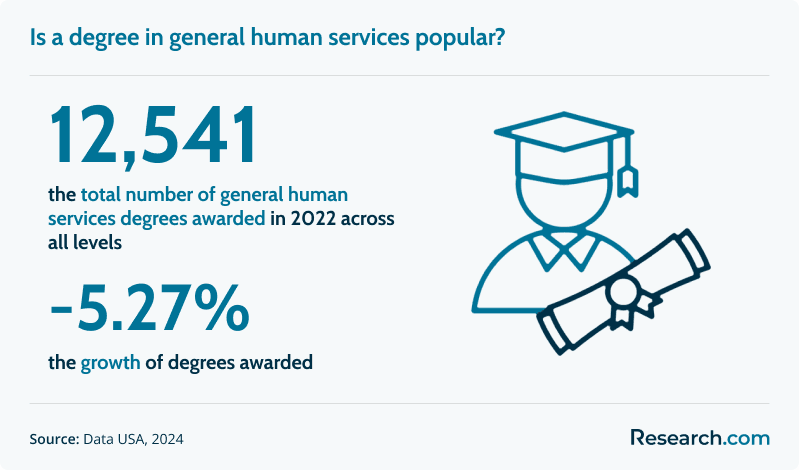
In 2022, a total of 12,541 degrees awarded were reported in general human services across all degree levels.
Online vs. On-Campus Human Services Degrees: Which Format Fits You?
An online human services degree is usually the better fit for students who need to keep working, manage family responsibilities, or study from a location far from campus. Many online programs offer the same core academic topics as campus programs, including ethics, case management, human behavior, crisis response, community resources, and program planning. The biggest difference is how you interact with faculty, classmates, and fieldwork sites.
An on-campus program may be better for students who learn best through regular face-to-face discussion, structured class meetings, campus-based support, and local networking. Online programs require more self-management, but they can provide more control over weekly scheduling. Students who already hold a bachelor’s degree and want advanced credentials may also compare online human services options with the easiest masters degree pathways, while those exploring a completely different field may consider an online cyber security associates degree.
| Factor | Online human services degree | On-campus human services degree |
| Best for | Working adults, transfer students, caregivers, and students outside commuting range | Students who prefer scheduled in-person learning and campus interaction |
| Flexibility | Often higher, especially with asynchronous courses | More limited because classes meet at set times and places |
| Field experience | May be arranged near the student’s location, depending on the school | Often connected to campus partnerships or local agencies |
| Networking | Requires intentional use of virtual advising, discussion boards, internships, and professional groups | May be easier through campus events, faculty office hours, and local placements |
| Main risk | Choosing a program without enough support, fieldwork guidance, or transfer clarity | Less flexibility for students balancing work and personal responsibilities |
How Much Do the Shortest Online Human Services Degrees Cost?
Tuition varies widely by school, residency status, transfer credits, and whether the program uses semester credits, quarter credits, or a degree-completion structure. Among the programs in this list, the average cost per credit is around $392 for in-state students and about $408 for out-of-state students. Based on those rates, the average total tuition is approximately $45,398 for in-state students and around $47,347 for out-of-state students.
The lowest listed in-state cost per credit starts at about $105, while the lowest listed out-of-state rate begins at $219. Total tuition can start as low as $12,586 for in-state students and around $19,260 for out-of-state students. At the higher end, per-credit tuition can reach $547 for both in-state and out-of-state students, with total tuition reaching as high as $65,640. Students who want a shorter, skills-focused alternative to a bachelor’s degree may also compare this path with a trade or vocational school, though that route leads to different occupations.
Cost factors to check before enrolling
- Transfer-credit acceptance: A lower per-credit price may not save money if the school accepts fewer of your previous credits.
- Fees: Ask about technology fees, online learning fees, graduation fees, internship fees, and course material costs.
- Residency rules: Public colleges may charge different rates for in-state and out-of-state online students.
- Term structure: Accelerated terms can reduce time in school, but heavy course loads may be difficult for working adults.
- Fieldwork expenses: Internships may require transportation, background checks, immunizations, or unpaid hours.
Financial Aid Options for Short Online Human Services Programs
Students in accredited online human services programs may be able to use several types of aid to reduce out-of-pocket costs. The right mix depends on your school, enrollment level, financial need, employer benefits, state residency, and scholarship eligibility.
- Federal grants: Pell Grants and other federal need-based grants may be available to eligible students.
- Scholarships: Schools, nonprofits, foundations, and professional organizations may offer awards for online learners or students preparing for human services careers.
- Federal student loans: Direct Subsidized and Unsubsidized Loans may help cover tuition and approved education expenses.
- State aid: Some states provide grants or scholarships for residents attending eligible institutions.
- Employer tuition assistance: Human services agencies, health systems, schools, and nonprofits may help employees pay for job-related education.
- Payment plans: Monthly payment options can spread tuition costs across a term instead of requiring one upfront payment.
Before borrowing, compare net cost after grants and scholarships, not just advertised tuition. Students prioritizing cost can review an affordable human services online degree list, while those considering broader interdisciplinary options may also ask what are the easiest liberal studies degrees and whether that curriculum fits their career plans.
Admissions Requirements for Accelerated Online Human Services Degrees
Admission requirements differ by institution, but short online human services programs often expect applicants to show readiness for upper-division or accelerated study. Degree-completion programs may have additional transfer-credit requirements that traditional first-year admission does not require.
- High school diploma or GED: Applicants generally need proof of secondary school completion or an equivalent credential.
- Minimum GPA: Some schools require a minimum GPA, often around 2.0 to 2.5, either from high school or previous college coursework.
- Standardized test scores: Many online bachelor’s programs no longer require SAT or ACT scores, though some may use scores for placement or admissions review.
- Application essay or personal statement: Programs may ask applicants to explain their interest in human services, career goals, and readiness for online learning.
- Recommendation letters: Some schools request references from teachers, supervisors, community leaders, or others who can speak to the applicant’s preparation and character.
- Interview: A program interview may be used to evaluate fit, communication skills, or motivation for entering the helping professions.
Accelerated professional studies programs may also require prior college credits, work experience, or a completed associate degree. If speed is a top priority, compare each school’s transfer policy with broader fast track degree program online options before committing.
In 2022, human services programs awarded 6,016 bachelor's degrees and 1,042 master's degrees.
Common Courses in Short Online Human Services Degree Programs
Fast online human services programs concentrate on practical, career-relevant foundations. Students typically study how service systems work, how to assess client needs, how to communicate professionally, and how to connect people with resources while following ethical standards.
| Course area | What students usually learn | Why it matters in human services |
| Introduction to Human Services | History of the field, service models, professional roles, ethics, and client populations | Helps students understand how agencies, communities, and support systems fit together |
| Human Behavior and Social Environment | Theories of behavior and the influence of family, culture, community, and social conditions | Builds context for working with clients facing complex life circumstances |
| Case Management | Assessment, service planning, documentation, referrals, and coordination of care | Prepares students for one of the most common functions in entry-level human services roles |
| Ethics in Human Services | Boundaries, confidentiality, informed consent, professional conduct, and ethical dilemmas | Supports responsible practice with vulnerable clients and communities |
| Crisis Intervention | Immediate response strategies, safety planning, trauma-informed communication, and referral procedures | Provides a foundation for supporting people in urgent or high-stress situations |
These courses do not replace graduate-level clinical training, but they can help students build the applied knowledge needed for many direct service, intake, advocacy, outreach, and coordination roles.
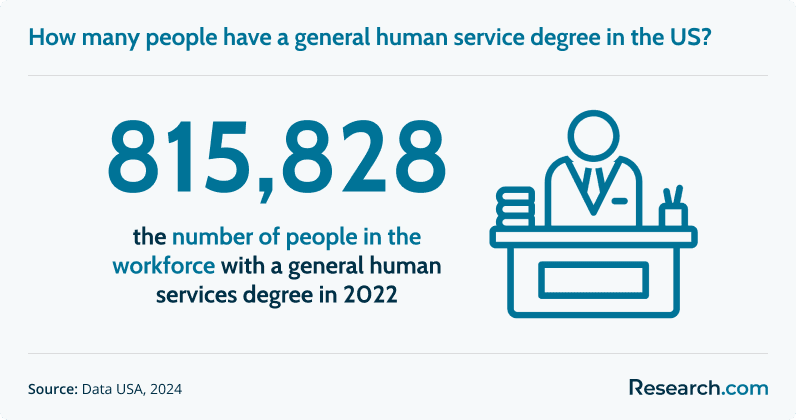
In 2022, around 815,828 people in the workforce held general human services degrees across degree levels.
Specializations Available in Short Online Human Services Programs
Specializations help students align a broad human services degree with a more specific population, setting, or career direction. The best concentration is the one that matches the type of work you want to do after graduation and the credentials that field may require later.
- Addictions counseling: Focuses on substance use, recovery support, relapse prevention, and referral systems. Students comparing adjacent behavioral health routes may also review easy psychology degree options.
- Case management: Emphasizes assessment, service planning, client advocacy, referrals, and interagency coordination.
- Child and family welfare: Prepares students to understand family systems, child safety, neglect, abuse, and family support services.
- Gerontology: Centers on aging, elder services, long-term care systems, caregiver support, and quality-of-life concerns.
- Crisis intervention: Develops skills for responding to trauma, emergencies, acute distress, and community disruption.
- Community advocacy: Focuses on access to services, social justice, policy awareness, and support for underserved groups.
- Public health: Introduces health disparities, prevention programs, community education, and population-level wellness strategies.
Students who eventually want senior leadership roles may later consider graduate-level study, including affordable doctoral programs in leadership, but a bachelor’s specialization is usually a first step rather than a final credential for executive-level work.
Why Accreditation Matters for Online Human Services Degrees
Accreditation is one of the first things to verify when evaluating an online human services program. Institutional accreditation can affect federal financial aid eligibility, transfer-credit acceptance, graduate school admission, and employer confidence. It also signals that the school has been reviewed for academic quality, faculty qualifications, student services, and institutional stability.
Before enrolling, confirm the school’s accreditation through official accreditor or government sources, not only through marketing pages. Also check whether the program meets any specific requirements relevant to your state, employer, graduate school plans, or future credential. A broad degree in human services can support many roles, but it does not automatically qualify graduates for licensed clinical practice.
Should You Earn a Master’s Degree After a Human Services Bachelor’s?
A master’s degree may make sense if your target role requires advanced training, clinical preparation, supervision, policy expertise, program administration, or licensure. For example, counseling, social work, marriage and family therapy, and some leadership positions may require graduate education beyond a bachelor’s degree.
However, graduate school is not always the immediate next step. First, compare tuition, accreditation, licensure alignment, field placement support, expected career outcomes, and how much experience you already have. If you are weighing graduate options, review what can you do with a masters in human services before deciding whether the added cost and time are justified.
How to Choose the Best Short Online Human Services Degree Program
The best short program is not simply the one with the fastest completion time. It is the one that lets you graduate efficiently while protecting credit transfer, financial aid eligibility, academic quality, and career relevance.
- Verify accreditation: Make sure the institution is accredited by a recognized accreditor and that the credential will be accepted by employers or graduate schools you care about.
- Ask for a transfer evaluation: Do not rely on general promises. Request a written estimate showing how many credits will apply toward your degree.
- Compare total cost: Look beyond tuition per credit and include fees, books, technology, fieldwork costs, and the number of credits you still need.
- Review the curriculum: Choose courses and specializations that match your goals in counseling-related support, case management, advocacy, public health, administration, or crisis work.
- Check career support: Ask about internships, resume help, employer connections, alumni networks, and guidance for human services jobs.
- Evaluate flexibility honestly: Accelerated study is demanding. Make sure the weekly workload fits your job, family, and health commitments.
Students interested in policy, government, or systems-level change may also compare human services programs with a public policy degree online, especially if their long-term goal is program design, legislation, advocacy, or public-sector leadership.
Questions to ask before applying
- How many of my previous credits will transfer, and can I get that answer in writing?
- Is the program fully online, or are there required campus visits?
- Are internships, practicums, or capstones required?
- Will field placements be available in my local area?
- What is the maximum course load allowed each term?
- What happens if I need to slow down or take a break?
- Does the program prepare students for any certifications, or would those require additional training?
- What career services are available specifically for online students?
Career Paths for Graduates of Short Online Human Services Programs
A bachelor’s degree in human services can support entry-level and advancement-oriented roles in social services, nonprofit organizations, community agencies, health-related programs, corrections, rehabilitation services, and public-sector organizations. Some roles involve direct client contact, while others focus on coordination, outreach, advocacy, program support, or administration.
- Social services and counseling support: Graduates may work with individuals and families through intake, referral, advocacy, and support services. Independent counseling roles often require a graduate degree and licensure.
- Community and public health: Roles may involve outreach, education, prevention, and connecting people to health and social resources. Additional certification or graduate public health study can strengthen advancement options.
- Criminal justice and rehabilitation: Graduates may support reentry, probation-related services, victim services, or rehabilitation programs. Some roles require state-specific certification or additional training.
- Human services administration: Students interested in leadership may pursue agency coordination, program support, compliance, staff supervision, or operations roles, often after gaining experience.
- Advocacy and nonprofit management: Graduates may work in community organizations focused on service access, social justice, fundraising support, client outreach, or program delivery.
It is important to distinguish between human services roles and licensed clinical roles. Becoming a social worker, marriage and family therapist, mental health counselor, or similar licensed professional usually requires more education than a bachelor’s degree.
The chart below provides additional context on earnings in community and social service occupations in 2023. Among the highest-paying occupations shown, health education specialists had median annual pay of $62,860.
Job Market Outlook for Human Services Graduates
Human services graduates enter a broad labor market tied to community needs, public health priorities, aging-related services, behavioral health demand, family support, corrections, housing assistance, disability services, and nonprofit programs. Job options vary by location, employer funding, experience, and whether a role requires licensure or graduate education.
Graduates may find opportunities in mental health support settings, social service agencies, public health organizations, rehabilitation programs, schools, community nonprofits, and government-funded programs. However, a short degree does not guarantee a specific salary or job title. Employers often weigh experience, internships, communication ability, documentation skills, and knowledge of local service systems.
The following chart shows estimated job growth rates for selected higher-paying community and social service occupations from 2023 to 2033, with marriage and family therapists listed at 16%.
Certifications That Can Strengthen a Human Services Degree
Certifications can help graduates demonstrate focused skills beyond the bachelor’s curriculum. The most useful credential depends on your target role, state rules, employer expectations, and whether you plan to continue into graduate school. For example, students interested in behavioral health or recovery services may explore an addiction counseling certification pathway, but requirements can differ significantly by state and job function.
Common certification areas may involve crisis response, case management, substance abuse support, nonprofit management, community health, behavioral intervention, or family services. Before paying for a credential, ask employers in your area whether they recognize it and whether it improves hiring or advancement prospects.
Do Employers Respect Short Online Human Services Degrees?
Employers are generally more likely to value an online human services degree when it comes from an accredited institution and includes relevant coursework, applied projects, internships, or field experience. The word “online” is usually less important than whether the graduate can document client interactions, write professionally, understand ethics, coordinate services, and work reliably in complex settings.
That said, some employers may prefer candidates with local internship experience or specialized credentials. If your long-term goal is clinical counseling, a bachelor’s degree is usually not enough; you may eventually need graduate study, such as one of the affordable masters in counseling online options, depending on your state and intended license.
What Graduates Say About Short Online Human Services Programs
- : "I entered the program expecting basic career preparation, but the case studies and applied assignments helped me understand how human services work in real situations. The online discussions brought in classmates from many communities, which made the coursework feel practical and grounded. I finished with a clearer sense of how I could support people who need help. — Jordan"
- : "Working full time made returning to school difficult, but the online format gave me a realistic way to finish. My instructors were responsive, and the material connected directly to situations I was already seeing at work. I especially benefited from the crisis management and conflict resolution content. — Chris"
- : "I needed a program that could fit around family responsibilities, and online learning made that possible. The assignments were challenging without feeling disconnected from practice, and the discussion boards helped me connect with other students balancing similar pressures. The degree helped me feel ready for more responsibility in social services. — Keisha"
Can a Short Human Services Degree Help You Move Into Graduate Study?
A short online human services degree can be a practical foundation for graduate study if it is accredited, academically rigorous, and aligned with your next program’s prerequisites. Students may later pursue graduate training in counseling, social work, marriage and family therapy, public policy, public health, organizational leadership, or human services administration.
Before choosing a bachelor’s program, check whether its courses satisfy admissions expectations for your intended graduate path. If you are considering family therapy, for example, compare undergraduate preparation with options such as an online marriage and family therapy masters. Graduate programs may also require specific GPA thresholds, recommendation letters, field experience, or prerequisite coursework.
Can a Human Services Degree Lead to Psychology-Related Roles?
Human services and psychology overlap in areas such as human behavior, communication, crisis response, ethics, advocacy, and client support. A human services bachelor’s degree may help graduates qualify for psychology-adjacent support roles, especially in community agencies, behavioral health organizations, residential programs, rehabilitation services, or case management settings.
However, psychology practice and clinical mental health roles often require additional education, supervised experience, and licensure. Students who want to compare career options should review psychology degree career paths and identify which roles require graduate training.
Potential Drawbacks of a Short Online Human Services Degree
Accelerated programs can save time, but they also create trade-offs. Condensed courses move quickly, leaving less time for reflection, relationship-building, and deep exploration of complex client issues. Students who are new to college or working long hours may find the pace difficult.
- Less time for skill development: Short terms can make it harder to practice interviewing, documentation, and case analysis.
- Limited networking: Online students must be intentional about faculty contact, peer connection, internships, and professional associations.
- Fieldwork challenges: Finding an approved local placement can take planning, especially in rural areas or specialized settings.
- Licensure confusion: A human services bachelor’s degree alone usually does not qualify graduates for licensed clinical roles.
- Transfer-credit risk: A program advertised as short may take longer if fewer credits transfer than expected.
Students aiming for advanced clinical, assessment, or research roles should compare bachelor’s options with longer graduate pathways, including doctor of psychology programs online, before assuming an accelerated degree will meet all future requirements.
Are CACREP-Accredited Online Programs Necessary for Human Services Careers?
CACREP accreditation is most relevant for students pursuing counseling education and licensure-oriented counseling careers. It is not required for every human services role, but it can matter if you plan to move into professional counseling after earning a bachelor’s degree. Students who expect to pursue counseling licensure should examine CACREP accredited online programs and compare curriculum, field placement structure, faculty qualifications, and state licensure alignment.
For nonclinical human services roles, institutional accreditation, applied experience, and job-relevant skills may matter more than CACREP status. The key is to match accreditation type to your actual career goal.
Return on Investment: Is a Short Online Human Services Degree Worth It?
The return on investment depends on how much you pay, how quickly you finish, how many credits transfer, whether you avoid excessive borrowing, and whether the degree helps you qualify for better roles. A shorter timeline can improve value because students may graduate and pursue advancement sooner, but only if the program is affordable and recognized by employers or graduate schools.
To evaluate ROI, compare total tuition, fees, lost work time, certification costs, internship requirements, and likely local job options. Students weighing similar helping-profession degrees may also compare costs with the cheapest psychology degree options, while remembering that psychology and human services can lead to different credentials and career outcomes.
Trends Shaping Human Services Careers
Human services work is being influenced by technology-enabled service delivery, remote client support, telehealth-related coordination, data-informed program evaluation, and integrated care models. Agencies increasingly need workers who can document outcomes, communicate across systems, use digital platforms responsibly, and support clients who access services both in person and remotely.
Interdisciplinary training is also becoming more useful. For example, some students combine human services foundations with behavioral intervention, public health, policy, or leadership preparation. Those interested in applied behavior analysis may compare specialized options such as cheap online BCBA programs, while confirming whether those programs meet the credential requirements they need.
Are Online Human Services Degrees as Respected as Online Psychology Degrees?
Online human services and online psychology degrees can both be respected when they come from accredited institutions and include rigorous coursework, qualified faculty, and meaningful applied learning. The better choice depends on the student’s goal. Human services is often more practice-oriented toward service coordination, advocacy, case management, and community support. Psychology may provide deeper study of behavior, cognition, research methods, and mental processes.
Employers and graduate schools tend to look beyond the degree label. They review accreditation, internships, course relevance, writing ability, recommendations, and experience. Students comparing online psychology options can review whether can you get your psychology degree online aligns with accepted academic and career standards.
Student Support Services That Matter in Online Human Services Programs
Strong support services can make the difference between enrolling and graduating. Online students should look for academic advising, transfer-credit guidance, tutoring, writing support, technical help, career coaching, internship coordination, disability services, and responsive faculty communication.
Career support is especially important in human services because experience often matters alongside the degree. Ask whether the school helps online students locate internships, prepare for interviews, connect with agencies, and plan for graduate study. Students who may later shift toward behavioral science can also compare pathways such as an accelerated psychology degree.
Common Mistakes to Avoid When Choosing a Short Online Human Services Degree
| Mistake | Why it can hurt you | Better approach |
| Choosing only the fastest program | The shortest timeline may depend on transfer credits you do not have. | Ask for a personalized degree plan before enrolling. |
| Ignoring accreditation | Unaccredited study can affect financial aid, transfer credits, employer recognition, and graduate admission. | Verify institutional accreditation through official sources. |
| Looking only at cost per credit | A cheap credit rate may not mean a low total cost if many credits are required. | Compare total remaining tuition and fees after transfer evaluation. |
| Assuming the degree leads to licensure | Clinical roles often require graduate education, supervised hours, and state licensure. | Check state and profession-specific requirements early. |
| Overlooking field experience | Employers may prefer candidates with internship, practicum, or direct service experience. | Choose programs with applied projects, internships, or strong career support. |
| Underestimating workload | Accelerated online courses can be intense, especially for working adults. | Start with a realistic course load and ask about pacing options. |
Key Insights
- The shortest online human services programs on this list can take about 16 months, but that speed usually depends on transfer credits and degree-completion eligibility.
- Accreditation should be nonnegotiable because it can affect financial aid, transferability, graduate school options, and employer confidence.
- Program cost should be evaluated by total remaining tuition, not just cost per credit. The listed programs range from about $105 per credit at the low end to $547 per credit at the high end.
- A human services bachelor’s degree can support roles in case management, advocacy, outreach, public health support, rehabilitation services, nonprofit work, and administration, but licensed clinical careers usually require graduate education.
- Online programs can be respected when they are accredited, academically rigorous, and include practical learning such as internships, capstones, case studies, or fieldwork.
- The best program is the one that balances speed, affordability, transfer-credit acceptance, student support, field experience, and alignment with your career plan.
References:
- U.S. Bureau of Labor Statistics. (2024). Community and social service occupations. BLS.
- U.S. Bureau of Labor Statistics. (2024). Health education specialists. BLS.
- U.S. Bureau of Labor Statistics. (2024). Marriage and family therapists. BLS.
- U.S. Bureau of Labor Statistics. (2024). Occupational employment and wages, May 2023 - 21-1093 Social and human service assistants. BLS.
- U.S. Bureau of Labor Statistics. (2024). Probation officers and correctional treatment specialists. BLS.
- U.S. Bureau of Labor Statistics. (2024). School and career counselors and advisors. BLS.
- U.S. Bureau of Labor Statistics. (2024). Social and human service assistants. BLS.
- U.S. Bureau of Labor Statistics. (2024). Social workers. BLS.
- Wilson, S. (2021). The definition of human services. HumanServicesEdu.org.
Other Things You Should Know About Online Human Services Degree Programs
Prerequisites for the shortest online human services degree programs often include a high school diploma or GED. Some programs may also require specific coursework in psychology or sociology before admission. Check individual program requirements for specific details.
Most accelerated online human services associate degrees require about 60 semester credits. Programs with transfer credit, prior learning assessment, or an 8-week term format can reduce completion time, but the final degree still must meet the school’s minimum credit total and accreditation standards.