2027 Best Online Social Work Degree Programs

Co-Founder and Chief Data Scientist
With many universities now offering flexible and accredited online BSW and MSW options, students can access quality education without sacrificing personal or professional commitments. According to the Council on Social Work Education (CSWE), over 35% of MSW students were enrolled in online programs as of recent years, highlighting the growing demand for remote learning pathways.
This guide highlights some of the best online social work programs available today, offering key details on curriculum, costs, program length, and career outcomes to help you make an informed and confident decision.
What are the benefits of getting an online degree in social work?
- Online social work programs allow students to complete coursework on their own schedule, making it easier to balance education with work or family responsibilities.
- Studying online often reduces expenses related to commuting, housing, and campus fees, offering a more affordable path to a respected degree.
- Social workers earn an average salary of $73,564 per year, with opportunities expected to grow due to rising demand in healthcare, mental health, and community services.
What can I expect from an online social work degree program?
An online social work degree program offers a combination of academic coursework, real-world field experience, and flexible scheduling designed to prepare students for professional practice.
Courses typically cover topics like human behavior, social policy, ethics, and diverse populations, all taught through virtual lectures, discussions, and assignments. Students are also required to complete supervised field placements in their local communities, gaining hands-on experience in social service settings.
Programs often include support from faculty advisors, access to online libraries, and preparation for licensure.
Where can I work with an online degree in social work?
With an online degree in social work, graduates can pursue careers in a wide range of settings that serve individuals, families, and communities.
Common workplaces include hospitals, mental health clinics, schools, child welfare agencies, nonprofit organizations, and government programs. Some social workers also work in correctional facilities, substance abuse centers, or private practice (with the appropriate licensure).
The flexibility of an online degree allows graduates to meet the same licensure and certification requirements as on-campus programs, opening doors to both local and national job opportunities. These roles often involve advocacy, counseling, case management, and connecting people to essential resources and support.
How much can I earn with an online degree in social work?
Earning potential with an online degree in social work depends on your level of education, area of specialization, and work setting. According to the U.S. Bureau of Labor Statistics, the average salary for social workers is $73,564 per year, with clinical and healthcare social workers often earning more.
Those with a BSW typically qualify for entry-level roles in case management and community services, while MSW graduates can pursue licensed clinical positions with higher earning potential.
Salaries also vary by location, with urban areas and government agencies often offering more competitive pay. An online degree from an accredited program provides the same credentials as an on-campus degree, supporting both licensure and long-term career advancement.
- List of the Best Online Social Work Degree Programs for 2027 List of Programs
- How long does it take to complete an online social work degree program? Completion Time
- How does an online social work program compare to an on-campus program? How does an online social work program compare to an on-campus program?
- What is the average cost of an online social work degree program? Average Cost
- What are the financial aid options for students enrolling in an online social work degree program? Financial Aid
- What are the prerequisites for enrolling in an online social work degree program? Requirements
- What courses are typically in an online social work degree program? What courses are typically in an online social work degree program?
- What types of specializations are available in an online social work degree program? What types of specializations are available in an online social work degree program?
- How do I choose the best online social work program? How do I choose the best online social work program?
- What is the long-term return on investment of an online social work degree? What is the long-term return on investment of an online social work degree?
- Do employers value online social work degrees? Do employers value online social work degrees?
- What career paths are available for graduates of an online social work degree program? Career Paths
- What is the job market for graduates with an online degree in social work? Job Market
- Can additional certifications complement an online social work degree? Can additional certifications complement an online social work degree?
Best Online Social Work Degree Programs for 2027
Choosing an online social work degree is not just a question of convenience. The right program can determine whether you qualify for field placements, meet licensure expectations, transfer credits efficiently, and graduate with a credential employers recognize. This guide is designed for students comparing online Bachelor of Social Work (BSW) and Master of Social Work (MSW) options, including working adults, transfer students, career changers, and future clinical social workers.
You will find a ranked program list, a practical comparison of online versus campus formats, cost and financial aid considerations, admissions requirements, common courses, specialization options, career paths, job outlook, and decision points to review before enrolling. The goal is to help you choose a CSWE-accredited online social work program that fits your schedule, budget, career goals, and state licensure plans.
Quick answer: What is the best online social work degree program?
The best online social work degree program is the one that is accredited by the Council on Social Work Education (CSWE), provides strong local field placement support, fits your timeline and budget, and aligns with your intended career path. For students seeking entry-level social work roles, an online BSW is usually the starting point. For students pursuing clinical practice, leadership, healthcare social work, or advanced licensure, an online MSW is generally the required next step.
When comparing programs, prioritize CSWE accreditation first. Then review field practicum requirements, total tuition, transfer credit policies, online course format, faculty support, and whether the curriculum prepares you for the type of social work licensure required in your state.
How Research.com evaluates online social work programs
Research.com uses our methodology to compare programs using publicly available education data, institutional information, and recognized higher education sources. Rankings should be used as a starting point, not as the only factor in your decision. A highly ranked school may still be a poor fit if it does not support field placements in your area, match your schedule, or align with your licensure goals.
- IPEDS database
- Peterson's database, including the Distance Learning Licensed Data Set
- College Scorecard database
- National Center for Education Statistics
Online social work programs at a glance
| School and program | Degree level | Program length | Cost information | Accreditation |
| Maryville University – Online Bachelor of Social Work | BSW | Four years (120 credit hours) | $575 per credit | Council on Social Work Education (CSWE) |
| Spring Arbor University – Online Bachelor of Social Work | BSW | Two to four years (120 credit hours) | $525 per credit | Council on Social Work Education (CSWE) |
| Capella University – Online Master of Social Work | MSW | 45 months (88 quarter credits) | $47,520 total tuition | CSWE |
| Texas State University – Bachelor of Social Work | BSW | Four years (120 credit hours) | Visit the Student Business Services website at TSU for tuition calculation. | CSWE |
| University of Cincinnati – Online Bachelor of Social Work | BSW | Four years (120 credit hours) | $74,520 estimated total tuition | CSWE |
| Columbia University – Online Master of Social Work | MSW | One to two years | Not listed explicitly online | CSWE |
| University of Alabama – Online Bachelor of Social Work | BSW | Three to six years | $399 per credit | CSWE |
| University of Utah – Online Bachelor of Social Work | BSW | Four years (120 credit hours) | $537.55 per credit | CSWE |
| Cleveland State University – Online Bachelor of Social Work | BSW | 4 years (120 credits total) | $552 per credit (in-state), $790 per credit (out-of-state). | CSWE |
| Ball State University – Online Bachelor of Social Work | BSW | Four years | Approx. $10,440/year for Indiana residents; $27,924/year out of state. | CSWE |
1. Maryville University – Online Bachelor of Social Work
Maryville University’s online BSW is built for students who want a generalist social work foundation with coursework in advocacy, diversity, social justice, client support, and professional self-care. The program requires a local field practicum, typically about 400 hours, so students should confirm early that approved placement options are available near them. Graduates may pursue entry-level positions in areas such as child welfare, healthcare, mental health, and community services, and the curriculum is designed to prepare students to sit for the ASWB licensing exam.
- Program Length: Four years (120 credit hours)
- Tracks/concentrations: N/A
- Cost per Credit/Tuition: $575 per credit
- Accreditation: Council on Social Work Education (CSWE)
2. Spring Arbor University – Online Bachelor of Social Work
Spring Arbor University’s online BSW may appeal to students who want professional social work preparation within a faith-centered academic setting. The program emphasizes ethical practice, service, social justice, and work with individuals, families, groups, and communities. Its modular and accelerated delivery options can support adult learners, but students should evaluate whether the pace is realistic alongside employment and field education requirements.
- Program Length: Two to four years (120 credit hours)
- Tracks/concentrations: Generalist BSW with Christian values
- Cost per Credit/Tuition: $525 per credit
- Accreditation: Council on Social Work Education (CSWE)
3. Capella University – Online Master of Social Work
Capella University’s online MSW follows a guided-path model with weekly assignments, discussions, and research-focused projects. The advanced generalist curriculum includes topics such as assessment, diagnostics, clinical supervision, leadership, and technology in social work. Students also complete 2 elective courses and 5 practicum and internship opportunities, making placement planning an important part of enrollment preparation.
- Program Length: 45 months (88 quarter credits)
- Tracks/concentrations: Advanced generalist social work
- Cost per Credit/Tuition: $47,520 total tuition
- Accreditation: CSWE
4. Texas State University – Bachelor of Social Work
Texas State University offers an online-eligible BSW structured around a three-phase model that prepares students for beginning generalist practice. The curriculum develops skills in communication, advocacy, ethical decision-making, research, and culturally responsive service delivery. Because tuition depends on student-specific factors, applicants should calculate the full cost directly through the university before comparing it with flat-rate online options.
- Program Length: Four years (120 credit hours)
- Tracks/concentrations: N/A
- Cost per Credit/Tuition: Visit the Student Business Services website at TSU for tuition calculation.
- Accreditation: CSWE
5. University of Cincinnati – Online Bachelor of Social Work
The University of Cincinnati online BSW combines general education with social work coursework in ethics, human behavior, research, group practice, and intervention. Students complete a supervised practicum of 432 hours, approximately 16 hours per week, and the university provides placement assistance for students, including those outside the Cincinnati region. This program may be a practical fit for students who want a structured BSW with defined field requirements.
- Program Length: Four years (120 credit hours)
- Tracks/concentrations: N/A
- Cost per Credit/Tuition: $74,520 estimated total tuition
- Accreditation: CSWE
6. Columbia University – Online Master of Social Work
Columbia University offers an online MSW through its School of Social Work that combines advanced coursework with field education. Students can select method specializations such as Advanced Clinical Practice, Policy Practice, Integrated Practice & Programming, or Leadership, Management & Entrepreneurship, along with fields of practice including aging, mental health, and refugee services. Applicants should request current tuition details because the cost is not listed explicitly online.
- Program Length: One to two years
- Tracks/concentrations: Advanced clinical practice, policy practice, leadership, management, and entrepreneurship for social justice.
- Cost per Credit/Tuition: Not listed explicitly online
- Accreditation: CSWE
7. University of Alabama – Online Bachelor of Social Work
The University of Alabama online BSW includes research-based coursework, virtual skills labs, and supervised field learning. In the final year, students complete 450 clock hours of in-person practicum over a 15-week semester, typically four days per week. The university coordinates placements through 300+ agency partners and also offers Washington, D.C., or international experience options.
- Program Length: Three to six years
- Tracks/concentrations: N/A
- Cost per Credit/Tuition: $399 per credit
- Accreditation: CSWE
8. University of Utah – Online Bachelor of Social Work
The University of Utah online BSW, offered through UOnline, prepares students for generalist social work with an emphasis on social justice, rural communities, underrepresented populations, and culturally responsive practice. Students must complete a local supervised practicum that meets CSWE expectations. The program may be especially attractive to transfer students because the university allows students to bring in up to 90 credits.
- Program Length: Four years (120 credit hours)
- Tracks/concentrations: N/A
- Cost per Credit/Tuition: $537.55 per credit
- Accreditation: CSWE
9. Cleveland State University – Online Bachelor of Social Work
Cleveland State University’s online BSW is designed for students interested in urban practice, underserved communities, and applied social service work. The curriculum emphasizes professional ethics, evidence-informed tools, and real-world social challenges such as addiction, poverty, aging, and incarceration. Students comparing public university options should review in-state and out-of-state tuition carefully because the rate difference is significant.
- Program Length: 4 years (120 credits total)
- Tracks/concentrations: N/A
- Cost per Credit/Tuition: $552 per credit (in-state), $790 per credit (out-of-state).
- Accreditation: CSWE
10. Ball State University – Online Bachelor of Social Work
Ball State University’s online BSW blends liberal arts study with professional social work coursework. The program is a good match for students who want practical problem-solving skills, ethical preparation, and a final-semester practicum connected to social service agencies. Students complete a full-time practicum of 400 to 420 hours, coordinated by Ball State for professional fit.
- Program Length: Four years
- Tracks/concentrations: N/A
- Cost per Credit/Tuition: Approx. $10,440/year for Indiana residents; $27,924/year out of state.
- Accreditation: CSWE
How Long Does an Online Social Work Degree Take?
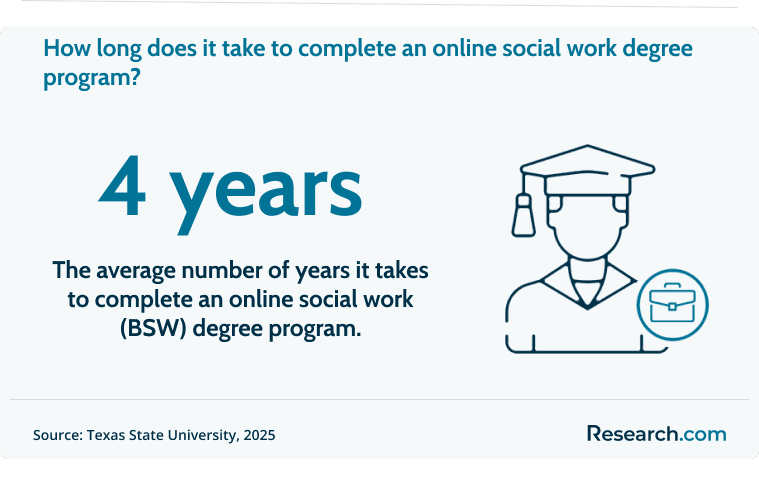
An online social work degree can take anywhere from one year to six years depending on the degree level, enrollment pace, transfer credits, and field placement schedule. A BSW commonly requires 120 credit hours and is often structured for four years of full-time study. Students with prior college credit may finish sooner, while part-time students may need additional time.
Field education is one of the biggest timeline factors. Even when coursework is online, social work students usually complete supervised in-person practicum hours at approved agencies. Placement availability, work schedules, background checks, and agency requirements can all affect how quickly students progress.
An MSW typically takes about two years of full-time study for students who do not already hold a BSW. Students with a CSWE-accredited BSW may qualify for advanced standing, which can reduce completion time to as little as 12 to 16 months. MSW programs usually require 30 to 60 credit hours, depending on the track, and include field education, often 900–1,200 hours, depending on state licensing requirements. Students exploring mental health-focused credentials may also compare the best online psychiatric mental health nurse practitioner graduate certificate programs if they are considering adjacent clinical pathways.
| Degree path | Typical timeline stated | Best fit | Important consideration |
| Online BSW | Four years (120 credit hours) | Students seeking entry-level social work roles or future MSW advanced standing eligibility | Requires field practicum in addition to online coursework |
| Online MSW without BSW | About two years full-time | Students with a bachelor’s degree in another field | May require 30 to 60 credit hours plus extensive field education |
| Advanced Standing MSW | As little as 12 to 16 months | Students with a CSWE-accredited BSW | Eligibility often depends on how recently the BSW was earned |
Online vs. On-Campus Social Work Programs: Which Format Is Better?
Online and on-campus social work programs can both prepare students for professional practice when they are properly accredited and include supervised field education. The better format depends on how you learn, how much schedule flexibility you need, whether you can attend campus-based classes, and how much support you need in person.
| Factor | Online social work program | On-campus social work program | Best choice when... |
| Schedule | Often allows more flexibility through asynchronous or virtual coursework | Usually follows set class times and campus schedules | Choose online if you work, parent, or live far from campus; choose campus if you prefer fixed structure |
| Field education | Completed in person, usually near the student’s community | Completed in person, often through local campus partnerships | Ask both formats how placements are approved and supported in your location |
| Faculty and peer interaction | Uses video meetings, online discussions, learning platforms, advising, and virtual office hours | Offers face-to-face conversations, campus events, and in-person mentoring | Choose campus if spontaneous networking is important; choose online if digital communication works well for you |
| Learning style | Requires organization, self-direction, technology comfort, and consistent time management | Provides more physical structure and immediate classroom interaction | Be honest about how you stay motivated and how much accountability you need |
In both formats, students should expect hands-on fieldwork. That experience is essential in a practice-based profession. Students who are particularly interested in supporting survivors, crisis intervention, and advocacy may also want to review the domestic violence counselor career path to understand how social work training can connect with specialized advocacy roles.
How Much Does an Online Social Work Degree Cost?
The cost of an online social work degree varies by institution type, residency rules, degree level, transfer credits, and fees. Tuition alone does not show the full price. Students should also consider technology fees, books, background checks, transportation to field sites, lost work hours during practicum, and any campus visit requirements.
The examples below show how published tuition information can differ across online BSW and MSW programs. These figures should be verified with each school before enrollment because final cost may depend on transfer credits, course load, residency, and financial aid.
| Program | Published cost information | What to review before enrolling |
| Maryville University – BSW | $69,000 | Ask how transfer credits affect total cost and confirm practicum expectations in your area |
| University of Alabama – BSW | $47,880 | Review the final-year 450 clock hours of in-person practicum over a 15-week semester |
| Spring Arbor University – BSW | $63,000 | Evaluate whether the faith-based model and accelerated pacing fit your goals and schedule |
| University of Utah – BSW | $64,440 | Confirm transfer credit acceptance, especially if you plan to bring in up to 90 credits |
| Capella University – MSW | $47,520 | Review practicum and internship requirements before committing to the timeline |
Lower tuition is important, but it should not be the only deciding factor. A program that is slightly more expensive may be worthwhile if it accepts more transfer credits, provides stronger field placement support, or helps you stay enrolled while working. Conversely, a cheaper program can become costly if placement delays extend your graduation date.
Students looking for flexible faith-centered academic options beyond social work may also compare a religious studies degree online, especially if they are exploring ministry, nonprofit work, or community service careers alongside social work-related interests.
Use the chart below as a quick visual comparison of cost differences among selected programs.
Financial Aid Options for Online Social Work Students
Online social work students may qualify for many of the same aid options available to campus-based students, as long as the school and program meet eligibility requirements. The most important first step is to confirm accreditation and financial aid eligibility with the institution before applying.
- Federal financial aid: Students in eligible accredited programs can submit the FAFSA to be considered for federal grants, loans, and work-study. Eligibility can depend on financial need, enrollment level, satisfactory academic progress, and other federal rules.
- Scholarships and grants: Schools may offer awards for online learners, social work majors, transfer students, adult learners, or students with financial need. Professional organizations, including social work associations, may also sponsor competitive scholarships.
- Employer tuition assistance: Students already working in human services, healthcare, education, behavioral health, or government agencies should ask whether their employer provides tuition reimbursement or direct tuition assistance for a social work degree.
- State and institutional aid: Some students may qualify for state grants or school-based aid. Residency, enrollment intensity, academic performance, and program type can affect eligibility.
- Payment plans: Installment plans can help students spread tuition over a term instead of paying a large amount upfront. Always check whether the plan includes fees.
| Cost-reduction strategy | Why it matters | Question to ask |
| Transfer credits | Accepted credits can reduce both time and tuition | How many credits will transfer into the social work major, not just general electives? |
| Advanced standing MSW | Can shorten graduate study for eligible BSW graduates | Does my CSWE-accredited BSW qualify, and are there time limits? |
| Local field placement | Travel and scheduling can create hidden costs | Will the school help secure a practicum near where I live? |
| Employer support | Can reduce out-of-pocket costs while you remain employed | Does my employer require a service commitment after reimbursement? |
Admissions Requirements for Online Social Work Programs
Admissions requirements vary by school and degree level, but accredited social work programs commonly look for academic readiness, communication skills, ethical awareness, and a clear commitment to working with people and communities. Students interested in the behavioral science side of social services may also compare a social psychology degree online as a related academic option.
- BSW applicants: Most programs require a high school diploma or GED. Some expect a minimum GPA, often around 2.5 or higher, and may require prior coursework in fields such as psychology or sociology.
- MSW applicants: Applicants need a bachelor’s degree from an accredited institution. The degree does not always have to be in social work, but Advanced Standing MSW programs require a BSW from a CSWE-accredited program earned within the past five to seven years.
- Recommendation letters: Many programs request two to three letters from academic instructors, supervisors, or professional contacts who can speak to the applicant’s maturity, readiness, and service orientation.
- Personal statement: Applicants are often asked to explain why they want to study social work, what populations or practice areas interest them, and how their background has prepared them for the field.
- Interview and background check: Some programs conduct interviews and may require a background check before practicum placement. Field agencies may also have their own screening standards.
Students comparing helping-profession degrees should pay close attention to licensure requirements. For example, the educational requirements for addiction counseling versus psychology programs can differ from social work requirements in coursework, supervised experience, and credentialing pathways.
Common Courses in an Online Social Work Degree
Online social work curricula are designed to build professional judgment, ethical practice, assessment skills, research literacy, and field readiness. BSW programs generally focus on generalist practice, while MSW programs move into advanced practice, clinical preparation, leadership, policy, or specialized populations.
- Human Behavior in the Social Environment: Students examine development across the life span and learn how families, communities, culture, social systems, and environment shape behavior. Students interested in applied behavioral roles can also review the behavior therapist career guide.
- Social Work Practice Methods: Courses introduce assessment, communication, interviewing, intervention planning, case management, and practice with individuals, families, groups, organizations, and communities.
- Social Welfare Policy: Students study how social programs, laws, and public policies affect vulnerable populations and how social workers participate in policy analysis and advocacy.
- Research Methods in Social Work: Students learn to evaluate evidence, interpret data, understand outcomes, and apply research findings to practice decisions.
- Field Education or Practicum: Students apply classroom learning in supervised agencies. Even online students complete this requirement in person at approved sites.
- Diversity and Cultural Competence: Coursework prepares students to work respectfully and effectively with people across differences in race, ethnicity, gender, sexuality, disability, socioeconomic status, and lived experience.
Online Social Work Specializations
Specializations help students focus their training on a population, practice setting, or service approach. Not every BSW program offers formal concentrations, but MSW programs often provide more defined specialization options.
| Specialization | What it focuses on | Common work settings |
| Clinical social work | Mental health assessment, therapy, diagnosis, and treatment planning | Private practice, hospitals, community mental health centers |
| Child and family social work | Family systems, child welfare, safety planning, and support services | Government agencies, nonprofits, schools |
| School social work | Student well-being, behavioral support, family-school coordination, and intervention planning | K-12 schools and educational agencies |
| Medical social work | Patient advocacy, discharge planning, illness adjustment, and care coordination | Hospitals, clinics, hospice care, rehabilitation facilities |
| Substance abuse counseling | Addiction recovery, treatment support, relapse prevention, and behavioral health coordination | Rehabilitation centers, outpatient clinics, correctional facilities |
| Gerontology, military and veteran services, or policy advocacy | Specialized populations, systems-level support, or social justice work | Public agencies, nonprofits, healthcare organizations, advocacy groups |
Students comparing graduate options should review what are the different MSW specializations available before choosing a program. The right specialization can affect field placement options, licensure preparation, and the types of employers likely to value your training.
How to Choose the Best Online Social Work Program
The best online social work program is not automatically the cheapest, fastest, or most famous. It is the program that meets professional standards, supports field education where you live, and prepares you for the job or license you want after graduation.
- Verify CSWE accreditation. Confirm that the program is accredited by the Council on Social Work Education (CSWE). CSWE accreditation is a central requirement for many social work licensure pathways and indicates that the curriculum meets recognized professional education standards.
- Check state licensure alignment. Licensing rules vary by state. Ask whether the program meets educational requirements in the state where you plan to practice, especially if you are pursuing clinical licensure.
- Ask detailed field placement questions. Do not assume the school will automatically find a convenient site. Ask who identifies placements, whether agencies exist near you, and how many hours are required each term.
- Calculate total cost, not only tuition. Include fees, books, transportation, background checks, technology, residency differences, and potential income reduction during intensive practicum terms.
- Compare course delivery formats. Asynchronous classes offer flexibility, while live online classes may provide more structure. Choose the format that matches your discipline, work schedule, and need for interaction.
- Review student support services. Online learners should have access to advising, library resources, writing support, tech help, disability services, career counseling, and field education staff.
- Evaluate faculty experience. Faculty with practice backgrounds, licensure, research experience, or specialization expertise can strengthen classroom learning and professional mentoring.
Questions to ask before applying
- Is the program currently CSWE-accredited?
- Does the program meet educational requirements for licensure in my state?
- How are field placements arranged for online students in my location?
- Can I complete practicum hours while working?
- How many transfer credits will apply to my degree plan?
- What is the total estimated cost after fees and required materials?
- Are classes asynchronous, synchronous, or a mix of both?
- What academic and career support is available to online students?
Is an Online Social Work Degree Worth It?
An online social work degree can be worth it when it helps you qualify for a specific professional role, licensure pathway, or advancement opportunity at a cost you can reasonably manage. The return on investment depends on tuition, debt, financial aid, transfer credits, program length, practicum feasibility, salary expectations, and whether you plan to pursue advanced credentials such as an MSW or clinical licensure.
The degree may offer stronger value for students who choose a CSWE-accredited program, reduce costs through scholarships or employer assistance, complete fieldwork without delaying graduation, and enter a role that requires or rewards formal social work education. It may offer weaker value if a student enrolls without checking licensure rules, borrows heavily for a low-paying target role, or selects a program that cannot support local field placement.
Students comparing human services and behavioral health degrees may also review a psychology degree online cheap option to understand how costs, career pathways, and credential requirements differ across related fields.
Do Employers Respect Online Social Work Degrees?
Employers are more likely to value an online social work degree when it comes from a properly accredited program and includes supervised field education. In hiring, the delivery format usually matters less than CSWE accreditation, licensure eligibility, practicum quality, relevant experience, communication skills, and readiness to work with clients and agencies.
Online students can also demonstrate strengths employers value, including self-management, digital collaboration, documentation discipline, and comfort with remote communication tools. However, students should avoid assuming that “online” automatically means easier or less demanding. A credible online social work program still requires rigorous coursework, ethical preparation, and in-person field experience.
Graduates who want to broaden their behavioral health expertise may compare related graduate credentials, including the cheapest online masters forensic psychology, when considering specialized roles outside traditional social work practice.
Career Paths for Online Social Work Degree Graduates
Graduates of online social work programs can work in healthcare, schools, behavioral health, child welfare, public agencies, nonprofits, community programs, and advocacy organizations. A BSW can prepare students for entry-level generalist roles, while an MSW may support clinical practice, supervision, specialized practice, or leadership opportunities. Students interested in systems-level community change may also explore an urban planning degree online as a related path focused on public spaces and community development.
The roles below show common career directions and average salaries cited in the source material. Salaries are not guaranteed and can vary by location, employer, experience, licensure, and specialization.
| Career path | Average salary | Typical responsibilities | Common degree expectation |
| Licensed Clinical Social Worker (LCSW) | $73,564 | Provides therapy, mental health assessment, diagnosis-related support, and case management for individuals, families, and groups | Usually MSW plus supervised experience and licensure |
| Child and Family Social Worker | $76,266 | Supports children and families facing abuse, neglect, poverty, housing instability, or service access barriers | Often BSW or MSW depending on role and employer |
| Healthcare Social Worker | $78,890 | Coordinates care, advocates for patients, supports discharge planning, and helps clients manage illness or disability | Often BSW or MSW; clinical roles may require MSW licensure |
| School Social Worker | $54,245 | Supports student emotional, behavioral, and social well-being in collaboration with families, teachers, and counselors | Requirements vary by state and school system |
| Substance Abuse Counselor | $59,190 | Works with clients experiencing drug, alcohol, or behavioral addictions and supports recovery planning | Requirements vary by state, credential, and employer |
If you are comparing behavioral health licenses, review licensed clinical social worker vs licensed professional counselor degree programs. The two pathways can overlap in counseling-related work, but they differ in educational focus, licensure structure, scope of practice, and career settings.
Job Outlook for Social Work Graduates
The labor market for social work graduates is supported by demand in healthcare, mental health, schools, child welfare, aging services, and substance abuse treatment. According to the U.S. Bureau of Labor Statistics, overall employment of social workers is projected to grow 7 percent from 2023 to 2033, which is faster than the average for all occupations.
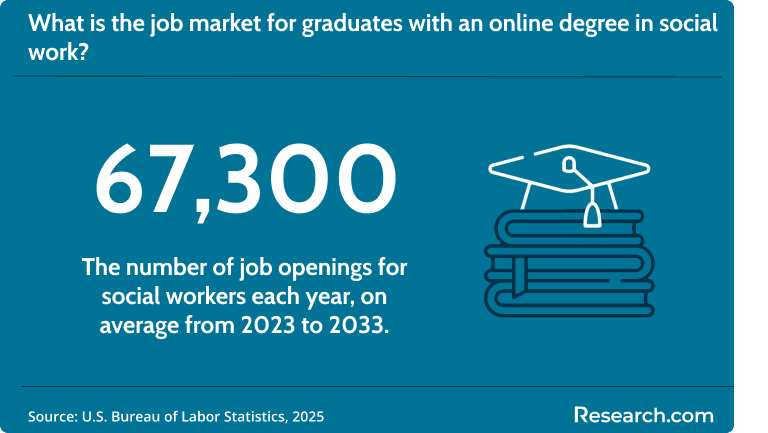
The same source reports an estimated 67,300 job openings for social workers each year on average. Openings can result from new jobs as well as the need to replace workers who retire, move into other fields, or leave the labor force.
Students with a BSW may qualify for entry-level social service and case management positions. Students with an MSW may be more competitive for clinical, supervisory, healthcare, behavioral health, and specialized practice roles. Students comparing adjacent assessment-focused careers can also review the psychometrician job outlook to understand another helping-profession pathway in educational, research, and clinical environments.
Certifications That Can Complement a Social Work Degree
A social work degree provides the academic foundation for practice, but additional credentials can help professionals build expertise in specialized populations or methods. Certifications may be useful in areas such as trauma-informed care, substance abuse counseling, behavioral analysis, gerontology, crisis response, or school-based services.
Before pursuing a certification, verify whether it is recognized by employers, licensing boards, or professional organizations in your state. Some certificates add useful skills but do not change your legal scope of practice. Others may support advancement, strengthen a resume, or help you move into a more focused role.
Social work graduates interested in behavior-based interventions may also compare affordable online BCBA degree programs to understand how behavior analysis training can complement work with children, families, schools, and behavioral health clients.
Common Mistakes to Avoid When Choosing an Online Social Work Program
- Ignoring CSWE accreditation: This is one of the biggest risks. A non-accredited program may not support your licensure or graduate school goals.
- Assuming online means fully remote: Social work programs still require in-person field education. Confirm hours, location, schedule, and placement support.
- Looking only at tuition per credit: Total cost depends on transfer credits, fees, books, practicum costs, and time to completion.
- Not checking state licensure rules: Licensure requirements vary. Make sure the program aligns with the state where you plan to work.
- Choosing the fastest program without reviewing workload: Accelerated courses can be useful, but fieldwork and heavy reading loads can make fast programs difficult for working adults.
- Overvaluing rankings: Rankings can narrow your list, but fit, accreditation, field placement, affordability, and licensure alignment matter more.
- Waiting too long to plan practicum hours: Field placements may require applications, interviews, background checks, immunizations, or schedule changes.
What Online Social Work Graduates Say
- Melissa: "I did not think I could keep my job, care for my two children, and finish a degree at the same time. The online format gave me room to study around my family schedule, and it helped me move into work that feels meaningful to me."
- Jordan: "I had doubts about learning a practice-based profession online, but the field placement, faculty support, and interactive coursework made the experience much stronger than I expected. When I started as a case manager, I felt prepared."
- Tristan: "Being able to study from anywhere made the degree possible for me, but I still had access to advising, feedback, and a serious internship experience. The program changed how I understand community needs and culturally responsive service."
Key Insights
- CSWE accreditation should be your first filter when evaluating online BSW or MSW programs because it affects licensure pathways and professional credibility.
- Online social work degrees are not fully online in practice. Field education is completed in person, so local placement support is essential.
- A BSW is commonly structured around 120 credit hours and can prepare students for entry-level social work roles or advanced standing MSW eligibility.
- An MSW is usually the stronger pathway for clinical practice, supervision, specialized roles, and many advanced social work positions.
- Program cost should be evaluated as total cost, not only tuition per credit. Practicum scheduling, transfer credits, fees, and lost work time can affect affordability.
- Employers are most likely to respect online social work degrees when the program is accredited, fieldwork is rigorous, and graduates meet licensure or role requirements.
- The U.S. Bureau of Labor Statistics projects social worker employment to grow 7 percent from 2023 to 2033, with an estimated 67,300 job openings for social workers each year on average.
- The best program is the one that fits your state licensure goals, budget, schedule, learning style, field placement needs, and intended population or practice area.
References
- Capella University. (2025). Master of Social Work. CU
- Maryville University. (2025). Cost of Attending Maryville Online. MU
- National Association of Social Workers Wisconsin Chapter. (2024). How Much Does A Licensed Clinical Social Worker (LCSW) Make? NASW
- Spring Arbor University. (2025). Undergraduate and Graduate Tuition and Costs. SAU
- Texas State University. (2025). Online and Extended Programs: Bachelor of Social Work (B.S.W.). TSU
- The University of Alabama. (2025). Bachelor of Social Work (BSW). UA
- U.S. Bureau of Labor Statistics. (2025). Occupational Outlook Handbook: Substance Abuse, Behavioral Disorder, and Mental Health Counselors. U.S. BLS
- University of Utah. (2025). Online Bachelor of Social Work. UU
- ZipRecruiter. (2025). Salary: Child Family Social Worker in the United States. ZipRecruiter
Other Things You Should Know About Online Social Work Degree Programs
Yes. CSWE-accredited online social work programs usually arrange field placements within a student’s local area, often in agencies approved by the program. BSW programs commonly require about 400 to 500 field hours, while MSW programs often require 900 or more hours.
Yes, fieldwork is typically required in 2027 online social work degree programs to provide practical experience. Programs often include 400–1,000 hours of supervised fieldwork at a social service agency, crucial for meeting educational standards set by the Council on Social Work Education (CSWE).


![2027 Best Advanced Standing Online MSW Programs [CSWE Accredited] thumbnail](https://research.com/resized/uploads/Online_Advanced_Standing_MSW_301dbd5368.jpg?format=thumbnail)