
2027 What Can You Do With a Master’s in Sociology?

Co-Founder and Chief Data Scientist
A master’s in sociology is a graduate degree for people who want to study social behavior, inequality, institutions, communities, policy, and human relationships at a deeper level. The main decision is not simply whether sociology is interesting. It is whether the degree will help you reach a specific career goal, qualify for research or leadership roles, prepare for doctoral study, or strengthen work in public service, education, healthcare, advocacy, human resources, planning, or social research.
This guide explains what a Master’s in Sociology covers, how admissions and costs usually work, whether online programs are respected, which careers connect to the degree, and how to evaluate return on investment. It also highlights practical ways to improve employability, including internships, research experience, certifications, counseling-related credentials, and interdisciplinary training.
Quick answer: What are the main benefits of a Master’s in Sociology?
A Master’s in Sociology can be useful if you want advanced training in research, data interpretation, social theory, public policy, community programs, or organizational behavior. It is most valuable when connected to a clear career path, such as research, nonprofit leadership, public administration, urban planning, higher education, social services, or human resources.
- Career flexibility: Graduates may pursue roles in academia, public policy, community planning, nonprofit management, research, social services, and organizational leadership.
- Wide salary range: Reported annual salaries across sociology-related roles range from $53,710 to $136,350, depending on occupation, experience, employer, location, and additional credentials.
- Online study options: Accredited online programs can make graduate study more accessible by reducing commuting and campus housing costs, especially for working adults.
- Stronger research skills: Students learn qualitative and quantitative methods that can apply to policy analysis, program evaluation, survey design, social research, and data-informed decision-making.
- Preparation for further study: The degree can support doctoral study, teaching goals, or interdisciplinary graduate work in counseling, psychology, public health, education, or social work.
- What is a master’s in sociology?
- What are the admission requirements for a master’s in sociology?
- How much does a master’s in sociology cost?
- Do employers respect an online Master’s in Sociology?
- Top careers for Master’s in Sociology graduates
- How much can you earn with a Master’s in Sociology?
- Which industries hire sociology master’s graduates?
- Which states offer strong opportunities for sociology graduates?
- What is the job outlook for Master’s in Sociology graduates?
- Is a Master’s in Sociology worth it?
- How can internships and field experiences advance your sociology career?
- What additional certifications can improve career prospects?
- What interdisciplinary trends are shaping sociology careers?
- Can counseling credentials strengthen a sociology career?
- What career services should sociology graduate students use?
- How can sociology graduates pursue counseling licensure?
- How can faith-based counseling perspectives support sociology careers?
- How can accelerated psychology programs complement sociology training?
- Can a PsyD expand sociology-related career options?
- Can a one year clinical psychology master’s program add interdisciplinary value?
What is a master’s in sociology?
A Master’s in Sociology is an advanced graduate program focused on how people, groups, institutions, cultures, and systems interact. Students examine topics such as inequality, social change, family structures, race and ethnicity, gender, organizations, health, crime, urban life, globalization, and public policy. Most programs take one to two years, depending on enrollment status, program design, thesis requirements, and whether the student attends full time or part time.
The curriculum usually combines sociological theory with research methods. Students learn how to design studies, analyze data, interpret social patterns, evaluate programs, and communicate findings to academic, government, nonprofit, or business audiences. Some programs allow concentrations in areas such as medical sociology, environmental sociology, criminology, social policy, urban sociology, or applied research.
The degree can serve different goals. Some students use it to qualify for research or program leadership positions. Others use it as preparation for a doctorate, teaching, public policy work, or community-focused roles. Students considering long-term academic study may also compare doctoral routes, including options such as a doctorate degree online with no dissertation, if their career goals do not require a traditional dissertation-based PhD pathway.
| Best fit for | Why the degree may help | Potential limitation |
| Research-focused students | Builds skills in qualitative research, quantitative analysis, survey design, and social theory. | Some research roles may prefer or require a PhD. |
| Public service and nonprofit professionals | Supports work in program evaluation, advocacy, community planning, and social policy. | Leadership roles may also require management experience. |
| Students interested in counseling or social services | Provides a strong understanding of social systems and human behavior. | Clinical counseling roles usually require separate licensure-specific training. |
| HR, organizational, or DEI-focused professionals | Offers insight into workplace culture, group behavior, inequality, and organizational systems. | Business, HR, or analytics experience may be needed for competitive roles. |
| Future doctoral students | Can strengthen research preparation and clarify a dissertation or specialization area. | Funding, faculty fit, and research productivity matter heavily for doctoral admission. |
What are the admission requirements for a master’s in sociology?
Admission requirements vary by university, but most Master’s in Sociology programs look for evidence that applicants can handle graduate-level reading, writing, research, and theory. A sociology major is helpful but not always mandatory if the applicant has related coursework or professional experience in fields such as psychology, anthropology, political science, social work, public health, education, or criminal justice.
- Bachelor’s degree: Most programs require a bachelor’s degree in sociology or a related field such as psychology, anthropology, social work, political science, public policy, or another social science.
- Relevant undergraduate preparation: Prior coursework, including sociology course requirements, can show readiness for graduate theory, statistics, and research methods.
- Minimum GPA: Many programs expect a minimum GPA around 3.0 or higher.
- GRE scores: Some schools still request GRE scores, though many programs are moving away from this requirement.
- Letters of recommendation: Applicants usually submit recommendations from professors, supervisors, or professionals who can comment on academic ability, research potential, writing skills, or leadership.
- Statement of purpose: This essay should explain your research interests, career goals, reasons for studying sociology, and why the specific program is a good fit.
- Writing sample or resume: Some programs ask for a research paper, policy memo, professional writing sample, or detailed resume showing relevant work, volunteer, or research experience.
| Application item | What admissions committees look for | How to strengthen it |
| Statement of purpose | Clear goals, research interests, and fit with faculty or program strengths. | Name specific interests, methods, populations, or policy issues you want to study. |
| Recommendation letters | Evidence of writing ability, analytical thinking, maturity, and persistence. | Ask recommenders who know your academic or professional work well. |
| Writing sample | Ability to organize arguments, use evidence, and write clearly. | Submit polished work with strong structure, citations, and sociological relevance. |
| Resume | Research, community, nonprofit, policy, teaching, data, or service experience. | Emphasize measurable responsibilities, fieldwork, data tasks, and leadership. |
| Prior coursework | Preparation in sociology, statistics, research methods, or related social science. | If your background is limited, consider prerequisite or bridge coursework. |
How much does it cost to complete a master’s in sociology?
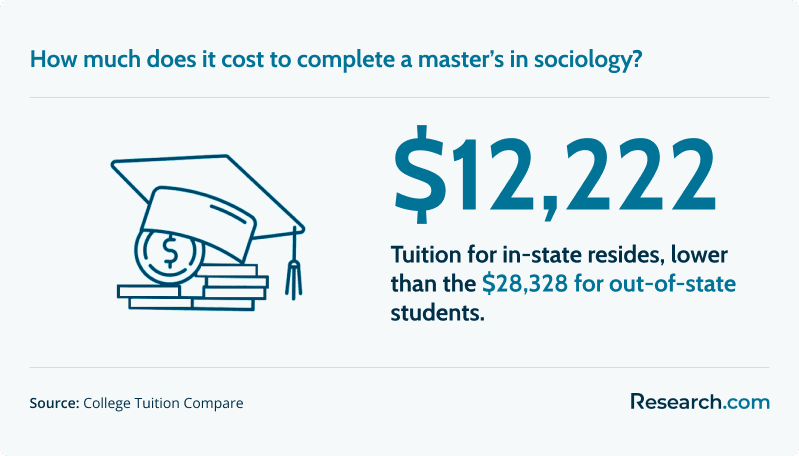
The cost of a Master’s in Sociology depends on the school, residency status, program length, enrollment pace, and whether the program is online or campus-based. For the academic year 2024, average graduate tuition for sociology programs is approximately $12,222 for state residents and $28,328 for out-of-state students. Some listed program costs differ, with in-state tuition as low as $11,958 and out-of-state tuition up to $27,680.
Tuition is only part of the total price. Students should also budget for books, supplies, fees, technology, transportation, housing, and personal expenses. At a public 4-year institution, the average cost for books and supplies is about $1,220 annually. Online students may save on commuting or relocation, but they may still pay technology fees, distance learning fees, or internship-related costs.
| Cost category | Reported amount or consideration | Decision tip |
| Average graduate tuition for state residents | $12,222 for state residents | Public in-state programs may offer the strongest tuition value if the curriculum fits your goals. |
| Average graduate tuition for out-of-state students | $28,328 for out-of-state students | Compare out-of-state tuition against online public programs and private-school aid offers. |
| Books and supplies | About $1,220 annually | Ask whether courses use open educational resources, library materials, or required software. |
| Living and personal costs | Housing, transportation, food, and personal expenses can raise the total cost. | Do not evaluate affordability based on tuition alone. |
| Online program costs | May reduce commuting and campus housing costs. | Check whether online students pay additional technology or distance learning fees. |
Before enrolling, ask the school for the total program cost, not just tuition per credit. Also ask about assistantships, employer tuition benefits, scholarships, transfer credit, course load flexibility, and whether thesis or internship credits affect the final price.
Will employers recognize an online Master's in Sociology degree?
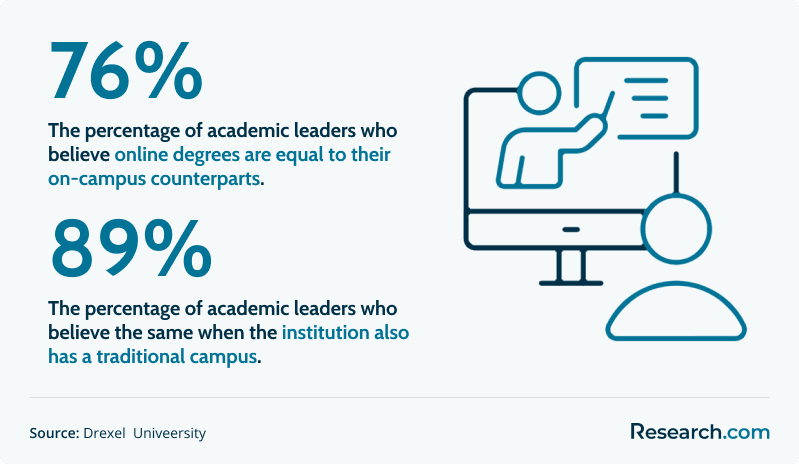
Employers are most likely to respect an online Master’s in Sociology when it comes from an accredited institution, has the same academic standards as the campus program, and is offered by a school with a credible reputation. The delivery format matters less than the legitimacy of the institution, the rigor of the curriculum, and the graduate’s ability to demonstrate research, writing, analysis, and practical experience.
An online degree can be a strong option for working professionals, caregivers, military students, and adults who cannot relocate. However, students should be cautious with programs that lack recognized accreditation, provide limited faculty interaction, have weak career services, or do not offer research, practicum, internship, or applied project opportunities.
The same logic applies across related fields. For example, the best LCSW online programs are generally more credible when they are housed in reputable, accredited institutions and meet the academic or licensure expectations of the profession. Sociology students should use a similar standard when comparing online programs.
| What to check | Why it matters | Question to ask |
| Institutional accreditation | Accreditation affects credibility, transferability, financial aid eligibility, and employer trust. | Is the university institutionally accredited by a recognized accreditor? |
| Program curriculum | Research methods, theory, statistics, and applied experience are central to graduate-level sociology. | Does the online program match the academic depth of the campus program? |
| Faculty access | Mentorship is important for thesis work, research assistantships, doctoral applications, and career planning. | How do online students meet with faculty and receive research supervision? |
| Career support | Online students need practical help with job searches, resumes, internships, and networking. | Are career services available to online students, not only campus students? |
| Transcript wording | Some schools do not distinguish online and campus formats on transcripts. | Will the transcript identify the degree as online? |
Top Careers for Master's of Sociology Graduates
A Master’s in Sociology does not lead to one single occupation. Its value depends on how you pair sociological training with research skills, policy knowledge, field experience, certifications, management ability, or additional licensure. The roles below show common career directions connected to sociology, social research, community systems, education, planning, counseling-adjacent work, and organizational leadership.
| Career | What the role does | Average Annual Salary | Growth Rate |
| Substance Abuse, Behavioral Disorder, and Mental Health Counselors | Support people dealing with addiction, behavioral challenges, and mental health concerns through assessment, treatment planning, counseling, and recovery support. | $53,710 | 19% |
| Social Workers | Help individuals, families, and communities address challenges involving health, family support, mental health, crisis response, advocacy, and access to services. | $58,380 | 7% |
| Survey Researchers | Create surveys, plan sampling methods, collect information, analyze responses, and report findings for public opinion, health, education, policy, or market research. | $60,960 | 0% (Little or no change) |
| Historians | Study records, documents, artifacts, and historical evidence to interpret the past and explain its relevance to institutions, policy, culture, and public understanding. | $72,890 | 6% |
| Social and Community Service Managers | Coordinate community programs, supervise staff, manage services, pursue funding, and evaluate programs that support public well-being. | $77,030 | 8% |
| Urban and Regional Planners | Develop land use plans, review community needs, work with public officials, analyze data, and help shape urban, suburban, and rural development. | $81,800 | 4% |
| Postsecondary Teachers | Teach college-level courses, prepare materials, conduct research, advise students, and publish academic work. Those considering going back to school to be a teacher should note that college teaching often requires deep subject expertise and may require a PhD for tenure-track roles. | $84,380 | 8% |
| Sociologists | Analyze social behavior, institutions, organizations, cultures, and social processes through research, observation, surveys, and data interpretation. | $101,770 | 7% |
| Political Scientists | Research political systems, public policy, political ideas, government behavior, and social trends that affect decision-making. | $132,350 | 3% |
| Human Resources Managers | Oversee hiring, employee relations, staffing strategy, policies, compensation processes, and organizational culture. Students asking Can you get a degree in human resources? may find sociology useful for understanding workplace behavior and institutional systems. | $136,350 | 6% |
How to choose the right sociology career path
- Choose research roles if you enjoy statistics, interviews, survey design, policy analysis, reports, and evidence-based recommendations.
- Choose community or nonprofit leadership if you want to manage programs, work with vulnerable populations, coordinate services, and improve systems.
- Choose planning or policy if you are interested in housing, transportation, land use, inequality, public services, and government decision-making.
- Choose HR or organizational roles if you want to apply sociology to workplace culture, employee behavior, diversity, and organizational change.
- Choose counseling-adjacent careers carefully because direct clinical practice usually requires additional counseling, social work, psychology, or state-specific licensure preparation.
How much can I make with a Master's in Sociology?
Earnings with a Master’s in Sociology vary widely because graduates move into different occupations. A graduate working in survey research, community services, or social work may earn a very different salary from someone in human resources management, political science, higher education, or applied social research. Reported salaries in the roles covered here range from $53,710 to $136,350.
For example, postsecondary sociology teachers are listed at $84,380, while sociologists are listed at $101,770. Political scientists are listed at $132,350, and human resources managers are listed at $136,350. These figures should not be treated as guaranteed outcomes. Actual pay depends on job title, location, employer type, experience, credentials, and whether the role requires additional degrees or licensure.
Students comparing masters in social work vs psychology vs sociology should focus on career requirements, not only salary. Social work and counseling pathways may require supervised hours and licensure for clinical roles. Sociology may be stronger for research, policy, organizational analysis, and academic preparation, but it may not independently qualify graduates for licensed therapy positions.
| Salary range consideration | What it means for planning |
| Lower-paid sociology-related roles | May still be meaningful and mission-driven, but students should be careful with debt and living costs. |
| Mid-range public service and education roles | Can offer stable career paths, especially when paired with research, program evaluation, or management skills. |
| Higher-paying management, policy, or specialized research roles | Often require experience, strong analytical skills, leadership ability, or advanced specialization beyond the degree alone. |
| Clinical or counseling roles | May require a separate degree path, supervised clinical hours, exams, and state licensure. |
Which industries are best for graduates of a Master's in Sociology?
Master’s in Sociology graduates are most competitive in industries that need people who can understand social systems, interpret data, evaluate programs, write clearly, and work with diverse populations. The strongest industry fit depends on whether the student’s training is more research-based, applied, policy-focused, or service-oriented.
- Academic and research institutions: Colleges, universities, think tanks, and research organizations may hire sociology graduates for teaching support, research coordination, survey work, policy analysis, and academic research roles.
- Government: Local, state, and federal agencies use sociology-related skills in public administration, planning, policy development, data analysis, program evaluation, and community services.
- Healthcare and social assistance: Employers in this sector may value graduates who understand health disparities, family systems, behavioral health needs, social services, and community-based interventions.
- Nonprofit organizations: Advocacy groups, foundations, community organizations, and social service providers need professionals who can analyze social problems, manage programs, evaluate outcomes, and communicate impact.
- Private sector: Companies may use sociological training in human resources, organizational research, user research, market research, diversity initiatives, corporate social responsibility, and workplace culture analysis.
| Industry | Strong sociology skill match | How to stand out |
| Government | Policy analysis, planning, statistics, public administration, community research. | Build experience with data tools, policy writing, and public-sector internships. |
| Nonprofit and community services | Program evaluation, advocacy, grant support, community engagement, needs assessment. | Gain field experience and learn how to measure program outcomes. |
| Healthcare and social assistance | Health equity, behavioral health systems, family services, population needs. | Consider related credentials if you want direct client-facing roles. |
| Higher education and research | Teaching, research design, academic writing, data collection, theory. | Seek research assistantships, conference experience, and strong faculty mentorship. |
| Business and HR | Organizational behavior, workplace culture, employee systems, social trends. | Add HR, analytics, project management, or organizational development experience. |
Which states are best for graduates of a Master's in Sociology?
Location can affect both job availability and salary. For Master’s in Sociology graduates, strong states often include places with large government agencies, universities, research employers, healthcare systems, nonprofit networks, policy organizations, planning departments, and corporate headquarters.
- California: California offers strong employment and competitive wages for Urban and Regional Planners, high employment levels and good wages for Sociologists, and notable opportunities for Postsecondary Sociology Teachers, especially in metropolitan areas such as Los Angeles and San Francisco.
- New York: New York has strong opportunities for Human Resources Managers, along with high wages and significant employment for Political Scientists, Historians, and Sociology Teachers.
- Washington D.C.: Washington D.C. is especially strong for Political Scientists because of its high employment concentration and competitive wages. It also offers opportunities for Human Resources Managers and Survey Researchers.
- Massachusetts: Massachusetts can be a strong market for Sociologists and Sociology Teachers, with a high concentration of jobs and top wages in these fields.
- Virginia: Virginia offers strong employment levels and high wages for Political Scientists, as well as a high concentration of jobs and competitive wages for Human Resources Managers.
When comparing locations, look beyond salary. Cost of living, commuting, housing, public-sector hiring cycles, university density, and professional networks can all affect whether a state is financially and professionally realistic.
What is the job outlook for graduates of Master's in Sociology?
The job outlook for Master’s in Sociology graduates depends on the occupation they pursue. Sociology itself is a flexible field, but not every related job is growing at the same pace. Students should compare growth rates, salary, credential requirements, and competition before choosing a specialization.
- Sociologists: Employment of sociologists is projected to grow by 7% from 2023 to 2033, supported by demand for research and analysis in areas such as public policy, social services, and nonprofit work.
- Survey Researchers: Survey research has a projected growth rate of 0% over the same period, meaning little or no change. Graduates interested in this area should strengthen data analytics, methodology, and software skills.
- Substance Abuse, Behavioral Disorder, and Mental Health Counselors: This career has a projected growth rate of 19%, making it one of the strongest outlooks listed. Sociology graduates interested in this path should confirm additional counseling education and licensure requirements.
- Social and Community Service Managers: These roles have an 8% projected growth rate, reflecting continued need for organized community programs and social service leadership.
- Postsecondary Teachers: Postsecondary teaching has an 8% projected growth rate, although many long-term academic roles may require doctoral preparation.
- Urban and Regional Planners: Planning roles have a 4% projected growth rate, connected to land use, development, infrastructure, and community planning needs.
| Career direction | Growth signal | Planning advice |
| Counseling and behavioral health | 19% growth for Substance Abuse, Behavioral Disorder, and Mental Health Counselors. | Strong demand, but check licensure and clinical training requirements early. |
| Community program leadership | 8% growth for Social and Community Service Managers. | Combine sociology with management, budgeting, grant writing, and evaluation experience. |
| Academic teaching | 8% growth for Postsecondary Teachers. | A master’s may be enough for some roles, but many competitive academic tracks require a doctorate. |
| Applied sociology research | 7% growth for Sociologists. | Develop strong research methods, statistics, writing, and policy analysis skills. |
| Survey research | 0% growth for Survey Researchers. | Build broader data, analytics, and mixed-methods skills to avoid relying only on traditional survey roles. |
Is a Master's in Sociology worth it?
A Master’s in Sociology can be worth it when the degree is tied to a realistic career plan, a manageable total cost, and a program that provides strong research training, mentorship, and applied experience. It may be less financially practical if a student borrows heavily for a low-paying role, chooses a program with weak career support, or assumes the degree automatically leads to a high salary.
The average cost of completing a Master’s in Sociology ranges from around $27,146 to $58,628 per academic year, depending on whether the institution is public or private and whether the student pays in-state or out-of-state tuition. Salaries across sociology-related professions listed here range from around $53,710 to $136,350, so return on investment can vary substantially.
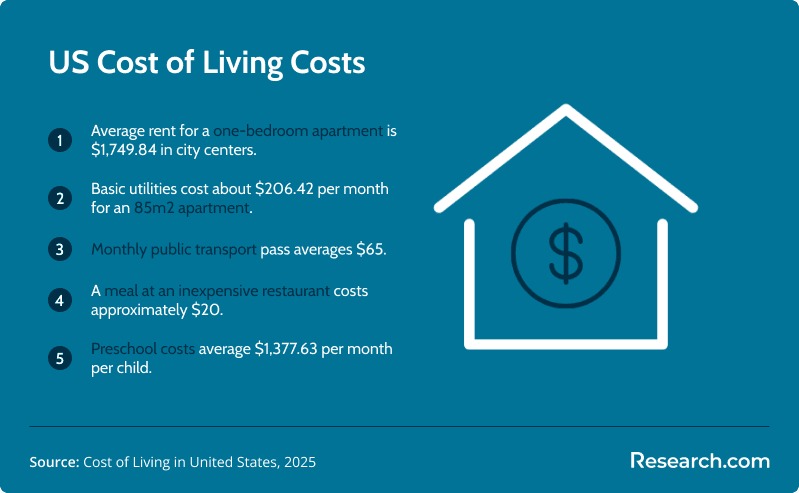
Cost of living also matters. For a single person, estimated monthly costs without rent are around $1,163. That means graduates entering lower-paid roles, such as some social work, community service, or survey research positions, may need to be especially cautious about student loan debt and location choices.
The degree is more likely to pay off for students who use it strategically. Stronger ROI often comes from choosing an affordable accredited program, building marketable research or data skills, completing internships, networking with employers, and targeting roles with clearer advancement paths in government, research, higher education, human resources, planning, or program management.
| A Master’s in Sociology may be worth it if... | It may not be the best choice if... |
| You need graduate-level research, policy, or program evaluation skills. | You want to become a licensed therapist but have not checked counseling or social work licensure rules. |
| You can attend an affordable accredited program or receive funding. | You would need to borrow heavily without a clear salary or advancement plan. |
| You want to work in applied research, government, nonprofit leadership, planning, HR, or academia. | You expect the degree alone to guarantee a high-paying job. |
| You plan to pursue doctoral study and need stronger preparation. | You dislike research, writing, theory, or data analysis. |
| You will complete internships, assistantships, or applied projects. | The program offers little career support, faculty access, or practical experience. |
How can internships and field experiences advance your sociology career?
Internships, fieldwork, research assistantships, and applied projects can turn sociology coursework into marketable experience. Employers often want proof that graduates can collect data, work with communities, evaluate programs, write reports, communicate with stakeholders, and solve practical problems. Field experience helps demonstrate those abilities.
Students interested in behavioral health, addiction services, or direct support roles should look for placements that expose them to case management, community outreach, prevention programs, research ethics, and service coordination. A related credential pathway, such as an addiction counseling degree, may also strengthen preparation for specialized behavioral health roles.
- Research assistantships: Useful for students targeting doctoral study, survey research, policy analysis, or academic careers.
- Government internships: Helpful for public policy, planning, public administration, and community development roles.
- Nonprofit field placements: Strong for advocacy, program management, grant support, and community engagement.
- Healthcare or social service placements: Useful for students interested in health disparities, behavioral health systems, family services, or case coordination.
- Organizational projects: Relevant for HR, workplace culture, diversity initiatives, and employee research.
What additional certifications can boost your career prospects?
Certifications can help sociology graduates signal job-ready skills, especially when they target a specific career niche. The best credential depends on the role. A student interested in program evaluation may prioritize data or analytics training, while someone moving toward behavioral services may need a counseling, behavioral analysis, or licensure-aligned credential.
For graduates interested in behavior analysis, a BCBA certification online may complement sociological training by adding specialized knowledge in behavioral assessment and intervention. This can be useful in roles that combine social systems, human behavior, education, disability services, or behavioral health, although students should confirm eligibility requirements before enrolling.
| Career goal | Helpful add-on preparation | Why it can help |
| Policy or research analyst | Statistics, data visualization, survey methods, qualitative analysis. | Shows employers you can turn social questions into evidence-based findings. |
| Community program manager | Grant writing, nonprofit management, program evaluation. | Supports leadership roles in service organizations and public programs. |
| Behavioral services | Behavior analysis, addiction counseling, supervised field experience. | Adds applied tools for working with individuals, families, or service systems. |
| Human resources | HR fundamentals, employment law, organizational development. | Connects sociological insight to workplace systems and employee relations. |
| Higher education or doctoral study | Research assistantships, conference presentations, academic writing. | Builds a stronger profile for PhD applications or teaching roles. |
What emerging interdisciplinary trends are shaping sociology careers?
Sociology careers increasingly overlap with data analytics, public health, education, behavioral science, technology, and organizational strategy. Employers often look for people who can interpret social behavior using both traditional research methods and digital tools. Skills in survey design, interviews, statistical analysis, qualitative coding, social media data interpretation, and program evaluation can make a sociology graduate more competitive.
Interdisciplinary training can also help graduates work across systems. For example, students interested in families, relationships, community mental health, or social support systems may explore related options such as online MFT graduate programs. The key is to choose additional training that directly supports the role you want rather than collecting unrelated credentials.
- Data-informed social research: Employers increasingly value graduates who can combine theory with quantitative and qualitative evidence.
- Public health and health equity: Sociology training is useful for analyzing disparities, access to care, community outcomes, and institutional barriers.
- Technology and society: Social media, digital communities, algorithmic bias, and online behavior create new research questions.
- Workplace culture and organizational change: Companies need professionals who understand group behavior, inequality, communication, and institutional systems.
- Behavioral health collaboration: Sociology can complement counseling, psychology, social work, and family systems training when credentials align with the role.
Can integrating counseling credentials enhance your sociology career?
Counseling credentials can broaden opportunities for sociology graduates who want to move from studying social behavior to providing direct support. However, counseling is a regulated field. A sociology master’s by itself usually does not qualify someone for licensed clinical counseling. Students should confirm state requirements, supervised hour expectations, exam rules, and accreditation standards before choosing a counseling pathway.
For those who want a more clinical or client-facing direction, accredited counseling education may be a practical next step. Cost-conscious students may compare options such as the cheapest CACREP-accredited programs online to see whether a counseling degree can build on their sociology background while meeting professional expectations.
What career services and job placement resources are available to sociology graduates?
Career support can make a major difference in the value of a Master’s in Sociology. Strong programs help students translate academic training into job language, connect with employers, find internships, prepare writing samples, and build a professional network. Online students should receive comparable access to advising, employer events, resume reviews, and job search platforms.
Students who want to expand into counseling or helping professions may also use career advising to compare related pathways, including affordable options such as the cheapest counseling degree online. The goal is not to add credentials randomly, but to identify which credential is required or preferred for the intended role.
- Ask about placement support: Does the department help students find internships, research roles, or community placements?
- Review alumni outcomes: Where do recent graduates work, and what job titles do they hold?
- Use faculty networks: Faculty can be important for research opportunities, doctoral recommendations, and applied projects.
- Build a portfolio: Save examples of research reports, survey projects, policy briefs, data analysis, and program evaluations.
- Attend employer events: Look for government, nonprofit, research, higher education, healthcare, and HR employers.
What is the process for obtaining counseling licensure as a sociology graduate?
Sociology graduates who want to become licensed counselors or therapists should treat licensure as a separate planning process. Requirements commonly include specific counseling coursework, supervised clinical hours, and passing required state or national examinations. Because licensure rules differ by state and profession, students should verify requirements before enrolling in any program.
A sociology background can be valuable in counseling because it strengthens understanding of families, inequality, communities, institutions, and social stressors. Still, the academic degree must align with licensure rules. Students can use resources on the fastest route to becoming a therapist to compare practical steps and avoid choosing a program that does not meet licensing expectations.
- Identify the counseling license you want: Different roles have different education and supervision requirements.
- Check your state board rules: Do this before choosing a program, not after graduation.
- Choose an appropriate accredited program: Make sure coursework and clinical training match the license pathway.
- Complete supervised experience: Clinical roles typically require documented supervised practice.
- Pass required exams: Licensing often includes state or national examinations.
- Maintain the credential: Licensed professionals usually need continuing education and renewal compliance.
How can integrating faith-based counseling perspectives enhance sociology careers?
Faith-based counseling perspectives can be useful for sociology graduates who work with communities where religion, spirituality, and cultural identity shape family life, decision-making, coping, and social support. This perspective may be especially relevant in nonprofit, community outreach, pastoral counseling, family support, and culturally responsive service settings.
Students interested in this direction should evaluate whether the credential supports their intended role and whether it meets any required professional standards. A program such as a masters Christian counseling may help graduates understand spiritually informed approaches while building on sociological knowledge of culture, institutions, and community life.
How can integrating accelerated psychology programs complement your sociology expertise?
Psychology and sociology examine human behavior from different angles. Sociology emphasizes groups, institutions, systems, culture, and social structures. Psychology often focuses more on individual behavior, cognition, development, and mental processes. Combining the two can be useful for careers involving community programs, behavioral health, education, organizational development, or applied research.
An option such as a fast track psychology degree online may help sociology graduates add psychological foundations more quickly. Before enrolling, students should confirm whether the program supports their goals, whether credits transfer, and whether it is appropriate for any future licensure or graduate study plans.
Can a PsyD degree broaden your sociology career?
A PsyD may broaden opportunities for sociology graduates who want advanced clinical training, but it is a major commitment and should not be treated as a simple add-on. PsyD programs focus on clinical assessment, diagnosis, intervention, and applied psychological practice. This can complement sociology when a professional wants to address individual mental health needs while also understanding social systems and community context.
This path may be relevant for students interested in clinical practice, community mental health, academic work, public health initiatives, or interdisciplinary research. However, students should carefully review admissions requirements, accreditation, licensure outcomes, supervised training, and total cost. Those exploring this route can compare information on online APA accredited PsyD programs.
Can a one year clinical psychology masters program significantly boost your interdisciplinary expertise?
A short clinical psychology master’s program may help sociology graduates build a stronger foundation in psychological concepts, assessment principles, and applied helping skills. It can be especially useful for students who want to work at the intersection of social research, community programs, behavioral health, and human services.
However, students should be careful with expectations. A one year clinical psychology masters program may add useful knowledge, but it may not automatically qualify graduates for clinical licensure. Before enrolling, confirm whether the program is designed for career advancement, doctoral preparation, or licensure preparation.
Common mistakes to avoid when choosing a Master’s in Sociology
| Mistake | Why it can hurt you | Better approach |
| Choosing a program without checking accreditation | Accreditation affects credibility, financial aid, transfer options, and employer acceptance. | Verify institutional accreditation before applying. |
| Looking only at tuition | Fees, books, living costs, technology expenses, and lost work hours can change affordability. | Compare total program cost and likely debt. |
| Assuming the degree leads directly to counseling licensure | Sociology and counseling are different credential pathways. | Check state licensure rules before choosing a clinical direction. |
| Ignoring research and data skills | Many sociology-related jobs reward evidence-based analysis and strong writing. | Take methods, statistics, evaluation, and data-focused courses seriously. |
| Skipping internships or applied projects | Academic knowledge alone may not show employers what you can do. | Build a portfolio with fieldwork, research reports, or program evaluation samples. |
| Relying only on rankings | A highly ranked program may not fit your budget, schedule, interests, or career goals. | Compare faculty fit, cost, support, curriculum, outcomes, and flexibility. |
| Assuming salary outcomes are guaranteed | Pay varies by role, location, employer, experience, and credentials. | Research actual job postings and alumni outcomes in your target market. |
Questions to ask before enrolling
- Is the university institutionally accredited?
- Does the program emphasize theory, research, applied sociology, policy, or a specific concentration?
- Can online students access faculty, internships, research projects, and career services?
- What is the total program cost, including fees, books, supplies, and living expenses?
- Are assistantships, scholarships, employer benefits, or part-time options available?
- What jobs do recent graduates obtain, and in which industries?
- Does the curriculum include statistics, qualitative methods, quantitative methods, and program evaluation?
- Will the degree support doctoral study if you choose that path later?
- If you want counseling or clinical work, does the program meet licensure requirements?
- How will you build practical experience before graduation?
Key Insights
- A Master’s in Sociology is strongest when it is connected to a specific goal: research, policy, nonprofit leadership, planning, HR, higher education, social services, or doctoral preparation.
- For the academic year 2024, average graduate sociology tuition is approximately $12,222 for state residents and $28,328 for out-of-state students, before books, supplies, housing, transportation, and personal costs.
- Online sociology master’s degrees can be respected when they come from accredited institutions with rigorous coursework, credible faculty, and strong student support.
- Career outcomes vary widely. Reported salaries across related roles range from $53,710 to $136,350, but those figures depend heavily on occupation, location, experience, and credentials.
- Job growth is not equal across all sociology-related paths. Substance Abuse, Behavioral Disorder, and Mental Health Counselors show 19% growth, while Survey Researchers show 0% growth.
- California, New York, Washington D.C., Massachusetts, and Virginia offer notable opportunities in several sociology-related careers, but cost of living should be part of any location decision.
- The degree may not be the right standalone path for licensed therapy. Students interested in counseling should verify licensure requirements before committing to a program.
- Internships, research assistantships, data skills, writing samples, and applied projects can matter as much as the degree title when competing for jobs.
References:
- Bureau of Labor Statistics. Occupational Outlook Handbook: Historians. BLS.
- Bureau of Labor Statistics. Occupational Outlook Handbook: Human Resources Managers. BLS.
- Bureau of Labor Statistics. Occupational Outlook Handbook: Political Scientists. BLS.
- Bureau of Labor Statistics. Occupational Outlook Handbook: Postsecondary Teachers. BLS.
- Bureau of Labor Statistics. Occupational Outlook Handbook: Social and Community Service Managers. BLS.
- Bureau of Labor Statistics. Occupational Outlook Handbook: Social Workers. BLS.
- Bureau of Labor Statistics. Occupational Outlook Handbook: Sociologists. BLS.
- Bureau of Labor Statistics. Occupational Outlook Handbook: Substance Abuse, Behavioral Disorder, and Mental Health Counselors. BLS.
- Bureau of Labor Statistics. Occupational Outlook Handbook: Survey Researchers. BLS.
- Bureau of Labor Statistics. Occupational Outlook Handbook: Urban and Regional Planners. BLS.
- College Tuition Compare. Graduate Sociology.
- Drexel University Online. Online Degree vs. Traditional Degree.
- Education Data. Average Cost of College.
- Motto Mortgage. Ranking Each of the 50 States by Cost of Living.
- Numbeo. Cost of Living in United States.
Other Things You Should Know About Master’s in Sociology
Yes, a Master’s in Sociology remains relevant in the 2027 job market. It can open doors to various fields such as social research, public policy, international development, and human resources. The degree equips graduates with analytical skills and a deep understanding of social dynamics, making them valuable in diverse sectors.
In 2027, a Master’s in Sociology can qualify you for roles such as social researcher, policy analyst, community development manager, human resources specialist, and market researcher. These positions often benefit from the analytical and communication skills acquired during the program.
The job market for Master's in Sociology graduates in 2027 is versatile, with opportunities in research, policy analysis, human resources, and community services. While some sectors may experience growth, competition is keen, and interdisciplinary skills enhance employability, particularly in roles that require data analysis and understanding social dynamics.


![2027 Best Advanced Standing Online MSW Programs [CSWE Accredited] thumbnail](https://research.com/resized/uploads/Online_Advanced_Standing_MSW_301dbd5368.jpg?format=thumbnail)


