
2027 Best Online Religious Studies Degree Programs

Co-Founder and Chief Data Scientist
As of fall 2023, nearly 500 academic departments across the United States were awarding degrees in religion. For students interested in understanding diverse faiths, ethics, and cultural traditions—but who also need a flexible learning format—online religious studies programs offer a practical solution. This guide explores the benefits, expectations, career paths, and salary potential for those pursuing a bachelor’s degree in this field online.
What are the benefits of getting an online religious studies degree?
- Graduates can pursue roles in education, counseling, nonprofit leadership, ministry, publishing, or interfaith outreach, as well as advanced study in theology, law, or social work.
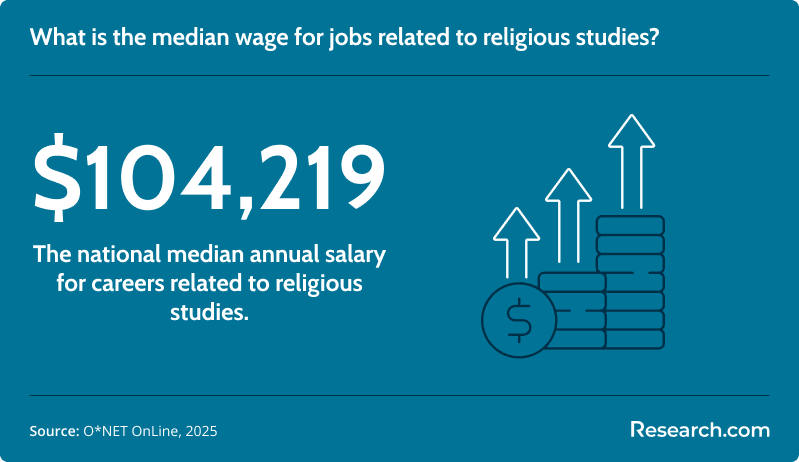
- Professionals in fields related to religious studies can earn an average annual wage of about $104,219, depending on career path and experience.
- Online programs allow students to complete coursework from anywhere, balance studies with work or personal commitments, and often choose from a wider range of schools and specializations.
What can I expect from an online religious studies program?
An online bachelor’s degree in religious studies explores the world’s faith traditions, sacred texts, ethics, and the influence of religion on history, politics, and culture. Programs typically combine coursework in philosophy, literature, and social sciences with critical thinking and research skills.
Many also incorporate opportunities for discussion with classmates from diverse backgrounds, fostering a deeper understanding of different belief systems. Students may complete readings, essays, and virtual lectures, as well as capstone projects or internships. While the curriculum varies by school, the online format offers a high degree of flexibility, making it ideal for those balancing academic goals with professional or personal responsibilities.
Where can I work with a religious studies degree?
Graduates of religious studies programs often find roles in nonprofit organizations, educational institutions, and religious or interfaith organizations. Many work as educators, faith-based community leaders, or program coordinators for humanitarian or advocacy groups. Others enter publishing, journalism, or cultural resource management, applying their analytical and communication skills to work that involves understanding diverse perspectives.
Outside of directly faith-related organizations, graduates can work in government agencies, healthcare systems, and international NGOs where cultural competence is critical. Religious studies also provides a strong foundation for graduate-level education in fields such as law, public policy, counseling, or chaplaincy, leading to broader career opportunities across multiple sectors.
How much can I make with a religious studies degree?
Earnings for religious studies graduates vary depending on career path, education level, and location. For example, clergy members and religious educators may earn between $55,000 and $80,000 annually, while those in academic or administrative roles at universities may earn higher salaries, especially with advanced degrees.
Professionals who move into leadership, nonprofit management, or specialized counseling roles can often command salaries above $100,000, aligning with the national average wage for this degree type of $104,219. Those who combine religious studies expertise with skills in communication, organizational leadership, or cultural analysis may find additional opportunities in consulting or policy roles, which can further increase earning potential.
- List of the Best Online Religious Studies Degree Programs for 2027 List of Programs
- How long does it take to complete an online religious studies program? Completion Time
- How does an online religious studies degree compare to an on-campus program? How does an online religious studies degree compare to an on-campus program?
- What is the average cost of an online religious studies program? Program Cost
- What are the financial aid options for students enrolling in an online religious studies program? What are the financial aid options for students enrolling in an online religious studies program?
- What are the prerequisites for enrolling in an online religious studies program? Prerequisites
- What courses are typically in an online religious studies program? What courses are typically in an online religious studies program?
- What types of specializations are available in an online religious studies program? What types of specializations are available in an online religious studies program?
- How do you choose the best online religious studies program? How do you choose the best online religious studies program?
- What career paths are available for graduates of online religious studies programs? Career Paths
- What is the job market like for graduates of online religious studies programs? Job Outlook
- Can combining an online religious studies degree with complementary qualifications boost career prospects? Can combining an online religious studies degree with complementary qualifications boost career prospects?
- How do online religious studies programs develop transferable professional skills? online
Best Online Religious Studies Degree Programs for 2027: Programs, Costs, Careers, and How to Choose
Choosing an online religious studies degree is not only a question of faith, theology, or academic interest. It is also a practical decision about cost, flexibility, transfer credits, career goals, and whether a program’s worldview and curriculum match what you want to study. Some students pursue religious studies to prepare for ministry or faith-based leadership. Others use the degree to build skills in ethics, cultural analysis, education, nonprofit work, counseling-adjacent roles, public service, or graduate study.
This guide explains how online religious studies programs work, how they compare with campus-based degrees, what they cost, which courses and specializations are common, and what graduates can realistically expect in the job market. It also highlights ranked programs, decision factors, common mistakes, and questions to ask before enrolling.
Quick Answer: Is an Online Religious Studies Degree Worth Considering?
An online religious studies degree can be a strong fit if you want a flexible humanities-based program focused on religion, ethics, culture, scripture, theology, or interfaith understanding. It is most useful for students who plan to work in ministry, religious education, nonprofit service, community outreach, chaplaincy-related pathways, graduate school, or roles that value research, writing, cultural literacy, and ethical reasoning. Before enrolling, confirm accreditation, total cost, transfer credit policies, theological orientation, online course format, and whether the degree supports your intended career or graduate program.
How do we rank schools?
Research.com evaluates online religious studies programs by looking beyond advertised tuition. A useful ranking should help students compare academic quality, affordability, flexibility, institutional credibility, and student support in one place. Our ranking process uses transparent criteria so readers can understand why programs appear on the list and how to use the information in their own decision-making. More details are available in our methodology section.
Program information was compiled from verified education data sources, including the IPEDS database, Peterson’s database and its Distance Learning Licensed Data Set, the College Scorecard database, and the National Center for Education Statistics.
Best Online Religious Studies Programs at a Glance
| Rank | School | Online Degree | Cost per Credit | Credits Required | Accreditation |
| 1 | Arizona State University | Bachelor of Arts in Religious Studies | $561 | 120 | Higher Learning Commission (HLC) |
| 2 | American Public University System | Bachelor of Arts in Religion | $350 (undergraduate) | 120 | HLC |
| 3 | Liberty University | Bachelor of Science in Religion | $390 (full-time); $455 (part-time) | 120 | Southern Association of Colleges and Schools Commission on Colleges (SACSCOC) |
| 4 | Florida International University | Bachelor of Arts in Religious Studies | $228.81 (in-state); $345.87 (out-of-state) | 120 | SACSCOC |
| 5 | Oregon State University | Bachelor of Arts or Bachelor of Science in Religious Studies | $375 | 180 quarter credits | Northwest Commission on Colleges and Universities (NWCCU) |
| 6 | University of Central Florida | Bachelor of Arts in Religion and Cultural Studies | $179.19 (in-state); $715.80 (out-of-state) | 120 | SACSCOC |
| 7 | Saint Leo University | Bachelor of Arts in Religion | $415 | 120 | SACSCOC |
| 8 | Colorado Christian University | Bachelor of Arts in Biblical Studies | $469 | 120 | HLC |
| 9 | Regent University Online | Bachelor of Arts in Biblical and Theological Studies | $450 (full-time) | 120 | SACSCOC |
| 10 | Louisiana State University – Alexandria | Bachelor of Arts in Religious Studies | $291 | 120 | SACSCOC |
1. Arizona State University
Arizona State University offers an online Bachelor of Arts in Religious Studies for students who want to examine religion through historical, ethical, cultural, and social lenses. The program is designed for online learners who need flexibility but still want a broad academic foundation in world religions and public life. Students can use the degree to strengthen research, interpretation, writing, and cross-cultural communication skills for work in education, ministry, public service, nonprofit organizations, or graduate study.
- Program Length: Four years (full-time)
- Tracks/concentrations: Religion, Culture, and Public Life; Religion and Applied Ethics
- Cost per Credit: $561
- Required Credits to Graduate: 120
- Accreditation: Higher Learning Commission (HLC)
2. American Public University System
The American Public University System provides an online Bachelor of Arts in Religion that focuses on comparative religion, ethics, religious traditions, and philosophical questions. Its asynchronous format may appeal to working adults, military-affiliated students, and learners managing family or professional obligations. The program is a practical option for students who want a broad religious studies foundation that can support ministry, nonprofit service, community leadership, or further academic preparation.
- Program Length: Four years (full-time)
- Tracks/concentrations: General Religious Studies
- Cost per Credit: $350 (undergraduate)
- Required Credits to Graduate: 120
- Accreditation: HLC
3. Liberty University
Liberty University offers an online Bachelor of Science in Religion that combines biblical and theological coursework with ministry-focused preparation. Courses are delivered in 8-week formats, which can help motivated students progress through the degree more quickly than a traditional semester schedule. The program is taught from a Christian worldview and includes specialization options for students preparing for church leadership, ministry service, evangelism, or related graduate education.
- Program Length: Three and a half to four years (full-time)
- Tracks/concentrations: Biblical and Theological Studies, Christian Ministries, Evangelism
- Cost per Credit: $390 (full-time); $455 (part-time)
- Required Credits to Graduate: 120
- Accreditation: Southern Association of Colleges and Schools Commission on Colleges (SACSCOC)
4. Florida International University
Florida International University delivers an online Bachelor of Arts in Religious Studies that treats religion as a major force in culture, history, politics, and human experience. The curriculum may interest students considering careers in education, international work, counseling-adjacent fields, public service, or cultural analysis. Because the program is fully online, students can complete coursework remotely while engaging with global religious traditions and interdisciplinary perspectives.
- Program Length: Four years (full-time)
- Tracks/concentrations: Religion and Ethics; Religion and Culture
- Cost per Credit: $228.81 (in-state); $345.87 (out-of-state)
- Required Credits to Graduate: 120
- Accreditation: SACSCOC
5. Oregon State University
Oregon State University offers an online Bachelor of Arts or Bachelor of Science in Religious Studies through OSU Ecampus. The program explores how religion shapes societies, identities, institutions, and public issues across the world. Students build research, analysis, written communication, and cultural interpretation skills that can support work in nonprofit organizations, education, public policy, law-related graduate pathways, or advanced religious studies programs.
- Program Length: Four years (full-time)
- Tracks/concentrations: General Religious Studies
- Cost per Credit: $375
- Required Credits to Graduate: 180 quarter credits
- Accreditation: Northwest Commission on Colleges and Universities (NWCCU)
6. University of Central Florida
The University of Central Florida offers an online Bachelor of Arts in Religion and Cultural Studies through its College of Arts and Humanities. The program examines religion in relation to culture, history, philosophy, anthropology, and contemporary social issues. It may suit students who want a humanities degree with strong cultural analysis components and the convenience of fully online coursework.
- Program Length: Four years (full-time)
- Tracks/concentrations: Religion and Cultural Studies
- Cost per Credit: $179.19 (in-state); $715.80 (out-of-state)
- Required Credits to Graduate: 120
- Accreditation: SACSCOC
7. Saint Leo University
Saint Leo University provides an online Bachelor of Arts in Religion with an emphasis on theology, faith traditions, and interreligious understanding. Although the university is rooted in the Catholic tradition, the program is open to students from different religious and personal backgrounds. Its asynchronous structure can help online learners complete coursework around work, family, service, or ministry responsibilities.
- Program Length: Four years (full-time)
- Tracks/concentrations: General Religion Studies
- Cost per Credit: $415
- Required Credits to Graduate: 120
- Accreditation: SACSCOC
8. Colorado Christian University
Colorado Christian University offers an online Bachelor of Arts in Biblical Studies for students who want a scripture-centered program grounded in Christian theology. The curriculum connects biblical scholarship with practical application for ministry, service, and leadership roles. Courses are offered in accelerated 5-week blocks, which may benefit students who prefer shorter terms and a more concentrated learning schedule.
- Program Length: Three and a half to four years (full-time)
- Tracks/concentrations: Biblical Studies, Theology
- Cost per Credit: $469
- Required Credits to Graduate: 120
- Accreditation: HLC
9. Regent University Online
Regent University offers an online Bachelor of Arts in Biblical and Theological Studies for students preparing for ministry, Christian education, faith-based leadership, or graduate theological study. The program is taught from a Christian perspective and includes online lectures, discussions, assignments, and collaborative learning experiences. Multiple start dates can make it easier for students to begin without waiting for a single annual admissions cycle.
- Program Length: Four years (full-time)
- Tracks/concentrations: Biblical and Theological Studies
- Cost per Credit: $450 (full-time)
- Required Credits to Graduate: 120
- Accreditation: SACSCOC
10. Louisiana State University – Alexandria
Louisiana State University – Alexandria offers an online Bachelor of Arts in Religious Studies that focuses on religion’s historical, cultural, philosophical, and social dimensions. The fully online format may work well for transfer students, working adults, and other nontraditional learners who need scheduling flexibility. Graduates can apply their training in research, writing, ethics, and critical analysis to education, nonprofit work, public service, or graduate study.
- Program Length: Four years (full-time)
- Tracks/concentrations: General Religious Studies
- Cost per Credit: $291
- Required Credits to Graduate: 120
- Accreditation: SACSCOC
How long does it take to complete an online religious studies program?
Most online bachelor’s programs in religious studies are designed to take about four years of full-time enrollment. The actual timeline depends on your transfer credits, course load, term structure, and whether the school offers accelerated sessions. Students entering with prior college credits may finish sooner, while part-time students often need additional semesters.
Students who want a shorter completion timeline can compare fast track religious studies online options. Accelerated programs may use shorter terms and year-round scheduling, but they also require stronger time management because assignments arrive quickly. A slower part-time route can be better for students balancing work, caregiving, ministry duties, or military service.
| Enrollment Path | Typical Fit | Main Advantage | Potential Trade-Off |
| Full-time study | Students who can prioritize school each term | Often matches the standard four-year plan | Less flexibility for heavy work or family obligations |
| Part-time study | Working adults, caregivers, and ministry professionals | More manageable weekly workload | Longer time to graduation |
| Accelerated study | Highly organized students with time to handle compressed courses | Can shorten the degree timeline | Faster pace can increase stress and reduce time for reflection |
| Transfer-friendly path | Students with completed general education or prior college credits | May reduce total credits needed at the new school | Transfer rules vary by institution and course type |
How does an online religious studies degree compare to an on-campus program?
Online and campus-based religious studies programs can cover similar academic material, but the learning experience is different. The better choice depends on how you learn, how much schedule flexibility you need, and whether in-person community is important to your goals.
| Factor | Online Religious Studies Degree | On-Campus Religious Studies Degree |
| Schedule | Often offers asynchronous coursework or flexible weekly deadlines | Usually follows fixed class meeting times |
| Location | Can be completed from home if the program is fully online | Requires commuting, relocation, or campus attendance |
| Interaction | Uses discussion boards, video meetings, email, and digital collaboration | Provides face-to-face faculty access, campus events, and in-person peer networks |
| Pace | May include accelerated terms, including options similar to an accelerated online Christian studies degree | Often follows a more traditional semester or quarter schedule |
| Best for | Students who need flexibility, cannot relocate, or are already working | Students who want campus life, chapel or community events, and in-person mentoring |
When online study makes sense
- You need to keep working while earning the degree.
- You live far from a school with the religious studies focus you want.
- You are comfortable reading independently and writing frequently.
- You prefer recorded lectures, online discussions, and digital research tools.
When campus study may be better
- You want daily face-to-face academic or spiritual community.
- You benefit from highly structured class schedules.
- You are seeking campus-based ministry, service, or research opportunities.
- You want frequent in-person mentoring from faculty or religious leaders.
What is the average cost of an online religious studies program?
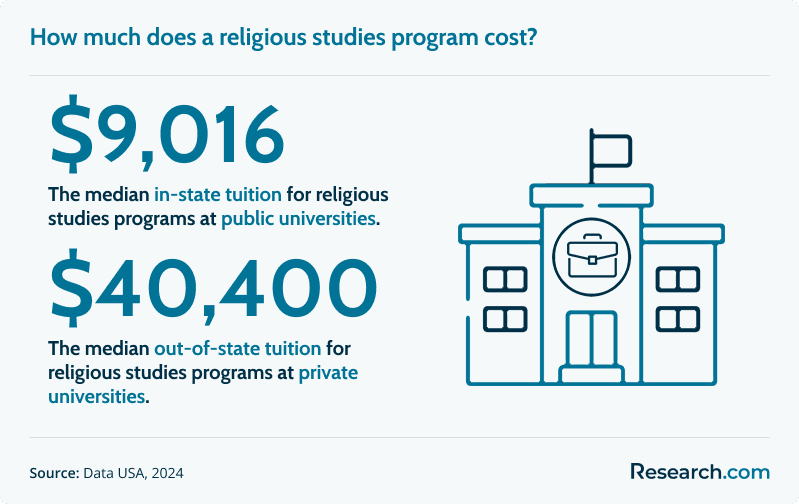
The cost of an online religious studies degree depends on the school, residency status, public or private institution type, required credits, fees, books, and transfer credit policy. Recent national data show median in-state tuition at public universities of around $9,016, while median out-of-state tuition at private universities is approximately $40,400. These figures make it important to compare total program cost, not just the per-credit rate listed on a school website.
Students considering specialized or accelerated study, including the fastest online theology degree programs, should also ask about technology fees, online course fees, textbooks, graduation fees, possible residency requirements, and fieldwork-related expenses. Online students may save on transportation or campus housing, but tuition and fees can still vary widely.
Cost factors to compare before enrolling
| Cost Factor | Why It Matters | Question to Ask |
| Per-credit tuition | This is the base price for each credit hour or quarter credit | Is the rate different for online, full-time, part-time, in-state, or out-of-state students? |
| Required credits | A lower per-credit price may not mean lower total cost if more credits are required | How many credits must I complete after transfer evaluation? |
| Fees | Technology, course, student service, and graduation fees can add up | What is the full estimated cost of attendance for online students? |
| Transfer credits | Accepted credits can shorten time and reduce tuition | How many of my previous credits will apply to the major, general education, or electives? |
| Books and materials | Religious studies courses may require multiple texts per class | Are digital materials included, or do I buy books separately? |
What are the financial aid options for students enrolling in an online religious studies program?
Online religious studies students at eligible accredited institutions may qualify for many of the same aid options as campus students. Aid availability depends on the school, program eligibility, enrollment intensity, citizenship or residency status, academic progress, and funding rules.
- Federal Financial Aid – Students can apply for grants, loans, and work-study consideration by completing the FAFSA application.
- Scholarships – Colleges, foundations, community groups, and private organizations may offer awards for students studying religion, theology, humanities, service, or leadership.
- Employer Tuition Assistance – Some employers help pay for degree programs that connect to an employee’s role, professional development plan, or organizational mission.
- Faith-Based Scholarships – Churches, denominations, religious orders, and faith-based nonprofits may support students preparing for ministry, education, or service.
- Military Benefits – Eligible service members, veterans, and qualifying family members may be able to use GI Bill benefits for approved programs.
How to reduce your out-of-pocket cost
- Submit the FAFSA as early as possible if you plan to use federal aid.
- Ask each school for a written financial aid estimate, including fees.
- Request a transfer credit review before committing to a program.
- Compare scholarships from the school, local religious communities, and national organizations.
- Avoid borrowing based only on expected salary; religious studies career outcomes vary by role and setting.
What are the prerequisites for enrolling in an online religious studies program?
Most online bachelor’s programs in religious studies require a high school diploma or GED. Transfer applicants usually submit college transcripts, and some schools may evaluate prior credits, military training, or previous coursework before admission. Requirements vary, so students should check each school’s admissions page rather than assuming all programs use the same standards.
Students considering professional outcomes should also research potential jobs for religious studies majors before choosing a program. Some roles may require graduate education, ordination, denominational approval, clinical pastoral education, teaching credentials, or additional training beyond the bachelor’s degree.
Common application requirements may include:
- Educational Background – The majority of students entering religious studies hold or are pursuing a bachelor’s degree, which is the most common credential among religious education directors (61%), followed by master’s degrees (25%) and associate degrees (9%).
- Transcripts – Schools usually request official high school, GED, or college records to verify prior academic work.
- Standardized Tests – Some institutions may still ask for SAT or ACT scores, although many online programs use test-optional admissions policies.
- Personal Statement – A written statement may ask you to explain your academic interests, faith or service background, and future goals.
- Letters of Recommendation – Recommendations may come from teachers, supervisors, clergy, mentors, or community leaders.
Applicants seeking graduate ministerial preparation, such as the shortest MDiv degree online, should expect different admissions standards. Master of Divinity programs commonly require a completed bachelor’s degree before enrollment.
What courses are typically in an online religious studies program?
Online religious studies programs usually combine humanities, history, ethics, philosophy, theology, and cultural analysis. The exact curriculum depends on whether the program is broad and comparative, Christian-focused, biblical, theological, or connected to cultural studies. Students comparing religion with adjacent humanities fields may also want to review the best online humanities degree programs.
Common core courses
- Introduction to World Religions
- Comparative Religious Thought
- Religious Ethics and Morality
- Sacred Texts in Context
Common specialized courses
- Religion and Politics
- Philosophy of Religion
- Interfaith Dialogue and Cultural Competence
- Religion in Contemporary Society
Capstone, thesis, or applied project
Many programs end with a senior seminar, research paper, thesis, internship, or applied project. This final experience helps students connect coursework to a specific topic, ministry context, community issue, or graduate school interest.
Skills students should expect to build
- Close reading of sacred, historical, and philosophical texts
- Research and source evaluation
- Ethical reasoning and argumentation
- Intercultural and interfaith communication
- Academic writing and presentation
- Independent learning in online environments
What types of specializations are available in an online religious studies program?
Specializations help students connect religious studies coursework to a clearer academic or career direction. A student preparing for church leadership may need a different curriculum than a student interested in interfaith work, cultural research, nonprofit service, or graduate study in social science, education, counseling, law, or theology.
Salary outcomes depend heavily on role, location, employer, experience, and additional credentials. The U.S. Bureau of Labor Statistics (BLS) notes that industries such as the federal executive branch offer median annual wages of $116,880 for directors of religious activities and education, while general medical and surgical hospitals pay about $101,010.
Students interested in human behavior, group dynamics, and social identity may also compare religious studies with the best online social psychology degree programs.
Other well-paying fields include management of companies and enterprises ($88,000), other residential care facilities ($77,630), and colleges, universities, and professional schools ($62,920).
| Specialization | What It Emphasizes | Best Fit |
| Biblical Studies | Scripture, interpretation, theology, and biblical history | Students preparing for ministry, theological study, or scripture-focused teaching |
| Interfaith and Comparative Religion | Multiple religious traditions, rituals, histories, and belief systems | Students interested in cultural work, dialogue, education, or global contexts |
| Religious Education | Teaching, curriculum, formation, and faith-based learning environments | Students considering education or leadership roles; some may later explore the best online counselor education programs |
| Ministry and Leadership | Pastoral care, preaching, administration, and church operations | Students seeking faith-based leadership, lay ministry, or preparation for graduate ministry study |
| Religion and Society | Religion’s relationship to politics, ethics, law, identity, and public life | Students interested in public service, nonprofit work, advocacy, or cultural analysis |
- Biblical Studies – Focuses on Old and New Testament interpretation, theology, language context, and scriptural meaning.
- Interfaith and Comparative Religion – Examines multiple traditions to build religious literacy and cross-cultural understanding.
- Religious Education – Prepares students to think about teaching, formation, learning design, and faith-based educational leadership.
- Ministry and Leadership – Covers pastoral communication, leadership practice, sermon development, and religious organization management.
- Religion and Society – Studies how religion intersects with public ethics, politics, culture, conflict, law, and social change.
How do you choose the best online religious studies program?
The best online religious studies program is the one that is accredited, affordable for your situation, academically aligned with your goals, and realistic for your schedule. Students should compare programs carefully because “religious studies,” “religion,” “biblical studies,” “Christian studies,” and “theology” can describe different types of curricula.
- Accreditation: Confirm that the school is accredited by a recognized agency. Accreditation can affect credit transfer, federal financial aid eligibility, graduate admission, and employer confidence.
- Curriculum and Specializations: Review the course list to see whether the program is comparative, theological, biblical, cultural, ministry-focused, or interdisciplinary.
- Learning Format: Choose asynchronous courses if you need maximum flexibility, or synchronous sessions if you want real-time discussion and structure.
- Cost and Financial Aid: Compare tuition, fees, scholarships, transfer credits, and expected borrowing before deciding.
- Student Support Services: Look for online library access, tutoring, writing support, advising, career services, disability services, and technology help.
Questions to ask before you apply
| Question | Why It Matters |
| Is the institution accredited by a recognized accreditor? | Accreditation affects aid, transferability, and academic recognition. |
| Is the program comparative, faith-based, biblical, theological, or cultural? | The curriculum should match your beliefs, academic goals, and career plans. |
| How many transfer credits will count toward the degree? | Transfer evaluation can significantly change cost and time to graduation. |
| Are classes asynchronous, synchronous, or blended? | The format determines whether the schedule will work with your job or responsibilities. |
| Does the program support my intended next step? | Graduate study, ministry, education, chaplaincy-related work, and nonprofit careers may require different preparation. |
| What is the total cost, including fees and materials? | A low tuition rate may not reflect the full amount you will pay. |
Common mistakes to avoid
- Choosing a program without checking institutional accreditation.
- Assuming every online religious studies degree has the same theological orientation.
- Comparing only tuition while ignoring fees, books, and transfer credit limits.
- Enrolling before confirming whether the degree supports graduate school, ministry preparation, or career requirements.
- Assuming online means easier; these programs still require extensive reading, writing, and discussion.
- Relying only on rankings instead of reviewing curriculum, faculty, and student support.
What career paths are available for graduates of online religious studies programs?
Religious studies graduates can pursue roles in faith communities, schools, nonprofits, healthcare-adjacent spiritual care settings, social service organizations, public agencies, publishing, cultural organizations, and graduate education. The degree is often most powerful when paired with practical experience, language study, leadership training, counseling-related preparation, teaching credentials, or graduate study.
According to national wage data, directors of religious activities and education earn a median annual salary of $54,840, though certain careers related to religious studies can pay significantly more—averaging $104,219 for some specialized positions. These figures should not be read as guaranteed outcomes. Pay varies by employer, region, denomination, credential level, and job responsibilities.
Students who want a broader interdisciplinary foundation may also compare religious studies with an online social sciences degree, especially if they are interested in public policy, community programs, research, or human services.
| Career Direction | How Religious Studies Helps | Additional Preparation That May Be Needed |
| Religious education | Builds knowledge of scripture, tradition, ethics, and curriculum themes | Teaching experience, denominational approval, or graduate education may be required |
| Ministry or church leadership | Supports biblical, theological, ethical, and pastoral understanding | Ordination, seminary, supervised ministry, or denominational requirements may apply |
| Nonprofit and community work | Strengthens cultural literacy, writing, ethics, and service orientation | Program management, fundraising, grant writing, or social service experience can help |
| Chaplaincy-related pathways | Provides religious literacy and pastoral foundations | Graduate theological study, clinical pastoral education, and endorsement are often needed |
| Graduate study | Prepares students for advanced research, theology, humanities, law, education, or social science | Strong academic writing, faculty recommendations, and prerequisite coursework may matter |
What is the job market like for graduates of online religious studies programs?
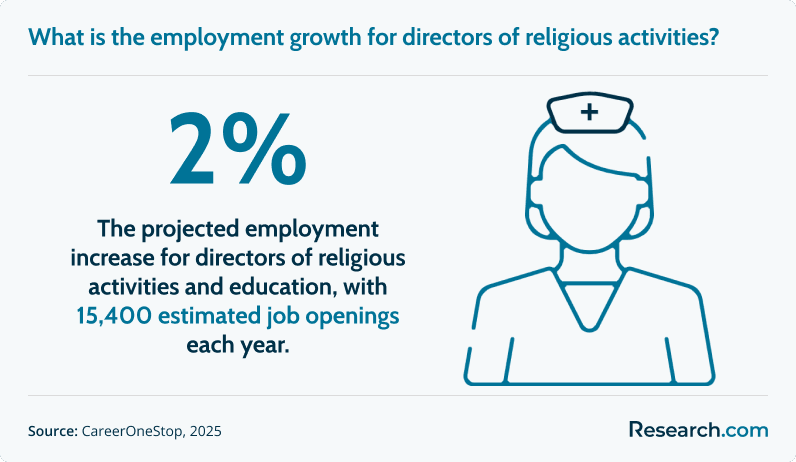
The job market for religious studies graduates is steady but not broad in the same way as some high-demand technical fields. Projections show a 2% increase in employment from 2023 to 2033 for directors of religious activities and education. On average, there will be about 15,400 job openings each year, which include both new positions and replacements for workers who retire or change careers.
Because growth is modest, students should plan strategically. Graduates who combine religious literacy with administration, writing, teaching, counseling-adjacent skills, public speaking, intercultural communication, digital tools, or nonprofit experience may have more options than those who rely on the degree alone.
Students preparing for ministry, faith-based leadership, or advanced theological education may also consider how a theology degree online compares with a broader religious studies curriculum.
Current trends affecting religious studies students
- Interdisciplinary hiring: Employers often value religious studies graduates for writing, interpretation, ethics, and cultural analysis, but many roles also require applied skills.
- Online ministry and digital communication: Faith communities and nonprofits increasingly use online platforms for education, outreach, fundraising, and community engagement.
- Credential stacking: Students may improve career flexibility by adding certificates, graduate study, language skills, teaching credentials, nonprofit management experience, or counseling-related training.
- Careful ROI evaluation: Because salaries vary widely, students should compare debt, career goals, and likely next steps before enrolling.
Can combining an online religious studies degree with complementary qualifications boost career prospects?
Yes. Religious studies is a flexible humanities degree, but many career paths become more accessible when students add targeted skills. Useful combinations may include nonprofit management, education, counseling-related coursework, digital humanities, public administration, languages, archival work, grant writing, or research methods. Students interested in preserving religious texts, managing collections, or working in research environments may find that religious studies pairs well with library and information science, including pathways connected to masters in library science jobs.
How do online religious studies programs develop transferable professional skills?
Online religious studies programs require students to read complex texts, evaluate arguments, write clearly, participate in discussions, and manage deadlines without constant in-person supervision. Those habits translate well to many professional settings. Students also learn to interpret cultural differences, communicate respectfully across belief systems, and approach ethical questions with nuance.
The online format can strengthen digital communication, independent research, time management, and collaboration across locations. Students who add skills in digital archiving, information organization, or data management may also find connections to fields such as the most affordable online master's in library science.
Here’s What Graduates Have to Say About Online Religious Studies Programs
- Maya: "The online format made it possible for me to keep my full-time job and stay present with my family while completing my coursework. I expected distance learning to feel detached, but the discussions, feedback, and virtual study groups made the experience engaging. I became much more confident reading religious texts and explaining their cultural significance. Faculty support was easier to access than I expected, and the program gave me a solid foundation for future study or professional opportunities."
- James: "My online religious studies program gave me space to study different faith traditions deeply while learning alongside students in many locations. Recorded lectures helped me revisit difficult material, and the reading pace encouraged serious reflection. The program strengthened my sense of purpose, improved my cultural awareness, and gave me tools I now use in community outreach. For students who want both academic depth and schedule flexibility, this path can work very well."
- Elena: "Studying online allowed me to move through the program at a pace that fit my life without lowering the academic expectations. The mix of recorded lectures, live conversations, and discussion boards gave me structure and independence. I improved my writing, sharpened my critical thinking, and learned to connect ethics and leadership to real situations. Even across time zones, the learning community felt active and supportive."
References:
- BLS. (2025). Occupational Employment and wage Statistics Profiles. data.bls.gov.
- CareerOneStop. (2025). Occupation profile for Directors, religious activities and Education. careeronestop.org.
- Data USA. (2024). Religious Studies. datausa.io.
- Humanities Indicators of the American Academy of Arts and Sciences. (2025). Religious Studies Programs Today: Findings from the 2024 Department Survey. aarweb.org.
- O*NET OnLine. (2025). 21-2021.00 - Directors, Religious Activities and education. onetonline.org.
- Zippia. (2025, January 8). Best Colleges and Degrees for Religious Education Directors. zippia.com.
Key Insights
- An online religious studies degree is best for students who want flexible study in religion, ethics, culture, theology, scripture, or interfaith understanding.
- Program fit matters. A comparative religious studies degree, biblical studies degree, theology-oriented program, and ministry-focused degree can lead to different academic and professional outcomes.
- Most bachelor’s programs require about four years of full-time study, but accelerated formats, part-time enrollment, and transfer credits can change the timeline.
- Cost comparisons should include tuition, fees, required credits, books, transfer policies, and financial aid—not just the advertised per-credit rate.
- Accreditation is nonnegotiable because it can affect federal aid eligibility, credit transfer, graduate admission, and employer recognition.
- Career outcomes vary widely. Religious studies can support ministry, education, nonprofit, community, cultural, and graduate pathways, but many roles require additional credentials or experience.
- Students improve their prospects by pairing the degree with practical skills such as leadership, teaching, counseling-related preparation, digital communication, nonprofit administration, language study, or research methods.
Other Things You Should Know About the Best Online Religious Studies Degree Programs
In 2027, many online institutions offering religious studies degrees accept transferable credits from accredited programs, including Liberty University and Emory University's online divisions. Prospective students should verify transfer policies and ensure compatibility with program requirements for a smoother transition.
In 2027, online religious studies courses typically require a reliable internet connection, a computer with updated software, and access to learning platforms like Moodle or Canvas. Specific programs may also require a webcam for participation in virtual classes or assessments.
Admission requirements for the 2027 best online religious studies degree programs typically include a high school diploma or GED, transcripts, and possibly letters of recommendation. Some programs may also require a personal statement or evidence of prior coursework in humanities or religious studies.
Yes. Graduate programs usually accept online religious studies degrees from regionally accredited institutions, provided the transcript shows a completed bachelor’s degree and a minimum GPA, often 2.5 to 3.0. Some seminaries also require prerequisite theology or Bible courses before admission.


