2027 Best Online Social Sciences Degree Programs

Co-Founder and Chief Data Scientist
More students are choosing to study social sciences online. It's not just for convenience, but because remote programs are becoming more respected and effective. In fact, 83% of employers believe online degrees hold the same value as those earned on campus.
To help students find the best and most affordable online social sciences degrees in the U.S., I reviewed public data from various universities. Using these findings and my experience in academic advising, I’ve put together a list of the top 10 programs for 2027. Each one includes key details to help you compare options and choose what fits your goals.
What are the benefits of pursuing an online degree in social sciences?
- Online learning offers flexibility. 53% of online students report choosing this format for better work-life balance.
- Social science degrees open doors to diverse careers in fields like education, public service, and market research. Many of these positions do not require in-person training.
- Sociologists earn a median salary of $98,590, while political scientists earn around $130,990 annually.
What can I expect from an online social science program?
The program usually begins with general education courses in the first year. After that, students take core social science subjects like sociology, psychology, political science, or anthropology. As they move forward, they can choose electives or focus areas such as criminal justice, public policy, or cultural studies.
Most programs include research work, writing-heavy assignments, and sometimes a final capstone project. Some schools may also require internships, done remotely or with local partners. By the end of the degree, graduates gain a solid understanding of human behavior and society, plus valuable skills in writing, research, and analysis.
Where can I work with an online social science degree?
Because the degree focuses on understanding people, behavior, and society, graduates are well-suited for roles in both public and private sectors. Many jobs focus on research, communication, social support, or policy.
Here are some common places where graduates can work:
- Government agencies
- Nonprofit organizations
- Schools and universities
- Hospitals and healthcare centers
- Mental health clinics
- Market research firms
- Human resources departments
- Community outreach programs
- International aid organizations
- Media and communications companies
- Criminal justice or law enforcement agencies
- Research institutions
How much can I make with a social science degree in 2027?
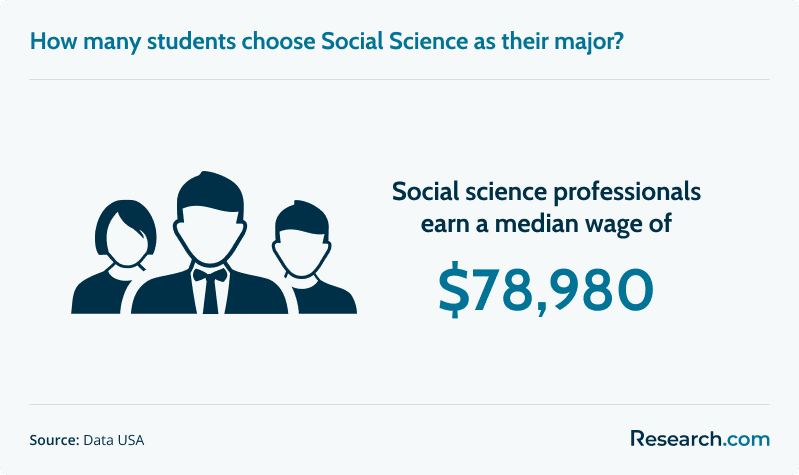
Professionals with a social science degree typically start their careers earning a median of around $36,000 per year. As they gain experience and specialize, their earning potential grows significantly. The overall median annual wage for social science degree holders is about $78,980.
As they advance into mid- and senior-level positions, graduates may pursue roles such as sociologist, political scientist, economist, or similar. Sociologists earn a median salary of $101,690, while political scientists command a median wage of $139,380.
- The Best Online Social Science Degree Programs in 2027 List of Programs
- How long does it take to complete an online social science degree? Completion Time
- How does an online social science degree compare to an on-campus program? How does an online social science degree compare to an on-campus program?
- What is the average cost of an online social science degree? Average Cost
- What are the financial aid options for students enrolling in an online social science degree? Financial Aid
- What are the prerequisites for enrolling in an online social science degree? Requirements
- What courses are typically in online social science degrees? What courses are typically in online social science degrees?
- What types of specializations are available in online social science degrees? What types of specializations are available in online social science degrees?
- How do you choose an online social science degree? How do you choose an online social science degree?
- What career paths are available for graduates of an online social science degree? Career Paths
- What student support services boost online degree success? What student support services boost online degree success?
- Can supplemental certifications boost the value of an online social science degree? Can supplemental certifications boost the value of an online social science degree?
- How can I verify the accreditation and quality of an online social science degree? How can I verify the accreditation and quality of an online social science degree?
- What is the job market for graduates of an online social science degree? Job Market
Best Online Social Science Degree Programs in 2027: Rankings, Costs, and Career Paths
An online social science degree can be a practical route for students who want to study people, communities, institutions, policy, culture, and social behavior without relocating or pausing work. The challenge is that “social science” is a broad label. One program may emphasize sociology and research methods, another may focus on political science, psychology, anthropology, public service, or interdisciplinary studies.
This guide is designed for prospective bachelor’s students, transfer students, working adults, and career changers comparing online social science programs. You will find ranked program options, cost and time expectations, admissions requirements, common courses, specialization choices, career outcomes, job market considerations, and practical questions to ask before enrolling.
The goal is not just to list schools. It is to help you decide whether an online social science degree fits your goals, how to compare programs responsibly, and what to look for before committing tuition dollars.
Quick Answer: Is an Online Social Science Degree Worth Considering?
An online social science degree can be worth considering if you want a flexible bachelor’s program that builds research, writing, communication, policy analysis, cultural awareness, and data interpretation skills. It is especially useful for students interested in public service, social research, nonprofit work, communications, community programs, policy, urban planning, human services, graduate school, or interdisciplinary careers.
However, the degree is broad. To make it pay off, students should choose a program with strong accreditation, relevant concentrations, research or capstone requirements, internship options when available, career support, and electives aligned with a specific job path. Students who want a licensed profession, such as clinical social work or counseling, should verify whether the degree meets later graduate-school or licensure prerequisites.
How We Rank Schools
Choosing a degree is a major financial and career decision, so rankings should be transparent and based on dependable information. Research.com uses data from sources such as the IPEDS database, Peterson’s, the College Scorecard, and the National Center for Education Statistics to compare programs using consistent school and student-outcome information.
For this guide, the focus is on online social science bachelor’s programs that combine academic credibility, flexible delivery, relevant curriculum options, and student value. You can review the broader ranking process on our methodology page.
Top Online Social Science Degree Programs in 2027
The programs below are designed for students who want online access to broad social science training. Costs, credits, accreditation, and distinguishing features are listed exactly as available in the source article, but students should always confirm current tuition and fees directly with the school before applying.
| Rank | School and Program | Cost Per Credit | Credits | Accreditation | Best Fit |
| 1 | University of Central Florida — B.S. in Social Sciences | $179.19 (in-state); $715.80 (out-of-state) | 120 | Southern Association of Colleges and Schools Commission on Colleges (SACSCOC) | Students who want a flexible online degree with broad career preparation |
| 2 | Pennsylvania State University World Campus — B.S. in Integrated Social Sciences | $638 | 120 | Middle States Commission on Higher Education | Learners seeking an interdisciplinary degree with a portfolio-based capstone |
| 3 | University of Alaska Southeast — B.A. in Social Science | $241 (in-state); $841 (out-of-state) | 120 | Northwest Commission on Colleges and Universities | Students who want multiple concentration options and a senior portfolio |
| 4 | Washington State University — B.A. in Social Sciences | $518.40 (in-state); $577.50 (out-of-state) | 120 | Northwest Commission on Colleges and Universities | Students who want to combine two or three fields of study |
| 5 | University of Maine at Augusta — B.A. in Social Science | $260 (in-state); $390 (out-of-state) | 120 | New England Commission of Higher Education | Students interested in empirical research and accessible tuition options |
| 6 | University of North Dakota — B.A. in Social Science | $407.97 | 120 | Higher Learning Commission | Students who want to build a customized degree across three disciplines |
| 7 | University of Nevada, Las Vegas — B.A. in Interdisciplinary Studies, Social Sciences Studies Concentration | $322.50 | 120 credits | Northwest Commission on Colleges and Universities | Students who want an interdisciplinary capstone and strong social science breadth |
| 8 | Central Washington University — B.S. in Interdisciplinary Studies | $240 | 180 | Northwest Commission on Colleges and Universities | Students seeking a personalized plan across social science-related areas |
| 9 | New York University — B.A. in Social Sciences | $1,833 | 120 | Middle States Commission on Higher Education | Students looking for a liberal arts foundation with 11 concentration options |
| 10 | CUNY School of Professional Studies — B.A. in Sociology | $305 (in-state); $350 (out-of-state) | 120 | Middle States Commission on Higher Education | Students who want sociology training with an urban and inequality-focused lens |
1. University of Central Florida — B.S. in Social Sciences
UCF’s online Bachelor of Science in Social Sciences is built for students who want a broad, customizable education across fields such as sociology, anthropology, political science, psychology, and communication. The program is a strong option for learners who want to strengthen critical thinking and prepare for several possible career directions rather than train for one narrow occupation.
- Cost per credit: $179.19 (in-state); $715.80 (out-of-state)
- Required Credits to Graduate: 120
- Accreditation: Southern Association of Colleges and Schools Commission on Colleges (SACSCOC)
- What Makes It Stand Out: Strong emphasis on critical thinking and versatile career preparation
2. Pennsylvania State University World Campus — B.S. in Integrated Social Sciences
Penn State World Campus offers an online Integrated Social Sciences degree that brings together multiple disciplines, including anthropology, economics, psychology, and related areas. Its portfolio-based capstone can be especially useful for students who want to show employers or graduate schools evidence of applied learning.
- Cost Per Credit: $638
- Required Credits to Graduate: 120
- Accreditation: Middle States Commission on Higher Education
- What Makes It Stand Out: Interdisciplinary focus and capstone portfolio project
3. University of Alaska Southeast — B.A. in Social Science
UAS allows students to shape the B.A. in Social Science around up to three concentration areas, such as anthropology, psychology, or political science. The program is a good fit for students who want to examine human behavior and social institutions from more than one academic perspective. A Senior Student Assessment Portfolio completed in the final semester adds a reflective, outcomes-based component.
- Cost Per Credit: $241 (in-state); $841 (out-of-state)
- Required Credits to Graduate: 120
- Accreditation: Northwest Commission on Colleges and Universities
- What Makes It Stand Out: Self-paced structure with multiple area concentrations
4. Washington State University — B.A. in Social Sciences
WSU’s online B.A. in Social Sciences gives students two degree-design routes: Plan A, which uses two concentrations, and Plan B, which uses three. Options can include anthropology, history, sociology, political science, psychology, economic sciences, and other fields. This structure can work well for students planning careers in social services, education, government, public service, or other roles that value broad analytical training.
- Cost Per Credit: $518.40 (in-state); $577.50 (out-of-state)
- Required Credits to Graduate: 120
- Accreditation: Northwest Commission on Colleges and Universities
- What Makes It Stand Out: High enrollment and flexible, customizable concentrations
5. University of Maine at Augusta — B.A. in Social Science
UMA’s online B.A. in Social Science emphasizes empirical research and interdisciplinary inquiry. Students begin with foundational courses such as Introduction to Social Sciences, Introduction to Psychology, and Interpersonal Communication before choosing areas such as psychology, communications, sociology, social media, anthropology, or geography.
- Cost Per Credit: $260 (in-state); $390 (out-of-state)
- Required Credits to Graduate: 120
- Accreditation: New England Commission of Higher Education
- What Makes It Stand Out: High financial aid availability and research emphasis
6. University of North Dakota — B.A. in Social Science
The University of North Dakota’s online B.A. in Social Science is structured for students who want to design a degree across several disciplines. Students select from areas such as anthropology, geography, criminal justice, economics, history, political science, psychology, and sociology, completing at least 36 credits across three disciplines.
- Cost Per Credit: $407.97
- Required Credits to Graduate: 120
- Accreditation: Higher Learning Commission
- What Makes It Stand Out: Blend of flexibility, strong satisfaction, and experiential learning options
7. University of Nevada, Las Vegas — B.A. in Interdisciplinary Studies, Social Sciences Studies Concentration
UNLV’s B.A. in Interdisciplinary Studies with a Social Sciences Studies concentration lets students combine disciplines such as anthropology, history, political science, psychology, sociology, and women’s studies. The program is especially relevant for students who want to connect several social science perspectives into one research or problem-solving framework.
- Cost Per Credit: $322.50
- Required Credits to Graduate: 120 credits
- Accreditation: Northwest Commission on Colleges and Universities
- What Makes It Stand Out: Strong graduate earnings and interdisciplinary capstone focus
8. Central Washington University — B.S. in Interdisciplinary Studies
CWU’s B.S. in Interdisciplinary Studies supports personalized study across areas such as sociology, political science, anthropology, psychology, history, economics, public health, and law & justice. It can be a useful option for students whose career goals do not fit neatly into one department.
- Cost Per Credit: $240
- Required Credits to Graduate: 180
- Accreditation: Northwest Commission on Colleges and Universities
- What Makes It Stand Out: High graduate earnings and strong personalization
9. New York University — B.A. in Social Sciences
NYU’s B.A. in Social Sciences begins with a liberal arts foundation and develops writing, reasoning, analytical, and interdisciplinary thinking skills. Students may choose from 11 concentrations, including anthropology, media studies, sustainability, and urbanism.
- Cost Per Credit: $1,833
- Required Credits to Graduate: 120
- Accreditation: Middle States Commission on Higher Education
- What Makes It Stand Out: Wide range of concentrations and high median graduate earnings
10. CUNY School of Professional Studies — B.A. in Sociology
CUNY SPS offers an online B.A. in Sociology for students who want a more focused social science major. Coursework covers areas such as social theory, research methods, urban sociology, globalization, inequality, and sociological data analysis.
- Cost Per Credit: $305 (in-state); $350 (out-of-state)
- Required Credits to Graduate: 120
- Accreditation: Middle States Commission on Higher Education
- What Makes It Stand Out: Top rankings, NYC focus, veteran-friendly reputation
How Long Does It Take to Complete an Online Social Science Degree?
Most online bachelor’s degrees in social science require 120 credits and are designed to take about four years of full-time study. Transfer students may finish sooner if a school accepts prior college credits, an associate degree, military training, or eligible exam credits. Some students also shorten the timeline through accelerated terms or year-round enrollment.
Students comparing faster interdisciplinary options may want to look at an accelerated interdisciplinary studies online degree, which can overlap with social science coursework when the curriculum includes sociology, political science, psychology, anthropology, public policy, or related fields.
At the graduate level, online social science master’s programs usually take about two years of full-time study. These programs commonly require 30 to 60 credits, depending on the discipline, thesis expectations, capstone requirements, and whether the program includes a practicum or field experience.
| Student Situation | Typical Timeline | What Can Affect Completion Time? |
| First-time bachelor’s student | About four years | Full-time or part-time enrollment, summer courses, and course availability |
| Transfer student with prior credits | Potentially faster | Transfer-credit limits, general education requirements, and major prerequisites |
| Student in an accelerated format | Often two or three years | Year-round terms, shorter sessions, and heavier course loads |
| Online master’s student | About two years full time | Credit requirement, thesis or practicum, and specialization |
Online vs. On-Campus Social Science Programs: Which Format Fits You?
Online social science programs usually deliver coursework through recorded lectures, readings, digital assignments, discussion boards, video meetings, and online exams. This format can be ideal for students who need to study around work, family responsibilities, military service, or other commitments. It also requires discipline because students must manage deadlines, participate consistently, and stay organized without the routine of commuting to campus.
Online learning is especially attractive to adult learners. More than 70% of students aged 25-54 favor online study formats, reflecting the need for programs that work around complex schedules.
On-campus programs, by contrast, may offer more face-to-face discussion, easier access to campus clubs or research labs, and informal interaction with faculty and classmates. For students who learn best through live conversation and structured routines, campus learning may provide stronger day-to-day engagement.
| Factor | Online Social Science Degree | On-Campus Social Science Degree |
| Schedule flexibility | Often stronger, especially with asynchronous classes | Usually tied to set class times and campus attendance |
| Peer interaction | Built through forums, group projects, and virtual meetings | More spontaneous in classrooms, campus events, and study groups |
| Self-management | Requires strong independent planning | Provides more built-in structure |
| Access to campus resources | Depends on the school’s online support model | Often easier for labs, events, and in-person advising |
| Best for | Working adults, transfer students, caregivers, remote learners | Students who want an immersive campus experience |
What Is the Average Cost of an Online Social Science Degree?
The cost of an online social science degree depends on the school, public or private status, residency rules, fees, transfer credits, and whether tuition is charged per credit or through another model. Most online undergraduate social science programs fall within the range of $300 to $700 per credit hour.
Public colleges charge about $338 per credit hour on average for fully online instruction, which can make them a strong value for in-state students. Private colleges are often more expensive, with an average closer to $516 per credit hour.
For a typical 120-credit bachelor’s degree, that can mean roughly $40,000 to $62,000 at a public institution and $61,000 or more at a private institution before fees, books, technology expenses, and other costs.
Graduate social science-related programs vary widely. For example, the shortest public policy master's programs online typically have total tuition costs between $28,900 and $93,000. Some institutions use nontraditional pricing. Western Governors University, for example, uses a flat-rate tuition model of about $8,856 per year, which may benefit students who can complete courses quickly.
Before choosing the lowest sticker price, compare total program cost. A school with a higher per-credit rate may still be affordable if it accepts more transfer credits, offers stronger aid, or includes fewer added fees.
| Cost Factor | Why It Matters | Question to Ask |
| Per-credit tuition | This is the largest direct cost for most students | Is tuition different for in-state and out-of-state online students? |
| Transfer credits | Accepted credits can reduce both cost and time | How many prior credits can apply to the major and general education requirements? |
| Fees | Online, technology, graduation, and course fees can add up | What is the total cost of attendance, not just tuition? |
| Books and software | Research and data courses may require texts or statistical tools | Are digital materials, software, or library resources included? |
| Financial aid | Grants, scholarships, loans, and employer support change the net price | What aid is available specifically to online students? |
What Financial Aid Is Available for Online Social Science Students?
Students in accredited online social science programs are usually eligible for many of the same financial aid options as campus-based students. The first step is completing the Free Application for Federal Student Aid, or FAFSA. This can open access to federal grants, loans, work-study, and school-based aid.
Students considering a specialized path such as an online social psychology degree should confirm that the school is accredited and eligible for federal financial aid before enrolling.
- Federal Pell Grant: Up to $7,395 per year (2024–25) for eligible undergraduate students.
- Federal Direct Loans: Subsidized and unsubsidized loans with annual limits of $5,500 to $20,500, depending on degree level and dependency status.
- Federal Work-Study: Part-time work for students with financial need. Earnings vary, but they typically range from $1,000 to $5,000 per year.
- State and Institutional Grants: Amounts vary by state and school; some offer up to $5,000+ per year for online students.
- Private Scholarships: Awards range widely from $500 to more than $10,000 and may come from nonprofits, employers, professional associations, or community organizations.
What Are the Admissions Requirements for an Online Social Science Degree?
Admissions requirements vary by school, but most online bachelor’s programs look for evidence that applicants can succeed in college-level reading, writing, research, and online learning. Transfer students should pay close attention to credit evaluation policies because accepted credits can significantly change cost and completion time.
Common requirements include:
- High school diploma or GED: Many schools require at least a 2.0 GPA, while some may expect a 2.5 GPA for direct admission from high school.
- Official transcripts: Applicants usually submit high school and college transcripts. Some transfer pathways may require a minimum of 60 college credits.
- Standardized test scores: SAT or ACT scores may be required by some schools, though many programs now use test-optional admissions.
- Personal statement or letter of intent: Some programs ask applicants to explain their academic interests, career goals, or reasons for choosing social science.
If you do not meet the standard requirements, ask whether the school offers conditional admission, bridge coursework, or degree-completion tracks. Students who want a different academic direction may compare social science with humanities or faith-based programs, including the best online religious studies degree programs. If your goal is hands-on vocational training rather than a bachelor’s degree, the best online pet grooming trade school programs represent a very different type of career-focused option.
What Courses Are Common in Online Social Science Degrees?
Social science coursework teaches students how to study human behavior, social systems, institutions, cultures, inequality, public issues, and decision-making. Strong programs usually combine theory with research methods, writing, and data interpretation.
Common courses include:
- Introduction to Sociology
- Principles of Psychology
- Global Perspectives in Anthropology
- Research Methods in the Social Sciences
- Introduction to Cultural Anthropology
- Data Analysis in the Social Sciences
- Diversity Awareness
- Historiography and Historical Methods
Students in a fast-track social sciences degree online should pay close attention to the pace of research and quantitative courses. Statistics, research methods, and data analysis can be demanding because they require precision, software use, interpretation of results, and clear explanation of findings.
For example, a statistics or data analysis course may require students to run tests, interpret numerical output, and use software such as SPSS or R. These courses are valuable because employers often value graduates who can move beyond opinion and use evidence to support decisions.
What Specializations Are Available in Online Social Science Programs?
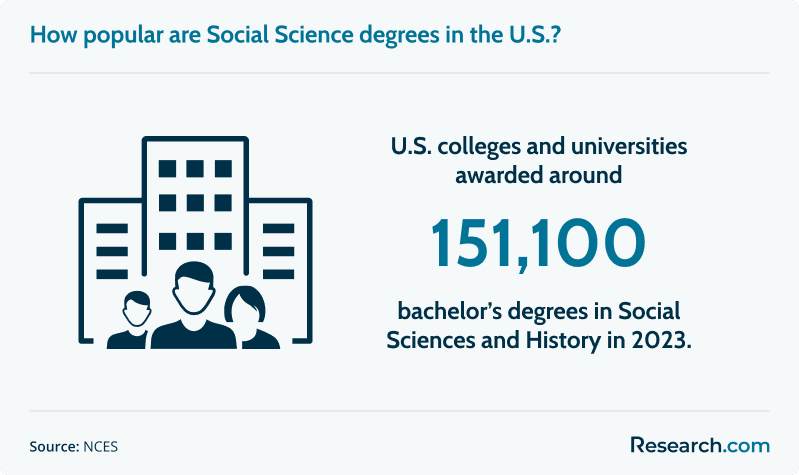
Social science is not a single career track. It is a broad academic field that includes multiple disciplines. About 8% of all bachelor’s degrees awarded in 2020 were in social sciences, which shows the field’s scale across undergraduate education.
Choosing a specialization matters because it shapes your electives, capstone, internship possibilities, graduate-school preparation, and job search. A student aiming for policy work may choose political science or public policy-related electives, while someone interested in community programs may choose sociology, psychology, or criminal justice.
| Specialization | What You Study | Best For Students Interested In |
| Anthropology | Human cultures, archaeology, traditions, and social practices | Cultural research, global issues, museums, nonprofits, or graduate study |
| Criminal Justice | Justice systems, policy, crime, social change, and institutions | Public safety, corrections, victim services, policy, or legal support roles |
| Environmental Social Science | How communities interact with land, resources, planning, and environmental change | Sustainability, planning, environmental justice, or community advocacy |
| Political Science | Government, policy-making, public institutions, elections, and power | Students considering an accelerated online political science bachelor's degree, public policy, government, or law-related paths |
| Psychology | Behavior, mental processes, development, and applied subfields | Human services, research support, organizational roles, or graduate study |
| Sociology | Inequality, social structures, institutions, culture, and group behavior | Community work, research, nonprofit programs, advocacy, or social policy |
| International Studies | Global systems, regional cultures, diplomacy, and world politics | Global development, international nonprofits, government, or graduate school |
| Data Analytics | Quantitative methods, statistical software, survey data, and social trends | Research, program evaluation, policy analysis, and data-informed roles |
How Do You Choose the Right Online Social Science Degree Program?
A 2022 survey found that 77% of online learners decided on the online format before choosing their field of study. Eighty-two percent (82%) prioritized the subject itself. That means many students first decide they need online flexibility, then look for a program that matches their interests.
That order makes sense, but it can also lead to mistakes. A program should not be chosen only because it is online. Students should also evaluate accreditation, curriculum depth, concentration options, transfer policies, faculty access, student support, internship or applied-learning options, and career outcomes.
Checklist for Comparing Online Social Science Programs
- Verify accreditation: Regional accreditation is generally preferred because it supports credit transfer, graduate-school recognition, and federal financial aid eligibility.
- Match the curriculum to your goal: Look beyond the program title. Review required courses, electives, research methods, statistics, and capstone expectations.
- Check concentration options: Choose a school that lets you build depth in the area most relevant to your career or graduate-school plans.
- Ask about transfer credits: Transfer policies can change both your graduation timeline and total cost.
- Review online support: Confirm access to advising, tutoring, library databases, technical help, writing support, and career services.
- Understand the total price: Compare tuition, fees, books, software, and expected aid, not just the advertised per-credit rate.
- Look for applied learning: Capstones, portfolios, internships, research projects, and community-based assignments can help turn a broad degree into job-ready evidence.
What Careers Can You Pursue With an Online Social Science Degree?
Online social science graduates can work in many sectors because the degree develops transferable skills: research, writing, analysis, communication, cultural understanding, and problem-solving. According to Data USA, individuals with social sciences degrees comprised approximately 4.07 million workers.
Career outcomes depend heavily on specialization, experience, location, internships, graduate education, and technical skills. Some roles may require a master’s degree, certification, licensure, or significant experience.
| Career Path | Typical Work | Salary Information Provided | Notes |
| Public Relations Manager | Develops messaging, manages communication strategy, and supports public reputation | Around $138,520 a year | Often benefits from strong writing, media, and organizational communication skills |
| Urban Planner | Works on land use, community plans, housing, transportation, and public spaces | Median salary of $83,720 | Some roles may prefer or require graduate training |
| Sociologist | Conducts research on social behavior, groups, institutions, and social issues | Median salary of approximately $101,690 | Graduates of the fastest online sociology bachelor's degree programs may need graduate study for advanced research or academic roles |
| Social and Community Service Manager | Oversees programs that support community needs and public services | About $77,030 | Relevant experience in nonprofits, human services, or public agencies can be important |
| Data Analyst | Interprets trends, organizes data, and supports decisions with evidence | Typical salary of $83,884 | Students should build quantitative, spreadsheet, database, and visualization skills |
What Student Support Services Help Online Social Science Students Succeed?
Support services can make a major difference in online completion, especially for students balancing school with work or family responsibilities. Strong programs give online learners access to academic advising, technical support, library databases, research help, writing centers, tutoring, disability services, and career counseling.
Career support is particularly important in social science because the degree is broad. Students should ask whether advisors help connect coursework to specific roles, graduate-school plans, internships, portfolios, and résumé-ready projects. Cost guidance also matters. Students comparing psychology-related options, for example, may want to review resources on the cheapest psychology degree to understand how affordability differs across closely related fields.
Can Certifications Increase the Value of an Online Social Science Degree?
Certifications can strengthen an online social science degree when they add a concrete skill employers recognize. They do not replace the degree, but they can help students show competence in data analysis, grant writing, project management, nonprofit administration, behavioral services, research methods, geographic information systems, or other applied areas.
The best certification depends on your intended career. A student interested in behavioral services may explore affordable BCBA programs online, while a student aiming for policy or research roles may benefit more from statistics, data visualization, survey design, or program evaluation training.
What Is the Job Market for Online Social Science Degree Graduates?
The job market for social science graduates is mixed but promising for students who combine the degree with practical experience, research skills, writing ability, and career-focused specialization. The field overlaps with government, education, nonprofits, public policy, business, communications, social services, planning, and research.
According to the U.S. Bureau of Labor Statistics, employment in social science and related occupations is projected to grow by about 6% until 2033, which is roughly in line with the average for all occupations. This is expected to produce an estimated 3,300 job openings each year, driven by replacement needs and modest job growth.
Some social science roles offer higher pay and often require advanced training. Political scientists, for example, earn a median annual wage of $139,380 and may work in government agencies, research organizations, policy institutes, or international relations settings. Other career areas include market research analysis, sociology, urban planning, and survey research.
Students comparing broader liberal arts paths may also want to review the best online humanities degrees, while those who want direct preparation for helping professions should compare social science with online social work programs. Social work programs may be more appropriate for students pursuing specific human-service or licensure-oriented career paths.
Current hiring trends favor graduates who can use social science knowledge with practical tools. Data-driven social research, human-centered design, policy analysis, community impact assessment, and program evaluation all reward students who can interpret evidence and communicate findings clearly.
Common Mistakes to Avoid When Choosing an Online Social Science Degree
- Choosing a program without checking accreditation: Accreditation affects financial aid, transfer credits, graduate-school eligibility, and employer confidence.
- Looking only at tuition: Fees, books, software, transfer-credit limits, and time to graduation can change the real price.
- Assuming all social science degrees lead to the same careers: Sociology, political science, psychology, anthropology, and interdisciplinary studies prepare students for different pathways.
- Ignoring research and statistics requirements: These courses can be challenging, but they are often among the most valuable for employment and graduate school.
- Skipping career planning until senior year: Students should build a portfolio, choose targeted electives, and seek internships or applied projects early.
- Assuming online means easier: Online programs can be flexible, but they still require consistent reading, writing, deadlines, and participation.
- Relying only on rankings: Rankings are a starting point. The best program is the one that fits your budget, transfer status, learning style, goals, and support needs.
Questions to Ask Before You Enroll
- Is the institution regionally accredited?
- How many of my transfer credits will apply directly to the degree?
- Are online students charged in-state, out-of-state, or separate online tuition?
- What are the total fees beyond tuition?
- Which concentrations or electives match my intended career?
- Does the program include a capstone, portfolio, internship, or research project?
- What software or quantitative skills will I learn?
- Can online students access the same career services as campus students?
- What graduate programs do alumni commonly enter?
- Will this degree meet prerequisites for the graduate or licensed profession I may pursue later?
What Graduates Say About Their Online Social Science Degree Programs
- Isaac: "The research methods requirement ended up being more useful than I expected. I had to create a survey, test it with a small group, and write an analysis using confidence intervals and margin of error. Later, I used that same process while helping with a grant report during my internship."
- Luisa: "In an environmental justice course, I wrote about a landfill expansion near my neighborhood. Another student from New Mexico reached out because her community was facing something similar. We turned the connection into a joint research presentation, and it was the first time the online program felt genuinely personal."
- Marisol: "The asynchronous format made finishing college possible for me. In my sociology of work class, we kept weekly field notes from our own jobs, and that made my writing more specific, honest, and connected to real life."
References
- Accredited-Online-College.org. (n.d.). Online degrees vs traditional degrees: Do employers really see them equally? Retrieved from https://www.accredited-online-college.org/online-graduates-vs-traditional-graduates-do-employers-really-see-them-equally
- Bureau of Labor Statistics, U.S. Department of Labor. (n.d.). Field of degree: Social science—Occupational Outlook Handbook. https://www.bls.gov/ooh/field-of-degree/social-science/social-science-field-of-degree.htm
- EducationData.org. (2025, February 22). Average cost of online college. Retrieved from https://educationdata.org/average-cost-of-online-college/
- National Center for Education Statistics. (2024). Undergraduate degree fields. Condition of Education, U.S. Department of Education, Institute of Education Sciences. https://nces.ed.gov/programs/coe/indicator/cta
- Wiley Education Services. (2023, May). Voice of the online learner 2023. https://edservices.wiley.com/wp-content/uploads/2023/05/Voice-of-the-Online-Learner-2023.pdf
- News.com.au. (2025, January). University responds to HECS cuts. https://www.news.com.au/lifestyle/real-life/doesnt-actually-help-university-responds-to-albos-hecs-cuts/news-story/eca570df245b675480b31450699c0414
- U.S. Department of Education, Federal Student Aid. (n.d.). Types of grants: Federal Pell Grant. https://studentaid.gov/understand-aid/types/grants/pell
Key Insights
- An online social science degree is best for students who want flexible study and broad skills in research, analysis, writing, communication, and social problem-solving.
- The strongest programs are accredited, transfer-friendly, affordable after aid, and clear about concentrations, capstones, research training, and online support.
- Most bachelor’s programs require 120 credits and take about four years, but transfer credits and accelerated formats can shorten the timeline.
- Costs vary widely. Students should compare total cost, not just tuition, because fees, transfer-credit rules, and aid packages can change the real price.
- Career outcomes improve when students choose a focused specialization, complete applied projects, build data or research skills, and connect coursework to a specific job path.
- Social science can lead to roles in public relations, urban planning, sociology, community services, policy, research, and data analysis, but some advanced careers require graduate education.
- Before enrolling, ask whether the degree supports your next step: employment, graduate school, licensure preparation, public service, or a specialized professional credential.
Other Things You Should Know About the Best Online Social Science Degree Programs in CURRENT_YEAR
An online social sciences degree program in 2027 stands out through accreditation, a diverse curriculum, experienced faculty, and robust student support services. Programs offering interactive experiences such as virtual seminars and internships also provide added value, enhancing students' learning and career readiness.
The top-ranked online social sciences degree programs for 2027 include offerings from renowned universities such as the University of Florida, Arizona State University, and the University of Central Florida. These programs are recognized for their comprehensive curricula, flexible online formats, and excellent faculty expertise.
In 2027, most top online social sciences degree programs require a completed application, high school transcripts or equivalent, a minimum GPA (often around 2.5 to 3.0), and sometimes standardized test scores. Some programs may also request personal statements, letters of recommendation, or a resume.