
2027 MBA Requirements You Must Meet Before You Apply

Co-Founder and Chief Data Scientist
Applying to an MBA program in 2026 is less about checking a few boxes and more about proving that you are ready for graduate-level business training, leadership development, and a measurable career move. Interest in graduate management education has rebounded: worldwide, business school applications saw a 12% increase in 2024, the first growth since 2021. That makes preparation more important, especially for applicants comparing full-time, online, accelerated, executive, and specialized MBA formats.
This guide explains the MBA requirements you should understand before applying: academic background, GPA expectations, GMAT or GRE decisions, work experience, English proficiency, recommendations, interviews, financial aid, accreditation, and program fit. It is designed for working professionals, career changers, recent graduates, and international applicants who want a practical admissions roadmap rather than a generic checklist.
Quick Answer: What Do You Usually Need to Apply for an MBA?
Most MBA programs expect applicants to have a bachelor’s degree from an accredited institution, a competitive academic record, professional experience, essays or a statement of purpose, recommendation letters, a resume, and in many cases GMAT or GRE scores. International applicants may also need TOEFL, IELTS, or PTE scores, credential evaluations, translations, and visa documentation. Requirements vary by school and program format, so applicants should verify each program’s admissions page before applying.
Key Things You Should Know About MBA Requirements Before You Apply
- A bachelor’s degree from an accredited college or university is the standard academic requirement. You do not usually need an undergraduate business major; MBA cohorts often include applicants from engineering, healthcare, humanities, technology, social sciences, and public service backgrounds.
- Work experience matters, but the expected amount depends on the MBA format. Full-time MBA programs often value 2 to 5 years of experience, while executive MBA programs commonly look for 10 or more years and evidence of leadership responsibility.
- Many business schools still use the GMAT or GRE to evaluate readiness for quantitative, analytical, and verbal coursework. Some programs offer test waivers based on professional experience, prior academic performance, or credentials such as CPA or CFA.
- Applicants whose first language is not English may need TOEFL, IELTS, or another approved English proficiency test. Some schools waive this requirement if the applicant completed prior education in English.
- The strongest MBA applications connect past experience, career goals, program fit, and leadership potential. Meeting minimum requirements is not the same as being competitive.
- Core MBA admissions requirements
- MBA GPA expectations
- GMAT vs. GRE for MBA applicants
- Work experience business schools value
- Executive MBA academic and career requirements
- MBA programs applicants can compare
- MBA return on investment
- Affordable quality online MBA options
- Need-based financial aid for MBA students
- Ways to strengthen an MBA application
- Alternatives to an MBA
- Online MBA vs. full-time MBA admissions
- Requirements for international MBA applicants
- Why MBA accreditation matters
- MBA interview preparation
- Accelerated online MBA career impact
- MBA career outcomes and salary expectations
- Certifications that can support an MBA application
- Emerging MBA specializations
- Networking and experiential learning in MBA programs
- Accelerated healthcare administration programs and career growth
What are the MBA requirements that you must meet before you apply?
Total applications among all MBA program types increased by 13% in 2024, which means applicants should treat MBA admissions as a structured project rather than a last-minute paperwork task. Requirements differ by school, and they can be especially compressed for formats such as an accelerated MBA. Still, most programs evaluate the same core areas.
| Requirement | What it shows admissions committees | How to prepare |
| Bachelor’s degree | You have completed undergraduate-level academic work and are eligible for graduate study. | Request official transcripts early and confirm that your institution is recognized by the MBA program. |
| Academic record | You can handle quantitative, analytical, reading-heavy, and team-based graduate coursework. | Explain any weak semesters and highlight stronger later coursework, quantitative classes, or professional training. |
| Work experience | You can contribute practical insight and understand workplace leadership, conflict, and decision-making. | Build a resume that emphasizes impact, promotions, leadership, and measurable achievements. |
| GMAT or GRE | You have tested readiness in reasoning, analysis, verbal skills, and quantitative thinking. | Check whether each program requires, accepts, or waives standardized tests before choosing a test strategy. |
| Essays and goals statement | You understand why you need an MBA and how the program fits your next career step. | Write specific goals tied to your background, target role, and the program’s curriculum or network. |
| Recommendations | Other professionals can confirm your performance, judgment, leadership, and growth potential. | Choose recommenders who know your work well and can provide detailed examples. |
| English proficiency | You can succeed in an English-language academic and professional communication environment. | If required, schedule TOEFL, IELTS, or another accepted test far enough ahead of application deadlines. |
Bachelor’s Degree
An accredited bachelor’s degree is the baseline requirement for most MBA programs. Your major is usually less important than your overall readiness. A business degree may help with accounting, economics, or finance foundations, but non-business applicants are common and often add valuable perspective to classroom discussions.
Work Experience
Many programs prefer applicants who have worked long enough to understand organizations, customers, teams, and results. Some full-time programs admit candidates with limited experience, but professional examples make essays, interviews, and classroom participation stronger. Online and executive formats typically place even more weight on career history.
Entrance Exams
The GMAT and GRE remain common MBA admissions tools. They help schools assess academic readiness, especially when applicants come from different undergraduate majors, countries, grading systems, or career paths. A waiver can be useful, but applicants should not assume a waiver is always the best choice if a strong score would improve the profile.
English Language Proficiency
If English is not your first language, many schools require TOEFL, IELTS, PTE, or another approved assessment. Waivers may be available for applicants who studied in English or worked extensively in English-speaking environments, but policies differ by institution.
What are the minimum GPA requirements for MBA programs?
Many MBA programs do not publish a strict minimum GPA, but they still review undergraduate performance closely. With applications increasing, many top-tier MBA programs prefer applicants with a GPA of 3.5 or higher because it signals academic consistency and graduate-level readiness. Some schools may still consider applicants with a GPA slightly below 3.0 when the rest of the application shows strong professional achievement, leadership, test scores, or upward academic momentum.
Admissions committees rarely make decisions based on GPA alone. They compare your transcript with the difficulty of your coursework, your GMAT or GRE performance, your professional record, your essays, your recommendations, and your stated goals. A lower GPA should be addressed directly but briefly, with evidence that you can succeed now.
| If your GPA is... | What it may mean | How to strengthen your application |
| Strong | Your academic record already supports your readiness for MBA coursework. | Use the rest of the application to show leadership, career purpose, and program fit. |
| Mixed | Admissions readers may look for patterns, such as improvement over time or weaker performance in specific terms. | Explain context if necessary and highlight later success, quantitative work, or professional accomplishments. |
| Below the school’s typical range | The committee may need additional evidence that you can manage the academic workload. | Consider a strong GMAT or GRE score, business-related coursework, certifications, or a concise optional essay. |
What is the GMAT and GRE, and which one should I take for an MBA?
The GMAT and GRE are standardized exams used by business schools to compare applicants across different institutions, majors, industries, and countries. Both tests measure skills that matter in MBA coursework, including reasoning, problem-solving, reading comprehension, and quantitative analysis.
- GMAT: The GMAT has historically been closely associated with business school admissions. It is designed around skills commonly used in management education, including data analysis, quantitative reasoning, and critical reasoning.
- GRE: The GRE is used across many types of graduate programs and is accepted by many MBA programs. It measures verbal reasoning, quantitative reasoning, and analytical writing.
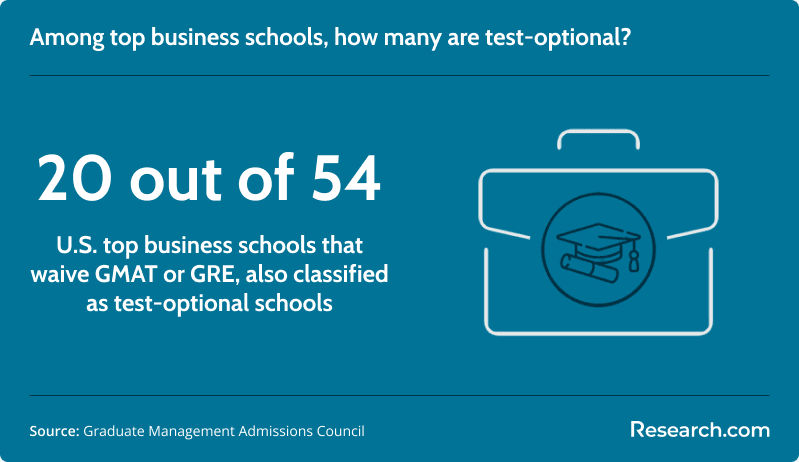
Currently, only 20 of the top 54 U.S. business schools are test-optional. That does not mean every applicant needs a test score, but it does mean applicants should make a deliberate choice rather than assuming tests no longer matter.
| Choose the GMAT if... | Choose the GRE if... |
| You want a test built specifically for business school admissions. | You may apply to other graduate programs in addition to MBA programs. |
| Your target schools or employers appear to value GMAT scores. | Your strengths align better with the GRE format after practice testing. |
| You want to demonstrate business-focused quantitative and data reasoning. | You want flexibility across broader graduate education options. |
When deciding between the two, compare five factors.
- Program policy: Some schools state that they accept both tests equally, but you should still confirm current requirements with each admissions office, including flexible options such as self paced online MBA programs.
- Your practice scores: Take timed practice exams for both. The better test is often the one where your score is strongest relative to the program’s admitted-student profile.
- Your career plans: Some finance and consulting employers may ask about GMAT scores during recruiting, so research expectations in your target field.
- Your testing style: Question format, pacing, and section structure can affect performance. Comfort with the exam matters.
- Score reporting options: Review how each test provider allows you to send scores, especially if you plan multiple attempts.
What kind of work experience do MBA programs look for?
MBA admissions teams use work experience to understand how you think, lead, solve problems, and influence results. The strongest applications do not simply list job titles. They show progression, judgment, and impact. As Baylor’s Hankamer School of Business notes, applicants should carefully highlight in your application the experience that best explains their readiness and goals.
Leadership and Measurable Impact
- Ownership: You do not need a formal manager title to show leadership. Leading a client initiative, improving a process, mentoring peers, or coordinating a cross-functional project can all matter.
- Results: Admissions committees respond to evidence. Describe what changed because of your work, such as revenue, efficiency, quality, customer outcomes, or team performance.
- Initiative: Strong candidates identify problems, propose solutions, and act rather than waiting to be assigned every task.
Relevant Business Skills
- Business judgment: Schools look for applicants who understand how decisions affect budgets, customers, operations, people, or strategy.
- Analytical ability: Examples involving data, trade-offs, forecasting, process improvement, or problem diagnosis can strengthen your case.
- Communication and collaboration: MBA programs are team-heavy. Your application should show that you can work with people across functions and levels.
Career Growth
- Progression: Promotions, expanded scope, larger clients, bigger budgets, or more complex assignments can show readiness for graduate management education.
- Learning mindset: Training, certifications, stretch assignments, and feedback-driven growth help show that you will benefit from an MBA.
- Clear goals: Your past experience should connect logically to your post-MBA direction, even if you are making a career change.
Diversity of Experience
- Industry perspective: MBA classrooms benefit from students in technology, healthcare, finance, manufacturing, nonprofit, government, military, and entrepreneurial settings.
- Functional exposure: Work across marketing, finance, operations, analytics, product, or strategy can be especially useful for leadership-focused programs and an affordable executive MBA.
- Global or cross-cultural work: Experience with international teams, global clients, or multicultural environments can strengthen an application in a business world that is increasingly interconnected.
What academic qualifications do you need for an executive MBA?
Applications for Executive MBA (EMBA) programs increased by 25% among international students in 2024. EMBA programs are built for experienced professionals who want to continue working while developing higher-level leadership, strategy, and decision-making skills. A bachelor’s degree is still commonly expected, including at business schools with high acceptance rates, but professional maturity and leadership evidence usually carry more weight than undergraduate major.
| Traditional MBA | Executive MBA |
| Often designed for early- to mid-career professionals. | Designed for experienced managers, senior professionals, and executives. |
| May require fewer years of work experience. | Often expects 8-10 years or more of professional experience. |
| May emphasize career switching, internships, and campus recruiting. | Often emphasizes leadership development, peer learning, and applying lessons immediately at work. |
| GMAT or GRE may be required, optional, or waived depending on the school. | GMAT, GRE, or Executive Assessment policies vary and may be waived for strong senior candidates. |
- Bachelor’s degree: Most EMBA programs expect an accredited undergraduate degree, though the discipline is usually flexible.
- Extensive professional experience: This is often the defining requirement. Programs want applicants who have managed people, projects, budgets, clients, products, or strategic decisions.
- Leadership potential: Essays, recommendations, and interviews should show how you lead now and what kind of executive responsibilities you are preparing for.
- GMAT/GRE: Some EMBA programs require or recommend a test score, while others waive it for applicants with substantial experience.
- Executive Assessment: Some schools use executive-focused assessments to evaluate reasoning, decision-making, and leadership readiness, including fit for specific MBA specializations.
What MBA programs can you consider applying to?
The right MBA program depends on your goals, budget, schedule, preferred learning format, and target industry. The examples below show how program length, concentrations, cost per credit, credits required, and accreditation can vary across respected MBA options.
1. Rice University
The Jones Graduate School of Business at Rice University offers MBA@Rice, an online MBA launched in 2020 for working professionals seeking advancement. The program follows the on-campus MBA curriculum through live online classes, interactive coursework, and residential immersions. Students may focus on areas such as Finance, Marketing, and Energy.
- Program Length: 24 months
- Tracks/Concentrations: Finance, Marketing, Energy, Leadership, Strategy, Operations Management
- Cost per Credit: $2,194
- Required Credits to Graduate: 54
- Accreditation: Association to Advance Collegiate Schools of Business
2. University of Washington
The Foster School of Business at the University of Washington offers a Hybrid MBA that combines online coursework with in-person residencies. The program began in 2001 and is intended for working professionals who want flexibility without losing structured face-to-face engagement. Students complete a core MBA curriculum and can personalize learning through electives.
- Program Length: 24 months
- Tracks/Concentrations: General Management
- Cost per Credit: $1,548
- Required Credits to Graduate: 60
- Accreditation: Association to Advance Collegiate Schools of Business
3. University of North Carolina–Chapel Hill
The University of North Carolina-Chapel Hill Kenan-Flagler Business School offers MBA@UNC, an online MBA launched in 2011. The program combines live online classes, self-paced work, and global immersions for professionals who want academic rigor with flexibility. Concentrations include Finance, Marketing, Strategy & Innovation, and other business-focused areas.
- Program Length: 24 months
- Tracks/Concentrations: Finance, Marketing, Strategy & Innovation, Data Analytics and Business Analytics, Operations Management, Entrepreneurship, Consulting
- Cost per Credit: $2,025
- Required Credits to Graduate: 66
- Accreditation: Association to Advance Collegiate Schools of Business
4. University of Florida
The Warrington College of Business at the University of Florida offers an Online MBA that launched in 1999. The program is built for working professionals and uses a flexible online format. Students study core business areas and may pursue specializations such as Finance, Marketing, or Information Systems.
- Program Length: 24 months
- Tracks/Concentrations: Finance, Marketing, Information Systems, Business Analytics, Healthcare Management, Supply Chain Management
- Cost per Credit: $1,208
- Required Credits to Graduate: 48
- Accreditation: Association to Advance Collegiate Schools of Business
5. Arizona State University
The W. P. Carey School of Business at Arizona State University offers an Online MBA that began in 2002. The program is fully online and serves working professionals interested in advancement or a career pivot. Specialization options include Finance, Marketing, Supply Chain Management, Business Analytics, and Healthcare Management.
- Program Length: 21 months
- Tracks/Concentrations: Finance, Marketing, Supply Chain Management, Business Analytics, Healthcare Management
- Cost per Credit: $1,369
- Required Credits to Graduate: 45
- Accreditation: Association to Advance Collegiate Schools of Business
Is an MBA a sound investment?
An MBA can be a sound investment when the program’s cost, format, reputation, alumni network, and career outcomes align with your goals. It is less compelling when applicants enroll mainly for prestige without a clear plan for using the degree. Before applying, compare tuition, fees, lost income if you study full time, financing costs, employer sponsorship, scholarship possibilities, and expected career mobility. For a deeper return-on-investment discussion, see Research.com’s guide: Is MBA worth it?
Which online MBA programs offer both quality and affordability?
Affordable online MBA programs can be strong options for working professionals, but low tuition should not be the only filter. Compare accreditation, faculty experience, student support, live versus asynchronous learning, graduation requirements, career services, employer recognition, and networking access. Research.com’s guide to an inexpensive online MBA can help applicants compare cost-conscious programs while still evaluating quality.
Do MBA programs offer need-based financial aid?
MBA financial aid varies widely. Merit-based scholarships are common, while need-based aid can be more limited, especially at highly selective schools. In 2024, 35% of the incoming class received merit-based aid or fellowships, a notable increase from 24% in 2016. Applicants should build a funding plan before enrolling because MBA costs can include more than tuition.
- Need-based scholarships: Some business schools award scholarships based on demonstrated financial need, often using FAFSA in the United States or institution-specific financial documentation elsewhere.
- Federal student loans in the US: Direct Unsubsidized Loans and Grad PLUS Loans may be available to eligible MBA students and can help cover tuition and living expenses, but repayment with interest is required.
- Private loans: Private lenders may offer graduate student loans, but terms, interest rates, repayment protections, and co-signer requirements vary.
- Institutional loans: Some universities provide school-based loan options, sometimes with terms that differ from private lenders.
- Work-study programs: Work-study may exist at some universities, although opportunities can be limited for MBA students because of program intensity and professional schedules.
- Employer sponsorship: Some employers provide tuition assistance or reimbursement. Applicants should ask about service commitments, grade requirements, annual limits, and repayment obligations if they leave the company.
What strategies can further strengthen the MBA application?
Once you meet the basic requirements, your goal is to make the admissions committee understand why you, why this MBA, and why now. Strong applicants show a coherent story: what they have done, what they want to do next, and how the program fills a specific gap. Additional business coursework, targeted professional certifications, leadership in community or workplace initiatives, and a thoughtful professional presence can help. Applicants who need foundational business training before an MBA may also compare options such as the cheapest online business degree programs.
| Common mistake | Better approach |
| Applying only to famous schools without checking fit. | Compare curriculum, recruiting strength, location, format, alumni network, and specialization options. |
| Writing essays that repeat the resume. | Use essays to explain motivation, decisions, leadership lessons, and future direction. |
| Choosing recommenders based only on title. | Choose people who can describe your work with concrete examples. |
| Ignoring accreditation. | Confirm institutional and business-school accreditation before applying. |
| Assuming online programs are automatically easier. | Evaluate time commitment, live attendance requirements, group work, exams, and residency expectations. |
| Focusing only on tuition. | Include fees, travel, books, technology, time away from work, loan interest, and opportunity cost. |
Should I Consider Alternative Advanced Business Degrees to an MBA?
An MBA is not the only advanced business credential. Professionals interested in research, consulting, senior strategy roles, or academic pathways may consider a Doctorate in Business Administration. A DBA is generally more research-oriented than an MBA and focuses on applied business inquiry, advanced analysis, and organizational problem-solving. If you are comparing executive, consulting, or academic goals, review flexible options such as the best online DBA programs.
How do online MBA admissions compare to full-time programs?
Online and full-time MBA programs often ask for similar materials: transcripts, resume, essays, recommendations, and sometimes GMAT or GRE scores. The difference is usually emphasis. Full-time programs may focus more on immersive campus experience, internships, and career switching, while online programs often evaluate whether applicants can balance graduate study with work and personal responsibilities.
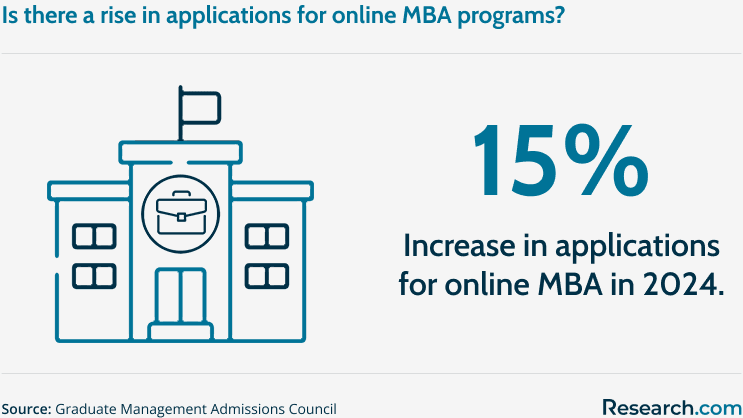
In 2024, applications for online MBA increased by 15%. This growth reflects demand for flexible graduate business education, but applicants should still compare quality carefully. Some online programs are structured for speed and convenience, including options described as the fastest MBA, while others are designed around live classes, residencies, and cohort-based learning.
| Admissions factor | Online MBA | Full-time MBA |
| Work experience | Often heavily weighted because students usually remain employed. | Important, though some programs admit earlier-career applicants. |
| Schedule readiness | Schools may look for self-discipline, time management, and comfort with virtual collaboration. | Schools may focus on campus engagement, team participation, and recruiting readiness. |
| Career goals | Often tied to advancement while working, promotion, or targeted career pivot. | Often tied to internships, networking, and more intensive career switching. |
| Learning format | May include asynchronous coursework, live online sessions, residencies, or hybrid requirements. | Usually built around in-person classes, clubs, events, and campus recruiting. |
Before choosing an online MBA, ask whether the program offers career coaching, alumni access, employer-recognized accreditation, sufficient faculty interaction, and networking that matches your goals.
Are there different MBA requirements for international applicants?
While 62% of business schools worldwide provide non-degree credentials, most professionals still prefer to pursue an MBA degree. International applicants usually complete the same core MBA application as domestic applicants, but they may also need to prove English proficiency, verify academic credentials, translate records, and prepare visa documentation.
English Language Proficiency
- TOEFL/IELTS/PTE: Many English-language MBA programs require international applicants to submit scores from an approved English proficiency exam. Each program sets its own score expectations.
- Waivers: A school may waive English testing if the applicant completed a degree in English or has substantial professional experience in an English-speaking environment. Applicants should not assume a waiver; they should confirm the policy in writing.
Academic Credentials Evaluation
- Transcript evaluation: International transcripts may need review by a recognized credential evaluation service so the MBA program can understand degree equivalency, credits, grades, and academic level.
- Certified translations: If transcripts or diplomas are not in English, applicants usually need certified translations submitted with the original documents.
Visa Requirements
- Student visa: Accepted students may need a student visa, such as an F-1 visa in the US or a Study Permit in Canada, depending on the destination country and program format.
- Financial documentation: Schools and immigration authorities may require proof that you can cover tuition, living costs, travel, insurance, and related expenses.
Does Accreditation Elevate the Value of an MBA?
Accreditation matters because it signals that a school or business program has been reviewed against recognized standards for curriculum, faculty qualifications, governance, student support, and academic quality. Employers, licensing-related organizations, scholarship providers, and doctoral programs may all care about accreditation. Applicants comparing online options should pay special attention to program-level business accreditation, including pathways such as an AACSB online MBA affordable option.
Before applying, confirm both institutional accreditation and business-school accreditation directly through the school and the accreditor. Do not rely only on advertising language.
What do graduates have to say about meeting their MBA application requirements?
-
: "
The MBA process forced me to define my goals before I ever entered the classroom. Preparing essays, recommendations, and interviews was demanding, but it helped me understand how leadership would fit into my next career stage. Anya
"
-
: "
I thought the requirements were just obstacles at first. In reality, they pushed me to organize my experience, explain my career vision, and choose a program that matched the kind of work I wanted after graduation. Ben
"
-
: "
The application felt intense, especially as an international applicant, but each step made me more prepared. By the time I started the MBA, I had a clearer plan, stronger confidence, and a broader professional network. Carlos
"
Are MBA interviews a critical part of the application process?
Yes. MBA interviews can be decisive because they test whether your written application matches how you communicate in real time. Schools may use behavioral interviews, case-style questions, alumni interviews, admissions-staff interviews, panel formats, or virtual meetings. Applicants should prepare concise examples that show leadership, conflict resolution, ethical judgment, teamwork, failure, resilience, and career clarity. Reviewing interview expectations at programs such as top online business schools can help you tailor your preparation.
- Practice answering “Why MBA?” and “Why this program?” without sounding scripted.
- Prepare examples using a clear situation-action-result structure.
- Know your resume well enough to discuss every role, transition, and achievement.
- Prepare thoughtful questions about curriculum, career support, alumni networks, and experiential learning.
- For virtual interviews, test your camera, audio, lighting, internet connection, and background in advance.
How can an accelerated online MBA enhance my career progression?
An accelerated online MBA can help professionals move through graduate business coursework more quickly while continuing to work. This format may make sense if you already have clear goals, strong time management skills, and the ability to handle an intensive pace. It is less suitable for applicants who need a slower transition, extensive campus recruiting, or more time to explore career options. Applicants comparing accelerated pathways can also review related fast-format business programs such as a fast-track business degree.
What are the career outcomes and salary expectations after an MBA?
MBA outcomes depend on the program, the student’s prior experience, the economy, industry demand, location, and career strategy. Graduates often pursue management, consulting, finance, operations, product management, entrepreneurship, analytics, healthcare leadership, marketing, and general management roles. However, no MBA guarantees a specific salary or promotion. Applicants should ask each program for recent employment reports, salary data, internship access, employer relationships, and alumni outcomes before enrolling. Time-compressed options such as 1 year MBA programs online may appeal to professionals who want faster completion, but the pace can limit exploration time.
Can supplementary certifications boost my MBA application?
Certifications can help when they support your goals and fill a real skills gap. For example, project management, analytics, finance, accounting, supply chain, cybersecurity, or industry-specific credentials may strengthen an application if they align with your career narrative. A credential such as a fast track project management online degree may be useful for applicants who want to demonstrate structured leadership and execution skills. Certifications should complement, not replace, a strong record of impact.
Are there emerging niche MBA specializations that cater to evolving industry needs?
Many MBA programs now offer specialized tracks that combine core management training with industry-specific knowledge. Common areas include technology management, healthcare, sustainability, analytics, supply chain, entrepreneurship, and sports management. Specialized tracks can be valuable when you already know your target field, but they may be too narrow if you want broad career flexibility. Applicants interested in the sports industry, for example, can compare options such as the best MBA sports management programs.
How do networking and experiential learning opportunities elevate MBA success?
Networking and experiential learning are often what separate a useful MBA from a purely academic credential. Case competitions, consulting projects, internships, residencies, simulations, venture labs, mentorship, alumni events, and employer treks can help students apply business concepts and build relationships. These features can be especially important in flexible programs such as an executive MBA online, where students may immediately test classroom ideas in their current organizations.
Is an accelerated healthcare administration degree online a game-changer for career advancement?
An accelerated healthcare administration program can be useful for professionals targeting management roles in hospitals, clinics, public health organizations, insurance, health technology, or long-term care. Unlike a general MBA, healthcare administration programs usually focus more directly on healthcare operations, regulation, patient care systems, compliance, finance, and organizational leadership in health settings. Applicants comparing business and healthcare leadership routes can review an accelerated healthcare administration degree online to decide which credential better fits their target role.
Questions to Ask Before Applying to an MBA Program
- Is the program accredited, and by which accrediting body?
- Does the program match my target industry, function, and location?
- What are the real total costs, including fees, travel, residencies, books, and financing?
- Does the program require GMAT or GRE scores, and are waivers available?
- What kind of work experience does the school prefer?
- How strong are career services for online, part-time, or executive students?
- What employment outcomes are reported for recent graduates?
- How active and accessible is the alumni network?
- Will the schedule realistically fit my work and personal responsibilities?
- If I am an international applicant, what English proficiency, visa, and credential evaluation steps are required?
Key Insights
- MBA admissions are competitive again: worldwide business school applications saw a 12% increase in 2024, and total applications among all MBA program types increased by 13% in 2024.
- The standard MBA application usually includes a bachelor’s degree, transcripts, resume, essays, recommendations, and often GMAT or GRE scores.
- A GPA of 3.5 or higher is preferred by many top-tier MBA programs, but applicants below that level can still compete with strong work experience, test scores, leadership, and clear goals.
- Only 20 of the top 54 U.S. business schools are test-optional, so applicants should still make a thoughtful GMAT or GRE plan.
- Executive MBA admissions focus heavily on seniority, leadership responsibility, and professional impact; applications for EMBA programs increased by 25% among international students in 2024.
- Online MBA applications increased by 15% in 2024, but applicants should compare accreditation, career support, networking, and program structure rather than choosing based only on flexibility.
- Financial aid is not guaranteed. In 2024, 35% of the incoming MBA class received merit-based aid or fellowships, up from 24% in 2016.
- International applicants should prepare early for English proficiency testing, credential evaluation, certified translations, visa documentation, and proof of funds.
- The best MBA choice is not always the highest-ranked or fastest program. It is the program that fits your career goal, budget, schedule, learning style, and expected return.
References:
- BusinessBecause. (2025). Business school applications growing at record pace.
- Business Wire. (2025). MBA enrollments and completions tick upward, reports validated insights in new research.
- Graduate Management Admissions Council. (2024). 2024 admissions & application trends survey.
- Graduate Management Admissions Council. (2024). 2024 application trends survey infographic.
- Graduate Management Admissions Council. (2024). 2024 prospective students survey: Candidate mobility infographic.
- Graduate Management Admissions Council. (2024). 2024's top 10 trends from GMAC research year in review. GMAC Advisor.
- Higher Ed Dive. (2024). MBA applications spike in 2024, 2025, GMAC reports.
Other Things You Should Know About MBA Application Requirements
Most MBA programs ask international applicants to submit TOEFL iBT, IELTS Academic, or a similar approved test. Common minimums are 90–100 on TOEFL iBT and 6.5–7.0 on IELTS, with some schools setting higher section-score rules for reading, writing, listening, and speaking.
To apply for an MBA in 2027, you typically need a bachelor's degree from an accredited institution. While most programs accept any major, some may prefer degrees in business-related fields. Check specific MBA program prerequisites for any additional requirements.


