2027 What Is a Good Average Age for an MBA: Is It Worth It After 30?

Co-Founder and Chief Data Scientist
Choosing the right time for an MBA is not really about finding a “perfect” age. It is about deciding whether the degree will help you move into the role, industry, salary range, or leadership track you want next. For some professionals, that timing comes in their late 20s after several years of work experience. For others, especially those considering an MBA after 30, the degree makes sense only if it solves a specific career problem: stalled advancement, a planned career pivot, a move into executive leadership, or the need for stronger business credentials.
This guide explains how MBA timing works in the United States, what age and experience level usually fit different MBA formats, how the return on investment changes for younger and older students, and what alternatives may be better if a full MBA is not the most efficient path. It also covers salaries, funding options, specializations, online MBA considerations, and practical questions to ask before enrolling.
Quick Answer: What Is the Best Age to Get an MBA?
The best age to start an MBA is the point at which the degree clearly supports your next career move. Many full-time MBA students enter in their late 20s, often after building several years of professional experience. Professionals over 30 are also strong candidates, especially for part-time, online, and executive MBA formats that let them keep working while applying business concepts directly to their current roles.
Age alone should not drive the decision. A stronger test is whether you have enough work experience to contribute in class, a realistic plan for using the degree, and a financial strategy that accounts for tuition, lost income, debt, and expected career outcomes.
What are the benefits of getting an MBA?
- An MBA can prepare graduates for leadership, management, strategy, finance, consulting, marketing, operations, technology, healthcare, and entrepreneurship roles.
- Business and management careers can offer strong earning potential, though salaries vary widely by role, industry, school reputation, location, and prior experience.
- Online, hybrid, part-time, executive, and accelerated MBA formats can make graduate business education more accessible for working professionals who cannot pause their careers.
What can I expect from an MBA?
An MBA is a graduate business degree designed to build management judgment, financial literacy, strategic thinking, leadership ability, and cross-functional business knowledge. Most programs cover core areas such as accounting, finance, marketing, operations, organizational behavior, economics, analytics, and strategy. Many also allow students to specialize in fields such as consulting, entrepreneurship, healthcare management, information systems, or supply chain management.
The learning experience is usually applied rather than purely theoretical. Students often analyze business cases, work in teams, complete simulations, build presentations, evaluate financial decisions, and solve problems that resemble real company challenges. For working professionals, the value often comes from immediately connecting coursework to current workplace issues.
An MBA can also expand a student’s professional network. Classmates, faculty, alumni, career coaches, executives, recruiters, and project partners may become important contacts. This network can matter as much as the coursework for students who are changing industries, targeting competitive employers, or preparing for senior leadership.
Where can I work with an MBA?
MBA graduates work across nearly every sector that needs business leadership. Common destinations include consulting firms, financial services companies, technology employers, healthcare organizations, consumer goods companies, manufacturing firms, startups, nonprofits, and government-adjacent organizations. Typical roles may include product manager, management consultant, finance manager, marketing director, operations manager, business development leader, healthcare administrator, strategy manager, or general manager.
The best industry fit depends on what you bring into the MBA. A younger professional may use the degree to enter consulting or finance. A mid-career engineer may use it to move into product management. A healthcare professional may use it to transition into hospital administration or health system strategy. An experienced nonprofit leader may use it to strengthen finance, operations, and scaling skills.
How much can I make with an MBA?
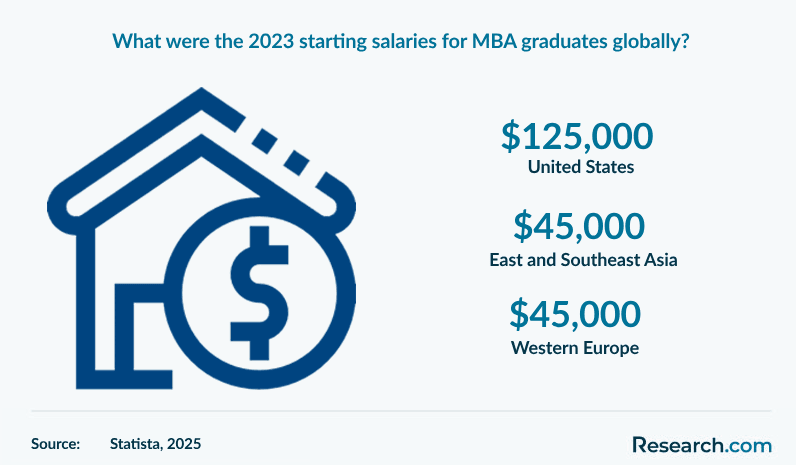
MBA compensation varies substantially. In 2023, the estimated median starting salary offered to MBA graduates in the United States was $125,000. By comparison, East and Southeast Asia and Western Europe showed a median starting salary of $45,000 for MBA graduates, Central and South Asia, Africa, and the Middle East reported $35,000, and Latin America reported $30,000 (Statista, 2025).
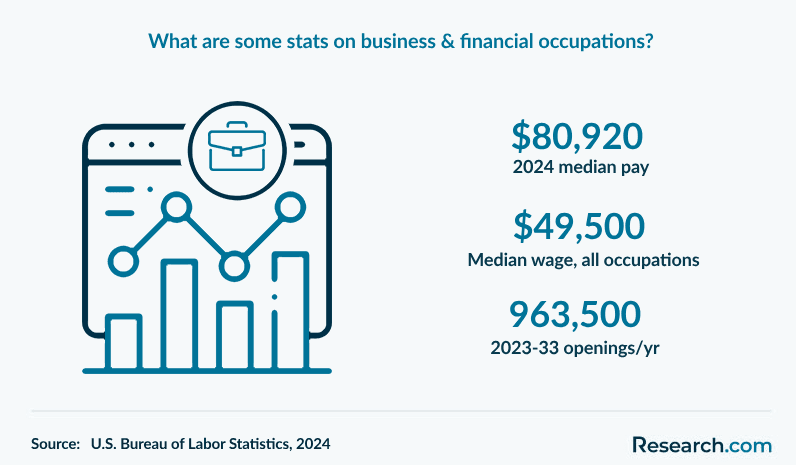
Broader labor data also shows why business education remains attractive to many students. Employment in business and financial occupations is expected to grow faster than average from 2023 to 2033, with about 963,500 openings annually due to growth and worker replacement. In May 2024, the median annual wage for these roles was $80,920, compared with $49,500 for all occupations (U.S. Bureau of Labor Statistics, 2025).
Still, an MBA does not guarantee a specific salary. Outcomes depend on the program, employer relationships, student performance, prior work history, career services, geographic market, specialization, and whether the graduate uses the degree to change roles or advance in an existing field.
- What is a good average age for an MBA?
- What are the benefits of pursuing an MBA after 30 years old?
- How does the ROI of an MBA compare for younger vs. older professionals?
- Are there scholarships or financial aid options for MBA students over 30?
- What are some career specializations for MBAs for younger vs. older professionals?
- What are the most popular MBA specializations in the United States?
- What are some alternatives to an MBA for career advancement after 30?
- Which MBA program format best fits my career goals?
- What are the comparative average salaries of MBAs in various fields?
- Can supplemental credentials boost an MBA's career impact?
- How does the learning experience differ for younger and older MBA students?
- What is the future outlook for MBA graduates of different age groups in the US job market?
- How do cost factors affect the long-term ROI of an MBA?
- Is an online MBA degree program the right choice for mid-career professionals?
- What else should MBA applicants consider before enrolling?
What is a good average age for an MBA?
A good MBA age is the age at which your work experience, career goals, and program format line up. Full-time MBA programs often attract students in their late 20s, especially those with enough professional experience to understand business problems but enough runway to benefit from a major post-MBA career shift. Executive MBA and part-time formats usually serve older professionals who want advancement without stepping away from work.
| Career stage | Common MBA fit | When it makes sense | Main caution |
| Early career | Full-time MBA or accelerated MBA | You have several years of work experience and want to switch industries, enter consulting or finance, or accelerate into management. | Too little experience can make it harder to contribute in class or compete for post-MBA leadership roles. |
| Late 20s to early 30s | Full-time, part-time, hybrid, or online MBA | You have a clearer career target and can use the degree for advancement, a pivot, or stronger leadership preparation. | Opportunity cost becomes more important if leaving a good salary for a full-time program. |
| Mid-career professional | Online MBA, part-time MBA, or executive MBA | You want to keep working while building strategic, financial, and leadership skills. | A traditional full-time MBA may not be the best fit if you already have significant management experience. |
| Senior professional | Executive MBA or targeted executive education | You need board-level, enterprise strategy, or C-suite preparation rather than entry-level career switching support. | The ROI depends heavily on employer support, current salary, and whether the credential unlocks a specific next step. |
Several factors matter more than age:
- Work experience: Many MBA candidates have 2-7 years of professional experience, which can provide enough workplace context to make the curriculum more useful.
- Career direction: The degree is easier to justify when it supports a defined goal, such as moving into consulting, leading a business unit, changing industries, or preparing for executive management.
- Program type: Executive MBA programs often enroll professionals with substantial experience, frequently 10+ years. Students comparing price and format may want to review affordable executive MBA options.
- Personal readiness: Finances, family obligations, employer support, relocation flexibility, and study time all influence whether now is the right moment.
- Industry expectations: Some employers value an MBA earlier for recruiting pipelines, while others value the degree more when combined with deep functional experience.
The strongest MBA candidates are not necessarily the youngest or oldest. They are the ones who can explain why they need the degree now and how they plan to use it after graduation.
What are the benefits of pursuing an MBA after 30 years old?
Pursuing an MBA after 30 can be a smart move when the degree builds on meaningful professional experience. Older students often know what they want from the program, understand workplace politics and leadership challenges, and can evaluate the degree through a practical ROI lens.
- Clearer career goals: Professionals over 30 are often better able to choose courses, projects, internships, and networks that match a specific objective.
- Stronger classroom contributions: Years of experience help students connect frameworks to real decisions involving budgets, teams, customers, operations, and strategy.
- More credibility for leadership roles: An MBA can reinforce a track record of performance and signal readiness for broader responsibility.
- Better use of networking: Mid-career students may already have contacts they can combine with alumni, faculty, and peer networks from the MBA.
- More targeted career pivots: A professional with a decade of experience may use the degree to move from a technical, nonprofit, healthcare, military, or functional role into general management or strategy.
- Greater financial planning capacity: Some students over 30 have more savings or employer support, though they may also have larger household expenses.
In 2023, the estimated median starting salary offered to MBA graduates in the United States was $125,000, significantly higher than in other world regions. East and Southeast Asia, along with Western Europe, showed a median starting salary of $45,000 for MBA graduates. Central and South Asia, Africa, and the Middle East reported an estimated median starting salary of $35,000 for MBA graduates. The lowest estimated median starting salary was observed in Latin America, at $30,000 (Statista, 2025).
Admissions flexibility can also help experienced applicants. Many business schools let candidates choose between the GMAT or GRE for MBA admission, allowing applicants to select the exam that better reflects their strengths and preparation strategy.
The salary comparison shown below highlights the gap between MBA starting salaries across world regions, with the United States reporting the highest figure in the data cited. Applicants should interpret these numbers carefully because compensation is influenced by market conditions, employer type, cost of living, program reputation, and the candidate’s prior experience.
How does the ROI of an MBA compare for younger vs. older professionals?
MBA return on investment differs by age because students give up and gain different things. Younger students usually have more working years ahead after graduation, which can increase lifetime earning potential. Older professionals may have a shorter payback window but can sometimes use the degree for faster advancement because they already have management experience, industry knowledge, and professional credibility.
| ROI factor | Younger MBA students | Older MBA students |
| Time to benefit | More years to apply the degree over a long career. | May need quicker salary growth or promotion to justify the cost. |
| Opportunity cost | Lost wages may be lower if pre-MBA salary is still early-career. | Lost income can be higher if leaving an established role for full-time study. |
| Career switching | Often easier to reposition into structured MBA recruiting pipelines. | Possible, but the pivot should connect logically to prior experience. |
| Leadership advancement | May need more time after graduation to reach senior roles. | Can use the MBA to formalize business knowledge and move into broader leadership faster. |
| Cost strategy | Affordable formats can reduce debt; some students compare options such as an online MBA less than $10000. | Employer sponsorship, part-time study, or online formats may preserve income and improve ROI. |
The main ROI question is not “Am I too old?” or “Am I too young?” It is “Will this program create a realistic path to a better outcome than I could achieve without it?”
Employment in business and financial occupations is expected to grow faster than average from 2023 to 2033, with about 963,500 openings annually due to growth and worker replacement. In May 2024, the median annual wage for these roles was $80,920, compared to $49,500 for all occupations (U.S. Bureau of Labor Statistics, 2025), as shown in the graphic below.
Are there scholarships or financial aid options for MBA students over 30?
Yes. MBA students over 30 can pursue many of the same funding options as younger graduate students, including scholarships, loans, employer tuition assistance, veterans benefits, and school-based aid. Age by itself usually does not prevent applicants from being considered for graduate business school funding.
- Merit scholarships: Business schools may award funding based on academic background, professional achievement, test scores, leadership record, or overall applicant strength.
- Need-based aid: Some institutions use financial need to determine grant or scholarship support.
- Employer sponsorship: Working professionals may be able to secure partial or full tuition support, especially when the MBA aligns with internal leadership development. Employer support is especially relevant for students comparing online executive MBA cost options.
- Federal and private loans: Graduate students may use loans to cover tuition and related expenses, but borrowers should model repayment before enrolling.
- Professional association funding: Industry groups, foundations, and membership organizations may offer graduate scholarships or grants.
- Veterans benefits: Eligible service members and veterans may be able to use the GI Bill toward MBA expenses.
| Funding question | Why it matters |
| Does the school automatically consider applicants for merit aid? | Some programs require separate scholarship applications, while others review all admitted students. |
| Can I keep working while enrolled? | Maintaining income can improve ROI more than a small tuition discount. |
| Will my employer require a work commitment after sponsorship? | Tuition support may come with retention requirements or repayment clauses. |
| What is the total cost beyond tuition? | Fees, travel, residencies, textbooks, technology, and lost income can change the real price of the degree. |
Older applicants should compare aid packages carefully and avoid assuming that the highest-ranked or most expensive program will automatically produce the best financial outcome.
What are some career specializations for MBAs for younger vs. older professionals?
MBA specialization choice should reflect your target role, not your age alone. However, younger and older professionals often approach concentrations differently because they are solving different career problems. Students comparing flexible programs may find that online MBA programs make it easier to choose a specialization without relocating or leaving work.
| Specialization area | Often useful for younger professionals | Often useful for professionals over 30 |
| Finance | Investment banking, corporate finance, analyst-to-manager pathways. | Portfolio management, finance leadership, corporate strategy, or executive decision-making. |
| Consulting | Entry into management consulting, strategy consulting, or internal consulting roles. | Senior advisory work that builds on deep industry experience. |
| Technology or information systems | Product management, business analytics, digital strategy, or tech operations. | Digital transformation, enterprise systems leadership, or technology-enabled change management. |
| Operations and supply chain | Operations analyst, supply chain management, logistics, or process improvement. | Plant leadership, operational excellence, procurement strategy, or enterprise-wide efficiency roles. |
| Healthcare management | Entry into healthcare administration or healthcare consulting. | Leadership roles for clinicians, administrators, or healthcare professionals moving into management. |
| Entrepreneurship | Startup launch, venture development, innovation roles. | Scaling an existing venture, acquiring a business, or moving from functional leadership to ownership. |
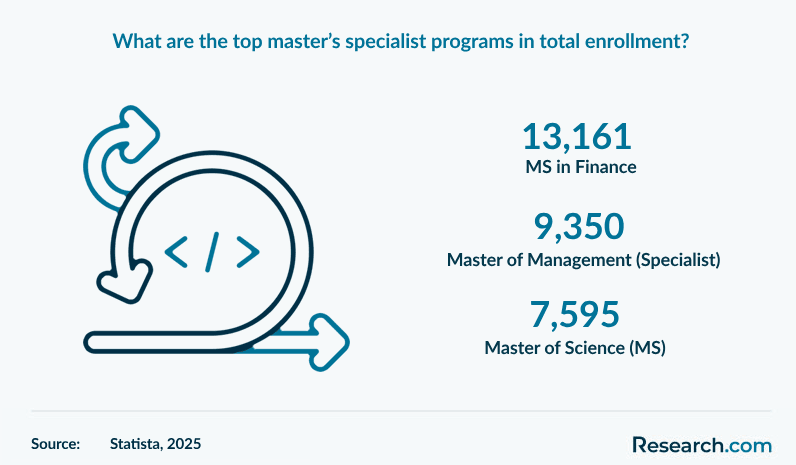
According to the Association to Advance Collegiate Schools of Business (AACSB), the top 10 Master’s Specialist programs by total enrollment are led by MS in Finance with 13,161 students, followed by Master of Management (Specialist) with 9,350, and Master of Science (MS) with 7,595 enrolled students. Master of Professional Accountancy (or Accounting) programs have a total enrollment of 7,183, while MS in Business Administration accounts for 5,170 students. Further down the list, Master of Accountancy (or Accounting) programs enroll 4,997 students, Master of Arts (MA) programs have 4,784 students, MS in Information Systems programs have 4,179 students, MS in Marketing programs account for 4,033 students, and Master of International Business programs have a total enrollment of 3,375.
This enrollment pattern shows strong demand for finance and other specialized business master’s programs. It also signals an important MBA decision: if your goal is deep technical expertise in one field, a specialist master’s may compete directly with a general MBA.
What are the most popular MBA specializations in the United States?
Popular MBA specializations tend to align with major business functions and employer demand. The most common choices include finance, management, consulting, marketing, operations, information systems, entrepreneurship, and healthcare management.
- Finance: Focuses on corporate finance, investment analysis, capital markets, risk, valuation, and financial decision-making.
- Management: Builds broad leadership, organizational, strategy, and decision-making skills for multiple industries.
- Consulting: Develops analytical problem-solving, communication, client management, and strategic recommendation skills.
- Marketing: Covers brand strategy, customer research, digital channels, market positioning, and growth planning.
- Operations: Trains students to improve processes, manage supply chains, reduce inefficiencies, and strengthen execution.
- Information systems: Connects business strategy with technology, analytics, enterprise systems, and digital transformation.
- Entrepreneurship: Supports students interested in launching, funding, acquiring, or scaling businesses.
- Healthcare management: Prepares students to manage healthcare organizations, policy pressures, operations, and delivery models.
Applicants who want flexibility in admissions may also compare online MBA programs with no GMAT requirement, though they should still evaluate accreditation, outcomes, faculty, curriculum, and employer reputation.
Specialization choice is similar to choosing between related degree paths in other fields. For example, sport administration and sport management degrees can emphasize different responsibilities even when they appear similar. MBA concentrations work the same way: finance, analytics, healthcare, and operations can lead to very different day-to-day roles.
Across degree programs, undergraduate programs constitute the largest share at 40.6%, as reported by AACSB International in 2025. Master's specialist programs represent the second largest category at 25.8%, followed by master's generalist (MBA/dual degree) programs at 21.7%. Master's generalist (MBA) programs account for 11.8% of the total, while doctoral programs make up 7.1% and non-degree programs represent 7.7%, as shown in the graph below.
The data suggests that business education is not limited to the traditional MBA. Undergraduate business programs remain the largest category, while graduate business education is divided among specialist master’s degrees, MBA programs, dual degrees, doctoral programs, and non-degree options. MBA and dual-degree MBA programs together remain a major part of graduate business education at 33.5% (AACSB International, 2025).
What are some alternatives to an MBA for career advancement after 30?
An MBA is not always the most efficient credential for career advancement after 30. If your goal is narrow, technical, or tied to a regulated profession, another pathway may produce a better result with less time and cost.
| Alternative | Best for | When it may beat an MBA |
| Specialized master’s degree | Finance, accounting, analytics, data science, information systems, or another focused business field. | You need deep technical expertise more than broad management training. Some learners also compare accelerated MBA programs when speed is a priority. |
| Executive education | Managers who need short, targeted training in leadership, strategy, negotiation, finance, or innovation. | You already have senior experience and do not need a full graduate degree. |
| Professional certification | Project management, accounting, finance, HR, analytics, cybersecurity, or operations roles. | Employers in your target field value a specific credential more than a general MBA. |
| Online courses or certificate programs | Skill refreshers in analytics, AI tools, marketing, finance, or leadership. | You need one skill gap closed quickly rather than a full degree. |
| Internal advancement and mentorship | Professionals already on a strong promotion path. | Your employer values performance, sponsorship, and leadership exposure more than another degree. |
Professionals seeking a career pivot into education or global training may also consider options such as the most affordable online TESOL master's degree programs if their long-term goal is language instruction, ESL leadership, or international education rather than business management.
The right alternative depends on the job you want. Before choosing an MBA, review job descriptions for your target role and note which credentials employers actually request.
Which MBA Program Format Best Fits My Career Goals?
MBA format can affect cost, networking, recruiting access, schedule flexibility, and career outcomes. A full-time campus program may be best for students making a major career switch and seeking immersive recruiting support. A part-time, hybrid, or online MBA may be better for working professionals who want to keep earning while studying. An executive MBA is usually designed for experienced leaders who need strategic and enterprise-level training.
| Program format | Best fit | Trade-off to consider |
| Full-time MBA | Career switchers, students targeting structured recruiting, and candidates who can pause work. | Higher opportunity cost because students may leave full-time employment. |
| Part-time MBA | Professionals who want advancement without leaving their jobs. | Less immersive than a full-time program and may take longer to complete. |
| Online MBA | Working adults who need geographic flexibility and schedule control. | Networking and recruiting support vary widely by school. |
| Hybrid MBA | Students who want online flexibility with some face-to-face interaction. | Residencies or campus sessions may require travel and time away from work. |
| Executive MBA | Experienced managers and senior professionals preparing for broader leadership. | Usually less focused on entry-level career switching than traditional MBA programs. |
| One-year MBA | Students who want a faster path and can handle an intensive schedule. Some compare options such as an online MBA one year pathway. | Less time for internships, exploration, and extended networking. |
Choose format after defining your career goal. If you need a new industry, recruiting access may matter most. If you need promotion in your current field, flexibility and employer sponsorship may matter more.
What are the comparative average salaries of MBAs in various fields?
MBA salaries differ by field, job level, employer, location, and previous work experience. Consulting, finance, technology, and senior product leadership often produce some of the strongest compensation opportunities, while nonprofit and some public-sector paths may offer lower salaries but other forms of mission-driven value.
- Consulting: MBA graduates may enter strategy, management, operations, or specialized advisory roles where pay can include bonuses tied to performance.
- Finance: Investment banking, asset management, corporate finance, private equity, and related roles can offer high compensation but may also involve demanding hours and competitive recruiting.
- Technology: Product management, strategy, business operations, and business development roles may include salary plus equity or stock-based compensation.
- Healthcare: MBA graduates may manage hospitals, clinics, health systems, payers, healthcare operations, or strategy teams.
- Marketing: Brand, growth, product marketing, and market strategy roles can lead to senior leadership opportunities.
- Operations and supply chain: Graduates may work in manufacturing, logistics, procurement, process improvement, and operations leadership.
- Nonprofit and social impact: Compensation may be lower than in corporate sectors, but MBA skills can help leaders improve funding strategy, operations, and organizational scale.
The average salaries range from $71,677 to $140,262. Occupations with the highest average salaries are senior product manager ($140,262), marketing director ($130,896), and management consultant ($126,220). The lowest average salaries are for financial analyst ($71,677), senior accountant ($74,518), and marketing manager (International Business) ($77,674). The average salary for MBA-specific roles is $97,000.00. Management roles have an average salary of $98,983.18. These are shown in the graph below.
These figures show that “MBA salary” is not a single number. Role selection matters. A graduate entering senior product management may see very different compensation from a graduate entering accounting, nonprofit management, or an early-career finance role.
Students should compare expected salary against total program cost, not just advertised outcomes. Ask schools for employment reports, salary ranges, industry placement data, and outcomes by program format whenever available.
Can supplemental credentials boost an MBA's career impact?
Additional credentials can strengthen an MBA when they fill a specific skill gap or match employer expectations. The best add-ons are targeted, recognizable, and relevant to the role you want. Examples may include project management, analytics, accounting, finance, HR, cybersecurity, product management, or industry-specific certificates.
For professionals who want project leadership skills, a credential or degree pathway in project management may complement business training. One example to compare is the fastest bachelor's degree in project management online, especially for learners who need structured project management preparation before or alongside graduate business education.
Do not collect credentials randomly. A supplemental certificate should make your resume easier to understand, not more scattered. If a credential does not appear in job postings for your target role, it may not improve your MBA ROI.
How does the learning experience differ for younger and older MBA students?
Younger and older MBA students often approach the same curriculum differently. Younger students may use the program to build business fundamentals and explore career options. Older students may use it to solve known leadership problems, formalize experience, and fill gaps in finance, strategy, analytics, or executive communication.
| Learning dimension | Younger students | Older students |
| Classroom perspective | Often focus on frameworks, theory, and career exploration. | Often connect lessons to direct workplace experience. |
| Group work | May contribute recent academic training, technical fluency, and adaptability. | May contribute management judgment, industry context, and leadership experience. |
| Networking | Usually building a first major professional network. | Often expanding an existing network and using it more strategically. |
| Career services use | May explore multiple industries or recruiting pipelines. | May target a narrower set of roles, promotions, or executive transitions. |
| Time management | May have fewer family or senior-work responsibilities. | May balance coursework with family, management duties, travel, or demanding jobs. |
A strong MBA cohort benefits from both groups. Younger students may bring energy, flexibility, and emerging technology awareness. Older students may bring practical judgment, industry knowledge, and hard-won leadership lessons.
What is the future outlook for MBA graduates of different age groups in the US job market?
The outlook for MBA graduates depends less on age and more on whether their skills match changing employer needs. Employers continue to value leadership, analytical thinking, financial understanding, communication, operational discipline, and the ability to make decisions under uncertainty. At the same time, MBA graduates increasingly need comfort with data, AI-enabled tools, digital transformation, remote collaboration, and technology-driven business models.
- Younger MBA graduates: May be attractive for rotational programs, consulting, finance, technology, and roles that reward adaptability and long-term leadership potential.
- Mid-career MBA graduates: Can be competitive for management, strategy, operations, product, healthcare, and business transformation roles that require both experience and formal business training.
- Senior MBA or EMBA graduates: May use the credential to strengthen executive presence, broaden enterprise thinking, or prepare for general management and C-suite responsibilities.
- All MBA graduates: Need continuous learning. Business models, AI tools, analytics expectations, and employer skill requirements are changing too quickly for one degree to remain sufficient forever.
Compared with degrees that may lead to less direct management pathways, such as a low cost degree in philosophy online, an MBA is usually more explicitly tied to business, finance, operations, and leadership roles. However, the degree still works best when paired with a clear career plan.
How do cost factors affect the long-term ROI of an MBA?
MBA cost has a direct impact on ROI. Tuition is only one part of the calculation. Students should also consider fees, living expenses, travel, technology requirements, interest on loans, and the income they may give up if they reduce work hours or leave a job to study full time.
| Cost factor | How it affects ROI | What to ask before enrolling |
| Tuition and fees | Higher upfront cost requires stronger post-graduation gains to justify the investment. | What is the total program cost, including required fees? |
| Opportunity cost | Lost wages can be one of the largest expenses for full-time students. | Can I keep working, or will I need to pause my income? |
| Program length | Longer programs may spread workload but extend time before full ROI appears. | How long do students with my schedule usually take to finish? |
| Employer support | Tuition reimbursement or sponsorship can sharply improve ROI. | Does my employer offer education benefits, and are there repayment conditions? |
| Accreditation and reputation | Recognized quality can affect employer trust and transferability of the credential. | Is the business school properly accredited and respected in my target market? |
| Career services | Strong coaching and employer connections can improve job search outcomes. | What career support is available to online, part-time, and executive students? |
Students seeking a lower-cost accredited option may compare programs such as an AACSB online MBA cheapest pathway, while still checking curriculum quality, student support, and alumni outcomes.
Is an online MBA degree program the right choice for mid-career professionals?
An online MBA can be a strong option for mid-career professionals who need flexibility, want to keep earning, and can succeed in a self-directed learning environment. It is especially useful for students who are not relocating, cannot leave a full-time job, or want to apply coursework immediately at work.
However, online MBA quality varies. Students should evaluate accreditation, faculty access, live versus asynchronous coursework, networking design, career services, employer relationships, cohort structure, residency requirements, and graduation outcomes. A flexible schedule is valuable only if the program also provides credible academic training and career support.
Professionals comparing flexible options can start with a broader look at an online MBA degree program, then narrow the list by specialization, cost, admissions requirements, accreditation, and career outcomes.
Common Mistakes to Avoid When Choosing an MBA
- Choosing only by ranking: Rankings can be useful, but they may not reflect your industry, location, budget, learning style, or target role.
- Ignoring accreditation: Accreditation can affect employer confidence, academic quality, and transferability. Always verify the school and business program credentials.
- Focusing only on tuition: The lowest tuition is not always the lowest total cost, and the highest tuition is not always the best ROI.
- Assuming online programs are all the same: Online MBAs differ in faculty interaction, networking, career services, admissions standards, and employer recognition.
- Starting without a career plan: An MBA is too expensive to treat as a vague “career boost.” Know the role, industry, or advancement path you are targeting.
- Underestimating opportunity cost: Lost income, reduced work hours, and delayed promotion can affect ROI as much as tuition.
- Choosing the wrong specialization: A concentration should support your target job, not simply sound impressive.
- Assuming salary outcomes are guaranteed: Published averages do not predict individual compensation.
Questions to Ask Before Applying to an MBA Program
- What specific job or promotion do I want after the MBA?
- Does this program place graduates into the industry, function, or region I am targeting?
- Can I afford the total cost without taking on debt that limits my future choices?
- Will I study full time, part time, online, hybrid, or in an executive format?
- Does the program offer the specialization, career coaching, and employer access I need?
- What outcomes are available for students with my background, not just the overall class?
- Will my employer support the degree financially or through schedule flexibility?
- Would a certificate, specialized master’s, executive education course, or internal promotion path meet my goals faster?
Here's What Graduates Say About Their MBA Degrees
-
: "
My MBA changed the direction of my career more than I expected. I had been in middle management and felt ready for more responsibility, but I needed stronger strategy and leadership tools. The program helped me think at an executive level, and the relationships I built with classmates and faculty continue to support my work today. Alicia
"
-
: "
Going back to school in my early thirties was intimidating, but the timing was right. Because I had real work experience, I could apply lessons immediately. The discussions with classmates from different industries also helped me understand business problems from a much wider perspective. Idris
"
-
: "
After years in the nonprofit sector, I wanted stronger financial and operational skills. The MBA gave me the language and frameworks to lead a larger organization, make better strategic choices, and scale social impact more effectively. Sonya
"
Key Insights
- There is no universal best MBA age: The right time is when the degree connects directly to a career goal and the expected benefits justify the cost.
- Late 20s is common for full-time MBAs: Many students enter after several years of work experience, but professionals over 30 can be strong candidates for part-time, online, hybrid, and executive formats.
- An MBA after 30 can be valuable: Older students often bring clearer goals, stronger professional experience, and a better understanding of how to use the degree strategically.
- ROI changes by career stage: Younger students may benefit from a longer earning horizon, while older students need to weigh opportunity cost, current salary, and speed of advancement carefully.
- U.S. MBA starting salaries are strong in the cited data: In 2023, MBA graduates in the United States had an estimated median starting salary of $125,000 (Statista, 2025).
- Salary outcomes vary by role: Senior product manager ($140,262), marketing director ($130,896), and management consultant ($126,220) had the highest average salaries among the roles cited, while financial analyst ($71,677), senior accountant ($74,518), and marketing manager (International Business) ($77,674) were lower in the cited data.
- Business and financial careers show favorable labor data: Employment in business and financial occupations is expected to grow faster than average from 2023 to 2033, with about 963,500 openings annually, according to the U.S. Bureau of Labor Statistics.
- Finance remains a major business education area: MS in Finance had the highest enrollment among Master’s Specialist programs with 13,161 students (AACSB International, 2025).
- Alternatives may be better for narrow goals: Specialized master’s degrees, certifications, executive education, and employer-based advancement can be more efficient than an MBA for some professionals.
- Program format matters: Full-time, part-time, online, hybrid, executive, and one-year MBAs serve different students. Choose based on career goal, schedule, recruiting needs, and total cost.
References:
- AACSB International. (2025, April 6). 2025 Business School Data Guide. AACSB International.
- PayScale. (2025). Master of Business Administration (MBA) Salary. PayScale.
- PayScale. (2025). People with Master of Business Administration (MBA) Degrees Salary. PayScale.
- PayScale. (2025). MBA Paths and Their Payoff [infographic]. PayScale.
- PayScale. (2025). Master of Business Administration (MBA), Business Administration. PayScale.
- Statista. (2023, June). Expected starting salary for MBA graduates in 2023, by world region. Statista.
- U.S. Bureau of Labor Statistics. (2025, April). Business and financial occupations. U.S. Department of Labor.
Other Things You Should Know About the Average Age for an MBA
Pursuing an MBA after 30 in 2027 can enhance career prospects, especially for those seeking leadership roles, career shifts, or entrepreneurial ventures. With significant work experience, older students bring valuable insights, making them attractive to potential employers and enhancing learning experiences for their peers.
Admission requirements for MBA programs for those over 30 in 2026 generally include a bachelor's degree, a strong professional background, and GMAT or GRE scores. Candidates may need to demonstrate leadership experience and a clear career vision. Some programs offer waivers for standardized tests based on work experience.