
2027 GMAT or GRE Test: Which Entrance Exam Should You Take for MBA of Business School?

Co-Founder and Chief Data Scientist
Choosing between the GMAT and GRE is one of the first strategic decisions many MBA applicants make. Both exams can support a business school application, but they do not measure skills in exactly the same way, they use different scoring systems, and some programs may view them differently depending on the applicant pool and degree format. The right choice is not simply “which test is easier.” It is the exam that best fits your target schools, academic strengths, timeline, budget, and backup graduate school plans.
This guide compares the GMAT and GRE for MBA admissions in practical terms. You will learn how the exams differ in structure, cost, scoring, validity, retake rules, school acceptance, preparation strategy, and long-term usefulness. The goal is to help you choose the test that gives you the strongest and most efficient path into business school.
Quick Answer: Should MBA Applicants Take the GMAT or GRE?
Take the GMAT if you are focused mainly on business school, want to signal readiness for quantitative and data-heavy MBA coursework, and your target programs clearly prefer or commonly use GMAT scores. Take the GRE if you want flexibility to apply to business and non-business graduate programs, perform better on verbal reasoning and vocabulary-based questions, or want a test with broader graduate school use.
Approximately 2,400 business schools accept the GMAT for MBA admissions, while about 1,300 accept the GRE. However, acceptance alone should not drive your decision. Compare the score ranges of admitted students at your target programs, review scholarship policies, take one practice test for each exam, and choose the test on which you can realistically earn the more competitive result.
Key Things You Should Know About the GMAT vs. GRE
- Approximately 2,400 business schools accept the GMAT, while about 1,300 schools accept the GRE for MBA admissions.
- The GMAT reports one total score from 205–805 based on quantitative, verbal, and data insights performance. The GRE reports verbal and quantitative scores separately from 130–170 each, plus an analytical writing score from 0–6.
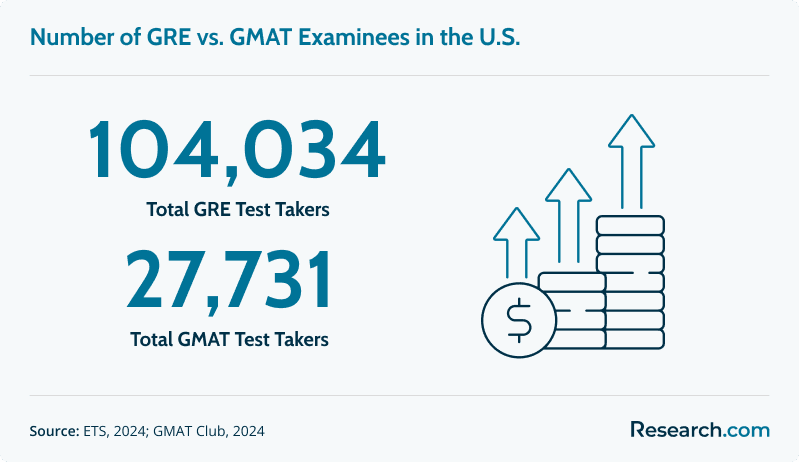
- In the United States, approximately 104,000 test-takers took the GRE, while about 27,700 chose the GMAT in 2024.
- What is the GMAT?
- What is the GRE?
- How do the eligibility requirements for the GMAT and GRE differ?
- How do the GMAT and GRE test structures and formats differ?
- How is the GMAT scored compared to the GRE?
- What are the costs associated with taking the GMAT vs. the GRE?
- How long are GMAT and GRE scores valid?
- How do standardized test scores influence access to affordable online MBA programs?
- What unique challenges do non-traditional applicants encounter when taking the GMAT or GRE?
- Can standardized test scores unlock opportunities beyond business school?
- How do standardized test scores influence long-term career earnings?
- How can standardized test scores open opportunities for advanced degree programs beyond the MBA?
- What are the differences in GMAT vs GRE retake policies?
- What are the best strategies for preparing for the GMAT or GRE test?
- What should you consider when choosing between the GMAT and GRE for business school?
GMAT vs. GRE at a Glance
| Factor | GMAT | GRE | What it means for MBA applicants |
| Primary use | Graduate management admissions | Broad graduate admissions, including business school | The GMAT is more business-focused; the GRE gives applicants more flexibility across disciplines. |
| Business school acceptance | Approximately 2,400 business schools | About 1,300 business schools | Both are accepted by many MBA programs, but applicants should verify each target school’s current policy. |
| Score format | Total score from 205–805 | Verbal and quantitative scores from 130–170 each, plus writing from 0–6 | The GMAT gives schools one combined score; the GRE shows strengths and weaknesses by section. |
| Test length | 2 hours and 15 minutes | About 1 hour and 58 minutes | The GRE is slightly shorter, but pacing and question style matter more than total length. |
| Cost | $275 at a test center and $300 online | $220 in most countries, including the U.S. | The GRE has a lower base fee, but total cost depends on rescheduling, retakes, and score reports. |
| Best fit | Applicants focused on MBA or business master’s programs | Applicants considering MBA and non-business graduate options | Your target degree plans should guide the decision. |
What is the GMAT?
The Graduate Management Admission Test, or GMAT, is a standardized computer-based exam created for graduate business and management admissions. It is administered by the Graduate Management Admission Council (GMAC) and is commonly used by MBA programs to evaluate reasoning, quantitative problem-solving, verbal analysis, and data interpretation skills.
The GMAT is most useful for applicants who want to demonstrate readiness for business school coursework, especially programs with a strong emphasis on analytics, finance, consulting, operations, strategy, or data-driven management. It can be especially relevant for applicants applying to MBA pathways such as accelerated MBA programs, specialized business master’s degrees, or competitive graduate management programs.
Who usually takes the GMAT?
- MBA applicants: Candidates applying to full-time, part-time, executive, online, or accelerated MBA programs often choose the GMAT because it was designed specifically for management education.
- International business school candidates: Applicants applying across countries may use the GMAT because it is widely recognized by business schools worldwide.
- Early-career professionals: Workers with several years of experience may use a strong GMAT score to support an application that also includes employment history, essays, recommendations, and undergraduate performance.
- Undergraduate students planning ahead: Some students take the GMAT before leaving college so they have a valid score available for future business school applications.
- Career changers: Applicants from engineering, humanities, science, healthcare, public service, or other non-business fields may use the GMAT to show academic readiness for management training.
What is the GRE?
The Graduate Record Examination, or GRE, is a standardized graduate admissions test administered by the Educational Testing Service (ETS). Unlike the GMAT, which is built around business school admissions, the GRE is used across many graduate disciplines. Many MBA programs accept it, making it a flexible option for applicants who are considering business school but also want to keep other master’s, doctoral, or professional degree options open.
The GRE evaluates verbal reasoning, quantitative reasoning, and analytical writing. Because it is accepted by a broad range of graduate programs, it may be a better choice for applicants applying to both MBA programs and other graduate routes, including accelerated options such as 1 year masters degree programs.
Who usually takes the GRE?
- Graduate school applicants across disciplines: Students applying to master’s or doctoral programs in fields outside business often take the GRE.
- MBA applicants who want flexibility: Candidates applying to business school and non-business graduate programs may prefer one test that can support multiple application types.
- Some law school candidates: Certain law schools accept GRE scores as an alternative to the LSAT.
- International applicants: Students applying to graduate programs in the U.S., Europe, and other regions may use the GRE to satisfy admissions requirements.
- Working professionals returning to school: The GRE can serve applicants who are advancing in their current field or moving into a new discipline.
How do the eligibility requirements for the GMAT and GRE differ?
The GMAT and GRE are both widely accessible exams, and neither requires applicants to already be admitted to a graduate program. The biggest eligibility differences are not usually about who may sit for the exam; they are about which schools accept the score, what degree the applicant is pursuing, and whether the score supports the applicant’s admissions strategy.
GMAT eligibility requirements
- Age requirement: Test-takers must be at least 18 years old. Candidates ages 13 to 17 may take the exam with written consent from a parent or guardian. There is no upper age limit.
- Educational background: The exam itself does not require a completed bachelor’s degree, but MBA programs generally expect applicants to hold an undergraduate degree from a recognized institution.
- Work experience: The GMAT does not require employment history. However, many competitive MBA programs value full-time professional experience, and applicants with 2–3 years of full-time work experience are often more competitive.
- Identification requirements: Test-takers must meet official identification rules. Applicants whose first language is not English may also need IELTS or TOEFL scores if required by the school.
GRE eligibility requirements
- Age requirement: Candidates must generally be at least 18 years old. Those ages 13 to 17 may test with written permission from a parent or guardian.
- Educational background: There is no formal degree prerequisite to register for the GRE. Still, most graduate programs, including MBA programs, require a bachelor’s degree from an accredited institution. Some students use fast online degrees as a way to complete undergraduate study before applying to graduate school.
- Professional experience: ETS does not require work experience to take the GRE. Individual MBA programs may still expect or prefer professional experience.
- Identification requirements: Candidates must present valid identification, usually a government-issued ID, when testing.
If you are weighing graduate school while balancing work, family, or a career change, the exam choice should fit your broader academic plan. Applicants exploring education-related paths, for example, may also find it useful to review whether they can earn a teaching degree online while comparing testing and program requirements.
How do the GMAT and GRE test structures and formats differ?
The GMAT is built around business school skills and uses a section-adaptive structure. The GRE is a broader graduate admissions exam that evaluates verbal, quantitative, and writing ability. The GMAT places more emphasis on data interpretation and business-relevant reasoning, while the GRE may feel more familiar to applicants who are comfortable with vocabulary, reading comprehension, and general quantitative reasoning.
| Exam feature | GMAT | GRE |
| Main sections | Quantitative Reasoning, Verbal Reasoning, Data Insights | Analytical Writing, Verbal Reasoning, Quantitative Reasoning |
| Total test time | 2 hours and 15 minutes | Approximately 1 hour and 58 minutes |
| Breaks | Optional 10-minute break | No optional break, but a 10-minute break is provided after the third section |
| Adaptivity | Section-adaptive | Sections are independent; difficulty does not change based on previous responses |
| Calculator use | Not permitted in the Quantitative Reasoning section | Quantitative section includes GRE-style calculator access |
GMAT test structure and format
The GMAT is a computer-adaptive exam for business school applicants. It includes three scored sections:
- Quantitative Reasoning: This section lasts 45 minutes and includes 21 questions. It tests mathematical reasoning, problem-solving, and the ability to work through quantitative information without a calculator.
- Verbal Reasoning: This section lasts 45 minutes and includes 23 questions. It measures reading comprehension, critical reasoning, and the ability to evaluate written arguments.
- Data Insights: This section lasts 45 minutes and includes 20 questions. Introduced in 2023, it evaluates how well test-takers interpret tables, graphics, multi-source information, and data-based scenarios.
The GMAT allows candidates to select the order in which they complete sections, which can help with pacing and energy management. Applicants comparing business graduate options should also consider how much quantitative and analytical coursework their preferred programs require. If you are still evaluating whether business school is the right next step, Research.com’s broader graduate guides, including this comparison of other graduate credential paths, can help you think through alternatives.
GRE test structure and format
The GRE General Test is used for many graduate admissions contexts, including some MBA applications. It includes the following components:
- Analytical Writing: This 30-minute section includes one “Analyze an Issue” writing task. It evaluates the ability to build and communicate a clear argument.
- Verbal Reasoning: The verbal portion has two sections. The first contains 12 questions and the second contains 15 questions, with 41 minutes total. It tests reading comprehension, text completion, and sentence equivalence.
- Quantitative Reasoning: The quantitative portion also has two sections. The first includes 12 questions and the second includes 15 questions, with 47 minutes total. It covers arithmetic, algebra, geometry, and data analysis.
The GRE may appeal to applicants who want a shorter test, prefer separate section scores, or plan to apply to graduate programs outside business. However, MBA applicants should not assume the GRE is automatically easier; the better test is the one that fits their skill profile and target school expectations.
How is the GMAT scored compared to the GRE?
The GMAT and GRE use different scoring systems, which can affect how admissions committees interpret results. The GMAT produces one total score from 205 to 805, while the GRE reports separate Verbal Reasoning and Quantitative Reasoning scores from 130 to 170 and an Analytical Writing score from 0 to 6. This means GMAT performance is presented as a combined business school admissions score, while GRE performance gives schools a more section-by-section view.
| Scoring area | GMAT score range | GRE score range |
| Total score | 205–805 | No single total score in the same format |
| Quantitative | 60 to 90 | 130 to 170 |
| Verbal | 60 to 90 | 130 to 170 |
| Data or writing component | Data Insights: 60 to 90 | Analytical Writing: 0 to 6 |
GMAT scoring breakdown
The GMAT combines performance from three sections into a total score. Each section also gives admissions teams a view of specific academic abilities:
- Quantitative Reasoning: Scores range from 60 to 90 and reflect mathematical reasoning and problem-solving ability.
- Verbal Reasoning: Scores range from 60 to 90 and show performance in reading comprehension, critical reasoning, and written argument analysis.
- Data Insights: Scores range from 60 to 90 and measure the ability to interpret, evaluate, and apply data in multiple formats.
GRE scoring breakdown
The GRE separates scores by skill area, which can help applicants highlight uneven strengths. For example, an applicant with exceptional verbal ability and solid quantitative ability may prefer a score report that displays both separately.
- Verbal Reasoning: Scores range from 130 to 170 and measure the ability to understand, analyze, and synthesize written material.
- Quantitative Reasoning: Scores range from 130 to 170 and evaluate mathematical problem-solving using core quantitative concepts.
- Analytical Writing: Scores range from 0 to 6 and assess how clearly a test-taker can analyze an issue and express a structured argument.
What are the costs associated with taking the GMAT vs. the GRE?
The GRE has a lower base registration cost than the GMAT, but applicants should compare total expenses rather than only the first test fee. Retakes, rescheduling, extra score reports, preparation materials, and application timelines can change the real cost of either exam.
| Cost category | GMAT | GRE |
| Standard registration | $275 at a test center; $300 online | $220 in most countries, including the U.S. |
| Additional score reports | $35 per recipient beyond the initial five | $35 per additional score report |
| Rescheduling | $55 if more than 60 days before the test; $110 if 15–60 days before; $165 within 14 days of the test | $50 |
| Cancellation | Refunds range from $55 to $120 depending on timing | 50% refund if canceled at least 4 days before the scheduled exam date |
| Fee reduction | Not listed here | Eligible test-takers can pay $100 for the GRE General Test and receive free test preparation materials valued at $110 |
How to control testing costs
- Take a full diagnostic exam before registering so you do not waste an official attempt before you are ready.
- Check whether your target schools offer test waivers before paying for an exam.
- Register only after confirming deadlines, score reporting rules, and test availability.
- Build retake time into your plan so you do not pay premium rescheduling fees near application deadlines.
- Use official free materials first, then decide whether paid prep is necessary.
How long are GMAT and GRE scores valid?
GMAT and GRE scores are both valid for five years from the test date. The main difference is reportability. GMAT scores can be reported for up to 10 years, though scores older than five years may not meet the admissions policies of many programs. Applicants should not assume an older score will be accepted without checking directly with each school.
GRE scores are reportable only during the five-year validity period. After that period ends, ETS no longer permits score reporting, so applicants who need a GRE score after expiration must retake the test. Because schools may set their own rules, applicants should confirm whether the score must be valid on the application deadline, interview date, admission date, or enrollment date.
When should you take the GMAT or GRE?
- If you are applying this year: Take the exam early enough to allow one retake before the application deadline.
- If you are still in college: Consider testing when math and academic reading skills are still fresh, but make sure the five-year window fits your MBA timeline.
- If you are a working professional: Plan around busy work seasons, travel, and family obligations so preparation is realistic.
- If you may apply to multiple degree types: The GRE may offer more future flexibility because it is used across many graduate fields.
How do standardized test scores influence access to affordable online MBA programs?
Affordable online MBA programs often review GMAT or GRE scores as one part of a broader admissions file. A score can help demonstrate quantitative reasoning, verbal analysis, and readiness for graduate-level coursework, especially for applicants whose undergraduate GPA, major, or work history does not fully show business school preparation. However, online MBA admissions are usually holistic, so test scores are considered alongside professional experience, transcripts, essays, recommendations, and sometimes interviews.
Applicants comparing cost-conscious options should review whether each program requires, accepts, waives, or ignores standardized tests. A strong GMAT or GRE result may also support scholarship consideration at some schools, but it does not guarantee admission or funding. If affordability is a priority, compare test policies while researching affordable online MBA programs, tuition, fees, employer reimbursement, transfer credit policies, and financial aid options.
What unique challenges do non-traditional applicants encounter when taking the GMAT or GRE?
Non-traditional applicants often have different testing barriers than full-time students. Working professionals may have limited study time. Career changers may need to rebuild math or academic reading skills. International applicants may face language, testing-center, documentation, or time-zone challenges. Parents and caregivers may need a longer preparation calendar because uninterrupted study blocks are harder to schedule.
The best approach is to choose the exam that minimizes friction while still meeting admissions goals. A healthcare professional exploring management roles, for example, might compare test expectations across flexible online MBA formats, including options such as affordable online MBA healthcare management programs. The right exam is the one that supports the applicant’s target programs without creating unnecessary cost, time, or scheduling pressure.
Practical tips for non-traditional test-takers
- Start with one official practice GMAT and one official practice GRE before committing.
- Use short daily study blocks if long study sessions are unrealistic.
- Prioritize weak areas that are most likely to affect admissions competitiveness.
- Ask admissions offices whether test waivers are available for applicants with strong work experience or prior graduate coursework.
- Schedule the exam during a lower-stress period at work or home.
Can standardized test scores unlock opportunities beyond business school?
GMAT and GRE scores are primarily admissions tools, but strong scores can also strengthen a broader academic profile. The GRE, in particular, may support applications outside business school because it is accepted across many graduate disciplines. The GMAT is more specialized, but it can still demonstrate analytical and quantitative readiness for management-focused graduate study.
Applicants considering degrees beyond the MBA should verify each program’s testing policy rather than assuming a score will help. Some professional and doctoral programs may not require the GMAT or GRE at all, while others may consider them as part of a holistic review. Students comparing healthcare, pharmacy, and clinical management pathways can review examples such as online Pharm D programs to see how admissions requirements vary by field and institution.
How do standardized test scores influence long-term career earnings?
GMAT or GRE scores do not directly determine long-term earnings. Employers typically place more weight on degree quality, work experience, leadership ability, industry, location, internships, networking, and job performance. However, a strong test score can indirectly affect career outcomes if it helps an applicant gain admission to a stronger-fit program, qualify for scholarships, or access recruiting pipelines that align with high-value career goals.
Applicants should be cautious about treating test scores as a salary predictor. A score may support admission, but the return on investment depends on the total cost of the degree, career target, opportunity cost, and employment outcomes. Students comparing earning potential across fields may also want to examine resources such as high-earning medical bachelor’s degree paths to understand how education choices, not test scores alone, relate to compensation.
How can standardized test scores open opportunities for advanced degree programs beyond the MBA?
A strong standardized test score can help some applicants show readiness for advanced academic work, especially when applying to competitive, quantitative, research-oriented, or management-focused programs. The GRE generally has broader utility beyond business school, while the GMAT is more closely associated with graduate management education.
Applicants should match the exam to the degree path. If you are applying only to MBA programs, the GMAT may be the more direct signal. If you are also considering healthcare administration, public policy, psychology, education, research, or doctoral programs, the GRE may be more versatile. For example, students exploring healthcare-related professional pathways can compare admissions requirements for options such as the most affordable online Doctor of Pharmacy programs before deciding whether a standardized test is useful or required.
What are the differences between GMAT vs. GRE retake policies?
Retake rules matter because many applicants improve after a first official attempt. The GMAT requires at least 16 days between attempts, whether the exam is taken online or at a test center. Candidates may take the GMAT up to five times within a rolling 12-month period, with a lifetime maximum of eight attempts. If a test-taker earns a perfect total score of 805, they must wait five years before testing again.
The GRE allows test-takers to sit for the exam once every 21 days, up to five times within any continuous 12-month period. Unlike the GMAT, the GRE has no lifetime attempt limit. Canceled GRE scores still count toward the annual limit, so applicants should avoid using official tests as casual practice.
| Retake rule | GMAT | GRE |
| Minimum wait between attempts | 16 days | 21 days |
| Maximum attempts in 12 months | Five times within a rolling 12-month period | Up to five times within any continuous 12-month period |
| Lifetime limit | Eight attempts | No lifetime limit |
| Special rule for perfect score | Perfect total score of 805 requires a five-year wait before retesting | No comparable lifetime limit stated here |
What are the best strategies for preparing for the GMAT or GRE test?
Strong preparation starts with choosing the right exam, not buying the most expensive prep course. Before committing, take one timed practice GMAT and one timed practice GRE under realistic conditions. Compare your percentile competitiveness, comfort level, pacing, and the amount of improvement needed for your target schools.
1. Use diagnostic tests before choosing an exam
A diagnostic test shows whether your instincts match your actual performance. Some applicants assume they are “better at math” but perform better on GRE Quantitative Reasoning. Others expect the GRE to be easier but struggle with vocabulary-heavy verbal questions. Use data from practice tests to make the decision.
2. Build a study plan around your weakest high-impact areas
Do not study every topic equally. If a specific question type is consistently lowering your score, give it priority. GMAT applicants often need focused work on data interpretation, timing, and quantitative reasoning without a calculator. GRE applicants may need more work on vocabulary, reading precision, writing structure, or quantitative fundamentals.
3. Choose a prep format that fits your schedule
Self-study works well for disciplined learners with clear weaknesses and enough time. Online courses can help applicants who need structure but want flexibility. Tutoring may be useful for test-takers who have plateaued, have a compressed timeline, or need help diagnosing repeated mistakes. The best prep method is the one you will actually follow consistently.
4. Practice under official timing rules
Untimed practice can build accuracy, but it does not prepare you for test-day pressure. Add timed section practice early enough to learn pacing. Track not only wrong answers, but also questions that took too long, questions guessed correctly, and errors caused by rushing.
5. Review mistakes in a structured way
After each practice set, label mistakes by cause: content gap, misread question, calculation error, timing issue, or strategy problem. This turns practice into improvement. Without review, more questions do not necessarily produce a higher score.
6. Align preparation with your broader graduate goals
If you may pursue non-business graduate study, choose an exam that keeps options open. For example, applicants considering psychology doctoral study may want to understand how to get a PhD in psychology before deciding whether the GRE is more useful than the GMAT.
| Common mistake | Why it hurts applicants | Better approach |
| Choosing the test based on rumors | “Easier” depends on the individual test-taker and target program. | Take a timed practice test for both exams and compare results. |
| Looking only at registration cost | Retakes, prep, score reports, and rescheduling can raise the total expense. | Estimate the full cost before registering. |
| Ignoring school-specific policies | Some programs may prefer, require, waive, or de-emphasize scores. | Check each target school’s admissions page and ask admissions staff if needed. |
| Testing too close to deadlines | There may be no time for a retake or score reporting delay. | Schedule the first official attempt early enough to retest. |
| Assuming a high score guarantees admission | MBA admissions also consider work experience, essays, recommendations, and fit. | Use the score to strengthen, not replace, the rest of the application. |
What should you consider when choosing between the GMAT vs. GRE for business school?
The best exam for MBA admissions depends on how your target schools evaluate scores, which test better matches your strengths, and whether you want flexibility beyond business school. A practical decision should include admissions fit, score potential, preparation time, cost, retake flexibility, and scholarship strategy.
Use this decision framework
| Choose the GMAT if... | Choose the GRE if... |
| You are applying mainly to MBA or graduate business programs. | You are applying to both business and non-business graduate programs. |
| Your target schools appear to value GMAT scores strongly. | Your target schools state that they accept the GRE equally. |
| You perform well on data interpretation, quantitative reasoning, and business-style logic questions. | You perform well on reading comprehension, vocabulary, and general quantitative reasoning. |
| You want a single total score that is familiar in MBA admissions. | You want separate verbal and quantitative scores that may better show your strengths. |
| You are targeting programs, industries, or scholarships where GMAT performance may be especially visible. | You want broader graduate school portability from one exam. |
Important factors to review before registering
- Program requirements: Some business schools and many online MBA programs accept either test, while others may prefer one or offer test waivers. Always confirm policies directly with each program.
- Score competitiveness: Look for admitted student score ranges when available. Your goal is not just to submit a score; it is to submit a score that strengthens your application.
- Preparation timeline: If one exam requires far more study time than the other, the more efficient option may be better.
- Long-term academic plans: The GRE may be more useful if you are also considering non-business graduate programs.
- Employer and industry expectations: Some MBA recruiting environments may be more familiar with GMAT scores, though employers usually evaluate the full candidate rather than the test score alone.
- Scholarship and financial aid strategy: Some schools may consider standardized test scores in merit aid decisions. Applicants should also research broader affordability resources, including the best online colleges that accept FAFSA, when planning how to pay for school.
- Doctoral or executive education plans: If you are comparing future advanced business or education leadership degrees, review requirements early. A guide to DBA vs. EdD degree paths can help clarify how future goals may affect today’s testing choice.
Questions to ask admissions offices
- Do you accept the GMAT and GRE equally for MBA admissions?
- Do admitted student score ranges differ for GMAT and GRE applicants?
- Are test waivers available, and what qualifies an applicant?
- Are standardized test scores considered for scholarships?
- Do online, part-time, executive, and full-time MBA formats use the same testing policy?
- If I submit both scores, how will the admissions committee evaluate them?
Here’s What MBA Graduates Have to Say About Taking the GMAT vs. GRE
-
: "
Preparing for the GMAT was demanding, but it strengthened the analytical habits I use in my MBA classes. The quantitative and data-focused sections gave me useful practice for the kind of business problems we discuss every week. — Manuel
"
-
: "
I selected the GRE because I was applying to business and non-business programs. Its verbal section matched my strengths in reading and language, and that made the application process feel more flexible. — Jeva
"
-
: "
Trying practice materials for both exams helped me understand my own test-taking style. The GMAT felt more intense for timing and structure, while the GRE was a better personal fit. Either test can work if it supports your school list and strengths. — Alex
"
Key Insights
- The GMAT is usually the more business-specific exam, while the GRE is the more flexible graduate admissions exam.
- Approximately 2,400 business schools accept the GMAT, compared with about 1,300 that accept the GRE for MBA admissions.
- The GMAT costs $275 at test centers and $300 online. The GRE costs $220, with a fee reduction program lowering the GRE General Test to $100 for eligible test-takers.
- Both score types are valid for five years. GMAT scores can be reported for up to 10 years, while GRE scores are reportable only within the five-year validity period.
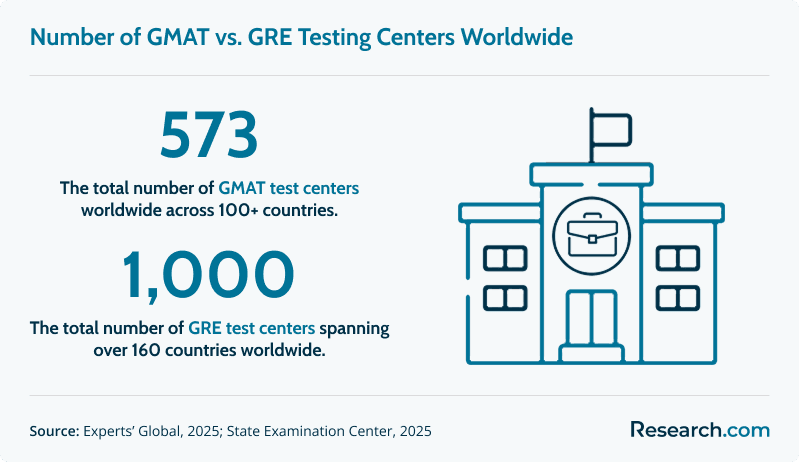
- The GRE has significantly more testing centers worldwide, with approximately 1,000 centers across over 160 countries, compared to 573 GMAT centers in 100+ countries.
- The GRE takes about 1 hour and 58 minutes, while the GMAT takes 2 hours and 15 minutes.
- GMAT candidates can test up to 5 times per year with a lifetime limit of 8 attempts. GRE candidates can retake the exam every 21 days up to 5 times annually with no lifetime limit.
- The right test is the one that best supports your target schools, score potential, timeline, budget, and graduate school backup plans.
References:
- CGSM. (2022, November 5). Preparing for the GMAT and GRE: Which exam is right for you? Retrieved from CGSM.
- CGSM. (2022, December 10). GMAT vs GRE: Differences, how scores are used, and the trend. Retrieved from CGSM.
- Clear Admit. (n.d.). MBA programs that don’t require GMAT, GRE, or EA test scores. Retrieved from Clear Admit.
- e-GMAT. (n.d.). Importance of GMAT for securing scholarships. Retrieved from e-GMAT.
- Experts Global. (n.d.). GMAT test centers. Retrieved from Experts Global.
- GeeksforGeeks. (2024, July 10). GMAT vs GRE 2024: What are the key differences. Retrieved from GeeksforGeeks.
- GMAT Club. (n.d.). Advantage of higher GMAT. Retrieved from GMAT Club.
- GMAT Club. (n.d.). Should I submit only my GRE or both my GRE and GMAT? Retrieved from GMAT Club.
- GMAT Club. (2023, August 18). GMAT vs GRE: The B-School applications. Retrieved from GMAT Club.
- GMAT Ninja. (2023, July 19). GRE vs. GMAT, Part I: MBA admissions. Retrieved from GMAT Ninja.
- Investopedia. (2015, March 11). GRE vs. GMAT: What's the difference? Retrieved from Investopedia.
- Magoosh. (n.d.). Average GMAT scores. Retrieved from Magoosh.
- MBA.com. (2024, October). GMAT vs. GRE: Which admissions exam is more popular? Graduate Management Admission Council. Retrieved from MBA.com.
- MBA.com. (n.d.). GMAT vs GRE. Retrieved from MBA.com.
- QuestBridge. (2024, February 22). Standardized testing guide: Graduate School Match: MBA. Retrieved from asset.questbridge.org.
- Smart with a Heart. (2024, January 12). Applying to MBA programs? Retrieved from smartwithaheart.org.
- State Employment Service of Azerbaijan Republic (dim.gov.az). (n.d.). GRE. Retrieved from dim.gov.az.
- TopMBA.com. (2023, November 22). GMAT or GRE for MBA admission: How to decide. Retrieved from TopMBA.com.
- Wharton Executive MBA. (2023, October 30). Differences between the GMAT, GRE, & EA for Executive MBA. Retrieved from Wharton Executive MBA.
Other Things You Should Know About the GMAT vs. GRE
Neither the GMAT nor the GRE is universally considered easier for MBA applications in 2027. The perceived difficulty varies depending on individual strengths. The GMAT may favor those with stronger quantitative skills, while the GRE may be more suited for those with strong verbal and analytical writing skills.
Higher GMAT or GRE scores can enhance scholarship prospects, as many business schools in 2027 consider these scores as part of their scholarship criteria. Strong scores indicate academic potential and can set applicants apart in competitive scholarship evaluations.
In 2027, the GMAT focuses primarily on analytical and quantitative skills, whereas the GRE covers a broader range, including vocabulary and analytical writing. MBA programs typically accept both, but some may prefer the GMAT due to its business-specific focus. --- **Question** Is one test considered easier between the GMAT and GRE for 2027 MBA applications? **Answer** In 2027, the perception of difficulty between the GMAT and GRE varies by individual. The GMAT is often seen as more challenging for quantitative sections, while the GRE might be tougher for those weaker in verbal reasoning. Your skills in these areas will influence which feels easier. --- **Question** Do higher GMAT or GRE scores increase scholarship opportunities for those applying to business schools in 2027? **Answer** Yes, in 2027, higher GMAT or GRE scores can bolster scholarship opportunities for MBA applicants. Many business schools use these scores among the criteria to assess merit and award scholarships, enhancing an applicant's financial aid prospects. --- **Question** Which entrance exam should I take for an MBA in 2027 if I am not from a quantitative background? **Answer** If you're aiming for an MBA in 2027 and lack a quantitative background, the GRE might be more suitable. It generally provides a broader assessment and may be perceived as less daunting in terms of quantitative demands compared to the GMAT.


