
2027 How to Get a PhD in Psychology

Co-Founder and Chief Data Scientist
Choosing whether to pursue a PhD in Psychology is not just an academic decision. It affects how long you will study, whether you can become licensed, what type of research or clinical work you can do, how much debt you may take on, and which career doors will realistically open after graduation.
This guide is for prospective doctoral students comparing psychology PhD programs in the United States, including students interested in clinical practice, research, academia, consulting, school psychology, military psychology, organizational psychology, or interdisciplinary work. You will learn what a psychology PhD involves, how admissions and training usually work, what licensing requires, how funding can reduce costs, what salaries and job outlook data show, and how to evaluate whether a program is reputable and worth the commitment.
Quick answer: Is a PhD in Psychology worth it?
A PhD in Psychology can be worth it if your goal requires doctoral-level research training, independent clinical practice, university teaching, advanced assessment work, policy research, consulting, or leadership in a specialized psychology field. It is usually not the fastest route into counseling or mental health support roles, and it may not be necessary for students whose goals can be met with a master’s degree, counseling license, social work license, or a PsyD.
The strongest candidates are students who are prepared for years of graduate study, research, statistics, writing, supervised training, and a dissertation. The best programs provide strong mentorship, transparent funding, accredited training where required, and career outcomes that match your goals.
What are the main benefits of earning a PhD in Psychology?
- Broader access to advanced roles: A psychology PhD can qualify graduates for specialized work as professors, researchers, clinical psychologists, industrial-organizational consultants, forensic psychology professionals, school psychology specialists, military psychologists, and applied behavioral science experts.
- Higher earning potential in some roles: Professionals with doctoral psychology training often move into positions with more responsibility. Depending on specialization and setting, earnings are often described as ranging from $80,000 to $150,000 or more annually, although actual salaries vary by role, employer, location, licensure status, and experience.
- Deep research and analytical preparation: A PhD is built around evidence, methodology, data analysis, theory, and original inquiry. This makes it valuable for students who want to generate new knowledge rather than only apply existing interventions.
- Flexible study formats in some programs: Online and hybrid doctoral options can help some students continue working or manage family responsibilities, although clinical and counseling pathways still usually require substantial in-person supervised training.
What should you expect from a PhD in Psychology?
A PhD in Psychology is a research-intensive doctoral degree centered on psychological theory, scientific methods, statistics, ethics, specialization coursework, and original scholarship. Students typically complete advanced seminars, work with faculty on research, develop an independent research agenda, and produce a dissertation that must be defended before a committee.
Depending on the program, students may also teach undergraduate courses, assist with faculty research, publish papers, present at conferences, complete practicum placements, and build supervised clinical experience. Clinical, counseling, and school psychology tracks generally include more applied training than experimental, cognitive, social, developmental, or industrial-organizational psychology tracks.
| Program component | What it usually involves | Why it matters |
| Doctoral coursework | Advanced study in psychology, research design, statistics, ethics, and specialization topics | Builds the theoretical and methodological foundation needed for doctoral-level work |
| Research training | Lab work, research assistantships, study design, data collection, analysis, and publication preparation | Prepares students for dissertations, academic careers, policy research, and evidence-based practice |
| Dissertation | An original research project reviewed and defended before a faculty committee | Demonstrates independent scholarly ability and is central to earning the PhD |
| Teaching or mentoring | Teaching assistantships, guest lectures, grading, supervision of undergraduates, or course instruction | Supports academic career preparation and strengthens communication skills |
| Clinical practicum or internship | Supervised applied experience, especially in clinical, counseling, and school psychology programs | Often essential for licensure preparation and professional competence |
Where can you work with a PhD in Psychology?
Psychology PhD graduates work in universities, research centers, hospitals, private practices, schools, government agencies, nonprofits, correctional settings, consulting firms, technology companies, and corporate human resources or organizational development departments. The right setting depends heavily on your specialization and whether you complete the licensure steps required for independent practice.
| Work setting | Common roles | Best fit for students interested in |
| Universities and colleges | Professor, lecturer, principal investigator, research mentor | Teaching, publishing, grants, and academic research |
| Hospitals and clinics | Clinical psychologist, assessment specialist, treatment team member | Diagnosis, therapy, testing, and integrated healthcare |
| Private practice | Licensed psychologist, evaluator, consultant | Independent clinical work and specialized services |
| Business and industry | Industrial-organizational psychologist, talent consultant, organizational development consultant | Workplace behavior, leadership, employee assessment, and performance |
| Government, military, and nonprofits | Research psychologist, military psychologist, program evaluator, policy analyst | Public service, population health, military readiness, advocacy, and applied research |
| Legal and forensic settings | Forensic evaluator, expert consultant, correctional psychologist | Assessment, courts, public safety, and justice-related behavioral science |
How much can you make with a PhD in Psychology?
Earnings for psychology PhD graduates vary widely because “psychologist” covers many roles. Salary is shaped by specialization, licensure, work setting, location, years of experience, faculty rank, private practice volume, and whether the role is clinical, research-focused, academic, corporate, or government-based.
Common salary estimates discussed for psychology PhD careers include academic and research positions ranging from $70,000 to $100,000+, clinical psychologists in private practice or hospitals earning $80,000 to $150,000+, industrial-organizational psychologists earning $90,000 to $180,000+, and forensic and school psychologists earning $70,000 to $120,000. These figures should be treated as broad estimates, not guarantees.
- How do you become a psychology PhD student for 2027?
- What education do you need before a PhD in Psychology?
- What skills do psychology PhD students and graduates need?
- How does licensing work after a psychology PhD?
- What ethical and legal rules apply to doctoral-level psychologists?
- How can psychology PhD students pay for the degree?
- What salary can you expect with a PhD in Psychology?
- How do you choose a reputable psychology PhD program?
- What is the job market like for psychology PhD graduates?
- How can you get strong clinical training during a psychology PhD?
- How should you judge a program’s credibility and impact?
- Can online or hybrid doctoral study expand your options?
- What specializations and career paths can a psychology PhD lead to?
- Can interdisciplinary training strengthen your doctoral experience?
- What challenges should you prepare for before starting?
How do you become a psychology PhD student for 2027?
Becoming a psychology PhD student requires more than completing prerequisite classes. Competitive applicants usually demonstrate academic strength, research readiness, a clear fit with faculty interests, and a realistic understanding of doctoral training.
- Earn a bachelor’s degree: Many students major in psychology, but programs may also consider applicants from related fields if they have the necessary psychology, statistics, and research background.
- Build research experience early: Work in a faculty lab, complete an honors thesis, assist with data collection, present posters, or contribute to manuscripts when possible. Research fit is often central in PhD admissions.
- Consider whether a master’s degree is useful: Some programs admit students directly from a bachelor’s degree, while others prefer or require graduate preparation. Students who need additional academic preparation may compare options such as the cheapest Masters in Psychology programs before applying.
- Identify faculty mentors, not just schools: A strong application should explain why your research interests align with specific faculty members and resources.
- Prepare application materials: Programs may request transcripts, recommendation letters, a statement of purpose, a writing sample, a CV, and GRE scores if required.
- Complete doctoral coursework and milestones: After admission, students move through classes, exams, research projects, teaching or assistantship duties, and dissertation preparation.
- Finish and defend the dissertation: The dissertation is the central scholarly project of the PhD and must be approved by a committee.
- Complete internship requirements if pursuing clinical or counseling practice: Students in clinical or counseling psychology typically need supervised internship training for licensure preparation.
From 2019 to 2023, the share of adults aged 18 and older in the United States who received mental health treatment increased each year: 19.2% in 2019, 20.3% in 2020, 21.6% in 2021, 23.4% in 2022, and 23.9% in 2023.
The pattern in the graph below shows steady growth in adult mental health treatment over the five-year period, with the largest increase occurring between 2021 and 2022. For prospective doctoral students, this trend helps explain why mental health services, assessment, research, and workforce preparation remain important topics in psychology.
What education do you need before a PhD in Psychology?
The educational path into a psychology PhD varies by program, but most applicants need evidence that they can handle advanced research, statistics, writing, and theory. A psychology major is helpful, but it is not the only possible route.
| Requirement | What programs may look for | How to strengthen your preparation |
| Bachelor’s degree | A completed undergraduate degree, often in psychology or a related discipline | Take core psychology courses and maintain a strong academic record |
| Statistics and research methods | Evidence that you can understand data, design studies, and evaluate evidence | Complete research methods, statistics, and lab-based courses |
| Research experience | Faculty-supervised research, lab work, thesis experience, or conference presentations | Join a research lab, assist with studies, and ask mentors for feedback on your fit |
| Master’s degree | Required by some programs and optional or embedded in others | Use a master’s program strategically if you need stronger grades, research experience, or specialization |
| Doctoral admission materials | Statement of purpose, recommendations, transcripts, CV, and test scores if required | Show clear research goals and explain why specific faculty are a strong match |
Students comparing delivery formats should look closely at academic quality, supervision, and licensing alignment. An online doctorate in psychology may provide flexibility, but students pursuing clinical or counseling licensure should verify in-person training expectations before enrolling.
What skills do psychology PhD students and graduates need?
Doctoral training develops technical, scientific, ethical, and interpersonal abilities. The exact mix depends on the specialization, but the following skills are central to most psychology PhD pathways.
- Research design: Creating studies that ask meaningful questions, use appropriate methods, and follow ethical standards.
- Statistical and data analysis: Working with quantitative or qualitative data, interpreting results, and recognizing limits in the evidence.
- Critical evaluation: Reading research carefully, identifying weak claims, and drawing conclusions that are supported by data.
- Academic and professional writing: Producing manuscripts, grant materials, clinical reports, literature reviews, dissertation chapters, and policy or program reports.
- Oral communication: Presenting research, teaching students, discussing cases, defending decisions, and communicating with interdisciplinary teams.
- Ethical reasoning: Applying professional standards to research, assessment, teaching, supervision, and clinical practice.
- Clinical and interpersonal skill: For practice-oriented tracks, building rapport, listening accurately, assessing risk, documenting care, and working within one’s competence.
- Project management: Managing long-term research, deadlines, supervision, assistantship duties, and dissertation progress.
How does licensing work after a psychology PhD?
A PhD in Psychology does not automatically allow someone to practice independently as a psychologist. Licensure is controlled by state or jurisdictional psychology boards, and requirements differ. Students who plan to provide clinical services should research licensing rules before choosing a program.
- Doctoral degree: Licensure generally requires a qualifying doctoral degree in psychology, often from an accredited program depending on the jurisdiction and practice area.
- Supervised experience: Most jurisdictions require supervised clinical training during the doctoral program and may require postdoctoral supervised hours.
- National examination: The Examination for Professional Practice in Psychology (EPPP) is required for licensure in most jurisdictions.
- State or jurisdictional rules: Boards may require additional exams, jurisprudence training, background checks, documentation, or specific coursework.
- Continuing education: Licensed psychologists typically need continuing education to maintain active licensure.
Before enrolling, ask the program which jurisdictions its graduates commonly pursue licensure in, whether graduates are regularly approved for internships, and how the curriculum maps to state licensing requirements.
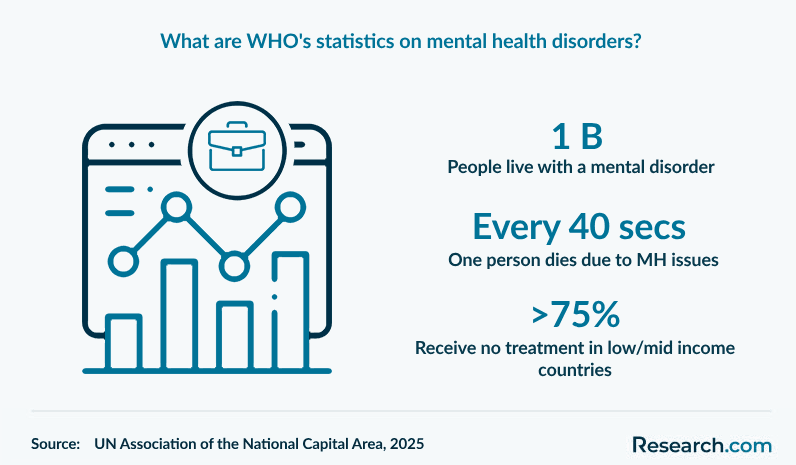
Mental health includes psychological and emotional well-being, and mental disorders remain a major contributor to disability and ill health worldwide. The World Health Organization indicates that approximately 1 billion people worldwide live with a mental disorder, and one person dies every 40 seconds because of mental health-related issues. Access remains uneven, especially in low- and middle-income countries, where more than 75% of people affected receive no treatment, as shown in the graphic below.
What ethical and legal rules apply to doctoral-level psychologists?
Psychology PhD graduates work with sensitive data, vulnerable populations, confidential records, and high-stakes decisions. Ethical conduct is therefore not optional; it is a core professional obligation in research, teaching, supervision, assessment, and clinical practice.
- Professional ethics codes: Psychologists should understand the ethical standards that apply to their role, including guidance from professional psychology organizations.
- Informed consent: Clients and research participants must understand the purpose, risks, limits, and voluntary nature of services or studies whenever consent is required.
- Confidentiality: Psychologists must protect private information while also understanding legally required exceptions.
- Competence: Professionals should provide services only in areas where they have adequate training, supervision, and experience.
- Conflicts of interest: Psychologists must avoid relationships or incentives that could impair professional judgment.
- Non-discrimination: Ethical practice requires respect for clients, students, participants, and colleagues across race, gender, disability, religion, sexual orientation, nationality, and other identities.
- Legal compliance: Psychologists must follow relevant laws related to reporting, documentation, licensure, research subjects, privacy, and professional conduct.
Students interested in the intersection of psychology, law, ethics, and regulation may also compare legal support credentials such as a paralegal certificate online ABA-approved, although this is not a substitute for psychology licensure or doctoral training.
How can psychology PhD students pay for the degree?
Funding should be one of the first issues you evaluate because doctoral study can take several years and may limit full-time employment. Strong PhD programs often provide a combination of tuition support, stipends, assistantships, or fellowships, but packages vary significantly.
| Funding source | How it works | Questions to ask before accepting |
| Research assistantship | Students support faculty research in exchange for pay, tuition support, or both | Is the assistantship guaranteed, renewable, and aligned with your research interests? |
| Teaching assistantship | Students help teach, grade, lead sections, or support undergraduate instruction | How many hours are required, and does the workload delay progress? |
| Fellowships and grants | Competitive awards may support tuition, living costs, or research expenses | Are awards internal, external, one-time, or multi-year? |
| Tuition waivers | Some programs reduce or remove tuition charges for funded doctoral students | Does the waiver cover all credits, fees, summer terms, and dissertation enrollment? |
| Loans | Federal or private borrowing can cover costs not met by aid | What will repayment look like under realistic salary expectations? |
| External funding | Government agencies, foundations, and private organizations may fund specific research areas | Does your topic, population, or method qualify for outside support? |
Assistantship experience can begin before doctoral study. For example, students in cheap online master's programs in forensic psychology may use graduate-level coursework and research exposure to strengthen later doctoral applications.
Military and related funding options
- GI Bill: Eligible service members, veterans, and dependents may use GI Bill benefits for graduate education, including psychology doctoral study.
- Yellow Ribbon Program: Participating institutions may help cover tuition costs beyond GI Bill limits.
- Military scholarships and service-linked programs: Some programs, including the Health Professions Scholarship Program (HPSP), may support advanced training with service obligations.
- National Defense Science and Engineering Graduate (NDSEG) Fellowship: This fellowship is not psychology-specific but may support doctoral work in STEM fields connected to national defense.
Students interested in data-intensive research can also build complementary skills through fields such as analytics. Reviewing the most affordable online master's programs in analytics may be useful for applicants planning work in psychometrics, behavioral data, neuropsychology, or applied research.
What salary can you expect with a PhD in Psychology?
Salary outcomes for psychology PhD graduates are not uniform. A licensed clinical psychologist, school psychologist, research scientist, industrial-organizational psychologist, university professor, and postdoctoral researcher can all have different pay patterns even though each may have doctoral-level training.
- Specialization: Some areas, such as clinical neuropsychology or organizational psychology, may offer stronger compensation than other paths.
- Experience: Earnings usually increase with professional experience, seniority, caseload, publication record, grant funding, or leadership responsibility.
- Work setting: Academic institutions, private practice, hospitals, government agencies, schools, and corporations may compensate psychologists differently.
- Location: Pay often differs by region, cost of living, and local demand.
- Degree and license level: Doctoral training can support access to roles that are not available to master’s-level graduates. For example, professionals with online forensic psychology masters degrees generally pursue different roles and salary levels than licensed doctoral psychologists.
According to data from Payscale.com (2025), the average salary for a psychologist is $110,700, while the average salary for a clinical psychologist is $95,220. School psychologists have an average salary of $71,929, and research scientists earn $89,919. Industrial-organizational psychologists earn an average of $93,000. Experimental psychologists, categorized as research scientists, earn $74,143. Clinical psychologists with a phd earn $102,035, and psychologists with a phd earn $89,000. Clinical psychologists in the USAF also earn $95,220. Postdoctoral scientists and postdoctoral researchers both have an average salary of $89,919. Counseling psychologists with a phd and organizational development consultants with a phd both earn $89,000 and $93,000, respectively. Finally, university professors of psychology earn an average of $89,000.
The graph below shows that compensation differs considerably by job title and specialization. It also shows why students should evaluate career fit rather than assuming every PhD path produces the same financial outcome.
A psychology PhD can support access to better-paid advanced roles, but the strongest salary outcomes usually depend on specialization, licensure, applied skills, work setting, and career strategy.
How do you choose a reputable psychology PhD program?
A reputable psychology PhD program should match your career goal, provide credible training, and show evidence that students complete the program and move into relevant careers. Do not choose only by school name. In psychology, mentor fit, accreditation, funding, internship outcomes, research productivity, and licensure alignment can matter more than broad institutional prestige.
| Selection factor | Why it matters | What to verify |
| Accreditation and licensure fit | Clinical, counseling, and school psychology students may need specific training for licensure | Ask whether the program meets requirements in the state where you plan to practice |
| Faculty mentor match | PhD students usually work closely with research advisors | Review recent publications, lab projects, and whether faculty are accepting students |
| Funding transparency | Funding can determine affordability and reduce reliance on loans | Request details on stipend, tuition waiver, fees, summer support, and guarantee length |
| Student outcomes | Completion, internship, licensure, and placement outcomes show whether students succeed | Ask for recent data, not just anecdotes |
| Research infrastructure | Strong labs, datasets, clinics, and partnerships improve training quality | Review grants, research centers, clinical sites, and publication opportunities |
| Format and pace | Online, hybrid, full-time, and accelerated formats serve different students | Compare whether an accelerated psychology degree or traditional path better supports your goals |
What is the job market like for psychology PhD graduates?
The job market for psychology PhD graduates is broad but uneven. Demand is influenced by mental health needs, healthcare access, school staffing, organizational consulting trends, research funding, government budgets, and competition for faculty positions.
- Mental health service demand remains important: More adults are receiving mental health treatment, which supports continued need for qualified professionals.
- Specialization changes opportunity: Clinical, counseling, school, industrial-organizational, neuropsychology, and research-focused roles each have different hiring patterns.
- Academic jobs can be competitive: Tenure-track roles often require strong publication records, teaching experience, and research fit.
- Applied research skills are valuable: Employers outside academia may value training in assessment, data analysis, behavior change, evaluation, and measurement.
- Licensure expands clinical options: Graduates who complete licensing requirements can pursue independent practice, hospitals, clinics, and assessment roles.
Some psychology PhD graduates also combine behavioral science with business, consulting, or financial decision-making. Students exploring that direction may benefit from understanding what can you do with a masters in finance when evaluating interdisciplinary career options.
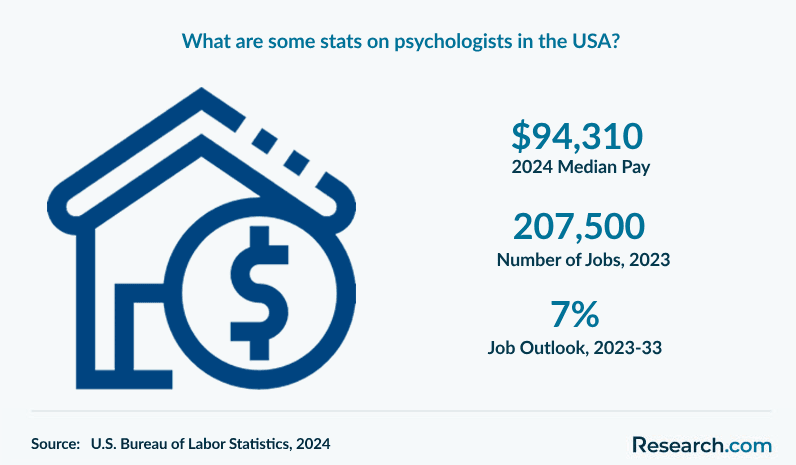
According to the U.S. Bureau of Labor Statistics (2024), the median pay for psychologists in 2024 was $94,310 per year, or $45.34 per hour. A typical entry-level education for this field varies. While no work experience in a related occupation is typically required, an internship or residency is part of the on-the-job training. In 2023, there were 207,500 jobs, and the job outlook from 2023 to 2033 is projected to grow at a rate of 7%, which is faster than the average for all occupations, resulting in an employment change of 14,000 jobs. These are shown in the graphic below.
The strongest job prospects usually come from aligning your doctoral training with a clear market: licensed clinical care, school-based services, industrial-organizational consulting, health research, data-driven behavioral science, forensic assessment, military psychology, or academic research.
How can you get strong clinical training during a psychology PhD?
If your goal is clinical practice, do not evaluate a PhD program only by coursework. You need to know where students train, who supervises them, how cases are assigned, whether the program prepares students for internship, and whether graduates become licensed in the jurisdictions that matter to you.
- Review practicum sites: Look for hospitals, university clinics, community mental health centers, schools, veterans’ services, specialty clinics, or forensic settings that match your interests.
- Ask who provides supervision: Supervision from licensed clinicians is essential for applied competence and licensure preparation.
- Compare client populations: Strong training exposes students to diverse diagnoses, age groups, cultural backgrounds, and treatment needs.
- Check internship preparation: Ask how the program helps students secure internships and how recent students performed in the match process.
- Clarify scope: A PhD in clinical or counseling psychology is different from a faster counseling credential. If speed into counseling practice is your main concern, compare alternatives such as a fast track to becoming a counselor.
How should you judge a program’s credibility and impact?
A credible psychology PhD program should provide evidence of quality. Marketing language is not enough. Look for measurable indicators: accreditation status where relevant, faculty productivity, grant activity, student publications, internship outcomes, dissertation quality, alumni placements, licensure results, and professional reputation within your specialization.
| Evidence to request | What it can reveal | Warning sign |
| Recent graduate placements | Whether alumni move into careers similar to the one you want | Only vague success stories are available |
| Faculty publications and grants | Research activity and mentorship capacity | Faculty research does not match advertised strengths |
| Licensure or internship outcomes | Clinical training effectiveness | The program cannot explain graduate licensure pathways |
| Funding details | Real affordability and financial risk | Support is uncertain, short-term, or excludes major fees |
| Curriculum and competencies | Whether training builds the skills you need | Courses are outdated or poorly aligned with your specialization |
Students interested in applied behavior analysis or evidence-based behavioral intervention may also explore affordable BCBA college programs online as a complementary or alternative credential, depending on career goals.
Can online or hybrid doctoral study expand your options?
Online and hybrid psychology programs can improve access for working adults, caregivers, military-affiliated students, and people who cannot relocate. However, flexibility should not be confused with lower expectations. Doctoral work still requires rigorous research, writing, faculty mentorship, and, for clinical pathways, supervised field experience.
| Format | Potential advantage | Potential limitation |
| Campus-based PhD | More direct access to labs, clinics, faculty, and peer networks | May require relocation and full-time study |
| Hybrid PhD | Combines online coursework with in-person intensives or training | Travel, local placement requirements, and scheduling can still be demanding |
| Online doctoral program | Can support geographic flexibility and continued employment | Students must carefully verify accreditation, supervision, research support, and licensure fit |
| PsyD comparison | May be more practice-oriented than a PhD | Students should compare outcomes, cost, and licensing preparation; reviewing online PsyD programs can help clarify differences |
What specializations and career paths can a psychology PhD lead to?
Psychology is not a single career path. A PhD can lead to research, teaching, clinical practice, consulting, public service, military work, legal applications, or organizational leadership depending on training and licensure.
- Clinical psychology: Assessment, diagnosis, treatment, testing, research, and mental health services, including work with specialized populations such as military communities.
- Counseling psychology: Therapy, prevention, adjustment, career concerns, life transitions, and wellness-focused interventions.
- Social psychology: Research on how social contexts shape thoughts, emotions, choices, and behavior.
- Cognitive psychology: Study of attention, memory, perception, reasoning, learning, and problem-solving.
- Developmental psychology: Research on growth and change across the lifespan.
- Industrial-organizational psychology: Application of psychological science to hiring, performance, teams, leadership, workplace well-being, and organizational change.
- Neuropsychology: Study and assessment of relationships between brain function and behavior.
- Military psychology: Mental health care, assessment, operational support, research, and services for service members and families.
- Research psychology: Studies that inform mental health programs, education, policy, health systems, military readiness, or behavioral interventions.
- Operational psychology: Application of psychological principles to selection, training, performance, resilience, and mission support.
- Academic careers: Teaching, mentoring, research leadership, publishing, and grant-funded scholarship at colleges and universities.
Students drawn to forensic or legal applications may also review how criminal justice degree online accredited programs integrate psychology, criminology, and justice system concepts.
If your long-term interest is therapy with couples and families, it is important to understand the difference between lmft and AMFT. These credentials have different licensing implications and are not the same as becoming a licensed psychologist.
Can interdisciplinary training strengthen your doctoral experience?
Interdisciplinary training can make a psychology PhD more useful when it is chosen strategically. The key is to add skills that support your research agenda or career direction, not to collect unrelated credentials.
- Data and analytics: Useful for psychometrics, behavioral science, neuroscience, program evaluation, and large-scale research.
- Law and forensic studies: Useful for students interested in courts, corrections, expert evaluation, ethics, or policy.
- Business and finance: Useful for organizational psychology, consulting, leadership assessment, and decision science.
- Marriage and family therapy: Useful for students comparing therapy pathways; an affordable MFT degree online may fit some counseling goals better than a research-heavy PhD.
- Nonprofit leadership: Useful for graduates planning to lead advocacy, public mental health, or community-based programs.
What challenges should you prepare for before starting?
A PhD in Psychology can be rewarding, but it is demanding. Students should enter with clear expectations about time, stress, finances, research pressure, and the uncertainty of some career markets.
| Common challenge | Why it matters | Better strategy |
| Long timeline | Doctoral programs often take 4-7 years to complete | Ask programs for typical time-to-degree and funding duration |
| Financial strain | Even funded students may face fees, relocation, and living costs | Compare total cost, not tuition alone |
| Research pressure | Dissertations, publications, and faculty expectations can be intense | Choose a mentor with a strong advising record and realistic expectations |
| Clinical training demands | Practicum, internship, documentation, and supervision can be time-consuming | Confirm training sites and licensing alignment before enrolling |
| Academic job competition | Faculty positions can be difficult to secure | Build transferable skills for research, consulting, healthcare, or industry roles |
| Emotional load | Clinical work, research setbacks, and dissertation stress can affect well-being | Use supervision, peer support, and realistic workload planning |
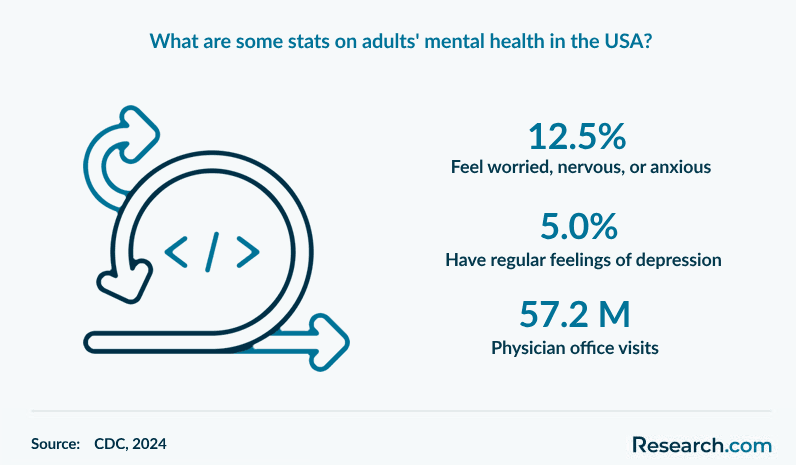
According to the CDC, 12.5% of adults aged 18 and older experienced regular feelings of worry, nervousness, or anxiety, and 5.0% of adults in the same age group reported regular feelings of depression. There were also 57.2 million physician office visits with mental disorders as the primary diagnosis.
The graphic below highlights the scale of mental health concerns among U.S. adults through both self-reported symptoms and medical visits. These figures reinforce the importance of well-trained mental health professionals, researchers, and program leaders.
For psychology PhD graduates aiming to work in nonprofit mental health, advocacy, or community programming, leadership and budgeting skills may be valuable. The cheapest online master's in nonprofit management can be relevant for those who want to manage organizations rather than focus only on clinical or research roles.
Common mistakes to avoid when choosing a psychology PhD program
- Choosing by prestige alone: A famous university is not automatically the best fit if faculty research, funding, or licensing preparation do not match your goals.
- Ignoring accreditation and licensure: Students pursuing clinical practice should confirm whether the program supports licensure in their intended jurisdiction before enrolling.
- Focusing only on tuition: Stipends, fees, health insurance, relocation, summer funding, internship costs, and time-to-degree all affect affordability.
- Assuming online means license-ready: Online or hybrid programs may still require in-person supervised training, and not all programs meet every state’s requirements.
- Applying without faculty fit: In many PhD programs, admissions depend heavily on whether a faculty mentor wants to supervise your research area.
- Underestimating the dissertation: A dissertation is a major independent research project, not a final paper that can be completed quickly at the end.
- Assuming salary outcomes are guaranteed: Pay depends on specialization, licensing, employer, geography, experience, and career choices.
Questions to ask before applying
- Which faculty members are accepting doctoral students in my research area?
- What funding is guaranteed, for how long, and what costs are excluded?
- What are recent graduates doing now?
- How many students complete the program, and how long do they usually take?
- For clinical, counseling, or school psychology: does the program support licensure in my intended state?
- What practicum, internship, clinic, hospital, school, or community placements are available?
- How often do students publish, present at conferences, or receive grants?
- What happens if my advisor leaves, retires, or no longer matches my research direction?
- How does the program support students’ mental health, professional development, and career planning?
What graduates say about earning a PhD in Psychology
-
: "
My doctoral training in psychology gave me access to serious research opportunities and close mentorship from respected scholars. It helped me grow as a researcher and strengthened my commitment to improving mental health outcomes. Anika
"
-
: "
The collaborative culture of my program helped me build lasting professional relationships with peers who care deeply about the science of behavior. Contributing to work with real-world mental health impact has been one of the most meaningful parts of the experience. Dario
"
-
: "
I was able to shape my research around questions that genuinely mattered to me. The program was intellectually demanding, but it also gave me a clearer sense of purpose and professional identity. Leon
"
Key Insights
- A PhD in Psychology is best for research-heavy and advanced professional goals: It is a strong fit for students who want careers in academia, research, clinical psychology, assessment, consulting, specialized practice, or applied behavioral science.
- Licensure is separate from the degree: Clinical practice usually requires supervised experience, jurisdiction-specific requirements, and the Examination for Professional Practice in Psychology (EPPP).
- Funding can determine whether the degree is financially realistic: Compare assistantships, tuition waivers, stipends, fees, summer support, and loan needs before accepting an offer.
- Program fit matters more than generic rankings: The best program is the one with the right mentor, training model, accreditation status, funding package, research environment, and outcomes for your goal.
- The labor market is broad but specialized: According to the U.S. Bureau of Labor Statistics (2024), psychologists had median pay of $94,310 per year, or $45.34 per hour, with 207,500 jobs in 2023 and projected growth of 7% from 2023 to 2033.
- Mental health demand remains a major context: U.S. adult mental health treatment rose from 19.2% in 2019 to 23.9% in 2023, while global data indicate approximately 1 billion people worldwide live with a mental disorder.
- Online and hybrid options require careful review: Flexibility can help, but students must verify accreditation, supervision, clinical placement quality, and licensure alignment.
- Do not assume the PhD is the only path: For some counseling, therapy, nonprofit, applied behavior analysis, or organizational roles, a master’s degree, PsyD, licensure-track counseling program, or specialized credential may be a better match.
References:
- Centers for Disease Control and Prevention. (2024, October 2). FastStats: Mental health. National Center for Health Statistics. Centers for Disease Control and Prevention.
- Centers for Disease Control and Prevention. (2024, December 19). QuickStats: Mental health treatment trends among adults aged ≥18 years, by age group — United States, 2019–2023. Morbidity and Mortality Weekly Report, 73(50), 1150. Centers for Disease Control and Prevention.
- PayScale. (2022, December 19). Doctorate (PhD), Experimental Psychology Salary. PayScale.
- PayScale. (2023, July 25). Doctor of Philosophy (PhD), Industrial Psychology Salary. PayScale.
- PayScale. (2023, September 22). Doctorate (PhD), Psychology Salary. PayScale.
- PayScale. (2024, August 14). Doctor of Philosophy (PhD), Psychology Salary. PayScale.
- PayScale. (2025, April 2). Average School Psychologist Salary. PayScale.
- PayScale. (2025, April 21). Research Scientist Salary in 2025. PayScale.
- PayScale. (2025, April 22). Average Clinical Psychologist Salary. PayScale.
- United Nations Association of the National Capital Area. (2025). World Health Organization: Addressing global mental health: Bridging gaps in access and reducing stigma. Global Classrooms DC Winter Training Conference 2025. United Nations Association of the National Capital Area.
- U.S. Bureau of Labor Statistics. (2025, April 18). Psychologists. Occupational Outlook Handbook. U.S. Bureau of Labor Statistics.
Other Things You Should Know About Getting a PhD in Psychology
A strong 2027 psychology PhD application should include a well-articulated statement of purpose, transcripts with competitive grades, relevant research experience, strong letters of recommendation, high GRE scores (where required), and evidence of personal and professional alignment with the program's research goals.
Typically, admission to a psychology PhD program in 2026 requires a bachelor's or master's degree in psychology or a related field, a strong GRE score, relevant research experience, letters of recommendation, a personal statement, and sometimes an interview. Requirements may vary by program.


