2027 Last-Minute Admissions: Online Speech Pathology Degree Master's Programs Still Accepting Students

Co-Founder and Chief Data Scientist

Reviewed by Rhea Paul, PhD
SLP Education & Research Expert
Applying late to an online speech pathology master’s program is possible, but the real question is whether you can still enter a credible cohort with enough time to complete admissions review, prerequisite checks, financial aid steps, and clinical onboarding. In speech-language pathology, a fast admission offer is not enough. The program must also prepare you for supervised clinical requirements, certification expectations, and state licensure rules tied to where you plan to practice.
This guide is for applicants who missed a priority deadline, changed career plans, relocated, or decided late that graduate study is the next step. It explains how last-minute admissions work, how late you can realistically apply, what documents to prepare first, how GPA and conditional admission are handled, and which warning signs should make you slow down before paying an application fee or deposit.
The timing matters because speech-language pathology is both a high-demand and highly regulated profession. The U.S. Bureau of Labor Statistics projects a 17% growth in speech-language pathology jobs through 2035, but long-term career mobility depends on completing the right graduate program, meeting clinical training requirements, and qualifying for certification or licensure in your intended state of practice.
Key Benefits of Online Speech Pathology Degree Master's Programs With Last-Minute Admissions
- Flexible enrollment options enable students to apply and start coursework quickly, accommodating diverse schedules without waiting for traditional semester start dates.
- Last-minute admissions allow beginners to enter graduate study immediately, bypassing lengthy traditional application cycles that can delay career progress.
- Extended deadlines support working professionals by facilitating rapid enrollment, helping them advance in speech pathology careers without sacrificing current job responsibilities.
What Are Last-Minute Admissions for Online Speech Pathology Master's Programs?
Last-minute admissions for online speech pathology master’s programs are application pathways that remain available close to a program’s start date or after a priority deadline has passed. They usually appear in programs with rolling admissions, several start dates per year, extended deadlines, or policies that allow an application to be reviewed while a limited number of materials are still pending.
These options can help qualified applicants avoid waiting another full cycle, but they should not be confused with relaxed standards. A legitimate speech pathology program still needs to review your academic record, prerequisite coursework, GPA, recommendations, statement of purpose, and readiness for clinical graduate training. The schedule may be flexible; the academic and professional expectations should remain firm.
Approximately 45% of online graduate programs in health-related fields have adopted rolling admissions or similar flexible enrollment options. For working adults, career changers, and students whose plans changed unexpectedly, that flexibility can make graduate enrollment more realistic without removing the need for careful program evaluation.
Common forms of last-minute admission
- Rolling admissions: The admissions team reviews complete applications as they arrive instead of waiting until one fixed review date.
- Multiple start dates: The program admits students more than once per year, such as fall, spring, summer, quarterly, or shorter academic terms.
- Extended deadlines: A school may keep applications open if the cohort still has seats and there is enough time to process new students.
- Conditional review: A program may begin reviewing your file while final transcripts, prerequisite grades, or administrative documents are still in progress.
Before applying, ask whether the program is still reviewing applicants for the specific start date you want, whether the open seats are real or waitlist-based, and whether clinical placement planning is still available for late admits. If you are comparing flexible admissions in related fields, reviewing an online BCBA program can help you see how other health and behavior programs structure rolling or accelerated entry.
How Late Can You Apply to an Online Speech Pathology Master's Degree Program?
You may be able to apply a few weeks before an online speech pathology master’s program begins if the school uses rolling admissions or offers multiple entry points. Approximately 40% of online graduate programs nationwide offer flexible application deadlines. Even so, speech pathology programs often need more lead time than nonclinical online degrees because they must evaluate prerequisites, plan clinical training, and complete compliance-related steps.
Applying only a few days before classes start is usually unrealistic. An open application portal does not mean the university can review your file, admit you, process financial aid, register you, and prepare you for clinical expectations in time. Online speech pathology students may also need to complete orientation, technology setup, background checks, immunization documentation, or other onboarding requirements before the first term begins.
What determines the latest realistic application date?
- Application completeness: Your file must include transcripts, recommendations, essays, prerequisite documentation, and any required test scores quickly enough for review.
- Cohort capacity: A program may close before the published final deadline if seats or clinical placement resources are full.
- Separate document deadlines: Transcripts, prerequisite grades, compliance forms, and financial aid paperwork may have earlier cutoffs than the general application.
- Review process: Some schools make decisions quickly, while others require interviews, faculty review, or committee approval.
- Financial aid and registration timing: Admission alone does not guarantee you can start if billing, aid certification, orientation, or enrollment steps are unfinished.
If you are applying late, contact admissions before paying the application fee. Ask whether applications are still being reviewed for the next cohort, whether seats remain, what the hard document deadline is, and whether late admission affects clinical placement timing. Students considering broader academic alternatives may also compare a 2-year psychology degree online, but speech pathology typically involves more clinical and licensure-related constraints.
What Schools Accept Last-Minute Admissions for Online Speech Pathology Master's Programs?
Schools most likely to accept last-minute applications are those with mature online graduate systems, more than one start date per year, admissions staff who review applications continuously, and clinical placement processes that can support online learners. Online graduate programs have grown by more than 20% in recent years, and that growth has pushed more institutions to offer flexible enrollment models.
Speed, however, should never be the main reason you choose a speech pathology program. A school that can admit you quickly still needs to meet your professional needs. You should verify accreditation, curriculum, state authorization, clinical training support, total cost, and whether the program aligns with the certification or licensure pathway you intend to follow.
Types of schools that may offer late application options
- Large public universities: These institutions may have larger admissions teams, established online infrastructure, and multiple enrollment periods, although competitive cohorts may still fill early.
- Private nonprofit universities: Some nonprofit schools serving adult and online learners use streamlined graduate admissions processes and year-round advising.
- Competency-based institutions: These programs may offer flexible pacing, but applicants should confirm that the model is appropriate for speech pathology coursework and clinical training.
- Career-focused universities: These schools may promote frequent starts and working-adult support, but applicants should closely review accreditation, practicum quality, costs, and student outcomes.
Questions to ask before you submit a late application
- Is the speech pathology master’s program still accepting applications for the next start date?
- Are late applicants being considered for open seats, a waitlist, or a future cohort?
- Can the program support clinical placements for online students in your state or local area?
- Does the program support the certification and licensure requirements tied to your career goals?
- Are financial aid, orientation, prerequisite verification, or compliance deadlines earlier than the admissions deadline?
A graduate student who submitted last-minute applications to online speech pathology programs described the process as stressful but workable. He said, “I had to gather all my materials quickly while balancing my job, which felt overwhelming at first.” He added that it helped to know some schools recognize real-life timing challenges: “It was reassuring to know some schools really understand that life happens and still accept you.”
Some online speech pathology master’s programs with last-minute admissions are accredited, but an extended deadline does not prove program quality. Accreditation should be verified separately before you apply. This is especially important in speech-language pathology because certification, licensure eligibility, employer recognition, and clinical training access may depend on the program you complete.
Approximately 60% of online healthcare graduate programs hold regional or specialized accreditation. For speech pathology applicants, the key issue is not only whether the university is accredited, but whether the specific master’s program meets professional expectations for speech-language pathology preparation.
Accreditation checks to complete before applying
- Institutional Accreditation: Confirm that the university is accredited by a recognized regional agency such as the Higher Learning Commission or Middle States Commission on Higher Education. Institutional accreditation can affect federal aid eligibility, transferability, and academic credibility.
- Program-Specific Accreditation: Speech pathology master’s programs often seek approval from the Council on Academic Accreditation in Audiology and Speech-Language Pathology (CAA). This can help show that coursework and clinical preparation align with professional standards.
- Regional vs. National Accreditation: Regional accreditation is generally more widely recognized in graduate education by employers, universities, and licensing boards. National accreditation may be more limited depending on the field and jurisdiction.
Do not rely on vague language such as “approved,” “recognized,” “professional,” or “career-ready.” Check the school’s official accreditation page and, when necessary, verify the status directly with the accrediting body. For a comparison from another regulated field, reviewing how online engineering degrees handle accreditation can show why field-specific review matters.
Last-minute applicants usually need the same documents as regular-deadline applicants. Flexible admissions may shorten the timeline, but it rarely removes the evidence a program needs to judge academic readiness, communication ability, prerequisite preparation, and fit for clinical graduate study.
The strongest strategy is to assemble your application packet before you find an open deadline. That way, once a school confirms it is still reviewing applications, you can submit quickly instead of losing several days waiting for transcripts, references, or prerequisite documentation.
Documents to prepare first
- Official Transcripts: Request transcripts from every postsecondary institution you attended, including schools where you completed only one or two courses. Programs use transcripts to verify your degree, GPA, prerequisites, and academic history.
- Letters of Recommendation: Most programs require two or three references. Strong recommenders may include professors, clinical supervisors, healthcare managers, research mentors, or workplace supervisors who can speak to your readiness for graduate-level clinical training.
- Personal Statement: Explain why you are pursuing speech-language pathology, what experiences shaped your goals, and why the program fits your academic and professional plans.
- Resume or Curriculum Vitae (CV): Include education, employment, volunteer service, observation hours if applicable, certifications, research, awards, and relevant healthcare, education, or communication-related experience.
- Standardized Test Scores: Some programs still require GRE scores, but many have waived or made testing optional to accommodate applicants applying near deadlines.
How to avoid preventable delays
- Order official transcripts early, including transcripts from community colleges, summer programs, and transfer institutions.
- Ask recommenders whether they can submit by a specific date before you list them in the application portal.
- Keep unofficial transcripts, syllabi, and course descriptions available in case the program questions prerequisite equivalency.
- Create a school-by-school checklist so you do not confuse deadlines, document formats, or portal instructions.
- Submit materials as soon as they are ready if the system allows separate uploads instead of waiting to complete everything at once.
One graduate admitted last-minute to an online speech pathology master’s program described the process as demanding: “It was overwhelming to coordinate transcripts and secure recommendation letters quickly, but clear communication with the admissions office helped manage expectations.” She also said the standardized test waiver reduced pressure and recommended staying organized, contacting mentors early, and submitting materials as soon as each item is ready.
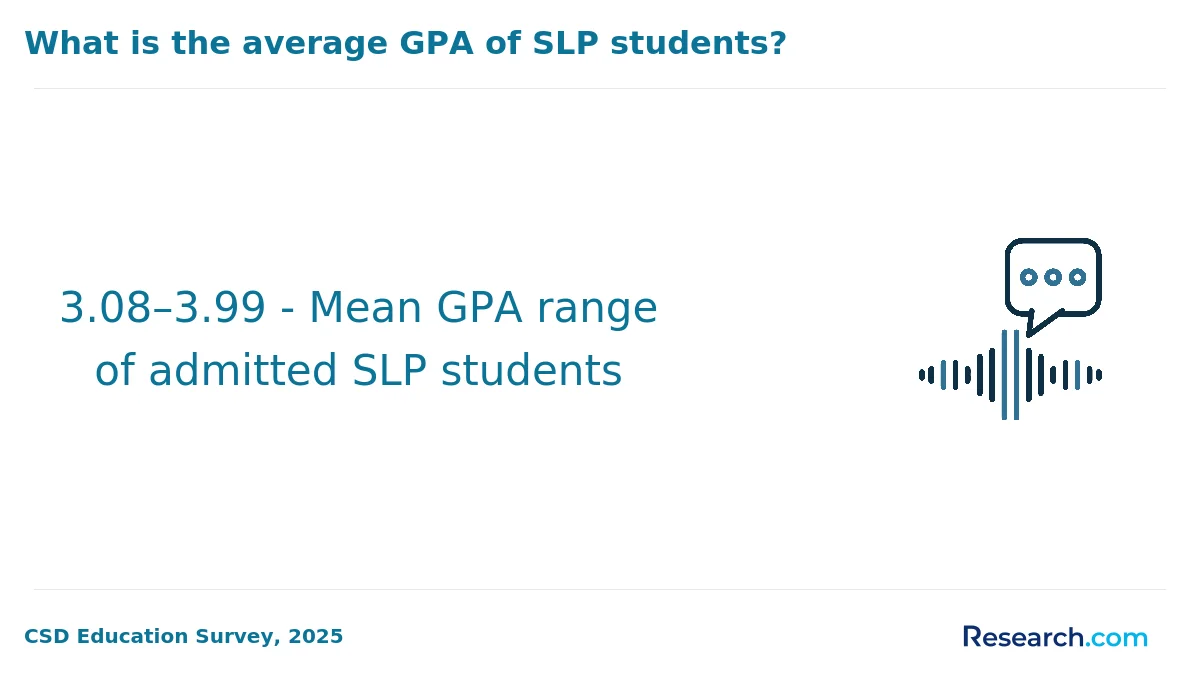
Online speech pathology master’s programs with last-minute admissions generally apply the same GPA standards used for regular applicants. A late application window may help you start sooner, but it does not usually make the program less selective. Typically, successful candidates present an average GPA near 3.5.
Most programs require a minimum undergraduate GPA of about 3.0, while admitted students often have GPAs between 3.3 and 3.7. Applicants below the typical range may still receive consideration at programs with holistic review, but they should be prepared to show strong evidence that they can handle graduate-level clinical coursework.
How programs interpret GPA
- Minimum GPA Threshold: Many programs use about 3.0 as the baseline for graduate admission consideration.
- Competitive GPA Range: GPAs between 3.3 and 3.7 can strengthen an application, especially when seats are limited.
- Prerequisite Grades: Strong performance in communication sciences, biology, psychology, linguistics, statistics, or related prerequisite courses can help demonstrate readiness.
- Recent Academic Performance: Higher grades in upper-division, post-baccalaureate, or prerequisite coursework may help offset an older weaker GPA.
- Professional Experience: Work in education, healthcare, rehabilitation, communication disorders, human services, or related settings may provide useful context.
- Holistic Review: Recommendation letters, personal statements, research exposure, volunteer work, and service experience can strengthen an application beyond the GPA alone.
If your GPA is below the stated minimum, contact admissions before applying. Ask whether the program considers conditional admission, prerequisite retakes, post-baccalaureate coursework, recent academic improvement, or a graduate-level trial term. That conversation can help you avoid spending money on an application the program is not allowed to review under its own policy.
Conditional admission may be available for some last-minute applicants, but it depends on the school, the program, and the missing or incomplete requirement. A conditional offer means the program may admit you or hold your place while you meet specific requirements by stated deadlines. It is not the same as full, unconditional admission.
This option can be helpful if you are close to meeting all requirements, but it carries real risk. If you miss a condition, earn an insufficient grade, fail to submit final documents, or cannot complete a prerequisite in time, your enrollment may be delayed, limited, or canceled.
Common reasons a program may offer conditional admission
- Incomplete Transcripts: A program may allow enrollment while final grades are pending, as long as official transcripts arrive by the required deadline.
- Slightly Lower GPAs: Applicants just below the cutoff may be reviewed if they show strong recent coursework, relevant experience, or other evidence of readiness.
- Pending Prerequisite Courses: Some programs allow students to finish required courses within a defined timeframe.
- Missing Administrative Documents: Recommendation letters, test scores, background checks, or compliance materials may be accepted after initial review in limited cases.
What to confirm before accepting a conditional offer
- Which exact conditions must you complete?
- What is the deadline for each condition?
- Can you register for graduate courses before all conditions are cleared?
- Will conditional status affect financial aid, clinical placement, or course sequencing?
- What happens if a final grade, transcript, or prerequisite does not meet the program’s standard?
Conditional admission can help late applicants keep moving, but informal promises are not enough. Ask for the conditions, deadlines, and consequences in writing before you accept an offer, enroll in courses, or make a financial commitment.
Online speech pathology master’s programs may start in fall, spring, summer, quarterly terms, or shorter course cycles, depending on the university. Approximately 70% of these programs provide multiple enrollment periods annually, and some offer monthly or quarterly start dates. If you apply late, your actual start date depends on when your file becomes complete, whether the cohort still has space, and whether the school can finish enrollment processing on time.
Most online speech pathology master’s programs process applications within one to three weeks, with students beginning their studies within one to two months of applying. That timeline can lengthen if transcripts, recommendations, prerequisite evaluations, financial aid, background checks, or compliance steps are delayed.
Start-date models late applicants may encounter
- Monthly Start Dates: Some online programs allow students to begin coursework throughout the year rather than waiting for a traditional semester.
- Rolling Admissions: Applications are reviewed continuously, and decisions are typically released after files are complete.
- Accelerated Course Cycles: Shorter terms may reduce waiting time, but they usually require faster pacing and stronger time management.
- Orientation Requirements: Late enrollees may need to complete live or asynchronous orientation immediately before classes begin.
- Enrollment Processing: Registration, tuition payment, technology setup, student accounts, and compliance requirements often must be completed before the first day of class.
Ask whether the next available start date is for full admission, conditional admission, or a future cohort waitlist. If you are comparing related human services degrees, online MSW programs can offer a useful comparison for how flexible graduate start dates work in another practice-oriented field.
Yes. Last-minute online speech pathology master’s applicants may still qualify for financial aid if they meet eligibility requirements. Aid is usually based on factors such as FAFSA completion, enrollment status, citizenship or eligible noncitizen status, satisfactory academic progress, program and institutional accreditation, and school-specific deadlines, not simply on when the admissions application was submitted.
Approximately 60% of graduate students receive some form of financial aid. Late applicants should move quickly because federal aid processing, school certification, billing, and registration can take time. Institutional scholarships, grants, assistantships, and tuition discounts may also have earlier deadlines or limited funding.
Financial aid items to verify right away
- FAFSA Submission: Submit the FAFSA as soon as possible because processing can take several weeks and some aid is awarded on a first-come, first-served basis.
- Accreditation: Federal financial aid generally requires enrollment at an institution accredited by a recognized agency.
- Enrollment Status: Many aid options require at least half-time enrollment, so confirm how the program defines credits and course load.
- Institutional Deadlines: Scholarship, grant, assistantship, and tuition discount deadlines may be earlier than the final admission deadline.
- Documentation Accuracy: FAFSA errors, missing tax information, or incomplete school forms can delay an aid package.
If cost is a major concern, compare tuition, fees, technology charges, clinical placement costs, travel requirements, and residency expenses before enrolling. Reviewing cheapest slp master's programs can help you identify lower-cost options, but affordability should be weighed alongside accreditation, licensure alignment, clinical support, and student outcomes.
Students comparing accelerated graduate pathways in other fields may also review a 2 year construction management degree to understand how financial aid and compressed academic timelines can interact across disciplines.
Last-minute applicants are more vulnerable to rushed decisions. With over 1,500 accredited U.S. institutions offering online graduate education, quality, cost transparency, clinical support, and professional alignment can vary widely. A fast admissions process is useful only if the program can support your long-term goal of becoming or advancing as a speech-language pathology professional.
Warning signs that deserve serious attention
- Unclear Accreditation: If the school does not clearly state institutional accreditation and relevant speech pathology accreditation status, proceed carefully. Inadequate accreditation can affect certification, licensure, employment, and financial aid.
- Unrealistic Completion Timelines: Be cautious of promises to finish a clinical master’s degree unusually quickly without clear details about coursework, supervised practice, and clinical training.
- Vague Curriculum Information: A legitimate program should explain courses, practicum expectations, clinical hours, assessment requirements, and any in-person components.
- Weak Student Support: Online speech pathology students need advising, faculty access, technology support, academic resources, and clinical placement guidance.
- High-Pressure Recruitment: Recruiters should answer questions about accreditation, costs, outcomes, and licensure alignment before asking for a deposit.
- Unclear Clinical Placement Responsibility: If you are expected to find placements on your own, ask how sites are approved, how supervision works, and what happens if a placement falls through.
- Hidden Costs: Ask about fees, background checks, immunizations, liability insurance, travel, residencies, technology, and clinical documentation expenses.
A trustworthy program should provide direct answers, written policies, and enough time for you to make an informed decision. If the admissions timeline is urgent but the school cannot clearly explain accreditation, clinical placement, total cost, or licensure alignment, waiting for the next start date may be the safer choice.
What Graduates Say About Last-Minute Admissions in Online Speech Pathology Degree Master's Programs
- : "I decided to apply for an online speech pathology master's degree at the last minute because I realized that advancing my career hinged on formal qualification. Navigating the tight deadlines was stressful, but the program's flexible admissions process made it possible to enroll despite the rush. Completing the degree online not only fit my hectic schedule but also expanded my professional opportunities in diverse clinical settings. — Justine"
- : "When unexpected changes in my job prompted me to pursue a new path, the last-minute application to an online speech pathology master's program felt like a leap of faith. The challenge of quickly assembling application materials taught me resilience, and being accepted validated my decision. This degree has since transformed how I approach patient care, blending convenience with comprehensive learning that fits perfectly with my current lifestyle. — Alyson"
- : "Applying late to an online speech pathology master's program was a strategic move after recognizing a gap in my qualifications within the healthcare field. The compressed timeline to complete prerequisites and submit my application was intense but worthwhile. Now, as a graduate, I appreciate how the program's online format empowered me to advance professionally without sacrificing my ongoing work commitments. — Jacob"
Other Things You Should Know About Speech Pathology Degrees
Yes, some programs offer accelerated course options for last-minute applicants that allow completion in as little as 18 months, subject to specific prerequisites. These options may include intensive coursework and condensed semesters to ensure timely graduation.
Yes. Many online speech pathology master’s programs allow conditional review if official GRE results are pending, but admission is not final until scores arrive by the program deadline. ASHA-aligned programs may also require prerequisite coursework, transcripts, and a minimum GPA, often 3.0, before enrollment is confirmed.
- U.S. Bureau of Labor Statistics - Speech-Language Pathologists https://www.bls.gov/ooh/healthcare/speech-language-pathologists.htm
- ASHA EdFind - Accredited Speech-Language Pathology Programs https://find.asha.org/ed/
- ETS Praxis - Speech-Language Pathology (5331) https://praxis.ets.org/test/speech-language-pathology-5331.html
- Idaho State University - Master of Science in Speech-Language Pathology (Online/Distance Education) https://www.isu.edu/slp/programs-offered/slp-graduate-program/
- University of North Carolina at Greensboro - Speech-Language Pathology, M.A. (Online) https://csd.uncg.edu/graduate/masters-of-arts-online/
- University of Scranton - Master of Science (M.S.) in Speech-Language Pathology https://www.scranton.edu/academics/pcps/health-and-human-performance/programs/speech-language-pathology/index.shtml
- West Virginia University - Speech-Language Pathology, M.S. - Online https://medicine.hsc.wvu.edu/communications-sciences-and-disorders/speech-language-pathology-ms/future-students/curriculum/online-slp-program/
- Baylor University - Master of Science in Speech-Language Pathology (Online) https://csd.robbins.baylor.edu/graduate/online-csd-graduate-program