2027 Best Accelerated Construction Management Degree Programs Online

Co-Founder and Chief Data Scientist
Construction management is a professional service that offers project owners effective oversight of the project's timeline, budget, quality, safety, scope, and functionality. For those who want to pursue this career, choosing the right online construction management degree program can be overwhelming.
This article aims to help you navigate this challenge by providing information on various reputable online programs available for 2027. It highlights factors to consider such as accreditation to help you find the program that best suits your needs and goals.
What are the benefits of getting an online construction management program?
- Graduates with an online accelerated construction management degree will discover opportunities in industries related to building and development.
- As of May 2023, the median annual salary for construction managers was $104,900.
- An online accelerated construction management degree program provides a flexible and potentially quicker path to a fulfilling career in construction leadership.
What can I expect from an online construction management program?
An online accelerated construction management degree program offers a flexible and potentially faster route to a rewarding career in construction leadership. The coursework equips you with the necessary skills to manage construction projects effectively, covering budgeting, scheduling, construction law, and safety protocols.
While online learning provides convenience, it is crucial to choose a program with a strong reputation and industry accreditation to ensure a well-rounded education valued by potential employers.
Where can I work with an online construction management program?
Graduates with an online accelerated construction management degree will find opportunities across diverse industries involved in building and development. Most graduates land jobs in general contracting firms, overseeing all aspects of a construction project, from initial planning and budgeting to subcontractor management and quality control. They may also work for architectural or engineering firms, where their expertise bridges the gap between design and execution, ensuring projects are built according to specifications and within budget.
Their skillset is also valuable beyond traditional construction companies. Government agencies, for instance, often require construction management professionals to oversee public infrastructure projects like roads, bridges, and schools. Similarly, developers seeking to revitalize urban areas or build large-scale sustainable communities will find these graduates' knowledge of project management and construction processes highly sought-after.
How much can I make with an online construction management degree?
In May 2023, the median annual salary for construction managers was $104,900. This means that half of the workers in this occupation earned more than this amount, while the other half earned less. The bottom 10% earned under $64,480, whereas the top 10% made over $172,040. Besides their salaries, construction managers can also receive bonuses, with their total earnings influenced by the amount of business they generate.
- 2027 List of the Best Online Accelerated Construction Management Programs List of Programs
- How long does it take to complete an online construction management program? How long does it take to complete an online construction management program?
- How does an online construction management degree compare to an on-campus program? Online vs. On-Campus
- What is the average cost of an online construction management program? Cost
- What are the financial aid options for students enrolling in an online construction management program? Financial Aid
- What are the prerequisites for enrolling in an online construction management program? Requirements
- What courses are typically in an online construction management program? Courses
- What types of specializations are available in online construction management programs? Specializations
- How to choose the best online construction management programs? How to choose the best online construction management programs?
- Emerging Trends in Construction Management Education Emerging Trends in Construction Management Education
- What are the key factors to consider when choosing an online construction management program? What are the key factors to consider when choosing an online construction management program?
- How does construction management integrate with urban planning? How does construction management integrate with urban planning?
- What career paths are available for graduates of online construction management programs? What career paths are available for graduates of online construction management programs?
- What support services and mentorship opportunities do online construction management programs offer? What support services and mentorship opportunities do online construction management programs offer?
- What challenges might students encounter in online construction management programs? What challenges might students encounter in online construction management programs?
- What is the job market for graduates of online construction management programs? Job Outlook
- What technological skills are essential for construction management for 2027? Skills
- How can continuous professional development elevate your construction management career? How can continuous professional development elevate your construction management career?
- Sustainability and Green Building Practices in Construction Management Sustainability and Green Building Practices in Construction Management
- How can a construction management degree enhance your career opportunities? How can a construction management degree enhance your career opportunities?
- Should I consider starting with an online associate degree in construction management? Should I consider starting with an online associate degree in construction management?
- Is the ROI of an online construction management degree worth the investment? Is the ROI of an online construction management degree worth the investment?
- Can an accelerated online master's degree further enhance my management expertise? Can an accelerated online master's degree further enhance my management expertise?
2027 Guide to the Best Online Accelerated Construction Management Programs
Choosing an online accelerated construction management program is usually a time-sensitive decision: you want a degree that can help you move into project leadership without leaving the workforce for four years. The challenge is that programs vary widely in price, credit requirements, accreditation, online support, transfer policies, and how well they prepare students for real construction management work.
This guide is built for working adults, transfer students, construction tradespeople, military learners, and career changers comparing accelerated online construction management degrees. You will find a ranked program list, cost and timeline comparisons, admissions expectations, course topics, career outcomes, technology trends, common mistakes, and practical questions to ask before enrolling.
Quick Answer: What Is the Best Online Accelerated Construction Management Program?
The best online accelerated construction management program is the one that matches your transfer credits, budget, schedule, accreditation needs, and career goal. Programs on this list generally require 120 to 180 credits and may be completed in about 24 to 48 months, depending on the school and the number of credits accepted toward the degree.
If you already have college credits or construction experience, prioritize programs with generous transfer-credit policies, strong advising for online students, and construction-specific accreditation or recognized institutional accreditation. If you want the fastest route, compare program length carefully rather than assuming that every “online” program is accelerated.
How Research.com Ranked These Programs
Research.com evaluates online construction management programs with the understanding that a bachelor’s degree is a major financial and career investment. Our ranking process uses a structured research approach designed to help students compare institutions more clearly.
To support accuracy and consistency, we reviewed information from established education data sources, including:
- The Integrated Postsecondary Education Data System (IPEDS) database
- Peterson's databases, including the Distance Learning Licensed Data Set
- The College Scorecard database
- National Center for Education Statistics (NCES)
Rankings should be used as a starting point, not as the only deciding factor. Before applying, confirm current tuition, online availability, transfer policies, and accreditation directly with the school.
Best Online Accelerated Construction Management Programs for 2027
| Rank | School | Program Length | Cost per Credit | Credits Required | Accreditation |
| 1 | Everglades University | 41 months | $800 | 123 | Southern Association of Colleges and Schools Commission on Colleges (SACSCOC) |
| 2 | Indiana State University | 36 months | $337 (in-state); $438 (out-of-state) | 120 | American Council for Construction Education |
| 3 | National University | 36 to 40 months | $370 | 180 | Western Association of Schools and Colleges |
| 4 | Rowan University | 24 to 36 months | $506 | 120 | Middle States Commission on Higher Education |
| 5 | The University of Southern Mississippi | 24 to 36 months | $421 | 120 | American Council for Construction Education (ACCE) |
| 6 | Tarleton State University | 36 to 48 months | $439 | 120 | SACSCOC |
| 7 | University of Minnesota Twin Cities | 24 to 36 months | $538 (in-state); $1,278 (out-of-state) | 120 | Applied and Natural Science Accreditation Commission of ABET |
| 8 | East Carolina University | 24 to 36 months | $204 (in-state); $883 (out-of-state) | 120 | ACCE |
| 9 | Michigan State University | 24 to 36 months | $521 (in-state); $1,434 (out-of-state) | 120 | ACCE |
| 10 | Colorado State University-Pueblo | 36 months | $381 (in-state); $572 (out-of-state) | 130 | Higher Learning Commission |
1. Everglades University
The Bachelor of Science in Construction Management from Everglades University is designed for students seeking an online route into entry-level construction management. The program combines construction-focused coursework with business and management training, which can be useful for students aiming to supervise people, budgets, schedules, and jobsite processes.
- Program Length: 41 months
- Cost per Credit: $800
- Required Credits to Graduate: 123
- Accreditation: Southern Association of Colleges and Schools Commission on Colleges (SACSCOC)
2. Indiana State University
Indiana State University offers a fully online Bachelor of Science in Construction Management through a public institution. The program emphasizes both technical construction knowledge and management preparation, making it relevant for students who want to move toward supervisory, project coordination, or leadership responsibilities.
- Program Length: 36 months
- Cost per Credit: $337 (in-state); $438 (out-of-state)
- Required Credits to Graduate: 120
- Accreditation: American Council for Construction Education
3. National University
The Bachelor of Science in Construction Management at National University prepares students for roles such as construction executive, project manager, field engineer, planning engineer, scheduling engineer, and related positions in construction operations and project delivery.
- Program Length: 36 to 40 months
- Cost per Credit: $370
- Required Credits to Graduate: 180
- Accreditation: Western Association of Schools and Colleges
4. Rowan University
Rowan University offers a full-time Bachelor of Arts in Construction Management for students who want to strengthen their qualifications for construction-related advancement. Coursework covers subjects such as project administration, construction project planning, advanced leadership and communication, building systems, and codes.
- Program Length: 24 to 36 months
- Cost per Credit: $506
- Required Credits to Graduate: 120
- Accreditation: Middle States Commission on Higher Education
5. The University of Southern Mississippi
The construction management program at The University of Southern Mississippi trains students to plan and oversee project workflow, people, equipment, and construction processes. The program emphasizes safe, ethical, budget-conscious project completion using current technologies and accepted construction practices.
- Program Length: 24 to 36 months
- Cost per Credit: $421
- Required Credits to Graduate: 120
- Accreditation: American Council for Construction Education (ACCE)
6. Tarleton State University
Tarleton State University offers a construction science and management program that incorporates applied learning through labs, field trips, internships, team competitions, and related activities. Students gain exposure to practical jobsite skills, modern hand and power tools, computerized testing equipment, and construction technology.
- Program Length: 36 to 48 months
- Cost per Credit: $439
- Required Credits to Graduate: 120
- Accreditation: SACSCOC
7. University of Minnesota Twin Cities
The Bachelor of Applied Science in Construction Management at the University of Minnesota Twin Cities develops business and construction knowledge for students who want to manage projects from planning through closeout. For learners comparing technical bachelor’s completion options, it is also relevant to review other fast online degree completion programs.
- Program Length: 24 to 36 months
- Cost per Credit: $538 (in-state); $1,278 (out-of-state)
- Required Credits to Graduate: 120
- Accreditation: Applied and Natural Science Accreditation Commission of ABET
8. East Carolina University
East Carolina University prepares students for construction management work across commercial, residential, and infrastructure settings. The curriculum is designed to build planning, organization, and oversight skills for projects of different scopes and building types.
- Program Length: 24 to 36 months
- Cost per Credit: $204 (in-state); $883 (out-of-state)
- Required Credits to Graduate: 120
- Accreditation: ACCE
9. Michigan State University
Michigan State University focuses its Construction Management Program on preparing future construction leaders and contributors who can support innovation across the industry.
- Program Length: 24 to 36 months
- Cost per Credit: $521 (in-state); $1,434 (out-of-state)
- Required Credits to Graduate: 120
- Accreditation: ACCE
10. Colorado State University-Pueblo
Colorado State University-Pueblo offers a Construction Management Program covering topics such as project planning and scheduling, construction law and ethics, safety management, and sustainable building techniques.
- Program Length: 36 months
- Cost per Credit: $381 (in-state); $572 (out-of-state)
- Required Credits to Graduate: 130
- Accreditation: Higher Learning Commission
Students balancing employment, caregiving, and school may also want to compare broader online options designed for adult learners, including colleges for working adults. If your interests are more technical or design-focused than management-focused, review whether one of the easy online engineering degree pathways would better fit your goals.
What Is an Online Accelerated Construction Management Degree?
An online accelerated construction management degree is a bachelor’s program delivered primarily or fully online with a structure that can shorten the time to graduation. Acceleration may come from shorter terms, year-round enrollment, transfer credits, prior learning credit, or a degree-completion format for students who already have college coursework.
Construction management is the professional discipline of coordinating construction projects so they are planned, staffed, scheduled, budgeted, built safely, and completed according to contract requirements. Unlike a skilled-trade program, a construction management degree focuses on supervision, estimating, scheduling, contracts, safety, cost control, building systems, and leadership.
How Long Does an Online Accelerated Construction Management Program Take?
An accelerated online construction management bachelor’s program typically takes two to three years, though the actual timeline depends on transfer credits, course load, term structure, and program requirements. This is similar to how completion time varies in other fields, such as accelerated accounting degree programs. At the graduate level, some affordable online master’s programs may take up to 18 months.
The table below summarizes common completion timelines by credential level.
| Credential | Typical Accelerated Completion Time |
| Bachelor's Degree | 2-3 years |
| Master's Degree | 18 months |
Online vs. On-Campus Construction Management Degrees
Online construction management programs are often best for students who need flexibility because of work, family responsibilities, military service, or location. Instead of commuting to campus on a fixed weekly schedule, online learners can often complete lectures, assignments, discussions, and some project work around existing obligations.
The trade-off is that online study requires discipline. Students who rely on in-person reminders, classroom energy, or face-to-face lab interaction may prefer a campus-based program. On-campus programs can make networking, hands-on demonstrations, and immediate instructor feedback easier, while online programs require students to be proactive about asking questions and building relationships.
Cost is another major difference. Some of the cheapest online bachelor's degree programs can reduce total expenses by eliminating housing, meal plans, and commuting costs. However, online tuition is not always cheaper, especially for out-of-state students, so compare the full cost of attendance rather than tuition alone.
| Factor | Online Program | On-Campus Program |
| Best for | Working adults, transfer students, students outside commuting range | Students who want in-person instruction and campus access |
| Main advantage | Flexible scheduling | Direct interaction and structured routine |
| Main challenge | Requires strong self-management | Less flexible for full-time workers |
| Cost considerations | May reduce commuting and housing expenses | May include housing, transportation, and campus fees |
What Is the Average Cost of an Online Construction Management Program?
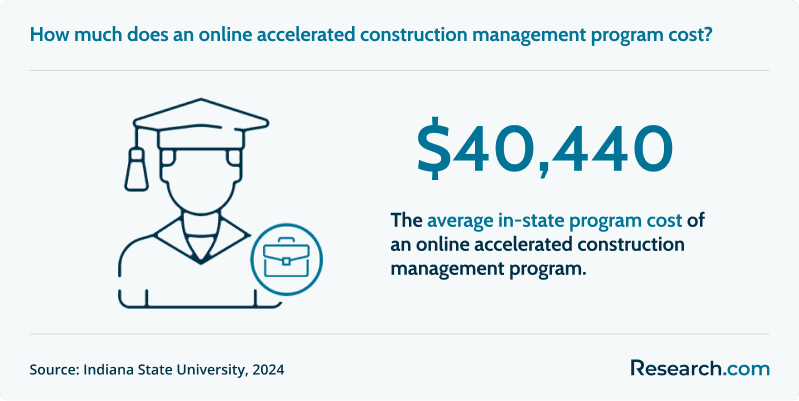
Based on the programs listed above, costs vary substantially. For a 120-credit program, the average cost is around $40,440, while for a 180-credit program, it can be up to $66,600.
The final price depends on the institution, your residency status, transfer credits, fees, books, technology requirements, and financial aid. When comparing affordable online degree programs, calculate your likely remaining credits instead of comparing only the published cost per credit.
Financial Aid Options for Online Construction Management Students
Online construction management students may qualify for many of the same funding sources as campus-based students, provided the school and program meet eligibility rules. These options also apply across many online fields, whether you are comparing construction management or affordable online public health degrees.
- Federal financial aid: Submit the FAFSA to determine eligibility for federal grants, subsidized and unsubsidized loans, and work-study programs.
- Scholarships and grants: Look for awards from colleges, construction associations, trade groups, community foundations, and professional organizations.
- Employer tuition assistance: If you already work in construction, ask whether your employer reimburses tuition, pays for job-related credentials, or supports degree completion.
- Military education benefits: Veterans and active-duty service members may be able to use the GI Bill or other military programs.
Admissions Requirements for Online Construction Management Programs
Admissions requirements vary by school, but most online bachelor’s programs expect applicants to show readiness for college-level work. Degree-completion programs may also require previous college credits before admission.
- High school diploma or GED: Most bachelor’s programs require proof of secondary completion or an equivalent credential.
- College transcripts: Transfer students should submit transcripts from every institution attended so the school can evaluate prior credits.
- Math and English preparation: Construction management uses estimating, scheduling, contracts, technical communication, and data analysis, so placement or prerequisite coursework may be required.
- Standardized tests: Online bachelor’s programs may not always require standardized tests, while some graduate programs may request GRE scores.
Common Courses in an Online Construction Management Curriculum
Course titles differ by school, but most online accelerated construction management programs cover the same core areas: construction methods, project planning, estimating, safety, contracts, scheduling, and technology.
- Construction fundamentals: Introduces materials, building methods, equipment, project phases, and common construction processes.
- Construction project management: Covers planning, scheduling, budgeting, risk control, quality management, and team coordination in construction settings.
- Construction law and contracts: Explains contract types, bidding, claims, legal responsibilities, safety requirements, and dispute-related issues.
- Construction estimating and cost control: Teaches students to prepare project estimates using labor, materials, equipment, overhead, and contingencies.
- Construction scheduling: Focuses on building and monitoring project timelines so work stays aligned with budget and delivery expectations.
- Building Information Modeling (BIM): Introduces digital building models used for coordination, visualization, clash detection, and collaboration.
- Construction safety management: Covers safety systems, jobsite hazards, regulatory expectations, and practices used to protect workers and the public.
Specializations in Online Construction Management Programs
Not every construction management program offers formal concentrations, but some allow students to focus electives or projects in a specific area. A specialization can be useful if you already know which part of the industry you want to enter.
- Sustainability and green construction: Focuses on energy efficiency, sustainable materials, waste reduction, and environmentally responsible building practices.
- Construction project management: Builds deeper preparation in planning, scheduling, budgeting, risk management, and project delivery. Students considering a broader project leadership route can also compare affordable online project management degree programs or accelerated project management degree programs online.
- Construction technology: Emphasizes tools such as BIM, construction software, digital documentation, and data-based project coordination.
- Facility management: Prepares students to manage existing buildings, maintenance operations, safety systems, and long-term facility performance.
- Real estate development: Covers site selection, feasibility, financing, planning, and the construction side of development projects.
- Supply chain and logistics technology: Focuses on improving material flow, equipment availability, procurement, and jobsite logistics.
How to Choose the Best Online Construction Management Program
The right program should fit your career target, schedule, learning style, and budget. Use the checklist below before applying.
- Start with your career goal: Decide whether you want to become a project manager, superintendent, estimator, scheduler, safety coordinator, facility manager, or construction business leader.
- Verify accreditation: Look for institutional accreditation and, when relevant, programmatic accreditation from a recognized body such as ACCE.
- Review the curriculum: Make sure the program includes estimating, scheduling, safety, contracts, technology, and management coursework—not just general business classes.
- Ask about transfer credits: If you have prior college work, military training, or an associate degree, request a transfer evaluation before estimating your graduation date.
- Compare faculty experience: Programs with instructors who have construction industry backgrounds may provide more practical examples and jobsite context.
- Check online support: Confirm that online students can access advising, tutoring, library services, career coaching, technical help, and internship guidance.
- Understand total cost: Include tuition, fees, software, books, transfer-credit limits, and lost work time when calculating affordability.
- Use rankings carefully: Rankings and student reviews can help narrow your list, but they should not replace accreditation checks, cost analysis, and program-fit questions.
If you are comparing programs by difficulty, structure, or completion flexibility, a guide to the easiest construction management programs can help you identify options that may better match your academic background while still requiring serious professional preparation.
Current Trends in Construction Management Education
Construction management programs are adapting as jobsites become more digital, collaborative, regulated, and sustainability-focused. Students should look for curricula that teach both the fundamentals of project delivery and the tools now used to manage complex construction work.
- Artificial intelligence in planning and risk review: Some programs are beginning to expose students to AI-supported scheduling, resource planning, document review, and risk assessment tools. Students should treat AI as a support tool, not a replacement for judgment, code knowledge, or field experience.
- Building Information Modeling (BIM): BIM is increasingly important for visualization, coordination, clash detection, and collaboration across design and construction teams.
- Remote project management platforms: Construction managers now often use tools such as Procore and Primavera to coordinate schedules, budgets, documentation, and communication across dispersed teams.
- Leadership and communication training: Technical knowledge alone is not enough. Construction managers must communicate with owners, subcontractors, inspectors, architects, engineers, suppliers, and field crews.
- Sustainability and green building topics: Energy efficiency, material selection, waste reduction, and green building standards are becoming more common in construction management coursework.
- More customized online pathways: Some programs allow students to align electives with construction technology, green construction, project management, or infrastructure. Students comparing value should also understand how much is a bachelor's degree in construction management before committing.
Key Factors to Compare Before Enrolling
When evaluating online construction management programs, focus on factors that affect completion, employability, and cost. Accreditation should come first because it affects credibility, transferability, and sometimes eligibility for financial aid. After that, compare curriculum depth, faculty qualifications, student support, job placement resources, alumni outcomes, and networking opportunities.
| Question to Ask | Why It Matters |
| Is the institution accredited? | Accreditation supports academic quality, transfer credit review, and financial aid eligibility. |
| Does the program have construction-specific accreditation? | Programmatic accreditation may signal closer alignment with construction education standards. |
| How many of my credits will transfer? | Transfer credits can shorten completion time and lower total cost. |
| Are courses asynchronous, synchronous, or mixed? | The delivery format determines whether the program fits your work schedule. |
| What software will I need to learn? | Construction management employers often value practical software familiarity. |
| Does the program help online students find internships or career opportunities? | Career support can be especially important if you are changing fields. |
How Construction Management Connects With Urban Planning
Construction management and urban planning overlap when projects must fit zoning rules, infrastructure limits, community priorities, environmental expectations, and long-term development plans. Construction managers may coordinate with planners, engineers, public agencies, developers, and community stakeholders to keep projects aligned with legal, logistical, and neighborhood requirements.
If you want to work on city development, infrastructure, housing, transportation, or public-sector projects, an affordable urban planning degree can complement construction management training by adding knowledge of land use, planning policy, and urban design.
Career Paths for Online Construction Management Graduates
Online construction management programs can prepare graduates for leadership-oriented roles in residential, commercial, industrial, infrastructure, and specialty construction. As of May 2023, construction managers were primarily employed in heavy and civil engineering construction, nonresidential building construction, specialty trade contractors, and residential building construction.
Over the next decade, population and business growth will support demand for new homes, office buildings, hospitals, and other structures. Infrastructure improvements may also contribute to employment as roads, bridges, and sewer systems are upgraded or replaced.
The chart below shows median annual wages for construction managers in the industries referenced above.
Support Services and Mentorship in Online Programs
Strong online programs do more than post lectures. Look for academic advising, virtual tutoring, library access, writing support, technical help, career coaching, internship guidance, and networking opportunities. Mentorship can be especially valuable for students who are moving from fieldwork into management or entering construction from another industry.
Some institutions also connect online learners with simulation tools, project management platforms, and structured support systems similar to those used in accelerated college programs. Students who need a shorter starting point before a bachelor’s degree may also compare options such as a 6 month associate degree online, although construction management advancement often requires more extensive preparation.
Challenges Online Construction Management Students Should Expect
Online construction management can be effective, but it is not effortless. Students often need to manage deadlines without the structure of a physical classroom, coordinate group projects virtually, learn technical software remotely, and seek networking opportunities more intentionally.
- Limited in-person contact: Build relationships through discussion boards, office hours, student groups, and professional associations.
- Time-management pressure: Use a weekly schedule that blocks study time around work shifts, family duties, and project deadlines.
- Technology barriers: Confirm computer specifications, internet reliability, software access, and technical support before the first term begins.
- Hands-on learning gaps: Seek internships, employer projects, field visits, or local construction exposure when possible.
Job Market Outlook for Construction Management Graduates
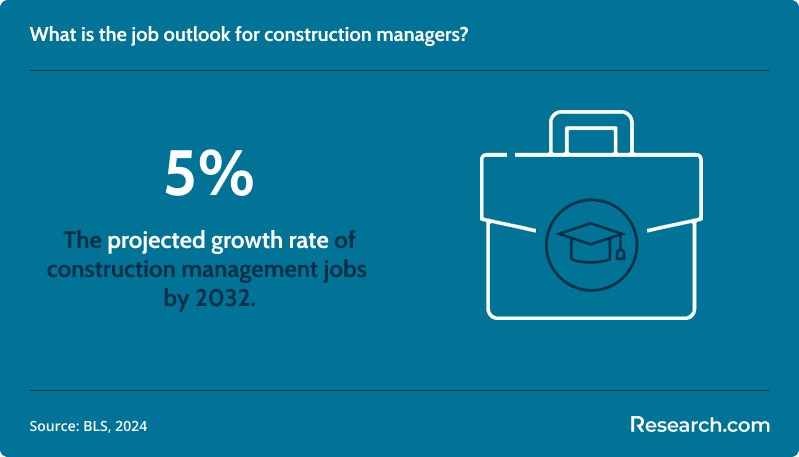
Employment of construction managers is expected to grow by 5% from 2022 to 2032. On average, there will be about 38,700 openings for construction managers each year, totaling 528,700 by 2032. Many openings are expected to come from workers transferring to other occupations or leaving the labor force, including retirement.
Demand for construction managers is expected to continue as construction activity increases. Retrofitting buildings for energy efficiency may also create work for general contractors, who are more likely to manage renovations and upgrades than new large-scale construction projects. As building technologies and construction processes become more complex, specialized management skills may become increasingly important, even as technology improves productivity.
Technology Skills Construction Managers Need in 2027
Construction management increasingly depends on digital tools for planning, estimating, collaboration, documentation, safety, and progress tracking. Students should choose programs that teach software concepts and also explain how these tools support real jobsite decisions.
- Building Information Modeling (BIM): BIM helps managers work with digital representations of building systems, coordinate with project stakeholders, and identify issues before they become field problems.
- Project management software: Tools such as Procore, Microsoft Project, and Primavera P6 are commonly used to manage schedules, budgets, resources, tasks, and team communication.
- Drones and aerial data collection: Drones may support surveying, progress monitoring, inspection, and site documentation when used according to applicable rules.
- Construction estimating software: Platforms such as PlanSwift and Sage Estimating can improve bid preparation, cost analysis, and financial tracking.
- Virtual reality and augmented reality: VR and AR can help teams visualize projects, communicate design intent, and identify planning issues earlier in the process.
How Professional Development Can Strengthen a Construction Management Career
A degree can help you qualify for construction management opportunities, but continuing education often matters as responsibilities grow. Certifications, safety training, software training, mentorship, and advanced coursework can help managers keep up with technology, regulations, contracts, and leadership demands.
Experienced professionals who want to move from operational supervision into senior management may consider graduate study. When comparing options, be realistic about workload and value; even a cheapest easiest master's degree should still provide relevant skills, credible instruction, and measurable career value.
Sustainability and Green Building in Construction Management
Sustainability is now an important part of many construction projects. Construction managers may be asked to reduce waste, coordinate energy-efficient systems, source more responsible materials, support green building documentation, and help teams meet environmental expectations.
- Green building certifications and standards: Knowledge of systems such as LEED and BREEAM can help managers understand sustainable design, construction, and operations criteria.
- Energy-efficient building design: Managers may coordinate materials, insulation, lighting, ventilation, and building systems that support lower operating costs and reduced energy use.
- Sustainable materials and waste reduction: Construction managers may help source recycled or lower-impact materials and reduce waste through planning, recycling, and inventory control.
- Water conservation strategies: Projects may use low-flow fixtures, rainwater systems, efficient irrigation, and other approaches to reduce water use.
- Renewable energy integration: Solar, wind, and geothermal systems may be included in some projects, requiring coordination among designers, installers, inspectors, and owners.
- Lifecycle assessment and carbon footprint reduction: Lifecycle thinking helps teams consider environmental impact from construction through building operation and eventual demolition.
How a Construction Management Degree Can Improve Career Options
A construction management degree can help workers move from task-based roles into project coordination, supervision, estimating, scheduling, safety, or management. It may also help career changers demonstrate that they understand construction processes, contracts, budgets, safety expectations, and project delivery.
- Management preparation: Coursework in planning, budgeting, scheduling, and resource coordination can support movement into leadership roles.
- Industry knowledge: Programs often cover building codes, construction law, safety, materials, estimating, and project documentation.
- Certification pathways: Some programs may help students prepare for credentials such as the Project Management Professional (PMP) or Associate Constructor (AC), though requirements vary by credentialing body.
If affordability is your top concern, compare the cheapest online construction management degree options carefully. The lowest tuition is not always the best value if the program lacks accreditation, transfer flexibility, software training, or career support.
Should You Start With an Online Associate Degree in Construction Management?
An online associate degree can be a practical starting point if you want a lower-cost introduction to construction management before committing to a bachelor’s program. It may cover planning, estimating, safety, materials, and basic project coordination while helping you enter the workforce sooner.
This route can make sense if you are budget-conscious, unsure about committing to a four-year program, or planning to transfer later. Before enrolling, confirm whether credits will apply toward a bachelor’s degree. Students comparing low-cost starting points can review cheapest associates degree options as part of a longer-term plan.
Is the ROI of an Online Construction Management Degree Worth It?
The return on investment depends on your current experience, total program cost, transfer credits, employer support, financial aid, and career goals. A student already working in construction may see value if the degree helps them qualify for project management, estimating, superintendent, or leadership roles. A career changer may need more time to build field credibility after graduation.
Accelerated formats can improve ROI when they reduce time in school without increasing academic risk. If speed is important, compare accelerated bachelor degree programs online and ask each school for a realistic graduation plan based on your completed credits.
Can an Accelerated Online Master's Degree Improve Management Expertise?
An accelerated online master’s degree may be useful for experienced construction professionals who already understand field operations and want to strengthen executive-level skills. Graduate study may focus on advanced project analysis, risk management, leadership, cost strategy, and complex problem-solving.
This path is usually not necessary for every construction management role, but it can be valuable for professionals targeting senior leadership, consulting, large-project management, or specialized administrative work. If you want a shorter graduate option, compare the workload and credibility of a 6 month masters degree before enrolling.
Common Mistakes to Avoid When Choosing a Program
- Choosing a school without checking accreditation: Always verify institutional accreditation and, when relevant, construction-specific accreditation.
- Comparing only tuition per credit: Total cost also includes fees, software, books, transfer-credit limits, and the number of credits you still need.
- Assuming online means faster: Some online programs follow traditional timelines. Confirm term length, course load, and transfer policies.
- Ignoring residency tuition differences: Out-of-state rates can significantly change total cost at some public universities.
- Overlooking software and technology requirements: Construction management programs may require specific software, hardware, or technical skills.
- Relying only on rankings: Rankings help with discovery, but your best-fit program depends on career goals, budget, schedule, and academic background.
- Assuming salary outcomes are guaranteed: Earnings depend on experience, location, industry, employer, project type, and economic conditions.
Questions to Ask Admissions Before Applying
- How many credits can I transfer into the construction management program?
- Is the program fully online, or are there campus, lab, internship, or field requirements?
- Are online courses asynchronous, live, or a combination of both?
- What construction software will students use?
- Does the program help online students find internships or industry mentors?
- What is the total estimated cost after transfer credits and fees?
- What academic and career services are available specifically to online learners?
- Does the curriculum align with the roles I want, such as estimator, project manager, superintendent, or scheduler?
References
- Construction Management Association of America. (2024). What is Construction Management? CMAA.
- U.S. Bureau of Labor Statistics. (2024). Construction Managers: Occupational Outlook Handbook. BLS.
Key Insights
- Online accelerated construction management programs are best for students who need flexibility and already have the discipline to manage coursework independently.
- Program length varies widely, from 24 to 48 months in the listed bachelor’s options, largely depending on transfer credits and program structure.
- Cost per credit does not tell the full story. Compare total remaining credits, fees, software, residency rates, and financial aid before choosing.
- Accreditation should be verified before enrollment. Construction-specific accreditation, such as ACCE, can be an additional quality signal for some programs.
- The strongest programs combine construction fundamentals with estimating, scheduling, contracts, safety, BIM, project management software, and leadership training.
- Employment of construction managers is expected to grow by 5% from 2022 to 2032, but individual outcomes depend on experience, location, industry, and employer needs.
- The best choice is not always the fastest or cheapest program. It is the program that helps you graduate efficiently with credible training, manageable debt, and skills aligned with your target construction role.
Other Things You Should Know About Online Construction Management Programs
Admission requirements typically include a high school diploma or equivalent, a minimum GPA, and standardized test scores like the SAT or ACT. Some programs may also require letters of recommendation or prior coursework in related fields for the 2027 intake.
In 2027, prominent institutions offering top accelerated online construction management degree programs include Purdue University Global, Colorado State University, and Arizona State University, all renowned for their strong curriculums and industry-focused training, aiming for rapid and effective career readiness.
Yes, many do. Programs often require a supervised internship, practicum, or capstone project, even when coursework is fully online. Some schools accept 3 to 6 months of approved industry experience instead, and upper-division programs may require on-site project documentation or employer verification.