2027 Core Subjects in a Business Administration Program

Co-Founder and Chief Data Scientist
Did you know business and financial occupations had a median annual wage of $80,920 for 2027, well above the U.S. average? A business administration degree opens the door to roles with strong salaries, job security, and versatile career options across industries.
In this article, we’ll break down what you can expect from a business administration program—its core subjects, career opportunities, and earning potential. You’ll walk away knowing if this degree is the right investment for your future.
What are the benefits of a business administration program?
- With a business administration degree program, you can earn a median salary of $80,920 per year.
- Employment in business and financial roles is projected to grow faster than average with 963,500 openings annually.
- Graduates can pursue careers in finance, healthcare, consulting, technology, and government sectors worldwide.
What can you do with a business administration degree?
Completing a business administration program for 2027 opens doors to leadership roles where you manage operations, finances, and strategic growth. Expect to play a central part in decision-making, team coordination, and problem-solving across industries—think of yourself juggling budgets, spearheading projects, and optimizing processes. You’ll build practical know‑how in accounting, marketing, HR, and analytics—skills employers crave.
Essentially, you'll emerge not just as a polished resume-liner, but as a versatile asset ready to tackle real-world business challenges. You don’t get a magic wand—but you do get sharpened business instincts.
Where can you work with a business administration degree?
A business administration degree isn't a golden ticket to a specific job—it’s more like a Swiss Army knife for the business world. Graduates can slot into roles ranging from operations coordinator to HR specialist, project manager to management analyst. The beauty lies in adaptability: you're deployable in multiple sectors because you understand how companies tick.
Top-employing industries include:
- Accounting, tax preparation, bookkeeping, and payroll services
- Financial investment firms, including securities and commodity trading
- Insurance and employee benefit funds
- Professional, scientific, and technical services
- Postal and courier services (surprise—but yep, they need business admins too)
In the U.S., demand for business and financial operations roles isn’t evenly spread—some states consistently hire more grads.
Top-employing states for business administration roles:
- California
- New York
- Texas
- Florida
- Illinois
Those states boast large corporate hubs, diverse industries, and robust job markets—so your odds of landing in a Fortune 500 office (or a booming startup) are better there.
How much can you earn with a business administration degree?
According to the U.S. Bureau of Labor Statistics, all business and financial occupations combined had a median annual wage of $80,920 in May 2024—considerably above the $49,500 median across all jobs.
Meanwhile, online sources vary—pick your preferred reality:
- Zippia reports typical business administrator salaries between $59,487 and $72,503.
- ZipRecruiter quotes an average of $69,117 per year (or $33.23/hour as of August 2025).
- Payscale states an average of $63,710 for Business Administrators.
- Indeed lists an average of $67,043 per year (based on recent postings).
- Glassdoor shows $100,106 per year on average, ranging from ~$75K to $138K.
So, your earning potential ranges widely. Remember, however, that salaries will vary depending on industry, geography, and your hustle.
- 10 Core Subjects in a Business Administration Program for 2027 Core Subjects
- How much does earning a business administration degree cost for 2027? Salary
- Is a business administration degree worth it in today's job market? Degree Value
- What career support and placement services come with a business administration program? Career Support
- How flexible is the curriculum—can I pivot into entrepreneurship or international business? Curriculum Flexibility
- Will I gain practical experience like internships or capstone projects? Practical Experience
- How do business administration programs prepare me with soft skills? Soft Skills
- Can I balance studying business administration with work, family, or other commitments? Can I balance studying business administration with work, family, or other commitments?
- What resources—like alumni networks or mentorship—will be available to me? What resources—like alumni networks or mentorship—will be available to me?
- How will a business administration degree compare to more specialized majors? How will a business administration degree compare to more specialized majors?
- Can a business administration degree fast-track entry into project management roles? Can a business administration degree fast-track entry into project management roles?
- How are emerging trends reshaping business administration education? How are emerging trends reshaping business administration education?
Business Administration Degree Guide for 2027: Core Subjects, Costs, Flexibility, and Career Value
Choosing a business administration degree is not just about picking a popular major. It is a decision about how broadly you want to prepare for roles in management, finance, marketing, operations, entrepreneurship, project coordination, and organizational leadership. Because business programs can vary widely in cost, format, specialization options, career support, and hands-on learning, students need to look beyond the course catalog before enrolling.
This guide explains the core subjects commonly found in business administration programs for 2027, what those courses actually prepare you to do, how much the degree may cost, whether the investment can make sense in the current labor market, and how to compare business administration with more specialized majors. It is designed for prospective students, working adults, transfer students, career changers, and anyone deciding whether a general business degree offers enough practical value for their goals.
Quick Answer: What do you study in a business administration degree?
A business administration program usually covers accounting, business law, marketing, organizational behavior, economics, finance, human resources, operations, ethics, and strategic management. These subjects give students a broad business foundation rather than training them for only one narrow function. The degree is often a good fit for students who want flexible career options, plan to move into management, or want a base for later specialization in areas such as entrepreneurship, international business, finance, analytics, project management, or an MBA.
| Core area | What you learn | Why it matters in business roles |
| Accounting | How to read, prepare, and interpret financial information | Managers need to understand budgets, reports, costs, and performance |
| Business law | Contracts, employment rules, liability, intellectual property, and compliance | Legal awareness helps leaders reduce risk and make defensible decisions |
| Marketing | Customer behavior, branding, pricing, promotion, and digital strategy | Organizations need effective ways to attract, convert, and retain customers |
| Organizational behavior | Leadership, motivation, communication, teams, and workplace culture | Business results depend heavily on how people work together |
| Operations | Processes, logistics, quality, inventory, and supply chains | Efficient systems help companies deliver products and services reliably |
Accounting Principles
Accounting Principles teaches students how business activity is measured and reported. Coursework commonly introduces financial statements, balance sheets, debits and credits, revenue recognition, and the basic rules organizations use to record transactions. The goal is not necessarily to turn every student into an accountant. Instead, the course helps future managers understand what financial reports are saying, where money is going, and whether a department, project, or company is performing as expected.
This subject is especially important for students who want leadership roles because managers routinely make decisions involving budgets, pricing, resource allocation, and performance targets. Even when accounting work is handled by specialists, business graduates need enough fluency to ask the right questions and avoid making decisions based on misunderstood numbers.
Business Law
Business Law explains the legal environment in which companies operate. Students typically study contracts, employment law, intellectual property, liability, consumer protection, and regulatory compliance. The practical value of the course is that it helps students recognize legal risk before it becomes a costly problem.
For future managers, legal knowledge supports better decision-making. Hiring practices, vendor agreements, workplace policies, advertising claims, data use, and product responsibilities can all create legal exposure. A business law course gives students a framework for knowing when to involve legal counsel, how to document decisions, and how to protect an organization’s reputation and assets.
Marketing Fundamentals
Marketing Fundamentals focuses on how organizations understand customers and communicate value. Common topics include consumer behavior, market research, product development, branding, pricing, promotion, segmentation, and digital marketing trends. Students learn that marketing is not only advertising; it is the process of identifying demand, positioning an offer, and building lasting customer relationships.
This course belongs in a business administration curriculum because nearly every organization depends on attracting and retaining customers, clients, donors, members, or users. Students who understand marketing can contribute to sales strategy, customer experience, product launches, campaign planning, and brand decisions, even if they do not pursue a dedicated marketing career.
Organizational Behavior
Organizational Behavior examines how individuals, teams, and leaders function inside workplaces. The subject draws from psychology, management, and communication to explain motivation, conflict, leadership styles, group dynamics, organizational culture, and employee engagement.
This course is valuable because business problems are rarely only technical. Poor communication, unclear expectations, weak leadership, and unhealthy culture can damage performance even when a company has strong products or systems. Students learn how to manage people more effectively, support collaboration, improve morale, and handle workplace challenges with more insight.
Economics for Business
Economics for Business gives students a working understanding of microeconomics and macroeconomics. Topics often include supply and demand, pricing, competition, market structures, inflation, fiscal policy, interest rates, global trade, and economic indicators.
The practical purpose is to help students connect business decisions to outside market forces. A manager who understands economics is better prepared to think through consumer demand, recession risk, tariffs, labor market changes, cost pressures, and competitive positioning. This subject helps students see why business strategy must adjust when economic conditions shift.
Finance and Investment
Finance and Investment introduces students to how organizations raise, manage, invest, and allocate money. Students may study capital budgeting, valuation, financing decisions, risk management, portfolio theory, and long-term financial planning.
Finance is central to business administration because organizations must decide which projects to fund, how much risk to accept, and how to balance short-term performance with long-term sustainability. Graduates who understand finance can participate more confidently in planning conversations, investment evaluations, and performance reviews.
Human Resource Management
Human Resource Management, often called HRM, covers how organizations recruit, train, evaluate, compensate, and retain employees. Students also study workforce planning, employee relations, labor law compliance, performance management, and inclusive workplace practices.
This subject matters because people strategy directly affects business performance. Hiring the wrong employees, failing to train workers, ignoring compliance, or allowing turnover to rise can weaken an organization quickly. HRM helps students understand the connection between workforce decisions and broader business goals.
Operations Management
Operations Management teaches students how goods and services are produced, delivered, improved, and controlled. Common topics include supply chain management, logistics, production planning, inventory control, quality assurance, process design, and continuous improvement.
Operations coursework is useful for students interested in process improvement, logistics, retail, healthcare administration, manufacturing, service delivery, or project-based work. For learners who want business knowledge plus hands-on technical training, resources such as online woodworking trade school programs can show how operational thinking connects with skilled production environments.
At its best, operations management helps students understand how to reduce waste, improve reliability, control costs, and keep customers satisfied without sacrificing quality.
Business Ethics
Business Ethics explores how leaders make responsible decisions when profit, legal requirements, stakeholder expectations, and social impact come into tension. Coursework may cover ethical theories, corporate social responsibility, sustainability, stakeholder management, conflicts of interest, transparency, and accountability.
This subject has become increasingly important as customers, employees, investors, and regulators pay closer attention to organizational conduct. Students learn how poor ethical judgment can harm trust, damage a brand, and create long-term consequences. They also learn how ethical decision-making can support stronger governance and more durable relationships with stakeholders.
Strategic Management
Strategic Management is often a capstone-style course because it asks students to combine what they have learned across accounting, finance, marketing, operations, leadership, and economics. Students commonly work with tools such as SWOT analysis, competitive positioning, environmental scanning, corporate governance, and growth strategy.
The purpose of this course is to move students from understanding individual business functions to thinking like decision-makers. Graduates learn how to evaluate internal capabilities, read external threats, compare strategic options, and recommend plans that support long-term organizational goals.
How much does earning a business administration degree cost for 2027?
The cost of a business administration degree for 2027 depends heavily on institution type, residency status, delivery format, transfer credits, program length, and fees. According to College Tuition Compare, the average annual cost for undergraduate programs in business administration and management is about $26,635. Public in-state tuition averages closer to $9,000, while private institutions can exceed $35,000 per year. Graduate-level programs tend to be higher, with averages ranging from $12,000 to $30,000 annually.
Students looking for lower-cost routes should compare online, public, transfer-friendly, and competency-based options carefully. Research.com’s guide to the most affordable online business degree programs can help students identify schools where tuition may be significantly below broader averages. Still, tuition alone does not show the full cost. Books, technology fees, assessment fees, transportation, housing, childcare, lost work hours, and graduation fees can change the real price of attendance.
| Cost factor | Why it changes the total price | What to check before enrolling |
| Residency status | Public universities often charge different rates for in-state and out-of-state students | Ask whether online students receive in-state, out-of-state, or separate online tuition rates |
| Transfer credits | Accepted credits can reduce the number of courses you must pay for | Request an official transfer evaluation before committing |
| Program format | Online programs may reduce commuting or housing costs, but fees vary | Compare total cost of attendance, not only tuition per credit |
| Program length | Part-time study may spread out costs, while accelerated study may shorten time to completion | Confirm whether faster formats increase course load or affect financial aid eligibility |
| Required materials | Books, software, proctoring, and technology can add expenses | Ask for an estimated fee schedule and course materials list |
The chart below visualizes tuition differences across vocational, undergraduate, and graduate programs. It shows why in-state options are often the least expensive and why students should compare out-of-state, private, online, and vocational routes before deciding where to enroll.
Is a business administration degree worth it in today's job market?
A business administration degree can be worth it for 2027 when the program is affordable, accredited, career-aligned, and paired with practical experience. The value is strongest for students who want broad business mobility rather than training for one narrow occupation. It may be less attractive for students who already know they need a highly technical credential, a licensed profession, or a specialized analytics, accounting, or finance track.
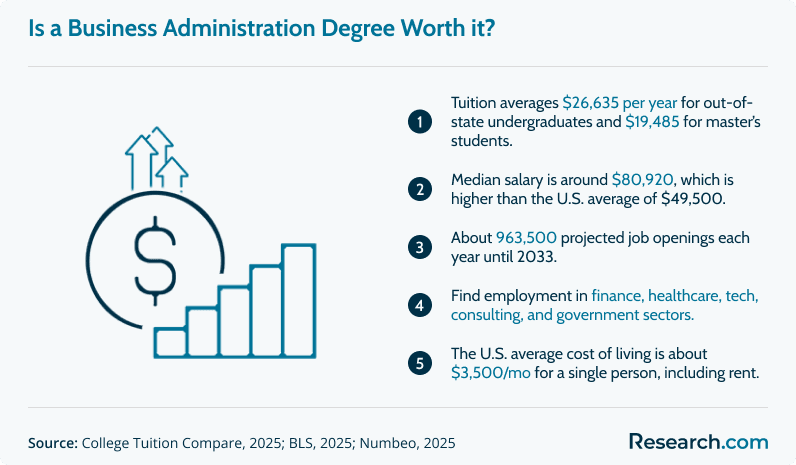
On the cost side, undergraduate tuition averages about $26,635 annually, while master’s programs typically range from $12,000 to $30,000 per year, according to College Tuition Compare. That means the full investment can run anywhere from $36,000 to over $120,000, depending on the school and program structure.
On the earnings and demand side, the U.S. Bureau of Labor Statistics reports a median salary of $80,920 for business and financial occupations. BLS also projects employment in these fields to grow faster than average from 2023 to 2033, with about 963,500 job openings each year, on average, from new growth and workforce replacement needs. Graduates may pursue roles in finance, healthcare, technology, consulting, operations, sales, human resources, and administration, although individual outcomes depend on experience, location, internships, industry, and job search strategy.
Cost of living also matters. With the U.S. cost of living averaging around $3,500 per month for a single person including rent, according to Numbeo, students should compare expected earnings with debt, living expenses, and local labor market conditions. Flexible options such as an online business school may improve the return on investment for students who can keep working while studying.
| A business administration degree may be worth it if... | You may want another path if... |
| You want a broad credential that can apply across industries | You need a highly specialized technical role immediately after graduation |
| You can choose an accredited program with reasonable total costs | The program requires heavy borrowing without clear career support |
| You plan to complete internships, projects, or employer-connected work | You expect the degree alone to guarantee a high salary |
| You are interested in management, operations, sales, HR, finance, or entrepreneurship | You already know you need licensure or a specialized professional degree |
The infographic below summarizes the major factors that affect whether a business administration degree is worthwhile. It highlights tuition costs, salary potential, job market projections, career options, and cost of living, showing why the degree can be a strong option when students manage cost and choose a program with practical career preparation.
What career support and placement services come with a business administration program?
Career support can make a major difference in how well a business administration student moves from coursework to employment. A strong program should not only teach business concepts; it should help students translate those concepts into resumes, interviews, internships, networking conversations, and job offers.
- Career coaching: Advisors or coaches help students clarify target roles, identify transferable skills, choose concentrations, and build a job search plan.
- Resume, cover letter, and interview support: Workshops and one-on-one reviews help students describe projects, internships, leadership experience, and technical tools in employer-friendly language.
- Internship and co-op connections: Employer partnerships can give students experience in marketing, finance, operations, sales, administration, or human resources before graduation.
- Career fairs and employer events: Recruiting events help students meet hiring managers, learn about industries, and practice professional communication.
- Alumni and employer networks: Alumni databases and employer relationships can create referral, mentorship, and informational interview opportunities. Similar career-connection models appear in specialized guides such as what you can do with a master's in nursing education, where professional networks can shape teaching, leadership, and clinical education opportunities.
Before enrolling, students should ask for evidence of career outcomes, not just promises. Useful questions include: Which employers recruit from the program? Are internships required or optional? Do online students receive the same career services as campus students? How long after graduation can alumni use career support?
How flexible is the curriculum—can I pivot into entrepreneurship or international business?
Most business administration programs are intentionally flexible. The core curriculum gives students a foundation in major business functions, while electives, concentrations, minors, certificates, and capstone projects allow them to move toward more specific goals such as entrepreneurship, international business, project management, finance, marketing, or analytics.
Entrepreneurship-focused students may take courses in innovation, venture planning, small business management, venture capital, product development, and business plan creation. International business students may study global finance, cross-cultural management, trade regulations, international marketing, and global supply chains. Some schools also offer study abroad, virtual global projects, or consulting assignments with international components.
Flexibility also depends on delivery format. Some programs use accelerated sessions, stackable credentials, or transfer-friendly structures that help students finish faster. Students with time-sensitive goals can compare options such as the fastest online business administration degree programs while still checking accreditation, workload, course availability, and fit with their preferred concentration.
| If your goal is... | Look for courses or features in... | Ask the school... |
| Starting a business | Entrepreneurship, venture planning, innovation, small business finance | Can I build a business plan or launch project as my capstone? |
| Working globally | International business, global trade, cross-cultural management, international marketing | Are global projects, language options, or study abroad available? |
| Moving into management | Leadership, organizational behavior, human resources, strategy | Are there leadership simulations, team projects, or management internships? |
| Building technical credibility | Business analytics, information systems, data tools, operations technology | Which software, platforms, or analytics tools will I use? |
Will I gain practical experience like internships or capstone projects?
Quality business administration programs usually include applied learning because employers want graduates who can do more than explain business theory. Internships, co-ops, simulations, consulting projects, and capstones help students practice analysis, communication, teamwork, and decision-making in realistic settings.
- Internships and co-ops place students in organizations where they can apply coursework in areas such as marketing, sales, finance, HR, operations, or administration while building professional contacts.
- Capstone projects often require students to analyze a business problem, develop recommendations, prepare written work, and present findings to classmates, faculty, or external partners.
- Team-based senior projects may run across several weeks or terms, requiring students to divide responsibilities, manage deadlines, resolve conflicts, and defend strategic decisions.
Online students should not assume practical experience is missing. Many accredited online business degree programs include virtual consulting projects, remote internships, employer-based assignments, and capstones that can be completed from a distance. The key is to confirm how the program verifies hands-on learning and whether students receive help finding placements.
How do business administration programs prepare me with soft skills?
Business administration programs develop soft skills because business work depends on communication, collaboration, judgment, and adaptability. Technical knowledge matters, but graduates also need to explain ideas clearly, work across departments, manage conflict, lead meetings, and solve problems under pressure.
Programs commonly build these abilities through presentations, group projects, case studies, simulations, peer feedback, writing assignments, and client-style projects. Job postings analyzed by Zippia reveal key sought-after skills include customer service, payroll, PowerPoint, and team support, with customer service appearing on 12% of business administrator resumes. ZipRecruiter confirms that employers highly value communication, administrative support, detail orientation, and technical tools like MS Office.
Students should also expect to practice adaptability, emotional intelligence, time management, conflict resolution, and self-motivation. These skills are not unique to business; professional programs in other fields emphasize them as well. For example, students exploring healthcare leadership can review the reasons to earn a doctorate in nursing practice degree to see how advanced professional education also develops leadership, strategic thinking, and decision-making.
| Skill | How business programs build it | Where it shows up at work |
| Communication | Presentations, reports, case discussions, and pitch assignments | Meetings, client updates, proposals, and executive briefings |
| Teamwork | Group projects, peer reviews, and collaborative simulations | Cross-functional projects, sales teams, operations teams, and committees |
| Problem-solving | Case studies, analytics exercises, and capstone projects | Process improvement, customer issues, budget trade-offs, and planning |
| Leadership | Team roles, management courses, and organizational behavior assignments | Supervision, project coordination, coaching, and change management |
The chart below illustrates common skills associated with business administration roles. It shows the blend of soft skills and technical tools that business programs often emphasize, from communication and customer service to Microsoft Excel and related workplace software.
Can I balance studying business administration with work, family, or other commitments?
Many business administration programs are designed for students who cannot pause their jobs, caregiving responsibilities, military service, or other commitments. Online, hybrid, evening, weekend, part-time, and accelerated formats can make the degree more manageable for working adults and nontraditional students.
Asynchronous courses can be especially helpful because students can watch lectures, complete discussions, and submit assignments without logging in at a fixed time every week. Some programs also offer eight-week courses, mobile-friendly platforms, remote group collaboration tools, online tutoring, digital libraries, and virtual office hours.
However, flexible does not mean easy. Business courses still require reading, writing, quantitative work, group coordination, exams, and projects. Students should estimate weekly study time before enrolling and confirm whether accelerated courses compress the workload. Learners balancing major responsibilities may benefit from taking fewer courses at a time, using employer tuition benefits, planning childcare around deadlines, and choosing programs with predictable course schedules.
| Student situation | Helpful program feature | Potential risk to watch |
| Full-time worker | Asynchronous online courses or evening classes | Overloading on credits while managing work deadlines |
| Parent or caregiver | Part-time pathways and flexible assignment windows | Group projects that require hard-to-schedule meetings |
| Transfer student | Generous transfer credit policy | Losing credits because courses do not match requirements |
| Student seeking faster completion | Accelerated terms or year-round enrollment | Higher weekly workload and less recovery time between courses |
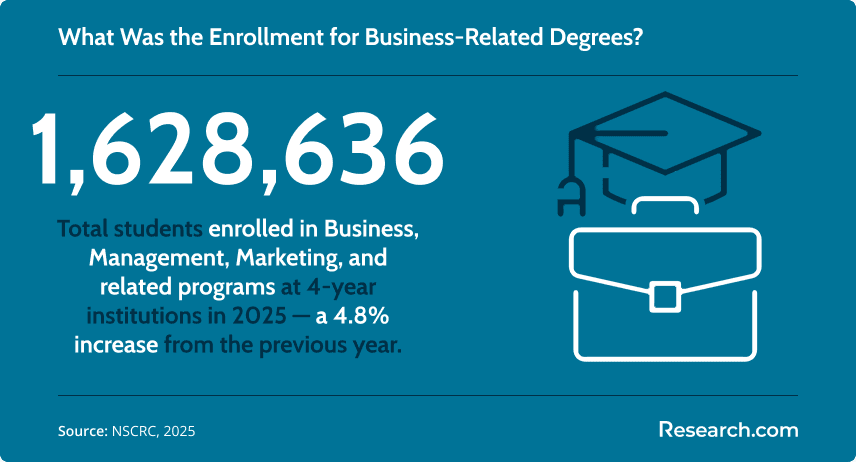
The infographic below shows that more than 1.6 million students enrolled in business-related programs in 2025, a 4.8% increase from the previous year. This growth reflects strong interest in business education and the importance of flexible pathways for students managing school alongside work, family, and other responsibilities.
What resources—like alumni networks or mentorship—will be available to me?
A business administration program can provide value beyond coursework when it gives students access to mentors, alumni, employers, faculty, and peer communities. These networks can help students explore career paths, find internships, prepare for interviews, and stay connected after graduation.
- Alumni networks: Graduates may gain access to professionals across industries who can offer career advice, informational interviews, referrals, or mentoring.
- Mentorship programs: Some schools match students with faculty, alumni, executives, entrepreneurs, or industry professionals for one-on-one guidance.
- Career centers: Career offices may support internship searches, job applications, salary research, resume development, and interview preparation.
- Networking events: Speaker series, employer panels, mixers, and career fairs can help students build contacts before graduation.
- Student and professional organizations: Business clubs, honor societies, entrepreneurship groups, and chamber partnerships can give students leadership practice and early professional exposure.
Students should compare the strength of these resources carefully. A large alumni network is useful only if it is active and accessible. Mentorship is valuable only if students can actually meet with mentors. Career services matter most when they are available to online and part-time learners, not just traditional campus students.
How will a business administration degree compare to more specialized majors?
Business administration is a broad degree. It prepares students to understand multiple business functions rather than becoming deeply specialized in one area from the start. Specialized majors, by contrast, usually provide more focused preparation for a specific field such as finance, marketing, international business, or data analytics.
| Major | Best for students who want... | Main trade-off |
| Business administration | A flexible foundation across management, marketing, finance, HR, operations, and strategy | Less depth in one technical area unless you choose a concentration or electives carefully |
| Finance | Preparation in investments, banking, corporate finance, modeling, and financial analysis | More specialized, but less broad preparation for nonfinance management roles |
| Marketing | Focused study in branding, consumer behavior, digital marketing, campaigns, and analytics | Stronger marketing depth, but less coverage of operations, HR, and finance |
| International business | Preparation for global trade, cross-border management, cultural negotiation, and international markets | More global focus, but may need added language, regional, or technical expertise |
| Data analytics | Training in data modeling, dashboards, statistical tools, and predictive decision-making | More technical, but narrower than a general management degree |
Students who choose business administration can still build targeted expertise through certificates, minors, internships, and electives. For example, professionals interested in tech-adjacent business roles may consider the easiest IT certification options to add technical credibility to a general business background.
The broad nature of business administration can also support advancement into leadership roles over time. Students interested in compensation potential can explore guides to the highest-paying business jobs, while remembering that salary outcomes depend on role, industry, location, experience, and performance.
The chart below compares average annual salaries across business administration and specialized majors. It shows that roles such as international business managers, marketers, and data analysts may earn more in some cases, while business administration remains competitive because it offers a broad foundation for multiple career directions.
Can a business administration degree fast-track entry into project management roles?
A business administration degree can support entry into project management, especially when the program includes coursework in operations, leadership, budgeting, risk, communication, process improvement, and strategy. Some programs also offer electives or tracks covering agile methods, stakeholder management, resource planning, scheduling, and project execution.
Students who know they want project management should look for programs with applied projects, team-based assignments, project management software exposure, and capstones that require planning and delivery. Those who want a more direct route can compare a business administration degree with an accelerated online project management degree, which may provide more targeted preparation in less time.
How are emerging trends reshaping business administration education?
Business administration education is changing as employers expect graduates to understand technology, data, remote collaboration, sustainability, and ethical decision-making. Many programs now include more coursework in analytics, information systems, digital transformation, global markets, responsible leadership, and technology-enabled operations.
Artificial intelligence and automation are also influencing business education. Students increasingly need to know how to use digital tools responsibly, interpret data, evaluate technology-driven decisions, and understand the limits of automated systems. At the same time, human skills such as judgment, communication, leadership, and ethical reasoning remain central because business decisions still affect employees, customers, communities, and investors.
Graduate and undergraduate programs are also changing how courses are delivered. Interactive virtual classrooms, project-based learning, online collaboration tools, simulations, and employer-connected assignments are becoming more common, especially in flexible programs and affordable online MBA programs.
Common mistakes to avoid when choosing a business administration program
| Mistake | Why it can hurt you | Better approach |
| Choosing based only on tuition | The cheapest program may not offer strong support, transfer value, or career preparation | Compare total cost, accreditation, outcomes, course quality, and services |
| Ignoring accreditation | Credits, financial aid, employer recognition, and graduate admissions can be affected | Verify institutional accreditation and review any program-level business accreditation when available |
| Assuming online means less work | Online courses still require consistent study, writing, projects, and exams | Ask about weekly workload, live meeting requirements, and course pacing |
| Skipping internships or applied projects | Graduating without experience can make the job search harder | Prioritize programs with internships, capstones, simulations, or employer projects |
| Relying only on rankings | A highly ranked school may not fit your budget, schedule, location, or goals | Use rankings as one input, then compare fit, cost, support, and outcomes |
| Assuming salary outcomes are guaranteed | Earnings vary by role, experience, location, industry, and job market conditions | Research local jobs, internship access, alumni outcomes, and employer demand |
Questions to ask before enrolling in a business administration program
- Is the institution accredited, and is the business program recognized by employers or graduate schools in my target field?
- What is the total cost of attendance, including tuition, fees, books, technology, housing, transportation, and lost work time?
- How many transfer credits will the school accept, and will they apply to major requirements or only electives?
- Does the program offer concentrations in areas such as entrepreneurship, international business, finance, marketing, analytics, HR, or project management?
- Are internships, co-ops, consulting projects, or capstones required?
- Do online, transfer, and part-time students receive equal access to career services, mentoring, tutoring, and alumni networks?
- What software, analytics tools, case methods, or simulations will I use?
- What roles do graduates commonly pursue, and what evidence does the school provide about outcomes?
- Can I realistically handle the course load with my work and family responsibilities?
- How quickly can I graduate, and will accelerated study affect cost, workload, or financial aid?
Here's What Graduates Have to Say About Their Business Administration Program
- Althea: "Completing business administration online made it possible for me to keep working while caring for my family. The courses were not abstract for me because I could use the concepts immediately at my job. Projects and mentoring helped me feel ready to pursue management responsibilities earlier than I thought I could."
- Renzo: "I enrolled online because I wanted to avoid extra housing and commuting costs. The capstone ended up being one of the most useful parts of the program because I worked with classmates in different locations on a real business problem. I am now earning above the national median salary, and the degree helped me access opportunities I did not have before."
- Mireille: "The flexible format helped me finish school without stepping away from my career or giving up family time. Team assignments pushed me to lead, listen, and solve problems with other people under deadlines. The degree did more than add a credential; it changed how I think about strategy, organizations, and my own career path."
Key Insights
- A business administration degree is broad by design. It is strongest for students who want flexibility across management, finance, marketing, HR, operations, entrepreneurship, or project-based roles.
- The 10 core subjects usually include accounting, business law, marketing, organizational behavior, economics, finance, HR, operations, ethics, and strategic management.
- Cost varies widely. College Tuition Compare reports an average annual undergraduate cost of about $26,635, with public in-state tuition closer to $9,000 and private institutions exceeding $35,000 per year.
- The degree can be worth it when students control costs, choose an accredited program, gain practical experience, and use career services. The BLS reports a median salary of $80,920 for business and financial occupations and faster-than-average projected growth from 2023 to 2033.
- Online and accelerated options can help working adults balance school with other responsibilities, but students should check workload, fees, transfer policies, and support services before enrolling.
- Business administration is not the same as a specialized major. Finance, marketing, international business, and data analytics offer deeper preparation in narrower areas, while business administration offers broader mobility.
- Applied learning matters. Internships, capstones, simulations, and employer-connected projects can be as important as classroom knowledge for improving employability.
- Do not choose a program based only on price or rankings. Accreditation, total cost, career services, curriculum fit, practical experience, and schedule compatibility should drive the final decision.
References:
- Bureau of Labor Statistics. Business and Financial Occupations.
- Bureau of Labor Statistics. Occupational Employment and Wages, Business and Financial Operations Occupations.
- College Tuition Compare. Business Administration and Management Career.
- College Tuition Compare. Business Administration and Management Major.
- Glassdoor. Business Administration Salaries.
- Indeed. Business Administrator Salaries.
- National Student Clearinghouse Research Center. Current Term Enrollment Estimates.
- Numbeo. United States Cost of Living.
- PayScale. Business Administrator Salary.
- Salary.com. Business Administrator Salary.
- Zippia. Business Administrator Education.
- Zippia. Business Administrator Job Skills.
- Zippia. Business Administrator Salaries.
- Zippia. Business Administrator Workforce Demographics.
- Zippia. Data Analyst Salaries.
- Zippia. Finance Professional Salaries.
- Zippia. International Business Manager Salaries.
- Zippia. Marketing Professional Salaries.
- ZipRecruiter. Business Administration: How to Become.
- ZipRecruiter. Business Administration Resume Keywords and Skills.
- ZipRecruiter. Business Administration Salaries.
Other Things You Should Know About the Business Administration Programs
In 2027, a Business Administration program typically includes subjects such as Financial Accounting, Marketing Management, Operations Management, Organizational Behavior, Business Law, and Strategic Management. These core courses provide a well-rounded foundation, equipping students with essential skills for a wide range of business environments.
In 2027, essential subjects for business administration students typically include financial accounting, marketing management, organizational behavior, business analytics, and strategic management. These core areas provide foundational knowledge necessary for understanding complex business operations and decision-making.
Yes, most programs offer concentrations or electives in fields like finance, marketing, human resources, entrepreneurship, or international business. These tracks allow you to focus on your career goals while still gaining the broad foundation of a business administration degree. Specializations are a great way to stand out to employers and tailor your education to the industry you’re targeting.