
2027 Best Online Woodworking Trade School Programs

Co-Founder and Chief Data Scientist
The construction industry has been dealing with a steady shortage of skilled tradespeople. Between 2013 and 2023, employment in key roles dropped anywhere from 6% to 23% (JCHS Harvard, 2025). If you’re good with your hands, that’s not just a number—it’s a clear sign that your skills are needed.
Turning that passion into a stable career requires a strategic approach, and gaining a formal credential through flexible online woodworking programs is the key to a competitive edge.
To help you find the right path, our career planning experts, who bring over a decade of experience in guiding students and professionals, have developed this comprehensive guide. It’s more than a simple list; it's a roadmap to a successful career.
What are the benefits of enrolling in an online woodworking trade school program?
- Online woodworking programs enable you to gain a credential that provides a competitive edge for the best jobs in a stable industry.
- These programs prepare you for careers with high-earning potential, as woodworkers earn a median salary of around $43,720 annually [US Bureau of Labor Statistics (BLS), 2025].
- The online format of these trade school programs lets you learn on a flexible schedule that fits your life, allowing you to study from anywhere.
What can I expect from an online woodworking trade school program?
Online woodworking programs are built on a blended learning model, which is designed to bridge the gap between theory and practice. You’ll study foundational concepts online through virtual lessons lectures and assigned readings, then apply that knowledge with practical projects in your own workspace. It’s a structured approach that effectively builds real-world skills from a distance.
Here’s a breakdown of what you can expect upon enrolling in these programs:
- Comprehensive Curriculum. You’ll cover everything from workshop safety and tool maintenance to advanced joinery and finishing techniques.
- At-Home Projects. Programs often send you materials or provide detailed plans for specific projects, allowing you to practice and develop your craft.
- Professional Instruction. Your instructors are typically vetted, experienced craftspeople who provide feedback on your work and guide your development.
- Hands-on Skill Building. You’ll hone essential woodworking skills like measuring, cutting, shaping, and finishing, while also exploring advanced areas such as cabinetry, furniture making, and CNC machining.
- Career-Ready Credentials. Successful completion typically leads to a certificate or diploma that validates your training and enhances your career prospects in woodworking or related trades.
Ultimately, you can expect a learning experience that combines theory, practical application, and flexibility. This is especially important considering the woodworking industry is constantly evolving, with 44% of construction firms investing in new technology in recent years (AGC , 2025).
A quality woodworking program prepares you for this modern landscape by giving you a structured, expert-led path to professional competence.
Where can I work after completing an online woodworking trade school program?
A formal credential in woodworking opens doors to stable career paths, primarily within the manufacturing and construction sectors. While starting your own business is an option, the vast majority of jobs are with established companies that value professionally trained craftspeople.
Here are the largest employers of woodworkers as of 2023, according to the latest data from the US BLS (2025):
- Furniture Manufacturing (39%): This is the largest sector, with roles in large-scale production facilities creating residential and commercial furniture.
- Wood Product Manufacturing (36%): This includes creating items like kitchen cabinets, architectural millwork, windows, and doors for the construction industry.
- Self-Employment (9%): For those with an entrepreneurial drive, you can establish a business creating custom furniture or providing specialized repair services.
- Specialty Trades (3%): This includes niche, high-skill areas like boat building, musical instrument making, or historical restoration projects.
The abovementioned industries aside, woodworking program graduates can also work in the construction and remodeling sector as finish carpenters or installers.
It’s important to note that these roles aren’t just niche specialties—they’re part of a much larger ecosystem.
The forest products industry, for example, ranks among the top manufacturing employers in 45 states (USDA Forest Service, 2025). This underscores how deeply woodworking and similar trades are woven into the U.S. economy and how much stability they provide for skilled professionals.
How much can I make after completing an online woodworking trade school program?
According to US BLS (2025), woodworkers earn a median annual salary of about $43,720. Think of this as a mid-career benchmark rather than a starting point.
As a new graduate, you’ll likely begin at an entry-level wage. But with a formal credential, you set yourself up for steady growth. The more experience you gain and the more specialized your skills become, the closer you’ll move toward—and often beyond—that median figure.
Experience level aside, your location may also influence your earning potential. For instance, woodworkers based in Washington can earn an average annual salary of $52,088 while those in Florida earn roughly $34,368 per year (ZipRecruiter, 2025).
- List of the Best Online Woodworking Trade School Programs for 2027 List of Programs
- How long does it take to complete an online woodworking trade school program? Completion Time
- How does an online woodworking trade school program compare to an on-campus program? How does an online woodworking trade school program compare to an on-campus program?
- What is the average cost of an online woodworking trade school program? Average Cost
- What are the financial aid options for students enrolling in an online woodworking trade school program? Financial Aid
- What are the prerequisites for enrolling in an online woodworking trade school program? Admission Requirements
- What courses are typically in an online woodworking trade school program? What courses are typically in an online woodworking trade school program?
- What types of specializations are available in an online woodworking trade school program? Specializations
- How to Choose the Best Online Woodworking Trade School Program How to Choose the Best Online Woodworking Trade School Program
- What career paths are available for graduates of an online woodworking trade school program? Career Paths
- What is the job market for graduates of an online woodworking trade school program? Job Market
- How Does Accreditation Impact Your Woodworking Credential's Value? How Does Accreditation Impact Your Woodworking Credential's Value?
- What challenges should you anticipate with online woodworking training? What challenges should you anticipate with online woodworking training?
Choosing an online woodworking trade school is not the same as signing up for casual weekend project videos. A trade program should help you build safe shop habits, learn joinery and finishing to a professional standard, understand drawings and measurements, and develop a portfolio that can support entry-level work in cabinetmaking, furniture production, architectural millwork, finish carpentry, or custom woodworking.
This guide is for students who want structured woodworking training but need to compare online, hybrid, and campus-based options carefully. You will learn which programs stand out, how long training takes, what it may cost, how accreditation affects financial aid and employer recognition, what courses and specializations to expect, and how to judge whether an online format fits your tools, workspace, schedule, and career goals.
Quick Answer: What Should You Know Before Choosing an Online Woodworking Trade School?
An online woodworking trade school can be a practical choice if you are self-motivated, have access to a safe workspace, and are prepared to buy or use the tools required for assigned projects. Certificate and diploma programs are often faster than associate degrees, while on-campus programs usually provide stronger access to professional equipment, direct supervision, and peer learning.
The best choice is not always the lowest-cost program. Before enrolling, verify accreditation, compare total costs beyond tuition, review the exact tool list, ask how instructors evaluate hands-on work, and confirm whether the curriculum matches your intended path, such as cabinetmaking, furniture design, CNC woodworking, or architectural millwork.
List of the Best Online Woodworking Trade School Programs for 2027
How do we rank schools?
Because trade school tuition, tools, and supplies can add up quickly, our ranking process emphasizes transparency, program quality, and student decision-making value. The goal is to help prospective students compare woodworking programs using consistent information rather than relying only on marketing claims.
Research.com reviews data from trusted education sources, including the IPEDS database, Peterson's database, the College Scorecard database, and the National Center for Education Statistics. These sources help support comparisons related to institutional profile, cost, completion, and student outcomes where available. You can review the broader ranking approach on Research.com’s methodology page.
| Program | Credential | Length | Cost Information | Accreditation |
| Sam Beauford Woodworking Institute | Professional Diploma in Wood Design | 40 weeks | $15,110 total tuition | Accrediting Commission of Career Schools and Colleges (ACCSC) |
| Bucks County Community College | Certificate Program in Furniture and Cabinetmaking | 12-24 months | $170 per credit in-state; $250 per credit out-of-state | Middle States Commission on Higher Education (MSCHE) |
| Northwood Technical College | Technical Diploma in Architectural Woodworking and Cabinetmaking | 1 year | $168.10 per credit in-state; $244.53 per credit out-of-state | Higher Learning Commission (HLC) |
| Red Rocks Community College | Fine Woodworking AAS Degree | 2 years | $403.50 per credit in-state; $438.40 per credit out-of-state | Higher Learning Commission (HLC) |
| Fox Valley Technical College | Technical Diploma in Woodworking Technology | 2 years | $149.50 per credit in-state; $263.65 per credit out-of-state | Higher Learning Commission (HLC) |
1. Sam Beauford Woodworking Institute – Professional Diploma in Wood Design
Sam Beauford Woodworking Institute offers a professional diploma built around furniture design, fine craftsmanship, and career preparation. Students study hands-on methods such as joinery, carving, and finishing while also learning design history, workflow planning, project management, and business practices that can support work in custom furniture or independent shop settings.
- Program Length: 40 weeks
- Required Credits to Graduate: Contact the school for more information.
- Total Tuition: $15,110
- Accreditation: Accrediting Commission of Career Schools and Colleges (ACCSC)
2. Bucks County Community College – Certificate Program in Furniture and Cabinetmaking
Bucks County Community College provides a certificate pathway for students who want foundational training for entry-level woodworking roles. The program combines furniture history, design concepts, tool safety, material preparation, and project-based work so students can begin building a portfolio that demonstrates practical skill.
- Program Length: 12-24 months
- Required Credits to Graduate: 31
- Cost per Credit: $170 (in-state); $250 (out-of-state)
- Accreditation: Middle States Commission on Higher Education (MSCHE)
3. Northwood Technical College – Technical Diploma in Architectural Woodworking and Cabinetmaking
Northwood Technical College focuses its technical diploma on the production and installation skills used in cabinet shops, architectural woodworking, and interior finish work. Students study blueprint reading, CNC machinery, shop safety, and equipment operation for professional-grade woodworking environments.
- Program Length: 1 year
- Required Credits to Graduate: 29
- Cost per Credit: $168.10 (in-state); $244.53 (out-of-state)
- Accreditation: Higher Learning Commission (HLC)
4. Red Rocks Community College – Fine Woodworking AAS Degree
Red Rocks Community College offers an associate degree for students who want a deeper academic and studio-based woodworking experience. The curriculum combines furniture design, traditional craft techniques, contemporary woodworking practices, and general education courses, making it suitable for students seeking portfolio development, employment preparation, or possible transfer options.
- Program Length: 2 years
- Required Credits to Graduate: 60
- Cost per Credit: $403.50 (in-state); $438.40 (out-of-state)
- Accreditation: Higher Learning Commission (HLC)
5. Fox Valley Technical College – Technical Diploma in Woodworking Technology
Fox Valley Technical College delivers a woodworking technology diploma that prepares students for cabinetmaking, millwork, and production-oriented roles. Coursework includes hand tool use, machine operation, AutoCAD, CNC equipment, and workplace readiness skills relevant to professional woodworking shops.
- Program Length: 2 years
- Required Credits to Graduate: 37
- Cost per Credit: $149.50 (in-state); $263.65 (out-of-state)
- Accreditation: Higher Learning Commission (HLC)
How long does it take to complete an online woodworking trade school program?
Many online woodworking certificate programs can be completed in 6 to 12 months with full-time study, though the actual pace depends on the school, the number of required projects, your access to tools, and whether you study part time. Diploma and associate degree options can take longer, especially when they include broader technical training or general education courses.
This timeline is common in hands-on trades where students need concentrated skill development before seeking entry-level work. A similar training model appears in other skilled trade pathways, including programs described in Research.com’s guide on how to become a welder.
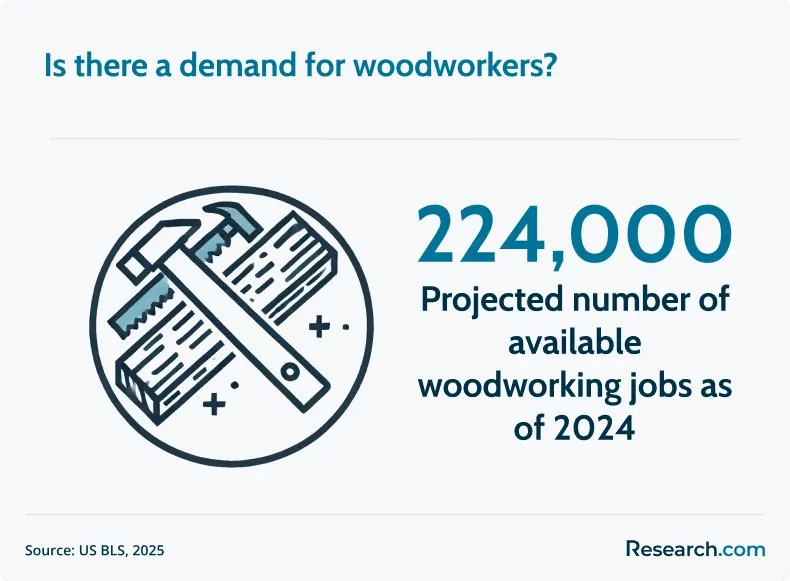
The purpose of a structured program is to move you from basic familiarity to job-ready competence as efficiently as possible. Woodworking is connected to an active labor market, with an estimated 224,000 available positions, but students should still expect competition and should build a portfolio that shows measurable skill.
| Credential Type | Typical Time Commitment | Best For | Trade-Off |
| Short certificate | 6 to 12 months | Students who want focused skills and faster workforce entry | May offer less depth in design, CNC, business, or advanced finishing |
| Technical diploma | 1 year to 2 years | Students targeting cabinet shops, millwork, machine operation, or production roles | Requires more time and often more project work |
| Associate degree | 2 years | Students who want broader education, portfolio development, and possible transfer options | Usually requires the longest commitment and more total credits |
How does an online woodworking trade school program compare to an on-campus program?
The right format depends on how you learn physical skills, what tools you already have, and how much direct supervision you need. Online woodworking training can work well for disciplined students with a safe shop setup, while campus programs usually offer better access to industrial equipment, instructor observation, and in-person troubleshooting.
If you are comparing hands-on and digital training options more broadly, it may also help to understand how flexible online credentials work in other creative and technical fields, such as an online UX design certification. The key difference is that woodworking requires physical tools, materials, and safety controls, so online convenience must be weighed against shop access.
| Factor | Online Woodworking Program | On-Campus Woodworking Program |
| Schedule | Often more flexible, especially for working adults or students with family responsibilities | Usually follows fixed class times, lab sessions, and shop schedules |
| Tools and workspace | You may need to supply your own tools, bench space, lumber, dust collection, and safety equipment | The school typically provides access to a supervised shop and professional equipment |
| Instructor feedback | Feedback may come through photos, videos, online meetings, or project submissions | Instructors can observe technique in real time and correct unsafe or inefficient habits quickly |
| Cost structure | Tuition may be lower, but tool and material costs can be significant | Tuition may be higher, but shared shop access can reduce the need to buy equipment immediately |
| Peer learning | Depends on discussion boards, critiques, or virtual project reviews | Students can learn by watching classmates solve layout, joinery, and finishing problems |
Which format is the better fit?
An online program makes sense if you already have basic shop access, can follow safety instructions independently, and need a schedule that fits around work or caregiving. This format is similar in convenience to other flexible graduate and professional programs, such as a TESOL masters online, but woodworking requires more self-managed practice than most fully digital fields.
A campus program is usually stronger if you are new to power tools, do not have space for a workshop, or want immediate correction from instructors. Beginners often benefit from supervised practice because small technique errors can affect project quality, tool safety, and material waste.
Questions to ask before choosing online woodworking training
- What tools are required before the first course? Ask for a complete list, not a general description.
- How are projects evaluated? Find out whether instructors review photos, videos, live demonstrations, measurements, or shipped work.
- What safety expectations apply to home shops? Confirm requirements for dust control, eye and hearing protection, ventilation, and machine setup.
- Can you access local partner facilities? Some students may need community workshops, maker spaces, or employer-based shop access.
- How much instructor interaction is included? A strong online program should provide more than prerecorded lessons.
What is the average cost of an online woodworking trade school program?
Online woodworking trade school tuition generally ranges from around $4,707 to $16,947. That amount usually covers access to lessons, demonstrations, learning materials, project instructions, and online student resources, but it may not represent the full cost of attendance.
Students should budget separately for lumber, hardware, finishes, blades, sharpening supplies, safety gear, measuring tools, clamps, dust collection, and any required technology fees. In woodworking, the “hidden” costs are often practical rather than academic: you need the materials and equipment to complete assigned work safely and accurately.
This cost range is similar to some other skilled trade pathways. For comparison, Research.com also reviews affordable online welding trade school programs for students weighing trade training options with different equipment and safety requirements.
When evaluating affordability, compare the total investment with your intended career path, not just the advertised tuition. A low-cost program may be less useful if it lacks instructor feedback, requires expensive tools you do not own, or does not teach the specialty you want to pursue.
Available earnings data also matters, but it should not be treated as a guarantee. Skilled woodworking professionals in the top 25% of earners make over $54,340 annually, which shows that advanced skill, experience, specialization, and business ability can improve income potential over time.
| Cost Category | Why It Matters | What to Ask the School |
| Tuition | This is the base price for instruction and program access | Is tuition charged per credit, per term, or as one program fee? |
| Tools | Online students may need to purchase equipment that campus students use in school shops | Which tools are required, recommended, or optional? |
| Materials | Projects require wood, hardware, adhesives, finishes, sandpaper, and replacement supplies | Does the program provide a project-by-project materials estimate? |
| Technology fees | Some online programs charge fees for platforms, software, or digital access | Are technology fees included in tuition or billed separately? |
| Travel or shop access | Hybrid programs or students using shared workshops may face local travel costs | Are any in-person sessions, exams, or shop assessments required? |
What are the financial aid options for students enrolling in an online woodworking trade school program?
Financial aid is not limited to bachelor’s degree students. Depending on the school and program, woodworking trade students may be able to use federal aid, grants, scholarships, payment plans, or loans to reduce upfront costs.
- Federal Student Aid: Start by completing the Free Application for Federal Student Aid (FAFSA). The FAFSA is used to determine eligibility for federal aid programs, including the Pell Grant, which does not have to be repaid.
- Scholarships and Grants: Look for awards aimed at skilled trades, construction, manufacturing, craft education, and woodworking. Examples include the DEWALT Trades Scholarship and scholarships from organizations such as the Wood Industry Association (WIA).
- School Payment Plans: Some schools allow students to divide tuition into scheduled payments instead of paying the full amount at once. This can help reduce the need for borrowing.
- Private Loans: A private loan from a bank or credit union may cover a remaining balance, but it should generally be considered after grants, scholarships, and lower-cost options.
Always confirm whether the specific program, not just the institution, is eligible for aid. Accreditation can affect aid access, credit transfer, and employer confidence, so ask the financial aid office and admissions office to explain eligibility in writing before you enroll.
What are the prerequisites for enrolling in an online woodworking trade school program?
Admissions requirements for woodworking trade programs are usually more accessible than selective college degree programs. Schools typically want to know that you meet basic education requirements, can participate safely, and have the technology and workspace needed to complete assignments.
This practical admissions model is common in technical education. For example, online solar technician training also tends to emphasize applied readiness and technical learning rather than a highly competitive academic admissions process.
- Educational Background: A high school diploma or GED certificate is commonly required.
- Minimum Age: Many programs expect students to be at least 18 years old, though some schools may consider younger applicants with parental consent.
- Technical Requirements: Students need a dependable computer, stable internet access, and the ability to use the school’s learning platform.
- Placement Tests: Some trade schools may use placement assessments to evaluate reading, math, measurement, or other skills connected to the program.
What courses are typically in an online woodworking trade school program?
A serious woodworking trade curriculum should go beyond project demonstrations. It should teach safety, planning, measurement, tool setup, material behavior, joinery, finishing, and professional documentation so students can complete work consistently rather than relying on trial and error.
As with accelerated academic pathways such as fastest online anthropology degree programs, a compressed format only works when the curriculum is organized and sequenced carefully. In woodworking, that sequence matters because advanced work depends on precise fundamentals.
- Safety and Shop Practices: Students learn machine safety, personal protective equipment, dust control, workspace organization, and safe operating procedures.
- Hand and Power Tool Skills: Courses cover selection, setup, maintenance, and correct use of tools such as chisels, hand planes, table saws, routers, and sanders.
- Wood Joinery: Students practice joints such as mortise and tenon, dovetails, dados, rabbets, and other construction methods used in furniture and cabinetry.
- Finishing Techniques: Instruction may include surface preparation, sanding sequences, staining, sealing, topcoats, and troubleshooting finish defects.
- Blueprint Reading and Design: Students learn how to interpret drawings, dimensions, cut lists, and design intent before building. This design foundation overlaps with skills used in broader building fields, including programs such as fast-track online architecture degrees.
Formal training can also help students stand out in a field where many workers learn informally. Among woodworking machine setters, 50% of workers have a high school diploma or equivalent (CareerOneStop, 2025), so a postsecondary credential and strong project portfolio can signal additional preparation to employers.
What types of specializations are available in an online woodworking trade school program?
Specialization helps you move from general project work toward a clearer professional identity. A student who wants to build custom dining tables needs different training priorities than someone aiming for CNC cabinet production, finish carpentry, or instrument making.
| Specialization | What You Learn | Best Fit For |
| Cabinetmaking | Precise casework, doors, drawers, hardware, installation, and shop production methods | Students interested in kitchens, bathrooms, offices, and commercial built-ins |
| Furniture Design and Building | Furniture forms, joinery, proportion, material selection, and standalone piece construction | Students who want to create tables, chairs, dressers, benches, and custom pieces |
| Architectural Woodworking | Trim, molding, stair parts, wall panels, built-ins, and interior finish elements | Students drawn to construction, remodeling, and high-end interiors |
| Luthiery | Instrument construction, acoustics, shaping, bracing, finishing, and precision handwork | Students interested in guitars, violins, and other stringed instruments |
| Woodturning | Lathe operation, spindle work, bowls, decorative forms, and curved components | Students who enjoy rounded forms, decorative work, and specialty components |
Cabinetmaking and architectural woodworking are especially connected to residential construction and remodeling. Students interested in those paths may also find related training options in Research.com’s guide to the cheapest home remodeling and repair trade school programs online.
How to Choose the Best Online Woodworking Trade School Program
The best woodworking program is the one that matches your career target, current skill level, tool access, budget, and need for instructor feedback. A fast program can be useful, but only if it teaches the techniques and safety practices required for the kind of work you plan to do.
- Confirm accreditation first. Look for recognized institutional accreditation, such as ACCSC or a regional accreditor approved by the U.S. Department of Education. Accreditation can affect aid eligibility, credit transfer, and employer trust.
- Match the curriculum to your goal. Choose furniture-focused training for custom design work, cabinetmaking courses for residential and commercial casework, and CNC or production training for manufacturing roles.
- Review instructor qualifications. Strong programs use instructors with real industry experience, not only classroom knowledge.
- Ask how hands-on work is assessed. Online woodworking requires a clear system for evaluating measurements, joinery quality, finish quality, and safe process.
- Compare total program cost. Add tuition, tools, lumber, finishing materials, hardware, software, technology fees, and any required travel.
- Evaluate career support. Look for portfolio guidance, resume help, employer connections, apprenticeship leads, or job placement resources.
- Check whether modern tools are included. CAD/CAM, CNC equipment, digital drawings, and business basics can be valuable if you want to work in a professional shop or start your own.
Common mistakes to avoid
| Mistake | Why It Can Hurt You | Better Approach |
| Choosing only by tuition | A cheap program may require expensive tools or provide limited instructor support | Compare full cost and educational value |
| Ignoring accreditation | You may limit financial aid access or reduce credential recognition | Verify institutional and program details before applying |
| Underestimating tool needs | You may be unable to complete projects safely or on time | Request the complete tool and material list in advance |
| Assuming online means easy | Woodworking requires repetition, measurement accuracy, and disciplined safety habits | Set weekly shop hours and project milestones |
| Skipping portfolio planning | Employers and clients need proof of skill, not just a credential | Photograph projects, document processes, and save finished work examples |
What career paths are available for graduates of an online woodworking trade school program?
The U.S. woodworking industry includes production shops, cabinet manufacturers, custom furniture studios, construction firms, architectural millwork companies, and self-employed craftspeople. Graduates often begin in production or assistant roles and then move toward more specialized or independent work as their skill and portfolio improve.
- Woodworking Machine Operator: Sets up and runs equipment such as CNC routers, saws, planers, and automated production machinery in manufacturing environments.
- Cabinetmaker: Builds and installs cabinets for homes, offices, kitchens, bathrooms, and commercial interiors.
- Finish Carpenter: Installs detailed interior woodwork, including trim, molding, built-ins, stair components, and other final-stage construction elements.
- Furniture Maker: Creates standalone furniture pieces for custom clients, small shops, or larger manufacturers.
Self-employment is also a realistic path for some experienced woodworkers. BLS data shows that 9% of woodworkers are self-employed (BLS, 2025), which means business skills, pricing, customer communication, scheduling, and materials management can be just as important as craftsmanship.
Students who eventually want to run a custom shop may benefit from business training in addition to technical woodworking. Some entrepreneurs later consider broader business education, including options such as the fastest online master's degree in entrepreneurship programs.
Woodworking careers are also shaped by the larger construction, housing, manufacturing, and remodeling markets. Labor conditions, material costs, safety practices, and consumer demand can all affect hiring and project availability.
What is the job market for graduates of an online woodworking trade school program?
The job market for woodworkers is competitive, and students should enter the field with realistic expectations. Interest in construction-related trades remains visible, including the continued attention around carpentry jobs, but demand varies by region, specialty, employer, and economic conditions.
Recent U.S. BLS data (2025) projects a slight decline (-2%) in demand for woodworkers over the next decade. That does not mean opportunities disappear; it means graduates should compete with stronger skills, better portfolios, and familiarity with modern shop technology. The broader furniture market remains economically significant, with the U.S. furniture market alone generating over $253 billion annually.
Current Trends Affecting Woodworking Training and Careers
- CNC and digital fabrication skills matter more. Many employers value workers who can operate or understand CNC routers, digital drawings, and production software.
- Portfolio proof is increasingly important. A credential helps, but photos, project notes, and finished pieces often carry major weight with employers and clients.
- Online training is expanding, but hands-on verification remains essential. Students should look for programs that provide detailed feedback on actual project work, not only video lessons.
- Construction and remodeling conditions influence demand. Cabinetmaking, finish carpentry, and architectural woodworking are closely tied to residential and commercial building activity.
- Business skills can separate independent woodworkers from hobbyists. Pricing, contracts, estimating, sourcing, and client management affect whether custom work is profitable.
Here’s What Graduates Have to Say about Their Online Woodworking Trade School Program
- Henry: "Before enrolling, I could operate a table saw, but I did not know how to estimate a built-in bookcase or prepare a professional contract. The business section ended up being the part I used most. It showed me how to price labor, track materials, and plan project time, which helped turn my woodworking into paid client work."
- Carlos: "A campus program was not realistic for me with two young children at home. The online format let me watch lessons at night and complete projects in my garage after bedtime. I could train for a different career without stepping away from my family responsibilities."
- Samantha: "I was skeptical about learning precise woodworking techniques online. The videos were detailed, and my instructor’s comments on my joinery photos were specific enough to change how I worked. I stopped guessing and started understanding what clean, accurate craftsmanship actually required."
How Does Accreditation Impact Your Woodworking Credential's Value?
Accreditation is one of the first things to verify because it signals that a school has been reviewed against recognized education standards. For students, accreditation may influence financial aid eligibility, credit transfer, employer confidence, and the overall credibility of the credential.
Accreditation does not guarantee a job or a salary. However, it can help separate structured career training from informal instruction. If you are comparing trade certificates with other career-focused credentials, Research.com’s guide to certificates that pay well can help you think about credential value, career fit, and return on investment.
What challenges should you anticipate with online woodworking training?
Online woodworking can be effective, but it places more responsibility on the student. You may not have an instructor standing beside you to correct posture, blade setup, feed rate, joinery layout, or finishing technique in real time. That can slow progress if the program does not provide strong feedback systems.
The other major challenge is workspace. A safe woodworking area needs more than a bench and a few tools. Students may need dust management, ventilation, storage, clamps, measuring equipment, stable power, and enough room to handle lumber safely. If your home setup is limited, ask whether the school allows work through local shops, maker spaces, employer facilities, or supervised partner sites.
Cost planning is also important. Students looking for lower-cost online education more broadly can compare funding and institutional options through resources such as Research.com’s guide to the cheapest online college options that accept FAFSA, while still confirming whether a specific woodworking program qualifies for aid.
Practical Steps Before You Enroll
- Define your target job first. Decide whether you want cabinetmaking, furniture work, finish carpentry, machine operation, architectural millwork, or self-employment.
- Request the full curriculum. Look for safety, joinery, tool use, finishing, drawing interpretation, materials, and career preparation.
- Get the tool and materials list. Estimate what you already own and what you must buy before the first project.
- Verify accreditation and aid eligibility. Confirm both with the school and through official financial aid channels.
- Ask about feedback. A credible online program should explain exactly how instructors review hands-on work.
- Compare total cost, not just tuition. Include tools, consumables, software, fees, and possible shop rental.
- Build a portfolio from day one. Document drawings, process photos, mistakes corrected, and finished projects.
Key Insights
- Online woodworking trade school is best for disciplined students with shop access. If you lack tools, space, or confidence with machine safety, an on-campus or hybrid program may be a better starting point.
- Program length varies by credential. Many certificates can take 6 to 12 months, while technical diplomas and associate degrees may take 1 year to 2 years.
- Total cost includes more than tuition. Online students should budget for lumber, finishes, hardware, safety gear, tools, technology fees, and workspace needs.
- Accreditation matters. It can affect financial aid, transfer options, and employer confidence in your training.
- Career outcomes depend on skill and proof of work. A credential helps, but employers and clients also want to see accurate joinery, clean finishes, safe habits, and completed projects.
- The market is competitive. BLS data projects a slight decline (-2%) in demand for woodworkers, so specialization, CNC familiarity, and portfolio quality can improve your competitiveness.
- Business skills are valuable for independent woodworkers. Since 9% of woodworkers are self-employed, pricing, contracts, estimating, and client management can directly affect long-term success.
References:
- Associated General Contractors of America (2025). The 2025 construction hiring and business outlook. Retrieved August 27, 2025, from https://www.agc.org/2025-construction-hiring-and-business-outlook
- CareerOneStop (2025). Woodworking machine setters, operators, and tenders, except sawing. Retrieved August 27, 2025, from https://www.careeronestop.org/Toolkit/Careers/Occupations/occupation-profile.aspx
- Joint Center for Housing Studies of Harvard University (2025). Improving America's housing 2025. Retrieved August 27, 2025, from https://www.jchs.harvard.edu/improving-americas-housing-2025
- Research and Markets (2024). United States construction market report and forecast 2024-2032. Retrieved August 27, 2025, from https://www.researchandmarkets.com/report/united-states-construction-market
- Statista (2025). Furniture - United States. Retrieved August 27, 2025, from https://www.statista.com/outlook/cmo/furniture/united-states
- U.S. Bureau of Labor Statistics (2024). Occupational employment and wage statistics (OEWS) profiles: 11-3012 administrative services managers. Retrieved August 27, 2025, from https://data.bls.gov/oesprofile
- U.S. Bureau of Labor Statistics (2025). Occupational outlook handbook: Woodworkers. Retrieved August 27, 2025, from https://www.bls.gov/ooh/production/woodworkers.htm
- U.S. Department of Agriculture, Forest Service (2025). Forest products. Retrieved August 27, 2025, from https://research.fs.usda.gov/forestproducts
- ZipRecruiter (2025). What is the average woodworking salary by state. Retrieved August 27, 2025, from https://www.ziprecruiter.com/Salaries/What-Is-the-Average-Woodworking-Salary-by-State
Other Things You Should Know About Online Woodworking Trade School Programs
In 2027, several online woodworking trade school programs have gained recognition. Popular choices include the Woodworkers Guild of America, Craftsy's woodworking courses, and The Ultimate Online Woodworking School. These programs offer comprehensive curriculums covering fundamentals, advanced techniques, and project-based learning.
When selecting the best online woodworking trade school in 2027, consider factors like accreditation, experienced faculty, comprehensive curriculum, and access to resources like video tutorials or live demonstrations. Additionally, assess the cost, duration, and the flexibility of their programs to fit your schedule.
In 2027, one highly ranked online woodworking trade school is the New England School of Woodworking, known for its comprehensive curriculum, expert instructors, and flexible online options. The school offers a variety of courses from beginner to advanced levels, focusing on both practical skills and theoretical knowledge.


