2027 Most Affordable Online Appliance Repair Trade School Programs

Co-Founder and Chief Data Scientist
Choosing an appliance repair trade school is usually a practical decision: you want job-ready training, a reasonable price, and a pathway that does not require a four-year degree. Across the U.S., nearly 32,000 individuals work as home appliance repairers, servicing refrigerators, ovens, washers, dryers, dishwashers, and other equipment that households and businesses rely on every day.
Online appliance repair programs can be a good fit for adults who need flexible training, people changing careers, high school graduates seeking a skilled trade, or technicians who want to add appliance diagnostics to an existing maintenance background. The key is knowing which programs offer real technical value, what they cost, how much hands-on practice you will need, and whether the credential will help you meet your career goals.
This guide reviews affordable online appliance repair trade school options, explains what these programs teach, compares online and campus-based training, and breaks down salary, job outlook, prerequisites, specializations, and common mistakes to avoid before enrolling.
Quick answer: Is an online appliance repair trade school worth it?
An online appliance repair trade school can be worth it if you want a low-cost, flexible route into hands-on technical work and you are prepared to practice with tools outside the online classroom. These programs are usually shorter and less expensive than degree programs, and they can help you build foundational skills in electrical systems, diagnostics, appliance components, safety, and customer service.
However, online training is not automatically enough by itself. The best outcomes usually come from pairing coursework with hands-on practice, mentorship, field experience, or additional certifications in areas such as refrigeration, gas appliances, HVAC, or electrical systems.
What are the benefits of getting into an online appliance repair trade school?
- Flexible training: Online programs allow you to study around work, family, or school commitments instead of attending scheduled classes on campus.
- Short completion timeline: Many programs can be completed in a few weeks to a few months, making this a relatively fast way to prepare for entry-level repair work or self-employment.
- No four-year degree requirement: Appliance repair is a skills-based field, so training, practice, troubleshooting ability, and professionalism often matter more than a traditional bachelor’s degree.
- Income potential: Home appliance repairers earn an annual average wage of around $50,000, with some earning upwards of $70,000, depending on the experience level or advanced certifications.
- Business potential: The trade can support independent work, especially for technicians who develop strong customer service, scheduling, pricing, and local marketing skills.
What can I expect from an affordable online appliance repair trade school program?
An affordable online appliance repair program usually focuses on practical diagnostics rather than broad academic coursework. Students learn how major appliances operate, how to identify common failures, how to use test instruments safely, and how to decide whether a part should be repaired or replaced.
Most programs combine recorded lessons, diagrams, quizzes, troubleshooting examples, and self-paced assignments. Some also include instructor forums, peer communities, employer dashboards, tool discounts, or certification preparation.
| Program feature | What it usually includes | Why it matters |
| Core technical instruction | Electricity, motors, gas systems, wiring, appliance parts, and diagnostic processes | Builds the foundation needed to troubleshoot multiple appliance types instead of memorizing one brand or model |
| Appliance-specific training | Washers, dryers, refrigerators, freezers, ranges, ovens, cooktops, and dishwashers | Helps students understand the systems they are most likely to encounter in residential service calls |
| Safety procedures | Electrical safety, gas safety, tool handling, and proper testing methods | Reduces risk when working around live circuits, moving parts, heat, water, and gas-powered equipment |
| Career preparation | Customer communication, estimates, service documentation, and workplace professionalism | Prepares students for real service calls where trust, accuracy, and clear communication matter |
| Online access | Self-paced lessons, digital materials, videos, forums, and online assessments | Makes training more accessible for working adults and students outside major metro areas |
Where can I work with an appliance repair trade school degree?
Graduates of online appliance repair trade school programs can work in settings where appliances, mechanical systems, electrical components, and customer service intersect. Some roles are residential and customer-facing, while others are located in retail, distribution, facilities, or contractor environments.
- Personal and household goods repair and maintenance: Technicians diagnose and repair appliances in customers’ homes, service shops, or small repair businesses. This is one of the most direct applications of appliance repair training.
- Electronics and appliance retailers: Retailers may hire technicians to support installations, warranty service, product testing, customer questions, and post-sale repairs.
- Merchant wholesalers, durable goods: Repairers in warehouse or distribution environments may inspect, test, refurbish, or repair appliances before they are sold or delivered.
- Furniture and home furnishings retailers: Stores that sell appliances with home furnishings may need technicians for display units, delivery issues, installation support, and customer service claims.
- Building equipment contractors: Contractors may use appliance repair skills for kitchens, laundry rooms, shared housing facilities, commercial spaces, or renovation projects.
Appliance repair skills can also transfer into construction, real estate, facilities maintenance, commercial machinery maintenance, and corporate building operations. In those environments, technicians may install, maintain, inspect, or repair appliances in newly built homes, renovated units, offices, multifamily properties, or large facilities.
Some repairers also branch into adjacent technical fields. For example, graduates of affordable online electrician certification online programs may pursue overlapping work involving wiring, circuits, safety procedures, and installation support. Appliance repairers who keep expanding their technical range can become more valuable in residential, commercial, industrial, corporate, and utility-related settings.
How much can I make with an appliance repair trade school degree?
According to the U.S. Bureau of Labor Statistics, home appliance repairers earn an average annual salary of $53,580. Workers in the 10th percentile earn $33,280, while those in the 90th percentile earn $77,800. Actual earnings depend on experience, employer type, location, workload, specialization, and whether the technician is employed or self-employed.
Industry can make a significant difference. Repairers in the natural gas distribution industry earn the highest wages for the occupation, at $98,900. These jobs can involve more complex responsibilities tied to the safe installation, maintenance, and operation of gas-powered appliances in residential and commercial environments.
Location also affects pay. Home appliance repairers in Massachusetts earn the most ($68,070), followed by Virginia ($64,870) and New Jersey ($64,120). Some metropolitan areas, including St. Louis, MO-IL and Kansas City, MO-KS, report earnings beyond $75,000, which may reflect stronger demand, higher-cost markets, or a larger concentration of residential and commercial clients needing service.
Additional credentials can also expand earning potential. A technician who moves into HVAC installation and maintenance may earn as much as $62,690. Self-employed repairers may increase income by setting their own rates, building repeat customers, offering emergency service, adding specialty repairs, or hiring other technicians, although business ownership also adds expenses and risk.
| Factor | How it can affect appliance repair earnings |
| Experience | Experienced technicians often diagnose faster, complete more jobs, and handle more complex repairs. |
| Specialization | Gas appliances, refrigeration, HVAC-related work, and advanced electronics can support higher-value service calls. |
| Location | States and metro areas with higher demand or higher living costs may offer stronger wages. |
| Employer type | Retailers, contractors, utility-related employers, service companies, and self-employment can produce different pay structures. |
| Business skills | Independent technicians who price accurately, manage schedules, retain customers, and control expenses may improve profitability. |
- Most Affordable Online Appliance Repair Trade School Programs for 2027
- How long does it take to complete an affordable online appliance repair trade school program?
- How does an online appliance repair trade school program compare to an on-campus program?
- What is the average cost of an affordable online appliance repair trade school program?
- What are the financial aid options for students enrolling in an online appliance repair trade school program?
- What are the prerequisites for enrolling in an online appliance repair trade school program?
- What courses are typically in an affordable online appliance repair trade school program?
- What types of specializations are available in online appliance repair trade school programs?
- Can a Trade School Program Deliver Comparable Value to an Associate Degree?
- Are online appliance repair programs accredited and recognized by industry leaders?
- What are the future trends impacting appliance repair careers?
- How do online appliance repair programs deliver effective hands-on training?
- How to choose the best affordable online appliance repair trade school programs?
- What career paths are available for graduates of online appliance repair trade school programs?
- What is the job market for graduates with an appliance repair trade school degree?
Most Affordable Online Appliance Repair Trade School Programs
How do we rank schools?
Because trade school tuition can still be a meaningful expense, students should compare affordability, training depth, schedule flexibility, student support, and credential value before enrolling. Research.com’s experts developed this ranking using a comprehensive methodology designed to weigh cost, accessibility, and program quality.
The ranking also draws from reliable education data sources, including the Integrated Postsecondary Education Data System, Peterson’s database and its Distance Learning Licensed Data Set, College Scorecard, and the National Center for Education Statistics (NCES).
| School | Program length | Cost | Best fit |
| Master Samurai Tech | 1–3 months | $795 | Students who want deep diagnostic training across appliance systems |
| Penn Foster | 2–6 months | $839–$1,139 | Learners who want an accredited, self-paced career diploma format |
| Fred’s Appliance Academy | 3–6 weeks | $200–$1,365 | Students or employers seeking modular training in laundry and kitchen appliances |
| Corner Stone Appliance Training | 4–10 weeks | $232 (starting cost); $695 (Fundamentals of Appliances All-in-One Bundle) | Learners who want a fundamentals-focused program with troubleshooting support |
1. Master Samurai Tech
Master Samurai Tech offers a self-paced online appliance repair course built around system-level diagnostics. Instead of teaching students to guess from symptoms, the program emphasizes how electricity, gas, motors, and other core systems work inside major appliances.
The training is designed to help learners troubleshoot appliances across different brands and models. Students are encouraged to practice by working on their own household appliances, helping others, or using donated machines while also participating in expert-supported forums and peer communities.
- Program Length: 1–3 months
- Tracks/Concentrations: Core and Advanced Appliance Repair
- Cost: $795
- Required Credits to Graduate: 70 units
- Accreditation: N/A
2. Penn Foster
Penn Foster provides an online Appliance Repair Career Diploma with a flexible, self-paced structure and no fixed exam schedule. The curriculum introduces appliance safety, basic electrical and gas systems, and troubleshooting for washers, dryers, ranges, and cooktops.
Students receive 24/7 access to course materials, digital library resources, and support services. The program also includes tool discounts through the Snap-on Student Excellence Program and offers a trial period that allows students to cancel for a full refund.
- Program Length: 2–6 months
- Tracks/Concentrations: Core Appliance Repair
- Cost: $839–$1,139
- Required Credits to Graduate: 22.2 continuing education units
- Accreditation: Distance Education Accrediting Commission (DEAC)
3. Fred’s Appliance Academy
Fred’s Appliance Academy delivers online appliance repair training through a dedicated learning platform focused on diagnostics, component function, and appliance system analysis. Students can study topics such as circuit design, wiring, and soldering, and EPA certification is available for refrigerator courses.
The program is also employer-friendly, with a progress-tracking system that allows companies to monitor trainee development. Individual courses cost $200 to $350, while bundles range from $300 to $1,365.
- Program Length: 3–6 weeks
- Tracks/Concentrations: Laundry and Kitchen Appliance
- Cost: $200–$1,365
- Required Credits to Graduate: 130.5 clock hours
- Accreditation: N/A
4. Corner Stone Appliance Training
Corner Stone Appliance Training offers an online appliance repair course that generally takes about 40 to 60 hours to complete. The program covers both electric and gas appliances and focuses on helping students understand how systems function rather than only memorizing repair steps.
The coursework emphasizes advanced troubleshooting so learners can approach common and uncommon appliance problems with a structured diagnostic process. Students also have access to personalized help through interactive forums.
- Program Length: 4–10 weeks
- Tracks/Concentrations: Core and Advanced Appliance Repair
- Cost: $232 (starting cost); $695 (Fundamentals of Appliances All-in-One Bundle)
- Required Credits to Graduate: 60
- Accreditation: Better Business Bureau
How long does it take to complete an affordable online appliance repair trade school program?
Most online appliance repair programs take anywhere from several weeks to several months, depending on the curriculum, format, and how many hours you can study each week. Shorter programs may focus on basic diagnostics and core appliances, while longer options may include broader troubleshooting, advanced systems, business practices, or certification preparation.
Self-paced programs can be faster for students who have open schedules or previous mechanical experience. Working adults may take longer because they need to fit coursework around employment, family responsibilities, or hands-on practice time.
Notably, 39% of home appliance repairers enter the field with just a high school diploma, making appliance repair a relatively accessible trade for people who want to build job-ready technical skills without spending years in school (Career One Stop, 2022).
Some programs include certification preparation, which may add several weeks. That extra time can be worthwhile if the credential helps you qualify for refrigeration, gas appliance, HVAC-adjacent, or employer-specific roles.
| Training pace | Typical student profile | What to consider |
| Fast completion | Students with available study time or prior repair experience | Make sure you still complete enough hands-on practice before taking paid service calls. |
| Part-time completion | Working adults or students balancing school and family obligations | Choose a program with long access windows, recorded lessons, and flexible deadlines. |
| Extended completion | Learners adding certifications, business training, or advanced diagnostics | Longer training may be useful if you want broader service offerings or self-employment. |
This chart displays the educational attainment of home appliance repairers.
How does an online appliance repair trade school program compare to an on-campus program?
Online and on-campus appliance repair programs can both prepare students for entry-level work, but they differ in access to equipment, instructor interaction, schedule structure, and hands-on practice. The better option depends on how you learn best and whether you can create practice opportunities outside class.
| Comparison point | Online appliance repair program | On-campus appliance repair program |
| Schedule | Usually self-paced or highly flexible | Often follows fixed class times and lab schedules |
| Hands-on access | Students may need to buy tools or practice on appliances at home | Campus labs may provide tools, parts, appliances, and instructor-supervised practice |
| Instructor feedback | May happen through forums, messages, video calls, or submitted assignments | Often available immediately during shop or lab sessions |
| Cost | Often lower because there is no campus housing or commuting requirement | May cost more, especially if fees, travel, and schedule disruption are included |
| Networking | Requires more intentional effort through forums, local employers, and industry groups | May offer easier in-person connections with instructors, peers, and local employers |
- Choose online training if: you need flexibility, already have access to tools or appliances, can learn from video demonstrations, and are comfortable seeking local practice opportunities.
- Choose campus training if: you want direct supervision, structured lab time, access to equipment, and immediate instructor feedback.
- Consider a hybrid approach if: you want online theory but also need in-person practice through a local repair shop, employer, or short workshop.
Students comparing technical trades often look across related fields, including questions such as what school has the best HVAC online certification. If you are deciding between appliance repair and HVAC, remember that HVAC work may involve different licensing, certification, and safety requirements.
What is the average cost of an affordable online appliance repair trade school program?
Online appliance repair training is typically one of the lower-cost trade education options. Tuition for an online appliance repair trade school ranges from $200 to $2,500, depending on program length, number of modules, instructor support, certification preparation, and whether materials or tool discounts are included.
Lower-cost courses may cover one appliance category or introductory repair concepts. More comprehensive bundles may include multiple appliance systems, advanced diagnostics, instructor support, digital resources, and preparation for specialized credentials.
Compared with longer programs such as the most affordable online audio and music degree programs, appliance repair training usually requires less time and a smaller financial commitment. That can make it attractive for career changers, high school graduates, and working adults who want practical skills without taking on a large education expense.
| Cost item | Questions to ask before enrolling |
| Tuition | Is pricing per course, per module, monthly, or for the full program? |
| Tools | Will you need to buy a multimeter, hand tools, diagnostic instruments, or safety equipment? |
| Materials | Are manuals, diagrams, videos, digital libraries, and practice resources included? |
| Certification fees | Are any exam fees included, or will you pay separately? |
| Access period | How long can you use the course materials after enrollment? |
| Refund policy | Is there a trial period, cancellation window, or refund option? |
The cheapest program is not always the best value. A slightly higher-cost option may be worthwhile if it includes stronger diagnostics training, instructor help, better materials, or support for certification preparation.
What are the financial aid options for students enrolling in an online appliance repair trade school program?
Financial aid for appliance repair programs depends heavily on the school’s accreditation status and how the program is structured. Some short vocational programs may not qualify for federal financial aid, especially if they are not offered by an eligible accredited institution. That does not mean students have no funding options, but it does mean they should compare payment terms carefully.
- School payment plans: Some providers allow students to divide tuition into monthly payments instead of paying the full amount upfront.
- Third-party financing: A school may work with financing companies that offer loans for career training. Review interest rates, fees, and repayment terms before agreeing.
- Employer assistance: Students already working in maintenance, property management, retail service, construction, or facilities roles may ask whether their employer will help pay for training.
- Workforce funding: Local workforce boards or job centers may support short-term training for eligible students, depending on location and program approval.
- Personal savings or staged enrollment: Because many courses are relatively low-cost, some students reduce financial risk by starting with one module before buying a full bundle.
Unlike MRI tech programs online, which often depend on formal accreditation for financial aid eligibility and clinical pathways, appliance repair programs are generally shorter and less expensive. That can make alternative financing more realistic, but students should still avoid taking on debt without a clear plan.
Before enrolling, ask the school for a written cost breakdown, refund terms, financing disclosures, and any conditions tied to payment plans. If a program is not accredited or does not qualify for federal aid, make sure you understand exactly what credential you will receive and how employers view it.
What are the prerequisites for enrolling in an online appliance repair trade school program?
Appliance repair trade schools usually have accessible admissions requirements. The field is less academically restrictive than many regulated careers, but students still need basic academic, technical, and physical readiness to succeed.
These requirements are generally less demanding than pathways with more specialized screening, such as the air marshal education requirements. Still, they help ensure students can understand technical lessons and safely complete hands-on work.
- High School Diploma or GED: Many programs ask for proof of high school completion or an equivalent credential because students need reading comprehension, basic math, and problem-solving skills.
- Minimum Age Requirement: Students are often expected to be at least 18 years old, especially when training is connected to employment or field service work.
- Basic English Proficiency: Since course materials, diagrams, manuals, and safety instructions are commonly delivered in English, students need enough proficiency to follow technical guidance accurately.
- Access to Tools or Equipment: Some programs require or recommend a repair manual, hand tools, a multimeter, diagnostic tools, or access to appliances for practice.
- Internet and Device Access: Online students need a reliable internet connection and a computer or tablet for videos, assignments, quizzes, and discussion forums.
Some employers may also expect physical stamina because technicians often bend, lift, move, or work around heavy appliances. A valid driver’s license is also commonly useful for jobs that involve traveling to homes or job sites.
Technical comfort is becoming more important as connected appliances become more common. Demand for connected home devices is expected to reach 785.16 million users globally by 2028, according to Statista (2025), so students who can work with sensors, digital controls, and smart systems may have an advantage.
What courses are typically in an affordable online appliance repair trade school program?
A good appliance repair curriculum should teach both how appliances work and how technicians make decisions in the field. Students should expect a mix of electrical theory, mechanical systems, diagnostic tools, safety procedures, appliance-specific troubleshooting, and customer communication.
- Tools and Test Instruments: Students learn how to use and maintain common diagnostic and repair tools, including multimeters, voltmeters, and hand tools.
- Basic Electricity, Electronics, Wiring and Circuit Systems: Coursework covers current, voltage, resistance, wiring diagrams, circuit behavior, and electronic components found in modern appliances.
- Appliance Parts and Motors: Students study components such as motors, belts, compressors, thermostats, sensors, switches, and control boards, along with how to identify failure points.
- Appliance Safety: Lessons may cover electrical shock prevention, gas safety, water hazards, moving parts, heat exposure, and correct lockout or testing procedures.
- Diagnostics and Troubleshooting: Students learn how to move from symptoms to probable causes using structured testing rather than random part replacement.
- Communication and Interpersonal Skills: According to O*NET OnLine (2025), 97% of home appliance repairers have phone conversations every day, and 89% cite they have face-to-face conversations with individuals or teams daily. Technicians need to explain problems, provide estimates, document work, and maintain professionalism in customers’ homes or workplaces.
| Course area | Skill developed | Career use |
| Electricity and circuits | Understanding how power moves through an appliance | Testing components safely and reading wiring diagrams |
| Motors and mechanical systems | Identifying how movement, belts, pumps, and motors function | Repairing washers, dryers, dishwashers, and other motor-driven appliances |
| Refrigeration basics | Understanding cooling systems and related components | Diagnosing refrigerators and freezers |
| Customer service | Communicating clearly and professionally | Building trust, explaining repairs, and reducing disputes |
This chart reveals the daily experiences of repairers.
What types of specializations are available in online appliance repair trade school programs?
Specializations help students move beyond general repair knowledge and develop expertise in higher-demand or more technically complex service areas. They can also help technicians market their services more clearly to employers or customers.
- Refrigerators and Freezers: Training focuses on cooling problems, defrost system failures, compressors, refrigerant handling, pressure testing, sealed systems, and EPA-related compliance where applicable.
- Microwaves, Ovens, and Ranges: Students learn to troubleshoot heating elements, control boards, power sources, timers, switches, displays, and safety systems.
- Washers, Dryers, and Dishwashers: Coursework covers water inlet valves, drainage, pumps, motors, spin cycles, drying problems, leaks, and electronic controls.
- Cooktops and Gas for Home Appliances: This area emphasizes gas burners, igniters, regulators, ventilation, installation safety, and code-aware service practices.
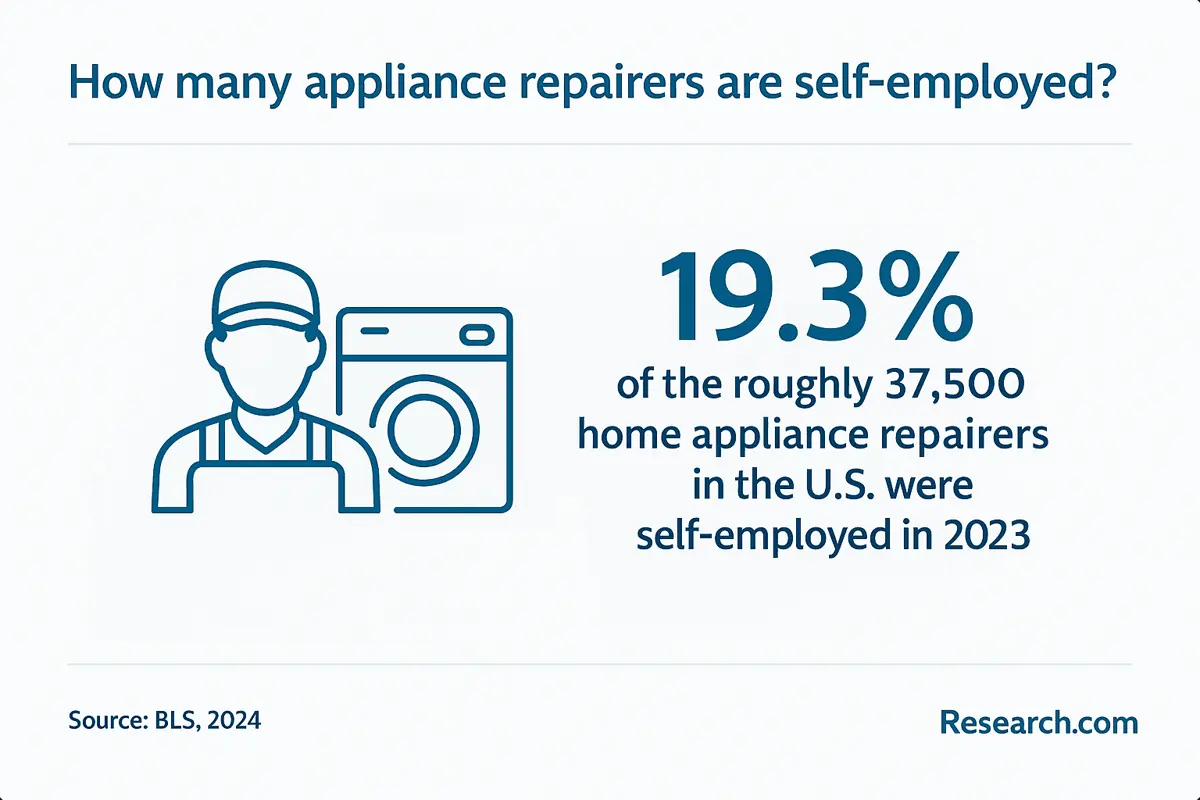
- Business Management and Basic Accounting: Around 19% of repairers were self-employed in 2023 (BLS, 2024), so independent technicians benefit from learning pricing, invoicing, inventory, taxes, customer records, and basic financial tracking. Students who want to understand business records more deeply can review the distinction between bookkeeping vs accounting and the difference between private and public accounting.
Some technicians expand even further by adding electronics repair, HVAC training, or electrical systems education. These skills may support work on TVs, home audio systems, smart appliances, HVAC equipment, commercial systems, or building maintenance roles.
Specialization is especially useful for technicians who want to raise service rates, reduce competition, qualify for employer-specific roles, or move into supervisory, instructional, or business ownership positions.
If you are comparing skilled trade alternatives, commercial driving is another practical pathway to consider. You can review affordable online CDL training courses to see how CDL training compares with appliance repair in cost, timeline, and work environment.
Can a Trade School Program Deliver Comparable Value to an Associate Degree?
A trade school program and an associate degree serve different purposes. An appliance repair trade program is usually the faster, narrower, and more job-specific option. It is designed to teach the technical skills needed for diagnostics, repair, safety, and entry-level service work.
An associate degree is broader. It may include general education, applied technology coursework, communication, math, and a credential that can be more useful for long-term advancement, supervisory work, or continued education. The trade-off is usually time and cost.
| Option | Best for | Possible limitation |
| Online appliance repair trade school | Students who want fast, targeted, lower-cost technical training | May offer less academic breadth and limited transfer value |
| Associate degree | Students who want a broader credential and possible long-term education pathway | Usually takes longer and may cost more |
| Trade school plus later degree | Workers who want to earn income first and continue education later | Requires careful planning so credits and credentials align with future goals |
If you are comparing short career-focused training with an accelerated academic credential, review the associate degree in 6 months online option and decide whether you need immediate trade skills, a broader college credential, or both over time.
Are online appliance repair programs accredited and recognized by industry leaders?
Some online appliance repair programs are accredited, while others are not. Accreditation matters most when you need federal financial aid eligibility, transferability, employer recognition, or proof that a school meets external educational standards. However, in appliance repair, some non-accredited training providers may still be useful if they offer strong technical instruction and are respected by employers or working technicians.
Before enrolling, verify the school’s claims directly. Look for recognized accrediting bodies, state authorization where applicable, employer partnerships, certification preparation, alumni outcomes, instructor credentials, and transparent refund policies.
Students who may later pursue a broader degree should be especially careful. Trade school coursework does not always transfer into college credit. If future education is part of your plan, compare options that could support continued study, including an accelerated bachelors degree.
What are the future trends impacting appliance repair careers?
Appliance repair is changing as household equipment becomes more connected, sensor-driven, and electronically controlled. Technicians increasingly need to understand digital diagnostics, smart appliance interfaces, control boards, sensors, software-related faults, and connected home systems.
At the same time, customers expect faster scheduling, clearer estimates, online communication, warranty coordination, and professional service documentation. Independent repairers may also need basic marketing, customer relationship management, online reviews, and mobile payment tools.
Technicians who keep learning can protect their career options. Adding refrigeration, HVAC, electrical systems, smart home technology, or business training may make it easier to adapt if demand shifts. If you want to compare additional short credentials, explore certificate programs online for high paying jobs.
How do online appliance repair programs deliver effective hands-on training?
Online programs cannot fully replace the feel of working with tools, live components, and real appliances. Strong programs address that limitation by combining visual instruction with structured practice and troubleshooting exercises.
- Detailed video demonstrations: Students watch instructors test parts, read diagrams, use meters, and diagnose failures step by step.
- Virtual labs and simulations: Some programs use interactive scenarios to help students practice decision-making before touching equipment.
- Home practice assignments: Learners may be encouraged to practice on household appliances, donated units, or safe training setups.
- Tool-based exercises: Students may learn how to use multimeters, hand tools, and diagnostic procedures through guided tasks.
- Instructor or peer forums: Discussion boards and troubleshooting communities can help students work through problems and learn from others’ field experiences.
- Local practice opportunities: Some students supplement online learning by shadowing a technician, volunteering, assisting a repair business, or attending a short in-person workshop.
If you are considering future academic advancement after hands-on trade training, you can also compare applied graduate options such as a 1 year masters program, though this type of program serves very different goals than entry-level appliance repair training.
How to choose the best affordable online appliance repair trade school programs?
The best program is not simply the cheapest one. It is the one that matches your budget, schedule, learning style, hands-on practice access, and career goals. Use the checklist below before committing.
- Confirm accreditation or licensing: If accreditation matters for financial aid, employer recognition, or future education, verify the claim with the accrediting agency, not only the school’s website.
- Compare total cost: Look beyond tuition. Add tools, books, platform fees, certification fees, financing charges, and replacement parts for practice.
- Review the curriculum: Make sure the program covers diagnostics, electricity, safety, wiring diagrams, major appliances, and troubleshooting—not just basic repair tips.
- Check hands-on expectations: Ask whether you need to supply tools, find appliances, complete practice assignments, or attend in-person sessions.
- Evaluate instructor qualifications: Look for instructors with real repair experience, industry credentials, or a strong record of training technicians.
- Ask about support: Find out whether the school offers tutoring, forums, instructor access, tech support, career guidance, or employer connections.
- Read graduate reviews carefully: Look for specific comments about course quality, job preparation, hands-on practice, and whether the training matched the school’s claims.
- Understand the credential: Know whether you will receive a certificate, diploma, continuing education units, certification preparation, or another form of completion record.
| Common mistake | Better approach |
| Choosing only by lowest tuition | Compare curriculum depth, support, hands-on practice, and tool requirements. |
| Assuming online training includes enough practice | Create a plan for working with real appliances, tools, and diagnostic tasks. |
| Ignoring accreditation | Check whether accreditation affects financial aid, transfer options, or employer acceptance. |
| Overlooking refund terms | Read cancellation policies and trial periods before paying. |
| Expecting guaranteed earnings | Use salary data as a guide, but account for location, experience, specialization, and business expenses. |
What career paths are available for graduates of online appliance repair trade school programs?
Online appliance repair graduates can pursue direct repair roles or use their skills as a foundation for related technical careers. The strongest pathway usually depends on whether you want residential service work, commercial maintenance, specialty systems, self-employment, or long-term supervisory roles.
- General Maintenance Technicians ($52,430): These workers maintain and repair buildings, systems, and equipment, often handling basic plumbing, electrical, structural, and mechanical issues.
- Repair Services Business Owners ($55,000): Some technicians start their own appliance repair businesses, managing scheduling, pricing, customer relationships, parts, billing, and service quality.
- Security and Fire Alarm Installers ($60,040): These technicians install, test, maintain, and repair systems that detect intrusion, smoke, or fire in homes and commercial buildings.
- HVAC Technicians ($62,690): With additional certification, appliance repairers may move into heating, ventilation, air conditioning, and refrigeration service.
- Telecommunications Equipment and Line Installers and Repairers ($66,650): These workers install and repair phone, cable, internet, and communications systems. Their technical foundation may also interest those exploring the network administrator career path, especially as building systems and networks become more connected.
- Electricians ($69,630): Electricians install, maintain, and repair wiring, circuit breakers, transformers, and electrical systems in residential, commercial, and industrial environments.
- Electrical/Electronics Technicians, Commercial and Industrial Equipment ($72,950): These technicians maintain and repair machinery used in production, manufacturing, and large facilities, including systems with motors, sensors, and programmable controls.
- Construction and Building Inspectors ($76,430): Inspectors evaluate structures for compliance with building codes, zoning rules, and contract specifications, often specializing in electrical, plumbing, or structural systems.
- Facilities Managers ($114,520): Experienced technicians may move into roles overseeing building systems, maintenance teams, budgets, schedules, vendors, and operations.
- Construction Managers ($119,660): These professionals coordinate construction projects, manage budgets and timelines, supervise crews, and work with architects, engineers, and contractors.
If your long-term goal is to run an appliance repair company, business training can be useful. Reviewing the best concentration for business administration degrees can help you understand options related to entrepreneurship, operations, management, or finance.
This chart displays the annual wages of appliance repairers and similar jobs.
What is the job market for graduates with an appliance repair trade school degree?
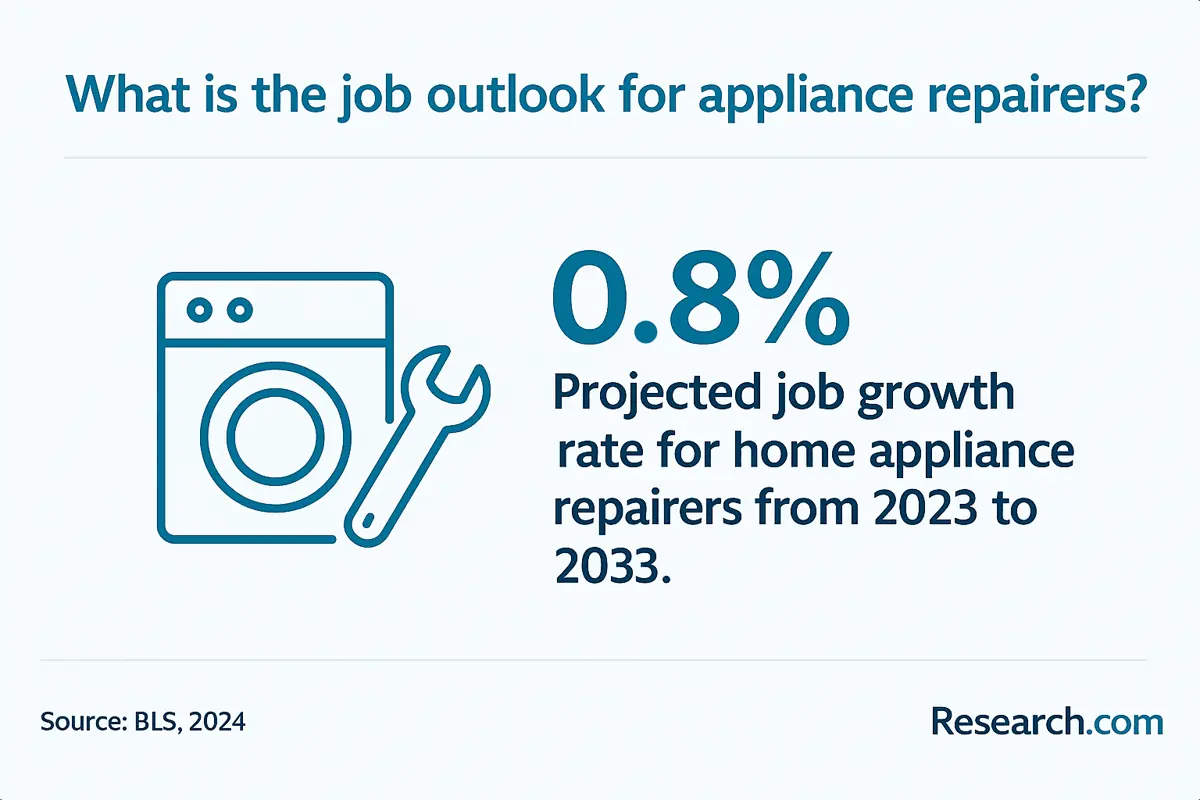
The job market for appliance repairers is stable but not rapidly growing. According to the U.S. Bureau of Labor Statistics, home appliance repairers have a projected job outlook of 0.8% from 2023 to 2033, with around 3,100 job openings per year.
The broader installation, maintenance, and repair category is stronger overall, with a 5.3% growth rate and approximately 606,200 annual openings. Many openings come from industry growth as well as the need to replace workers who retire, transfer, or leave the labor force.
Related technical fields may offer broader opportunities. HVAC and refrigeration installers have a projected growth rate of 9.1% over the same decade, with an estimated 42,500 annual job openings. Electrical and electronic equipment mechanics have a 4.2% growth rate and about 24,200 openings each year.
For students, the practical takeaway is clear: appliance repair training can open the door, but specialization can widen the path. Graduates who add refrigeration, HVAC, gas appliance, electrical, smart appliance, or business skills may have more options than those who rely only on basic repair training.
| Career strategy | Why it can improve job prospects |
| Build diagnostic depth | Employers and customers value technicians who can solve problems accurately instead of replacing parts by trial and error. |
| Add related credentials | HVAC, refrigeration, gas appliance, or electrical training can expand the types of work you are qualified to perform. |
| Gain field experience | Hands-on service calls help convert online coursework into practical confidence and speed. |
| Develop customer service skills | Clear communication, punctuality, and professionalism support repeat business and strong reviews. |
| Learn business basics | Self-employed technicians need pricing, scheduling, bookkeeping, inventory, and marketing skills. |
Here’s What Graduates Have to Say About Online Appliance Repair Trade School Programs
- “Online appliance repair training worked for me because I could keep my full-time job while studying. The videos and simulations broke down the repair process clearly, and I was surprised by how comfortable I became with multimeters and diagnostic steps. Being able to slow down on difficult lessons made a big difference.” - Joaquin
- “I had doubts about learning a hands-on trade online, but the course structure helped. The lessons walked me through electrical safety, appliance systems, and troubleshooting in a way that made sense. The quizzes, digital tools, and feedback helped me study after work without paying for a traditional campus program.” - Lenny
- “As a high school student, I wanted to try a practical career path early. An affordable online appliance repair program let me learn from home and fit lessons around my school schedule. I started practicing on small appliance problems for neighbors, which helped the material feel real.” - Alexis
Key Insights
- Online appliance repair trade schools can be a practical route into technical work for students who want flexible, affordable training without a four-year degree.
- Programs vary widely in cost, hands-on expectations, instructor support, and credential value, so students should compare total price and training depth before enrolling.
- 39% of home appliance repairers enter the field with just a high school diploma, but structured training can help students build diagnostics, electrical safety, and appliance-specific repair skills faster.
- Home appliance repairers earn an average annual salary of $53,580, while workers in related technical roles such as HVAC Technicians ($62,690) and Electrical/Electronics Technicians, Commercial and Industrial Equipment ($72,950) may earn more with additional training.
- Around 19% of repairers were self-employed in 2023, making business skills such as pricing, scheduling, customer service, recordkeeping, and local marketing especially useful.
- 97% of home appliance repairers have phone conversations every day, and 89% cite they have face-to-face conversations with individuals or teams daily, so communication skills are not optional in this trade.
- The projected job outlook for home appliance repairers is 0.8% from 2023 to 2033, with around 3,100 job openings per year. Students who add skills in HVAC, refrigeration, electrical systems, gas appliances, or smart technology may have broader career options.
- The biggest enrollment mistakes are choosing only by price, ignoring accreditation or refund terms, assuming online coursework replaces hands-on practice, and expecting salary outcomes to be guaranteed.
References:
- Bunce, B. (2024, April 16). Appliance repair industry statistics 2025. Consumer Affairs. Retrieved June 11, 2025, from https://www.consumeraffairs.com/homeowners/appliance-repair-industry-statistics.html
- Career One Stop. (2022). Home Appliance Repairers. Occupational Profile. Retrieved June 11, 2025, from https://www.careeronestop.org/Toolkit/Careers/Occupations/occupation-profile.aspx?keyword=Home%20Appliance%20Repairers&location=UNITED%20STATES&onetcode=49903100
- U.S. Bureau of Labor Statistics. (2024). Home Appliance Repairers [Interactive data]. May 2024 OEWS Profiles, Occupational Employment and Wage Statistics (OEWS) Profiles. Retrieved June 11, 2025, from https://data.bls.gov/oesprofile
- U.S. Bureau of Labor Statistics. (2025a, April 18). Occupational projections, 2023–33, and worker characteristics, 2023 (Numbers in thousands). Employment Projections. https://www.bls.gov/emp/tables/occupational-projections-and-characteristics.htm
- U.S. Bureau of Labor Statistics. (2025b, April 18). Installation, Maintenance, and Repair Occupations. Occupational Outlook Handbook. https://www.bls.gov/ooh/installation-maintenance-and-repair
Other Things You Should Know About Affordable Online Appliance Repair Trade School Programs
In 2027, online appliance repair trade schools such as Penn Foster and Ashworth College offer scholarships and financial aid options. Prospective students should check each school's website or contact admissions for detailed information on available financial support.
In 2027, trade schools such as Penn Foster, Ashworth College, and Stratford Career Institute are among the most affordable for online appliance repair programs. They offer comprehensive training at competitive prices, often including flexible payment plans and financial aid options.