2027 Fastest Online Electrical Engineering Degree Programs

Co-Founder and Chief Data Scientist
Finishing an electrical engineering degree faster can open doors to high-paying jobs without spending extra years in school. In response, many universities now offer accelerated online programs that compress coursework into shorter terms. This flexible format helps students save time and get into roles where the median annual wage is $111,910. It’s a smart option for those ready to move quickly into a growing and well-paid field.
To help students find the fastest online electrical engineering degrees in the U.S., I reviewed data from accredited schools. Using my background in academic advising and career planning, I’ve put together a list of the top ten programs. Each program comes with essential information to make your search easier and more focused.
What are the benefits of taking an online electrical engineering degree for 2027?
- Employment for electrical and electronics engineers is projected to grow 9% within a decade, with roughly 17,200 openings per year..
- Quality online programs often include career support, such as job placement assistance, resume help, and virtual networking with alumni and industry professionals.
- The median annual wage for electrical engineers was about $111,910.
What can I expect from an online electrical engineering degree program?
Students can expect a structured, project-based learning experience that mirrors the demands of the electrical engineering field. This includes foundational courses in physics, calculus, circuit theory, and advanced topics like embedded systems, digital signal processing, and power electronics. Rather than relying on passive lectures, students often complete interactive assignments using tools like MATLAB, Multisim, or LabVIEW.
Some schools incorporate real-time collaboration, where students work in virtual teams to solve engineering problems, just like in the workplace. Enrollees should expect to be challenged, not only with technical concepts but also with deadlines, problem-solving, and hands-on simulations that build job-ready skills.
Where can I work with an electrical engineering degree?
As grids modernize, vehicles go electric, and devices become smarter, companies need engineers who can bridge hardware, software, and systems. This shift has made electrical engineering one of the most versatile degrees in the tech-driven economy. Graduates aren’t limited to traditional utility roles. They're building electric drivetrains, automating factories, designing advanced sensors, and developing next-gen communication systems.
Here are some of the top industries where electrical engineering graduates are making an impact:
- Power and energy companies
- Telecommunications firms
- Aerospace and defense industries
- Electronics and semiconductor companies
- Automotive manufacturers
- Robotics and automation firms
- Government agencies
- Engineering consulting firms
- Research and development labs
- Technology startups
How much can I make with an electrical engineering degree?
Graduates with an electrical engineering degree can expect strong earning potential across a range of industries. As of 2027, the median annual salary for electrical engineers is around $111,910, with those in the top 10% earning over $166,970.
Entry-level roles typically start between $70,000 and $80,000, though this can vary based on industry, experience, and location. Engineers working in specialized fields like power systems, aerospace, or advanced electronics often command higher salaries. Even for those who earn their degree online, accredited programs can lead to similar income levels, especially when combined with relevant internships or hands-on experience.
- The Fastest Online Electrical Engineering Degree Programs for 2027 List of Programs
- How long does it take to complete an online electrical engineering degree program? Completion Time
- How does an online electrical engineering degree program compare to an on-campus program? How does an online electrical engineering degree program compare to an on-campus program?
- What is the average cost of an online electrical engineering degree program in 2027? Average Cost
- What are the financial aid options for students enrolling in an online electrical engineering degree program? Financial Aid
- What are the prerequisites for enrolling in an online electrical engineering degree program? Requirements
- What courses are typically in an online electrical engineering degree program? What courses are typically in an online electrical engineering degree program?
- What types of specializations are available in an online electrical engineering degree program? What types of specializations are available in an online electrical engineering degree program?
- How do you choose an online electrical engineering degree program? How do you choose an online electrical engineering degree program?
- What career paths are available for graduates with an online electrical engineering degree? Career Paths
- What is the job market like for graduates of an online electrical engineering degree program? Job Market
- Is an online electrical engineering degree a worthwhile investment? Is an online electrical engineering degree a worthwhile investment?
- What advanced degree options can further enhance my electrical engineering career? What advanced degree options can further enhance my electrical engineering career?
Fastest Online Electrical Engineering Degree Programs for 2027
Choosing an online electrical engineering degree is not just about finding the shortest calendar. You also need to know whether the program is ABET-accredited, how labs work online, how many transfer credits you can use, what the total cost may be, and whether the curriculum leads to the engineering roles you want. Electrical engineering is a demanding field, but it remains one of the most flexible STEM pathways for students interested in power systems, electronics, robotics, communications, embedded systems, semiconductors, and renewable energy.
This guide is for working adults, transfer students, military learners, and first-time college students who want a faster route to an online electrical engineering or electronics engineering technology degree. You will learn which programs offer accelerated formats, how online engineering compares with campus-based study, what costs and prerequisites to expect, and how to judge whether a program is worth the investment. Students comparing fast technical degrees may also want to review related accelerated options, such as accelerated logistics and supply chain management online programs.
Quick Answer: What Is the Fastest Online Electrical Engineering Degree?
The fastest online electrical engineering-related bachelor’s programs usually use short academic terms, generous transfer policies, year-round starts, or one-course-at-a-time scheduling. Some programs can be completed more quickly if students bring in prior college credits, military training, or an associate degree. However, speed should not be the only factor. For engineering careers, ABET accreditation, lab quality, transfer credit evaluation, total cost, and employer recognition matter just as much as the advertised timeline.
Students who want a traditional electrical engineering degree should focus on online B.S. or B.S.E. programs in electrical engineering. Students who want a more applied, hands-on pathway may also consider electronics engineering technology programs, which can be faster and career-focused but may lead to different job titles and licensure expectations.
How We Rank Schools
Research.com rankings are built to help students compare programs with practical decision factors in mind. For this guide, we considered online availability, program speed, credit requirements, tuition information, accreditation, transfer flexibility, curriculum relevance, and student support. We use established education data sources, including the IPEDS database, Peterson’s, the College Scorecard, and the National Center for Education Statistics.
The purpose of this ranking is to identify fast online electrical engineering and closely related electronics engineering technology programs without ignoring academic quality. For more detail on how Research.com evaluates schools and degree options, visit our methodology page.
Best Fast Online Electrical Engineering Degree Programs at a Glance
| School | Online Degree | Required Credits | Cost Listed | Accreditation | Best For |
| University of Arizona | B.S. in Electrical and Computer Engineering | 128 | $525 per credit | Engineering Accreditation Commission (ABET) | Students who want an online program that mirrors the campus curriculum |
| Arizona State University | B.S.E. in Electrical Engineering | 120 | $580-$661 per credit | ABET (via Fulton Schools of Engineering) | Learners who want 7.5-week terms and strong transfer options |
| University of North Dakota | B.S. in Electrical Engineering | 125 | $384 per credit | ABET | Transfer students and working adults who need flexible pacing |
| Mississippi State University | B.S. in Electrical Engineering | 128 | $460.75 per credit | ABET | Students seeking advising support and regional employer connections |
| Florida International University | B.S. in Electrical Engineering | 128 | ~$235 (in-state), ~$649 (out-of-state) | ABET | Students interested in dual concentrations and transfer pathways |
| ECPI University | B.S. in Electronic Systems Engineering Technology | ~120 (based on accelerated 30-month model) | ~$8,712 per semester | ABET | Students who want a highly accelerated applied technology format |
| National University | B.S. in Electrical and Computer Engineering | ~180 quarter units | $370 per quarter unit | ABET | Students who prefer one course per month and frequent start dates |
| University of Arkansas Grantham | B.S. in Electronics Engineering Technology | 120 | $250 per undergraduate credit hour | ABET | Working adults who want a steady 8-week-course structure |
| Eastern New Mexico University | B.S. in Electronics Engineering Technology | ~120 | $297 per credit (in-state); $380 per credit (out-of-state) | ABET (EET) | Budget-conscious transfer students |
| Old Dominion University | B.S. in Electrical Engineering | ~120 | $268 (in-state); $444 (out-of-state) | ABET | Military students, transfer students, and learners interested in defense-related hiring |
1. University of Arizona – B.S. in Electrical and Computer Engineering
The University of Arizona offers an online B.S. in Electrical and Computer Engineering that blends electrical engineering with computer engineering content. Students study embedded systems, wireless communications, signal processing, robotics, microelectronics, optics, cybersecurity, and cloud computing. The program is especially useful for learners who want a broad hardware-and-software foundation rather than a narrow electrical engineering curriculum.
- Cost: $525 per credit
- Required Credits: 128
- Accreditation: Engineering Accreditation Commission (ABET)
- What Makes It Stand Out: The online program uses residency-neutral pricing and is taught with the same curriculum and faculty as the campus program. Industry relationships with Raytheon, Intel, NASA, and Microsoft add career relevance.
2. Arizona State University – B.S.E. in Electrical Engineering
ASU is a strong option for students who want a faster academic rhythm. Instead of relying only on long 16-week terms, the program uses 7.5-week terms, which can help motivated students move through courses more quickly. Students can choose electives in communications, control systems, photonics, robotics, and quantum engineering. ASU also allows generous credit transfers, up to 90 credits.
- Cost: $580-$661 per credit
- Required Credits: 120
- Accreditation: ABET (via Fulton Schools of Engineering)
- What Makes It Stand Out: The 7.5-week schedule, asynchronous courses, and no mandatory log-in times make the program appealing for working students who can handle compressed coursework.
3. University of North Dakota – B.S. in Electrical Engineering
The University of North Dakota has a long track record in distance engineering education. Students complete core work in circuit analysis, signals and systems, embedded systems, and a senior capstone design project connected to industry problems. The program also uses a home lab kit, which helps online learners complete practical assignments without being fully dependent on campus facilities.
- Cost: $384 per credit
- Required Credits: 125
- Accreditation: ABET
- What Makes It Stand Out: Flexible pacing, virtual lab support, and strong salary outcomes make UND a practical choice for transfer students and working adults.
4. Mississippi State University – B.S. in Electrical Engineering
Mississippi State offers an online electrical engineering program built around industry-relevant engineering fundamentals. The 128-credit curriculum includes digital devices, circuits and electronics, electromagnetic field theory, energy conversion, and a full capstone design year. Students may also pursue technical interests in telecommunications, power systems, signal processing, and microelectronics.
- Cost: $460.75 per credit
- Required Credits: 128
- Accreditation: ABET
- What Makes It Stand Out: Strong advising resources and regional employer recruitment make the program a good fit for students who want structure and career support.
5. Florida International University – B.S. in Electrical Engineering
FIU offers an online electrical engineering program with coursework in circuits, signals and systems, logic design, senior design, academics and ethics, nanotechnology, cyber-security, and AI and big data. Many students choose FIU because of its dual-concentration model, which can help them focus on areas such as power systems or electronics.
- Cost: ~$235 (in-state), ~$649 (out-of-state)
- Required Credits: 128
- Accreditation: ABET
- What Makes It Stand Out: Dual concentrations and a community-college pathway guarantee support students who want a more targeted plan.
6. ECPI University – B.S. in Electronic Systems Engineering Technology
ECPI is designed for speed and applied technical learning. Students typically take two courses at a time in five-week terms, making it possible to complete the degree in as little as 2.5 years. The curriculum emphasizes analog and digital electronics, circuits, programmable logic controllers, robotics, microcontrollers, industrial automation, and communications systems. Students finish with a capstone project in which they design and validate an engineered system.
- Cost: ~$8,712 per semester
- Required Credits: ~120 (based on accelerated 30-month model)
- Accreditation: ABET
- What Makes It Stand Out: A rolling start model and short terms make ECPI one of the most accelerated options in this group.
7. National University – B.S. in Electrical and Computer Engineering
National University uses a one-course-per-month structure that can help students concentrate on one technical subject at a time. The 180-quarter-unit curriculum includes Advanced Engineering Math, Circuit Analysis, Digital Logic Design, Computer Architecture, Embedded Systems, and Linear Systems and Signals. Many courses include labs or simulation-based components.
- Cost: $370 per quarter unit
- Required Credits: ~180 quarter units
- Accreditation: ABET
- What Makes It Stand Out: The quarter system, monthly course format, veteran-focused support, and year-round starts help students move steadily through the program.
8. University of Arkansas Grantham – B.S. in Electronics Engineering Technology
The University of Arkansas Grantham offers a B.S. in Electronics Engineering Technology for adults who need flexibility and predictable course pacing. The program uses monthly 8-week courses and includes ~120 credits. Students study digital and analog circuits, embedded systems, control systems, instrumentation, communication systems, and programming.
- Cost: $250 per undergraduate credit hour
- Required Credits: 120
- Accreditation: ABET
- What Makes It Stand Out: The focused timeline is one of the shortest among online EET programs.
9. Eastern New Mexico University – B.S. in Electronics Engineering Technology
ENMU provides an online electronics engineering technology pathway that works well for students seeking flexibility and affordability. Courses cover analog and digital circuits, embedded programming, instrumentation, control systems, and communications. Project-based learning and capstone work give students opportunities to apply technical skills to practical problems.
- Cost: $297 per credit (in-state); $380 per credit (out-of-state)
- Required Credits: ~120
- Accreditation: ABET (EET)
- What Makes It Stand Out: Transfer-friendly policies, financial aid access, and both synchronous and asynchronous delivery options make ENMU accessible to different types of learners.
10. Old Dominion University – B.S. in Electrical Engineering
ODU offers a fully online ABET-accredited engineering degree with a required minor in engineering or science and a Capstone Design Project sequence. The program requires 128–134 credit hours, while the listed degree total is ~120 credits. Students can also explore concentrations such as Communications Systems Technology, Computer Engineering Technology, and Embedded Systems Technology.
- Cost: $268 (in-state); $444 (out-of-state)
- Required Credits: ~120
- Accreditation: ABET
- What Makes It Stand Out: ODU is transfer-friendly, awards credit for military training, and has a strong hiring reputation in defense-related fields.
How Long Does It Take to Complete an Online Electrical Engineering Degree Program?
A typical online bachelor’s degree in electrical engineering takes about four years of full-time study. Most programs require 120–126 credit hours, which is similar to the length of a campus-based engineering degree. The difference is that online formats may offer more scheduling flexibility, shorter terms, or year-round course availability.
Part-time students often need five or six years because they take fewer courses each term while balancing work or family responsibilities. The best online degree programs for working adults usually provide flexible pacing, asynchronous courses, and advising support for students who cannot study full time.
Accelerated formats can shorten the timeline for students who are ready for a heavier workload. With prior college credit or short academic sessions, some students may finish in as little as three years. Arizona State University’s fully online EE program, for example, uses 7.5-week terms and allows students to take two classes per session.
Transfer credit is one of the most important timeline factors. Students with completed general education, math, physics, or lower-division engineering courses may reduce the number of credits they need after enrollment. Schools review transcripts course by course, so the number of accepted credits can vary. Some universities, including Arizona State and Southern Illinois University, allow up to 90 transfer credits.
| Student Situation | Likely Timeline | What Can Speed It Up | What Can Slow It Down |
| First-time full-time student | About four years | Year-round enrollment and strong math placement | Repeating calculus, physics, or core engineering courses |
| Working adult studying part time | Five or six years | Asynchronous classes and predictable course rotation | Taking only one course per term |
| Transfer student | Potentially as little as three years | Accepted general education and lower-division engineering credits | Credits that do not match the engineering curriculum |
| Student in an accelerated format | Varies by school and course load | Short terms, rolling starts, and consistent enrollment | Compressed technical courses without enough study time |
How Does an Online Electrical Engineering Degree Compare to an On-Campus Program?
In a strong online electrical engineering program, students often study with the same faculty, use similar materials, and complete many of the same learning outcomes as campus students. The main difference is delivery. Online students access lectures, assignments, exams, labs, and group projects through digital platforms, while campus students attend classes and labs in person.
Labs are the biggest question for online engineering students. Programs may use simulation software, mailed lab kits, remote lab systems, or short in-person sessions. Before enrolling, students should ask exactly how each lab course works and whether any campus visits are required.
Campus programs may offer easier access to physical labs, faculty offices, student clubs, and local internships. Online programs, however, allow students to avoid relocation and commute costs while continuing to work. For many adults, that flexibility is the difference between starting a degree and postponing it.
If the program is ABET-accredited, an online electrical engineering degree can carry the same academic value as an on-campus version. Electrical engineering is not one of the easiest college degree options, but online delivery can make a difficult major more accessible for disciplined students.
| Factor | Online Electrical Engineering | On-Campus Electrical Engineering |
| Schedule | Often asynchronous or built around short terms | Usually tied to fixed class and lab times |
| Labs | May use simulations, remote labs, home kits, or residencies | Usually completed in physical engineering labs |
| Networking | Depends on virtual events, group work, alumni contacts, and career services | More spontaneous access to faculty, peers, clubs, and recruiters |
| Best fit | Working adults, military students, transfer students, and remote learners | Students who want daily campus access and in-person lab support |
What Is the Average Cost of an Online Electrical Engineering Degree Program for 2027?
The average cost of an online electrical engineering degree for 2027 ranges from $40,500 to $59,000, depending on the school and the student’s residency. Public universities are often less expensive, with in-state public students paying around $337 per credit, while private universities charge closer to $516 per credit.
Residency rules can make a major difference. At public institutions, in-state online students typically pay around $337 per credit, while out-of-state students may pay up to $574 per credit. Students who live outside a school’s state should look for programs with flat online tuition or waived out-of-state rates because that pricing can reduce total cost by thousands.
Tuition is only one part of the price. Online electrical engineering students may also pay for lab kits, software, online course fees, proctoring, textbooks, and required campus visits. Some schools include these expenses in tuition, while others bill them separately.
When comparing engineering degrees online, students should calculate total program cost rather than focusing only on the per-credit rate. A lower per-credit price may not be the better deal if the program requires more credits to graduate.
What Financial Aid Options Are Available for Online Electrical Engineering Students?
Nearly 91% of online engineering students receive some form of aid, including institutional grants, merit scholarships, and federal assistance. The first step is filing the FAFSA, which determines eligibility for federal aid such as Pell Grants of up to $7,395 per year and FSEOG of up to $4,000 per year.
Students may also qualify for federal loans, work-study, school-based scholarships, and sometimes income-share agreements that connect repayment to post-graduation income. Many top online colleges provide scholarships for online learners, and public colleges may award average grants of around $10,000 per year in grant and scholarship aid to first-time, full-time undergraduate students.
Engineering students should also look for STEM scholarships from private foundations and employer-sponsored programs. Some corporate-backed awards, including opportunities associated with Google and Lockheed Martin, support students with strong academic records or demonstrated interest in engineering and technology.
What Are the Prerequisites for an Online Electrical Engineering Degree Program?
Online admission does not mean easy admission. Electrical engineering requires strong preparation in math, science, logic, and problem-solving, so schools often review whether applicants are ready for calculus-based technical work. Students who are underprepared may still be admitted conditionally or advised to complete foundation courses first.
Common prerequisites include:
- A high school diploma or GED
- Completed coursework in algebra, trigonometry, and calculus
- At least one year of high school physics, with chemistry often helpful
- A minimum GPA, usually between 2.5 and 3.0 depending on the school
- Official high school or college transcripts
- SAT or ACT scores, which are optional at many schools but still reviewed by some
- Basic computer skills or prior programming exposure, which is recommended
Students who do not meet every requirement can strengthen their application through bridge courses, math refreshers at a community college, CLEP exams, or foundational online courses. Some accredited online degree programs may offer conditional admission after students complete required preparatory coursework.
What Courses Are Typically Included in an Online Electrical Engineering Degree?
Most online electrical engineering bachelor’s programs require around 120 credits and follow a four-year full-time structure. The curriculum usually combines general education, advanced mathematics, physics, core engineering theory, lab-based work, technical electives, and a senior design experience.
Common courses include:
- Calculus I and II: Students learn limits, derivatives, integrals, and mathematical tools used in physics and circuit modeling.
- Circuit Analysis: This foundational course teaches students how to analyze, model, and design electrical circuits.
- Signals and Systems: Students study filtering, frequency response, and time-domain analysis used in communications and controls.
- Electronics: Coursework covers semiconductors, diodes, transistors, amplifiers, and real-world hardware behavior.
- Digital Logic Design: Students learn binary systems, logic gates, and circuit design for computing applications.
- Electromagnetics: This course explores electric and magnetic fields, transmission lines, and wave propagation.
- Capstone Design Project: Students apply engineering knowledge to a final project, often tied to an industry or practical design problem.
Several core subjects are known for being especially difficult. Nearly 50% of electrical engineering students drop out or switch majors, and challenging courses are often part of the reason.
Electromagnetics, Signals and Systems, and Control Systems are common pressure points because they require abstract thinking and advanced math. Some of these subjects have failure rates exceeding 30%, making them demanding in a different way from writing- and documentation-heavy technical programs such as top online technical communication degree programs.
What Specializations Are Available in an Online Electrical Engineering Degree Program?
Specializations help students connect a broad electrical engineering curriculum to a specific job market. Not every online program offers the same tracks, so students should compare electives carefully before enrolling.
- Power Systems and Smart Grids: Focuses on electricity generation, grid modernization, clean energy integration, and smart infrastructure.
- Control Systems and Robotics: Covers feedback systems, automation, robotics, and embedded control for industrial and mechanical systems.
- Signal Processing and Telecommunications: Prepares students to work with communication systems, modulation, digital signal processing, and IoT-related networks.
- Microelectronics and Semiconductor Design: Emphasizes chip-level design, circuits, and semiconductor hardware architecture.
- Embedded Systems and IoT: Combines hardware, software, sensors, and real-time control for smart devices and connected systems.
- Renewable Energy and Sustainable Engineering: Covers solar and wind systems, power conversion, energy storage, and sustainability-focused design.
These focus areas can shape the types of internships, capstone projects, and first jobs students pursue. Fields such as microelectronics, power systems, aerospace, energy infrastructure, and semiconductor manufacturing may align well with the skills taught in online electrical engineering programs. Students exploring adjacent technology careers may also compare the career potential of top mobile app development degree online graduates.
For example, electrical engineers in industries such as aerospace product manufacturing earn over $136,500 annually. A specialization does not guarantee a specific salary, but choosing a track connected to strong employer demand can improve career fit and long-term mobility.
How Do You Choose an Online Electrical Engineering Degree Program?
The best online electrical engineering program is the one that matches your career goal, schedule, budget, transfer status, and need for lab access. Start with accreditation. The school should be institutionally accredited, and the engineering program should meet ABET standards when the goal is an engineering role that may require employer recognition or future licensure.
Students should then compare specialization options, course delivery, lab requirements, transfer policies, faculty experience, and employer connections. Location can also matter, even for online learners. California, Texas, and Michigan have the highest employment levels for electrical engineers in the U.S., with California alone employing over 27,000 professionals in this field.
Programs with internships, capstone partnerships, faculty networks, or employer relationships in these regions may create useful hiring connections. Students should also evaluate the learning platform. Lab-heavy online degrees require reliable simulations, remote access tools, clear instructions, and strong technical support. This kind of careful comparison is just as important when evaluating engineering programs as it is when reviewing top humanities degree online options.
Questions to Ask Before Enrolling
- Is the program ABET-accredited, and is that accreditation for electrical engineering or electronics engineering technology?
- How many credits can I transfer, and will my math, physics, and engineering courses count?
- Are labs completed through simulations, home kits, remote labs, or campus visits?
- Does the tuition include online fees, lab kits, software, and proctoring?
- Are courses asynchronous, synchronous, or a mix of both?
- How often are upper-division engineering courses offered?
- Does the program support internships, co-ops, capstones, or employer networking?
- Will the degree meet requirements for the types of engineering jobs or licenses I may want later?
What Career Paths Are Available With an Online Electrical Engineering Degree?
An online electrical engineering degree can lead to engineering careers that are very different from becoming an electrician. Electricians install, repair, and maintain electrical systems, while electrical engineers design, test, model, and improve systems, devices, and infrastructure. Graduates may work in energy, manufacturing, aerospace, defense, telecommunications, automation, electronics, or technology.
- Power Systems Engineer: Designs and maintains electrical power systems for utilities and energy companies. The median annual salary is $80,062.
- Electrical Design Engineer: Develops schematics, hardware layouts, and electrical systems for manufacturing and technology employers. The average annual salary is about $106,950.
- Systems Engineer: Manages complex systems that combine electrical, mechanical, and software components. Total compensation often ranges from $120,000 to $143,000 annually in high-demand roles.
- R&D Engineer: Works on prototypes, new technologies, and technical research. The median pay for an R&D electrical engineer is approximately $88,000.
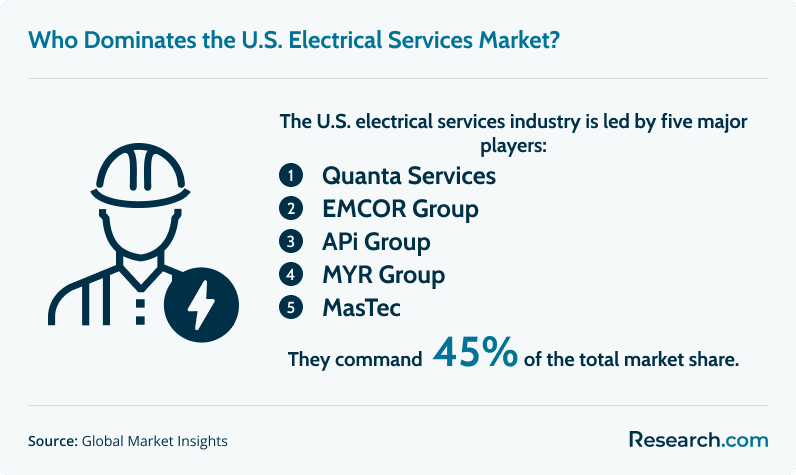
Graduates may also pursue roles with major U.S. electrical services companies, including Quanta Services, EMCOR Group, APi Group, MYR Group, and MasTec. These employers are involved in infrastructure, energy, construction, and large-scale technical systems, making them relevant to students who specialize in power, controls, embedded systems, or communications.
What Is the Job Market Like for Online Electrical Engineering Graduates?
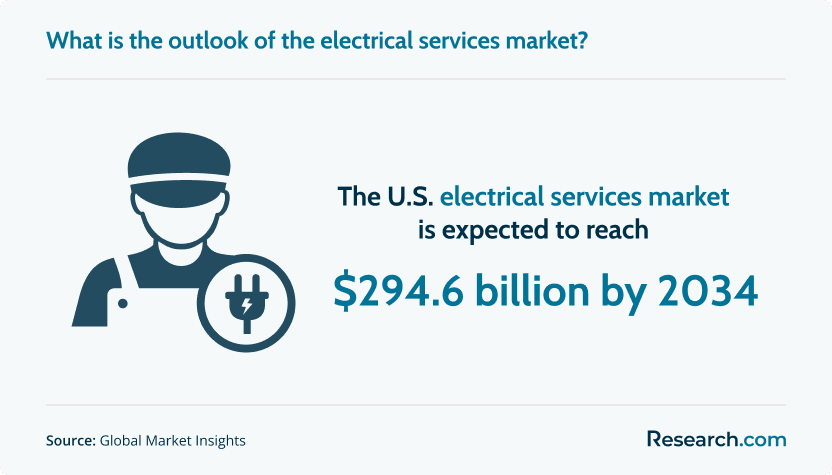
Electrical engineering graduates enter a market supported by major investment in electrical services, grid upgrades, smart infrastructure, energy-efficient buildings, renewable energy integration, and automation. The U.S. electrical services market was valued at approximately $163.9 billion in 2024 and is projected to grow to nearly $252.8 billion by 2032, at a CAGR of 5.6%.
Demand is especially relevant for graduates with skills in smart grid deployment, IoT-enabled monitoring, automated distribution systems, renewable energy infrastructure, embedded systems, and controls. Employers need engineers who can design, model, test, and improve complex systems rather than simply maintain existing equipment.
Students can strengthen their job prospects by building a portfolio of capstone work, simulations, design projects, internships, co-ops, and technical certifications. Credentials such as Engineer-in-Training (EIT) status and, later, the Professional Engineer (PE) license may be valuable in utilities, infrastructure, consulting, and public-facing engineering work.
Electrical Engineering vs. Electronics Engineering Technology: Which Online Path Should You Choose?
Some of the fastest online options are electronics engineering technology programs rather than traditional electrical engineering degrees. Both pathways can be valuable, but they are not identical. Students should understand the distinction before enrolling.
| Path | Typical Focus | Best For | Important Caution |
| Electrical Engineering | Theory, design, advanced math, systems modeling, and engineering analysis | Students who want engineering design roles, graduate study, or possible PE licensure pathways | Usually more mathematically demanding and may take longer |
| Electronics Engineering Technology | Applied systems, instrumentation, troubleshooting, automation, electronics, and implementation | Students who want hands-on technical roles and faster applied training | May not qualify for every role labeled “electrical engineer” or every licensure pathway |
What Networking Opportunities and Support Services Are Available in Online Electrical Engineering Programs?
Online engineering students should not assume they are limited to isolated coursework. Strong programs often provide virtual career fairs, online student communities, alumni mentoring, career coaching, employer webinars, project collaboration tools, and access to faculty office hours. These services are especially useful for students who cannot attend campus events but still need professional contacts.
Support services matter because electrical engineering is academically demanding. Look for tutoring in calculus and physics, technical support for lab software, structured advising, writing assistance for lab reports, and career help for resumes and interviews. Students who want to broaden their technical background beyond engineering may also compare interdisciplinary options such as affordable biotechnology master's programs.
What Graduates Say About Online Electrical Engineering Programs
- Chris: "I transferred 30 credits from military training and finished in just under two years. The most useful part was combining power systems coursework with Python-based modeling, which helped me stand out when I applied for a defense contractor internship."
- Anya: "The virtual labs were much more interactive than I expected, especially the control systems simulations that modeled real-time grid behavior. My capstone mentor worked at a utility company through the school’s industry partnership, so the online format actually expanded my network."
- Rajiv: "I finished my degree in 28 months while working maintenance shifts at a solar plant. Because the classes were asynchronous, I could study overnight, and the embedded systems course helped me solve problems directly in the field. My supervisor noticed the difference quickly."
Is an Online Electrical Engineering Degree Worth It?
An online electrical engineering degree can be worth it when the program is accredited, affordable relative to your budget, aligned with your career goals, and structured in a way you can realistically complete. The value is strongest for students who can continue working while studying, transfer prior credits, or use the degree to move into higher-responsibility technical roles.
The return on investment depends on more than salary. Students should compare total tuition, fees, lab costs, time to completion, transfer credit acceptance, financial aid, employer tuition benefits, and the opportunity cost of studying full time versus part time. Accelerated programs can reduce the time before graduation, but compressed engineering courses can also increase academic pressure.
Students who already work in engineering, manufacturing, utilities, defense, or technical operations may gain additional value from stacking credentials. For example, an accelerated engineering management master's degree online can support movement into supervisory, project management, or technical leadership roles after an undergraduate engineering foundation is complete.
What Advanced Degree Options Can Strengthen an Electrical Engineering Career?
A bachelor’s degree can qualify graduates for many entry-level engineering and technical roles, but advanced study may be useful for specialized or leadership positions. Graduate programs can deepen expertise in robotics, machine learning, semiconductor design, power systems, controls, data analytics, or engineering management.
Students should choose graduate study based on a clear career purpose. A technical master’s may be appropriate for research, design, or advanced engineering work. Engineering management may fit students moving toward project leadership. Interdisciplinary fields can help engineers work in emerging areas where hardware, software, and data overlap. For example, comparing options such as cheapest masters in artificial intelligence can help students understand how AI-focused graduate training may complement electrical and computer engineering skills.
Common Mistakes to Avoid When Choosing an Online Electrical Engineering Program
- Choosing speed over accreditation: A faster program is not a good deal if it lacks the recognition needed for your career goal.
- Confusing engineering with engineering technology: Both are useful, but they may lead to different job titles, graduate options, and licensure pathways.
- Looking only at tuition per credit: Total cost also depends on credit requirements, fees, lab kits, software, transfer credits, and residency pricing.
- Assuming all credits will transfer: Engineering programs often review math, physics, and technical courses carefully, and some credits may apply only as electives.
- Ignoring lab delivery: Online engineering requires hands-on learning through simulations, kits, remote systems, or residencies. Ask before enrolling.
- Underestimating the workload: Short terms can be efficient, but calculus-based engineering courses require consistent study time.
- Relying only on rankings: Rankings are a starting point. Your best program depends on schedule, cost, accreditation, support, and career alignment.
Key Insights
- The fastest online electrical engineering degrees usually rely on short terms, transfer credit, year-round starts, or one-course-at-a-time formats.
- ABET accreditation is one of the most important quality checks, especially for students pursuing engineering roles or future licensure.
- Electrical engineering and electronics engineering technology are related but not identical; students should choose based on career goals, not just completion speed.
- Costs vary widely, and the average online electrical engineering degree for 2027 ranges from $40,500 to $59,000.
- Transfer credit can significantly shorten the degree timeline, with some universities allowing up to 90 transfer credits.
- Online programs can be academically equivalent to campus programs when they offer strong labs, qualified faculty, and recognized accreditation.
- The best choice is the program that balances speed, affordability, accreditation, lab quality, specialization options, and career support.
References:
- Bureau of Labor Statistics. (2023, March 31). Occupational employment and wages, May 2022: Electrical engineers (17-2071). U.S. Department of Labor. https://www.bls.gov/oes/2022/may/oes172071.htm
- Center for Security and Emerging Markets. (2023, September). U.S. electrical engineering degrees: Trends, challenges, and implications for innovation and security [PDF]. Information Technology & Innovation Foundation. https://www2.itif.org/2023-ee-degrees.pdf
- College of Education, National Center for Education Statistics. (2024). Undergraduate enrollment. Condition of Education. https://nces.ed.gov/programs/coe/indicator/cua
- Consulting-Specifying Engineer. (2023, May 15). Professional engineer licensure pays off, says NSPE salary survey. https://www.csemag.com/professional-engineer-licensure-pays-off-says-nspe-salary-survey/
- FIU News. (2023, April 5). FIU receives 46 rankings in the top 50 for online learning from Intelligent.com. Florida International University. https://news.fiu.edu/2023/fiu-receives-46-rankings-in-the-top-50-for-online-learning-from-intelligent.com
- Global Market Insights. (2024). U.S. electrical services market size, growth & trends report, 2024–2032. https://www.gminsights.com/industry-analysis/us-electrical-services-market
- Salarship. (2023). How hard is electrical engineering? https://salarship.com/article/how-hard-electrical-engineering/
Other Things You Should Know About the Fastest Online Electrical Engineering Degree Programs for CURRENT_YEAR
For licensure, the relevant standard is ABET accreditation for the engineering degree used to qualify for the FE and PE exams. Most state boards expect a degree from an ABET-accredited electrical engineering program or an approved equivalent when reviewing eligibility.
The fastest online electrical engineering degree programs in 2027 can typically be completed in about 18 to 24 months. These accelerated programs are designed for students with a solid foundational knowledge in engineering principles, allowing them to progress through the coursework swiftly.