2027 Best Online Graduate Certificate Programs in Logistics and Supply Chain Management

Co-Founder and Chief Data Scientist
Refining expertise in global sourcing, transportation networks, and inventory optimization is typically the next step for professionals drawn to logistics and supply chain management. Many pursue graduate certificates to build leadership skills and gain exposure to case-driven learning that connects strategy with real-world operations.
The best online logistics and supply chain management programs emphasize faculty with industry experience, integrated technology tools, and opportunities to apply concepts through simulations and consulting-style projects.
In this guide, I will highlight how these graduate certificate programs are structured, from their usual length and tuition models to the prerequisites that set applicants up for success. I will also look at the roles these credentials can unlock, the industries that actively recruit graduates, and how the job market rewards those with advanced training in this field.
What are the benefits of online graduate certificate programs in logistics and supply chain management?
- On average, professionals holding a logistics and supply chain management certificate report a 6%–20% salary increase compared to non-certified peers.
- Holders of online graduate certificates in logistics and supply chain management earn about $72,000–$120,000 annually.
- Graduates often work in 3PL firms, manufacturing hubs, retail networks, and government agencies, applying advanced logistics skills across industries like automotive, healthcare, food, and e-commerce.
What can I expect from online graduate certificate programs in logistics and supply chain management?
Online logistics and supply chain management graduate certificate programs are typically organized around core areas such as supply chain strategy, procurement, operations, transportation, forecasting, and analytics. Coursework often incorporates case-based simulations, real-world projects, and training on industry-standard digital tools, including predictive modeling platforms used in global logistics. Many programs also integrate emerging technologies like predictive analytics and artificial intelligence to prepare students for evolving practices in demand forecasting, routing optimization, and inventory planning.
These programs emphasize applied learning, often allowing students to work on live or simulated projects with corporate partners, or to analyze case studies drawn from current global challenges. Many incorporate consulting-style assignments, enabling students to practice solving complex problems that mirror the realities of global sourcing, risk management, and sustainability efforts in supply chains. Faculty with both academic and professional experience guide these exercises, helping students bridge theory with the latest industry practices.
As for the program itself, students can expect a blend of asynchronous lectures, live sessions, peer collaboration platforms, and personalized support through advisors or success coaches. Top programs stand out through customizable electives, hands-on learning opportunities, and alignment with industry-recognized certifications or employer partnerships, offering strong value for professionals aiming to advance into leadership roles.
Where can I work with an online logistics and supply chain management graduate certificate?
Graduates of online logistics and supply chain management certificate programs typically find themselves applying their skills in various real-world environments.
In addition to conventional corporate logistics teams, professionals often land roles in:
- Third‑Party Logistics (3PL) and Supply Chain Services Firms: Companies such as FedEx Supply Chain and DHL Supply Chain manage transportation, warehousing, and end‑to‑end distribution for a variety of industries, including retail, healthcare, consumer goods, and manufacturing.
- Global Manufacturing and Distribution Hubs: Many program alumni work in internal logistics or procurement departments for large-scale operations across automotive, electronics, pharmaceutical, and food sectors.
- Retail and E-commerce Supply Chains: Large retailers and online marketplaces rely on logistics expertise to manage fulfillment centers and omnichannel distribution networks.
- Government and Nonprofit Organizations: Public agencies and nonprofits frequently hire logistics-trained professionals to oversee procurement, emergency planning, and large-scale distribution initiatives.
These industries provide a broad range of settings where graduates can immediately apply advanced skills and build long-term careers.
How much can I make with an online logistics and supply chain management graduate certificate?
Graduates of these certificate programs can expect salaries that reflect their advanced training and leadership potential. Earnings vary based on sector, level of responsibility, and specialization, but recent data highlights competitive compensation across roles.
Here is a breakdown of salary ranges and averages that show what graduates of these programs can expect across different tiers of responsibility and organizational settings.
- General Logistics Roles: Logisticians earn median annual wages ranging from $72,042 to $80,880, consistently above the national median for all occupations (Data USA, 2025; Bureau of Labor Statistics [BLS], 2025).
- Management and Supervisory Positions: Business and financial operations managers, which encompass senior supply chain leaders, report median pay of $80,920, while supervisors average $73,112 annually (BLS, 2025; Salary.com, 2025).
- Mid- to Upper-Level Supply Chain Management: Supply chain managers average base salaries of $92,485, with total pay ranging from $63,000 to $125,000 annually. National supply chain managers average $100,315, while global managers report about $97,117 (Salary.com, 2025).
- Senior Leadership Roles: Senior supply chain managers command some of the highest earnings in the field, averaging $120,287 per year (Salary.com, 2025).
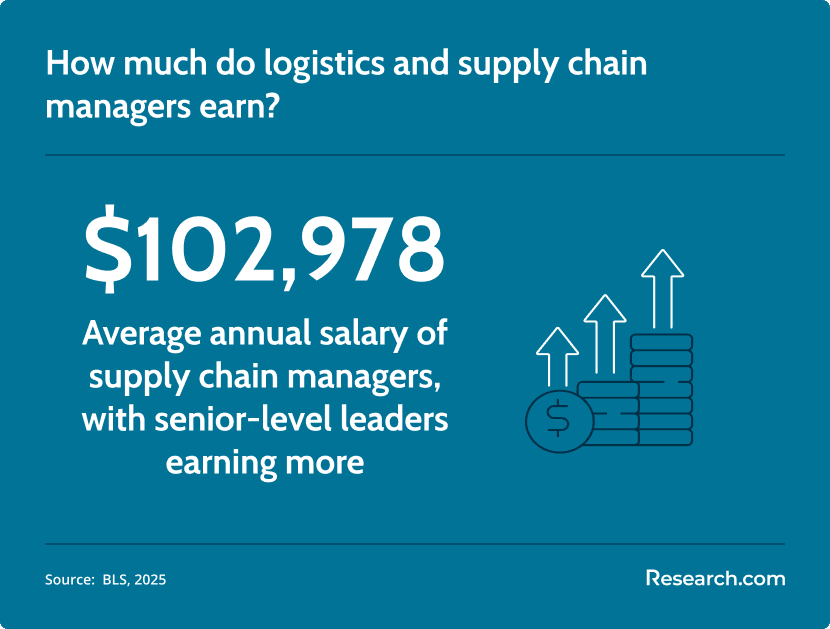
- Overall Market Average: Across sources, supply chain managers average $102,978 annually based on 2,700 reported salaries (Indeed, 2025).
With salaries ranging from the mid-$70,000s to over $120,000, online logistics and supply chain management programs position graduates for roles that provide strong financial returns and leadership opportunities.
- List of Online Logistics and Supply Chain Management Graduate Certificate Programs for 2027 List of Programs
- How long does it take to complete an online logistics and supply chain management graduate certificate? Completion Time
- How do online logistics and supply chain management graduate certificate programs compare to on-campus programs? How do online logistics and supply chain management graduate certificate programs compare to on-campus programs?
- What is the average cost of online logistics and supply chain management graduate certificate programs? Average Cost
- What are the financial aid options for students enrolling in online logistics and supply chain management graduate certificate programs? Financial Aid
- What are the prerequisites for enrolling in online logistics and supply chain management graduate certificate programs? Requirements
- What courses are typically in online logistics and supply chain management graduate certificate programs? What courses are typically in online logistics and supply chain management graduate certificate programs?
- What types of specializations are available in online logistics and supply chain management graduate certificate programs? What types of specializations are available in online logistics and supply chain management graduate certificate programs?
- How to choose the best online logistics and supply chain management graduate certificate programs? Program Criteria
- What career paths are available for online logistics and supply chain management graduate certificate holders? Career Paths
- What is the job market for online logistics and supply chain management graduate certificate holders? Job Outlook
- How Do Accreditation and Industry Partnerships Influence Program Quality? How Do Accreditation and Industry Partnerships Influence Program Quality?
- How Are Emerging Technologies Shaping Online Logistics and Supply Chain Management Programs? How Are Emerging Technologies Shaping Online Logistics and Supply Chain Management Programs?
- Should I Combine My Logistics Certificate with an Advanced Business Degree? Should I Combine My Logistics Certificate with an Advanced Business Degree?
Best Online Graduate Certificate Programs in Logistics and Supply Chain Management for 2027
A graduate certificate in logistics and supply chain management is designed for professionals who want advanced supply chain training without committing to a full master’s degree. It can help you build skills in procurement, transportation, inventory planning, analytics, supplier management, and global operations in a shorter format than a graduate degree.
This guide is for working professionals, career changers with business or technical backgrounds, military logistics personnel, operations supervisors, procurement specialists, and managers who want a focused credential. You will learn which online programs stand out, how long they take, what they cost, what courses they include, how to compare online and campus formats, and when a certificate is worth pursuing instead of a master’s degree or certification-only path.
If you are comparing short graduate credentials across technical management fields, you may also want to review related options such as the fastest online engineering management master’s programs, especially if your career goals combine operations, technology, and leadership.
Quick answer: Is an online graduate certificate in logistics and supply chain management worth it?
An online graduate certificate in logistics and supply chain management can be worth it if you already have a bachelor’s degree and want graduate-level supply chain training in less time than a master’s program. The strongest options are accredited, teach practical analytics and procurement skills, use current supply chain tools, and allow credits to transfer into a master’s degree. It is less useful if you need an entry-level undergraduate foundation, require employer-recognized professional certification only, or choose a program without checking accreditation, cost, and transfer policies.
How we evaluated programs
Programs were selected using Research.com’s methodology, with attention to accreditation, curriculum depth, online delivery quality, faculty expertise, applied learning, cost transparency, and fit for working professionals.
Program information was reviewed using trusted education data sources, including the Integrated Postsecondary Education Data System, Peterson’s Distance Learning database, the U.S. Department of Education’s College Scorecard, and the National Center for Education Statistics.
| School | Credits or Units | Typical Completion Time | Best Fit |
| Florida International University | 30 graduate credit hours | 10 months | Learners who want a technology-heavy logistics program with software exposure |
| University of West Florida | 9 graduate credit hours | Estimated 12 months | Professionals focused on logistics strategy and analytics |
| Fitchburg State University | 9 graduate credit hours | 5 months | Students seeking a short, applied certificate with GIS and logistics content |
| Western Kentucky University | 12 graduate credit hours | Typically completed within one term | Learners who want stackable credits toward WKU’s MBA program |
| Arizona State University | 9 graduate credit hours | Approximately 7.5 months | Students seeking a W. P. Carey supply chain credential with master’s pathway potential |
| University of Oklahoma | 12 graduate credit hours | Typically completed within one academic term | Professionals who want a structured curriculum with no course substitutions |
| Boston University | 16 units | 6 to 9 months | Learners interested in analytics, global logistics, and decision sciences |
| Ohio University | 9 graduate credit hours | Three seven-week courses | Students interested in operations, process improvement, and Six Sigma Green Belt preparation |
| Penn State World Campus | 12 credits | Typically 1-year part-time | Professionals who want a modular certificate connected to a Master of Supply Chain Management |
| University of Denver | 16 or 24 graduate credit hours | As few as six months, with an option to extend up to one year | Learners who want case projects, live sessions, and a practicum-based format |
1. Florida International University
Florida International University offers a fully online, cohort-style graduate certificate in logistics and supply chain management with a strong emphasis on logistics technology, analytics, and distribution modeling. Students work with tools such as SAP, SPSS, MercuryGate, and Magaya while studying with faculty who bring experience from organizations including Amazon and FedEx. The program also includes professional development seminars and optional internship opportunities supported by industry partnerships.
- Program length: 10 months
- Tracks/concentrations: Logistics technology; data analytics; distribution modeling
- Cost per credit: While not specified, the total tuition is approximately $28,000 (in-state), $30,000 (out-of-state)
- Required credits to graduate: 30 graduate credit hours
- Accreditation: Association to Advance Collegiate Schools of Business (AACSB) International
2. University of West Florida
University of West Florida provides a fully online graduate certificate in supply chain logistics management built around analytics, logistics systems, and global supply chain strategy. Coursework includes Global Logistics Management, Logistics Systems and Analytics, and a Seminar in Supply Chain Logistics Strategy. The 7-week course format is designed for working adults who want to apply cost, flow, and efficiency analysis to operational decisions.
- Program length: Estimated 12 months
- Tracks/concentrations: Supply chain logistics, strategy, analytics
- Cost per credit: In-state $384.60; out-of-state $1,044.24 (out-of-state waivers available)
- Required credits to graduate: 9 graduate credit hours
- Accreditation: AACSB
3. Fitchburg State University
Fitchburg State University offers a fully online graduate certificate in supply chain management that can be completed in an accelerated five-month schedule. The curriculum covers GIS and decision-making, transportation and logistics management, and supply chain competitiveness. Students also gain exposure to tools such as ArcGIS, making the program practical for professionals who want stronger spatial analysis and logistics planning skills.
- Program length: 5 months
- Tracks/concentrations: GIS and decision-making, transportation and logistics, supply chain competitiveness
- Cost per credit: $436
- Required credits to graduate: 9 graduate credit hours
- Accreditation: International Accreditation Council for Business Education (IACBE)
4. Western Kentucky University
Western Kentucky University delivers a 100% online graduate certificate in supply chain management for students who want advanced exposure to sourcing, procurement, design, and analytics. The four-course curriculum includes Supply Chain Management, Procurement Management, and Supply Chain Analytics. Credits may transfer into WKU’s MBA program, which makes the certificate useful for students who may later pursue a broader business degree.
- Program length: Typically completed within one term
- Tracks/concentrations: Strategic sourcing, procurement, analytics
- Cost per credit: Not specified separately
- Required credits to graduate: 12 graduate credit hours
- Accreditation: AACSB
5. Arizona State University
Arizona State University offers a fully online graduate certificate in supply chain management through the W. P. Carey School of Business, ranked among the nation’s top three for supply chain specialties. The program covers supply chain foundations, decision modeling, operations, and strategy. Credits can be applied toward a Master of Science in Supply Chain Management, making it a practical option for students who may want to continue into a graduate degree.
- Program length: Completed through four sequential 7.5-week courses or approximately 7.5 months
- Tracks/concentrations: Foundations of supply chain management, decision modeling, operations and strategy
- Cost per credit: Flat cost of approximately $3,000 for the credential
- Required credits to graduate: 9 graduate credit hours
- Accreditation: AACSB through W. P. Carey School of Business
6. University of Oklahoma
University of Oklahoma offers a fully online graduate certificate in supply chain management through the Price College of Business. Students begin with Fundamentals of Supply Chain and then complete 10 additional credit hours in areas such as Strategic Sourcing, Logistics and Transportation, Modeling and Analytics, and Global Supply Chain Excellence. Because the curriculum does not permit course substitutions, it is best for learners who want a clearly defined academic sequence.
- Program length: Typically completed within one academic term
- Tracks/concentrations: Fundamentals of supply chain, strategic sourcing, logistics and transportation, modeling and analytics, global supply chain excellence
- Cost per credit: $985 per credit (includes fees and software)
- Required credits to graduate: 12 graduate credit hours
- Accreditation: AACSB through Price College of Business
7. Boston University
Boston University Metropolitan College provides a fully online graduate certificate in supply chain management focused on global logistics, decision-making, analytics, and operational strategy. Students may access the Decision Sciences Research Laboratory and complete applied analytics projects using real-world case problems. The program is especially relevant for professionals who want stronger quantitative and managerial tools for supply chain roles.
- Program length: 6 to 9 months (four courses, 16 units)
- Tracks/concentrations: Global supply chain design, logistics strategy, import/export operations, lean and Six Sigma methods
- Cost per credit: Approximately $567 per undergraduate-level unit or $1,005 per graduate-level unit
- Required credits to graduate: 16 units
- Accreditation: AACSB through Questrom School of Business
8. Ohio University
Ohio University offers a fully online graduate certificate in operations and supply chain management through its College of Business. The certificate is structured around three seven-week courses and includes preparation aligned with Six Sigma Green Belt certification. Credits may transfer into MBA or Master of Science in Management programs, giving students a pathway from a short credential into a larger graduate plan.
- Program length: Three seven-week courses
- Tracks/concentrations: Inventory management, process flow, risk mitigation, Lean Six Sigma
- Cost per credit: $839 (Ohio resident) or $861 (non-resident)
- Required credits to graduate: 9 graduate credit hours
- Accreditation: AACSB
9. Penn State World Campus
Penn State World Campus, working with the Smeal College of Business, offers a 12-credit fully online Graduate Certificate in Supply Chain Management. The curriculum covers strategic procurement, demand fulfillment, inventory and operations metrics, and network design. The stackable format allows certificate credits to apply toward Penn State’s Master of Supply Chain Management, which is useful for students who want to test graduate study before committing to the full degree.
- Program length: Typically 1-year (part-time pacing)
- Tracks/concentrations: Integrated foundational certificate curriculum
- Cost per credit: About $1,154 per credit, totaling approximately $13,848 for the full certificate
- Required credits to graduate: 12
- Accreditation: AACSB (via Penn State Smeal College of Business)
10. University of Denver
University of Denver offers a fully online graduate certificate in supply chain management through the Daniels College of Business, Transportation and Supply Chain Institute, and University College. The four-course option can be completed in as few as six months and includes a practicum plus case projects developed with industry partners. Students who prefer interaction may value the program’s live online sessions and career support.
- Program length: Four-course certificate completed in as few as six months (option to extend up to one year)
- Tracks/concentrations: Core supply chain foundations, planning, execution, practicum
- Cost per credit: Approximately $11,680 for four-course option; $17,520 for six-course option
- Required credits to graduate: 16 graduate credit hours for four-course, or 24 for six-course
- Accreditation: Higher Learning Commission (HLC)
How Long Does an Online Logistics and Supply Chain Management Graduate Certificate Take?
Most online logistics and supply chain management graduate certificates are built for working professionals and can be completed in less than a year. The exact timeline depends on the number of credits, session length, start-date flexibility, and whether you enroll in one course at a time or carry multiple courses at once.
| Timeline | Typical Structure | Best For |
| Accelerated completion: 5–9 months | Short terms, 7-week courses, or tightly sequenced modules | Students who can handle a fast workload and want a quick credential |
| Standard timeline: 6–12 months | Part-time enrollment with steady course progression | Working professionals balancing study with full-time employment |
| Extended pace: up to 16 months | Traditional semesters or flexible part-time scheduling | Learners who need more time because of work, travel, or family commitments |
Some students use a certificate as part of a longer academic plan. If you are still completing undergraduate study, compare certificate options with an accelerated online bachelor’s degree in supply chain management to understand which credential fits your current education level.
Completion speed should not be the only deciding factor. A shorter program may be ideal if it covers the exact skills you need, but a slightly longer certificate may offer more analytics, software practice, internship access, or transferability into a master’s degree.
Salary and employment outcomes vary by role, location, employer, experience, and education. The chart below shows the median annual wages for logisticians as of 2024.
Online vs. On-Campus Logistics and Supply Chain Graduate Certificates
Online and on-campus graduate certificates can cover the same academic content, but the learning experience differs. The better choice depends on your schedule, need for in-person networking, access to local employers, and comfort with virtual collaboration tools.
| Factor | Online Certificate | On-Campus Certificate |
| Schedule flexibility | Usually stronger because courses may be asynchronous, accelerated, or offered in short sessions | Often requires travel to campus and attendance at set class times |
| Faculty and curriculum | Often taught by the same or comparable faculty using similar graduate outcomes | May provide direct classroom discussion and easier access to campus resources |
| Applied learning | May include virtual labs, analytics projects, simulations, and online team assignments | May include in-person labs, site visits, and campus-based projects |
| Networking | Depends on live sessions, cohort design, alumni access, and employer partnerships | Often stronger for local networking and in-person recruiting events |
| Best fit | Working professionals, remote learners, military students, and people changing careers while employed | Students who live near campus or want face-to-face interaction |
Online supply chain programs increasingly use the same collaboration patterns found in other skills-focused online programs, including virtual teams, project-based assignments, and software-driven labs. Students comparing online learning environments may find useful parallels in the structure of the best online cyberops training bootcamps, where hands-on virtual practice is central to the learning model.
Before enrolling, ask whether online students receive the same faculty access, career services, library resources, software licenses, and alumni networking opportunities as campus students. These details can matter more than the delivery format itself.
How Much Do Online Logistics and Supply Chain Management Graduate Certificates Cost?
Online graduate certificates in logistics and supply chain management vary widely in cost because schools use different tuition models. Some charge by credit, some list a total program price, and others add fees for technology, software, or student services.
Many programs require 9–16 credits, although some options use units or a larger credit structure. Students focused on speed may also compare these programs with the fastest online graduate certificate programs in logistics and supply chain management to see whether a shorter timeline also lowers total cost.
| Cost Category | Typical Pricing in This Field | What to Check |
| Lower-cost tier | $555–$695 per credit for 9–12 credits, or about $5,000–$8,300 total | Confirm whether fees, software, and textbooks are included |
| Mid-range cost | $750–$1,000 per credit for 9–16 credits, or about $8,100–$16,000 total | Compare transferability, accreditation, and employer reputation |
| Premium bracket | Around $919 per credit or $1,005 per unit for 16 credits, totaling roughly $14,500 | Decide whether brand recognition, faculty access, or career support justify the price |
Most online graduate certificates in this field fall within a $6,000–$16,000 range, and programs around $8,000–$12,000 may offer a practical middle ground for students who want a respected credential without the cost of a full graduate degree.
Do not compare tuition alone. A lower-cost certificate may become more expensive if credits do not transfer, required software is not included, or the program lacks career support. A higher-cost program may be worth considering if it is AACSB-accredited, stackable into a master’s degree, and aligned with your target role.
Financial Aid Options for Online Logistics and Supply Chain Graduate Certificate Students
Funding options for graduate certificates are more limited than for full degree programs, but students may still qualify for loans, scholarships, employer assistance, military benefits, or program-specific awards. Always confirm eligibility with the school’s financial aid office because certificate programs do not all qualify for the same aid.
| Funding Source | What It May Cover | Important Limitations |
| Federal graduate aid | Eligible students can borrow up to $20,500 annually through Direct Unsubsidized Loans, and Direct PLUS Loans may provide additional funding | Certificate eligibility depends on the program and institution; graduate work-study may be available only at participating schools |
| Employer tuition assistance | May reimburse tuition for job-related coursework in logistics, operations, procurement, or business analytics | Employers may require preapproval, minimum grades, or continued employment after completion |
| Mastercard Foundation and Arizona State University Strong Start Certificate Scholarships | Mastercard and ASU scholarship opportunities may fully fund eligible online graduate certificates in supply chain management and related fields | Eligibility is competitive and program-specific |
| ISM Richter Scholarship | The R. Gene Richter Scholarship awards up to $15,000 to graduate students studying supply chain management or procurement | Applicants must meet Institute for Supply Management requirements |
Before borrowing, calculate the total cost of attendance, not just tuition. Include fees, books, software, application costs, and any travel for optional residencies or networking events. Then compare that total with your expected career benefit, employer reimbursement, and whether credits can apply to a future degree.
Admission Requirements for Online Logistics and Supply Chain Management Graduate Certificates
Most graduate certificate programs expect applicants to have completed a bachelor’s degree and to be ready for quantitative, managerial, and analytics-based coursework. Requirements differ by school, so always verify the exact admissions rules before applying.
- Bachelor’s degree: Programs commonly require a bachelor’s degree from a regionally accredited institution. Many prefer applicants with business, engineering, technical, or quantitative backgrounds.
- Minimum GPA: A GPA of 3.0 or higher is commonly required, although some schools may review applicants holistically.
- Work experience: Two to three years of experience in logistics, supply chain, operations, procurement, transportation, or a related field is often helpful and sometimes expected.
- GMAT or GRE: Applicants without relevant experience may be asked to submit test scores, often with a minimum score near 500.
- Quantitative preparation: Undergraduate coursework in statistics, calculus, probability, or economics may be required, often with a minimum grade of C.
- English proficiency: International applicants may need TOEFL or IELTS scores unless they previously completed qualifying study in English.
If your long-term goal is management, compare certificate admissions expectations with the broader qualifications discussed in this guide to becoming a supply chain manager.
Common Courses in Online Logistics and Supply Chain Management Graduate Certificates
Graduate certificates are compact, so course selection matters. A strong program should cover both strategic decision-making and practical tools used in transportation, sourcing, inventory, analytics, and operations improvement.
| Course Area | What You Learn | Why It Matters |
| Supply chain strategy and design | Network design, process coordination, supplier relationships, and enterprise-wide planning | Helps managers align supply chain decisions with business goals |
| Performance metrics, cost analysis, and inventory control | Forecasting, inventory planning, cost evaluation, and operational KPIs | Builds the financial and analytical skills needed to reduce waste and improve service levels |
| Purchasing and supplier management | Supplier selection, contract negotiation, ethical sourcing, and procurement strategy | Supports better sourcing decisions and stronger supplier performance |
| Global logistics and transportation systems | Transportation networks, import/export operations, third-party logistics, and trade considerations | Prepares students for supply chains that cross borders and depend on multiple transport modes |
| Logistics systems and analytics | Data tools, decision models, logistics technology, and systems integration | Develops the technical fluency employers increasingly expect |
| Lean, Six Sigma, or structured problem solving | Process mapping, waste reduction, quality improvement, and continuous improvement methods | Supports operational improvement roles and process-focused leadership |
Students who want a broader business-building path outside logistics can compare supply chain coursework with programs in entrepreneurship, including the fastest online bachelor’s degree programs in entrepreneurship. This comparison is useful if your goal is to manage sourcing, fulfillment, or operations for a startup or small business.
Specializations in Online Logistics and Supply Chain Management Graduate Certificates
Some certificates follow a fixed curriculum, while others allow electives or focus areas. Choose a specialization based on the role you want next, not simply the course title that sounds most interesting.
| Specialization | Focus | Best For |
| Risk management and resilience | Disruption planning, supplier risk, contingency strategy, and resilience after major supply chain shocks | Professionals in global sourcing, healthcare supply chains, manufacturing, and critical infrastructure |
| Analytics and technology | Predictive modeling, ERP systems, blockchain applications, logistics platforms, and data-driven decision-making | Analysts, planners, operations managers, and professionals moving into technology-enabled roles |
| Global supply chain and procurement | International sourcing, trade compliance, supplier relationships, and cross-border operations | Procurement managers, sourcing specialists, and logistics professionals working with international vendors |
| Operations and quality management | Lean, Six Sigma, quality control, systems design, and process improvement | Operations supervisors, production managers, and professionals focused on efficiency and quality |
The value of a specialization depends on fit. For example, analytics is useful if your target role involves forecasting or network modeling, while procurement is stronger if you negotiate supplier contracts or manage sourcing. The same principle applies in other business fields, where focused concentrations in programs such as the fastest online MBA in marketing programs help students match coursework to career goals.
Specializations can also influence the industries and roles available after graduation. The chart below shows industries where logisticians are paid the most.
How to Choose the Best Online Logistics and Supply Chain Management Graduate Certificate
The best program is not necessarily the cheapest, fastest, or most recognizable. It is the one that matches your career target, budget, schedule, academic background, and future education plans.
| Selection Factor | What to Look For | Why It Matters |
| Accreditation | Regional accreditation at the institution level and, when relevant, AACSB accreditation for the business school | Accreditation affects credibility, transferability, employer acceptance, and sometimes financial aid eligibility |
| Curriculum fit | Courses in procurement, analytics, logistics systems, transportation, global operations, and process improvement | A certificate is short, so every course should support your target role |
| Faculty and industry experience | Instructors with supply chain leadership, analytics, consulting, procurement, logistics, or operations experience | Industry-aware faculty can connect theory to current supply chain problems |
| Applied learning | Case studies, simulations, capstone projects, software use, practicums, or employer-linked assignments | Applied work helps you build evidence of skills for promotions and interviews |
| Stackability | Credits that can transfer into an MBA, MS in Supply Chain Management, or related graduate degree | Stackable credits reduce duplicate coursework if you later continue your education |
| Career support | Advising, alumni networks, employer partnerships, internship options, and resume or interview help | Career services can be especially important for career changers and remote students |
AACSB accreditation is a widely recognized signal of business-school quality and is achieved by fewer than 6% of business schools worldwide. However, accreditation alone is not enough. Also review course descriptions, student outcomes, faculty backgrounds, and whether the certificate aligns with your preferred industry.
If your goal is to continue beyond a certificate, look for programs that connect naturally to a fast-track online master’s in supply chain management. This can help you avoid taking credits that will not count toward your next credential.
Common mistakes to avoid
| Mistake | Better Approach |
| Choosing a program only because it is fast | Confirm the curriculum includes the skills your target job requires |
| Looking only at tuition | Compare total cost, fees, books, software, transfer credits, and employer reimbursement |
| Assuming every online certificate is respected equally | Check institutional accreditation, business-school accreditation, faculty quality, and employer recognition |
| Ignoring transfer policies | Ask in writing whether credits apply to a master’s degree and how long those credits remain valid |
| Relying only on rankings | Use rankings as a starting point, then verify program fit, support services, and course relevance |
| Assuming salary gains are guaranteed | Evaluate likely outcomes based on your experience, location, current role, and employer demand |
Questions to ask before enrolling
- Is the institution regionally accredited?
- Is the business school AACSB-accredited, IACBE-accredited, or accredited by another recognized agency?
- Can certificate credits transfer into a master’s program?
- Are required software tools included in tuition and fees?
- Are courses asynchronous, synchronous, or a mix of both?
- Will online students have access to the same career services as campus students?
- Does the program include analytics, procurement, logistics systems, and applied projects?
- What support is available if you are new to graduate-level quantitative coursework?
Career Paths for Online Logistics and Supply Chain Management Graduate Certificate Holders
A graduate certificate does not guarantee a promotion, but it can strengthen your qualifications for roles that require analytical, operational, and cross-functional decision-making. It is especially useful when paired with relevant work experience.
| Role | Typical Responsibilities | Certificate Skills That Help |
| Supply chain manager | Coordinates procurement, inventory, planning, logistics, and supplier performance across the supply network | Supply chain strategy, analytics, supplier management, and performance metrics |
| Logistics manager or director | Manages transportation, warehousing, freight movement, distribution, and delivery performance | Transportation systems, logistics analytics, distribution modeling, and cost analysis |
| Operations manager | Improves production, quality, staffing, workflows, and operational efficiency | Lean, Six Sigma, process improvement, and operations strategy |
| Demand planning manager or analyst | Forecasts demand, manages inventory plans, and aligns supply with expected customer needs | Forecasting, analytics, inventory management, and data interpretation |
| Procurement or purchasing manager | Leads sourcing, supplier negotiations, contracts, purchasing strategy, and vendor performance | Procurement strategy, supplier management, ethical sourcing, and contract analysis |
| Global logistics manager or director of supply chain | Oversees international logistics, sourcing strategy, trade compliance, and cross-border supplier networks | Global supply chain management, risk planning, transportation, and strategic sourcing |
Demand planning and supply chain analytics roles require many of the same data reasoning habits seen in other analytics-heavy fields. If you are comparing analytics-focused graduate options more broadly, the best online master’s degree programs in sports analytics show how data skills can translate into specialized career paths.
Job Market Outlook for Logistics and Supply Chain Certificate Graduates
The labor market for supply chain talent remains closely tied to e-commerce, manufacturing, healthcare distribution, global sourcing, transportation networks, and companies’ need to manage disruption. Employers often look for professionals who can combine operational experience with analytics, technology, and cross-functional planning.
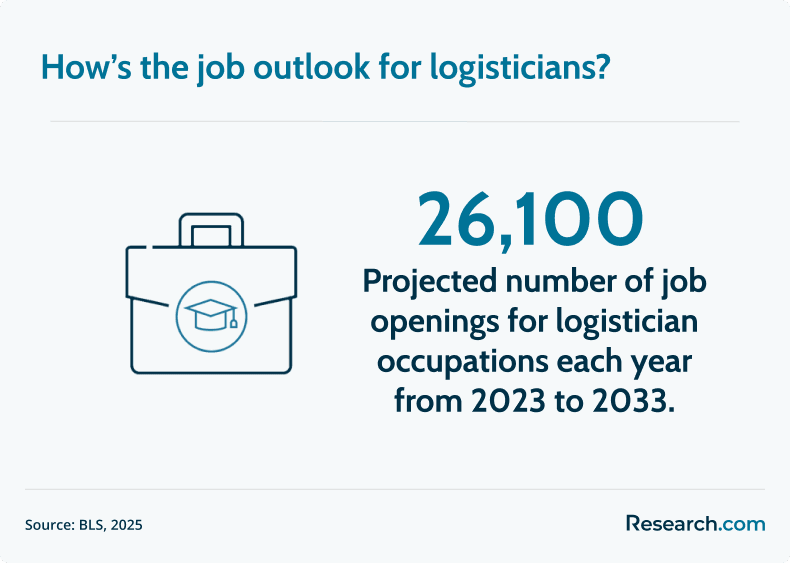
Employment for logisticians, which includes supply chain managers and analysts, is projected to grow 19% from 2023 to 2033. Approximately 26,100 job openings are expected each year during that period, driven by growth and replacement needs.
Graduates may also find opportunities in adjacent roles such as operations research, procurement, inventory planning, vendor management, and distribution management. These roles often reward people who can communicate across departments, interpret data, and improve systems. Students interested in broad, cross-functional career preparation may also compare supply chain credentials with the best online interdisciplinary studies degree programs.
Demand can vary by region. Major logistics hubs such as Chicago, Los Angeles, Atlanta, and the Dallas–Fort Worth area often have more transportation, warehousing, distribution, and supply chain employers than smaller markets.
The graph below illustrates the projected growth the logistician field is expected to see over the next decade.
How Accreditation and Industry Partnerships Affect Program Quality
Accreditation and employer connections are two of the strongest signals of program quality. Accreditation helps verify that a school meets recognized academic standards. Industry partnerships can improve access to real cases, guest speakers, software tools, internships, practicums, and employer-informed assignments.
Do not assume every partnership produces the same benefits. Ask whether partnerships lead to student projects, recruiting events, internships, mentoring, or simply advisory input. The most useful programs connect coursework to current supply chain problems such as supplier disruption, data visibility, warehouse automation, sustainability, and global transportation risk.
Students comparing professional programs in operations-heavy fields may see similar value in employer-connected learning models used in the fastest online construction management programs.
How AI and Emerging Technologies Are Changing Supply Chain Graduate Certificates
Supply chain education is shifting toward digital decision-making. Programs increasingly include artificial intelligence, Internet of Things systems, blockchain concepts, predictive analytics, simulation, ERP platforms, and real-time visibility tools. These topics matter because employers want professionals who can use data to anticipate disruption, improve forecasting, monitor suppliers, and make faster operational decisions.
AI is not replacing the need for supply chain professionals, but it is changing what employers expect. Workers who understand procurement, logistics, and operations may have an advantage when they can also interpret model outputs, question data quality, and translate analytics into practical decisions.
This technology shift also explains why many supply chain certificates now resemble broader graduate business programs in structure. They combine technical tools with strategy, leadership, and decision-making, much like modern online MBA programs.
Should You Combine a Logistics Certificate with an Advanced Business Degree?
A logistics and supply chain graduate certificate can be a smart first step toward a larger business credential if the credits are stackable. This approach lets you gain targeted skills now while keeping the option to continue into an MBA, MS in Supply Chain Management, or management degree later.
| Path | When It Makes Sense | What to Watch |
| Certificate only | You need focused supply chain skills for your current role or a near-term promotion | May not carry the same weight as a full master’s degree for senior leadership roles |
| Certificate plus MBA | You want supply chain expertise plus broader leadership, finance, strategy, and management training | Confirm which certificate credits transfer before enrolling |
| Certificate plus MS in Supply Chain Management | You want deeper specialization in logistics, sourcing, analytics, and operations | Some programs accept only specific certificate courses toward the degree |
| Professional certification after the certificate | You want academic training plus an industry-recognized credential | Certification exams may require separate preparation, fees, or experience |
If cost is the main concern, compare stackable certificate pathways with an affordable online MBA. A lower-cost MBA that accepts certificate credits may provide a better long-term return than completing unrelated credentials separately.
What Graduates Often Value in Online Logistics and Supply Chain Certificates
- : "The strongest part of the online format was being able to practice supply chain analytics while continuing to work full time. The coursework helped me review our internal processes with better data and clearer performance measures. — Davonte"
- : "I entered the program with warehouse experience and left with a better understanding of procurement, inventory planning, and logistics strategy. The flexibility made it possible to apply class concepts at work almost immediately. — Mitch"
- : "The certificate helped me connect global sourcing, transportation, and supplier risk in a more structured way. For my career goals, the online format was practical because I did not have to step away from my job. — Tariq"
Key Insights
- An online graduate certificate in logistics and supply chain management is best for professionals who already have a bachelor’s degree and want focused graduate training without committing to a full master’s program.
- Program length varies widely, from 5 months to about 1 year or longer, depending on credit load, course format, and whether the program is accelerated or part-time.
- Total cost often falls within a $6,000–$16,000 range, but students should compare fees, software costs, credit transfer policies, and employer reimbursement before choosing.
- Accreditation matters. Regional accreditation is essential, and AACSB accreditation can strengthen the credibility of business-focused programs.
- The most useful certificates include applied analytics, procurement, transportation, inventory management, global logistics, and process improvement—not just general business theory.
- Stackable certificates can be a lower-risk way to begin graduate study, especially if credits apply to an MBA or master’s in supply chain management.
- Do not assume salary growth or promotion is automatic. Outcomes depend on your work experience, employer, location, role, and ability to apply the credential.
- AI, predictive analytics, ERP systems, blockchain, and real-time logistics tools are becoming more important in supply chain education, making technology fluency a key program selection factor.
References
- Association for Supply Chain Management. (2025). The 10 highest-paying supply chain jobs. https://www.ascm.org/ascm-insights/the-10-highest-paying-supply-chain-jobs/
- Bureau of Labor Statistics. (2025). Business and financial operations occupations. https://www.bls.gov/ooh/business-and-financial/home.htm
- Bureau of Labor Statistics. (2025). Logisticians. https://www.bls.gov/ooh/business-and-financial/logisticians.htm
- Data USA. (2025). Logisticians. https://datausa.io/profile/soc/logisticians
- Indeed. (2025). Average salary for supply chain managers. https://www.indeed.com/career/supply-chain-manager/salaries
- Kapadia, S. (2025, June 9). Universities are tailoring supply chain courses to prepare students for the industry’s AI revolution. Business Insider. https://www.businessinsider.com/supply-chain-courses-at-universities-preparing-students-for-ai-technology-2025-6
- Opportunities for Youth. (2025, April 28). 2025 Arizona State University fully funded online graduate certificate scholarships in supply chain management and global management entrepreneurship and innovation. https://opportunitiesforyouth.org/2025/04/28/2025-arizona-state-university-asu-fully-funded-online-graduate-certificate-scholarships-in-supply-chain-management-and-global-management-entrepreneurship-and-innovation/
- Salary.com. (2025). Supply chain manager salary. https://www.salary.com/research/salary/benchmark/supply-chain-manager-salary
- Supply Chain Guide. (2024). Careers in supply chain management. https://www.supplychainguide.org/careers/
- Supply Chain Guide. (2025). Online master’s in supply chain management programs. https://www.supplychainguide.org/degrees/online-masters-in-supply-chain-management/
- U.S. Department of Education. (2025). Graduate and professional student aid. https://studentaid.gov/sites/default/files/graduate-professional-funding-info.pdf
- U.S. News & World Report. (2025). Online master’s in supply chain management. https://www.usnews.com/education/online-education/supply-chain-management-masters-degree
Other Things You Should Know About Online Logistics and Supply Chain Management Graduate Certificate Programs
Many programs allow up to 6 transfer credits from a regionally accredited graduate school, but the credits usually must be recent and earned with a grade of B or higher. Most certificates still require at least half of the credits, often 9 of 18, to be completed at the admitting university.
In 2027, top programs emphasize skills like data analysis, enterprise resource planning (ERP) software proficiency, and supply chain modeling tools. These skills are crucial for handling complex logistics and supply chain tasks effectively and are integrated through specific coursework and projects.