
2027 How to Become a Licensed Mental Health Counselor (LMHC)

Co-Founder and Chief Data Scientist
Becoming a Licensed Mental Health Counselor (LMHC) is a major professional decision: it requires graduate education, supervised clinical training, a licensing exam, and ongoing compliance with state rules. For people who want to provide therapy, support clients through mental health challenges, and build a counseling career in settings such as private practice, hospitals, schools, and community agencies, the path can be worth the time—but only if you understand the requirements before you enroll.
This guide explains how to become an LMHC for 2027, including what counselors do, how long licensure usually takes, what degree you need, how supervised hours work, how salaries compare with related roles, and how to choose a program that fits your budget, state licensing requirements, and career goals.
Quick answer: what should you know about becoming a licensed mental health counselor for 2027?
- LMHCs provide counseling and psychotherapy for individuals, couples, families, and groups, often focusing on concerns such as anxiety, depression, trauma, addiction, relationship issues, and life transitions.
- The typical path takes six to eight years and generally includes a bachelor’s degree, a counseling-related master’s degree, 2,000 to 4,000 supervised clinical hours, and a state-approved licensing exam.
- The median annual wage for substance abuse, behavioral disorder, and mental health counselors was $53,710 as of 2023, though earnings vary by state, setting, experience, and specialization.
- Specializations such as trauma counseling, substance abuse counseling, child and adolescent counseling, marriage and family therapy, and community mental health can help counselors focus their practice.
- Many accredited counseling programs now offer online or hybrid master’s options, but students must confirm that the program meets licensure requirements in the state where they plan to practice.
- What does a licensed mental health counselor do?
- How long does it take to become a licensed mental health counselor?
- What are the steps to become a licensed mental health counselor for 2027?
- How much can you earn as a licensed mental health counselor?
- How is an LMHC different from a psychologist, psychiatrist, or social worker?
- Where do licensed mental health counselors work?
- What skills do licensed mental health counselors need?
- Can additional certifications strengthen an LMHC career?
- What practical steps help you start an LMHC career?
- Can online programs be an affordable route to LMHC licensure?
- What affects LMHC earning potential?
- What legal and ethical rules do LMHCs follow?
- Can substance abuse counseling improve career opportunities?
- Can advanced degree programs improve LMHC career prospects?
- What professional networks support LMHCs?
- How can you pay for LMHC education?
- What challenges do new LMHCs face?
- Can organizational psychology help an LMHC career?
- How do LMHCs prevent burnout?
- What specializations can you pursue as an LMHC?
- Do LMHC requirements vary by state?
- What is the job outlook for licensed mental health counselors?
What does a licensed mental health counselor do?
A Licensed Mental Health Counselor is a master’s-level clinician who helps clients understand, manage, and work through emotional, behavioral, and psychological concerns. LMHCs may work with individuals, couples, families, or groups, depending on their training, license scope, workplace, and specialization.
In practice, an LMHC may assess a client’s needs, identify treatment goals, document progress, provide therapy, respond to crises, and coordinate care with other professionals. Many counselors use evidence-based approaches such as cognitive behavioral therapy, dialectical behavior therapy, mindfulness-based interventions, motivational interviewing, and trauma-informed care.
Typical responsibilities include:
- Conducting intake assessments: LMHCs gather information about a client’s history, symptoms, relationships, risks, strengths, and treatment goals.
- Providing therapy: They hold counseling sessions with individuals, couples, families, or groups to address mental health and behavioral concerns.
- Creating treatment plans: Counselors translate assessment findings into measurable goals, therapy strategies, timelines, and follow-up steps.
- Using evidence-based interventions: Depending on the client’s needs, LMHCs may use CBT, DBT-informed skills, trauma-focused strategies, solution-focused therapy, or other accepted methods.
- Responding to crises: When clients face suicidal thoughts, acute anxiety, trauma responses, or other urgent concerns, counselors help stabilize the situation and connect clients with appropriate resources.
- Collaborating with care teams: LMHCs may coordinate with psychiatrists, psychologists, social workers, physicians, school staff, and community agencies.
- Teaching coping and communication skills: Counselors help clients build tools for emotional regulation, stress management, decision-making, boundary-setting, and relationship repair.
- Maintaining clinical documentation: Accurate notes, treatment plans, consent forms, and risk assessments are part of responsible and legally compliant practice.
| LMHC work area | What it usually involves | Why it matters |
| Assessment | Understanding symptoms, history, risks, strengths, and goals | Good assessment helps counselors choose appropriate treatment strategies |
| Therapy | Meeting with clients to work through mental health, behavioral, and relationship concerns | This is the core service most people associate with counseling |
| Treatment planning | Setting goals, tracking progress, and adjusting interventions | Clients and providers need a clear path for care |
| Crisis support | Helping clients stabilize during urgent or high-risk situations | Risk management is central to ethical counseling practice |
| Care coordination | Communicating with other providers when appropriate and authorized | Many clients need support beyond weekly therapy sessions |
How long does it take to become a licensed mental health counselor?
How long does it take to become a licensed mental health counselor? In many cases, the full path takes six to eight years. The timeline depends on your undergraduate background, whether you study full time or part time, your state’s supervised experience requirements, and how quickly you complete the licensing exam and application process.
- Bachelor’s degree: 4 years. Most aspiring LMHCs begin with psychology, counseling, human services, social work, or another related field.
- Master’s degree: 2 to 3 years. A graduate degree in mental health counseling or a closely related field is typically required. If you are also exploring human services pathways, this guide on what you can do with a master’s in human services counseling can help you compare options.
- Supervised clinical experience: 1 to 2 years. Many states require 2,000 to 4,000 hours of supervised clinical work after graduation.
- Exam and licensure processing: Several months. You will need to pass the required exam and submit documentation to your state licensing board.
| Stage | Typical time | Decision point |
| Bachelor’s degree | 4 years | Choose courses that prepare you for graduate counseling admissions |
| Master’s degree | 2 to 3 years | Confirm the program meets your state’s LMHC education requirements |
| Supervised clinical hours | 1 to 2 years | Make sure your supervisor and work setting qualify under state rules |
| Licensing exam and application | Several months | Track deadlines, fees, transcripts, background checks, and exam scores |
The timeline can be shorter for students who already hold relevant credits or enroll full time, and longer for students who work while completing a part-time or online graduate program. The chart below illustrates the general sequence of education and training needed to become an LMHC.
What are the steps to become a licensed mental health counselor for 2027?
The LMHC path is structured for a reason: states need evidence that counselors have academic preparation, supervised clinical practice, exam-based competency, and ongoing professional accountability. Requirements differ by state, but the core process usually follows these steps.
- Earn a bachelor’s degree. Start with an undergraduate program in psychology, counseling, social work, human services, or a related area. Use this stage to build a foundation in human behavior, research methods, lifespan development, and social systems.
- Complete a qualifying master’s degree. Enroll in a graduate counseling program that aligns with your state’s licensure rules. Some students compare affordability and completion time when looking for a quick and low-cost master’s degree, but licensure fit should come before speed.
- Complete practicum and internship experiences. Most counseling master’s programs include supervised fieldwork before graduation, allowing students to practice counseling skills in approved settings.
- Accumulate post-graduate supervised clinical hours. After earning the master’s degree, you typically complete 2,000 to 4,000 hours under an approved supervisor, depending on state rules.
- Pass the required licensing exam. Many states use the National Clinical Mental Health Counseling Examination or another approved exam to assess clinical knowledge and decision-making.
- Submit your state license application. Expect to provide transcripts, verification of supervised hours, exam results, fees, background check materials, and other required documents.
- Maintain the license. Once licensed, you will need continuing education and license renewal to remain in good standing.
Some of these steps overlap with behavioral health counselor requirements, but the exact title, scope of practice, and licensing board rules vary by state.
| Before you enroll in a counseling master’s program | Why it matters |
| Check whether the curriculum meets your target state’s LMHC requirements | An affordable program is not useful if it does not qualify you for licensure where you plan to work |
| Ask how practicum and internship placements are arranged | Field placement support can affect graduation timing and clinical readiness |
| Review faculty credentials and clinical specializations | Faculty expertise can shape your training in areas such as trauma, addiction, family systems, or child counseling |
| Compare total cost, not just tuition | Fees, residency requirements, travel, supervision costs, and lost work time can change the real price |
| Confirm online program rules for your state | Online students may still need in-person clinical hours in approved local settings |
How much can you earn as a licensed mental health counselor?
LMHC pay depends on where you practice, your experience, your work setting, your specialty, and whether you are employed by an organization or operating a private practice. According to our research, the median annual wage for substance abuse, behavioral disorder, and mental health counselors was $53,710 as of 2023.
Related mental health and counseling roles show different pay levels: rehabilitation counselor ($44,040), marriage and family therapist ($62,860), school and career counselor ($61,710), and psychologist ($92,740). These roles are not interchangeable because they differ in education, licensure, scope of practice, and job duties.
For LMHCs, compensation may be higher in outpatient care centers, government roles, healthcare settings, or specialized clinical areas, but no program or credential can guarantee a specific salary. The chart below compares LMHC-related earnings with similar occupations.
How is an LMHC different from a psychologist, psychiatrist, or social worker?
LMHCs are part of the broader mental health workforce, but they are not the same as psychologists, psychiatrists, or licensed clinical social workers. The best path depends on whether you want to focus on therapy, psychological testing, medication management, social systems, research, or medical treatment.
LMHC vs. psychologist
An LMHC usually holds a master’s degree and provides counseling or psychotherapy for mental health and behavioral concerns. A psychologist typically holds a Ph.D. or Psy.D. and may provide therapy, conduct psychological testing, diagnose complex conditions, teach, or conduct research. Students comparing routes sometimes look at options such as a 1-year online psychology master’s, but a psychology master’s alone does not automatically qualify someone for LMHC licensure.
LMHC vs. psychiatrist
A psychiatrist is a medical doctor, either MD or DO, who specializes in mental health diagnosis and treatment. Psychiatrists can prescribe medication and may also provide psychotherapy. LMHCs do not prescribe medication; they primarily use counseling, psychotherapy, treatment planning, and behavioral interventions.
LMHC vs. licensed clinical social worker
Licensed Clinical Social Workers and LMHCs can both provide therapy, but their academic training differs. LCSWs complete an MSW, while LMHCs complete graduate training in counseling or a related field. Students comparing costs may review options such as the most affordable online master’s in social work, but they should also compare state licensure rules, fieldwork requirements, and long-term career goals.
| Role | Typical training | Common focus | Can prescribe medication? |
| LMHC | Master’s degree in counseling or related field | Therapy, treatment planning, mental health counseling | No |
| Psychologist | Doctoral degree such as Ph.D. or Psy.D. | Therapy, psychological assessment, diagnosis, research | Generally no, depending on jurisdiction and additional requirements |
| Psychiatrist | Medical degree such as MD or DO | Medication management, diagnosis, medical treatment of mental health disorders | Yes |
| Licensed Clinical Social Worker | Master of Social Work | Therapy, case management, social services, community systems | No |
If you are ready to compare graduate counseling options, Research.com also reviews the best master’s programs in mental health counseling.
Where do licensed mental health counselors work?
LMHCs are employed across healthcare, education, government, nonprofit, and private practice settings. The right environment depends on the population you want to serve, how much clinical supervision you need, your tolerance for administrative work, and whether you prefer a structured organization or independent practice.
- Outpatient mental health centers: Counselors provide therapy for clients managing anxiety, depression, trauma, addiction, relationship concerns, and other mental health needs.
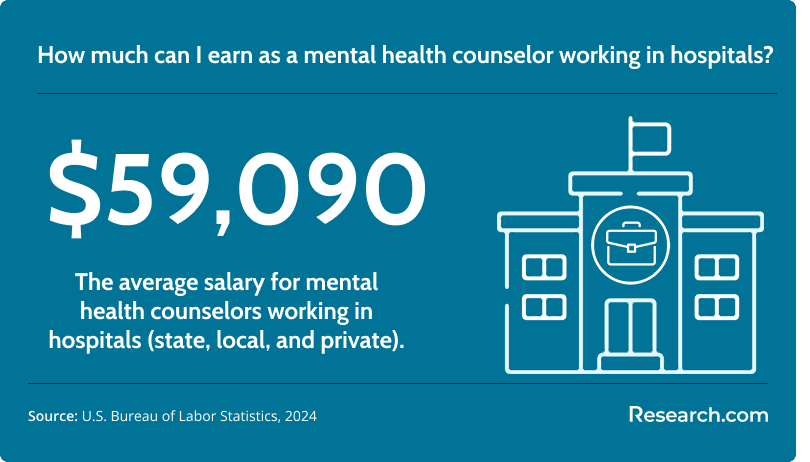
- Hospitals and healthcare organizations: LMHCs may support patients dealing with psychiatric concerns, chronic illness, crisis stabilization, care transitions, or behavioral health needs. The average salary for mental health counselors working in hospitals (state, local, and private) is $59,090.
- Community mental health agencies: Counselors often work with underserved clients, families, and communities, frequently coordinating care with case managers, social workers, and public programs.
- Schools and colleges: LMHCs may support students with stress, anxiety, grief, adjustment issues, crisis concerns, and referrals, though school counseling roles can have separate credential requirements.
- Substance use treatment programs: Counselors support clients through recovery, relapse prevention, co-occurring mental health concerns, and group counseling. Related specialized credentials can sometimes be among certifications that pay well, depending on employer demand and location.
- Private practice: Licensed counselors may offer therapy independently or in group practices, but they must manage billing, records, client acquisition, ethics, and business operations.
- Government and nonprofit organizations: LMHCs may provide direct counseling, crisis response, program coordination, or community-based mental health services.
| Work setting | Best fit for counselors who want... | Trade-off to consider |
| Community agency | Broad clinical exposure and mission-driven work | Caseloads may be demanding |
| Hospital or healthcare system | Interdisciplinary care and structured procedures | Documentation and compliance demands can be high |
| School or college setting | Work with students and developmental concerns | Credential rules may differ from LMHC requirements |
| Substance use treatment center | Specialized work in addiction and recovery | Co-occurring disorders and relapse risk require strong clinical skills |
| Private practice | Autonomy, niche specialization, and schedule control | Business, marketing, billing, and risk management fall heavily on the clinician |
What skills do licensed mental health counselors need?
Successful LMHCs combine clinical knowledge with strong interpersonal judgment. Technical training matters, but so do the everyday skills that help clients feel safe, understood, and supported while still receiving structured, ethical care.
- Empathy: Counselors need to understand clients’ experiences without minimizing, judging, or over-identifying with them.
- Active listening: Careful listening helps LMHCs identify patterns, emotions, risks, strengths, and treatment priorities.
- Clinical reasoning: Counselors must connect symptoms, context, diagnosis, goals, and interventions in a practical treatment plan.
- Clear communication: LMHCs explain concepts, ask sensitive questions, document accurately, and collaborate with other professionals.
- Cultural humility: Effective counseling requires awareness of culture, identity, bias, family systems, community context, and lived experience.
- Knowledge of therapy methods: Counselors need training in evidence-based techniques such as CBT, solution-focused therapy, trauma-informed care, and other approaches appropriate to their scope.
- Diagnostic familiarity: LMHCs should understand diagnostic frameworks such as the DSM-5 and know how diagnosis affects treatment, referrals, documentation, and insurance.
- Boundary-setting: Maintaining professional boundaries protects both the client and the counselor.
- Resilience: Counselors regularly hear difficult stories, manage risk, and make high-stakes decisions, so sustainable self-care and supervision are essential.
| Skill | What it looks like in practice | How to build it |
| Active listening | Reflecting meaning, tracking emotions, and noticing inconsistencies | Practice role-plays, supervision, and recorded session review when allowed |
| Assessment | Gathering history and identifying risk factors | Use supervised intake experiences and feedback |
| Documentation | Writing clear notes, treatment plans, and risk assessments | Learn your employer’s documentation standards and state rules |
| Cultural responsiveness | Adapting care to client identity, context, and values | Pursue continuing education and reflective supervision |
| Ethical decision-making | Handling confidentiality, consent, boundaries, and duty-to-report issues | Study professional codes and consult supervisors when needed |
Can additional certifications strengthen an LMHC career?
Additional certifications can help licensed counselors deepen expertise, serve specific populations, or move into specialized clinical settings. They are not a substitute for state licensure, but they can signal focused training in areas such as trauma, addiction, play therapy, family therapy, grief counseling, telehealth, or crisis intervention.
Before paying for a certification, ask whether employers in your region recognize it, whether it qualifies for continuing education, and whether it matches your intended client population. If you are comparing counseling-adjacent roles, this guide on how to become a behavioral health counselor can help you understand related pathways.
| Certification focus | When it may help | Question to ask first |
| Trauma counseling | You work with abuse survivors, first responders, veterans, grief, or crisis populations | Is the training evidence-based and within my scope of practice? |
| Substance use counseling | You want to work in addiction treatment or co-occurring disorders | Does my state require a separate addiction credential? |
| Family or couples work | You frequently treat relational conflict, parenting issues, or family systems | Do I need additional supervised experience for this scope? |
| Telehealth | You plan to provide online counseling | Does the training address interstate practice, privacy, and emergency protocols? |
What practical steps help you start an LMHC career?
Launching an LMHC career is easier when you treat licensure as a project with deadlines, documents, and verification steps. Do not wait until graduation to learn your state’s rules.
- Identify the state where you want to practice. LMHC requirements are state-specific, so your target state should guide program selection.
- Choose a licensure-aligned master’s program. Review coursework, fieldwork, accreditation, student support, and graduate outcomes before committing.
- Build clinical exposure early. Volunteer work, peer support roles, crisis line experience, and human services jobs can help confirm whether counseling is the right fit.
- Track every fieldwork and supervision requirement. Keep copies of supervisor forms, hour logs, evaluations, and board communications.
- Prepare for the licensing exam before the deadline. Study plans, practice questions, and supervision discussions can reduce test anxiety.
- Develop a professional network. Supervisors, faculty, alumni, local counseling associations, and internship contacts often lead to first jobs.
- Learn the business side of counseling. Even agency counselors need documentation, insurance, compliance, referral, and billing awareness.
For a broader career overview, Research.com’s guide on how to become a mental health counselor explains the role and preparation process in more detail.
Can online programs be an affordable route to LMHC licensure?
Online counseling master’s programs can make graduate education more accessible for working adults, parents, career changers, and students who do not live near a campus-based program. However, online delivery does not remove the need for supervised clinical training. Students still need practicum, internship, and post-graduate supervised hours in approved settings.
Affordability also requires more than comparing tuition. Consider technology fees, travel requirements, residency weekends, field placement support, exam preparation, graduation fees, and whether you can keep working while enrolled. Students comparing counseling-related online options may also review programs such as online MFT master’s programs, but LMHC and MFT licensure requirements are not the same.
| Online counseling program factor | What to verify |
| Licensure alignment | Does the curriculum meet your target state’s counseling board requirements? |
| Field placement support | Will the school help you find practicum and internship sites near you? |
| Residency requirements | Are there required campus visits, and what will travel cost? |
| Faculty access | Can online students reach faculty, advisors, and clinical placement staff easily? |
| Total program cost | What is the full cost after fees, books, travel, and supervision-related expenses? |
What affects LMHC earning potential?
LMHC income is shaped by several factors, including geography, employer type, specialization, years of experience, caseload, payer mix, and whether the counselor works in private practice or an organization. Urban markets and high-cost regions may offer higher pay, but living expenses, competition, licensing costs, and reimbursement rates also matter.
Specialized training may help counselors qualify for certain roles, but salary outcomes are never guaranteed. To compare counseling compensation across roles and settings, see Research.com’s guide on how much counselors make.
| Factor | How it can affect earnings |
| Location | Pay often reflects regional demand, cost of living, and employer budgets |
| Work setting | Healthcare, government, outpatient care, schools, and private practice can have different pay structures |
| Experience | Licensed counselors with stronger clinical judgment and specialized skills may qualify for higher-responsibility roles |
| Specialization | Trauma, substance use, family therapy, crisis work, and other niches may influence opportunities |
| Private practice model | Income depends on client volume, rates, insurance participation, expenses, and business management |
What legal and ethical rules do LMHCs follow?
LMHCs must follow state laws, licensing board rules, employer policies, and professional ethical standards. This includes protecting client confidentiality, obtaining informed consent, documenting care, practicing within scope, managing boundaries, and responding appropriately to risk.
Important legal and ethical areas include:
- Confidentiality and privacy: Counselors must protect client information and understand applicable privacy rules, including HIPAA when relevant.
- Informed consent: Clients should understand services, fees, confidentiality limits, cancellation policies, risks, benefits, and complaint procedures.
- Mandatory reporting: State rules may require reporting suspected abuse, neglect, threats, or other safety concerns.
- Scope of practice: LMHCs should provide services that match their training, license, supervision, and competence.
- Telehealth compliance: Online counseling can involve consent, privacy, emergency planning, and interstate practice concerns.
- Supervision and consultation: Ethical practice often requires consultation when cases are complex, high-risk, or outside the counselor’s expertise.
If program cost is a major concern while preparing for this field, compare affordable online counseling degree options carefully and confirm that they meet licensure expectations.
Can substance abuse counseling improve career opportunities?
Substance abuse counseling can be a valuable specialization because many clients experience overlapping mental health and addiction-related concerns. LMHCs who understand recovery, relapse prevention, motivational interviewing, group treatment, family impact, and co-occurring disorders may be well-positioned for roles in treatment centers, community programs, hospitals, and integrated behavioral health settings.
However, some states and employers require separate addiction counseling credentials in addition to LMHC licensure. Before choosing this path, review your state’s credentialing rules and compare local job postings. Research.com’s addiction counselor salary resource can help you examine related career and compensation information.
Can advanced degree programs improve LMHC career prospects?
Advanced study can support an LMHC career when it adds a clear skill, specialization, or leadership pathway. A doctorate, post-master’s certificate, or specialized graduate training may be useful for counselors interested in supervision, teaching, research, program leadership, advanced assessment, applied behavior analysis, or a specialized clinical population.
For example, a program such as a master’s in applied behavior analysis may help some professionals develop deeper behavior-focused intervention skills. The value depends on your goals, licensing implications, cost, and whether the credential expands your permitted scope or employability.
| Advanced option | May be useful if you want to... | Caution |
| Post-master’s certificate | Add targeted training without completing a full new degree | Confirm employer recognition and continuing education value |
| Doctoral study | Move toward research, teaching, leadership, or advanced clinical roles | Cost and time can be substantial |
| Specialized graduate program | Build expertise in behavior analysis, organizational psychology, trauma, or another niche | Make sure it supports your actual licensure and career plan |
What professional networks support LMHCs?
Professional networks help counselors stay current, find supervision and consultation, learn practice management skills, and avoid isolation. This is especially important for new counselors, private practitioners, and clinicians working with complex or high-risk cases.
Useful supports may include state counseling associations, local supervision groups, alumni networks, specialty organizations, continuing education providers, and interdisciplinary referral networks. If you are comparing professional roles across the mental health field, this overview of licensed clinical social workers and psychologists can help clarify how different practitioners fit into client care.
How can you pay for LMHC education?
Graduate counseling education can be a major investment, so students should compare funding options early. Possible sources include federal student aid, institutional scholarships, grants, employer tuition support, assistantships, payment plans, and private loans. Loan decisions should be made carefully because early-career counseling salaries may not support excessive debt.
When estimating affordability, compare total cost of attendance, not just tuition. Include fees, books, residency travel, unpaid internship time, exam costs, license application fees, and post-graduate supervision costs if applicable. Students comparing related mental health pathways may also review the most affordable online master’s degrees in psychology, while remembering that psychology and counseling programs may lead to different credentials.
| Cost question | Why you should ask it |
| What is the total program cost after fees? | Tuition alone rarely shows the full financial commitment |
| Can I work while enrolled? | Lost income can affect affordability as much as tuition |
| Does the school help with clinical placements? | Placement delays can increase time and cost |
| Are scholarships or assistantships available? | Institutional aid may reduce borrowing |
| What are typical licensing and exam costs? | Post-graduation expenses should be included in your budget |
What challenges do new LMHCs face?
New LMHCs often discover that counseling competence is only one part of the job. Early-career clinicians must also manage documentation, productivity expectations, risk assessment, insurance procedures, supervision requirements, client engagement, and professional boundaries.
Common challenges include:
- Finding qualified supervision: Post-graduate hours must usually be supervised by someone who meets state requirements.
- Managing high caseloads: Entry-level roles in agencies or community settings can involve complex client needs.
- Building confidence: New counselors may struggle with imposter feelings while developing clinical judgment.
- Learning administrative systems: Documentation, billing, compliance, and scheduling can take significant time.
- Planning career advancement: Some counselors explore further training, including options such as a PsyD degree online, when they want doctoral-level preparation for different professional goals.
| Common mistake | Better approach |
| Choosing a program only because it is cheap or fast | First confirm licensure alignment, accreditation, field placement support, and state acceptance |
| Assuming online programs automatically meet state requirements | Ask the licensing board or program for written licensure alignment information |
| Waiting until graduation to learn supervision rules | Track required hours, supervisor qualifications, and forms before starting post-graduate work |
| Ignoring documentation skills | Learn clinical note standards, treatment planning, and risk documentation early |
| Expecting salary outcomes to be guaranteed | Compare local job postings, work settings, experience requirements, and cost of living |
Can organizational psychology help an LMHC career?
Organizational psychology can be useful for LMHCs who want to work with employee mental health, workplace stress, leadership issues, conflict, burnout, organizational culture, or corporate wellness. It can also support counselors interested in consulting, training, employee assistance programs, or workplace-based mental health services.
For counselors who want to connect clinical skills with workplace systems, programs such as an affordable online master’s in organizational psychology may offer complementary knowledge. However, organizational psychology does not replace counseling licensure and may not expand clinical scope by itself.
How do LMHCs prevent burnout?
LMHCs work with distress, trauma, conflict, crisis, and long-term emotional pain. Without boundaries and support, the work can become draining. Burnout prevention is not a luxury; it is part of ethical and sustainable practice.
- Use supervision and consultation. Regular case discussion helps reduce isolation and improve decision-making.
- Set caseload limits where possible. Too many high-acuity clients can reduce clinical effectiveness.
- Protect time between sessions. Documentation, transition time, and breaks matter.
- Maintain professional boundaries. Clear communication around availability, crisis procedures, and contact rules protects both client and counselor.
- Continue learning. Training can make difficult cases feel more manageable and clinically grounded.
- Seek personal support when needed. Counselors benefit from their own therapy, peer support, rest, and community.
Some professionals also explore adjacent training routes, such as online MSW programs, to understand broader systems of care and social service supports.
What specializations can you pursue as an LMHC?
Specialization helps LMHCs focus their skills, market their services, and serve clients with more specific needs. The best specialization is not simply the highest-paying one; it should match your clinical strengths, local demand, training access, and state rules.
- Child and adolescent counseling: Work with young clients facing emotional, behavioral, social, family, developmental, or school-related challenges.
- Marriage and family therapy: Support couples and families with conflict, communication, parenting, trust, and relationship patterns.
- Substance abuse counseling: Help clients address addiction, recovery planning, relapse prevention, and co-occurring mental health concerns. Students interested in this field may compare an accredited online addiction counseling degree with graduate counseling pathways.
- Trauma and crisis counseling: Support clients affected by abuse, violence, grief, disasters, accidents, or post-traumatic stress symptoms.
- School-related counseling: Work with students on mental health, stress, adjustment, relationships, and academic barriers, while noting that school counseling may require separate credentials.
- Career counseling: Help clients clarify career direction, navigate transitions, manage workplace stress, and align work choices with values and skills.
- Behavioral therapy: Focus on behavior change using structured interventions, often relevant to anxiety, OCD, autism spectrum disorder, and related needs.
- Forensic counseling: Work at the intersection of mental health and legal systems, such as offender counseling, victim support, or court-related evaluations, depending on scope and training.
- Community mental health: Provide accessible services for underserved populations, often in nonprofit, public health, or government-funded settings.
| Specialization | Good fit if you want to work with... | Important consideration |
| Trauma counseling | Survivors of abuse, violence, disasters, grief, or crisis | Requires strong training in stabilization and trauma-informed practice |
| Substance abuse counseling | Clients with addiction or co-occurring disorders | Some states or employers may require an additional credential |
| Child and adolescent counseling | Children, teens, parents, and schools | Family involvement and mandated reporting rules are common |
| Marriage and family therapy | Couples and family systems | LMHC scope and MFT licensure rules differ by state |
| Community mental health | Underserved communities and public service settings | Caseload complexity can be high |
Do LMHC requirements vary by state?
Yes. LMHC licensure is state-regulated, and titles, required coursework, supervised hours, exams, renewal rules, and application procedures can differ. Some states use the LMHC title, while others use similar titles such as LPC or LPCC. You should always verify requirements with the licensing board in the state where you plan to practice.
- Education rules: Most states require a master’s degree in counseling or a related field, but specific course requirements can vary.
- Supervised experience: States set their own rules for required hours, supervisor qualifications, direct client contact, and documentation.
- Licensing exams: Many states require the NCMHCE or NCE, while some may have additional requirements.
- Application steps: Fees, background checks, fingerprinting, transcripts, forms, and deadlines are handled differently by each board.
- Continuing education: Renewal requirements vary by state, including the number of hours and required topics.
- Telehealth and interstate practice: Providing counseling across state lines can create legal issues, so verify rules before serving clients in another jurisdiction.
| What to ask your state board | Why it matters |
| Which degree titles and accreditations are accepted? | Prevents enrolling in a program that does not qualify |
| How many supervised hours are required? | Helps you estimate time from graduation to licensure |
| Who can supervise post-graduate hours? | Not every licensed clinician qualifies as an approved supervisor |
| Which exam is required? | Exam preparation depends on the test format and content |
| Can I provide telehealth to clients in another state? | Interstate practice rules can be strict |
What is the job outlook for licensed mental health counselors?
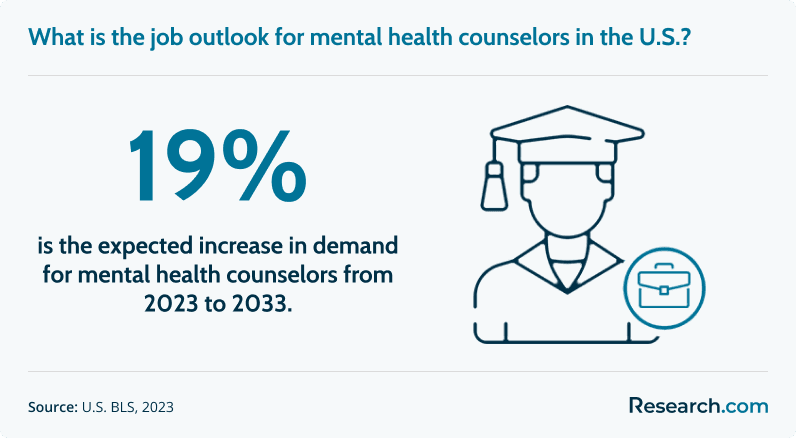
The employment outlook for substance abuse, behavioral disorder, and mental health counselors is strong. According to our research, employment in this group is projected to grow 19% from 2023 to 2033, much faster than the average for all occupations.
Several factors support demand, including greater public awareness of mental health, more people seeking counseling for anxiety, depression, stress, trauma, and addiction, and expanded use of behavioral health services in schools, hospitals, community organizations, and outpatient settings. Students considering related human services routes may also compare a social work degree online as one possible starting point.
At the same time, job growth does not mean every graduate will have the same opportunities. Location, licensure status, specialization, field experience, language skills, and willingness to work in high-need settings can all affect job prospects.
What counseling graduates say about their careers
Becoming an LMHC gave me the chance to do work that feels deeply purposeful. I spend my days helping people move through difficult moments, and the need for mental health services makes the career feel both meaningful and relevant. – Ariana
For me, counseling combines professional growth with personal fulfillment. The training was demanding, but seeing clients develop healthier patterns and more confidence makes the work feel worthwhile. – Peter
LMHC work has allowed me to support people during some of the hardest seasons of their lives. I also appreciate that the field offers different paths, from community programs to private practice. – Jillian
Key Insights
- To become an LMHC, you typically need a counseling-related master’s degree, 2,000 to 4,000 supervised clinical hours, a passing licensing exam score, and approval from your state licensing board.
- The process commonly takes six to eight years, including undergraduate study, graduate education, supervised experience, and licensure processing.
- The median annual wage for substance abuse, behavioral disorder, and mental health counselors was $53,710 as of 2023; related roles include rehabilitation counselor ($44,040), marriage and family therapist ($62,860), school and career counselor ($61,710), and psychologist ($92,740).
- Employment for substance abuse, behavioral disorder, and mental health counselors is projected to grow 19% from 2023 to 2033, but individual outcomes depend on location, licensure, setting, specialization, and experience.
- Online master’s programs can be flexible, but students must verify licensure alignment, clinical placement support, state authorization, and total cost before enrolling.
- Do not choose a counseling program based only on speed, tuition, or convenience. Licensure eligibility, supervised training quality, and state board acceptance are more important.
- LMHCs can work in private practice, hospitals, community mental health agencies, schools, substance use treatment programs, government roles, and nonprofit organizations.
- Specializations such as trauma, substance abuse, child and adolescent counseling, marriage and family work, and community mental health can shape your career path, but some may require additional training or credentials.
Resources:
- Bouvé Communications. (2023). How to Become a Licensed Mental Health Counselor (LMHC). https://bouve.northeastern.edu/news/how-to-become-a-licensed-mental-health-counselor-lmhc
- U.S. Bureau of Labor Statistics. (2024). Occupational Outlook Handbook. https://www.bls.gov/ooh/community-and-social-service/substance-abuse-behavioral-disorder-and-mental-health-counselors.htm#tab-8
Other Things You Should Know About Becoming a Licensed Mental Health Counselor
Most states require the National Clinical Mental Health Counseling Examination (NCMHCE) or, in some cases, the NCE. The exam is administered by the National Board for Certified Counselors (NBCC), and candidates must also complete the state’s education and supervised-practice requirements before licensure.
To become a licensed mental health counselor in 2027, candidates must complete 2,000 to 3,000 hours of supervised clinical experience, depending on state regulations, under a qualified supervisor. This practical training ensures readiness for independent practice and adherence to professional standards.


