
2027 How Long Does it Take to Become A Licensed Mental Health Counselor?

Co-Founder and Chief Data Scientist
Becoming a licensed mental health counselor is a multi-step career path, not a single degree decision. You need the right graduate education, supervised clinical experience, a passing licensure exam score, and approval from your state licensing board before you can practice independently. The timeline matters because it affects your tuition costs, work schedule, internship planning, and when you can begin earning as a fully licensed counselor.
This guide is for undergraduate students, career changers, working adults comparing online counseling programs, and anyone trying to understand how long the licensure process really takes. You will learn the usual requirements, how full-time and part-time study affect the timeline, what skills matter most, how counseling differs from related mental health careers, what costs to expect, and how to choose a program that supports licensure rather than delaying it.
Quick answer: How long does it take to become a licensed mental health counselor?
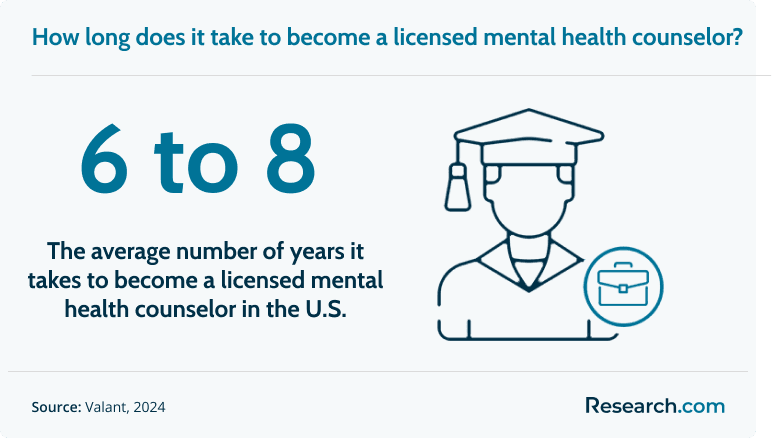
Most aspiring licensed mental health counselors should plan for about six to eight years from the start of college through full licensure. A faster route may take 5–7 years if you complete your degrees without breaks and move quickly through supervised experience. Students who study part-time, change careers, pause between degrees, or work fewer clinical hours per week may need closer to eight to ten years.
- Typical timeline: 5–7 years or six to eight years, depending on how the path is counted and how quickly you complete supervised experience.
- Minimum education: A master’s degree in mental health counseling or a closely related licensure-eligible field is usually required.
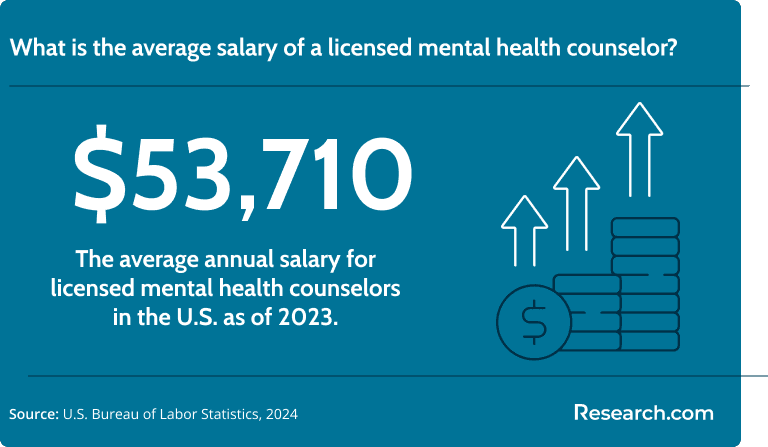
- Salary range: The U.S. Bureau of Labor Statistics reported that substance abuse, behavioral disorder, and mental health counselors earned from less than $36,700 to more than $89,920, with a median annual wage of $53,710 as of May 2023.
- Program flexibility: Many schools offer online master’s programs in mental health counseling, which can help students balance coursework, employment, and clinical training.
- Requirements and steps to become a licensed mental health counselor
- How long the LMHC path usually takes
- Skills that help counselors succeed
- Counselor vs. therapist vs. psychologist
- Cost of becoming a licensed mental health counselor
- How to evaluate graduate programs in mental health counseling
- Average salary for licensed mental health counselors
- Licensure exam and clinical placement preparation
- Marriage and family therapy training as a counseling add-on
- Certifications that can strengthen a counseling career
- How to check the credibility of online counseling programs
- Affordable online counseling programs and quality
- Ways to accelerate the licensure timeline
- Faith-based counseling and mainstream mental health practice
- How to choose the right mental health counseling program
- How a doctoral degree can expand counseling career options
- Whether a 1-year online psychology master’s can support a counseling path
- Scholarships and financial aid for counseling students
- Careers similar to licensed mental health counseling
- Job outlook for mental health counselors
What are the requirements and steps to become a licensed mental health counselor?
The path to becoming a licensed mental health counselor usually includes undergraduate study, graduate counseling education, supervised clinical practice, a licensure exam, and ongoing continuing education. State boards set the final rules, so students should confirm requirements before enrolling in any program. For a broader overview of the profession, see Research.com’s guide on how to become a licensed mental health counselor.
| Step | What it involves | Why it matters for licensure |
| Bachelor’s degree | Complete undergraduate study, often in psychology, social work, counseling, human services, or a related field. | Graduate counseling programs usually require a bachelor’s degree for admission, even when they accept students from non-psychology backgrounds. |
| Master’s degree | Earn a counseling graduate degree, commonly a 60-credit program covering diagnosis, ethics, psychotherapy, assessment, and treatment planning. | Most states require a licensure-eligible graduate degree, often from a Council for Accreditation of Counseling and Related Educational Programs (CACREP)-accredited or state-approved program. |
| Supervised clinical experience | Work with clients under the oversight of a licensed supervisor after graduation. | States require documented supervised hours before granting independent practice privileges. |
| Licensure exam | Pass the National Clinical Mental Health Counseling Examination (NCMHCE) or the National Counselor Examination (NCE), depending on state rules. | The exam verifies readiness in areas such as ethics, treatment planning, case conceptualization, and counseling practice. |
| State licensure application | Submit transcripts, supervision documentation, exam results, fees, and any required background check materials. | The state board must approve your application before you can use the protected professional title or practice independently. |
| Continuing education | Complete required CE credits every 1–2 years, often including ethics or specialized clinical training. | Continuing education keeps the license active and supports safe, current practice. |
A doctoral degree is not usually required to become licensed as a mental health counselor, but some professionals pursue one for advanced clinical specialization, teaching, research, leadership, or consulting roles. If a doctorate is part of your long-term plan, compare affordability and format carefully through resources such as low-cost online PhD programs in counseling.
How long does it take to become a licensed mental health counselor?
The LMHC timeline commonly ranges from six to eight years, but the actual length depends on your academic pace, state requirements, clinical placement availability, and how quickly you complete supervised experience. The route is usually longer for students who study part-time or continue working full-time while completing practicum, internship, or postgraduate supervised hours.
Students often assume they need a psychology bachelor’s degree to enter counseling, but that is not always true. Many graduate programs consider applicants from other majors if they meet prerequisite or admissions requirements. Career changers can review options for becoming a counselor without a psychology degree before deciding whether they need additional undergraduate coursework.
| Path | Likely timeline | Best fit | Main trade-off |
| Full-time undergraduate and graduate study | About six years before completing the education portion and moving through supervised experience as quickly as allowed | Students who can attend continuously and prioritize speed | Less flexibility for full-time employment |
| Standard full-time route with supervised experience | About six to eight years overall | Students who follow a traditional sequence from bachelor’s to master’s to licensure | Requires careful planning for practicum, internship, and postgraduate supervision |
| Part-time or working-adult route | Closer to eight to ten years | Career changers, parents, and students balancing employment with school | Lower course load may reduce short-term stress but lengthen the path to independent licensure |
| Accelerated path | Potentially 5–7 years | Students who transfer credits efficiently, avoid enrollment gaps, and complete supervised hours quickly | Fast pacing can be demanding and may not fit every learner or clinical placement schedule |
What skills do I need to be a successful licensed mental health counselor?
Licensure proves that you met formal requirements, but effectiveness as a counselor depends on how well you combine clinical judgment, ethical practice, communication, and self-management. These skills are developed through coursework, supervised practice, feedback, and ongoing professional development.
- Careful listening and clear communication: Counselors need to hear what clients say, notice what they do not say, ask useful questions, and explain treatment goals in language clients can understand.
- Empathy with boundaries: Clients need to feel respected and understood, but counselors must also maintain professional distance, avoid over-identification, and keep the session focused on the client’s needs.
- Clinical reasoning: Effective counselors connect symptoms, history, context, risk factors, strengths, and treatment options rather than relying on generic advice.
- Emotional stamina: Counseling can involve trauma, grief, crisis, relapse, family conflict, and high-stress situations. Resilience helps clinicians stay grounded and avoid burnout.
- Ethical and cultural competence: Confidentiality, informed consent, mandated reporting, scope of practice, and culturally responsive care are central to safe counseling practice.
- Organization and documentation: Counselors must manage schedules, treatment notes, supervision records, referrals, insurance documentation, and continuing education requirements.
- Adaptability with technology: Telehealth, electronic health records, digital screening tools, and AI-supported administrative systems are changing how counseling services are delivered and documented.
What are the differences between a therapist, counselor, and psychologist?
The words counselor, therapist, and psychologist are sometimes used loosely, but they are not identical credentials. The difference matters because education level, legal scope of practice, licensure exams, salary expectations, and job settings can vary. If you are comparing roles, Research.com’s guide to counseling careers and salaries can help you look beyond job titles.
| Role | Typical education | Primary focus | Common work settings |
| Counselor | At least a master’s degree in counseling, psychology, or a related field | Talk therapy, coping skills, mental wellness, treatment planning, and support for clients facing emotional or behavioral concerns | Private practices, community clinics, rehabilitation centers, schools, and mental health agencies |
| Therapist | A broad label that may include counselors, social workers, psychologists, and marriage and family therapists | Therapy for emotional, relational, behavioral, and psychological concerns using approaches such as CBT or psychodynamic therapy | Hospitals, clinics, private practices, nonprofits, and mental health organizations |
| Psychologist | Doctoral degree, usually a Ph.D. or Psy.D., which takes 5–7 years after a bachelor’s degree | Assessment, diagnosis, therapy, psychological testing, research, and specialized clinical practice | Hospitals, universities, research settings, private practices, corporate environments, and specialty clinics |
Counselor
A counselor usually completes a master’s-level program and earns a state license such as LMHC or LPC. Mental health counseling can also align with broader human services training, which is why it is often listed among the career paths for graduates with a master’s in human services.
Therapist
Therapist is an umbrella term rather than one single license. A therapist may be trained in counseling, social work, marriage and family therapy, psychology, or another mental health discipline. Students who want flexible graduate preparation may compare options such as an accredited online master’s in human services, but they should verify whether the program meets counseling licensure requirements in their state.
Psychologist
Psychologists typically complete doctoral training and may provide therapy, testing, diagnosis, research, consultation, and specialized assessments. This route is longer than the master’s-level counseling path and usually requires passing the Examination for Professional Practice in Psychology (EPPP) after supervised clinical training.
How much does it cost to become a licensed mental health counselor?
The cost of becoming a licensed mental health counselor depends heavily on the school, format, residency status, transfer credits, fees, books, technology requirements, commuting, and whether you can keep working while enrolled. Tuition is only one part of the budget; exam and state application fees also matter.
For example, an online MS in clinical mental health counseling program at NU costs about $42,650. A traditional M.Ed./Ed.S. in MHC degree program from UF costs around $31,360 for in-state students and $35,980 for out-of-state students. Licensing exam fees are typically around $300 to $500, and state licensing board application fees can range from $100 to $300.
| Cost item | Amount stated | Decision point |
| NU online MS in clinical mental health counseling | About $42,650 | Compare total program cost, clinical placement support, accreditation, and state licensure alignment. |
| UF traditional M.Ed./Ed.S. in MHC, in-state | Around $31,360 | In-state tuition can reduce the degree cost, but students should also consider attendance format and local placement requirements. |
| UF traditional M.Ed./Ed.S. in MHC, out-of-state | Around $35,980 | Out-of-state students should compare total cost against online and local alternatives. |
| Licensing exam | Typically around $300 to $500 | Budget for exam preparation, registration timing, and possible retesting policies. |
| State licensure application | $100 to $300, depending on the state | Confirm current fees directly with the licensing board before applying. |
The chart below provides a sample comparison of master’s-level clinical mental health counseling costs at different universities.
What are the best graduate programs for mental health counseling?
The best graduate program is not simply the most recognizable school. For counseling students, the strongest choice is the program that meets licensure requirements in the state where you plan to practice, offers appropriate supervised clinical training, has qualified faculty, and fits your schedule and budget. Research.com’s overview of top master’s programs in mental health counseling can help you compare program types.
- Clinical Mental Health Counseling: A 60-credit licensure-focused program emphasizing psychotherapy, assessment, diagnosis, ethics, and treatment planning.
- Dual Master’s in Mental Health Counseling and Education Specialist (Ed.S.): A combined path that pairs advanced counseling preparation with education-focused coursework, including areas such as crisis intervention and substance use treatment.
- Master of Science in Counseling with a Clinical Mental Health Concentration: A research-informed program that usually blends counseling theory, clinical practice, and mental health treatment across the lifespan.
- Master of Science in Mental Health Counseling: A counseling-focused degree that may include developmental psychology, assessment, career counseling, and opportunities for specialization.
- Master of Arts in Mental Health Counseling: A graduate route that may offer licensure and non-licensure tracks, including areas such as child and family mental health, youth development, and trauma intervention.
Questions to ask before choosing a counseling graduate program
- Does the program meet licensure requirements in the state where I intend to work?
- Is the program CACREP-accredited, state-approved, or otherwise accepted by my licensing board?
- How are practicum and internship placements arranged?
- Can online students complete clinical placements near where they live?
- What support is available for licensure exam preparation?
- What are the total costs beyond tuition, including fees, books, travel, technology, and exam expenses?
- Will transfer credits, previous graduate work, or prerequisites affect my timeline?
- Does the program publish licensure exam pass rates, placement outcomes, or graduate support resources?
What is the average salary of a licensed mental health counselor?
According to the U.S. Bureau of Labor Statistics, the median annual wage for substance abuse, behavioral disorder, and mental health counselors was $53,710 as of May 2023. The lowest 10 percent earned less than $36,700, and the highest 10 percent earned more than $89,920.
Salary can vary by setting, state, specialization, years of experience, supervisory responsibilities, and whether a counselor works in private practice, healthcare, education, government, rehabilitation, or community-based services. Additional training in areas such as trauma therapy, substance abuse counseling, crisis intervention, or family systems may improve competitiveness, but no degree or certification guarantees a specific salary.
How can I optimize preparation for licensure exams and clinical placements?
Start preparing for licensure before graduation rather than waiting until supervised experience is nearly complete. Build a study calendar, review exam domains, take practice tests, discuss case conceptualization during supervision, and use mock scenarios to strengthen diagnostic reasoning and treatment planning. For clinical placement, prioritize sites that provide ethical supervision, varied client exposure, clear documentation expectations, and feedback from licensed professionals. Research.com’s guide on how to become a mental health counselor offers additional planning context.
How can online marriage and family therapy programs complement my mental health counseling career?
Marriage and family therapy training can be useful for counselors who want deeper preparation in couples, parenting, family conflict, and relational systems. This does not automatically expand your legal scope of practice, but it can strengthen clinical understanding when working with clients whose symptoms are connected to family dynamics. Working professionals who want flexible specialization options can compare online marriage and family therapy programs as a possible complement to counseling preparation.
How can additional certifications boost my counseling career?
Certifications can help counselors develop expertise in a focused area, demonstrate professional commitment, and prepare for specialized client needs. They are most valuable when they align with your population, setting, and state practice rules. For example, a counselor working with addiction, recovery, relapse prevention, or co-occurring concerns may benefit from reviewing a substance abuse counseling certification pathway.
How can I assess the credibility of online mental health counseling programs?
Online counseling programs can be legitimate, but students must evaluate them carefully. Confirm accreditation, licensure alignment, clinical placement support, faculty qualifications, supervision expectations, and student services. A low tuition price is not helpful if the program does not qualify you for the license you want. Students comparing accredited and cost-conscious options can start with Research.com’s list of affordable online CACREP-accredited counseling programs.
Can affordable online programs provide quality preparation for a counseling career?
Affordable online programs can provide strong preparation when they maintain recognized accreditation, include rigorous clinical training, support practicum and internship placement, and align with state licensure standards. The key is to compare outcomes and requirements, not just the advertised tuition rate. If cost is a major constraint, review affordable online colleges for counseling degrees while also checking state board approval.
How can I accelerate your journey to licensure?
You can sometimes shorten the path by choosing a licensure-aligned program early, transferring eligible credits, enrolling full-time, avoiding gaps between degrees, scheduling exams strategically, and selecting clinical sites that support steady supervised-hour completion. However, speed should not come at the expense of accreditation, supervision quality, or readiness for client care. Students focused on the fastest safe route can compare strategies in Research.com’s guide to the fastest way to become a licensed counselor or therapist.
Can faith-based counseling approaches complement mainstream mental health practices?
Faith-based counseling can complement clinical practice when it is used ethically, with client consent, cultural humility, and respect for evidence-based mental health care. It may be especially relevant for clients who want their spiritual beliefs considered as part of treatment. Counselors interested in this area should look for programs that address ethics, referral boundaries, cultural competence, and integration of faith with accepted therapeutic methods. Research.com’s guide to the best Christian counseling programs can help students explore this option.
How do I choose the right mental health counseling program?
Choose a counseling program by working backward from licensure. First identify the state where you plan to practice, then confirm required degree type, credits, internship expectations, exams, and supervised experience rules. After that, compare programs by accreditation, curriculum fit, faculty experience, clinical placement support, total cost, online learning quality, and graduation-to-licensure support. If you are still completing undergraduate preparation and want a faster academic route, an accelerated online psychology degree may be worth comparing.
How can a doctoral degree boost my mental health counseling career?
A doctoral degree can support advanced clinical expertise, teaching, supervision, program leadership, research, consulting, and policy-related roles. It is not the required entry point for most licensed mental health counseling roles, so students should weigh the cost and time commitment against their career goals. Those considering a psychology doctorate rather than a counseling doctorate can explore APA-approved PsyD programs.
Can a 1-year online psychology master's program prepare me for a career in mental health counseling?
A 1-year psychology master’s program may strengthen your knowledge of behavior, research, and mental health concepts, but it may not meet licensure requirements for mental health counseling. Before enrolling, verify whether the program includes the required counseling coursework, practicum, internship, and state-approved clinical preparation. Students considering accelerated study should compare 1-year online psychology master’s programs carefully against LMHC or LPC requirements.
Are there scholarships or financial aid for aspiring mental health counselors?
Yes. Counseling students may qualify for federal aid, state assistance, institutional scholarships, professional association awards, and targeted programs for students committed to underserved communities or specialized populations. Because counseling education often includes graduate tuition and unpaid or lower-paid clinical training periods, students should build a funding plan before enrolling.
- FAFSA: The Free Application for Federal Student Aid is the main entry point for federal grants, loans, and work-study eligibility.
- Pell Grants: These need-based federal grants support eligible undergraduate students and do not have to be repaid.
- State grants and forgivable loans: Some states support students entering high-need fields, including mental health counseling, and may offer loan forgiveness for graduates who work in underserved areas.
- NBCC Foundation scholarships: The National Board for Certified Counselors Foundation offers scholarships for students in CACREP-accredited graduate programs, with attention to minority, rural, and underserved communities.
- American Psychological Association graduate student scholarships: APA funding opportunities may support graduate students in psychology, counseling, and related mental health fields, including students from diverse or underrepresented groups.
- Cohen Veterans Network Scholarship: The Cohen Veterans Network scholarship supports students focused on veteran and military mental health, including PTSD, trauma, and reintegration concerns.
What careers are similar to a licensed mental health counselor?
If counseling interests you but you are still comparing mental health careers, look closely at education level, licensure rules, scope of practice, and typical work setting. Similar roles may involve therapy, assessment, crisis support, case management, school-based services, addiction treatment, or family systems work.
| Career | Typical requirement | How it differs from mental health counseling | Average annual salary stated |
| Clinical Psychologist | Ph.D. or Psy.D. plus state licensure | Psychologists often conduct psychological testing and may specialize in areas such as forensic psychology. Students researching this path may also compare forensic psychologist salary factors. | $92,740 |
| Marriage and Family Therapist | Master’s degree in Marriage and Family Therapy plus licensure | MFTs focus heavily on couples, families, relationships, and family systems. | $58,510 |
| School Counselor | Master’s degree in school counseling plus state certification | School counselors support academic, social, emotional, and career development in K–12 settings. | $61,710 |
| Substance Abuse Counselor | Requirements vary by state and may range from bachelor’s-level preparation to a master’s degree and certification | These counselors focus on addiction, recovery, relapse prevention, and treatment planning. | $53,710 |
| Licensed Clinical Social Worker | Master of Social Work plus clinical licensure | LCSWs may provide therapy while also addressing case management, crisis intervention, trauma, and social service needs. Students seeking a lower-cost MSW route can compare affordable CSWE-accredited online MSW programs. | $58,380 |
The chart below compares median salary information for occupations similar to mental health counseling.
What is the job outlook for mental health counselors?
The employment outlook for mental health counselors is strong. According to the U.S. Bureau of Labor Statistics, employment of substance abuse, behavioral disorder, and mental health counselors is projected to grow by 19% from 2023 to 2033, which is much faster than the average for all occupations.
Demand is being shaped by several factors: more attention to anxiety, depression, trauma, and substance use; broader recognition of mental health as part of healthcare; and continued need for services in schools, hospitals, clinics, rehabilitation centers, community organizations, and private practices. Telehealth has also expanded access to counseling, especially for people in rural or underserved areas.
Technology is changing the work but not eliminating the need for trained clinicians. Counselors increasingly use teletherapy platforms, digital documentation tools, online screening resources, and remote care workflows. Related behavioral health roles, such as Board Certified Behavior Analyst BCBA, also reflect the growing demand for specialized support across behavioral and mental health services.
Common mistakes to avoid when planning a counseling career
- Choosing a program before checking state licensure rules: A degree that works in one state may not automatically meet requirements in another.
- Assuming every online program leads to licensure: Online format is not the issue; licensure alignment, accreditation, and clinical placement structure are.
- Comparing only tuition: Fees, books, travel, technology, unpaid clinical time, exam costs, and application fees can change the real cost.
- Waiting too long to plan clinical placements: Practicum and internship availability can affect graduation and licensure timelines.
- Ignoring supervision quality: Good supervision shapes clinical competence, ethics, documentation habits, and exam readiness.
- Assuming salary outcomes are guaranteed: Pay varies by location, employer, specialization, experience, and practice setting.
- Relying only on rankings: Rankings can be useful, but licensure fit and clinical training quality matter more for this career path.
Resources
- National University. (2025). Tuition and Fees. https://www.nu.edu/admissions/tuition
- University of Florida. (2025). 2024-25 Academic Year Graduate Cost of Attendance. https://www.sfa.ufl.edu/cost/graduate-costs
- U.S. Bureau of Labor Statistics. (2024). Substance Abuse, Behavioral Disorder, and Mental Health Counselors. https://www.bls.gov/ooh/community-and-social-service/substance-abuse-behavioral-disorder-and-mental-health-counselors.htm#tab-1
- Valant. (2024). How Long Does It Take to Become a Mental Health Counselor? https://www.valant.io/resources/blog/how-long-does-it-take-to-become-a-mental-health-counselor
Key Insights
- Becoming a licensed mental health counselor usually takes about six to eight years, though a fast, uninterrupted route may take 5–7 years and a part-time route may take eight to ten years.
- The master’s degree is the central credential. Choose a CACREP-accredited or state-approved counseling program that matches the licensure rules where you plan to practice.
- As of May 2023, the BLS reported a median annual wage of $53,710 for substance abuse, behavioral disorder, and mental health counselors, with earnings ranging from less than $36,700 to more than $89,920.
- Costs vary widely. The examples listed include about $42,650 for an online MS in clinical mental health counseling at NU and around $31,360 in-state or $35,980 out-of-state for UF’s traditional M.Ed./Ed.S. in MHC program.
- The job market is favorable: BLS projects 19% employment growth for substance abuse, behavioral disorder, and mental health counselors from 2023 to 2033, and the field had about 449,800 jobs as of 2023.
- The safest way to avoid delays is to verify accreditation, state licensure alignment, supervised experience rules, clinical placement support, and total program cost before enrolling.
Other things you should know about becoming a licensed mental health counselor
Most states require a master’s degree in counseling or clinical mental health counseling from a program with at least 60 semester credits. The program must usually be accredited by CACREP or meet state board standards before you can apply for supervised postgraduate experience and the licensing exam.
Supervision must be completed under a licensed mental health professional and typically involves 2,000 to 4,000 hours of supervised clinical experience. The exact requirements can vary by state, so it's essential to check the specific regulations for 2027 in your area.
As of 2027, becoming a licensed mental health counselor involves earning a master's degree in counseling, completing supervised clinical hours (typically 2,000-4,000), and passing a state-specific licensure exam. The process generally takes around 5-7 years, depending on the educational path and the state's specific requirements.


