
2027 How to Become a Nurse in South Carolina

Co-Founder and Chief Data Scientist
Becoming a nurse in South Carolina starts with choosing the right education pathway, completing an approved nursing program, passing the appropriate NCLEX exam, and earning licensure through the South Carolina Board of Nursing. The decision matters because your first credential—LPN, RN, or an advanced practice role—affects how long you will study, what duties you can legally perform, how much responsibility you can take on, and how quickly you can move into higher-paying or specialized positions.
South Carolina remains an important state for nursing careers, with nearly 50,000 registered nurses, projected RN job growth of 9.9% through 2032, and an average RN salary of $81,390 per year. This guide explains the steps to licensure, education options, license types, renewal rules, compact-state practice, career outlook, advancement paths, and practical questions to ask before enrolling in a nursing program.
Quick answer: How do you become a nurse in South Carolina?
To become a nurse in South Carolina, complete a state-approved nursing program, apply to the South Carolina Board of Nursing, pass the NCLEX-PN for LPN licensure or the NCLEX-RN for RN licensure, complete required background checks, and maintain your license through renewal and continuing education. RNs can qualify through an Associate Degree in Nursing or Bachelor of Science in Nursing, while LPNs typically complete a shorter practical nursing program. Advanced practice nurses need graduate-level education, national certification, and additional authorization to practice in their specialty.
Key things to know before choosing a nursing path in South Carolina
- South Carolina is currently facing a significant nursing shortage, with projections indicating a need for over 20,000 additional nurses by 2030.
- The average salary for registered nurses in South Carolina is approximately $65,000 per year, which is competitive compared to the national average.
- Employment opportunities for nurses in South Carolina are expected to grow by 12% over the next decade, driven by an aging population and increased healthcare demands.
- South Carolina offers several entry points into nursing, including Associate Degree in Nursing (ADN), Bachelor of Science in Nursing (BSN), practical nursing, and graduate nursing pathways.
- The state includes rural hospitals, community clinics, long-term care facilities, outpatient centers, and large urban medical systems, giving nurses multiple work settings to consider.
- What are the steps to becoming a nurse in South Carolina?
- What education do you need to become a nurse in South Carolina?
- What types of nurses can legally practice in South Carolina?
- What are the licensing requirements for nurses in South Carolina?
- What nursing licenses are available in South Carolina?
- Can a Compact nurse practice in South Carolina?
- Can you work as a nurse without a license in South Carolina?
- What is nursing like in South Carolina today?
- What is the job outlook for nursing in South Carolina?
- How can nurses advance their careers in South Carolina?
- How can advanced certifications improve a nursing career in South Carolina?
- What options are available for LPN education in South Carolina?
- What are the nurse practitioner education requirements in South Carolina?
- How do LPN and RN career paths differ in South Carolina?
- What are the benefits of moving into non-clinical healthcare roles in South Carolina?
- What are the career opportunities for LVNs in South Carolina?
- How can online education support nursing career growth in South Carolina?
- What are the renewal and continuing education requirements for South Carolina nursing licenses?
- What are the best nursing programs for career growth in South Carolina?
- What are the career prospects for nurse midwives in South Carolina?
- What complementary healthcare roles can broaden career options in South Carolina?
- What advanced practice and leadership opportunities are available to nurses in South Carolina?
- What financial aid and scholarship options can reduce nursing education costs in South Carolina?
What are the steps to becoming a nurse in South Carolina?
The basic process depends on whether you want to become an LPN, RN, or advanced practice nurse, but every licensed nursing route in South Carolina follows the same broad pattern: approved education, state application, examination, background review, and license maintenance.
| Step | What to do | Why it matters |
| 1. Choose your nursing role | Decide whether you want to pursue LPN, RN, APRN, nurse midwife, nurse anesthetist, or another nursing track. | Your role determines the program length, exam, license type, scope of practice, and career ceiling. |
| 2. Complete an approved program | Enroll in a practical nursing, ADN, BSN, MSN, DNP, or specialty program that meets South Carolina Board of Nursing requirements. | Graduating from an approved program is required before you can qualify for licensure. |
| 3. Apply for licensure | Submit the required application materials to the South Carolina Board of Nursing. Candidates often begin about six weeks before graduation. | The Board must review your eligibility before you can receive authorization to test or be licensed. |
| 4. Complete identity and background requirements | Provide documents such as proof of identity, a recent photograph, a social security card or permanent resident card, and name change documentation when applicable. | South Carolina uses these records to verify identity and determine licensure eligibility. |
| 5. Pass the NCLEX | Take the NCLEX-PN for LPN licensure or the NCLEX-RN for RN licensure. The NCLEX-RN includes 75 to 145 questions and allows up to five hours. | Passing the exam shows that you meet the minimum competency standard for safe entry-level practice. |
| 6. Keep your license active | Renew your nursing license every two years and meet continuing education or competency requirements. | Renewal keeps you legally authorized to practice and helps ensure you stay current with healthcare standards. |
For most future RNs, the biggest early choice is whether to begin with an ADN or BSN. An ADN can be a faster path into practice, while a BSN may offer stronger long-term flexibility, especially for leadership, public health, specialty care, graduate study, or employers that prefer bachelor’s-prepared nurses.
If your long-term goal is advanced practice, plan your timeline early. Many nurses begin as RNs, build clinical experience, and then move into graduate study. Those exploring advanced practice can review pathways such as RN to nurse practitioner programs to understand how registered nurses move into provider-level roles.
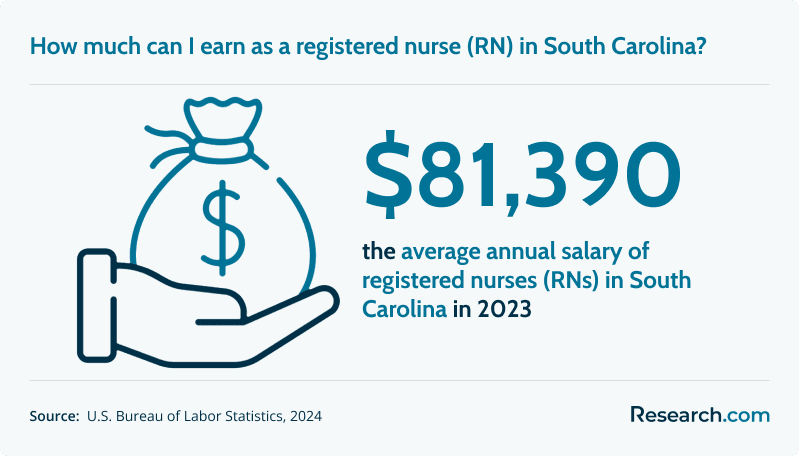
In 2023, RNs in South Carolina earn $81,390 per year on average, significantly higher than the average annual salary of all occupations in the state at $54,250. Salary alone should not drive your decision, but it is an important factor when comparing tuition, time in school, debt, and expected career mobility.
What education do you need to become a nurse in South Carolina?
South Carolina nursing education requirements vary by license level. LPNs usually complete a shorter practical nursing program, RNs complete an ADN or BSN, and advanced practice nurses complete graduate education plus specialty certification. The best path depends on how quickly you want to start working, how much responsibility you want, and whether you plan to pursue graduate-level practice later.
| Education path | Typical student | Common timeline stated in this guide | Best fit |
| Practical nursing program | Students who want to become LPNs | Typically about one year | People who want a faster entry into direct patient care and may later bridge to RN study. |
| Associate Degree in Nursing | Students preparing for RN licensure | Usually about two years | Students seeking a relatively direct RN pathway with the option to work before completing a BSN. |
| Bachelor of Science in Nursing | Students preparing for RN licensure and broader advancement | Generally four years | Students who want stronger preparation for leadership, specialty practice, graduate school, or employers that prefer BSN graduates. |
| Accelerated BSN | Career changers who already hold a bachelor’s degree | As little as 12 to 18 months | Degree holders who want to move into nursing quickly without starting from the beginning of undergraduate study. |
| Master of Science in Nursing or Doctor of Nursing Science | RNs pursuing advanced practice, education, leadership, or specialization | Often an additional two to three years | Nurses aiming for nurse practitioner, nurse educator, leadership, or advanced clinical roles. |
Why accreditation should be one of your first filters
Before applying, confirm that the program is approved for South Carolina licensure and appropriately accredited. Accreditation can affect eligibility for licensure, transfer credits, graduate admission, employer recognition, and financial aid. A low tuition price or convenient schedule is not worth much if the program does not meet licensure standards.
Online, hybrid, and accelerated study options
Online coursework can help working adults complete prerequisites, BSN-completion requirements, or graduate nursing classes. However, nursing is not fully theoretical. Programs that lead to initial licensure must include supervised clinical training, and students should confirm where clinical placements occur, who arranges them, and whether they satisfy South Carolina requirements.
For nurses who already hold graduate credentials and want a faster route into family practice specialization, fastest post master's FNP certificate programs may be useful to compare. Always check whether a certificate program aligns with your license, certification, and practice goals before enrolling.
What types of nurses can legally practice in South Carolina?
South Carolina recognizes multiple nursing and nursing-adjacent roles, each with different training requirements, responsibilities, and legal authority. Understanding the distinctions helps you avoid choosing a program that does not match the job you actually want.
| Role | Minimum preparation described in this guide | Primary responsibilities | Licensure or registry requirement |
| Licensed Practical Nurse | Accredited practical nursing program, typically lasting about a year | Basic nursing care, medication administration within scope, vital signs, patient support, and care under RN or physician supervision | NCLEX-PN and South Carolina LPN licensure |
| Registered Nurse | ADN or BSN from an accredited nursing program | Patient assessment, care planning, medication administration, patient education, coordination of care, and supervision of some support staff | NCLEX-RN and South Carolina RN licensure |
| Advanced Practice Registered Nurse | Master’s degree or higher, advanced clinical preparation, and national certification in a specialty | Advanced assessment, diagnosis, treatment, prescribing within legal authority, and specialty care | Advanced practice authorization and compliance with South Carolina practice rules |
| Certified Nursing Assistant | State-approved nurse aide training program | Assistance with daily living activities, basic patient support, and bedside care tasks under supervision | Competency exam and listing on the South Carolina Nurse Aide Registry |
RNs are central to hospital, outpatient, community health, and long-term care delivery. LPNs provide important hands-on care and often serve as a practical entry point into nursing. APRNs include nurse practitioners, clinical nurse specialists, nurse anesthetists, and nurse midwives; these roles require graduate-level preparation and specialty certification. CNAs are not licensed nurses, but they are essential members of the care team.
If you are comparing entry-level nursing options, start with the legal scope of practice. For example, if you want to assess patients independently, develop care plans, and qualify for a wider range of hospital RN positions, an RN route is usually more appropriate than an LPN route. If you want a shorter training period and are comfortable working under supervision, review how to become a practical nurse through resources such as how to become a LPN.
In 2023, there were 48,790 RNs and 5,470 NPs in the state. The chart below provides a more detailed view of nursing employment levels in South Carolina.
What are the licensing requirements for nurses in South Carolina?
South Carolina nursing licensure is handled through the South Carolina Board of Nursing. The exact application process depends on the license type, but initial LPN and RN applicants generally need approved education, an application, fees, identity documentation, background review, and a passing NCLEX score.
- Approved education: Applicants must graduate from a nursing program that meets requirements for the license they are seeking. RNs generally complete an ADN or BSN, while LPNs complete a practical nursing program.
- Application and fees: Candidates submit a licensure application and pay the applicable fee. Fees can range from $100 to $200, depending on the license type sought.
- Fingerprinting and background checks: South Carolina requires a criminal background check. Applicants submit fingerprints for review by the South Carolina Law Enforcement Division (SLED) and the FBI.
- NCLEX examination: RN candidates take the NCLEX-RN, while LPN candidates take the NCLEX-PN. The exam fee is approximately $200.
- License issuance: Once the Board verifies eligibility and exam results, qualified applicants may receive licensure to practice.
Licensing is not just paperwork. It protects patients by confirming that nurses have completed the required education, passed a national competency exam, and met state standards for safe practice. Before enrolling in any program, ask the school directly whether graduates are eligible to apply for South Carolina licensure and sit for the appropriate NCLEX exam.
What nursing licenses are available in South Carolina?
South Carolina nursing licenses reflect different levels of training and legal authority. The license you pursue should match the type of care you want to provide, the setting where you hope to work, and your long-term advancement goals.
| License type | Education requirement described in this guide | Scope and typical duties | Career considerations |
| Licensed Practical Nurse | State-approved practical nursing program, typically about one year | Provides basic patient care under the supervision of RNs or physicians; may monitor vital signs, assist with daily care, and administer medications within scope. | Good for faster workforce entry, but advancement may require bridge education to RN status. |
| Registered Nurse | Associate or bachelor’s degree in nursing plus NCLEX-RN | Performs assessments, develops care plans, educates patients, administers treatments, and coordinates patient care. | Broader job market than LPN and a common foundation for specialty and graduate nursing roles. |
| Advanced Practice Registered Nurse | Master’s degree or higher with advanced clinical training and national certification | Includes nurse practitioners, clinical nurse specialists, nurse anesthetists, and nurse midwives; may diagnose, treat, prescribe, and manage patients within state rules. | Best for nurses seeking provider-level practice, specialty care, leadership, or higher clinical autonomy. |
South Carolina nurses must continue meeting license renewal and competency expectations after initial licensure. This matters because healthcare practice changes quickly, and ongoing education helps nurses keep up with safety standards, technology, clinical guidelines, and patient-care expectations.
Specialty choice can also shape earning potential. For example, nurses interested in neonatal care may want to compare role requirements and compensation information through resources such as neonatal nurses salary information.
In 2023, the highest-paid nurses in the state are nurse anesthetists, earning an average annual salary of $233,920. The chart below shows additional South Carolina nursing salary information.
Can a Compact nurse practice in South Carolina?
Yes. South Carolina participates in the Nurse Licensure Compact, which allows eligible nurses with a multistate license from another compact state to practice in South Carolina without applying for a separate single-state license. This can be especially useful for nurses who relocate, travel, work near state borders, or provide care across compact jurisdictions.
The Compact does not mean every nurse automatically receives multistate privileges. New applicants who live in compact states must meet uniform licensure requirements to obtain a multistate license. Nurses who do not qualify for a multistate license may still apply for a single-state South Carolina license, which authorizes practice only in South Carolina.
| Situation | What it usually means | What to verify |
| You hold an active multistate license from another compact state | You may practice in South Carolina under the Nurse Licensure Compact. | Confirm your license status and whether South Carolina recognizes your compact privileges for your intended role. |
| You live in South Carolina and are applying for RN or LPN licensure | You may seek a multistate license if you meet compact requirements. | Review South Carolina Board of Nursing guidance before applying. |
| You do not meet compact requirements | You may need a single-state South Carolina license. | Check whether your job requires multistate mobility or only South Carolina practice. |
Compact licensure can improve workforce mobility, but nurses still need to follow the nursing practice laws of the state where the patient is located. If your long-term plan includes advanced practice, graduate education can expand your role beyond compact RN mobility. Nurses considering family practice specialization may compare affordable online RN to FNP programs as part of their planning.
Can you work as a nurse without a license in South Carolina?
No. You cannot legally practice as a nurse in South Carolina without the appropriate nursing license. The title “nurse” carries legal and professional responsibilities, and practicing without authorization can put patients at risk and expose the individual to serious consequences.
- Legal risk: South Carolina requires practicing nurses to hold a valid license. Unlicensed practice can lead to enforcement action and lasting damage to a healthcare career.
- Patient safety risk: Nursing involves assessment, medication administration, clinical judgment, and communication with the healthcare team. Unlicensed practice undermines the safeguards designed to protect patients.
- Professional accountability: Licensure confirms that a nurse has completed required training, passed a national exam, and is accountable to professional standards.
The stakes are high in advanced nursing as well. In 2023, the median annual wage for nurse anesthetists, nurse midwives, and nurse practitioners reached $125,900. That level of responsibility requires formal preparation, credentialing, and compliance with state law.
-
: "
“The day I received my license, I understood that it was more than permission to work. It meant patients, families, and colleagues could trust that I had met the standard expected of a nurse.”
"
What is nursing like in South Carolina today?
Nursing in South Carolina offers strong opportunity, but it is not without pressure. Demand is shaped by an aging population, chronic disease needs, rural access challenges, staffing shortages, burnout, and the growth of outpatient and telehealth services. New nurses should evaluate not only whether jobs are available, but also what type of setting fits their skills, schedule needs, and tolerance for clinical intensity.
Hospitals remain major employers, but nurses also work in outpatient clinics, long-term care facilities, home health, schools, public health, correctional health, telehealth, and specialty practices. Rural communities may offer meaningful patient relationships and high demand for healthcare workers, while urban medical centers may offer more specialty departments, residency programs, and advancement tracks.
Cost of living can make South Carolina attractive for early-career nurses, especially compared with more expensive states. However, salaries vary by location, employer, specialty, shift differential, and experience. Nurses comparing healthcare careers may also want to examine related roles, including how much do ultrasound technicians make, before committing to one training path.
Current trends affecting South Carolina nurses
- Staffing shortages: Facilities may have difficulty filling roles, especially in rural and high-acuity settings.
- Telehealth expansion: Remote patient monitoring, virtual visits, and digital documentation are changing how nurses communicate and coordinate care.
- Employer preference for higher credentials: While ADN-prepared RNs can enter the field, a BSN can improve competitiveness for some roles and future graduate study.
- Burnout and retention concerns: New nurses should ask employers about orientation, staffing ratios, mentorship, scheduling, and mental health support.
- Growth in advanced practice care: Nurse practitioners, nurse anesthetists, and nurse midwives remain important in expanding access to care, especially where provider shortages exist.
What is the job outlook for nursing in South Carolina?
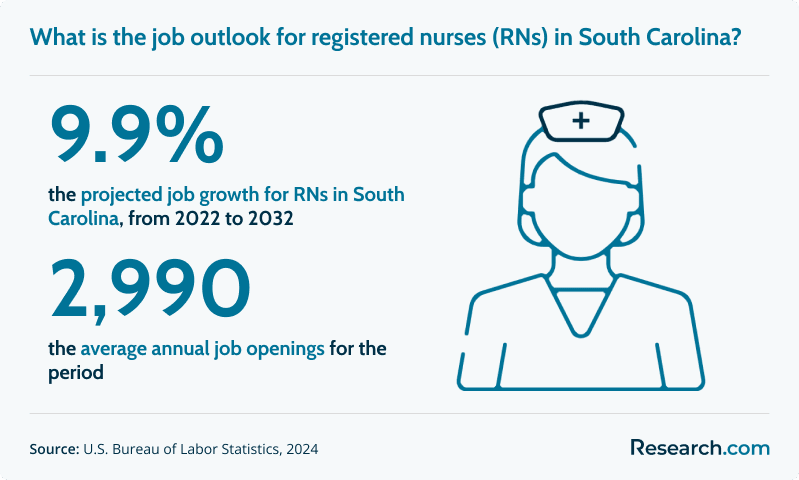
The job outlook for nursing in South Carolina is favorable based on the projections cited in this guide. Projections Central estimates a 9.9% increase in nursing jobs from 2022 to 2032. During the same period, there are 2,990 projected annual job openings for RNs in the state.
Demand is linked to population aging, ongoing healthcare needs, turnover, retirements, and expanding service delivery in hospitals, outpatient care, long-term care, home health, and community settings. Still, job outlook should be interpreted carefully. A strong statewide projection does not guarantee a specific job, salary, schedule, or location. Specialty, experience, employer, shift, and geography all affect outcomes.
| Factor | How it can affect your job search |
| Location | Rural areas may have stronger need but fewer specialty units; urban areas may offer more hospital systems and advanced departments. |
| Degree level | ADN graduates can qualify for RN licensure, while BSN graduates may be more competitive for some employers and leadership pipelines. |
| Specialty | Critical care, perioperative, emergency, maternal-child, psychiatric, long-term care, and advanced practice roles may differ in demand and compensation. |
| Experience | New graduates may need residency or orientation programs; experienced nurses may qualify for charge nurse, specialty, travel, or leadership roles. |
| Schedule flexibility | Willingness to work nights, weekends, or high-need units can increase available opportunities. |
How can nurses advance their careers in South Carolina?
Nursing advancement in South Carolina can happen through education, specialty certification, leadership experience, advanced practice preparation, or movement into non-clinical healthcare roles. The strongest path depends on whether you want more clinical autonomy, higher pay potential, a less physically demanding job, better schedule control, or influence over healthcare systems.
- Earn a higher degree: LPNs can pursue RN bridge options, RNs can complete a BSN, and experienced RNs can move into MSN, DNP, or specialty graduate programs. Nurses considering provider-level practice can review nurse practitioner requirements.
- Build specialty expertise: Certifications in areas such as critical care, pediatrics, oncology, emergency nursing, or maternal health can show focused competence.
- Move into leadership: Experienced RNs may become charge nurses, nurse managers, clinical coordinators, quality improvement specialists, educators, or administrators.
- Consider advanced practice: Nurse practitioners, nurse anesthetists, nurse midwives, and clinical nurse specialists need graduate education and national certification.
- Explore non-clinical roles: Case management, utilization review, informatics, compliance, education, medical billing, quality, and healthcare operations can use nursing knowledge outside direct bedside care.
How can advanced certifications improve a nursing career in South Carolina?
Advanced certifications can help South Carolina nurses document expertise, qualify for specialty roles, improve confidence in complex care settings, and stand out in competitive hiring. They are most valuable when they align with the nurse’s actual practice area and long-term career plan.
| Certification goal | When it makes sense | Potential benefit |
| Specialty bedside certification | You work in or want to enter areas such as critical care, pediatrics, oncology, emergency care, or perioperative nursing. | Signals focused clinical competence and may support advancement within a unit or specialty. |
| Advanced practice certification | You have completed the required graduate program for a role such as nurse practitioner or nurse midwife. | Required or strongly tied to authorization for advanced clinical practice. |
| Leadership or education certification | You want to move into management, staff development, clinical instruction, or quality improvement. | Can support transition from bedside practice into organizational or teaching responsibilities. |
| Population or practice-focused certification | You want to specialize in family nursing, psychiatric nursing, acute care, or similar areas. | Helps define your clinical niche and may improve competitiveness for targeted roles. |
Certifications do not automatically guarantee a promotion or salary increase. Their value depends on employer recognition, local demand, your experience, and whether the credential matches the role you are seeking. For RNs trying to move quickly into graduate-level practice, fastest RN to MSN online programs can be one option to compare, especially if the program is accredited and supports the certification path you intend to pursue.
What options are available for LPN education in South Carolina?
Students who want to become Licensed Practical Nurses in South Carolina should look for Board-approved practical nursing programs that combine classroom learning with supervised clinical training. These programs prepare students for the NCLEX-PN and for entry-level patient care under the direction of RNs, physicians, or other authorized providers.
LPN education can be a practical route for students who want to begin working sooner, test their interest in nursing, or later bridge into RN education. However, LPNs generally have a narrower scope of practice than RNs, so students who already know they want broader responsibilities may prefer an RN pathway from the start. Flexible options, including online LPN programs in South Carolina, should be evaluated carefully for clinical placement support, approval status, NCLEX preparation, and total program cost.
What are the nurse practitioner education requirements in South Carolina?
Nurse practitioners in South Carolina generally follow a sequence that begins with RN preparation, RN licensure, clinical experience, and graduate nursing education. A future NP typically earns a Bachelor of Science in Nursing, obtains an active RN license, completes a master’s or doctoral program with advanced clinical coursework, and meets national certification requirements in a population focus or specialty.
Graduate NP programs include advanced health assessment, pharmacology, pathophysiology, evidence-based practice, diagnostic reasoning, and supervised clinical rotations. Because nurse practitioner authority is regulated at the state level, students should confirm that a program’s curriculum and clinical experiences support South Carolina requirements. For a detailed role-specific guide, review nurse practitioner education requirements in South Carolina.
How do LPN and RN career paths differ in South Carolina?
LPN and RN paths differ in education length, scope of practice, daily responsibility, advancement potential, and common work settings. LPNs usually complete shorter training and provide foundational bedside care under supervision. RNs complete associate or bachelor’s nursing education and take on broader responsibilities, including assessment, care planning, patient education, coordination, and leadership of care teams.
| Comparison point | LPN path | RN path |
| Education | Practical nursing diploma or certificate program | ADN or BSN program |
| Licensing exam | NCLEX-PN | NCLEX-RN |
| Scope | Basic nursing care under supervision | Broader clinical judgment, assessment, care planning, and coordination |
| Advancement | Often requires bridge education to expand opportunities | Can lead to specialty, leadership, BSN, MSN, DNP, or APRN roles |
| Best fit | Students seeking faster entry into nursing support roles | Students seeking wider clinical responsibility and long-term flexibility |
For a fuller comparison, see the licensed practical nurse LPN vs registered nurse RN difference. The right choice depends on your timeline, budget, academic readiness, and career goals.
What are the benefits of moving into non-clinical healthcare roles in South Carolina?
Not every nurse wants to remain in direct bedside care for an entire career. Non-clinical healthcare roles can allow nurses to use their knowledge of patient care, documentation, regulations, and healthcare workflows in settings such as administration, care coordination, compliance, quality improvement, informatics, education, insurance review, and medical billing.
This transition can be attractive for nurses who want less physical strain, more predictable schedules, or opportunities to influence healthcare systems. For example, nurses with strong documentation and coding awareness may find that medical billing and coding builds on their understanding of diagnoses, procedures, reimbursement, and compliance. Those considering that direction can explore how to become a medical biller and coder in South Carolina.
What are the career opportunities for LVNs in South Carolina?
South Carolina most commonly uses the Licensed Practical Nurse designation, while the term Licensed Vocational Nurse is used in some other states. Students searching for LVN pathways should verify the terminology and licensing requirements that apply in South Carolina before enrolling in a program.
Entry-level practical nursing roles can be found in long-term care, rehabilitation, clinics, home health, and some hospital settings. The key is to choose a program that meets South Carolina regulatory standards, prepares students for licensure assessment, and includes sufficient hands-on clinical training. For state-specific guidance, review how to become an LVN in South Carolina.
How can online education support nursing career growth in South Carolina?
Online education can be useful for South Carolina nurses who need flexibility while working shifts, caring for family, or living far from campus. It is especially common in RN-to-BSN, MSN, DNP, certificate, and continuing education formats. For initial licensure programs, however, students should expect clinical requirements that must be completed in approved healthcare settings.
| Online nursing option | Useful for | What to check before enrolling |
| Online prerequisite courses | Students preparing for nursing admission | Transferability, lab requirements, grade minimums, and school acceptance policies |
| Online RN-to-BSN programs | Licensed RNs seeking a bachelor’s degree | Accreditation, transfer credits, clinical or practicum expectations, and employer tuition support |
| Online MSN or DNP programs | RNs pursuing advanced practice, leadership, or education | Clinical placement process, state authorization, certification alignment, and residency requirements |
| Online continuing education | Licensed nurses maintaining competence or renewal requirements | Whether the course satisfies South Carolina Board of Nursing requirements |
When comparing best online nursing programs in South Carolina, look beyond convenience. Ask about accreditation, NCLEX outcomes if applicable, clinical placement support, faculty access, technology requirements, total cost, and whether the program meets your license or certification goal.
What are the renewal and continuing education requirements for South Carolina nursing licenses?
South Carolina nurses must keep their licenses current through periodic renewal. Registered nurses in the state are required to renew their licenses every two years, and renewal involves meeting continuing education or competency expectations. Requirements can vary by license type and may change, so nurses should verify details directly with the South Carolina Board of Nursing before the renewal deadline.
Continuing education is more than a renewal formality. It helps nurses stay current on patient safety, ethical practice, technology, medication standards, documentation expectations, and evolving care models. For a focused overview, see the requirements for nursing licensure in South Carolina.
What are the best nursing programs for career growth in South Carolina?
The best nursing program for career growth is not always the highest-ranked or most expensive option. It is the program that matches your target license, is approved and accredited, prepares graduates for the required exam or certification, offers strong clinical experiences, and fits your budget and schedule.
How to compare nursing programs in South Carolina
| Question to ask | Why it matters |
| Is the program approved for South Carolina licensure? | Approval affects whether you can apply for the license you want. |
| Is the program accredited? | Accreditation can affect financial aid, transfer credits, graduate admission, and employer recognition. |
| What are the clinical placement arrangements? | Nursing requires hands-on training; students need to know whether the school or student secures placements. |
| What is the total cost, including fees, supplies, testing, background checks, and transportation? | Tuition alone does not show the full cost of becoming a nurse. |
| Does the program fit your work and family schedule? | Even a strong program can be difficult to complete if the format is unrealistic. |
| Does the curriculum support your long-term goal? | A student targeting advanced practice should consider BSN readiness, graduate prerequisites, and specialty alignment. |
For aspiring nurse practitioners, the best NP programs in South Carolina can help identify graduate options that support advanced clinical training and specialization. Working nurses may also prefer hybrid or flexible formats that allow them to continue earning income while completing advanced coursework.
A strong program should provide more than lectures. Look for clinical mentorship, simulation resources, evidence-based practice training, faculty support, career services, and connections with healthcare employers in South Carolina. These features can make the difference between simply finishing a degree and being ready to practice confidently.
What are the career prospects for nurse midwives in South Carolina?
Nurse midwives provide prenatal, birth, postpartum, reproductive, and family-centered care. In South Carolina, this path requires advanced nursing education, clinical preparation, certification, and compliance with state licensure rules. It is best suited for RNs who want to specialize in maternal and reproductive health and who are comfortable with both independent clinical judgment and collaboration with other healthcare professionals.
Career opportunities may exist in hospitals, birth centers, women’s health clinics, community health programs, and collaborative practices. Because maternal healthcare needs can vary widely across urban and rural communities, nurse midwives may play an important role in improving access to preventive and personalized care. Nurses considering this specialty can review how to become a nurse midwife in South Carolina.
What nurses say about becoming a nurse in South Carolina
- “South Carolina appealed to me because I wanted a nursing career where community still matters. Working closely with patients has helped me grow clinically while also building relationships that make the work meaningful.” Justin
- “I expected nursing to feel isolating, but the healthcare teams I have worked with in South Carolina have been supportive. With demand projected to increase by 15% by 2026, I have also seen real room to keep developing professionally.” Mallory
- “Nursing in South Carolina gave me a path into pediatrics and a manageable work-life balance. Continuing education options helped me specialize without feeling like I had to pause my entire life.” Vicky
What complementary healthcare roles can broaden career options in South Carolina?
Nursing experience can be a strong foundation for related healthcare careers. Some nurses expand into pharmacy collaboration, clinical research, healthcare administration, quality improvement, informatics, public health, compliance, or education. These paths can broaden career options and help professionals contribute to patient care from a systems perspective.
Complementary roles are most useful when they build on your existing strengths. A nurse who enjoys medication education and interdisciplinary care, for example, may be interested in learning how to become a pharmacist in South Carolina. Others may choose informatics, case management, or compliance if they prefer data, systems, or policy-focused work.
What advanced practice and leadership opportunities are available to nurses in South Carolina?
Advanced practice and leadership roles allow nurses to move beyond entry-level bedside responsibilities into specialty care, organizational decision-making, education, or health system improvement. Common directions include nurse practitioner, nurse anesthetist, nurse midwife, clinical nurse specialist, nurse educator, nurse manager, quality leader, clinical director, and executive nursing roles.
A Doctor of Nursing Practice can be useful for nurses who want to combine advanced clinical expertise with leadership, evidence-based practice, and systems improvement. Nurses who want an efficient route should compare accreditation, clinical requirements, program outcomes, and workload before choosing among options such as the shortest DNP program.
What financial aid and scholarship options can reduce nursing education costs in South Carolina?
Nursing students should build a funding plan before enrolling. Tuition is only one part of the cost; students may also pay for uniforms, supplies, background checks, immunizations, testing fees, transportation, textbooks, technology, and licensure expenses. Financial aid can include federal aid, state programs, institutional scholarships, employer tuition assistance, local healthcare scholarships, and loan repayment or forgiveness options for qualifying service.
Before accepting admission, ask each school for a complete cost estimate and a written explanation of available aid. Also confirm whether scholarships are renewable, whether you must maintain a specific GPA, and whether any award requires employment with a particular facility after graduation. To compare reputable academic pathways, review the best nursing schools in South Carolina.
Common mistakes to avoid when becoming a nurse in South Carolina
- Choosing a program before checking approval and accreditation: Always confirm that the program supports South Carolina licensure or your intended certification.
- Looking only at tuition: Add fees, supplies, exams, clinical travel, lost work hours, and licensure costs before comparing programs.
- Assuming online means fully remote: Nursing programs that lead to licensure or advanced practice typically require clinical experiences.
- Ignoring scope of practice: LPN, RN, and APRN roles differ significantly. Choose the credential that matches the work you actually want to do.
- Relying only on rankings: Rankings can help, but clinical placement quality, licensure eligibility, support services, and affordability matter more.
- Assuming salary outcomes are guaranteed: Pay varies by specialty, employer, region, experience, shift, and credentials.
- Waiting until graduation to understand licensure: Learn the application, background check, and NCLEX process early so there are no surprises.
Key Insights
- South Carolina offers multiple nursing entry points, but the right choice depends on your timeline, budget, desired scope of practice, and long-term goals.
- An LPN pathway can get you into patient care faster, while an RN pathway provides broader responsibility and stronger advancement potential.
- RNs in South Carolina can qualify through ADN or BSN programs, but a BSN may be more useful for leadership, specialty roles, and graduate study.
- Licensure is mandatory. South Carolina nurses must complete approved education, pass the NCLEX, satisfy background requirements, and keep their licenses current.
- South Carolina participates in the Nurse Licensure Compact, giving eligible multistate license holders added mobility.
- The nursing job outlook is positive, with a projected 9.9% increase in nursing jobs from 2022 to 2032 and 2,990 projected annual RN openings during the same period.
- Advanced practice, specialty certifications, online bridge programs, and non-clinical healthcare roles can all expand career options, but each should be evaluated for accreditation, cost, clinical requirements, and state eligibility.
- The best nursing program is the one that is approved, affordable, clinically strong, realistic for your schedule, and aligned with the license or role you want.
Related Articles for Nearby States
- 2027 How to Become a Nurse in Georgia
- 2027 How to Become a Nurse in North Carolina
- 2027 How to Become a Nurse in Florida
- 2027 How to Become a Nurse in Tennessee
- 2027 How to Become a Nurse in Alabama
- 2027 How to Become a Nurse in Virginia
- 2027 How to Become a Nurse in Kentucky
- 2027 How to Become a Nurse in Mississippi
- 2027 How to Become a Nurse in West Virginia
- 2027 How to Become a Nurse in Louisiana
References:
- limestone.edu (21 Jan 2022). How to Become a Registered Nurse in South Carolina. limestone.edu
- llr.sc.gov (n.d.). South Carolina Board of Nursing. llr.sc.gov
- U.S. Bureau of Labor Statistics. (2023, September 6). Occupational outlook handbook - Nurse anesthetists, nurse midwives, and nurse practitioners. Retrieved February 16, 2024, from BLS.
Other Things You Need to Know About Nursing in South Carolina
In 2027, aspiring registered nurses in South Carolina must complete an accredited nursing program, such as an Associate Degree in Nursing (ADN) or a Bachelor of Science in Nursing (BSN). Graduates must also pass the NCLEX-RN exam to obtain licensure.
Becoming a registered nurse in South Carolina typically takes about 2-4 years, depending on the educational path. An Associate Degree in Nursing (ADN) usually takes 2-3 years, while a Bachelor of Science in Nursing (BSN) takes about 4 years. Licensing and exams may add additional time.





