
2027 How to Become a Licensed Practical Nurse (LPN)

Co-Founder and Chief Data Scientist
Becoming a licensed practical nurse (LPN) is one of the more direct ways to enter nursing without first completing a full registered nursing degree. LPNs provide hands-on bedside care, monitor patients, support treatment plans, and work under the supervision of registered nurses and physicians. For students, career changers, medical assistants, and healthcare workers who want a faster route into patient care, the LPN pathway can offer a practical starting point.
This guide explains how to become an LPN, what education and licensure require, where LPNs work, how much they earn, what challenges to expect, and how to choose a program that is affordable, legitimate, and aligned with your long-term nursing goals. It also explains when an LPN path makes sense—and when you may want to consider an RN, BSN, MSN, or other advanced nursing route instead.
Quick Answer: How do you become an LPN?
To become an LPN, you typically need a high school diploma or GED, completion of a state-approved practical nursing program, and a passing score on the NCLEX-PN exam. Most state-approved practical nursing programs take 1-2 years and combine classroom learning with supervised clinical training. After licensure, LPNs can work in nursing homes, hospitals, home healthcare, physicians' offices, and other care settings.
Key Things You Should Know About Becoming an LPN
- Most state-approved practical nursing programs take 1-2 years to complete and commonly include nursing fundamentals, pharmacology, anatomy, physiology, and clinical practice.
- Graduating from a program is not enough by itself. You must pass the NCLEX-PN exam before you can receive an LPN license.
- LPNs work in multiple healthcare environments, including nursing homes, hospitals, home healthcare agencies, and physicians' offices.
- Specialty credentials such as IV Therapy or Gerontology are not always required, but they can strengthen your clinical skills and make you more competitive for certain jobs.
- The U.S. employs over 632,120 LPNs, and a 7% shortage is projected by 2026, which points to continuing demand, especially in areas with limited healthcare staffing.
- What are the steps to becoming an LPN?
- What are the educational requirements for licensed practical nursing licensure?
- What are the types of licensed practical nursing licenses issued?
- What is the state of the licensed practical nursing industry?
- What is the job outlook for LPNs?
- How much do LPNs make?
- Where can I work as an LPN?
- What do LPNs do?
- What are the best locations and work environments for licensed practical nurses?
- What are common challenges licensed practical nurses face, and how can they overcome them?
- What are the admission requirements for LPN programs?
- How can I bridge from LPN to advanced nursing roles?
- How can becoming a functional practitioner boost my LPN career?
- How can I access affordable advanced nursing education?
- What are affordable options for advanced nursing degrees?
- How can I evaluate affordable and quality LPN programs?
- How can I effectively prepare for the NCLEX-PN exam?
- Top Licensed Practical Nursing Programs for 2027
- Is a career in licensed practical nursing worth it?
- Pathways for Career Advancement from LPN
- What are the salary expectations for specialized nursing roles?
- What is the fastest way to become a licensed practical nurse?
What are the steps to becoming an LPN?
The LPN process is straightforward, but each step matters. Licensure is controlled by state nursing boards, so you should always confirm requirements in the state where you plan to practice.
- Choose a state-approved practical nursing program. Look for programs at community colleges, technical colleges, vocational schools, and approved hybrid or online nursing options. If you are already working as a medical assistant, a medical assistant to LPN online program may help you build on prior healthcare experience.
- Complete classroom and clinical requirements. LPN programs combine lectures, labs, simulations, and supervised patient-care experiences. Clinical placements are essential because nursing licensure requires hands-on competency, not just online coursework.
- Apply for authorization to test. After graduation, you must follow your state board’s process to become eligible for the NCLEX-PN exam.
- Pass the NCLEX-PN exam. This exam assesses whether you can provide safe entry-level practical nursing care. Key areas include patient care, health promotion, infection control, safety, and related nursing responsibilities.
- Apply for your LPN license and begin working. Once licensed, you can pursue entry-level roles in long-term care, hospitals, home health, clinics, and physicians' offices.
- Plan your next move early. Some LPNs stay in practical nursing for years, while others later move into RN, BSN, MSN, or nurse practitioner pathways. If you are comparing long-term nursing routes, Research.com’s guide on how to go from RN to nurse practitioner can help you understand how advanced roles differ.
| Step | What to verify before moving forward | Why it matters |
| Program selection | State approval, accreditation, clinical placement access, cost, and NCLEX-PN outcomes | An unapproved program may not qualify you for licensure. |
| Coursework and clinicals | Attendance rules, lab requirements, clinical schedules, and health documentation | Clinical training is usually the hardest part to reschedule if you work or have family obligations. |
| NCLEX-PN preparation | Exam readiness support, practice exams, faculty guidance, and remediation policies | Passing the exam is required before you can practice as an LPN. |
| Licensure application | State board forms, background checks, fees, and compact eligibility | Licensing rules vary by state, and delays can postpone your job start date. |
| First job | Workload, orientation length, supervision, shift expectations, and patient population | Your first setting can shape your confidence, skills, and future specialization options. |
What LPN Graduates Often Value About the Career
LPNs frequently describe the role as demanding but meaningful because it places them close to patients and families. The work is practical, personal, and skill-based. It can also be a stepping stone for nurses who later want to pursue RN or advanced nursing credentials.
- As an LPN, I saw how much small acts of care mattered to patients. The job pushed me to become more organized, more compassionate, and more confident in clinical settings. -Jenny
- Online coursework helped me manage school while handling family responsibilities, but my clinical rotations were what prepared me for real nursing work. Starting in a hospital gave me room to keep learning. -Mike
- The LPN path changed my career direction. I wanted a stable healthcare role where I could help people every day, and practical nursing gave me that foundation. -Emily
What are the educational requirements for licensed practical nursing licensure?
To qualify for LPN licensure, you generally need a high school diploma or GED and completion of an approved practical nursing program. Programs may be offered through technical schools, community colleges, vocational institutions, and some traditional or online nursing school options. Even when lectures are online, clinical training must be completed in person.
LPN programs usually take about a year and include both academic instruction and practical application. Common subject areas include:
- Biology
- First Aid
- Chemistry
- Physical Education
- Anatomy
- Foods and Nutrition
- Psychology
- Child Growth and Development
- Emergency Medical Technology
In addition to coursework, students complete supervised clinical experience. This is where you learn to apply patient-care skills in real healthcare environments under supervision.
Online vs. campus LPN programs: which should you choose?
| Program format | Best for | Important caution |
| Campus-based LPN program | Students who want face-to-face labs, structured schedules, and direct access to faculty | Commuting and fixed class times may be difficult for working adults. |
| Hybrid LPN program | Students who want online theory courses but can attend labs and clinicals locally | Clinical schedules may still require daytime, evening, or weekend availability. |
| Online-supported LPN program | Students who need flexibility for lectures, assignments, or review materials | No legitimate LPN program is entirely online because clinical training must be completed in person. |
What are the types of licensed practical nursing licenses issued?
LPN licensure depends on the state where you apply and where you intend to work. The main license options are:
- Single-State License: This authorizes you to practice in one state only. You must satisfy that state’s education, exam, background check, and application requirements.
- Enhanced Nurse Licensure Compact (eNLC): This multi-state option allows eligible nurses to practice in multiple participating states without applying for separate licenses in each one.
If you expect to move, work near state borders, or pursue travel-related opportunities, the Enhanced Nurse Licensure Compact may be especially useful. Always confirm current eligibility with your state board of nursing before choosing a program or applying for licensure.
What is the state of the licensed practical nursing industry?
The LPN workforce remains an important part of the U.S. healthcare system. According to Bureau of Labor Statistics occupational employment data, the country employs over 632,120 LPNs. Workforce projections also point to a 7% deficit by 2026, equal to about 46,920 unfilled positions. Shortages are often more visible in rural areas, where healthcare employers may have fewer applicants and a growing need for long-term and chronic care services.
Several factors continue to shape the field: an aging population, increased chronic disease management, pressure on long-term care facilities, and a shift toward outpatient and home-based services. Schools and employers are responding with expanded program capacity, flexible scheduling, and targeted nursing specialization pathways.
The chart below compares the shortage in various nursing roles.
What is the job outlook for LPNs?
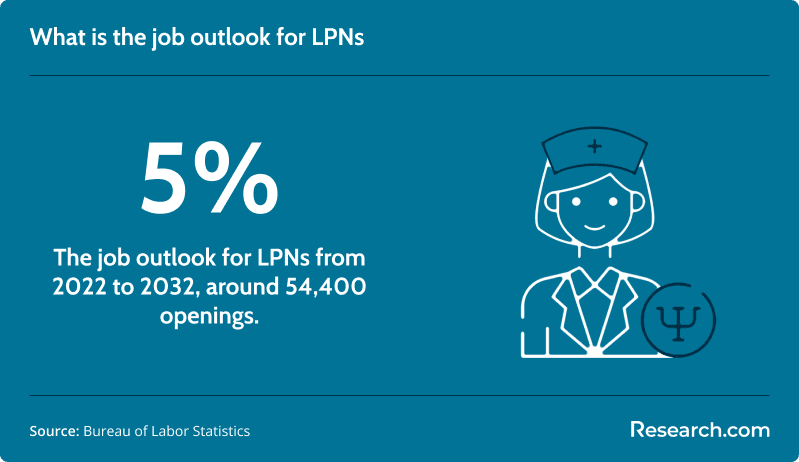
LPN employment is projected to grow 5% from 2022 to 2032, which is faster than the average for all occupations. About 54,400 openings for LPNs are expected each year. Many of these openings are projected to come from replacement needs as workers retire, change roles, or leave the occupation.
Demand is supported by the aging baby boom population and the growing prevalence of chronic conditions such as diabetes and obesity. LPNs are expected to remain especially important in residential care facilities, home health settings, and outpatient care centers. If you are comparing this route with other options, reviewing different nursing career paths can help you decide whether LPN, RN, or another nursing credential fits your timeline.
Current trends affecting LPN careers
- More care is moving outside hospitals. Outpatient centers, home health, and long-term care facilities continue to rely on practical nurses for direct patient support.
- Technology skills are becoming more important. LPNs increasingly use electronic health records, medication systems, telehealth tools, and digital documentation platforms.
- Employers value flexibility. Weekend, evening, long-term care, and home health availability may increase job options, depending on the local market.
- Career ladders matter. Many LPNs choose bridge programs later because RN and BSN credentials can expand scope of practice and advancement opportunities.
How much do LPNs make?
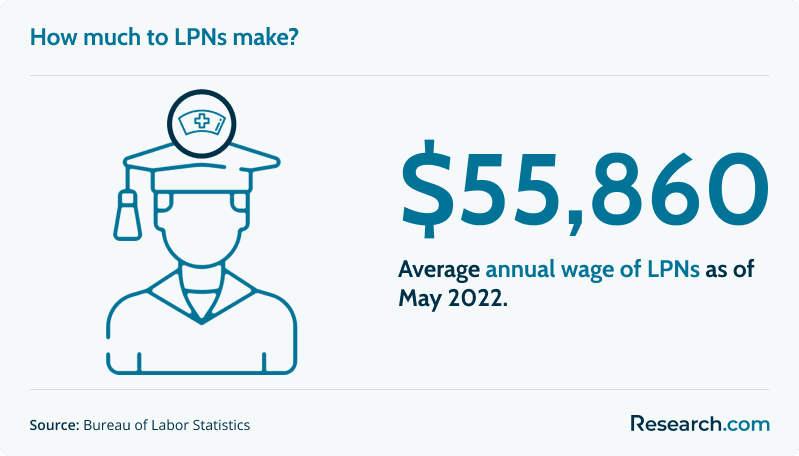
Licensed Practical Nurses earn an average annual wage of $55,860, with a median annual wage of $54,620. Pay varies by employer, state, metro area, experience level, shift, and specialty skills. The top-paying industries for LPNs include personal care services and grantmaking and giving services, where annual wages can reach up to $90,950 and $72,670, respectively.
Location can also make a major difference. Washington and California are among the highest-paying states for LPNs, with wages around $69,950 annually. Metropolitan areas such as San Francisco and San Jose report higher wages as well, averaging about $80,590 per year.
Further education can change earning potential. A bachelor’s degree, and especially a master degree in nursing, may open access to roles with broader responsibilities. Some nurses also pursue higher-paying specialties. For example, those researching neonatal nursing may ask how much does a neonatal nurse make; the average listed is $127,391 per year.
| Pay factor | How it can affect earnings | What to ask before accepting a job |
| Work setting | Long-term care, home health, hospitals, clinics, and specialty services may pay differently. | Are shift differentials, overtime, or weekend rates available? |
| Location | High-wage states and metro areas may also have higher living costs. | How does the salary compare with rent, transportation, taxes, and childcare in the area? |
| Experience | New LPNs usually start with entry-level responsibilities and may earn more after gaining clinical confidence. | Is there a structured raise schedule or clinical ladder? |
| Certifications | Skills such as IV Therapy or Gerontology may improve competitiveness for certain roles. | Does the employer pay for training or require certification before hiring? |
| Further education | RN, BSN, MSN, and advanced credentials may lead to wider career options. | Does the employer offer tuition assistance or bridge-program support? |
Where can I work as an LPN?
LPNs are employed in several care environments, including nursing care facilities, home health care services, general medical and surgical hospitals, and physicians' offices. Nursing care facilities employ the largest number of LPNs, followed by home health care services and hospitals.
States with the highest employment levels for LPNs include California, Texas, New York, Ohio, and Florida. Major cities such as New York, Los Angeles, and Dallas also have high concentrations of LPN jobs.
If you want more autonomy, broader clinical responsibilities, or stronger long-term advancement prospects, an LPN to RN online pathway may be worth comparing after you gain practical nursing experience.
Common LPN work settings compared
| Work setting | Typical patient-care focus | Best fit for LPNs who want |
| Nursing care facilities | Long-term care, medication support, daily living assistance, chronic condition monitoring | Consistent patient relationships and strong hands-on care experience |
| Hospitals | Basic bedside care, vital signs, specimen collection, patient support, and care-team coordination | Exposure to acute-care teams and a faster clinical environment |
| Home healthcare | Patient care in private homes, family education, monitoring, and support with treatment plans | One-on-one care and independence within defined supervision rules |
| Physicians' offices | Intake support, patient education, routine procedures, documentation, and follow-up care | More predictable schedules and clinic-based patient interactions |
What do LPNs do?
LPNs provide basic nursing care for patients who are ill, injured, disabled, recovering, or managing chronic conditions. Their work often includes taking vital signs, changing dressings, assisting with bathing and dressing, helping patients eat, documenting symptoms, and communicating concerns to RNs and physicians.
Exact responsibilities vary by state law and employer policy. In private homes, LPNs may teach family members how to support a patient’s care. In hospitals, they may collect samples for testing. In nursing homes, they often help residents with daily living needs. In some states, LPNs with additional training may administer medication or start IV drips.
What are the best locations and work environments for licensed practical nurses?
The best LPN workplace depends on your financial goals, preferred patient population, schedule needs, and tolerance for fast-paced or physically demanding care. High-paying locations can be attractive, but wages should be weighed against cost of living, commute time, licensure rules, and the availability of supportive employers.
Regions such as the West Coast, including California and Washington, and major metropolitan areas often offer higher-than-average nurse wages. However, these areas may also involve higher housing, transportation, and daily living costs. States such as Texas or Ohio may offer a different balance: steady healthcare demand with potentially more affordable living costs.
For a broader comparison of geography, salary, and lifestyle considerations, review Research.com’s guide to the best places to work as a nurse. Although the resource focuses on registered nurses, many of the location factors—pay, demand, cost of living, and healthcare infrastructure—are also useful for LPN decision-making.
What are common challenges licensed practical nurses face, and how can they overcome them?
LPN work can be meaningful, but it is not easy. The role often involves physical demands, emotional stress, shift work, and detailed documentation. Understanding the most common challenges before entering the field can help you prepare realistically.
| Challenge | Why it happens | Better strategy |
| Heavy workload and stress | LPNs may manage several patient-care tasks at once, especially in long-term care or high-volume settings. | Use prioritization routines, ask for clarification early, take scheduled breaks when possible, and learn facility protocols thoroughly. |
| Emotional strain | Practical nurses often support patients and families during illness, decline, or loss. | Build peer support, use employee assistance resources if available, and develop healthy boundaries outside work. |
| Limited advancement without more education | LPN scope of practice is narrower than RN scope in many settings. | Consider certifications, continuing education, or bridge programs if you want broader responsibilities. |
| Communication barriers | LPNs coordinate with patients, families, aides, RNs, providers, and administrators. | Practice concise documentation, active listening, and closed-loop communication when giving or receiving instructions. |
| New healthcare technology | Electronic records, medication systems, and remote-care tools change how nurses document and communicate. | Attend training, ask for demonstrations, and practice documentation workflows before high-pressure situations arise. |
What are the admission requirements for LPN programs?
LPN admissions requirements vary by school, but applicants are commonly asked to submit academic records, meet prerequisite requirements when applicable, and provide health and safety documentation such as immunization records and background checks. Some programs may also use placement tests, interviews, entrance exams, or minimum academic standards to determine whether students are ready for nursing coursework and clinical practice.
Because requirements differ, do not assume one school’s admissions process applies everywhere. If you are concerned about selectivity, compare published requirements and review Research.com’s guide to the easiest LPN program to get into.
Questions to ask before applying to an LPN program
- Is the program approved by the state board of nursing where I want to become licensed?
- What are the program’s NCLEX-PN pass rates?
- Where are clinical placements located, and who arranges them?
- Can I attend part time, evenings, weekends, or hybrid courses if I work?
- What background checks, drug screenings, immunizations, or physical exams are required?
- What is the total cost after fees, books, uniforms, supplies, testing, and transportation?
- Does the school offer tutoring, exam preparation, and job placement support?
- Will credits transfer if I later enroll in an LPN-to-RN or LPN-to-BSN program?
How can I bridge from LPN to advanced nursing roles?
LPNs who want greater clinical responsibility often use bridge programs to move into registered nursing and, later, advanced practice pathways. A common route is to complete an Associate Degree in Nursing first, become eligible for RN licensure, and then consider BSN, MSN, or nurse practitioner education depending on career goals.
For nurses planning a longer academic pathway, ADN to FNP programs online can help explain how associate-prepared nurses may eventually move toward graduate-level family nurse practitioner preparation. These pathways usually emphasize advanced clinical reasoning, leadership, decision-making, and broader patient-care responsibilities.
How can becoming a functional practitioner boost my LPN career?
Functional medicine and integrative care appeal to nurses who are interested in prevention, lifestyle factors, patient education, and whole-person care. However, becoming a functional medicine nurse practitioner is not the same as adding a short LPN certificate. It generally requires a much higher nursing credential and expanded scope of practice.
If this direction interests you, use the functional practitioner pathway as a long-term planning resource. For current LPNs, the immediate step is usually to build strong practical nursing experience, then consider RN and advanced nursing education if your goal is provider-level practice.
How can I access affordable advanced nursing education?
Cost should be part of your nursing career plan from the beginning. LPN programs may be shorter than RN or BSN programs, but expenses can still include tuition, lab fees, uniforms, background checks, immunizations, exam fees, transportation, and lost work hours during clinical rotations.
If your long-term goal includes advanced practice, compare tuition, accreditation, financial aid, employer tuition assistance, transfer policies, and program length before enrolling. Research.com’s guide to the cheapest online nurse practitioner programs can help you evaluate lower-cost graduate nursing options later in your pathway.
What are affordable options for advanced nursing degrees?
LPNs who eventually want leadership, advanced clinical practice, education, or healthcare administration may consider graduate nursing degrees after completing the required RN and bachelor’s-level preparation. A Doctor of Nursing Practice can build skills in clinical decision-making, evidence-based practice, and systems leadership.
Because graduate nursing education can be expensive, compare total program cost rather than tuition alone. Flexible scheduling, transfer credit, employer support, and efficient course sequencing can all affect affordability. If a doctoral pathway fits your goals, review options such as a cheap DNP program to understand cost-conscious approaches.
How can I evaluate affordable and quality LPN programs?
A low tuition price is not enough to make an LPN program a good choice. The best value comes from a program that is approved for licensure, prepares students for the NCLEX-PN, provides reliable clinical placements, and supports graduates in entering the workforce.
| Program factor | Why it matters | Warning sign |
| State approval | You need an approved program to qualify for LPN licensure. | The school cannot clearly show state board approval. |
| Accreditation | Accreditation can affect transfer options, employer confidence, and future education plans. | The program uses vague claims without naming an accrediting body. |
| NCLEX-PN results | Pass rates help show whether graduates are being prepared for licensure. | The school refuses to share recent outcomes or gives only promotional statements. |
| Clinical placements | Clinical experience is required for practical nursing preparation. | Students must find their own placements without clear support. |
| Total cost | Fees, supplies, exam costs, and transportation can change affordability. | The school advertises tuition but does not disclose other required expenses. |
| Career support | Resume help, employer relationships, and interview preparation can ease the transition to work. | No clear job placement assistance or employer connections are available. |
For online and hybrid options focused on affordability, compare programs listed among the cheapest licensed practical nurse programs online.
How can I effectively prepare for the NCLEX-PN exam?
The NCLEX-PN is the licensing exam that determines whether you are ready for safe entry-level practical nursing practice. Preparation should begin before graduation, not after you finish your program.
- Identify weak content areas early. Review performance in patient care, pharmacology, safety, infection control, health promotion, and clinical judgment topics.
- Create a realistic study calendar. Short, consistent review blocks are often easier to maintain than last-minute cramming.
- Use NCLEX-PN-style questions. Practice questions help you learn how exam items are written and how to eliminate unsafe or incomplete answers.
- Review rationales carefully. Do not just count correct answers. Study why the correct answer is right and why the other options are wrong.
- Simulate test conditions. Timed practice exams can help build endurance and reduce anxiety.
- Ask for support before you fall behind. Faculty, tutoring centers, and review courses can help you correct knowledge gaps.
If you are also researching later graduate nursing options, Research.com’s guide to the easiest online school for nurse practitioners to get into can help you understand how admissions selectivity changes at higher levels of nursing education.
Top Licensed Practical Nursing Programs for 2027
Choosing the right LPN program is one of the most important decisions you will make. A strong program should prepare you for clinical practice, support NCLEX-PN success, and position you for employment or future bridge programs. According to the salary data cited in this guide, LPNs earn an average annual wage of $55,860.
How do we rank schools?
This list is based on research and data analysis by our team of experts. You can review the detailed methodology. Data sources include:
- IPEDS database
- Peterson’s database
- Distance Learning Licensed Data Set, College Scorecard database
- National Center for Education Statistics
| School | Location | Program highlights |
| Texas County Technical College | Houston, Missouri | One-year LPN program, 100% NCLEX-PN pass rate, LPN-to-RN bridge option, and IV certification for graduates. |
| College of the Albemarle | Elizabeth City, North Carolina | One-year LPN program, 100% NCLEX-PN pass rate, and career preparation for hospitals, long-term care facilities, and doctors' offices. |
| Northwest Technical College | Bemidji, Minnesota | One-year LPN program, 100% NCLEX-PN pass rate, and preparation for hospitals, nursing homes, and clinics. |
| Bridgerland Technical College | Logan, Utah | Practical nursing program completed in less than a year (two semesters), 100% NCLEX-PN pass rate, competency-based instruction, and LPN-to-RN bridge option. |
| Chattahoochee Technical College | Marietta, Georgia | One-year practical nursing program, 100% NCLEX-PN pass rate, and LPN-to-RN bridge option. |
1. Texas County Technical College
Texas County Technical College in Houston, Missouri, offers a one-year LPN program with a 100% NCLEX-PN pass rate. The school also offers an LPN-to-RN bridge program for students who plan to continue their nursing education. Graduates are IV certified, which allows them to start IVs and administer fluids.
- NCLEX-PN Pass Rate: 100%
- Program Duration: 1 year
- Accredited: Accrediting Bureau of Health Education Schools (ABHES)
2. College of the Albemarle
College of the Albemarle in Elizabeth City, North Carolina, provides a one-year LPN program with a 100% NCLEX-PN pass rate. Graduates pursue roles in hospitals, long-term care facilities, and doctors' offices. The college belongs to the North Carolina Community College system.
- NCLEX-PN Pass Rate: 100%
- Program Duration: 1 year
- Accredited: Southern Association of Colleges and Schools Commission on Colleges (SACSCOC)
3. Northwest Technical College
Northwest Technical College in Bemidji, Minnesota, offers a one-year LPN program with a 100% NCLEX-PN pass rate. The curriculum prepares students to deliver basic nursing care in hospitals, nursing homes, and clinics while building patient communication and compassionate care skills.
- NCLEX-PN Pass Rate: 100%
- Program Duration: 1 year
- Accredited: Accreditation Commission for Education in Nursing, Inc.
4. Bridgerland Technical College
Bridgerland Technical College in Logan, Utah, offers a practical nursing program with a 100% NCLEX-PN pass rate. Students can complete the program in less than a year (two semesters). The program includes classroom, lab, and clinical instruction and uses hands-on, competency-based training. An LPN-to-RN bridge option is also available.
- NCLEX-PN Pass Rate: 100%
- Program Duration: Less than 1 year (Two semesters)
- Accredited: Accreditation Commission for Education in Nursing, Inc.
5. Chattahoochee Technical College
Chattahoochee Technical College in Marietta, Georgia, offers a one-year practical nursing program with a 100% NCLEX-PN pass rate. The program is designed to prepare students to provide safe and competent nursing care. The school also offers an LPN-to-RN bridge option for students who want to continue their education.
- NCLEX-PN Pass Rate: 100%
- Program Duration: 1 year
- Accredited: Georgia Board of Nursing and the Accreditation Commission for Education in Nursing, Inc., Accreditation Commission for Education in Nursing, Inc.
Pathways for Career Advancement from LPN
Many LPNs use practical nursing as a starting point rather than a final destination. Advancement usually requires additional education, licensure, and clinical experience.
- LPN to RN Programs. These bridge programs build on LPN education and experience and are often available through community colleges and vocational schools. Completion often takes 12-18 months, depending on program format.
- LPN to BSN Online Programs. Nurses who want broader career mobility may compare LPN to BSN online programs. A BSN can support leadership preparation, wider clinical opportunities, and future graduate study.
- Bridge Programs. Bridge programs may award credit for previous coursework or professional experience, reducing the time needed to earn a higher nursing credential.
| Pathway | Best for | Main trade-off |
| Stay as an LPN | Nurses who want direct patient care without a longer degree pathway | Scope of practice and advancement may be more limited. |
| LPN to RN | LPNs who want broader clinical responsibilities and more job options | Requires more school, exams, and clinical training. |
| LPN to BSN | Nurses aiming for leadership, public health, specialty roles, or graduate school later | Longer and often more expensive than an associate-level bridge. |
| Advanced nursing degrees | Nurses pursuing nurse practitioner, educator, administrator, or doctoral-level roles | Requires a multi-step education plan beyond LPN licensure. |
Is a career in licensed practical nursing worth it?
Yes, an LPN career can be worth it for students who want a relatively direct entry into nursing, hands-on patient care, and a pathway that can later lead to RN or BSN education. LPNs earn a median annual wage of $59,730, with opportunities for higher pay in industries such as government and nursing care facilities. The job outlook is positive, with projected growth of 5% from 2022 to 2032.
Whether it is worth it for you depends on cost, schedule, local job demand, and your long-term career target. Living expenses also matter. For example, monthly living costs for a single person average around $3,189 monthly, while a family of four may spend about $7,095 monthly. Comparing salary against local expenses is essential before choosing any healthcare career path.
If you already know you want a bachelor’s-level nursing role, an online LPN to BSN program may eventually be a better fit than remaining in practical nursing. Advanced roles can pay more, but they also require more education, time, and responsibility. For example, CRNA roles are listed among the highest-paid professions at $240,295 per year, and nurses comparing advanced options can review DNP vs FNP salary differences.
Who should consider becoming an LPN?
- Students who want to enter nursing faster than a traditional RN or BSN route.
- Career changers who want direct patient-care experience before committing to a longer degree.
- Medical assistants, nursing assistants, or healthcare workers ready for a licensed nursing role.
- People who want a stepping stone toward RN, BSN, MSN, or advanced practice nursing.
Who may want a different nursing path?
- Students who already know they want the broader scope of practice associated with RN roles.
- People who want leadership, advanced practice, or specialty nursing as quickly as possible.
- Applicants who cannot attend in-person clinical rotations.
- Students who need maximum transferability and should verify whether LPN credits will apply to future RN or BSN programs.
What are the salary expectations for specialized nursing roles?
Specialized nursing roles can have very different salary ranges because pay depends on education, licensure, location, experience, employer type, and clinical specialty. For example, researching labor and delivery nurse salary information can help you compare one specialization against general practical nursing work.
Specialty roles often require additional training, a broader scope of practice, or higher credentials. Before committing to a specialty, compare the required education, licensing steps, schedule demands, job availability, and salary potential in your state.
What is the fastest way to become a licensed practical nurse?
The fastest route is usually to enroll in a state-approved accelerated or full-time practical nursing program, complete required clinical hours, pass the NCLEX-PN, and apply for licensure without delays. Some accelerated programs can shorten the timeline, but faster does not always mean easier. Condensed schedules can be intense, especially when clinical rotations, labs, exams, and work responsibilities overlap.
- Choose an accelerated LPN program carefully. Some programs compress coursework and clinical training so students can graduate in as little as 12-18 months. Make sure the program is approved for licensure, not merely advertised as “fast.”
- Use prior healthcare experience if available. Applicants with related education or healthcare work experience may qualify for bridge-style options, depending on school policy.
- Consider hybrid or online-supported coursework. Online theory classes may improve flexibility, but clinical training must still be completed in person.
- Clear admissions and clinical requirements early. Background checks, immunizations, physical exams, CPR documentation, and placement paperwork can slow you down if you wait.
- Prepare for the NCLEX-PN before graduation. A fast program only helps if you are ready to pass the licensing exam promptly.
If speed is your main concern, compare the LPN pathway with other nursing routes in Research.com’s guide to the fastest way to become a nurse.
Common Mistakes to Avoid When Becoming an LPN
- Choosing a program without checking state approval. Accreditation is valuable, but state board approval is critical for licensure eligibility.
- Looking only at tuition. Total cost includes fees, uniforms, books, supplies, testing, transportation, and lost work time during clinicals.
- Assuming online means fully remote. LPN clinical requirements must be completed in person.
- Ignoring NCLEX-PN outcomes. A program’s pass rate can help you judge how well it prepares students for licensure.
- Failing to plan for transfer credits. If you want to become an RN or BSN later, ask whether your LPN coursework will count.
- Choosing based only on rankings. Rankings are useful, but your best program also depends on location, schedule, cost, clinical sites, and licensure fit.
- Assuming salary outcomes are guaranteed. Pay varies by state, employer, shift, experience, and specialty skills.
Key Insights
- The LPN pathway is a practical entry point into nursing for students who want hands-on patient care without first completing a full RN or BSN program.
- Most state-approved practical nursing programs take 1-2 years, but you must also complete clinical training, pass the NCLEX-PN, and meet state licensure rules.
- LPNs are employed in nursing care facilities, home health, hospitals, physicians' offices, and other healthcare settings; the best workplace depends on your preferred schedule, patient population, and advancement goals.
- Salary can be solid for an entry-level licensed nursing role, but location and cost of living matter. Compare wages against housing, transportation, family expenses, and local job demand.
- Program quality matters more than speed. Before enrolling, verify state approval, accreditation, NCLEX-PN pass rates, clinical placements, total cost, and transfer options.
- LPN can be a long-term career or a stepping stone. If you want broader scope, leadership, or advanced practice roles, plan early for LPN-to-RN, LPN-to-BSN, MSN, or DNP pathways.
References:
- American Association of Colleges of Nursing. (2024). Nursing shortage fact sheet.
- Bureau of Labor Statistics. (2024, April 17). Licensed Practical and Licensed Vocational Nurses: Occupational Outlook Handbook: U.S. Bureau of Labor Statistics.
- Licensure Compacts | NCSBN. (2018). NCSBN.
- LPN Education & Requirements | All allied health schools. (2024, February 1). All Allied Health Schools.
- National Nursing Shortage. (2024, May 27). 2024 Statistics by state in the US - Nightingale College.
- RN licensing in multiple states | Travel nursing.
- Zippia. (2024, April 5). Practical Nurse Demographics and Statistics [2024]: Number of practical nurses in the US.
Other Things You Should Know About How to Become a Licensed Practical Nurse
LPN programs typically last about 12 to 18 months in 2027, depending on whether you attend full-time or part-time. Completion times may vary by state and institution, but most programs offer a combination of classroom instruction and clinical practice.
Most state boards of nursing require a criminal background check, and many also require fingerprinting before you can sit for the NCLEX-PN or receive an LPN license. Some boards reject applicants with certain felony convictions, especially offenses involving violence, drugs, or patient abuse.


