2027 How to Become a Nurse in Texas

Co-Founder and Chief Data Scientist
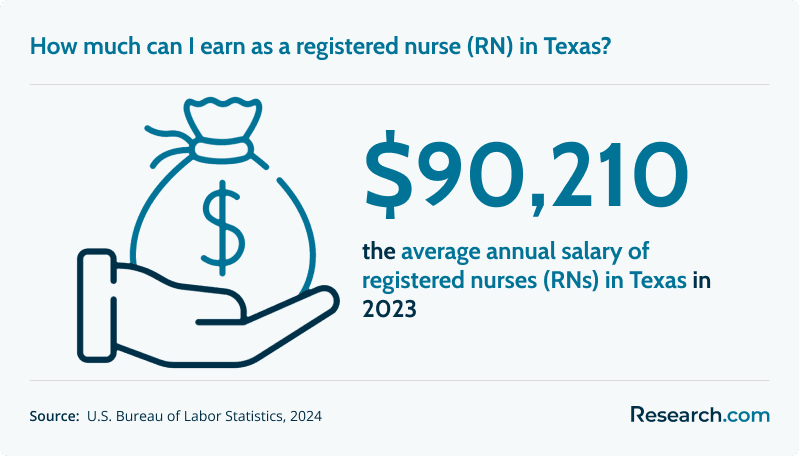
Becoming a nurse in Texas is a practical career goal, but the path depends on which nursing role you want, how quickly you need to enter the workforce, and whether you plan to pursue advanced practice later. Texas has a large healthcare labor market, with 251,840 registered nurses (RNs) working in the state in 2023 and an average RN salary of $90,210 per year. At the same time, the state continues to face workforce pressure, with projections indicating a need for over 60,000 additional nurses by 2030.
This guide explains how to become a nurse in Texas, including education routes, licensing steps, exam requirements, license types, compact license rules, career options, job outlook, financial aid considerations, and common mistakes to avoid. It is designed for first-time nursing students, career changers, LVNs considering an RN bridge, RNs planning graduate study, and nurses moving to Texas from another state.
Quick Answer: How Do You Become a Nurse in Texas?
To become a nurse in Texas, you generally need to complete an approved nursing program, pass the required licensing exam, complete the Texas Board of Nursing application process, submit fingerprints for a background check, and meet renewal and continuing education requirements after licensure. The exact path depends on whether you want to become a Licensed Vocational Nurse, Registered Nurse, or Advanced Practice Registered Nurse.
- Fastest licensed nursing route: Licensed Vocational Nurse programs usually take about one year and require passing the NCLEX-PN.
- Common RN route: An Associate Degree in Nursing typically takes about two years and leads to NCLEX-RN eligibility.
- Broader RN preparation: A Bachelor of Science in Nursing usually takes four years and may be preferred by some employers, especially for leadership, specialty, or hospital-based roles.
- Advanced practice route: Nurse practitioners, nurse midwives, nurse anesthetists, and clinical nurse specialists need graduate-level nursing education and certification.
- Texas license renewal: Nursing licenses must be renewed every two years, and nurses must complete at least 20 hours of continuing education.
Key Things You Should Know About Becoming a Nurse in Texas
- Texas has one of the country’s largest nursing workforces, but demand remains strong because of population growth, healthcare access needs, rural staffing gaps, and retirements.
- The average salary for registered nurses in Texas is around $90,210 per year, though pay varies by location, specialty, employer, shift, and experience level.
- RNs in Texas usually enter through an Associate Degree in Nursing or Bachelor of Science in Nursing, then pass the NCLEX-RN and complete Texas Board of Nursing requirements.
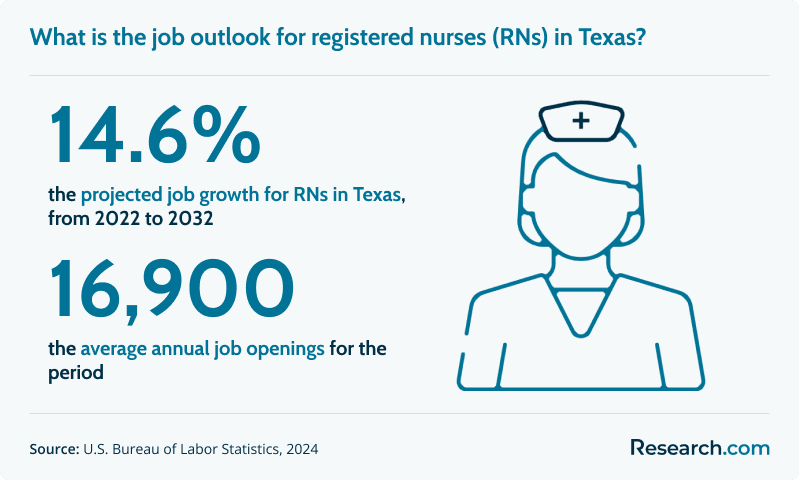
- The projected employment growth for nursing in Texas is 14.6% from 2022 to 2032, with an average annual job opening of 16,900 during the period.
- Program choice matters. Accreditation, clinical placement quality, NCLEX preparation, transfer policies, and total cost can affect your timeline, licensing eligibility, and long-term career mobility.
- What are the steps to becoming a nurse in Texas?
- What are the educational requirements for becoming a nurse in Texas?
- What types of nurses can legally practice in Texas?
- What are the licensing requirements for nurses in Texas?
- What types of nursing licenses are available in Texas?
- Can a Compact nurse practice in Texas?
- Can you practice as a nurse without a license in Texas?
- What opportunities exist for LVNs in Texas?
- Can nurses transition to pharmacy roles in Texas?
- What is the state of nursing in Texas?
- How can I transition to a nurse practitioner role in Texas?
- What is the job outlook for nursing in Texas?
- What are the alternative healthcare career paths for nurses in Texas?
- What are the alternative entry-level nursing pathways in Texas?
- What should I consider when evaluating nursing programs in Texas?
- Why advanced education matters for nurses in Texas
- What financial aid and scholarship opportunities are available for Texas nursing students?
- How can I transition to a nurse midwife role in Texas?
- What are the common workplace challenges for nurses in Texas?
- Is an online accelerated nursing program the right choice for your RN journey?
- What are the continuing education and professional development requirements for nurses in Texas?
What are the steps to becoming a nurse in Texas?
The basic process is straightforward, but each step has decisions that can affect your cost, timeline, and future options. Before enrolling, decide whether your short-term goal is LVN licensure, RN licensure, or an advanced practice role.
- Choose your nursing role. If you want the quickest licensed nursing pathway, an LVN program may be the right starting point. If your goal is broader RN practice, compare ADN and BSN programs. If you already hold a degree in another field, accelerated options may shorten your route.
- Complete an approved nursing program. Texas RN candidates usually complete either an Associate Degree in Nursing, which typically takes about two years, or a Bachelor of Science in Nursing, which usually takes four years. You can explore related healthcare degree options, but RN licensure requires nursing-specific education.
- Prepare for Texas-specific requirements. New nurses must complete the Texas Board of Nursing jurisprudence exam before sitting for the NCLEX-RN. This requirement helps candidates understand state nursing rules, ethics, and professional responsibilities.
- Submit fingerprints and complete the background check. Texas requires a criminal background review before licensure. If you have prior legal or disciplinary issues, contact the Texas Board of Nursing early so you understand how eligibility is reviewed.
- Pass the appropriate NCLEX exam. RN candidates take the NCLEX-RN, while LVN candidates take the NCLEX-PN. Passing the exam demonstrates entry-level readiness for safe nursing practice.
- Apply through the Texas Nurse Portal. After graduation and exam completion, applicants finalize licensure through the state process. The process usually takes about 6-8 weeks after graduation, though timing can vary by application completeness and background review.
- Renew your license and complete continuing education. Texas nursing licenses renew every two years. Nurses must complete at least 20 hours of continuing education, including required topics such as nursing jurisprudence and ethics. Your license expires in your birth month, so do not wait until the deadline.
| Step | What to Do | Decision Point |
| 1 | Select LVN, RN, or APRN as your target role | Choose based on timeline, scope of practice, and long-term goals |
| 2 | Enroll in an approved nursing program | Compare accreditation, clinical placements, cost, and NCLEX preparation |
| 3 | Complete Texas jurisprudence requirements | Plan this before your NCLEX timeline |
| 4 | Submit fingerprints and background information | Address eligibility concerns early |
| 5 | Pass the NCLEX-PN or NCLEX-RN | Use program outcomes and exam support when comparing schools |
| 6 | Apply for licensure through Texas | Keep transcripts, identification, and required documents organized |
| 7 | Maintain your license | Track renewal dates and continuing education hours |
Texas healthcare employers continue to need nurses across hospitals, outpatient clinics, long-term care, home health, schools, and rural facilities. The state’s projected nursing growth of 16.8% by 2028 makes licensing preparation especially important for students who want to enter the field efficiently. Nurses considering advanced roles can also review DNP salary information when weighing graduate education.
What are the educational requirements for becoming a nurse in Texas?
Texas nursing education requirements vary by license level. The right program depends on how quickly you want to work, how much clinical responsibility you want, and whether you plan to move into leadership or advanced practice later.
| Education Path | Typical Length | Leads To | Best For |
| Vocational nursing program | About one year | LVN eligibility | Students who want a faster licensed nursing entry point |
| Associate Degree in Nursing | About two years | RN eligibility | Students seeking a lower-cost or faster RN route |
| Bachelor of Science in Nursing | Usually four years | RN eligibility | Students who want broader preparation, leadership options, or graduate school readiness |
| Master of Science in Nursing | Varies by program | Specialty, leadership, or advanced practice preparation | RNs seeking specialization or expanded responsibility |
| Doctor of Nursing Practice | Varies by program | Advanced clinical practice preparation | Nurses pursuing high-level practice or systems leadership |
| Doctor of Philosophy in Nursing | Varies by program | Research and academic preparation | Nurses interested in teaching, research, or scholarship |
An ADN can be a practical option if you need to enter the RN workforce sooner. A BSN may offer broader coursework in leadership, population health, research, and care coordination. Many employers value BSN preparation, especially in larger healthcare systems or specialty units, but applicants should verify requirements with local employers rather than assuming one degree fits every role.
Students who already hold a non-nursing bachelor’s degree may look at accelerated nursing programs. Working RNs may consider flexible completion options, including online RN to BSN programs without clinical requirements, depending on prior education and program design.
Accreditation is not optional. Before applying, confirm that the nursing program is approved for Texas licensure and that its graduates are eligible for the appropriate NCLEX exam. Also ask where clinical rotations occur, how students are supported if they struggle academically, and whether credits will transfer if you later pursue a BSN, MSN, or DNP.
What types of nurses can legally practice in Texas?
Texas recognizes several levels of nursing and nursing-related practice. Each role has a different scope of practice, education requirement, supervision structure, and licensing or certification process.
- Registered Nurses: RNs assess patients, develop and coordinate care plans, administer medications, educate patients, and communicate with providers and care teams. They typically complete an ADN or BSN and pass the NCLEX-RN.
- Licensed Vocational Nurses: LVNs provide focused nursing care under appropriate supervision. They commonly work in long-term care, clinics, rehabilitation settings, home health, and hospitals. LVNs complete vocational nursing education and pass the NCLEX-PN.
- Advanced Practice Registered Nurses: APRNs include nurse practitioners, clinical nurse specialists, nurse anesthetists, and nurse midwives. These roles require graduate nursing education, certification, and authorization to practice at an advanced level.
- Certified Nursing Assistants: CNAs are not licensed nurses, but they support patient care by helping with daily living activities, mobility, hygiene, and basic observations under supervision. CNA training is shorter than nursing education and follows a separate certification process.
| Role | License or Credential | Main Responsibilities | Common Work Settings |
| Certified Nursing Assistant | CNA certification | Basic patient support and daily care assistance | Long-term care, hospitals, home health |
| Licensed Vocational Nurse | LVN license | Focused nursing care under supervision | Clinics, long-term care, rehabilitation, outpatient care |
| Registered Nurse | RN license | Assessment, care planning, medication administration, coordination | Hospitals, clinics, schools, public health, home health |
| Advanced Practice Registered Nurse | APRN authorization and certification | Advanced assessment, diagnosis, treatment, prescribing within state rules | Primary care, specialty practices, hospitals, women’s health, anesthesia |
The Texas Board of Nursing regulates nursing practice to protect patients and define professional standards. Knowing the difference between these roles is important because job titles, tasks, and legal authority are not interchangeable.
What are the licensing requirements for nurses in Texas?
Texas nursing licensure is handled through the Texas Board of Nursing. The exact process depends on whether you are applying as an LVN, RN, APRN, or nurse licensed in another state, but most applicants follow the same core sequence: education, application, background check, exam, and final approval.
- Complete the required education. RN candidates complete an approved ADN or BSN program. LVN candidates complete a vocational nursing program. APRN candidates need graduate-level nursing preparation.
- Submit the application. Applicants apply to the Texas Board of Nursing. The application fee is around $100.
- Complete fingerprinting and a background check. Texas requires fingerprint-based criminal history review. Fingerprinting usually costs about $50.
- Pass the correct NCLEX exam. RN applicants take the NCLEX-RN; LVN applicants take the NCLEX-PN. The exam fee is approximately $200.
- Provide required documents. Depending on your situation, you may need transcripts, proof of citizenship or legal residency, identity documentation, or additional eligibility information.
- Maintain your license after approval. Renewal is required every two years, along with continuing education.
If you have a criminal history, prior disciplinary action, or an eligibility concern, do not assume you are automatically disqualified. However, you should address the issue before investing in a program whenever possible. Licensing review can take time, and unresolved eligibility problems can delay or prevent licensure.
What types of nursing licenses are available in Texas?
Texas nursing licenses differ by scope of practice, education level, and responsibility. Choosing the right one should be based on your desired role, not simply on the shortest program.
| License Type | Education Requirement | Exam or Certification | When This Path Makes Sense |
| Licensed Vocational Nurse | Vocational nursing program | NCLEX-PN | You want a quicker entry into licensed bedside care |
| Registered Nurse | ADN or BSN | NCLEX-RN | You want broader clinical responsibility and more employment flexibility |
| Advanced Practice Registered Nurse | Master’s degree or higher in nursing | National certification and state authorization | You want advanced clinical, specialty, or provider-level responsibilities |
| License by Endorsement | Prior nursing licensure from another state | May not require retaking the NCLEX if criteria are met | You are already licensed elsewhere and are moving to Texas |
- RN license: This is the standard credential for registered nursing practice. RNs complete an approved nursing program and pass the NCLEX-RN. Their work may include assessment, medication administration, patient education, care coordination, and leadership within the care team.
- LVN license: LVNs complete a shorter vocational nursing pathway and pass the NCLEX-PN. This route can be useful for students who want to begin working in nursing sooner and later bridge into RN education.
- APRN authorization: APRNs include nurse practitioners, clinical nurse specialists, certified registered nurse anesthetists, and certified nurse midwives. These roles require advanced education and certification, and practice authority must align with Texas rules.
- Endorsement: Nurses licensed in another state may apply for Texas licensure by endorsement if they meet state requirements. Paramedics or other healthcare professionals interested in nursing may also compare paramedic to nurse bridge program options to see whether prior experience can support a transition.
Specialty choice can also affect pay. Among specialized nursing roles, nurse anesthetists earn the highest in the state, with an average annual salary of $216,280 in 2023.
Can a Compact nurse practice in Texas?
Yes. Texas participates in the Nurse Licensure Compact, so eligible nurses with a compact license may practice in Texas without obtaining a separate Texas single-state license. This is especially useful for travel nurses, telehealth nurses, and nurses who live near state borders.
Compact practice still comes with responsibilities. When working in Texas, compact nurses must follow Texas nursing laws and practice standards. A multistate license does not allow a nurse to ignore state-specific rules.
- Primary state of residence matters. To hold a Texas compact license, Texas must be your legal primary state of residence.
- Your license must be active and in good standing. Disciplinary history or restrictions can affect eligibility.
- Texas rules still apply. Nurses practicing in Texas must comply with the Texas Nursing Practice Act and Board of Nursing expectations.
- Education options still matter for new nurses. If you are not licensed yet and want a faster RN path, compare approved programs carefully, including fast RN degree options.
If you are relocating to Texas, confirm whether you need compact privileges, endorsement, or a Texas license based on your residence status and current license type.
Can you practice as a nurse without a license in Texas?
No. You cannot legally practice as a nurse in Texas without the appropriate license. Nursing is a regulated profession because nurses perform clinical tasks that can directly affect patient safety.
- Licensure is required. To work as an RN or LVN in Texas, you must complete approved education, pass the required NCLEX exam, and receive licensure from the Texas Board of Nursing.
- Unlicensed practice can harm patients. Nursing judgment, medication administration, assessment, and documentation require formal preparation and legal authority.
- Legal and career consequences can be serious. Practicing without a license can lead to fines, legal action, and future licensing barriers.
- Support roles are different from nursing roles. You may be able to work in non-nurse healthcare support positions if properly trained or certified, but you cannot represent yourself as a nurse or perform licensed nursing duties.
The nursing workforce is also aging, with the median age of RNs being 52 and LPNs/LVNs at 53. That makes qualified, licensed professionals important, but it does not reduce licensing standards. If you want experience before licensure, look for approved student clinical experiences, CNA roles, patient care technician positions, or healthcare volunteer roles that clearly define permitted duties.
What opportunities exist for LVNs in Texas?
Licensed Vocational Nurses can build meaningful careers in Texas, especially in settings that need hands-on patient care and close monitoring. LVNs commonly work in long-term care, outpatient clinics, rehabilitation centers, home health, correctional health, and some hospital units. Their duties often include collecting patient data, assisting with medications, performing treatments within scope, documenting care, and reporting changes to RNs or providers.
The LVN route is often attractive because it can lead to employment sooner than an RN program. It can also serve as a bridge for students who want to earn income and clinical experience before pursuing RN licensure. If you are comparing LVN education options, review online LPN programs in Texas and verify that any program you consider meets Texas requirements for vocational nursing licensure.
| LVN Path | Advantages | Limitations |
| Start as an LVN | Shorter training timeline and earlier entry into nursing work | More limited scope than RN practice |
| LVN-to-RN bridge | Uses prior nursing experience as a foundation for RN education | Requires additional admission, coursework, and clinical preparation |
| Remain in LVN practice | Can build stability in long-term care, clinics, and community settings | Advancement may require further education |
Can nurses transition to pharmacy roles in Texas?
Yes, but nursing experience alone does not qualify someone to practice as a pharmacist. Nurses who enjoy pharmacology, medication safety, patient counseling, and clinical decision-making may find pharmacy appealing, but the transition requires a separate education and licensure pathway.
A nursing background can help with patient communication, medication administration knowledge, and healthcare teamwork. However, pharmacy practice has its own academic standards, clinical training, examinations, and regulatory requirements. Before changing paths, compare the time, tuition, prerequisites, and opportunity cost with advanced nursing options such as nurse practitioner, nurse educator, or clinical nurse specialist roles.
For a role-specific overview, review how to become a pharmacist in Texas and compare those requirements with your current nursing career plan.
What is the state of nursing in Texas?
Nursing in Texas is shaped by a large population, major urban medical centers, rural access needs, and a broad mix of employers. The state employs a large number of licensed nurses, yet staffing pressure remains a recurring issue in rural areas, high-acuity units, long-term care, and specialized practice areas.
For RNs, Texas offers strong earning potential compared with the state average for all occupations. The annual average salary for RNs in the state is $90,210, compared with $61,240 for all occupations. Pay can differ significantly between metropolitan and rural areas, bedside and non-bedside roles, specialty units, and day versus night or weekend schedules.
Texas also has a wide range of healthcare employers. Hospitals remain major employers, but nurses also work in ambulatory surgery centers, public health departments, school systems, home health agencies, hospice organizations, correctional facilities, insurance companies, and corporate healthcare settings. Houston, Dallas, San Antonio, Austin, and other growing regions offer large healthcare markets, while rural communities may offer different responsibilities and access-to-care challenges.
Prospective students should not choose a nursing program based only on convenience. Clinical placements, faculty support, NCLEX preparation, and employer relationships can influence readiness for practice. Some students may also compare nursing schools with simpler admission processes, but easier admission should never replace checks for accreditation, licensure eligibility, and student outcomes.
Technology is also changing nursing work. Electronic health records, telehealth, remote monitoring, medication safety systems, and clinical decision-support tools are now part of many practice settings. These tools do not replace nursing judgment, but they do require digital comfort, documentation accuracy, and careful attention to privacy and patient safety.
How can I transition to a nurse practitioner role in Texas?
To become a nurse practitioner in Texas, you first need RN licensure, then graduate-level nursing education in a nurse practitioner specialty, national certification, and the appropriate state authorization. This path is best for nurses who want advanced clinical responsibility, deeper diagnostic training, and a more independent role in patient management within Texas practice rules.
Before applying to NP programs, consider your specialty carefully. Family practice, adult-gerontology, pediatrics, psychiatric-mental health, and women’s health can lead to different clinical experiences and job markets. Also compare clinical placement support, faculty experience, certification exam preparation, and whether the program format fits your work schedule.
For a more detailed pathway, review nurse practitioner education requirements in Texas.
What is the job outlook for nursing in Texas?
The employment outlook for nurses in Texas is strong, though job availability still depends on specialty, location, experience, and employer demand. According to Projections Central, the projected job growth is 14.6% from 2022 to 2032. This translates to an average annual job opening of 16,900 every year during the period.
Several factors support demand: population growth, aging patients, chronic disease management, rural healthcare needs, and replacement openings as older nurses leave the workforce. New graduates may find opportunities in residency programs, medical-surgical units, long-term care, behavioral health, rehabilitation, and outpatient care, while experienced nurses may move into specialties such as critical care, emergency nursing, pediatrics, geriatrics, case management, informatics, education, or advanced practice.
| Career Stage | Common Opportunities | How to Strengthen Your Prospects |
| Student | Clinical rotations, externships, CNA or patient care roles | Build references, practice documentation, and prepare early for NCLEX |
| New RN graduate | Residency programs, med-surg, long-term care, outpatient entry roles | Apply broadly and ask about orientation, mentorship, and staffing support |
| Experienced RN | Specialty units, charge nurse roles, case management, education | Earn relevant certifications and document measurable clinical experience |
| Advanced practice nurse | Primary care, specialty clinics, women’s health, anesthesia, leadership | Choose accredited graduate programs with strong clinical placement support |
What are the alternative healthcare career paths for nurses in Texas?
Nursing skills can transfer into healthcare roles beyond bedside care. Nurses who want less shift work, more administrative responsibility, or a different relationship with patients may consider roles in care coordination, utilization review, quality improvement, informatics, education, public health, healthcare administration, or documentation-focused work.
Medical billing and coding is one example of a non-bedside healthcare path that may appeal to nurses who understand clinical terminology, procedures, records, and payer documentation. It is not the same as nursing practice, but clinical knowledge can be useful in revenue cycle and documentation roles. To compare requirements, review how to become a medical biller and coder in Texas.
What are the alternative entry-level nursing pathways in Texas?
Not every student needs to start with a four-year BSN. Texas students can enter patient care through CNA roles, vocational nursing, ADN programs, or accelerated pathways if they already have college credit or a prior degree. The right route depends on your finances, academic background, work schedule, and career goals.
| Pathway | Why Students Choose It | What to Watch For |
| CNA or patient care support | Quick exposure to healthcare settings before nursing school | Does not qualify you to practice as a nurse |
| LVN | Faster licensed nursing entry point | Scope and advancement are more limited than RN practice |
| ADN | Common RN route with a shorter timeline than a BSN | Some employers may prefer BSN preparation |
| BSN | Broader education and stronger graduate school foundation | Usually takes longer and may cost more upfront |
| Accelerated RN program | Useful for qualified career changers | Intensive pace may be difficult while working |
If you are considering vocational nursing first, read how to become an LVN in Texas to understand the licensing sequence and whether that route fits your long-term plan.
What should I consider when evaluating nursing programs in Texas?
The best nursing program is not always the cheapest, fastest, or easiest to enter. It is the program that gives you a realistic path to licensure, clinical readiness, and employment without creating unnecessary debt or delays.
| Factor | Why It Matters | Questions to Ask |
| Accreditation and approval | Licensure eligibility depends on proper program recognition | Is the program approved for Texas nursing licensure? |
| Clinical placements | Nursing cannot be learned through theory alone | Where do students complete clinical rotations, and who arranges them? |
| NCLEX preparation | Passing the exam is required for licensure | How does the program support students who are at risk academically? |
| Total cost | Tuition is only one part of the financial picture | What are the fees, supplies, uniforms, testing costs, and commuting costs? |
| Program format | Online, hybrid, evening, and campus options affect schedule fit | Which parts are online, and which require in-person attendance? |
| Transfer and bridge options | Your first credential may not be your last | Will credits apply to RN-to-BSN or graduate study later? |
| Student support | Nursing school is demanding | Are tutoring, advising, simulation labs, and career services available? |
Students comparing flexible formats can start with the best online nursing programs in Texas, but they should still verify clinical requirements, state authorization, and licensure alignment before enrolling.
Why advanced education matters for nurses in Texas
Advanced nursing education can expand your options beyond entry-level or general bedside roles. An MSN, DNP, or PhD can support movement into advanced practice, leadership, education, quality improvement, research, administration, or specialty care. It can also help nurses build stronger skills in evidence-based practice, systems thinking, population health, and complex clinical decision-making.
Advanced education is not automatically the right move for every nurse. It requires time, tuition, clinical hours, and a clear career purpose. Before applying, ask whether the degree is required for your target role, whether your employer offers tuition support, and whether the program’s specialty matches the work you actually want to do.
Nurses interested in becoming nurse practitioners should compare specialty tracks, certification preparation, and clinical placement support. A useful starting point is the best NP programs in Texas.
What financial aid and scholarship opportunities are available for Texas nursing students?
Nursing education can involve tuition, fees, books, uniforms, background checks, immunizations, exam fees, transportation, and lost work hours during clinicals. Financial planning should begin before enrollment, not after the first tuition bill arrives.
- Federal aid: Submit the FAFSA if you plan to use federal grants, loans, or work-study eligibility.
- State and institutional aid: Texas schools may offer grants, scholarships, payment plans, or need-based awards.
- Employer support: Hospitals and healthcare systems may offer tuition reimbursement, especially for current employees moving from LVN to RN or RN to BSN pathways.
- Professional scholarships: Nursing associations, foundations, and local healthcare organizations may sponsor awards for nursing students.
- Cost reduction strategies: Compare community college ADN routes, transfer agreements, in-district tuition, used books, and employer-sponsored programs.
When comparing schools, do not stop at published tuition. Request a full cost estimate and compare financial aid packages from the best nursing schools in Texas before making a commitment.
How can I transition to a nurse midwife role in Texas?
Nurse midwifery is an advanced nursing specialty focused on reproductive health, pregnancy, birth, postpartum care, preventive services, and family planning. To pursue this role in Texas, nurses generally need RN licensure, graduate nursing education in nurse midwifery, clinical training, certification, and authorization that aligns with state rules.
This path may be a strong fit for nurses who want to care for patients across the reproductive health continuum and who are comfortable with advanced assessment, patient education, collaboration, and complex decision-making. Before choosing a program, confirm clinical placement support, certification preparation, and state eligibility. For a step-by-step overview, see how to become a nurse midwife in Texas.
Common mistakes to avoid when becoming a nurse in Texas
| Mistake | Why It Can Hurt You | Better Approach |
| Choosing a program without checking approval or accreditation | You may risk licensure delays or ineligibility | Confirm program status before applying or paying deposits |
| Looking only at tuition | Fees, supplies, exams, transportation, and clinical costs can add up | Compare total program cost and available aid |
| Assuming online means fully remote | Nursing programs usually require in-person labs or clinicals | Ask exactly where and when in-person requirements occur |
| Ignoring NCLEX support | Graduation alone does not create a license | Review tutoring, exam preparation, and student support resources |
| Choosing speed over fit | Accelerated programs can be overwhelming without enough time to study | Match program intensity with your work, family, and academic readiness |
| Assuming salary outcomes are guaranteed | Pay varies by region, employer, specialty, and experience | Research local job postings and speak with nurses in your target setting |
| Waiting to ask about background eligibility | Licensing concerns can delay or block approval | Contact the Texas Board of Nursing early if you have concerns |
What are the common workplace challenges for nurses in Texas?
Nursing can be rewarding, but it is not an easy career. Texas nurses may face high patient volume, long shifts, emotional strain, documentation demands, workplace safety concerns, and staffing shortages in some settings. Rural nurses may also work with fewer local resources, while urban nurses may manage high-acuity caseloads and fast patient turnover.
Burnout prevention should be part of your career plan. Ask employers about orientation length, nurse residency support, patient assignment practices, preceptor availability, overtime expectations, workplace violence prevention, and mental health resources. If you are weighing the personal and financial investment of nursing school, review whether being a nurse is worth it for your goals, temperament, and preferred work environment.
Is an online accelerated nursing program the right choice for your RN journey?
An online accelerated nursing program can work well for disciplined students who already meet prerequisites, can handle a compressed schedule, and have reliable access to required in-person labs and clinical placements. However, “online” does not mean easier, and accelerated does not mean less demanding.
Before enrolling, verify accreditation, Texas licensure eligibility, clinical placement arrangements, faculty access, technology requirements, and weekly time expectations. Ask whether students must find their own clinical sites and what happens if a placement falls through. For a closer look at this format, review whether a 1 year accelerated RN nursing degree online is easy.
What are the continuing education and professional development requirements for nurses in Texas?
Texas nurses must keep learning after licensure. Nursing licenses are renewed every two years, and nurses must complete at least 20 hours of continuing education. Required topics include areas such as nursing jurisprudence and ethics, and nurses should confirm current requirements with the Texas Board of Nursing before each renewal period.
Continuing education is more than a compliance task. It helps nurses stay current with clinical guidelines, patient safety practices, documentation standards, technology, legal responsibilities, and specialty expectations. Nurses planning advancement should also consider certifications, preceptor training, leadership development, informatics skills, and graduate coursework. For a licensing-focused overview, review the requirements for nursing licensure in Texas.
Key Insights
- Texas offers multiple nursing entry points, but the best path depends on your timeline, finances, academic background, and desired scope of practice.
- An LVN program can provide a faster start, while an ADN or BSN is the standard route to RN licensure. Advanced practice roles require graduate education and certification.
- Licensure requires more than graduation. Texas applicants must complete Board of Nursing requirements, background checks, jurisprudence expectations, and the correct NCLEX exam.
- Texas RN pay is strong compared with the state average for all occupations, with an annual average salary of $90,210 for RNs versus $61,240 for all occupations.
- The nursing job outlook in Texas is favorable, with projected job growth of 14.6% from 2022 to 2032 and an average annual job opening of 16,900 during the period.
- Program quality matters. Before enrolling, verify approval, accreditation, clinical placements, total cost, NCLEX support, and whether the program fits your long-term goals.
- Do not practice as a nurse without a license. If you want experience before licensure, choose approved student clinicals or properly defined healthcare support roles.
Related Articles for Nearby States
- 2027 How to Become a Nurse in Louisiana
- 2027 How to Become a Nurse in Oklahoma
- 2027 How to Become a Nurse in Arkansas
- 2027 How to Become a Nurse in New Mexico
- 2027 How to Become a Nurse in Kansas
- 2027 How to Become a Nurse in Missouri
- 2027 How to Become a Nurse in Colorado
- 2027 How to Become a Nurse in Mississippi
- 2027 How to Become a Nurse in Tennessee
- 2027 How to Become a Nurse in Arizona
References:
- nursejournal.org (11 Oct 2023). Become a Nurse in Texas: Requirements, Licensing, & Employment Outlook. nursejournal.org
- bestcolleges.com (08 Jan 2024). Nursing Requirements In Texas. bestcolleges.com
- bon.texas.gov (19 Jun 1999). Nurse Licensure Compact Information. bon.texas.gov
- Smiley, R., Ruttinger, C., Oliveira, C., Hudson, L., Allgeyer, R., Reneau, K., Silvestre, J., & Alexander, M. (2021). The 2020 National Nursing Workforce Survey. Journal of Nursing Regulation. (21)00027-2. https://doi.org/10.1016/S2155-8256
Other Things You Need to Know About Nursing in Texas
The Texas Board of Nursing licenses both registered nurses and vocational nurses in Texas. RN candidates must graduate from an approved program and pass the NCLEX-RN, while LVN candidates must complete an approved vocational nursing program and pass the NCLEX-PN before receiving a Texas license.
To enter a nursing program in Texas in 2027, applicants typically need a high school diploma or GED, satisfactory scores on the TEAS or HESI exams, and completion of prerequisite courses like biology and chemistry. Each program may have additional specific requirements.
In 2027, Texas nurses must complete a minimum of 20 contact hours of continuing education every two years. These hours must be approved by the Texas Board of Nursing and may include specific courses like jurisprudence and ethics.