2027 How to Become a Nurse in Missouri

Co-Founder and Chief Data Scientist
Becoming a nurse in Missouri means choosing a licensed healthcare career with several possible entry points, from practical nursing to registered nursing and advanced practice roles. The right path depends on how quickly you want to enter the workforce, how much responsibility you want, whether you plan to specialize, and how much time and money you can invest in school. Missouri is home to over 73,000 registered nurses, and registered nurse employment in the state is projected to grow 9.9% from 2022 to 2032. This guide explains how to become a nurse in Missouri, what education and licensing steps are required, which nursing roles are legally recognized, how compact licensure works, and how to evaluate career options before enrolling in a program.
Quick Answer: How Do You Become a Nurse in Missouri?
To become a nurse in Missouri, you must complete an approved nursing education program, apply through the Missouri State Board of Nursing, pass the appropriate NCLEX exam, complete the required background check, and receive your license before practicing. LPN programs usually take nine to twelve months, while RN pathways may take about two years through an associate degree, two to three years through a hospital diploma, or four years through a BSN program. Advanced practice nurses need graduate education, national certification, and additional state authorization.
Key Things You Should Know About Becoming a Nurse in Missouri
- Missouri has a sizable nursing workforce, including around 73,190 RNs and 12,720 LPNs in 2023, but workforce shortages remain a concern in many communities.
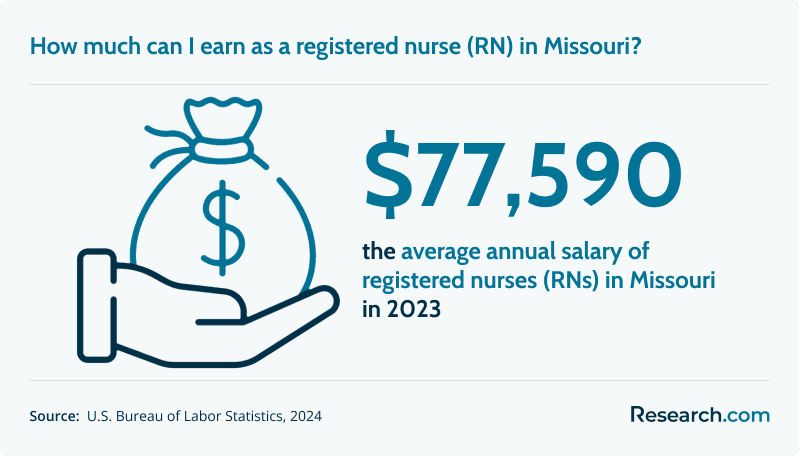
- Registered nurses in Missouri earn an average salary of $77,590 per year, though pay can vary by employer, location, specialty, shift, and experience level.
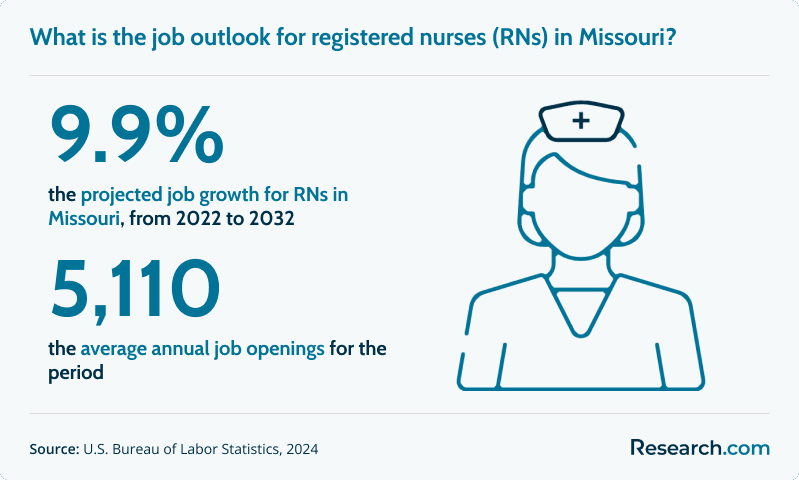
- RN employment in Missouri is projected to grow by approximately 9.9% from 2022 to 2032, with an estimated 5,110 annual job openings during the forecast period.
- Older workforce projections warned of a shortfall of nearly 18,000 nurses in Missouri by 2020, and another cited projection pointed to a shortage of over 20,000 registered nurses by 2025, underscoring why nursing education capacity and retention matter.
- You cannot legally practice nursing in Missouri without the proper license. Completing school is not enough; licensure is required before you use a protected nursing title or provide nursing care.
- Missouri participates in the Enhanced Nurse Licensure Compact, so eligible nurses with an active multistate license from another compact state may practice in Missouri without obtaining a separate single-state Missouri license.
- Steps to become a nurse in Missouri
- Education requirements for Missouri nurses
- Types of nurses allowed to practice in Missouri
- Missouri nursing licensing requirements
- Types of nursing licenses in Missouri
- Compact nursing license rules in Missouri
- Practicing nursing without a license in Missouri
- Current state of nursing in Missouri
- Missouri nursing job outlook
- Using nursing experience to move into pharmacy
- Nurse practitioner education requirements in Missouri and related healthcare career options
- Online nursing programs in Missouri, career changes, and job outlook
- LVN career transition questions
- Continuing education for nursing career growth
- Nursing license renewal and continuing education
- Nursing certifications that may improve career options
- Becoming a nurse midwife in Missouri
- LPN education options in Missouri
- Advanced nursing education opportunities
- Tuition and financial aid for nursing programs, advanced education, and employment outlook
- Non-clinical nursing career paths in Missouri
What are the steps to becoming a nurse in Missouri?
The process starts with choosing the nursing role you want. Missouri recognizes different levels of nursing practice, and each one has a different training timeline, exam, and scope of responsibility. A student who wants the fastest licensed entry point may choose an LPN program, while someone seeking broader clinical responsibility, more advancement options, or graduate study may choose an RN pathway.
- Finish high school or earn an equivalent credential. Nursing programs expect preparation in English, social studies, math, and science because these subjects support clinical reading, dosage calculation, patient communication, and anatomy-related coursework.
- Choose an entry pathway. Missouri students commonly begin as Licensed Practical Nurses or Registered Nurses. LPN training generally takes nine to twelve months. RN preparation may come through a two- to three-year hospital diploma, a two-year associate degree in nursing, or a four-year baccalaureate degree in nursing.
- Verify program approval and accreditation. Do not enroll based only on convenience or tuition. Confirm that the program is approved for Missouri licensure preparation and that its credentials will support your exam eligibility, transfer plans, and future degree goals.
- Complete classroom, lab, and clinical requirements. Nursing education includes both theory and supervised patient-care experience. Clinical placements are where students apply skills, communication, safety practices, documentation, and professional judgment.
- Apply for licensure through the Missouri State Board of Nursing. The application process includes proof of education, fees, and a fingerprint-based background check.
- Pass the correct NCLEX exam. RN candidates take the NCLEX-RN. LPN candidates take the NCLEX-PN.
- Maintain your license after approval. Once licensed, nurses must follow Missouri renewal rules, employer requirements, and any continuing education expectations tied to their role or specialty.
| Pathway | Typical education route | Approximate timeline stated | Best fit |
| LPN | Practical nursing program through a technical school or community college | Nine to twelve months | Students who want a quicker licensed route into bedside care under RN or physician supervision |
| RN through hospital diploma | Hospital-based nursing diploma | Two to three years | Students who prefer a hospital-centered training model where available |
| RN through ADN | Associate Degree in Nursing at a college or university | About two years | Students seeking a relatively direct route to RN licensure with the option to pursue a BSN later |
| RN through BSN | Bachelor of Science in Nursing at a college or university | Four years | Students who want stronger preparation for leadership, specialty practice, graduate school, or employers that prefer bachelor-prepared nurses |
The practical takeaway is simple: match your program choice to your long-term goal. If your goal is advanced practice, management, public health, or graduate school, planning early for a BSN or RN-to-BSN pathway can prevent extra steps later. If you are evaluating advanced practice income potential, reviewing DNP salary by state can help you understand how earnings differ across locations and roles.
What are the educational requirements for becoming a nurse in Missouri?
Missouri nursing education requirements vary by license level. All licensed nursing routes require an approved education program, but the depth of training, clinical expectations, and career outcomes differ. Before applying, students should confirm whether a program prepares them for LPN licensure, RN licensure, or advanced practice authorization.
- High school preparation: A high school diploma or equivalent is the starting point. Courses in science, math, English, and social studies help prepare students for nursing prerequisites and clinical coursework.
- Approved nursing education: Candidates must graduate from an accredited or state-approved nursing program appropriate to the license they are seeking.
- LPN education: Practical nursing programs usually take nine to twelve months and are commonly offered by technical schools and community colleges. LPNs provide direct care, monitor patient conditions, and work under the supervision of RNs or physicians.
- RN education: RN candidates may complete a hospital diploma program lasting two to three years, an Associate Degree in Nursing that takes about two years, or a Bachelor of Science in Nursing that requires four years of study.
- BSN completion options: Licensed RNs who started with an ADN may later use fast track RN to BSN online programs to build on previous nursing education and professional experience.
- Graduate nursing education: Nurses pursuing advanced practice, leadership, education, or research may consider an MSN, a Doctor of Nursing Science, or a Doctor of Philosophy in Nursing. MSN programs are typically two-year programs for advanced roles.
- Post-master’s specialization: Nurses who already hold graduate credentials may use certificate options, such as the fastest post master's FNP certificate programs, to prepare for additional advanced practice specialization.
How to choose the right nursing degree in Missouri
| If your priority is... | Consider this option | What to verify before enrolling |
| Entering licensed nursing as quickly as possible | LPN program | State approval, NCLEX-PN preparation, clinical placement quality, and transfer options into RN programs |
| Becoming an RN with a shorter initial degree | ADN program | NCLEX-RN pass preparation, local employer preferences, and RN-to-BSN transfer agreements |
| Improving long-term advancement options | BSN program | Accreditation, clinical sites, graduation outcomes, tuition, and scholarship options |
| Becoming an NP, CRNA, CNM, or CNS | MSN, doctoral program, or approved post-graduate certificate | Specialty accreditation, national certification eligibility, clinical hour requirements, and Missouri practice rules |
What types of nurses can legally practice in Missouri?
Missouri allows several categories of nursing and nursing-related workers to practice, but not all have the same legal authority. Understanding the difference matters because job duties, supervision requirements, education, and licensure rules are not interchangeable.
- Registered Nurses: RNs assess patients, develop and carry out care plans, administer medications, coordinate care, educate patients, and respond to changes in patient condition. RN candidates must complete an approved nursing program and pass the NCLEX-RN.
- Licensed Practical Nurses: LPNs provide bedside care, collect patient data, assist with daily care, monitor changes, and carry out nursing tasks within their authorized scope. They complete a practical nursing program and pass the NCLEX-PN.
- Advanced Practice Registered Nurses: APRNs include Nurse Practitioners, Clinical Nurse Specialists, Certified Registered Nurse Anesthetists, and Certified Nurse Midwives. These roles require graduate-level nursing education, national certification in the specialty area, and compliance with Missouri’s advanced practice requirements.
- Certified Nursing Assistants: CNAs are not licensed nurses, but they are important members of the care team. They help with daily activities and basic patient care under nurse supervision after completing state-approved training and passing a competency exam.
In 2023, there were around 73,190 RNs and 12,720 LPNs in Missouri. See the chart below for nursing employment details.
What are the licensing requirements for nurses in Missouri?
Licensure is the legal checkpoint between finishing nursing school and practicing as a nurse. Missouri uses education verification, national examination, application review, and background screening to confirm that new nurses meet minimum practice standards.
- Approved education: RN applicants typically complete an ADN or BSN, while LPN applicants complete a practical nursing program. The program must meet Missouri’s standards for licensure preparation.
- NCLEX examination: RN candidates must pass the NCLEX-RN, and LPN candidates must pass the NCLEX-PN.
- State application: Candidates apply to the Missouri State Board of Nursing and submit required documentation. The application fee is approximately $30 for LPNs and $35 for RNs.
- Background check: Missouri requires a fingerprint-based background check for nursing applicants.
- Additional costs: Applicants should also plan for fingerprinting costs and any supporting materials required during the application process.
Missouri nursing licensure checklist
| Requirement | Why it matters | Common mistake to avoid |
| Graduate from an approved program | Establishes eligibility for the licensing exam | Assuming any healthcare program qualifies for nursing licensure |
| Take the correct NCLEX | Matches the exam to the license level being sought | Confusing NCLEX-PN and NCLEX-RN pathways |
| Submit Missouri Board application | Starts the state review process | Waiting until after graduation to learn what documents are needed |
| Complete fingerprint background check | Supports patient safety and professional screening | Not budgeting time for processing delays |
| Track renewal obligations | Keeps the license active after approval | Assuming licensure is permanent once issued |
What types of nursing licenses are available in Missouri?
Missouri nursing licenses are tied to scope of practice. The right license depends on the level of clinical responsibility you want and the amount of education you are prepared to complete.
- Registered Nurse license: RNs provide comprehensive nursing care, patient education, medication administration, care coordination, and clinical assessment. Candidates generally complete an ADN or BSN and pass the NCLEX-RN.
- Licensed Practical Nurse license: LPNs provide practical nursing care under appropriate supervision. They complete a state-approved practical nursing program and pass the NCLEX-PN. This route usually takes less time than RN preparation.
- Advanced Practice Registered Nurse recognition: APRN roles include Nurse Practitioner, Clinical Nurse Specialist, Certified Registered Nurse Anesthetist, and Certified Nurse Midwife. These nurses complete advanced education, usually at the master's or doctoral level, and meet specialty certification requirements. Nurses considering psychiatric advanced practice can review psychiatric mental health nurse practitioner salary information; across the US, they make around $126,260 per year on average.
In 2023, nurse anesthetists were the highest-paid nurses in the state with an average annual salary of $230,470. As such, many nurses are looking into CRNA school requirements to be able to work in that capacity. This is followed by NPs, earning $116,680 per year on average. See the chart below for salary details.
Can a Compact nurse practice in Missouri?
Yes. Missouri is part of the Enhanced Nurse Licensure Compact, so a nurse who holds an active multistate license from another compact state may practice in Missouri without applying for a separate Missouri single-state license. This is especially useful for travel nurses, telehealth nurses, nurses living near state borders, and employers that need staffing flexibility.
- Multistate practice: A valid compact license allows eligible nurses to work in Missouri and other compact states without holding separate licenses in each state.
- Workforce flexibility: Compact licensure can help hospitals, clinics, and long-term care facilities respond to staffing needs, including in rural and underserved areas.
- Career mobility: Nurses who want to broaden their options can combine compact licensure with additional credentials. Some professionals also consider short healthcare credentials, and the fastest medical certifications with high pay can help nurses compare adjacent skill-building options.
Compact licensure does not remove the obligation to follow Missouri’s nursing laws while practicing in the state. Nurses should verify that their compact status is active, that Missouri is included in their practice privileges, and that any specialty or employer-specific requirements are satisfied.
In 2023, RNs in the state earned around $77,590 per year on average.
Can you practice as a nurse without a license in Missouri?
No. You cannot legally practice as a nurse in Missouri without the proper license. Nursing is a regulated profession because patients rely on nurses for medication administration, assessment, care planning, documentation, and safety-sensitive decisions. Completing coursework or clinical training does not authorize independent practice unless the person has been licensed or is practicing within an approved student role under supervision.
- Patient safety: Licensing confirms that the nurse has completed required education and passed a national competency exam.
- Legal protection: A valid license gives the nurse legal authority to perform nursing duties within the permitted scope of practice.
- Employer eligibility: Hospitals, clinics, long-term care facilities, and home health agencies require the appropriate license for nursing positions.
- Professional accountability: Licensed nurses are subject to board rules, ethical expectations, and disciplinary standards.
Advanced practice roles also require proper authorization. Nationally, approximately 29,200 openings are projected annually for nurse anesthetists, nurse midwives, and nurse practitioners, but those roles are not available to unlicensed individuals. A Missouri nurse described the moment she understood this clearly: “I remember realizing that school alone did not make me ready to practice. Balancing classes and clinical hours was hard, but earning the license proved I had met the standard patients deserved.”
What is the state of nursing in Missouri?
Nursing in Missouri offers meaningful opportunity, but the market is not uniform. Hospitals, long-term care facilities, outpatient clinics, home health agencies, public health programs, and rural providers may have different staffing needs, wages, schedules, and advancement options. Students should look beyond statewide averages and compare the specific labor market in the region where they plan to work.
Employment environment
Missouri employs a large nursing workforce across multiple settings. RNs, LPNs, APRNs, and CNAs support hospitals, community clinics, physician offices, skilled nursing facilities, assisted living centers, home health providers, schools, correctional health systems, and public agencies.
- RNs often have the broadest employment options because their scope includes assessment, care coordination, patient education, and higher-level clinical responsibility.
- LPNs may find opportunities in long-term care, rehabilitation, outpatient care, physician practices, and home health settings.
- APRNs can pursue advanced clinical practice in primary care, anesthesia, maternal health, acute care, mental health, and specialty services, subject to Missouri rules and certification requirements.
Workforce challenges
Missouri’s nursing workforce faces common pressures seen across healthcare: retirement of experienced nurses, rural staffing gaps, burnout, competition for clinical faculty, and rising demand from an aging population. These pressures can create job openings, but they can also affect working conditions. When comparing employers, nurses should ask about patient ratios, orientation, mentorship, overtime expectations, workplace safety, and career ladders.
Cost of living and lifestyle considerations
Missouri’s cost of living can be attractive compared with many larger metropolitan states, but affordability still varies by city, county, commute, housing market, and family needs. Salary should be evaluated alongside benefits, shift differentials, retirement contributions, tuition reimbursement, and loan repayment options.
Major employers and work settings
- Hospitals and medical centers for acute care, emergency care, surgery, specialty services, and inpatient units
- Long-term care and assisted living facilities for geriatric and rehabilitation-focused nursing
- Home health agencies for patients who receive care outside institutional settings
- Clinics, physician practices, urgent care centers, and community health organizations
- Schools, government agencies, correctional systems, and occupational health programs
What is the job outlook for nursing in Missouri?
The employment outlook for registered nurses in Missouri is favorable based on current projections. According to long-term projections, RN employment in Missouri is expected to grow by approximately 9.9% from 2022 to 2032. During that forecast period, the state is estimated to have 5,110 annual job openings.
Demand is tied to several factors: population aging, chronic disease management, healthcare access needs, turnover, retirement, and the continued use of nurses across inpatient and outpatient settings. However, a strong statewide outlook does not guarantee a specific salary or job offer. Specialty, experience, location, shift availability, and employer type all affect outcomes.
| Factor | How it affects nursing opportunities in Missouri | What applicants should ask |
| Location | Urban hospitals and rural providers may have different staffing needs and specialty openings | Which regions are hiring new graduates in my chosen role? |
| Education level | BSN and graduate credentials may support broader advancement options | Does this employer prefer or require a BSN for advancement? |
| Specialty | Critical care, anesthesia, primary care, mental health, long-term care, and home health may differ in demand | Which specialties offer structured training for new nurses? |
| Schedule | Night shifts, weekends, and high-need units may offer more openings or different compensation | What shift differentials, overtime rules, and staffing expectations apply? |
| Experience | New graduates often need residency, preceptorship, or strong onboarding support | How long is orientation, and who supports new nurses? |
Can Nursing Experience Open Doors to a Pharmacy Career in Missouri?
Nursing experience can be useful for a future pharmacy career because nurses already understand medication administration, patient education, safety protocols, charting, and interprofessional communication. However, nursing experience alone does not qualify someone to work as a licensed pharmacist. A pharmacist pathway requires pharmacy-specific education, experiential training, licensure exams, and compliance with pharmacy board requirements. If you are comparing healthcare career changes, review how to become a pharmacist in Missouri to understand the academic and licensing steps before making a transition.
Are online nursing programs a viable option in Missouri for career advancement?
Online nursing programs can be a practical option for Missouri nurses, especially for RN-to-BSN, MSN, post-master’s certificate, leadership, education, and informatics programs. They are less straightforward for pre-licensure nursing because students still need in-person labs, simulations, and clinical placements. The key question is not whether the coursework is online; it is whether the program is properly accredited, approved for the credential you need, and able to support required clinical experiences in Missouri.
- Good fit for online study: Licensed nurses completing BSN, MSN, leadership, informatics, nursing education, or post-graduate certificate programs.
- Use caution: Pre-licensure online programs that cannot clearly explain clinical placements, state authorization, and NCLEX eligibility.
- Must verify: Accreditation, Missouri approval where applicable, clinical site support, faculty access, tuition, fees, technology requirements, and graduation outcomes.
Students comparing distance-learning options can review online nursing programs to understand the range of available formats and degree levels.
What are the nurse practitioner education requirements in Missouri?
Nurse practitioners in Missouri must complete graduate-level nursing education that includes advanced theory, clinical preparation, and specialty-focused coursework. Typical NP programs include advanced pathophysiology, pharmacology, health assessment, diagnosis, and population-specific care. After graduation, candidates generally need national certification in their specialty and must meet Missouri’s advanced practice requirements.
Before enrolling, prospective NPs should confirm that the program’s specialty track matches their intended practice area, that clinical hours satisfy certification and state expectations, and that the program is appropriately accredited. For a role-specific breakdown, see nurse practitioner education requirements in Missouri.
What are tuition and financial aid options for nursing programs in Missouri?
Nursing school costs vary by institution type, degree level, residency status, clinical fees, books, uniforms, technology requirements, exam fees, transportation, and lost work time. Tuition is only one part of the total cost. Students should compare the full cost of attendance and ask how much financial aid is grant-based, loan-based, employer-funded, or tied to service commitments.
- Federal aid: Complete the FAFSA if the school participates in federal student aid programs.
- Scholarships and grants: Ask each school about nursing-specific awards, need-based aid, academic scholarships, and local foundation support.
- Employer tuition support: Some healthcare employers offer tuition reimbursement, especially for LPN-to-RN, RN-to-BSN, or graduate nursing pathways.
- Loan forgiveness or service programs: Review eligibility carefully because some programs require work in specific shortage areas or approved facilities.
- Lower-cost formats: Community colleges, transfer pathways, and distance-learning completion programs may reduce costs for some students. Comparing affordable online nursing programs can help identify flexible options.
How does Missouri support nursing students in clinical placements?
Clinical placements are one of the most important parts of nursing education because they connect classroom learning to supervised patient care. Missouri nursing programs typically work with healthcare facilities to secure clinical experiences, but availability can vary by region, specialty, program size, and employer partnerships.
- Healthcare partnerships: Schools coordinate with hospitals, clinics, long-term care facilities, and community organizations so students can experience different care settings.
- Clinical educator preparation: Strong clinical teaching helps students connect theory, safety, documentation, and hands-on care.
- Simulation labs: Simulation can help students practice urgent scenarios, communication, assessment, and procedures before direct patient care.
- Quality oversight: Programs should monitor whether clinical placements provide appropriate learning experiences and meet educational standards.
Can I Transition to an LVN Role in Missouri?
The term Licensed Vocational Nurse is commonly used in some states, while Missouri uses the Licensed Practical Nurse pathway. If you are researching how to become an LVN in Missouri, focus on Missouri’s LPN requirements instead. Practical nursing programs prepare students for the NCLEX-PN and for supervised nursing practice in settings such as long-term care, clinics, rehabilitation, and home health. For more detail on terminology and pathway differences, review how to become an LVN in Missouri.
How Can I Advance My Nursing Career Through Continuing Education?
Continuing education can help Missouri nurses move into specialties, leadership, case management, education, informatics, advanced practice, or higher-paid clinical roles. The best option depends on your current license and career target. A new RN may benefit most from a residency program and specialty certification preparation, while an experienced RN may choose a BSN, MSN, or post-master’s certificate.
- For clinical specialization: Look for certifications aligned with your unit, such as critical care, oncology, pediatrics, emergency nursing, or informatics.
- For leadership: Consider BSN completion, graduate leadership coursework, preceptor training, or quality improvement education.
- For advanced practice: Compare NP, CRNA, CNM, and CNS pathways based on education requirements, scope, clinical hours, and certification exams.
- For flexible study: Explore the best online nursing programs in Missouri if you need to balance coursework with shifts and family obligations.
What are the continuing education and renewal requirements for maintaining a nursing license in Missouri?
Missouri nurses must keep their licenses active by following renewal rules and any applicable continuing education requirements. Requirements can differ by license type, specialty, employer policy, and advanced practice certification. Nurses should check the Missouri Board of Nursing directly rather than relying only on school marketing pages, employer reminders, or general internet summaries.
At renewal time, confirm the expiration date, fee, documentation expectations, name or address updates, and any continuing competency requirements that apply to your role. A detailed licensing overview is available through the requirements for nursing licensure in Missouri.
Which Nursing Certifications Can Enhance My Career in Missouri?
Specialty certifications can help Missouri nurses demonstrate focused expertise, but they should be chosen strategically. A certification is most valuable when it aligns with your current unit, target specialty, employer incentives, or advancement plan. Examples include critical care, oncology, pediatrics, informatics, emergency nursing, case management, and advanced practice specialty certification.
- Choose based on role: Certifications should match the patient population or specialty you serve.
- Check eligibility: Many certifications require specific clinical experience before you can sit for the exam.
- Ask about employer support: Some employers pay exam fees, offer review courses, or provide salary differentials.
- Connect certification to education: If you need a degree before certification or promotion, compare the best nursing schools in Missouri for programs aligned with your goals.
How Can I Become a Nurse Midwife in Missouri?
To become a nurse midwife in Missouri, you generally need to become an RN, gain relevant clinical experience, complete an accredited graduate nurse-midwifery program, obtain national certification, and meet Missouri’s advanced practice requirements. Nurse midwives provide reproductive, pregnancy, birth, postpartum, and newborn-related care within their scope of practice. Because this is an advanced practice role, program accreditation, clinical placement quality, certification eligibility, and state authorization are essential. For a step-by-step role guide, see how to become a nurse midwife in Missouri.
What options are available for LPN education in Missouri?
LPN education is designed for students who want practical nursing preparation in a shorter timeframe than most RN programs. Missouri LPN students should look for programs that prepare them for the NCLEX-PN, provide strong supervised clinical practice, and offer transparent information about completion rates, exam preparation, and costs. Some students later bridge from LPN to RN, so transfer and articulation agreements matter.
Flexible formats may be available, but LPN training cannot be entirely theoretical because nursing skills must be practiced and evaluated. Students comparing options can start with online LPN programs in Missouri while carefully confirming in-person clinical and lab requirements.
What Are Advanced Nursing Education Opportunities in Missouri?
Advanced nursing education in Missouri can support movement into nurse practitioner practice, anesthesia, nurse midwifery, clinical leadership, nursing education, informatics, administration, quality improvement, and research. The right graduate path depends on whether you want to diagnose and treat patients, manage teams, teach future nurses, lead systems, or specialize in a particular population.
Nurse practitioner programs are a common option for RNs seeking advanced clinical responsibility. Missouri offers NP pathways in areas such as family practice, pediatrics, and acute care. Nurses comparing programs should evaluate accreditation, clinical placement support, certification pass preparation, faculty expertise, tuition, and whether the program format fits their work schedule. A useful starting point is the list of best NP programs in Missouri.
Advanced education can improve career options, but it is not automatically the best financial decision for every nurse. Compare tuition, lost income, time to completion, certification requirements, local job openings, and expected employer demand before committing.
Here's What Nurses Have to Say About Becoming a Nurse in Missouri
- “I became a nurse because I wanted work that felt useful every day. In Missouri, the community aspect is real, especially when teams support each other through difficult shifts. With nursing demand projected to increase by 10% over the next decade, new graduates can find opportunities, but they still need to choose employers carefully.” Prajna
- “My experience in Missouri has included both rural and urban care, and they feel very different. In a rural clinic, I know many of my patients over time, which makes the work personal and rewarding. The lower cost of living also helped me build a stable life while staying in the profession.” Michael
- “My nursing program gave me a solid foundation, but continuing education has been just as important. Healthcare changes quickly, and Missouri nurses who keep learning have more room to grow.” Gina
Can I Leverage My Nursing Background in Non-Clinical Roles in Missouri?
Yes. Missouri nurses who want to step away from direct bedside care can use their clinical background in case management, utilization review, quality improvement, patient safety, healthcare administration, informatics, education, compliance, insurance review, and revenue cycle roles. These positions often value nursing judgment, documentation skills, medical terminology, and understanding of care delivery.
Some nurses also explore health information and billing-related work. If that direction interests you, review how to become a medical biller and coder in Missouri to compare the training, certification, and job duties with your current nursing experience.
Common Mistakes to Avoid When Becoming a Nurse in Missouri
| Mistake | Why it can hurt you | Better approach |
| Choosing a program without checking approval or accreditation | You may face licensing, transfer, or employer-recognition problems | Confirm program approval, accreditation, NCLEX preparation, and clinical arrangements before enrolling |
| Looking only at tuition | Fees, books, uniforms, commuting, exam costs, and lost work hours can change the real cost | Compare total cost of attendance and financial aid packages |
| Assuming online means no campus or clinical requirements | Pre-licensure nursing requires hands-on skill development and clinical evaluation | Ask exactly where labs and clinicals occur and who arranges placements |
| Ignoring employer preferences | Some employers may prefer BSN-prepared nurses or specialty experience | Review local job postings before choosing ADN, BSN, bridge, or graduate pathways |
| Waiting to plan advancement | Credits may not transfer smoothly, and bridge programs may have prerequisites | Ask about LPN-to-RN, RN-to-BSN, and graduate pathways early |
| Assuming salary averages are guarantees | Pay depends on role, location, shifts, specialty, and experience | Use statewide salary figures as benchmarks, then research local employers |
Questions to Ask Before Enrolling in a Missouri Nursing Program
- Is the program approved for Missouri nursing licensure preparation?
- What NCLEX exam does the program prepare students to take?
- What are the program’s clinical sites, and are placements guaranteed or student-arranged?
- What is included in tuition, and what costs are billed separately?
- Does the school offer scholarships, grants, payment plans, or employer partnership discounts?
- Can credits transfer into an RN-to-BSN, BSN, MSN, or other advanced program later?
- How does the program support students who struggle academically or clinically?
- What scheduling options exist for working adults?
- What graduate outcomes does the school publish, and how current are they?
- Will the program meet requirements if you move to another state or use compact licensure?
Key Insights
- Missouri offers several nursing entry points, but the LPN, ADN, BSN, and APRN pathways lead to different scopes of practice, timelines, and advancement options.
- The essential licensure sequence is education, Missouri Board application, background check, NCLEX exam, and license approval. You cannot practice as a nurse without the correct license.
- Missouri’s RN job outlook is positive, with projected growth of approximately 9.9% from 2022 to 2032 and an estimated 5,110 annual openings, but local demand and pay vary by setting and region.
- Online nursing education can be valuable for career advancement, especially for licensed nurses, but pre-licensure students must carefully verify clinical and lab requirements.
- Program choice should be based on more than tuition. Accreditation, clinical placement quality, NCLEX preparation, transfer options, financial aid, and employer preferences all affect long-term value.
- Advanced practice and specialty certifications can expand opportunities, but nurses should compare education cost, certification eligibility, state rules, and realistic job prospects before committing.
Related Articles for Nearby States
- 2027 How to Become a Nurse in Kansas
- 2027 How to Become a Nurse in Iowa
- 2027 How to Become a Nurse in Nebraska
- 2027 How to Become a Nurse in Arkansas
- 2027 How to Become a Nurse in Oklahoma
- 2027 How to Become a Nurse in Illinois
- 2027 How to Become a Nurse in Kentucky
- 2027 How to Become a Nurse in Tennessee
- 2027 How to Become a Nurse in Indiana
- 2027 How to Become a Nurse in South Dakota
References:
- missourinurses.org (11 Jul 2017). Becoming A Nurse. missourinurses.org
- Missouri Nurses Association nursing pathway resource and pr.mo.gov (n.d.). Board of Nursing. pr.mo.gov
- Kathleen Gaines (11 Jun 2024). Compact Nursing States List 2024. nurse.org
- U.S. Bureau of Labor Statistics. (2023, September 6). Occupational outlook handbook - Nurse anesthetists, nurse midwives, and nurse practitioners. Retrieved February 16, 2024, from BLS.
- pr.mo.gov (31 May 2024). Board of Nursing. pr.mo.gov
Other Things You Need to Know About Nursing in Missouri
In 2027, to obtain a nursing license in Missouri, you must complete an accredited nursing program, pass the NCLEX-RN exam, and submit an application to the Missouri Board of Nursing. Additionally, you may need to pass a criminal background check and meet continuing education requirements.
To become a licensed nurse in Missouri in 2027, you must complete an accredited nursing program, pass the NCLEX-RN exam, and submit an application along with a background check to the Missouri Board of Nursing. Continuing education may also be required to maintain licensure.
To become a licensed nurse in Missouri in 2027, complete an approved nursing program and apply for licensure via the Missouri Board of Nursing. Pass the NCLEX-RN exam. Continuing education may be required for license renewal, so check the latest state requirements.