
2027 Most Affordable Online Master’s Degrees in Higher Education

Co-Founder and Chief Data Scientist
An affordable online master’s degree in higher education is designed for people who want to work in the systems that support colleges, universities, community colleges, and online learning organizations. It can be a practical graduate option if you already work in education, student services, admissions, advising, residence life, financial aid, institutional research, or a related field and want to move into more specialized or higher-responsibility roles.
This guide explains what these programs teach, how online and campus formats compare, what the most affordable listed programs cost, how long the degree can take, what admissions requirements to expect, and how to judge whether the investment fits your career goals. It also covers accreditation, financial aid, job outlook, career paths, online learning challenges, and alternatives if higher education administration is not the right fit.
Quick answer: Is an affordable online master’s in higher education worth considering?
An affordable online master’s degree in higher education can be worth considering if you want to build a career in postsecondary administration, student affairs, enrollment management, advising, institutional support, or higher education leadership. Online programs may be especially useful for working professionals because they often allow students to keep their jobs while completing graduate coursework.
The degree is not automatically a guarantee of promotion or a specific salary. Your results will depend on your prior experience, job market, institution type, location, specialization, and ability to build professional relationships in higher education.
What are the main benefits of an affordable online higher education degree?
- Career mobility: The degree can support career movement into student affairs, admissions, advising, registrar services, enrollment management, residence life, institutional research, and administrative leadership.
- Earning potential: Postsecondary education administrators earn an average annual wage of $122,010, according to the United States Bureau of Labor Statistics.
- Flexibility: Online delivery can make graduate study more manageable for students who are already working full time or balancing family responsibilities.
- Lower total cost: Some online programs reduce expenses tied to commuting, relocation, campus housing, and schedule disruption, although fees and tuition policies vary by school.
- Practical specialization: Many programs let students focus on areas such as student affairs, community college leadership, enrollment management, adult learning, or higher education administration.
What can I expect from an affordable online master’s degree in higher education?
An online master’s degree in higher education usually combines graduate coursework in college administration, student development, institutional policy, leadership, law, governance, and organizational decision-making. Most programs are built for working adults and use online learning platforms to deliver lectures, readings, discussions, assignments, and group projects.
Program format and flexibility
Many online programs use asynchronous coursework, which means you can complete weekly assignments on your own schedule as long as you meet deadlines. Some programs also include synchronous sessions, live webinars, virtual presentations, or scheduled meetings with instructors and classmates. Hybrid programs may require occasional campus visits or in-person experiences.
Before enrolling, confirm whether the program is fully online, hybrid, or online with required fieldwork. The difference matters if you live outside the school’s region or need a program that does not require travel.
Curriculum and academic expectations
Students typically study the structure and purpose of higher education, including history, governance, finance, policy, student development, diversity and inclusion, assessment, and leadership. Many programs also require a capstone, portfolio, internship, practicum, thesis, or applied project that connects coursework to a real issue in higher education.
Technology and student support
Online students usually work through a learning management system where they access lectures, readings, grades, discussion boards, and assignments. Strong programs also provide online library access, academic advising, career services, writing support, technical help, and faculty availability. These services are important because online success depends on more than course access.
Affordability considerations
Online programs may cost less than on-campus programs, but affordability depends on tuition, fees, residency rules, transfer credit policies, financial aid, employer tuition assistance, required technology, and whether you can continue earning income while enrolled.
Where can I work with an online master’s degree in higher education?
Graduates commonly pursue roles in postsecondary institutions and organizations that support colleges and students. The degree is most directly aligned with administrative, student-facing, operational, and leadership functions rather than K-12 classroom teaching.
| Work setting | How the degree may apply |
| Public and private colleges and universities | Student affairs, admissions, advising, registrar services, residence life, career services, financial aid, alumni relations, institutional research, and academic administration. |
| Community colleges | Student support, adult learner services, transfer advising, enrollment services, workforce training administration, and community college leadership. |
| Online learning institutions | Online student support, instructional program coordination, curriculum operations, student engagement, and distance learning administration. |
| Professional associations and nonprofits | Higher education advocacy, member services, policy support, research programs, professional development, and college access initiatives. |
How much can I make with an online higher education degree?
Salary varies widely because higher education roles differ by function, seniority, institution type, funding model, and geography. A graduate working in an entry-level student services role will not have the same pay range as a senior administrator, director, dean, or executive leader.
Key salary factors include your previous experience, job title, specialization, institution type, and location. Public institutions may have different compensation structures than private colleges and universities, and positions in high-cost areas may pay more to reflect local labor markets.
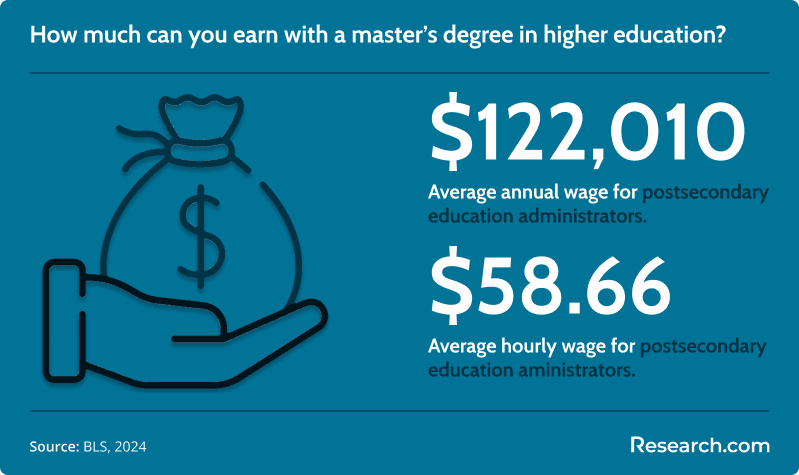
For a national benchmark, the United States Bureau of Labor Statistics reports that postsecondary education administrators earn an average annual wage of $122,010, or an average of $58.66 per hour.
- 2027 Most Affordable Online Master’s Degree Programs in Higher Education
- How does a bachelor teaching degree online prepare you for a master’s in higher education?
- How long does it take to complete an online master’s degree program in higher education?
- How does an online higher education degree compare to an on-campus program?
- What is the average cost of an online master’s degree in higher education?
- What are the financial aid options for students enrolling in an online master’s degree in higher education?
- What are the prerequisites for enrolling in an online master’s degree in higher education?
- What courses are typically included in an online higher education degree program?
- What concentrations are available in online master’s degree in higher education programs?
- How do you choose the best affordable online higher education degree program?
- What career paths are available for graduates of online higher education degree programs?
- What is the job market for graduates of online higher education degree programs?
- How can I fast-track my online Ed D?
- What challenges might you face in an online master’s degree in higher education?
- How are emerging digital innovations shaping online higher education programs?
- What skills will you gain from an online master’s degree in higher education?
- What are the advancement opportunities beyond a master's degree in higher education?
- How do online master’s programs in higher education foster diversity, equity, and inclusion?
- Is an online doctoral degree in higher education a strategic career investment?
- Is the ROI of an online master’s degree in higher education worth the cost?
- What alternative career paths exist after earning an online master’s degree in higher education?
- How do career services and networking opportunities enhance your professional advancement?
- What is the importance of accreditation and reputation in online master's degrees in higher education?
2027 Most Affordable Online Master’s Degree Programs in Higher Education
How do we rank schools?
Research.com built this affordability-focused ranking using a structured methodology that considers online reliability, affordability, and academic quality. The analysis also uses data from the Integrated Postsecondary Education Data System, Peterson’s database, including its Distance Learning Licensed Data Set, College Scorecard, and the National Center for Education Statistics to support transparent and verifiable comparisons.
| Rank | School | Program | Credits | Program length | Listed cost | Accreditation |
| 1 | University of North Carolina-Wilmington | Master of Education in Higher Education | 36 | 2 years | $10,630 (in-state); $39,401 (out-of-state) | Southern Association of Colleges and Schools Commission on Colleges (SACSCOC) |
| 2 | Fort Hays State University | Master of Science in Education / Higher Education Student Affairs | 36 | 2 years | $338.62 per credit hour; $10,748 | Higher Learning Commission |
| 3 | Appalachian State University | Master of Arts in Higher Education | 36 | 2 years | $10,952 (in-state); $40,972 (out-of-state) | SACSCOC |
| 4 | University of North Texas | Master of Education in Higher Education | 36 | 2 years | $11,668 (in-state); $12,842 (out-of-state) | Council for the Accreditation of Educator Preparation (CAEP) |
| 5 | University of Nebraska-Lincoln | Master of Arts in Educational Administration - Higher Education | 30 | 2 years | $12,378 (in-state); $24,168 (out-of-state) | Higher Learning Commission |
| 6 | University of Sioux Falls | Master of Education in Educational Administration for Adult & Higher Education | 33 | 2 years | $13,035 | Higher Learning Commission; CAEP |
| 7 | University of Nebraska at Kearney | Master of Science in Education - Higher Education Student Affairs | 36 | 2 years | $13,237 (in-state); $17,881 (out-of-state) | Higher Learning Commission |
| 8 | North Carolina Central University | Master of Science in Higher Education Administration | 42 | 2 years | $12,500 (in-state); $43,552 (out-of-state) | SACSCOC |
| 9 | University of Wyoming | Master of Arts in Education - Higher Education Administration | 33 | 2 years | $12,738 (in-state); $19,338 (out-of-state) | CAEP |
| 10 | Georgia State University | Master of Interdisciplinary Studies in Higher Education Administration | 30 | 2 years | $12,940 | SACSCOC |
1. University of North Carolina-Wilmington
The University of North Carolina-Wilmington offers a hybrid Master of Education (M.Ed) in Higher Education. The program enrolls only 25 to 30 students per year and prepares students for areas such as Academic & Career Advising, International Programs & Education Abroad, Transition/Orientation Programs, Student Leadership Training, Campus Life/Sorority & Fraternity Life, Campus Recreation and Entertainment, Assessment & Planning, Undergraduate Admissions, and Cultural Centers and Programming.
This program may be a strong fit for North Carolina residents seeking a lower-cost in-state option and for students who want a curriculum aligned with professional preparation in higher education and student affairs. Its curriculum is connected to core professional competencies and current Council for the Advancement of Standards in Higher Education (CAS) standards for master's preparation programs in higher education and student affairs.
- Location: Wilmington, NC
- Type of institution: Public
- Program: Master of Education in Higher Education
- Credits required to graduate: 36
- Program length: 2 years
- Program cost: $10,630 (in-state); $39,401 (out-of-state)
- Accreditation: Southern Association of Colleges and Schools Commission on Colleges (SACSCOC)
2. Fort Hays State University
Fort Hays State University offers a Master of Science in Education / Higher Education Student Affairs (HESA) program with online, campus, and blended enrollment options. The curriculum was developed with reference to CAS Masters-Level Student Affairs Administration Preparation Programs and the College Student Educators International (ACPA), and National Association of Student Affairs Administrators in Higher Education (NASPA) Professional Competency Areas for Student Affairs Educators.
ACPA was formerly known as the American College Personnel Association and is now College Student Educators International.
FHSU may appeal to students who want an online tuition rate that applies nationwide. At $10,748, it is the cheapest online master’s in higher education for out-of-state students in this ranking.
- Location: Hays, KS
- Type of institution: Public
- Program: Master of Science in Education / Higher Education Student Affairs
- Credits required to graduate: 36
- Program length: 2 years
- Tuition: $338.62 per credit hour
- Accreditation: Higher Learning Commission
3. Appalachian State University
Appalachian State University offers an online Master of Arts in Higher Education for students who want to advance in education, pursue promotion, contribute to institutional problem-solving, or prepare for leadership responsibilities. Coursework addresses modern college student needs and explores diversity, student development, organization, governance, advising, and leadership.
- Location: Boone, NC
- Type of institution: Public
- Program: Master of Arts in Higher Education
- Concentrations: Community College & University Leadership (CCUL); Adult and Developmental Education (ADE); and College Teaching
- Credits required to graduate: 36
- Program length: 2 years
- Program cost: $10,952 (in-state); $40,972 (out-of-state)
- Accreditation: SACSCOC
4. University of North Texas
The University of North Texas offers a fully online M.Ed. in Higher Education that covers historical, theoretical, and philosophical perspectives in higher education. The program is designed for entry-level and mid-management roles in areas such as student life, career centers, student housing, student unions, multicultural centers, alumni offices, advancement offices, international student offices, academic advising centers, institutional research offices, business affairs offices, and financial aid offices.
The student affairs track meets CAS requirements for graduate programs in student affairs. Students in the Standard Master’s Degree in Higher Education can choose from student affairs, general administration, and community college leadership.
- Location: Denton, TX
- Type of institution: Public
- Program: Master of Education in Higher Education
- Concentrations: Student Affairs; Community College Leadership; General Administration
- Credits required to graduate: 36
- Program length: 2 years
- Program cost: $11,668 (in-state); $12,842 (out-of-state)
- Accreditation: Council for the Accreditation of Educator Preparation (CAEP)
5. University of Nebraska-Lincoln
University of Nebraska-Lincoln offers an online Master of Arts (M.A.) in Educational Administration-Higher Education. The program is built for students who want to strengthen administrative and leadership abilities for higher education careers. Elective options allow students to shape coursework around topics such as diversity and equity, governance, assessment, and higher education planning.
- Location: Lincoln, NE
- Type of institution: Public
- Program: Master of Arts in Educational Administration - Higher Education
- Credits required to graduate: 30
- Program length: 2 years
- Program cost: $12,378 (in-state); $24,168 (out-of-state)
- Accreditation: Higher Learning Commission
6. University of Sioux Falls
The University of Sioux Falls offers an M.Ed. in Educational Administration for Adult and Higher Education for students interested in adult learning organizations, business and industry, and higher education environments.
The online program introduces students to postsecondary education through developmental, historical, social, and philosophical perspectives. As a Christian university, the curriculum also incorporates ethics and Christian compassion.
- Location: Sioux Falls, SD
- Type of institution: Private
- Program: Master of Education in Educational Administration for Adult & Higher Education
- Credits required to graduate: 33
- Program length: 2 years
- Program cost: $13,035
- Accreditation: Higher Learning Commission; CAEP
7. University of Nebraska at Kearney
University of Nebraska at Kearney offers an online Master of Science in Education - Higher Education Student Affairs. The program focuses on student development and support services and may be relevant for students interested in residence life, student health, career services, and disability support services.
- Location: Kearney, NE
- Type of institution: Public
- Program: Master of Science in Education - Higher Education Student Affairs
- Credits required to graduate: 36
- Program length: 2 years
- Program cost: $13,237 (in-state); $17,881 (out-of-state)
- Accreditation: Higher Learning Commission
8. North Carolina Central University
North Carolina Central University offers a fully online Master of Science in Higher Education Administration. The program is intended for future higher education professionals who want to build theoretical knowledge and practical competencies for work across varied postsecondary settings.
Students complete a 150-hour internship in a setting aligned with their field of study.
- Location: Durham, NC
- Type of institution: Public
- Program: Master of Science in Higher Education Administration
- Credits required to graduate: 42
- Program length: 2 years
- Program cost: $12,500 (in-state); $43,552 (out-of-state)
- Accreditation: SACSCOC
9. University of Wyoming
The University of Wyoming offers an online Master of Arts in Education - Higher Education Administration. The program is designed for students in the Rocky Mountain West and beyond who want to strengthen theoretical and practical understanding of postsecondary and lifelong learning access.
Features include online flexibility, faculty practitioners, travel grant opportunities for meetings and conferences, a portfolio for demonstrating competencies during the program, scholarship opportunities, and accreditation by the Council for Accreditation of Educator Preparation.
- Location: Laramie, WY
- Type of institution: Public
- Program: Master of Arts in Education - Higher Education Administration
- Credits required to graduate: 33
- Program length: 2 years
- Program cost: $12,738 (in-state); $19,338 (out-of-state)
- Accreditation: CAEP
10. Georgia State University
Georgia State University offers a Master of Interdisciplinary Studies in Higher Education Administration. It is the only fully online master’s program in higher education administration offered by a research-intensive university in the state.
The program develops knowledge of the higher education landscape, governance, institutional issues, race, gender, class, student integration, support service design, and applied theory. Graduates may pursue entry and mid-level roles in student affairs, admissions and financial aid, institutional research, residence life, and university relations.
- Location: Atlanta, GA
- Type of institution: Public
- Program: Master of Interdisciplinary Studies in Higher Education Administration
- Credits required to graduate: 30
- Program length: 2 years
- Program cost: $12,940
- Accreditation: SACSCOC
Key findings at a glance
- Online master’s degree programs in higher education could take two years to complete on average.
- Affordable online master’s degrees in higher education can cost as little as $10,630 for in-state students.
- The employment of postsecondary education administrators is projected to grow by 4% from 2022 to 2032.
- An average of 15,300 job openings for postsecondary education administrators can be expected each year over this 10-year period.
- The Council for the Accreditation of Educator Preparation (CAEP) is the main accrediting body for master's degrees in education.
How does a bachelor teaching degree online prepare you for a master’s in higher education?
A bachelor teaching degree online can provide a useful academic foundation for graduate study in higher education, especially for students who want to move from classroom teaching, instructional support, or education services into postsecondary administration.
Academic foundation
Undergraduate teacher preparation introduces students to learning theory, instructional planning, assessment, classroom management, and educational systems. Those concepts can help future graduate students understand how institutions support learning at scale.
Curriculum and program planning experience
Courses in curriculum development and instructional design can transfer well into higher education contexts, particularly for students interested in academic program support, teaching and learning centers, online learning, or curriculum operations.
Practical exposure to education settings
Student teaching, practicum experiences, internships, and fieldwork help students understand how educational institutions function. That experience can make graduate-level discussions about administration, policy, student services, and institutional improvement more concrete.
Communication, leadership, and research skills
Teaching-focused bachelor’s programs often require communication, organization, leadership, and basic educational research skills. These abilities are valuable in graduate programs where students analyze institutional problems, write policy-focused papers, and collaborate with classmates.
Graduate admissions alignment
A bachelor’s degree from an accredited institution is typically required for admission to a master’s program in higher education. A teaching background is not always required, but it can help show commitment to the education field and clarify career goals in a statement of purpose.
How long does it take to complete an online master’s degree program in higher education?
Online master’s programs in higher education could take two years to complete on average. Actual completion time depends on whether you study full time or part time, the number of credits required, whether the program includes an internship or capstone, and whether transfer credits are accepted.
Many programs require 30 to 36 credit hours, though some require more. Students with eligible prior graduate coursework may shorten their timeline if the school accepts transfer credits that match degree requirements.
The chart below shows that 68.82% or more than two-thirds of master’s degrees that were conferred in 2020-2021 were concentrated in five fields of study and that the second most popular field was education, which accounted for 17.23%.
How does an online higher education degree compare to an on-campus program?
Online and on-campus master’s programs can lead to similar academic outcomes when they are accredited and well supported, but the learning experience is different. The right format depends on your schedule, learning style, budget, access to campus resources, and networking needs. Similar to how students compare affordable online hospitality degrees, higher education students should compare format, cost, support, and career alignment rather than choosing based on tuition alone.
| Factor | Online master’s in higher education | On-campus master’s in higher education |
| Schedule | Often more flexible, especially with asynchronous courses. | Usually requires scheduled class attendance and campus access. |
| Cost | May reduce commuting, relocation, and housing costs. Students can also compare cheap online masters degrees when affordability is the main concern. | May include campus-related costs, though some students value in-person access to facilities and events. |
| Learning style | Requires self-direction, time management, and comfort with digital platforms. | Provides more built-in structure and regular face-to-face contact. |
| Networking | Can include virtual advising, online discussions, alumni groups, and remote events. | May offer easier access to campus offices, assistantships, and informal networking. |
| Career preparation | Best when the program includes internships, applied projects, career services, and faculty engagement. | May offer easier access to campus-based assistantships, local internships, and in-person career events. |
What is the average cost of an online master’s degree in higher education?
The cost of an online master’s degree in higher education depends on institution type, residency status, total credits, fees, and program length. Public universities often charge less than private institutions, but out-of-state tuition can change the comparison significantly.
According to the National Center for Education Statistics, students pursuing graduate studies pay an average annual tuition of $20,513. Students attending private colleges and universities can expect to pay an average of over $28,000, while those attending public institutions can expect an average of over $12,500.
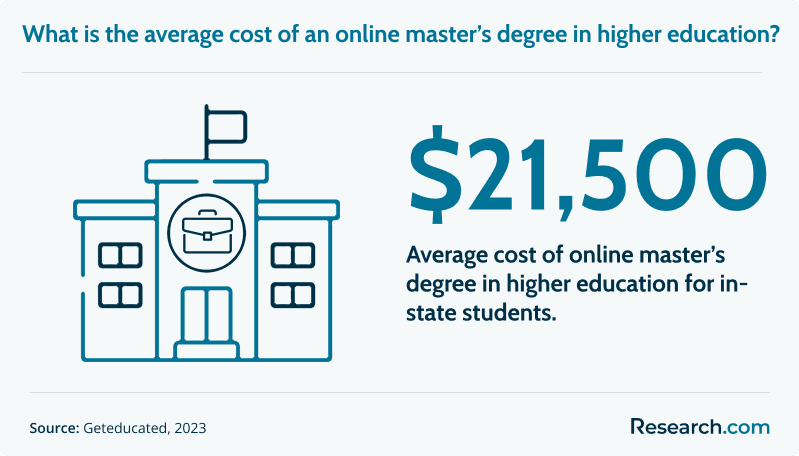
Affordable online master’s degrees in higher education can cost as little as $10,630 for in-state students. The average in-state cost is $21,500. If your budget requires a lower annual price point, compare financial aid options and related resources for a master's degree under $10 000.
Cost factors to compare before applying
- Tuition per credit: Multiply the per-credit price by the total number of required credits.
- Residency rules: Public universities may charge different in-state and out-of-state rates.
- Mandatory fees: Technology, online learning, graduation, and student service fees can increase the final price.
- Books and materials: Required readings and software may not be included in tuition.
- Time to completion: A cheaper per-credit program may cost more overall if it requires more credits.
What are the financial aid options for students enrolling in an online master’s degree in higher education?
Online graduate students may qualify for several types of financial aid, but eligibility depends on the school, enrollment status, accreditation, program structure, and individual financial circumstances.
Federal financial aid
- FAFSA: Completing the Free Application for Federal Student Aid is the starting point for federal aid consideration. Many online colleges that accept FAFSA participate in federal aid programs.
- Direct Unsubsidized Loans: These loans are available to eligible graduate students, but interest accrues from the time the loan is disbursed.
- Direct Graduate PLUS Loans: These loans are for eligible graduate students enrolled at least half-time in a qualified program and require a credit check.
State grants and institutional aid
Some states and universities offer grants, scholarships, or tuition support for graduate students. Check the financial aid office, graduate school website, and state higher education agency for current eligibility rules.
Professional association scholarships
Higher education associations may offer scholarships for students preparing for work in admissions, registrar services, student affairs, financial aid, or institutional administration.
Employer tuition assistance
If you already work at a college or university, ask whether your employer offers tuition remission, reimbursement, professional development funding, or reduced tuition through institutional partnerships.
What are the prerequisites for enrolling in an online master’s degree in higher education?
Admissions requirements vary by institution, but most online master’s programs in higher education evaluate academic preparation, professional goals, writing ability, and readiness for graduate study.
- Bachelor’s degree: Applicants usually need a bachelor’s degree from an accredited institution.
- Academic background: A specific major is not always required, but education, social sciences, and related fields are often considered relevant. Students comparing undergraduate options may review good majors for education-related pathways.
- Minimum GPA: Many programs set a minimum GPA requirement, often ranging from 2.75 to 3.0 on a 4.0 scale.
- GRE/GMAT: Some selective programs may require GRE or GMAT scores, though many programs now offer waivers or do not require them.
- Work experience: Some schools prefer or require experience in education, student services, administration, or a related field.
- Resume or CV: Applicants may need to document academic history, employment, leadership, and service experience.
- Statement of purpose: This essay explains your career goals and why the program fits your professional direction.
- Letters of recommendation: Programs may request recommendations from supervisors, faculty members, or professional mentors.
What courses are typically included in an online higher education degree program?
Course names vary by school, but most online higher education master’s programs combine theory, policy, leadership, student support, law, and applied administration.
Common core courses
- History of Higher Education: Examines how colleges and universities developed and how their public role has changed over time.
- Philosophy of Higher Education: Explores the mission, values, and purposes of postsecondary education.
- Higher Education Governance and Finance: Covers organizational structures, funding models, budgeting challenges, and institutional decision-making.
- Higher Education Law and Policy: Introduces legal obligations, student rights, federal regulations, accreditation standards, and compliance issues.
- Student Development Theory: Studies how college students develop academically, socially, emotionally, and personally.
Applied requirements
- Capstone or thesis: Many programs end with a research project, applied institutional analysis, or practical capstone.
- Internship or practicum: Some programs require supervised experience in a higher education setting.
- Portfolio: Students may compile evidence of competencies, projects, and professional growth.
What concentrations are available in online master’s degree in higher education programs?
Concentrations help students align coursework with specific career goals. Not every program offers every option, so compare the curriculum carefully before applying.
| Concentration | Best fit for students interested in | Common topics |
| Student Affairs | Residence life, student conduct, advising, student support, career services, accessibility, and student engagement. | Student development, advocacy, campus climate, support programs, and services for diverse student populations. |
| Enrollment Management | Admissions, recruitment, retention, financial aid strategy, and student enrollment planning. | Recruitment, admissions operations, financial aid packaging, retention strategies, and enrollment analytics. |
| Higher Education Leadership | Department leadership, institutional administration, policy, and strategic planning. | Governance, resource management, organizational culture, staff supervision, legal issues, and risk management. |
| Curriculum Development and Instructional Design | Academic program support, online learning, curriculum planning, and teaching innovation. | Curriculum theory, assessment, technology integration, instructional design, and online learning pedagogy. |
| Other potential areas | Students with specialized interests in institutional operations or policy. | Higher education finance, public policy and advocacy in higher education, student success and retention, and data analytics in higher education. |
How do you choose the best affordable online higher education degree program?
Start with fit, not ranking alone. The best program is the one that is accredited, affordable for your situation, aligned with your target role, and realistic for your schedule. Students comparing affordable online colleges should look beyond headline tuition and review the full academic and financial picture.
Step 1: Define your career target
Decide whether you want to work in student affairs, advising, admissions, community college leadership, online learning, institutional research, financial aid, registrar services, or administration. Your target role should guide your concentration, internship choices, and networking strategy.
The chart below shows why more and more people are going for higher educational attainment. The higher your education level, the higher your earning potential gets.
Step 2: Verify accreditation
Prioritize accredited institutions and, when relevant, programmatic accreditation. When comparing nationally accredited online colleges, also confirm whether regional accreditation, CAEP recognition, or another relevant quality marker applies to the specific institution or program.
Step 3: Compare total cost
Review tuition, fees, books, technology costs, residency rates, and the number of required credits. Ask whether online students pay the same rate regardless of state residency and whether employer tuition benefits can be applied.
Step 4: Review curriculum and field experience
Look for courses, concentrations, internships, capstones, or portfolios that match your career goals. If you want to work in student affairs, for example, a general administration track may be less useful than a program with student development and support-service coursework.
Step 5: Evaluate support and networking
Ask about faculty access, online advising, career services, alumni networks, virtual events, internship placement support, and professional association connections. These factors can matter as much as course content when you begin searching for jobs.
Questions to ask before enrolling
- Is the institution accredited, and is the program recognized by any relevant education accreditor?
- Is the program fully online, hybrid, or online with required campus visits?
- What is the total cost after fees, books, and technology charges?
- Are assistantships, scholarships, tuition remission, or employer benefits available to online students?
- Does the curriculum match the role I want after graduation?
- Does the program include fieldwork, internship placement, or applied projects?
- What career services are available to online students?
- How active is the alumni network in higher education administration?
What career paths are available for graduates of online higher education degree programs?
An online master’s degree in higher education can support multiple administrative and student-support career paths. The degree is most useful when paired with relevant experience, internships, assistantships, or current employment in an educational setting.
| Career area | Typical responsibilities | Helpful concentration or experience |
| Student Affairs | Support student engagement, conduct, residence life, orientation, career development, disability services, or student well-being. | Student Affairs; student support experience. |
| Admissions and Enrollment | Recruit students, review applications, coordinate admissions processes, support transfer students, and analyze enrollment trends. | Enrollment Management; admissions or recruitment experience. |
| Academic Advising | Guide students through course selection, major exploration, degree planning, policies, and graduation requirements. | Student development, advising, or academic support experience. |
| Registrar’s Office | Maintain student records, transcripts, academic calendars, degree audits, registration systems, and graduation certification. | Administrative operations, compliance, data systems, and policy knowledge. |
| Higher Education Leadership | Manage departments, lead initiatives, supervise staff, develop strategy, and support institutional goals. | Higher Education Leadership plus several years of relevant experience. |
The image below shows the average annual salary of postsecondary education administrators, which is one of the career paths graduates with a master's degree in higher education can choose.
What if higher education administration is not the right path?
If you are still comparing graduate or education-related options, it may help to look at adjacent fields before committing. Depending on your goals, you might compare affordable engineering master's programs online, easiest nursing programs for admission, easiest psychology degrees to obtain, or easiest associate degrees to obtain.
What is the job market for graduates of online higher education degree programs?
The job market for higher education graduates is shaped by student enrollment patterns, institutional budgets, online learning expansion, student support needs, and demand for professionals who can work across academic and administrative units.
Positive labor market signals
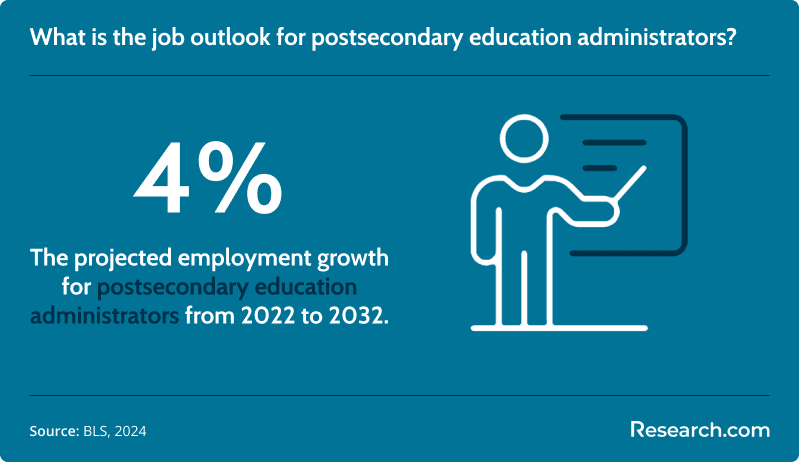
- Projected growth: The employment of postsecondary education administrators is projected to grow 4% from 2022 to 2032.
- Openings: An average of 15,300 job openings can be expected each year over this 10-year period.
- Online degree acceptance: Employers are more likely to consider online graduate degrees when they come from accredited institutions and include relevant coursework or experience.
Competitive factors
- Experience matters: A master’s degree alone may not be enough for leadership roles without higher education work experience.
- Skills matter: Employers often value communication, budgeting, data analysis, policy knowledge, project management, and problem-solving.
- Networks matter: Professional associations, alumni contacts, internships, and campus connections can help graduates learn about openings before they are widely advertised.
As an example, the Bureau of Labor Statistics reports that the employment of postsecondary education administrators is projected to grow 4% from 2022 to 2032, with an average of 15,300 job openings each year over this 10-year period.
How can I fast-track my online Ed D?
Fast-tracking an online doctoral program generally means choosing an accelerated structure, using eligible transfer credits, completing coursework in shorter modules, and maintaining continuous enrollment. These options can be useful for experienced professionals who already know their research or leadership focus and can handle a demanding schedule.
Before choosing an accelerated doctorate, confirm that speed does not come at the expense of accreditation, faculty support, dissertation quality, or career relevance. If you are comparing doctoral timelines, review fast-track options for an Ed D online degree to see whether an accelerated route fits your responsibilities and goals.
What challenges might you face in an online master’s degree in higher education?
Online study can be flexible, but it is not effortless. Students often struggle when they underestimate the time, self-discipline, and communication required to succeed in graduate-level online coursework.
| Challenge | Why it matters | Better approach |
| Weak time management | Asynchronous courses can make deadlines easier to miss. | Create a weekly study schedule and treat coursework like a fixed work commitment. |
| Limited interaction | Online students may feel disconnected from faculty and peers. | Use discussion boards, virtual office hours, group projects, and professional associations intentionally. |
| Technology problems | Platform issues or unreliable internet can affect participation. | Test systems early and confirm the school offers responsive technical support. |
| Unclear program quality | Not all online programs offer the same academic or career support. | Check accreditation, student services, internship options, faculty credentials, and alumni outcomes. |
Students comparing cost-conscious online graduate programs in adjacent fields may also review the cheapest MLS degree online as part of a broader decision process.
How are emerging digital innovations shaping online higher education programs?
Online higher education programs increasingly use digital platforms, virtual collaboration tools, learning analytics, and mobile access to support student engagement and course delivery. These tools can help instructors track participation, personalize feedback, and organize group work across time zones.
Technology can improve access, but it does not replace sound curriculum design, faculty engagement, or meaningful assessment. When comparing programs, ask how technology is used to improve learning rather than assuming that newer tools automatically mean a stronger program.
If you are interested in how online education can shorten traditional pathways in related fields, compare accelerated teacher preparation guidance such as What is the fastest you can get a teaching degree?.
What skills will you gain from an online master’s degree in higher education?
A strong master’s program should help students build both technical knowledge and applied administrative skills. The most valuable skills are transferable across offices, departments, and institution types.
- Leadership and management: Learn how to guide teams, manage resources, make decisions, and support institutional goals.
- Communication and interpersonal skills: Practice communicating with students, faculty, staff, families, and external partners.
- Policy and legal knowledge: Study student privacy, accessibility, accreditation, compliance, and institutional responsibilities.
- Analytical and data-driven decision-making: Use evidence to evaluate student success, improve programs, and support planning.
- Student development and support: Apply student development theory to advising, engagement, retention, and student well-being.
- Organizational and strategic planning: Build skills in budgeting, project management, long-term planning, and institutional improvement.
What are the advancement opportunities beyond a master's degree in higher education?
Professionals who want senior leadership, policy, research, or executive responsibilities may consider doctoral study after completing a master’s degree. A doctorate can support advancement toward roles such as Chief Academic Officer, Provost, or University President, although these positions also require extensive experience and a strong leadership record.
An EdD in Educational Leadership may be especially relevant for professionals who want to lead organizational change, improve policy, and apply research to practice. If cost is a concern, compare the cheapest online doctorate in educational leadership programs before committing to a doctoral pathway.
Doctoral programs may also deepen expertise in ethics, governance, data-driven decision-making, and diversity, equity, and inclusion strategies.
How do online master’s programs in higher education foster diversity, equity, and inclusion?
Many higher education master’s programs include coursework on access, equity, student identity, campus climate, institutional barriers, and inclusive leadership. These topics matter because higher education professionals often help design policies and services that affect student persistence and belonging.
Online programs can also expand access for students who cannot relocate or leave full-time employment. However, access alone is not enough. Strong programs should provide inclusive course design, accessible technology, mentoring, and support for students from varied backgrounds.
Students interested in inclusive online learning across disciplines can also explore the fastest creative writing degree online accredited programs as another example of flexible academic pathways.
Is an online doctoral degree in higher education a strategic career investment?
An online doctoral degree in higher education may be a strategic investment for professionals who need advanced research, policy, and leadership preparation for senior roles. It may also support work in institutional research, faculty positions, consulting, policy organizations, or executive administration.
The investment is strongest when the program is accredited, aligned with your professional goals, affordable enough to avoid unmanageable debt, and structured for working professionals. Compare program outcomes, dissertation support, faculty expertise, and career services before enrolling in an online PhD in higher education.
Is the ROI of an online master’s degree in higher education worth the cost?
The return on investment depends on your current role, target position, tuition cost, debt level, employer support, and ability to gain relevant experience while studying. An affordable online program can improve ROI by reducing relocation costs and allowing students to remain employed.
For teachers and education professionals considering a career shift, it may help to compare what jobs can I do with a teaching degree before deciding whether higher education administration is the best next step.
When the ROI may be stronger
- You already work in higher education and need a graduate credential for advancement.
- Your employer offers tuition assistance, remission, or reimbursement.
- The program includes a concentration linked to your target role.
- You can complete the degree without pausing full-time employment.
- You choose an accredited program with strong career services and alumni connections.
When the ROI may be weaker
- You enroll without a clear career target.
- You take on high debt for a role with modest salary growth.
- The program lacks accreditation, fieldwork, or career support.
- You assume the degree alone will substitute for experience.
What alternative career paths exist after earning an online master’s degree in higher education?
Graduates are not limited to traditional campus offices. Some use the degree in consulting, education technology, nonprofit college-access work, training and development, curriculum operations, institutional research support, or student success analytics.
Students who enjoy information systems, academic resources, archives, and student research support may also compare library science job opportunities to see whether information science offers a better fit.
How do career services and networking opportunities enhance your professional advancement?
Career services can make a major difference for online students because many higher education roles are relationship-driven. Useful services include resume reviews, mock interviews, job boards, alumni mentoring, virtual career fairs, internship guidance, and introductions to professional associations.
Networking also helps students learn the language of specific offices, identify realistic entry points, and understand how hiring works inside colleges and universities. Some students broaden their education interests through interdisciplinary fields, including creative writing programs online, especially when exploring teaching, student engagement, or academic program development.
What is the importance of accreditation and reputation in online master's degrees in higher education?
Accreditation is one of the most important checks before enrolling. It signals that an institution or program has gone through an external quality review. For graduate students, accreditation can affect transfer credit, employer recognition, financial aid eligibility, and admission to future doctoral programs.
Reputation also matters, but it should not be judged by name recognition alone. Review faculty qualifications, curriculum depth, student support, alumni outcomes, internship access, and whether the program is known in the area of higher education where you want to work.
If your long-term interest is teaching rather than administration, compare online master's in teaching programs to determine whether a teaching-focused graduate degree would be more appropriate.
Common mistakes to avoid when choosing an online master’s in higher education
- Choosing only by tuition: A low-cost program may not be the best value if it lacks advising, career support, relevant coursework, or field experience.
- Ignoring accreditation: A non-accredited program can create problems for employment, financial aid, transfer credit, and doctoral admissions.
- Assuming online means easier: Online graduate work still requires reading, writing, research, participation, and disciplined scheduling.
- Overlooking residency tuition: Out-of-state rates can make a public university much more expensive than it first appears.
- Skipping career planning: A higher education master’s is more useful when tied to a specific role, office, or institutional function.
- Relying only on rankings: Rankings are a starting point, not a substitute for checking curriculum, cost, accreditation, and support services.
- Assuming salary outcomes are guaranteed: Pay depends on role, experience, institution type, geography, and advancement opportunities.
Key Insights
- An affordable online master’s in higher education is best suited for students who want administrative, student-support, enrollment, advising, or leadership roles in postsecondary education.
- Online programs can offer flexibility and lower indirect costs, but students should still compare total tuition, fees, credit requirements, residency rules, and support services.
- The listed affordable programs can cost as little as $10,630 for in-state students, and many programs could take two years to complete on average.
- Accreditation is essential. It affects degree recognition, financial aid, future study, and employer confidence.
- Career outcomes depend heavily on experience, specialization, networking, and institutional hiring needs. The degree is strongest when paired with relevant work or field experience.
- Postsecondary education administrators earn an average annual wage of $122,010, and employment is projected to grow by 4% from 2022 to 2032, with an average of 15,300 job openings each year over this 10-year period.
- Before enrolling, ask whether the program’s curriculum, concentration, internship options, and career services align with the exact higher education role you want next.
References:
- Hanson, M. (2024, March 15). College Graduation Statistics. Education Data Initiative.
- U.S. Bureau of Labor Statistics. (2024, April 3). Occupational Employment and Wage Statistics: 11-9033 Education Administrators, Postsecondary. BLS.
- U.S. Bureau of Labor Statistics. (2024, April 17). Occupational Outlook Handbook: Postsecondary Education Administrators. BLS.
- U.S. Bureau of Labor Statistics. (2023, May). Education pays, 2022. BLS.
Other Things You Should Know About Affordable Online Master’s Degrees in Higher Education Programs
Some programs offer graduate assistantships, but many fully online higher education degrees do not because assistantships usually require on-campus duties. When available, they are often limited to students taking at least 6 credit hours per term and may include tuition remission, a stipend, or both.
Common admission requirements in 2027 include a bachelor's degree from an accredited institution, a minimum GPA of 3.0, and submission of GRE scores. Some programs may also require letters of recommendation and a statement of purpose. Check specific program requirements for additional details.
Yes, many online master’s programs in higher education offer financial aid options, including scholarships, grants, and student loans. Contact the financial aid office of the specific institution for details on available assistance for the 2027 academic year.


