
2027 Online Doctor of Education (EdD) Programs with No Residency Requirement

Co-Founder and Chief Data Scientist
Pursuing a Doctor of Education (EdD) is a powerful step for educators and professionals who want to strengthen their leadership, research, and problem-solving skills in education and beyond. An EdD can open doors to advanced roles in school administration, higher education, policy, or organizational leadership.
However, not all students can meet the demands of on-campus residencies due to work, family, or geographic limitations. Fortunately, there are universities now that offer fully online EdD programs with no residency requirements, making this advanced degree more accessible than ever.
This article explores these online Doctor of Education programs, allowing you to pick one that helps you reach your professional goals without the barrier of residency.
What are the benefits of pursuing fully online Doctor of Education programs?
- Flexibility for Working Professionals: Students can complete coursework on their own schedule, allowing them to maintain full-time employment while pursuing their degree.
- Accessibility Without Relocation: Online programs eliminate the need to move closer to a university or travel for residencies, making them ideal for those living in remote or international locations.
- Cost Savings: Without travel or housing costs for residencies, students can save significantly while still receiving a high-quality education.
- Career Advancement Opportunities: An EdD can open doors to leadership roles in education, government, nonprofits, or corporate training—all achievable without stepping away from current commitments.
- Diverse Learning Communities: Online programs often attract students from across the country or globe, creating opportunities to network and collaborate with peers who bring varied perspectives.
What can you do with an online EdD degree?
An online Doctor of Education equips graduates with advanced knowledge and leadership skills that can be applied across education, business, government, and nonprofit sectors. The degree focuses on solving real-world problems, driving organizational change, and shaping policies that improve learning and leadership practices. With an online EdD, you can pursue roles such as:
- School or District Administrator: Lead schools, districts, or educational organizations by shaping policies, managing staff, and improving student outcomes.
- Higher Education Leader: Take on positions such as dean, department chair, or director of student services within colleges and universities.
- Policy and Education Consultant: Influence educational policy and strategy at local, state, or national levels, or advise institutions on program improvements.
- Corporate or Nonprofit Trainer: Design and manage training and development programs for employees in organizations outside of traditional education.
- Researcher or Scholar-Practitioner: Conduct applied research to address challenges in education and organizational leadership, often bridging theory with practice.
By earning your EdD online, you gain the same career opportunities as on-campus graduates, with the added flexibility of balancing your studies with ongoing professional commitments.
Where can you work with an online EdD degree?
Graduates of online Doctor of Education programs have the flexibility to work in a variety of settings that extend beyond traditional classrooms. Because the degree emphasizes leadership, research, and organizational improvement, it prepares professionals for diverse roles across education, business, and public service.
With an online EdD, you can work in:
- K–12 School Systems: Serving as principals, superintendents, curriculum directors, or other leadership positions within public and private schools.
- Colleges and Universities: Taking on roles such as department chairs, academic deans, program directors, or leaders in student affairs.
- Government Agencies: Contributing to education policy, program development, or workforce initiatives at local, state, or federal levels.
- Nonprofit Organizations: Leading education-focused nonprofits or advocacy groups that address community, literacy, or workforce challenges.
- Corporate and Private Sector: Managing training and development programs, leadership coaching, or learning and development divisions within companies.
This broad range of career environments highlights the versatility of an EdD, giving graduates the chance to influence learning and leadership wherever organizations need innovation and change.
How much can you earn with a fully online EdD degree?
Earning an EdD can significantly boost your salary potential, especially for leadership and administrative roles. While actual earnings vary based on location, industry, and years of experience, professionals with an EdD often command higher salaries compared to those with only a master’s degree. On average:
- School Principals and Superintendents: According to the United States Bureau of Labor Statistics, elementary, middle, and high school principals earn a median annual salary of $$104,070.
- Postsecondary Administrators: Postsecondary education administrators, according to BLS, earn a median salary of $103,960 per year.
- Education Policy Analysts or Consultants: According to Glassdoor, education policy analysts earn anywhere from $98,000 to $173,000 per year. The median annual salary is at $130,000.
- Corporate Training and Development Managers: The median annual salary for training and development managers, according to BLS, is $127,090 per year.
Overall, an EdD can increase earning power while opening pathways to high-level positions in education, business, and beyond. Graduates benefit from both the advanced skills gained in the program and the credibility of holding a terminal degree.
- List of Online Doctor of Education Programs Without Residency Requirement List of Programs
- What are the admission requirements for online Doctor of Education programs? Requirements
- How much do online Doctor of Education programs typically cost? Cost
- What financial aid options are available for those who want to pursue online EdD programs? Financial Aid
- How long does it take to complete an online Doctor of Education program? How long does it take to complete an online Doctor of Education program?
- What courses are included in online Doctor of Education programs? What courses are included in online Doctor of Education programs?
- What skills can you develop by pursuing an online EdD program? Core Skills
- What is the job outlook for graduates of online Doctor of Education programs? Job Outlook
- What are the common challenges faced by EdD graduates? What are the common challenges faced by EdD graduates?
- Is pursuing an online EdD worth it? Is pursuing an online EdD worth it?
Choosing an online Doctor of Education program without a residency requirement is mainly a question of fit: Does the program match your career goal, schedule, budget, accreditation needs, and preferred specialization without requiring campus visits? This guide is for working educators, school administrators, instructional designers, higher education professionals, training leaders, and organizational managers who want a doctoral pathway that can be completed fully online.
Below, you will find a practical list of online EdD programs with no residency requirement, plus guidance on admissions, cost, financial aid, curriculum, timelines, career outcomes, and how to decide whether an online EdD is worth the investment.
Quick Answer: Can You Earn an EdD Fully Online With No Residency?
Yes. Many universities offer online Doctor of Education programs that do not require students to travel to campus for residencies, intensives, or in-person seminars. Coursework may be synchronous, asynchronous, or a mix of both. However, “online” does not always mean “no campus requirement,” so applicants should confirm residency policies directly with the school before applying.
A no-residency EdD is often best for experienced professionals who want doctoral-level leadership training while continuing to work full time. It is less ideal for students who need extensive in-person mentoring, campus-based research opportunities, or licensure preparation that requires state-specific fieldwork.
Online Doctor of Education Programs Without a Residency Requirement
The programs below are designed for students seeking an EdD that can be completed online without required campus residencies. Because universities can revise formats, tuition, and requirements, use this list as a starting point and verify the latest delivery format with each institution.
When comparing any professional doctoral program, accreditation should be one of your first checks. Students who want a broader example of how accreditation affects professional credentials may review PharmD program accreditation standards by state.
| University | Location | Online EdD Program or Specialization |
| Abilene Christian University | Abilene, TX 79601 | Doctor of Education (Ed.D.) in Organizational Leadership |
| Arizona State University | Tempe, AZ 85287 | Doctor of Education in Leadership and Innovation |
| Arkansas State University | Jonesboro, AR 72467 | Doctorate of Education in Educational Leadership with Concentrations in P-12 Education, and Higher Education Administration |
| Auburn University at Montgomery | Montgomery, AL 36124-4023 | Doctorate in Education in Instructional Systems and Learning Sciences with Concentrations in Instructional Technology, Early Childhood, and Instructional Leadership |
| Aurora University | Aurora, IL 60506 | Doctor of Education with Specializations in Leadership in Educational Administration (Superintendent Endorsement), and Leadership in Higher Education Administration; Doctor of Education with Specializations in Instructional Leadership: Coaching and Mentoring, Leadership in Adult Learning and Higher Education |
| A.T. Still University of Health Sciences | Kirksville, MO 63501 | Doctor of Education in Health Professions |
| Boise State University | Boise, ID 83725 | Doctor of Education in Educational Technology |
| Concordia University Chicago | River Forest, IL 60305 | Doctorate in Leadership Higher Education Leadership, Ed.D. in Leadership – Organizational Leadership |
| Drexel University | Philadelphia, PA 19104 | Doctorate in Educational Leadership and Management |
| Fairleigh Dickinson University | Teaneck, NJ 07666 | Doctor of Education (Ed.D.) in Higher Education |
| Franklin University | Columbus, OH 43215 | Doctor of Education in Organizational Leadership |
| Lamar University | Beaumont, TX 77705 | Doctorate in Educational Leadership – Global Educational Leadership |
| Liberty University | Lynchburg, VA 24515 | Doctor of Education in Christian Leadership, Doctor of Education in Educational Leadership, Doctorate in Education in Curriculum and Instruction |
| Marymount University | Arlington, VA 22207 | Doctor of Education in Educational Leadership and Organizational Innovation |
| Maryville University | St. Louis, MO 63141 | Doctor of Education in Higher Education Leadership |
| National University | San Diego, CA 92123 | Doctor of Education, Doctor of Education in Educational Leadership; Doctor of Education in Instructional Design, EdD in Organizational Innovation |
| Pennsylvania Western University (formerly California University of Pennsylvania) | California, PA 15419 | Doctor of Education in Education Administration and Leadership |
| Purdue Global | West Lafayette, IN 47907 | Doctor of Education (EdD) in Leadership and Innovation |
| Sam Houston State University | Huntsville, TX 77340 | Doctor of Education in Developmental Education Administration; Doctor of Education in Instructional Systems Design and Technology |
| Spalding University | Louisville, KY 40203 | Doctorate of Education (EdD) in Leadership |
| St. Thomas University | Miami Gardens, FL 33054 | Doctor of Education in Leadership and Innovation |
| The University of North Carolina at Chapel Hill | Chapel Hill, NC 27599 | Doctor of Education in Organizational Learning and Leadership |
| The University of Southern Mississippi | Hattiesburg, MS 39406 | Doctor of Education in Educational Administration (P-12); Doctor of Education in Higher Education Administration |
| The University of West Alabama | Livingston, AL 3547 | EdD in Rural Education |
| University of the Cumberlands | Williamsburg, KY 40769 | Doctorate in Educational Leadership |
| University of Virginia | Charlottesville, VA 22903 | Doctorate in Education in Curriculum and Instruction |
| University of West Florida | Pensacola, FL 32514 | Doctor of Education in Curriculum and Instruction, EdD in Instructional Design and Technology |
| William Carey University | Hattiesburg, MS 39401 | Doctor of Education in Educational Leadership |
What Does “No Residency Requirement” Mean in an Online EdD?
A no-residency online EdD means the program does not require students to attend on-campus sessions as part of the degree. This matters because some online doctoral programs still include short campus visits for orientations, seminars, dissertation workshops, or cohort networking events.
Before enrolling, ask whether the program has any required in-person activities, including dissertation defense travel, internship site visits, summer institutes, or state licensure meetings. Also confirm whether synchronous online attendance is required, since live classes can affect your weekly schedule even if travel is not required.
| Program Feature | Fully Online With No Residency | Online With Residency |
| Campus travel | No required campus visits | One or more required in-person sessions |
| Best for | Working professionals who need maximum flexibility | Students who want structured face-to-face networking |
| Potential drawback | Requires strong self-direction and online collaboration skills | Travel costs and time away from work may add pressure |
| What to verify | Whether dissertation defense, orientation, or fieldwork is fully online | How often travel is required and whether costs are included in tuition |
What Are the Admission Requirements for Online Doctor of Education Programs?
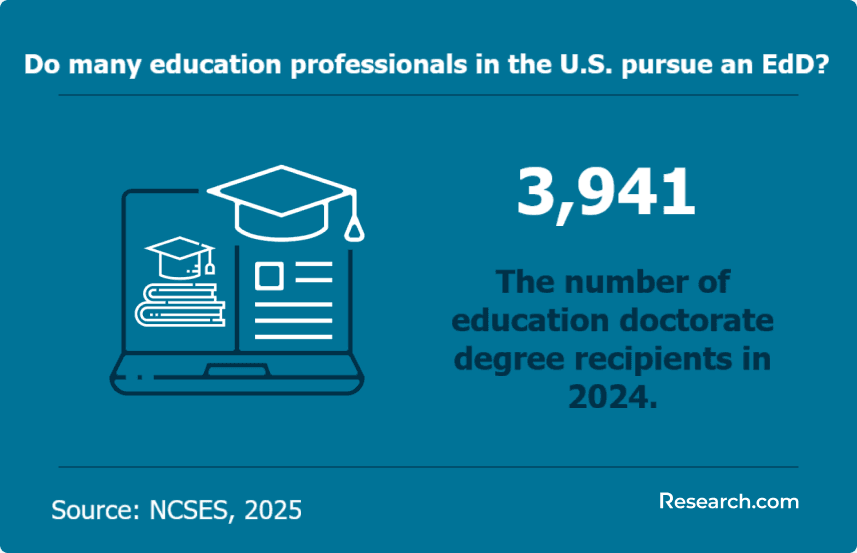
Online EdD admissions are typically selective because doctoral work requires graduate-level writing, applied research ability, professional maturity, and a clear leadership purpose. In 2024, around 3,941 candidates became recipients of a doctorate in education, showing that the pathway is well established but still academically demanding.
If you are comparing advanced professional degrees across fields, it may also help to review the levels of nursing degrees, since education and healthcare both use advanced credentials to prepare professionals for leadership and specialized practice.
| Admission Requirement | What Schools Usually Look For | How to Strengthen Your Application |
| Bachelor’s and master’s degrees | An accredited bachelor’s degree and a graduate degree, often a master’s in education online or a related field | Show how your previous graduate work connects to your doctoral goal |
| Graduate GPA | A cumulative GPA of around 3.0 on a 4.0 scale is commonly used as a minimum | Explain academic improvement, leadership experience, or relevant professional accomplishments if your GPA is borderline |
| Graduate credits | Some programs expect previous graduate coursework and may allow eligible transfer credits | Request an unofficial transfer review before committing to a program |
| Professional or leadership experience | Many EdD programs favor applicants with several years of education, training, administrative, or organizational leadership experience | Use your resume and essay to connect real workplace problems to your proposed doctoral work |
| Official transcripts | Records from all undergraduate and graduate institutions attended | Order transcripts early, especially if you attended multiple institutions |
| Statement of purpose | A focused explanation of your motivation, career plan, and readiness for doctoral study | Avoid generic goals; identify the leadership problem or practice area you want to address |
| Letters of recommendation | Usually three letters from academic or professional references | Choose recommenders who can describe your leadership, writing ability, and follow-through |
| Resume or CV | A detailed record of employment, leadership roles, credentials, projects, and achievements | Quantify scope where possible, such as teams led, programs managed, or initiatives developed |
| Standardized test scores | GRE or GMAT scores may be required, optional, or waived depending on the school | Ask whether your graduate GPA or work experience qualifies you for a waiver |
| English language proficiency | TOEFL, IELTS, Duolingo, or similar scores may be required for international applicants | Confirm waiver policies if you completed prior study in English |
| Writing sample | Some programs request an academic paper or prompt-based response | Submit polished work that shows analysis, structure, and evidence-based reasoning |
| Interview | A virtual or in-person interview may be used to assess fit and readiness | Prepare to discuss your goals, time management plan, and research interests |
How Much Do Online Doctor of Education Programs Cost?
The total price of an online EdD depends on credit requirements, tuition rate, public or private status, residency classification, dissertation or capstone fees, technology fees, and transfer credit policies. Base tuition is only one part of the cost, so applicants should request a full program cost estimate before enrolling.
Professionals comparing education and healthcare credentials may also consider how ongoing professional learning affects long-term budgets. For example, continuing education requirements for nurses show why degree costs and post-degree professional development should be evaluated together.
| University | Published Cost Detail | What to Check Before Enrolling |
| Purdue Global | The online EdD in Leadership & Innovation is $420 per quarter credit hour. | Ask how quarter credits translate into total program cost and expected time to completion. |
| Spalding University | The online EdD in Leadership requires 60 credit hours at $850 per credit hour, for a total of $51,000 in tuition. | Confirm whether fees, books, and dissertation-related charges are included. |
| Arkansas State University | The online EdD in Educational Leadership is 51 credit hours, with total tuition of $24,837. | Ask whether tuition differs by concentration or student status. |
| Auburn University at Montgomery | The online EdD in Instructional Systems & Learning Sciences is 61 credit hours. Tuition is $483 per credit hour for Alabama resident students and $531 per credit hour for non-residents. | Calculate the difference between resident and non-resident pricing across the full credit load. |
| Aurora University | Online Doctor of Education programs are listed at $690 per credit hour. | Review the current tuition page and ask about annual increases. |
| Marymount University | The online EdD in Educational Leadership & Organizational Innovation costs $1,402 per credit hour. | Request a full cost worksheet that includes fees and expected credits. |
Across online and campus-based EdD options, more affordable online EdD programs may fall around $15,000 to $30,000. Mid-range programs may cost $30,000 to $55,000, while higher-cost private or specialized programs can reach $55,000 to over $70,000.
Cost Factors Many Students Miss
- Dissertation or capstone charges: Some schools add fees for final project supervision, dissertation continuation, or defense processing.
- Technology and platform fees: Online students may pay for learning systems, software, digital libraries, or resource kits.
- Books and materials: Doctoral courses can require specialized texts, research tools, and publication access.
- Travel costs: A true no-residency program should not require campus travel, but always confirm whether optional or required events exist.
- Administrative fees: Application, graduation, transcript, and registration fees can increase the final bill.
- Extended enrollment: Taking longer than planned can raise costs if you must pay continuation or additional term fees.
What Financial Aid Options Are Available for Online EdD Students?
Online EdD students may be eligible for several forms of financial aid, but aid availability varies by school, enrollment status, citizenship status, and program structure. Before borrowing, compare the total cost of attendance with your expected career path and salary potential. For cross-field ROI context, you may also review the average salary of a pharmacist, but remember that salary outcomes differ by profession, region, employer, and experience.
| Financial Aid Option | How It Works | Best For |
| Federal loans | Graduate students may use federal options such as Unsubsidized Direct Loans and Graduate PLUS Loans if eligible. | Students who need predictable borrowing options and federal repayment protections. |
| Institutional scholarships and grants | Universities may award doctoral funding based on merit, need, leadership, research interests, or institutional priorities. | Applicants with strong professional records, academic performance, or mission alignment. |
| State aid and resident programs | Some states offer grants, tuition support, or tax benefits that may apply to online students. | Students attending eligible institutions or meeting residency requirements. |
| Employer tuition assistance | Schools, districts, nonprofits, universities, and companies may reimburse part of the tuition cost. | Working professionals whose EdD supports current or future leadership responsibilities. |
| Assistantships, fellowships, and research grants | Some doctoral programs provide stipends, tuition reductions, or project funding in exchange for teaching, research, or service. | Students who can take on academic or administrative work alongside doctoral study. |
| Program-specific awards | Some education degree pathways include awards for research, conference travel, publication, or equity-focused work. | Students with clear research agendas or professional projects tied to school priorities. |
How to Reduce the Cost of an Online EdD
- Ask for a full cost estimate: Include tuition, fees, books, dissertation costs, and projected tuition increases.
- Check transfer credit rules: Transfer credits can shorten the program, but only if accepted toward required coursework.
- Compare per-credit cost and total credits: A lower tuition rate may not save money if the program requires more credits.
- Use employer benefits early: Some employers require preapproval before a course begins.
- Avoid unnecessary delays: Dissertation extensions can become expensive if you pay by term or continuation credit.
How Long Does It Take to Complete an Online Doctor of Education Program?
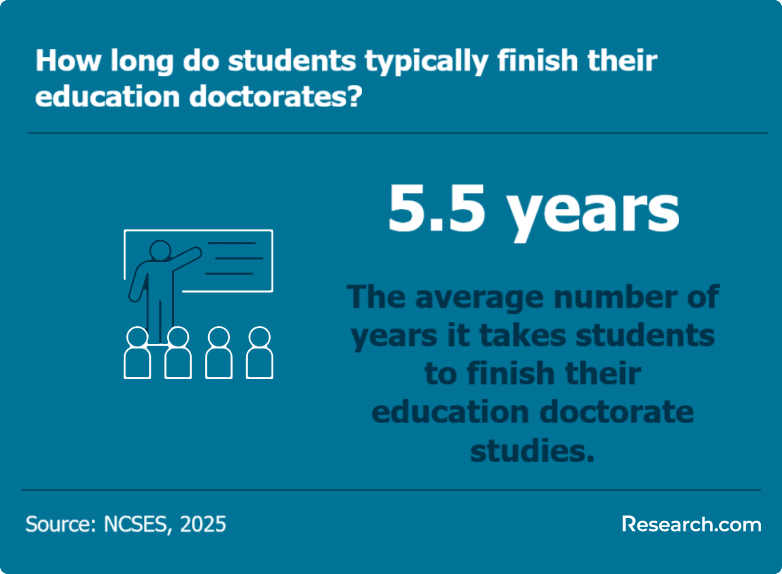
Most fully online EdD programs take three to four years for full-time students. Part-time students, especially those working full time, often take four to six years. Some accelerated formats allow completion in as little as two and a half to three years, but faster programs usually require a heavier course load and disciplined progress on the dissertation or capstone.
| Enrollment Pattern | Typical Timeline | When It Makes Sense |
| Accelerated | As little as two and a half to three years | You have strong time management, stable work demands, and a clear project focus. |
| Full-time | Three to four years | You can handle multiple doctoral courses while managing work and personal obligations. |
| Part-time | Four to six years | You need a sustainable pace because of work, family, or leadership responsibilities. |
Your actual timeline depends on transfer credits, course sequencing, cohort design, dissertation or capstone progress, and whether the program allows flexible pacing.
What Courses Are Included in Online Doctor of Education Programs?
Most online EdD programs combine applied research, leadership theory, organizational improvement, and specialized practice courses. Unlike a PhD, which is often more research-theory oriented, an EdD usually emphasizes solving real problems in schools, colleges, agencies, nonprofits, healthcare settings, or corporate learning environments.
| Common Course Area | What Students Learn | How It Applies Professionally |
| Leadership and organizational change | How to lead teams, guide innovation, and manage change in complex institutions. | Useful for school leadership, district administration, higher education, and organizational development. |
| Educational policy and ethics | How policy decisions are made, implemented, evaluated, and challenged. | Supports work in compliance, equity initiatives, policy analysis, and institutional governance. |
| Curriculum development and instructional design | How to design, assess, and improve learning experiences across varied settings. | Relevant to K–12 curriculum, higher education teaching, e-learning, and workforce training. |
| Research methods and data analysis | How to use qualitative and quantitative evidence to investigate practice-based problems. | Helps leaders make decisions based on data rather than assumptions. |
| Diversity, equity, and inclusion in education | How to identify barriers and design more inclusive educational systems. | Important for leaders responsible for access, student success, staff development, and community engagement. |
| Capstone or dissertation seminar | How to plan, conduct, write, and defend an applied doctoral project. | Allows students to address a real workplace or field-based problem. |
Electives may focus on higher education leadership, P-12 administration, rural education, instructional technology, organizational innovation, adult learning, health professions education, or curriculum and instruction. Educational leadership and administration remains one of the most common EdD specialization areas, followed by curriculum and instruction.
What Skills Can You Develop in an Online EdD Program?
An online EdD is designed to strengthen applied leadership. The goal is not only to understand education research, but to use evidence to improve organizations, programs, policies, and learning systems.
- Strategic leadership: Graduates learn to set priorities, lead teams, manage change, and align decisions with institutional goals.
- Applied research: Students develop the ability to frame practical problems, collect evidence, interpret findings, and recommend solutions.
- Data-informed decision-making: Coursework often trains students to evaluate programs, measure outcomes, and use data responsibly.
- Communication and advocacy: EdD students practice writing, presenting, persuading stakeholders, and defending recommendations.
- Curriculum and instructional improvement: Graduates may learn to design stronger learning experiences and evaluate instructional effectiveness.
- Organizational development: Students study how systems, culture, staffing, policy, and leadership behavior influence institutional performance.
These skills support advanced education career paths and may also transfer to corporate training, nonprofit leadership, government, healthcare education, and consulting.
Online EdD vs. PhD in Education: Which Is the Better Fit?
The EdD and PhD can both be rigorous doctoral degrees, but they usually serve different goals. An EdD is generally practice-focused and designed for professionals who want to lead change in educational or organizational settings. A PhD is usually more research-focused and often fits students pursuing academic research, theory development, or tenure-track faculty roles.
| Decision Factor | Online EdD | PhD in Education |
| Primary focus | Applied leadership and problem-solving | Original research and theory development |
| Common career goals | Administrator, superintendent, training leader, policy practitioner, organizational leader | Researcher, professor, scholar, policy researcher |
| Final project | Applied dissertation or capstone tied to a practical problem | Research dissertation designed to contribute to scholarship |
| Best for | Experienced professionals who want to improve systems and lead organizations | Students who want deep research training and academic research careers |
What Is the Job Outlook for Graduates of Online Doctor of Education Programs?
EdD graduates often pursue leadership, administrative, training, policy, and consulting roles. Career outcomes depend heavily on prior experience, location, employer type, licensure or certification requirements, and specialization. The degree can strengthen a candidate’s profile, but it does not guarantee promotion or salary growth.
- Postsecondary education administrators: Employment is projected to grow 2% from 2024 to 2034, with about 15,100 job openings per year on average over the decade.
- Training and development managers: Employment is projected to grow 6% from 2024 to 2034, making this one of the stronger non-school leadership options for EdD graduates with workforce learning experience.
- Elementary, middle, and high school principals: The outlook is more constrained, with ongoing openings driven by turnover, transfers, and retirements. The table below lists 20,800 projected annual job openings for this occupation from 2024 to 2034.
Demand for EdD-level leadership can be supported by institutional accountability, changing student needs, workforce training needs, and leadership turnover. At the same time, public education budgets, limited senior-level openings, and local hiring requirements can make some roles competitive. Candidates with data literacy, policy experience, instructional technology skills, and a strong professional network may be better positioned.
What Challenges Do EdD Graduates Commonly Face?
An EdD can prepare professionals for higher-level leadership, but the credential alone does not remove workplace complexity. Graduates often move into roles where decisions affect staff, students, budgets, compliance, and institutional strategy.
| Challenge | Why It Happens | How to Prepare |
| High leadership expectations | Doctoral-level professionals may be expected to solve complex problems quickly. | Build mentoring relationships and continue developing management skills after graduation. |
| Resistance to change | Schools and organizations may be slow to adopt new practices, even when evidence supports them. | Learn stakeholder communication, implementation planning, and change management. |
| Work-life pressure | Administrative and leadership roles can involve long hours and constant decision-making. | Set boundaries, delegate effectively, and evaluate whether a role fits your lifestyle. |
| Equity and inclusion responsibilities | Leaders are often expected to address achievement gaps, access issues, and institutional climate. | Choose coursework and projects that build practical equity-focused leadership skills. |
| Ongoing research and policy demands | Policy, consulting, and senior administrative roles may require continuous analysis and communication. | Stay current with research methods, data tools, and policy changes in your field. |
Is Pursuing an Online EdD Worth It?
An online EdD can be worth it if the degree clearly supports your next career step, the program is properly accredited, the total cost is manageable, and the curriculum matches your intended leadership path. It is most valuable for professionals who already have relevant experience and want to move into higher-responsibility roles in education, training, administration, policy, or organizational leadership.
The online format can add real value for working adults because it reduces or eliminates relocation and campus travel. However, flexibility does not mean the program is easy. Doctoral coursework, research, and the dissertation or capstone require sustained effort over several years.
Before enrolling, compare program cost with realistic career outcomes, including your current salary, promotion timeline, employer support, and the types of roles available in your region. For more detail on earnings by role, review information on EdD degree salary potential.
| Occupation | Projected Employment Growth (2024-2034) | Projected Annual Job Openings (2024-2034) | Median Annual Wage |
| Postsecondary Education Administrators | 2% | 15,100 | $103,960 |
| Training and Development Managers | 6% | 3,800 | $127,090 |
| Elementary, Middle, and High School Principals | -1% | 20,800 | $104,070 |
Who Should Consider an Online EdD?
- Experienced educators who want to move into district, school, or institutional leadership.
- Higher education professionals pursuing administrative, student success, or academic leadership roles.
- Instructional designers, learning leaders, and training professionals seeking senior organizational roles.
- Professionals who want applied doctoral training without pausing their careers or relocating.
- Leaders who have a clear problem of practice they want to investigate through a dissertation or capstone.
Who May Want a Different Path?
- Students whose main goal is academic research or a tenure-track faculty role may prefer a PhD in Education.
- Applicants without relevant professional experience may benefit from gaining leadership experience before applying.
- Students seeking state licensure should confirm that the online EdD meets all applicable requirements before enrolling.
- Professionals who cannot commit several years to doctoral-level writing, research, and independent work may want a shorter certificate or specialist degree.
How to Choose the Right No-Residency Online EdD Program
- Confirm the residency policy: Ask the admissions office to state in writing whether any campus visits, dissertation defenses, orientations, or intensives are required.
- Check institutional accreditation: Make sure the university is properly accredited and recognized by appropriate authorities.
- Match the specialization to your career goal: Educational leadership, higher education, instructional technology, curriculum, organizational leadership, and health professions education lead to different opportunities.
- Compare total cost, not just tuition: Include fees, books, project costs, possible extensions, and financing charges.
- Ask about dissertation support: Strong advising, milestones, writing support, and research methods preparation can affect completion.
- Review faculty expertise: Look for faculty whose backgrounds match your intended problem of practice.
- Evaluate online learning format: Determine whether courses are live, self-paced, cohort-based, or asynchronous.
- Check career services and alumni outcomes: Ask how the program supports working professionals seeking advancement.
- Verify licensure relevance: If you need superintendent, principal, or administrative certification, confirm state-specific requirements before enrolling.
Common Mistakes to Avoid When Choosing an Online EdD
- Assuming online means no residency: Some online programs still require campus visits, so confirm the policy before applying.
- Choosing only by tuition rate: A program with a low per-credit price may require more credits or charge higher fees.
- Ignoring accreditation: Accreditation affects financial aid eligibility, employer recognition, and transferability.
- Overlooking dissertation structure: Poor project support can extend your timeline and increase costs.
- Selecting the wrong specialization: A curriculum-focused EdD may not be the best fit for a corporate training leadership goal, and a higher education track may not support K–12 licensure needs.
- Assuming salary growth is automatic: Promotions and earnings depend on experience, employer budgets, job openings, location, and leadership performance.
- Forgetting state requirements: Licensure, certification, and endorsement rules can vary by state and may not be met by every online program.
Questions to Ask Before Applying
- Is the program 100% online with no required residency, campus visit, or in-person defense?
- Is the university institutionally accredited?
- How many credits are required, and how many transfer credits can be applied?
- What is the full estimated cost through graduation?
- Are courses synchronous, asynchronous, or both?
- How long do most students actually take to finish?
- What dissertation or capstone support is provided?
- Does the specialization align with my target role?
- Will the program meet any licensure, endorsement, or certification requirements I need?
- What financial aid, scholarships, employer partnerships, or payment plans are available?
Current Trends Affecting Online EdD Programs
Online EdD programs are evolving as schools, colleges, and organizations face new leadership demands. Several trends are especially important for 2026 applicants.
- AI and data use in education: Leaders increasingly need to understand analytics, responsible AI use, digital learning tools, and data privacy.
- Demand for flexible doctoral formats: Working professionals continue to seek programs that do not require relocation or campus travel.
- Greater focus on applied outcomes: Many EdD programs emphasize capstones or dissertations that solve real organizational problems rather than purely theoretical questions.
- Employer scrutiny of ROI: Schools and organizations may support doctoral study when it clearly improves leadership capacity, instructional quality, workforce learning, or organizational performance.
- Competition for senior roles: The EdD can strengthen credentials, but candidates still need experience, networks, measurable achievements, and strong communication skills.
References
- Glassdoor. (2025). How much does an Education Policy Analyst make? Glassdoor.
- National Center for Science and Engineering Statistics. (2024). Survey of Earned Doctorates 2023. NCSES.
- National Center for Science and Engineering Statistics. (2025). Survey of Earned Doctorates 2024. NCSES.
- Nietzel, M. (2024, February 5). Number Of Doctoral Degrees Awarded In U.S. Rebounds To All-Time High. Forbes.
- Online EdD Programs. (2025, September 23). Online Doctor of Education (Ed.D.) Programs in Education Technology and E-Learning. Online EdD Programs.
- United States Bureau of Labor Statistics. (2025, August 28). Occupational Outlook Handbook | Elementary, Middle, and High School Principals. BLS.
- United States Bureau of Labor Statistics. (2025, August 28). Occupational Outlook Handbook | Postsecondary Education Administrators. BLS.
- United States Bureau of Labor Statistics. (2025, August 28). Occupational Outlook Handbook | Training and Development Managers. BLS.
Key Insights
- A no-residency online EdD can be completed without required campus travel, but applicants should verify that orientation, dissertation defense, and fieldwork are also online.
- The best program depends on your career goal: K–12 leadership, higher education administration, instructional technology, organizational leadership, health professions education, and curriculum roles require different preparation.
- Costs vary widely. Affordable options may fall around $15,000 to $30,000, while higher-cost programs can reach $55,000 to over $70,000.
- Most full-time students finish in three to four years, while part-time students often need four to six years.
- An online EdD is most worthwhile for professionals with relevant experience, a clear leadership goal, and a realistic plan for financing the degree.
- Do not choose a program based on convenience alone. Accreditation, total cost, dissertation support, specialization fit, and licensure relevance are the factors that most affect long-term value.
Other Things You Should Know About Online Doctor of Education Programs
Participants in 2027 online EdD programs typically need a reliable internet connection, a computer with updated software, and possibly specific applications for virtual learning platforms. Technical requirements may vary by program, so checking each program's guidelines is essential.
Most no-residency online EdD programs require a dissertation, dissertation-in-practice, or applied doctoral project. Programs often expect a committee-approved proposal, research ethics review, and final defense by video conference. Some schools require 6 to 12 dissertation credits as part of the degree plan.
To verify accreditation, prospective students should ensure that the EdD programs are recognized by regional or national accrediting agencies listed by the U.S. Department of Education or the Council for Higher Education Accreditation. This guarantees the program meets quality standards and supports career advancement.


