2027 Most Affordable Online Master's in Education Technology Degree Programs

Co-Founder and Chief Data Scientist
Choosing an affordable online master’s in education technology is really a decision about career direction, not just tuition. The right program can help teachers become technology leaders, help instructional designers build stronger portfolios, and help career changers move into digital learning roles in schools, universities, companies, nonprofits, and EdTech organizations. The wrong program can cost more than expected, lack the specialization you need, or fail to support licensure or career goals.
This guide explains how online master’s in education technology programs work, what they cost, how long they take, which affordable programs stand out for 2027, and how to compare options with a practical return-on-investment mindset. You will also learn what admissions requirements to expect, which courses and specializations are common, what careers may be available after graduation, and what mistakes to avoid before enrolling.
Quick Answer: Is an Online Master’s in Education Technology Worth It?
An online master’s in education technology can be worth it if you want to design digital courses, lead technology integration, manage online learning programs, or move into instructional design and training roles. It is especially useful for working educators and professionals who need a flexible graduate program while building applied skills in instructional design, learning management systems, multimedia learning, accessibility, assessment, and emerging education technologies.
However, value depends on the program’s accreditation, total cost, curriculum fit, portfolio opportunities, and whether the degree supports your intended role. Prospective students should compare tuition, required credits, delivery format, specialization options, graduate outcomes, and employer expectations before committing.
Why students choose an online master’s in education technology
- Graduates may qualify for roles such as Instructional Designer, Education Technologist, Learning Program Manager, e-learning developer, curriculum specialist, or online learning coordinator.
- The Bureau of Labor Statistics reported an estimated 20,100 openings each year for instructional coordinators and related instructional design roles, largely because of retirements and workers changing jobs (BLS, 2023).
- ZipRecruiter reports an average annual salary of $68,086 for education technology roles, though earnings vary by job title, sector, experience, and location (ZipRecruiter, n.d.).
What Is an Online Master’s in Education Technology?
An online master’s in education technology is a graduate degree focused on using digital tools, instructional design principles, learning theory, and data-informed methods to improve teaching and training. Depending on the school, the degree may be titled educational technology, instructional technology, learning and instructional design, applied digital learning, curriculum and instruction with an EdTech focus, or instructional design and technology.
These programs are commonly built for working adults. Many use asynchronous coursework, virtual collaboration, project-based assignments, and portfolio development. Students often learn inside the same kinds of digital platforms they may later manage or design for, including learning management systems, multimedia authoring tools, online assessment platforms, and collaborative course design environments.
What you can usually expect in the program
- Instructional design foundation: Students study how people learn, how to structure lessons, and how to design measurable learning experiences for online, hybrid, and technology-supported environments.
- Applied technology projects: Programs often require students to create e-learning modules, digital curricula, multimedia lessons, training materials, or technology integration plans.
- Evaluation and assessment: Coursework typically addresses how to judge whether a digital tool, course, or training program is effective.
- Capstone or portfolio work: Many degrees end with a final project, research-based product, or professional portfolio that can be shared with employers.
- Flexible delivery: Online programs may include asynchronous classes, part-time pacing, accelerated terms, and multiple start dates, making them more manageable for teachers and full-time professionals.
Where Can You Work With an Online Master’s in Education Technology?
Education technology skills are used in more settings than K–12 classrooms. Graduates may work anywhere learning has to be designed, delivered, evaluated, or scaled through digital tools. The best workplace for you depends on whether you prefer direct education, adult learning, product development, training operations, or consulting.
| Work Setting | Common Responsibilities | Best Fit For |
| K–12 schools and districts | Support teachers, design digital lessons, manage technology integration, lead LMS adoption, and improve classroom technology use. | Licensed teachers, instructional coaches, and educators who want to influence schoolwide or districtwide learning practices. |
| Colleges and universities | Develop online courses, support faculty, manage instructional design projects, and improve virtual learning delivery. | Professionals interested in higher education, course design, accessibility, and online program support. |
| Corporate training departments | Create onboarding, compliance, leadership, and skills-based training for employees. | Career changers, trainers, and instructional designers who want to work outside traditional education. |
| EdTech companies | Support product development, customer training, user success, implementation, or learning experience design. | Professionals who enjoy software, product strategy, user experience, and education innovation. |
| Government agencies and nonprofits | Build digital literacy programs, workforce development training, public education resources, or community learning initiatives. | Students interested in access, public service, adult education, and large-scale learning programs. |
How Much Can You Earn With an Online Master’s in Education Technology?
Pay in education technology depends heavily on role, employer type, geographic location, prior experience, technical skill level, and whether you work in education, corporate learning, software, or consulting. A master’s degree may strengthen your qualifications, but it does not guarantee a specific salary.
According to ZipRecruiter (n.d.), education technology salary benchmarks include the following:
| Salary Level | Annual Pay | What It May Represent |
| Top earners | $91,000 or more per year | Often senior professionals, specialized instructional designers, managers, or employees at larger organizations. |
| 75th percentile | $79,000 annually | Typically professionals with stronger portfolios, specialized skills, or several years of experience. |
| Average salary | $68,086 per year | A broad benchmark across education technology roles such as Instructional Designer, EdTech Specialist, and Learning Consultant. |
| 25th percentile | $51,500 annually | Often early-career roles, entry-level positions, or jobs in lower-paying settings. |
- Affordable Online Master’s in Education Technology Programs for 2027
- How long does it take to complete an online master’s in education technology?
- How does an online master’s in education technology compare to an on-campus program?
- What are the prerequisites for enrolling in an online master’s in education technology?
- What courses are typically in an online master’s in education technology?
- What types of specializations are available in an online master’s in education technology?
- How to choose the best online master’s in education technology?
- What financial aid options can help fund an online master’s in education technology?
- What should you check for accreditation and program quality?
- What is the return on investment of an online master’s in education technology?
- What emerging trends are shaping online master’s in education technology?
- What career paths are available for graduates of an online master’s in education technology?
- What is the job market for graduates with an online master’s in education technology?
Affordable Online Master’s in Education Technology Programs for 2027
How Research.com evaluates programs
A master’s degree should be compared on more than sticker price. Affordability matters, but so do accreditation, online accessibility, academic quality, graduation outcomes, program structure, and whether the curriculum matches the roles students want after graduation.
Research.com uses data from the IPEDS database, Peterson’s database including its Distance Learning Licensed Data Set, the College Scorecard database, and the National Center for Education Statistics. These sources help evaluate programs using factors such as cost, distance learning availability, institutional quality, and student outcomes.
You can review the full ranking process in the Research.com methodology section. Use the list below as a starting point, then confirm current tuition, fees, admissions requirements, course delivery, and licensure implications directly with each university.
| School | Program Focus | Total Cost | Credits | Program Length |
| Grand Canyon University | Instructional Design | $22,140 | 32 credits | 6 weeks |
| Southern Illinois University - Edwardsville | Education Technology | $14,485.50 | 30 credits | 10 months |
| Lamar University | Applied Digital Learning | $10,802 | 30 credits | 12 months |
| North Carolina A & T State University | Technology Education | $6,990 (In-State Tuition), $25,800 (Out-of-State Tuition) | 30 credits | 18-24 months |
| Southeastern Oklahoma State University | Curriculum and Instruction - EdTech | $9,540 | 30 credits | 12 months |
| University of Central Arkansas | Instructional Technology | $10,080 | 30 credits | 2 years |
| Wichita State University | Learning and Instructional Design | $10,166 | 30 credits | 16 months |
| Liberty University | Instructional Design and Technology | $17,400 | 30 credits | 8 weeks |
| Indiana Wesleyan University - Marion | Online Teaching and Learning | $14,970 | 30 credits | 18 months |
| University of Central Missouri | Educational Technology | $12,750 | 30 credits | 2 years |
1. Grand Canyon University
Grand Canyon University offers an online Master of Science in Instructional Design for students who want to build learning experiences for education, workplace training, and organizational development. The curriculum emphasizes instructional strategies, curriculum planning, learning evaluation, and technology-supported design. It may fit professionals who want a graduate credential focused on practical course and training development.
- Program Length: 6 weeks
- Tracks/concentrations: Instructional Design
- Total Cost: $22,140
- Required Credits to Graduate: 32 credits
- Accreditation: Association for Advancing Quality in Educator Preparation (AAQEP)
2. Southern Illinois University - Edwardsville
Southern Illinois University - Edwardsville offers a Master of Science in Education in Instructional Technology with a specialization in Educational Technology. The program is designed for PK-12 professionals who want to improve technology-supported instruction, develop data-informed materials, and guide technology adoption in schools or districts. Its shorter timeline may appeal to educators looking for a focused online option.
- Program Length: 10 months
- Tracks/concentrations: Education Technology
- Total Cost: $14,485.50
- Required Credits to Graduate: 30 credits
- Accreditation: Higher Learning Commission (HLC)
3. Lamar University
Lamar University offers an online Master of Education in Applied Digital Learning. The program uses a project-based model that asks students to connect digital learning theory with implementation and evaluation. It is a strong match for educators, trainers, or learning professionals who want to develop practical digital strategies for classrooms, organizations, or online learning environments.
- Program Length: 12 months
- Tracks/concentrations: Applied Digital Learning
- Total Cost: $10,802
- Required Credits to Graduate: 30 credits
- Accreditation: Southern Association of Colleges and Schools Commission on Colleges (SACSCOC)
4. North Carolina A & T State University
North Carolina A&T State University offers an online Master of Arts in Teaching (MAT) in Technology Education. The program is aligned with INTASC, CAEP, and North Carolina Department of Public Instruction standards and is intended for students preparing to teach in technology, engineering, and design-related areas. Students should note that the MAT may support an initial teaching license pathway, but licensure requires a separate admission process through the Educator Preparation Program.
- Program Length: 18-24 months
- Tracks/concentrations: Technology Education
- Total Cost: $6,990 (In-State Tuition), $25,800 (Out-of-State Tuition)
- Required Credits to Graduate: 30 credits
- Accreditation: Southern Association of Colleges and Schools Commission on Colleges (SACSCOC)
5. Southeastern Oklahoma State University
Southeastern Oklahoma State University offers a 100% online Master of Education in Curriculum & Instruction with an educational technology focus. The program can support educators and learning professionals in schools, museums, nonprofits, and other instructional settings. Students study curriculum design, digital storytelling, and instructional leadership for technology-rich environments.
- Program Length: 12 months
- Tracks/concentrations: Curriculum and Instruction - EdTech
- Total Cost: $9,540
- Required Credits to Graduate: 30 credits
- Accreditation: Higher Learning Commission (HLC)
6. University of Central Arkansas
University of Central Arkansas offers a 100% online Master of Science in Instructional Technology (ITEC). The program combines curriculum design, media use, digital storytelling, and leadership for students interested in K–12, higher education, nonprofit, and cultural learning settings. It may be a good fit for professionals who want a structured timeline and applied instructional technology training.
- Program Length: 2 years
- Tracks/concentrations: Instructional Technology
- Total Cost: $10,080
- Required Credits to Graduate: 30 credits
- Accreditation: Higher Learning Commission (HLC)
7. Wichita State University
Wichita State University offers an online M.Ed. in Learning & Instructional Design. The program is built for professionals in K–12, higher education, instructional design, and corporate training. Because no education degree or licensure is required for admission, it may be useful for career changers who want a flexible instructional design pathway.
- Program Length: 16 months
- Tracks/concentrations: Learning and Instructional Design
- Total Cost: $10,166
- Required Credits to Graduate: 30 credits
- Accreditation: Higher Learning Commission (HLC)
8. Liberty University
Liberty University offers an online M.Ed. in Higher Education – Instructional Design and Technology. The program focuses on designing digital learning materials and technology-supported instruction for postsecondary education. It may suit students who want to work in higher education learning design rather than a traditional classroom teaching role.
- Program Length: 8 weeks
- Tracks/concentrations: Instructional Design and Technology
- Total Cost: $17,400
- Required Credits to Graduate: 30 credits
- Accreditation: Southern Association of Colleges and Schools Commission on Colleges (SACSCOC)
9. Indiana Wesleyan University - Marion
Indiana Wesleyan University - Marion offers a Master’s in Online Teaching and Learning. The program combines online instructional strategies, digital teaching tools, and a faith-based academic perspective. It is designed for educators who want to improve online and traditional instruction for P–12 learners.
- Program Length: 18 months
- Tracks/concentrations: Online Teaching and Learning
- Total Cost: $14,970
- Required Credits to Graduate: 30 credits
- Accreditation: Higher Learning Commission (HLC)
10. University of Central Missouri
The University of Central Missouri offers a Master’s in Educational Technology for students who want to apply instructional theory, curriculum development, and digital tools in classrooms, corporate learning, or healthcare training settings. The 100% online format emphasizes applied technology skills and adaptability as tools and platforms change.
- Program Length: 2 years
- Tracks/concentrations: Educational Technology
- Total Cost: $12,750
- Required Credits to Graduate: 30 credits
- Accreditation: Higher Learning Commission (HLC)
How Long Does It Take to Complete an Online Master’s in Education Technology?
Completion time depends on course load, academic calendar, transfer policies, capstone requirements, and whether the program uses traditional semesters or shorter accelerated terms. Northeastern University (n.d.) notes that traditional master’s degrees often take around two years of full-time study. Online options may move faster, while part-time study can extend the timeline to 2 to 3 years.
Students who are still completing undergraduate requirements may want to compare lower-cost pathways first, including affordable online bachelor’s degree options in education, before moving into graduate education technology programs.
| Program Type | Typical Duration | When This Format Makes Sense |
| Full-Time Master's Program | 2 years | A standard pace for students who want a predictable graduate schedule and can handle a full course load. |
| Accelerated Online Program | 6 weeks to 12 months | A faster option for students who can manage compressed coursework and frequent deadlines. |
| Part-Time Online Program | 2 to 3 years | A practical choice for full-time teachers, parents, and professionals balancing school with work responsibilities. |
Sources: Grand Canyon University (n.d.); Lamar University (n.d.); Northeastern University (n.d.); Coursera (2023)
How Does an Online Master’s in Education Technology Compare to an On-Campus Program?
Online and on-campus education technology programs can lead to similar academic outcomes when they are offered by properly accredited institutions and include rigorous coursework. The main differences are schedule, cost structure, learning environment, networking style, and how much direct experience students get with digital delivery systems.
| Factor | Online Master’s in Education Technology | On-Campus Master’s in Education Technology |
| Schedule | Often asynchronous or hybrid, which can help working educators and trainers study around employment. | Usually follows fixed class times and campus-based schedules. |
| Completion pace | May include accelerated formats and multiple start dates. | Often follows a semester-based sequence and may take about two years. |
| Learning environment | Students learn through LMS platforms, video modules, discussion tools, simulations, and online collaboration. | Students may have access to in-person workshops, campus labs, and face-to-face faculty interaction. |
| Networking | Peers may come from different districts, states, industries, and countries, which can broaden professional perspectives. | Networking is often more local and built through in-person classes and campus events. |
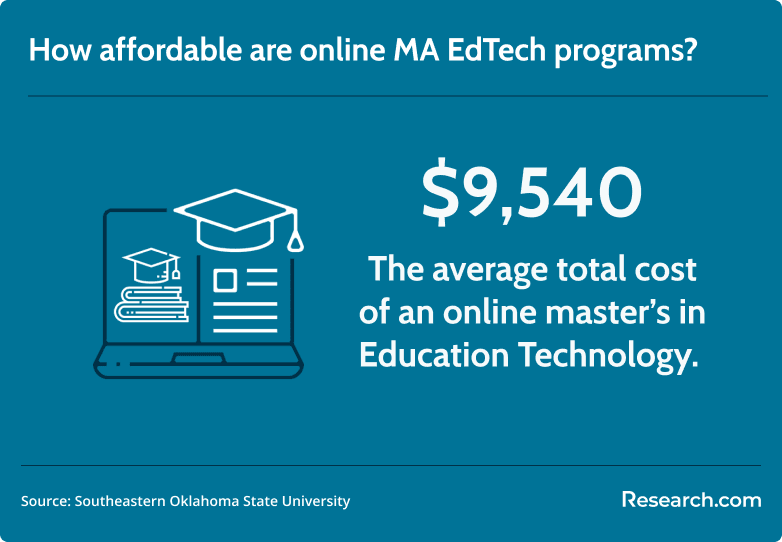
| Cost | Online MA EdTech programs can cost as low as $9,540, and students may avoid housing, commuting, and some campus-related expenses. | On-campus fees can go as high as $33,900 (Data USA, 2023). |
| Technology immersion | The format itself gives students regular practice with digital learning systems. | Technology use varies by program and may be balanced with campus-based activities. |
What Are the Prerequisites for Enrolling in an Online Master’s in Education Technology?
Admission standards vary, but most online master’s in education technology programs expect applicants to show academic readiness, basic technology comfort, and a clear reason for pursuing graduate study. Some programs are designed for licensed teachers, while others welcome corporate trainers, instructional designers, school technology staff, or career changers.
Students who previously compared teacher preparation options, such as early childhood education and elementary education degree pathways, may use a graduate EdTech degree to specialize in digital learning, instructional design, or technology leadership.
Common admission requirements
- A bachelor’s degree from a regionally accredited institution, often in education, instructional design, or a related field.
- A minimum GPA, typically 2.5 to 3.0 on a 4.0 scale (Florida Atlantic University, n.d.).
- A statement of purpose describing career goals and interest in education technology.
- A professional resume or CV showing teaching, training, technology, or curriculum experience.
- Basic technology proficiency, such as experience with digital tools or learning management systems.
- A teaching license for some K–12-focused programs, especially those tied to teacher preparation or licensure pathways.
Graduate programs in related fields may use similar admissions criteria. For example, affordable online master’s in adult education programs often value teaching, training, or curriculum experience as part of the applicant profile.
What Courses Are Typically in an Online Master’s in Education Technology?
Coursework usually combines learning theory, instructional design, digital media, assessment, accessibility, and leadership. The strongest programs ask students to produce usable work samples rather than only complete exams or discussion posts. These courses may also benefit educators in specialized areas, including those exploring early childhood education salary and career paths where developmentally appropriate technology use is increasingly important.
| Course Area | What Students Learn | Why It Matters |
| Instructional Design and Technology | How to plan, build, and evaluate lessons, modules, and training materials using design models and digital tools. | This is a core skill for instructional designer and learning experience designer roles. |
| Digital Learning Environments | How online and blended courses are structured, managed, and improved for different learners. | Graduates often work with LMS platforms and virtual course delivery. |
| Emerging Technologies in Education | How tools such as AI, VR/AR, and gamification may support engagement and learning. | Employers increasingly expect EdTech professionals to evaluate new tools critically, not simply adopt them. |
| Assessment and Evaluation | How to measure whether instruction, technology, or curriculum changes improve learning outcomes. | Data-informed decision-making is essential for schools, universities, and corporate training teams. |
| Learning Theories for Digital Contexts | How established learning theories apply to online, hybrid, and technology-enhanced instruction. | Good technology use depends on sound pedagogy, not novelty. |
| Educational Media and Digital Storytelling | How to design videos, interactive media, and multimedia learning materials. | Strong media design can improve clarity, engagement, and accessibility. |
| Technology Leadership in Education | How to plan, communicate, and lead technology adoption across teams or institutions. | Leadership skills matter for coordinators, specialists, consultants, and managers. |
| Capstone or Practicum | How to complete a major applied project, research product, or professional portfolio. | Portfolio evidence can be valuable when applying for instructional design or EdTech roles. |
What Types of Specializations Are Available in an Online Master’s in Education Technology?
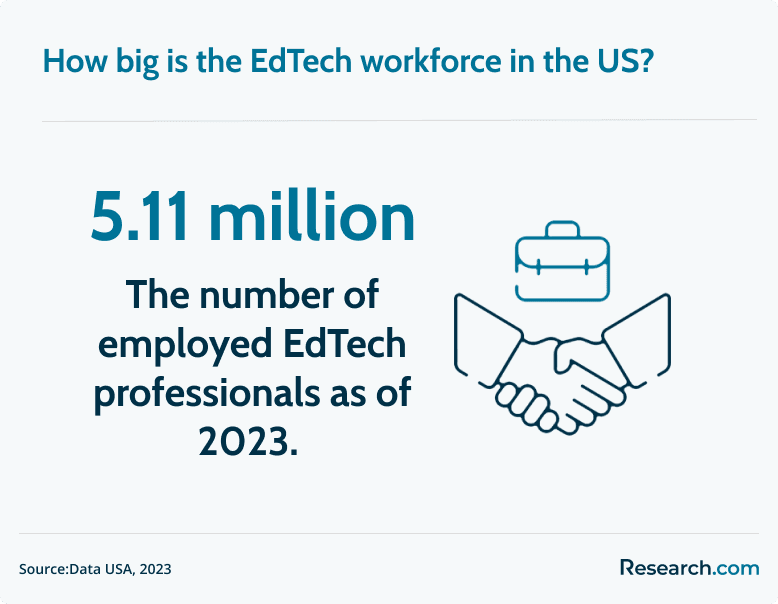
Specializations help students align the degree with a specific work setting or skill set. Data USA reports that the educational/instructional technology workforce has grown to over 5.11 million professionals in the US, and graduate students can use concentrations to prepare for more focused roles within that broad field.
| Specialization | Focus | Good Fit For |
| Instructional Design and Development | Designing structured learning experiences, multimedia content, and curriculum materials. | Future instructional designers, learning experience designers, and course developers. |
| Virtual and Remote Learning | Building and managing online classrooms, learner engagement, and digital communication. | Teachers, online program coordinators, and higher education course designers. |
| Technology Integration for K–12 | Helping teachers use technology effectively in elementary and secondary education. | Instructional coaches, school technology specialists, and classroom teachers. |
| Workplace Learning and Development | Creating adult learning and employee training programs aligned with organizational goals. | Corporate trainers, HR learning specialists, and training managers. |
| Higher Education Technology Leadership | Supporting online learning, faculty development, academic technology, and course quality in colleges and universities. | Higher education staff, instructional designers, and academic technology professionals. |
| Digital Citizenship and Literacy | Teaching safe, ethical, equitable, and responsible technology use. | K–12 educators, librarians, digital literacy coordinators, and community program leaders. |
| Assistive Technologies and Accessibility | Using technology to reduce learning barriers and support diverse learners. | Educators and designers focused on inclusive learning environments. |
Some students compare EdTech specializations with adjacent education fields. For example, affordable online master’s in gifted education programs may appeal to educators focused on advanced learners, while EdTech concentrations may better serve students interested in digital curriculum, online learning, or instructional systems. Students considering broader graduate pathways should also be cautious when comparing unrelated fields, such as a substance abuse counseling degree, because licensure, career outcomes, and coursework can differ substantially.
How to Choose the Best Online Master’s in Education Technology
The best program is the one that fits your intended career, budget, schedule, and professional background. A low tuition rate is attractive, but it should not be the only deciding factor. Students should also evaluate whether a program builds a strong portfolio, teaches current tools, includes accessible faculty support, and carries recognized accreditation.
Key factors to compare before applying
- Accreditation: Confirm institutional accreditation first, then check whether the education unit or educator preparation program has additional recognition relevant to your goals.
- Total cost: Compare tuition, fees, textbooks, software, technology requirements, travel for any residency, and graduation costs.
- Curriculum fit: Look for courses in instructional design, learning theory, assessment, accessibility, multimedia, and technology leadership.
- Portfolio development: Prioritize programs that require projects you can show employers, such as e-learning modules, course designs, evaluation plans, or digital curriculum products.
- Faculty experience: Review whether instructors have practical experience in K–12 technology integration, instructional design, higher education, or corporate learning.
- Specialization options: Choose a concentration that matches your target setting, such as K–12, higher education, workplace learning, or accessibility.
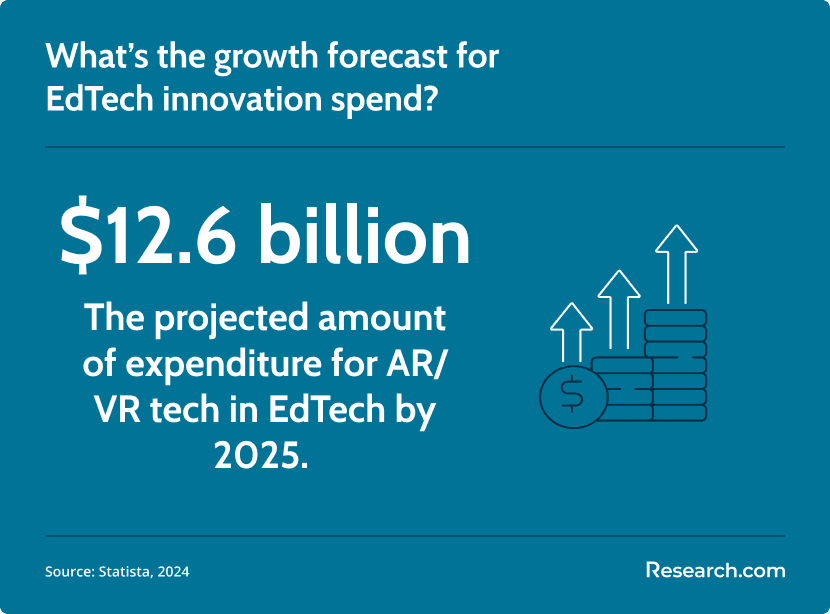
- Technology focus: Global EdTech spending on AR/VR is expected to grow from $1.6 billion in 2018 to $12.6 billion by 2025 (Statista, 2024), so programs that teach students to evaluate emerging technologies may offer practical value.
- Flexibility: Check whether the program offers asynchronous classes, multiple start dates, part-time pacing, or accelerated terms.
- Licensure implications: If you need a teaching credential or state endorsement, confirm in writing that the program meets requirements in your state.
If your long-term plan includes doctoral study, compare the master’s program with future options such as affordable online EdD programs so you understand how credits, costs, and academic goals may connect.
What Financial Aid Options Can Help Fund an Online Master’s in Education Technology?
Financial aid for an online graduate program may include federal aid, state programs, institutional scholarships, employer tuition assistance, payment plans, military or veteran education benefits, and sometimes assistantships. Availability varies by school, enrollment status, and student eligibility, so applicants should complete required aid forms early and ask each university for a full cost estimate.
Ways to reduce out-of-pocket cost
- Request a complete tuition-and-fee breakdown before enrolling.
- Ask whether online students pay different fees from campus students.
- Check whether your employer offers tuition reimbursement for education, instructional design, or training-related degrees.
- Ask whether graduate scholarships apply to part-time online students.
- Compare accelerated timelines carefully; faster programs may reduce time in school, but they can also require a heavier workload.
- Review alternatives such as fast-track online EdD programs only if a doctoral degree aligns with your long-term goals.
What Should You Look for in Accreditation and Program Quality?
Accreditation is one of the most important checks before enrolling. It affects credit transfer, employer recognition, eligibility for some forms of financial aid, and confidence that the institution meets external academic standards. For education technology programs, institutional accreditation is essential; education-specific recognition may also matter if the program connects to teacher preparation or state licensure.
Quality indicators to verify
- The institution is accredited by a recognized accrediting body.
- The program clearly states whether it leads to licensure, an endorsement, or neither.
- Online students have access to advising, library services, technology support, career services, and faculty communication.
- Coursework includes applied projects, not only readings and exams.
- The curriculum is reviewed regularly to reflect changes in digital learning tools and employer expectations.
- The school publishes clear information on tuition, fees, credit requirements, admissions standards, and graduation expectations.
Students comparing broader education graduate options can also review affordable online master’s degrees in teaching to understand how education technology differs from classroom teaching-focused graduate programs.
What Is the Return on Investment of an Online Master’s in Education Technology?
ROI is not just the difference between tuition and future salary. It also includes whether the degree helps you qualify for better roles, build a stronger portfolio, move into a new sector, increase job security, or gain leadership responsibilities. A program with lower tuition may produce better ROI if it is accredited, relevant, and aligned with your career target.
| ROI Factor | What to Ask | Why It Matters |
| Total program cost | What is the full cost after tuition, fees, books, software, and technology expenses? | A low advertised tuition rate may not reflect the full amount you will pay. |
| Career alignment | Does the curriculum match instructional design, K–12 EdTech, corporate training, or higher education roles? | A mismatch can reduce the practical value of the degree. |
| Portfolio value | Will you graduate with work samples that show course design, multimedia, assessment, and technology planning skills? | Employers often want evidence of applied ability. |
| Salary context | How do target roles compare with current salary benchmarks, such as the $68,086 average reported by ZipRecruiter? | Salary projections should be realistic and role-specific. |
| Opportunity cost | Can you continue working while enrolled? | Online flexibility may reduce lost income compared with leaving work for full-time study. |
For a salary comparison in another education-adjacent graduate field, students can review Research.com’s guide on what you can do with a master’s in library science.
What Emerging Trends Are Shaping Online Master’s in Education Technology?
Education technology programs are changing because schools, universities, and employers are asking learning professionals to do more than use tools. They need people who can evaluate technology, design accessible learning, interpret learning data, support teachers or trainers, and adapt to new delivery models.
Trends to watch
- Artificial intelligence in instruction: Programs increasingly discuss how AI can support lesson design, feedback, personalization, tutoring, and administrative workflows, while also raising concerns about ethics, bias, privacy, and academic integrity.
- AR/VR and immersive learning: Statista (2024) reported that global EdTech spending on AR/VR is expected to grow from $1.6 billion in 2018 to $12.6 billion by 2025.
- Microcredentials and competency-based learning: Shorter credentials and skills-based models are influencing how professionals document specific competencies alongside degrees.
- Accessibility and inclusive design: Digital learning teams increasingly need people who understand assistive technology, universal design, captions, screen-reader compatibility, and equitable access.
- Data-informed learning improvement: Employers value professionals who can use assessment and platform data to improve learning, not just report completion rates.
Students who are comparing graduate education costs across different disciplines can also examine unrelated but useful cost examples, such as an affordable online master’s degree in history, to see how program pricing and career goals differ by field.
Common Mistakes to Avoid When Choosing an Online EdTech Master’s
| Mistake | Why It Can Hurt You | Better Approach |
| Choosing only by lowest tuition | The cheapest option may not have the specialization, portfolio support, or faculty access you need. | Compare total cost alongside curriculum, outcomes, accreditation, and support services. |
| Ignoring accreditation | Credits may not transfer, employers may question the degree, and aid eligibility may be affected. | Confirm institutional accreditation and any program-level recognition before applying. |
| Assuming online means easier | Accelerated online coursework can be demanding, especially for full-time teachers and working professionals. | Ask about weekly time expectations, assignment formats, and course pacing. |
| Overlooking licensure rules | Some programs do not lead to teacher licensure or state endorsements. | Contact your state education agency and the program advisor before enrolling. |
| Not reviewing the portfolio requirements | Graduating without strong work samples may make career changes harder. | Choose programs with capstones, practicum projects, or applied design assignments. |
| Relying only on rankings | A highly ranked program may still be a poor fit for your schedule, sector, or specialization. | Use rankings as a shortlist, then verify fit with your goals and constraints. |
What Career Paths Are Available for Graduates of an Online Master’s in Education Technology?
Graduates can pursue positions in digital learning design, instructional support, curriculum development, training, educational consulting, and technology leadership. Some roles are education-specific, while others are found in business, healthcare, government, nonprofits, or software companies.
| Career Path | What the Role Does | Typical Work Setting |
| Instructional Designer | Designs lessons, courses, modules, and training materials using learning theory and technology. | Schools, universities, companies, nonprofits, and online learning providers. |
| E-Learning Developer | Builds interactive online content, multimedia lessons, and digital training experiences. | Corporate learning teams, EdTech companies, and higher education. |
| Education Technology Specialist | Helps educators select, implement, and use instructional technology effectively. | K–12 districts, schools, and colleges. |
| Curriculum Developer | Creates standards-aligned or competency-based learning materials for digital and blended formats. | Education publishers, schools, universities, nonprofits, and training teams. |
| Corporate Training Manager | Leads employee learning initiatives, onboarding, professional development, or compliance training. | Businesses, healthcare organizations, government, and large employers. |
| EdTech Product Manager | Guides development of educational software or platforms by connecting user needs, learning goals, and product features. | Education technology companies. |
| Online Learning Coordinator | Supports virtual program delivery, course operations, learner engagement, and LMS administration. | Colleges, universities, K–12 virtual programs, and training organizations. |
| Education Consultant | Advises schools or organizations on technology implementation, digital curriculum, and instructional improvement. | Consulting firms, independent practice, nonprofits, and education agencies. |
| Technology-Integrated Classroom Teacher | Uses advanced digital learning strategies to improve instruction and personalize learning. | K–12 schools. Students who need licensure should review how to get a teaching credential. |
Some graduates work in inclusive learning environments where digital tools support language access and differentiated instruction. Students interested in that area may also compare affordable online master’s in multilingual learner education programs.
What Is the Job Market for Graduates With an Online Master’s in Education Technology?
The job market is steady rather than explosive. The Bureau of Labor Statistics projected employment of instructional coordinators to grow 2% from 2023 to 2033, with about 20,100 openings expected each year, largely because workers retire or move into other roles (BLS, 2023). That means graduates should not assume a degree alone will guarantee employment; they should build a portfolio, gain tool experience, and target roles carefully.
Demand exists across K–12, higher education, corporate training, nonprofit learning, and EdTech companies, especially for professionals who can combine instructional design, technology evaluation, communication, and project management. Similar digital-skills demand can also be seen in adjacent training markets, including affordable online software engineering bootcamp options, where employer needs are shaped by changing technology requirements.
The current instructional technology teacher workforce also skews older. Zippia (n.d.) reports that 59% of instructional technology teachers are over the age of 40, 28% are between 30 and 40, and 12% are under 30. This age distribution may create room for newer professionals as organizations update digital learning systems and replace retiring workers.
What Graduates Say About Online Master’s in Education Technology Programs
-
: "
“Working full time as a teacher while managing family responsibilities was difficult, but the online format made graduate study realistic. I could complete coursework at night and test new classroom strategies almost immediately. The live discussions, peer review, and simulations made the experience much more interactive than I expected.” — Katherine
"
-
: "
“I assumed online graduate programs would feel shallow, but the projects changed my view. The program pushed me to build real materials, practice with new tools, and collaborate with other educators. I started as someone hesitant about technology and ended up helping lead a digital learning effort at my school.” — Ralph
"
-
: "
“I had experience in corporate training and wanted to move closer to education without leaving my job. The online program helped me study gamification, AR tools, and learning design through assignments that connected directly to workplace problems. It gave me a clearer direction and stronger confidence in my career pivot.” — Zina
"
References
- Coursera. (2023). How long does a master’s degree take? Coursera.org. Retrieved 27 May 2025.
- Data USA. (n.d.). Educational/Instructional Technology. Datausa.io. Retrieved 27 May 2025.
- Florida Atlantic University. (n.d.). Education programs. Fau.edu. Retrieved 27 May 2025.
- GCU. (n.d.). College of Education Accreditation. Grand Canyon University. Gcu.edu. Retrieved 27 May 2025.
- Indiana Wesleyan University. (n.d.). M.S. in Online Teaching and Learning. Indwes.edu. Retrieved 27 May 2025.
- Lamar University. (n.d.). Master of Education in Applied Digital Learning Online. Degree.lamar.edu. Retrieved 27 May 2025.
- Liberty University. (n.d.). M.Ed. in Higher Education – Instructional Design and Technology. Liberty.edu. Retrieved 27 May 2025.
- Northeastern University. (n.d.). How long does it take to get an online degree? Graduate.northeastern.edu. Retrieved 27 May 2025.
- North Carolina A&T State University. (n.d.). MAT in Technology Education. Online.ncat.edu. Retrieved 27 May 2025.
- Southeastern Oklahoma State University. (n.d.). M.Ed. in Curriculum and Instruction – Educational Technology. Online.se.edu. Retrieved 27 May 2025.
- Southern Illinois University Edwardsville. (n.d.). Instructional Technology – MSEd Online. Online.siue.edu. Retrieved 27 May 2025.
- Statista. (2024). Forecast of EdTech expenditure worldwide from 2018 to 2025. Statista.com. Retrieved 27 May 2025.
- University of Central Missouri. (n.d.). Educational Technology, M.S. Ucmo.edu. Retrieved 27 May 2025.
- US Bureau of Labor Statistics. (2023). Instructional Coordinators. U.S. Department of Labor. Bls.gov. Retrieved 27 May 2025.
- Wichita State University. (n.d.). M.Ed. in Learning and Instructional Design. Wichita.edu. Retrieved 27 May 2025.
- ZipRecruiter. (n.d.). Educational Technology Salary. Ziprecruiter.com. Retrieved 27 May 2025.
- Zippia. (n.d.). Instructional Technology Teacher Demographics and Statistics. Zippia.com. Retrieved 27 May 2025.
Key Insights
- An online master’s in education technology is best for students who want applied skills in instructional design, digital learning, curriculum technology, online teaching, or learning leadership.
- Program cost varies widely. Among the listed options, total costs range from $6,990 (In-State Tuition) to $25,800 (Out-of-State Tuition), so students should compare the full cost rather than tuition alone.
- Completion time can range from accelerated formats such as 6 weeks to 12 months to part-time pathways lasting 2 to 3 years.
- Online programs may offer strong value for working professionals because they reduce commuting and relocation demands while giving students direct experience with digital learning platforms.
- Accreditation, portfolio-building assignments, licensure fit, specialization options, and faculty support are more important than rankings alone.
- The job outlook is steady: instructional coordinator employment is projected to grow 2% from 2023 to 2033, with about 20,100 openings expected annually (BLS, 2023).
- Salary outcomes are not guaranteed, but ZipRecruiter reports an average annual education technology salary of $68,086, with top earners at $91,000 or more per year.
- Students should avoid enrolling before confirming accreditation, total cost, state licensure implications, online student support, and whether the program produces employer-ready work samples.
Other Things You Need to Know About Online Master’s in Education Technology
Many do not. For 2027, most accredited online master’s in education technology programs list no GRE requirement, and admissions usually focus on a bachelor’s degree from a regionally accredited school, official transcripts, and a minimum GPA, often around 2.75 to 3.0.
Admission requirements typically include a bachelor's degree, writing sample, and professional references. Some programs may require a minimum GPA and a statement of purpose. Check each institution's criteria to ensure you meet specific conditions before applying to 2027 programs.