2027 Fastest Online Educational Policy Degree Programs

Co-Founder and Chief Data Scientist
More than 839,000 professionals currently work in educational policy analysis, shaping decisions that affect schools, communities, and national standards. For those aiming to make an impact in this field without spending years in school, fast online educational policy degree programs offer a practical solution. This article explores the quickest ways to earn your degree online and what to expect from the journey.
What are the benefits of getting a fast online educational policy degree?
- Graduates often qualify for roles such as education policy analyst, curriculum coordinator, or director of education programs.
- According to ZipRecruiter, education policy analysts earn an average of $100,949 per year in the U.S., making this a high-value credential.
- Online accelerated programs let you study at your own pace—perfect for working professionals or those looking to advance quickly.
What can I expect from a fast online educational policy degree program?
A fast-track online educational policy degree—especially at the PhD level—focuses on preparing students to analyze, shape, and evaluate policies that impact educational systems. These programs often combine coursework in public policy, economics, leadership, and qualitative/quantitative research with dissertation requirements.
Most accelerated options are designed for individuals with a background in education or policy and can be completed in two to three years instead of the traditional four to siz. Online delivery offers asynchronous classes, faculty mentorship, and practical policy research projects, allowing students to apply what they learn in real time while maintaining work and family commitments.
Where can I work with an educational policy degree?
Graduates of educational policy degree programs commonly find work in federal and state education departments, nonprofit education advocacy groups, research institutions, and think tanks. Many also take leadership positions in K–12 districts or higher education institutions, where they help shape curricula, develop policy initiatives, and evaluate program effectiveness.
Private sector opportunities are also growing. Consulting firms and education-focused startups often hire policy experts to provide insights into compliance, strategy, and educational product development. International organizations such as UNESCO or the World Bank may also seek professionals with this background for policy planning and analysis roles worldwide.
How much can I make with an educational policy degree?
Earnings for educational policy professionals vary based on experience, location, and the specific role. Entry-level analysts may start around $65,000 annually, while those with advanced degrees and several years of experience can earn over $120,000. ZipRecruiter reports an average annual salary of approximately $100,949 for education policy analysts in the U.S.
Leadership roles—such as directors of education programs, senior policy advisors, or university faculty—can come with even higher compensation. Professionals in metropolitan areas or those working with large research organizations or government agencies often command top-tier salaries. Overall, the degree offers strong earning potential with room for upward growth.
- List of the Fastest Online Educational Policy Degree Programs for 2027 List of Programs
- How long does it take to complete a fast online educational policy degree? Completion Time
- How does a fast online educational policy degree compare to an on-campus program? Online vs. Traditional
- What is the average cost of a fast online educational policy degree? Cost
- What are the financial aid options for students enrolling in a fast online educational policy degree? Financial Aid
- What are the prerequisites for enrolling in a fast online educational policy degree? Prerequisites
- What courses are typically in a fast online educational policy degree program? What courses are typically in a fast online educational policy degree program?
- What types of specializations are available in a fast online educational policy degree? What types of specializations are available in a fast online educational policy degree?
- How do you choose the fastest online educational policy degree program? How do you choose the fastest online educational policy degree program?
- What career paths are available for graduates of fast online educational policy degrees? What career paths are available for graduates of fast online educational policy degrees?
- What is the job market for graduates of a fast online educational policy degree? What is the job market for graduates of a fast online educational policy degree?
- What accreditation and quality measures are essential for fast online educational policy degrees? What accreditation and quality measures are essential for fast online educational policy degrees?
- What challenges could fast online educational policy degree programs present? What challenges could fast online educational policy degree programs present?
- How do fast online educational policy degree programs adapt to emerging trends and ethical challenges? online
- What support services and digital tools bolster success in fast online educational policy degree programs? What support services and digital tools bolster success in fast online educational policy degree programs?
Fastest Online Educational Policy Degree Programs for 2027
Choosing an accelerated online educational policy doctorate is a high-stakes decision. The right program can help experienced educators, administrators, analysts, and nonprofit leaders move into senior policy, research, or systems-level leadership roles without leaving their jobs. The wrong program can cost more than expected, take longer than advertised, or fail to match your career goals.
This guide explains how fast online educational policy degree programs work, which schools offer some of the shortest options, what they cost, how online formats compare with campus programs, and what to check before applying. It is designed for working professionals who want a practical, decision-focused view of accelerated doctoral study in educational policy, leadership, and reform.
Quick answer: What is the fastest online educational policy degree?
Many fast online educational policy doctoral programs can be completed in about three years by full-time students, especially when the program allows transfer credits from prior graduate study. The fastest options are usually structured EdD or PhD programs with cohort models, asynchronous coursework, applied research projects, and clear dissertation milestones. However, “fastest” should not be the only factor. Accreditation, cost, faculty mentorship, transfer policies, dissertation support, and career alignment matter just as much as speed.
How this ranking was developed
Research.com built this list to help prospective students compare accelerated online educational policy programs using clear, data-informed criteria. Because doctoral study requires a substantial commitment of time, money, and professional energy, the ranking emphasizes practical factors such as program length, required credits, tuition, accreditation, and online flexibility.
Our research team reviewed information from established education data sources, including the IPEDS database, Peterson’s database and its Distance Learning Licensed Data Set, the College Scorecard database, and the National Center for Education Statistics. Readers who want more detail on our ranking process can review the Research.com methodology page.
The following schools offer 10 of the fastest online doctoral pathways connected to educational policy, educational leadership, policy analysis, and education system reform.
| School | Degree focus | Typical completion time | Credits required | Cost per credit |
| University of Kentucky | Educational Policy Studies and Evaluation | Three years (full-time) | 42 to 46 | $707 (in-state), $990 (out-of-state) |
| Florida State University | Educational Leadership and Policy | Three years | 69 | $444 (in-state), $1,075 (out-of-state) |
| University of Illinois Urbana-Champaign | Education Policy, Organization and Leadership | Three years (full-time) | 64 | $490 |
| University of Arkansas | Educational Leadership and Policy | Three years | 42 | $437 |
| Johns Hopkins University | Policy innovation and systemic reform | Three to four years | 54 | $1,650 |
| Texas Tech University | Educational Leadership and Policy | Three years | 60 | $595 |
| Liberty University | Educational Leadership | Three years (with transfer credits) | 60 | $595 (full-time); $650 (part-time) |
| Ball State University | Educational Administration and Supervision | Three to four years | 90 (some credits may be transferred) | $447 (in-state), $650 (out-of-state) |
| Northcentral University | Organizational Leadership | Three to three and a half years | 60 | $1,094 |
| University of Nebraska–Lincoln | Educational Leadership and Higher Education | Three years | 96 (includes master’s-level transfer credits) | $357 (in-state), $600 (out-of-state) |
1. University of Kentucky
The University of Kentucky offers an accelerated online PhD concentration in Educational Policy Studies and Evaluation for professionals who want advanced preparation in research, evaluation, and policy analysis. Its fully online doctoral offerings began in 2014, and the format is built for students who need flexibility while maintaining close contact with faculty.
Coursework is largely asynchronous, with optional live seminars and virtual research meetings available for students who want additional academic engagement. This program is a strong fit for educators, administrators, policy analysts, and education-system leaders who want to study policy problems through rigorous research methods.
- Program length: Three years (full-time)
- Tracks/concentrations: Educational Policy Studies and Evaluation
- Cost per credit: $707 (in-state), $990 (out-of-state)
- Required credits to graduate: 42 to 46
- Accreditation: Southern Association of Colleges and Schools Commission on Colleges (SACSCOC)
2. Florida State University
Florida State University offers an online EdD in Educational Leadership and Policy for mid-career professionals who want to connect leadership practice with policy strategy. Introduced in 2015, the program combines leadership theory, data-informed decision-making, organizational change, and policy-focused problem solving.
The cohort format supports peer learning, while most courses are asynchronous. Some synchronous sessions are included for research discussion and collaborative work. The program is especially relevant for K–12 and higher education professionals pursuing administrative, reform, or policy-influencing roles.
- Program length: Three years
- Tracks/concentrations: Educational Leadership and Policy
- Cost per credit: $444 (in-state), $1,075 (out-of-state)
- Required credits to graduate: 69
- Accreditation: SACSCOC
3. University of Illinois Urbana-Champaign
The University of Illinois Urbana-Champaign provides an online EdD in Education Policy, Organization and Leadership with fully online tracks available since 2016. The program serves professionals in K–12 schools, higher education, government, nonprofit organizations, and related policy settings.
Students can use asynchronous coursework and optional live sessions to balance doctoral study with full-time employment. The curriculum blends research, policy analysis, leadership, and specialization options, allowing students to shape their doctoral work around a specific professional problem or policy interest.
- Program length: Three years (full-time)
- Tracks/concentrations: Education Policy, Diversity and Equity, Global Studies in Education
- Cost per credit: $490
- Required credits to graduate: 64
- Accreditation: Higher Learning Commission (HLC)
4. University of Arkansas
The University of Arkansas offers an online EdD in Educational Leadership with substantial policy and systems-reform coursework. Available online since 2016, the program is structured for practicing educators, school leaders, and administrators who want to apply research directly to educational challenges.
Its asynchronous design gives working students schedule flexibility, while interactive learning tools and faculty feedback help maintain academic momentum. Research mentoring is a key feature, particularly for students developing applied solutions to leadership and policy issues in schools or districts.
- Program length: Three years
- Tracks/concentrations: Educational Leadership and Policy
- Cost per credit: $437
- Required credits to graduate: 42
- Accreditation: HLC
5. Johns Hopkins University
Johns Hopkins University offers an online EdD rather than a traditional PhD, but the program places significant emphasis on policy innovation, organizational redesign, and systemwide education improvement. Offered online since 2013, it is designed for experienced leaders in districts, nonprofits, education companies, and reform-focused organizations.
The program uses a cohort model with asynchronous coursework and periodic online residencies. Its research-intensive structure supports students who want to lead change through evidence-based policy, program development, and institutional transformation.
- Program length: Three to four years
- Tracks/concentrations: Entrepreneurial Leadership, Mind, Brain, and Teaching
- Cost per credit: $1,650
- Required credits to graduate: 54
- Accreditation: Middle States Commission on Higher Education (MSCHE)
6. Texas Tech University
Texas Tech University offers an EdD in Educational Leadership through its College of Education, with coursework that supports education policy development, analysis, and implementation. The online program has been available since 2015 and is organized for working professionals who want a clear path to completion.
Courses are asynchronous, and students move through the program with mentorship and cohort interaction. The degree concludes with a problem-of-practice dissertation, allowing students to address a real policy, leadership, or organizational issue in an educational setting.
- Program length: Three years
- Tracks/concentrations: Educational Leadership and Policy
- Cost per credit: $595
- Required credits to graduate: 60
- Accreditation: SACSCOC
7. Liberty University
Liberty University offers a faith-based, fully online PhD pathway centered on educational leadership and policy. Its online version launched in 2010, and the eight-week course format can help students move through requirements more quickly than in traditional semester structures.
The program is designed for K–12 leaders, higher education professionals, and education administrators who want practical policy and leadership preparation. Asynchronous coursework and transfer credit options may make the program more flexible for students with previous graduate credits.
- Program length: Three years (with transfer credits)
- Tracks/concentrations: Educational Leadership
- Cost per credit: $595 (full-time); $650 (part-time)
- Required credits to graduate: 60
- Accreditation: SACSCOC
8. Ball State University
Ball State University offers an EdD in Educational Administration for professionals preparing for district leadership, superintendent pathways, policy consulting, or senior administrative work. The program has been available online since 2012 and is aimed at leaders who want to connect education administration with policy decision-making.
The asynchronous format supports working students, and research opportunities can be shaped around practical leadership problems. Students also benefit from institutional support structures and an alumni network that may be useful for professional advancement.
- Program length: Three to four years
- Tracks/concentrations: Educational Administration and Supervision
- Cost per credit: $447 (in-state), $650 (out-of-state)
- Required credits to graduate: 90 (some credits may be transferred)
- Accreditation: HLC
9. Northcentral University
Northcentral University offers a fully online PhD pathway focused on leadership and education policy implementation. The program uses weekly course starts and a one-on-one faculty model, which may appeal to students who want individualized guidance and scheduling flexibility.
This option is best suited to independent learners who can manage a self-directed doctoral workload. Coursework includes research design, organizational theory, ethics, and policy-related leadership topics.
- Program length: Three to three and a half years
- Tracks/concentrations: Organizational Leadership
- Cost per credit: $1,094
- Required credits to graduate: 60
- Accreditation: WASC Senior College and University Commission (WSCUC)
10. University of Nebraska–Lincoln
University of Nebraska–Lincoln offers an online EdD pathway focused on educational leadership, higher education, and policy-informed decision-making. Available online since 2016, the program is built for mid-career professionals seeking advancement in education administration or policy roles.
Asynchronous courses allow students to study around work obligations, while applied research projects are often connected to students’ professional environments. The program emphasizes evidence-based leadership, strategic decision-making, and equity-oriented policy work.
- Program length: Three years
- Tracks/concentrations: Educational Leadership and Higher Education
- Cost per credit: $357 (in-state), $600 (out-of-state)
- Required credits to graduate: 96 (includes master’s-level transfer credits)
- Accreditation: HLC
How Long Does a Fast Online Educational Policy Degree Take?
Most accelerated online doctoral programs in educational policy are designed to take about three years for full-time students. This timeline is most realistic for applicants who already have a strong graduate background in education, leadership, public policy, or a related field and who can maintain steady progress through coursework and the dissertation or capstone process.
Transfer credits can shorten the path. Some schools allow students to apply credits from a master’s degree, EdS, or other prior graduate work toward doctoral requirements. Part-time students should expect a longer timeline, often four to five years, depending on course load, dissertation pace, and institutional policies.
| Enrollment path | Typical timeline | Best for | Main risk |
| Full-time accelerated doctoral study | About three years | Students with strong time availability and clear research goals | Heavy workload while working full-time |
| Accelerated study with transfer credits | Potentially shorter than a standard path | Students with eligible master’s or EdS credits | Not all credits may transfer |
| Part-time online study | Four to five years | Working professionals with major job or family obligations | Longer time to degree and possible tuition changes |
| Traditional doctoral pacing | Often longer than accelerated formats | Students who need more time for research development | Delayed career payoff |
Accelerated does not mean easy. Students still complete advanced coursework, research methods, policy-focused electives, and an original dissertation, capstone, or problem-of-practice project. If you are comparing doctoral pathways outside education, Research.com’s guide on how to get a PhD in psychology can help you understand how doctoral timelines, research expectations, and dissertation planning vary by field.
Fast Online vs. On-Campus Educational Policy Programs
Online and campus-based educational policy doctorates can lead to similar academic credentials, but the learning experience is different. The better option depends on your schedule, preferred learning style, research needs, and access to faculty or professional networks.
| Factor | Fast online program | On-campus program |
| Schedule | Often asynchronous, with some live sessions or residencies | Usually tied to fixed class times and campus attendance |
| Completion speed | Often structured for about three years | May take four to six years in traditional formats |
| Best fit | Working educators, administrators, and policy professionals | Students who want regular in-person faculty and peer interaction |
| Networking | Virtual cohorts, online residencies, faculty mentoring, alumni groups | In-person seminars, campus events, research centers, assistantships |
| Learning style | Requires independence and strong time management | Provides more structured in-person accountability |
Format and flexibility
Online educational policy programs are usually designed around the schedules of working adults. Asynchronous courses can make it easier to manage school, employment, and family responsibilities. Similar flexibility is common in other education pathways, such as the shortest online bachelor’s programs in early childhood education, where remote coursework helps students continue progressing without relocating.
Pace and workload
Fast online programs compress doctoral study into a shorter timeline, often around three years. That speed benefits students who are organized, self-directed, and ready to begin research early. Students who need more time for reading, writing, data collection, or family obligations may be better served by a part-time or less compressed format.
Academic interaction and networking
Campus programs offer more face-to-face contact, but online doctoral programs increasingly use virtual residencies, cohort discussions, faculty mentoring, and live research sessions to build community. Other professional doctorates have also moved successfully into flexible formats; for example, Research.com’s guide to a PsyD degree online shows how practice-oriented doctoral study can be adapted for remote learners.
How Much Does a Fast Online Educational Policy Degree Cost?
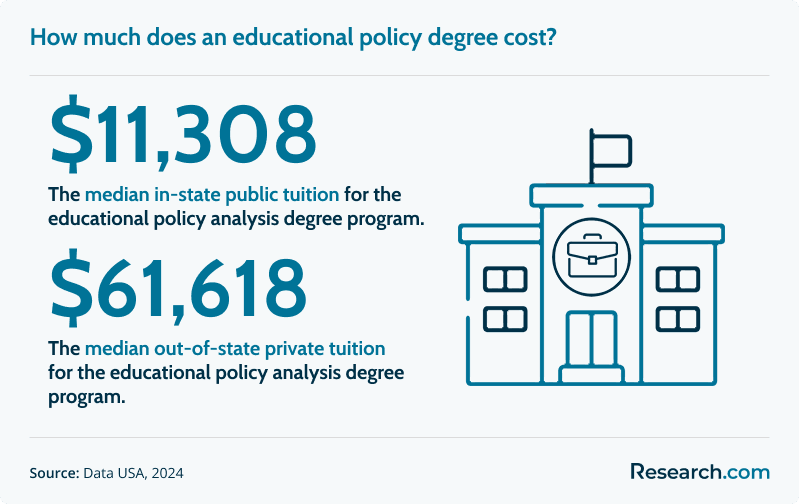
Costs vary widely by university, residency status, credit requirements, fees, and whether students can transfer prior graduate credits. According to Data USA, the median in-state public tuition for education policy programs is about $11,308 per year, while the median out-of-state private tuition can climb to $61,618 annually. Those figures make it important to compare total program cost, not only the per-credit rate.
A low per-credit price may still produce a high total cost if the program requires many credits. A higher per-credit program may be more manageable if it accepts more transfer credits or offers stronger institutional aid. Students focused on affordability should compare fast educational policy options with broader doctoral leadership programs, including Research.com’s guide to the cheapest online EdD programs.
| Cost factor | Why it matters | Question to ask |
| Per-credit tuition | Determines the baseline cost of coursework | Is the listed rate the same for online students? |
| Total required credits | Affects the real degree price | How many credits must I complete after transfer review? |
| Residency pricing | In-state and out-of-state rates may differ | Do online students pay a separate distance-learning rate? |
| Fees | Technology, graduation, dissertation, and student fees can add up | What fees are charged each term? |
| Transfer credits | Accepted credits can reduce cost and time | Which previous graduate credits are eligible? |
| Dissertation extension costs | Extra terms may increase the final bill | What happens financially if I need more time? |
Financial Aid Options for Fast Online Educational Policy Students
Online doctoral students may qualify for several forms of financial aid, depending on the school, enrollment status, citizenship or residency requirements, and program structure. Before enrolling, students should request a written cost estimate and confirm which aid options apply to online doctoral learners.
- Federal student aid: Eligible students can apply for federal aid through the FAFSA application, including loans and, in some cases, grants.
- Institutional scholarships and fellowships: Some universities provide merit-based or need-based awards for graduate students, though availability varies by program.
- Graduate assistantships: These are more common on campus, but some schools may offer remote research, teaching, or administrative assistantship opportunities.
- Employer tuition reimbursement: School districts, universities, government agencies, and education organizations may help pay for job-related doctoral study.
- Private scholarships and grants: Nonprofits, professional associations, research organizations, and advocacy groups may fund graduate education related to policy, equity, leadership, or public service.
Students comparing cost structures across online programs may also want to review lower-cost graduate and undergraduate options in other fields, such as Research.com’s guide to an affordable online philosophy degree, to understand how tuition models differ by discipline and institution type.
Admission Requirements for Fast Online Educational Policy Programs
Accelerated doctoral programs in educational policy often expect applicants to arrive with both academic preparation and professional experience. Most successful applicants have worked in education, administration, public policy, nonprofit leadership, government, or a related field where they have observed policy challenges firsthand.
- A master’s degree in education, public policy, leadership, administration, or a closely related field
- Professional experience in teaching, school leadership, higher education, policy work, program administration, or education reform
- Recommendation letters from academic or professional contacts who can speak to doctoral readiness
- A statement of purpose explaining career goals, research interests, and the policy problems the applicant wants to study
- GRE scores, although many institutions now make them optional
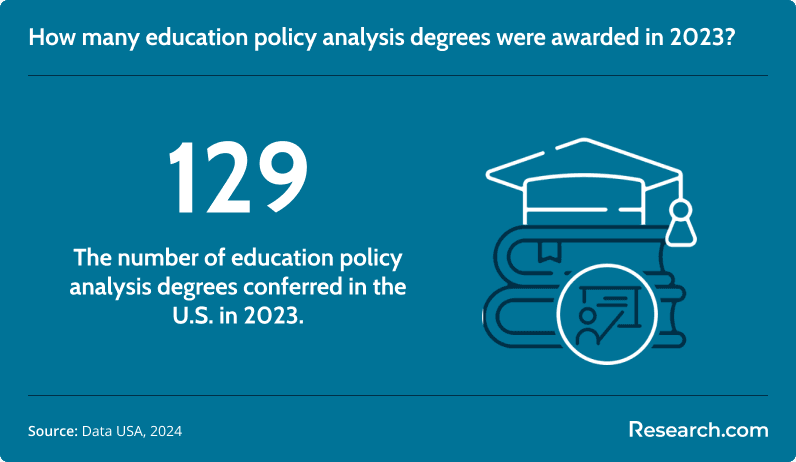
Applicants who recently completed specialized graduate study, including the shortest online graduate certificate programs in early childhood education, can use that experience to show readiness for doctoral-level education policy work. In 2023, only 129 degrees in education policy were awarded in the U.S. (Data USA), which underscores how specialized this field is. Professionals from adjacent roles can also build strong applications; for example, Research.com’s guide on how to become a school social worker can help applicants frame experience with student support, equity, and school systems.
Typical Courses in an Online Educational Policy Doctoral Program
Curricula differ by institution, but fast online educational policy programs usually combine policy theory, leadership practice, research methods, data interpretation, and applied problem solving. Many students enter after completing a master’s program in education or a specialized area, such as one of the shortest online master’s programs in science education, which can provide useful preparation in curriculum, pedagogy, and education systems.
| Course area | Common topics | How it supports policy work |
| Policy foundations | Educational Policy and Reform; Equity and Access in Education Systems | Helps students understand how laws, funding, accountability, and governance shape schools and colleges |
| Leadership and organizations | Organizational Theory in Education; Leadership in K–12 or Higher Education | Prepares students to lead change inside complex education institutions |
| Research methods | Quantitative and Qualitative Research Methods; Policy Evaluation and Impact Assessment | Builds the skills needed to analyze evidence, evaluate programs, and support decisions with data |
| Finance and administration | Budgeting and Finance in Educational Institutions | Connects resource allocation with policy outcomes and institutional priorities |
| Doctoral project preparation | Dissertation Seminar or Capstone Development | Guides students through proposal development, research design, writing, and defense preparation |
| Global and comparative policy | Global Perspectives on Education Policy | Broadens students’ understanding of education reform across different systems and contexts |
When comparing programs, look beyond course titles. Ask whether assignments are theoretical, applied, or research-heavy. Program structure can vary widely across disciplines; Research.com’s explanation of the difference between sports management and sports administration offers a useful example of how similar-sounding degrees may prepare students for different professional outcomes.
Common Specializations in Fast Online Educational Policy Programs
Specializations help students connect doctoral coursework to a specific career goal. Some programs offer formal concentrations, while others allow students to customize electives, dissertation topics, or applied research around a policy problem.
- K–12 education policy: Focuses on school funding, accountability, curriculum requirements, assessment systems, and district-level reform.
- Higher education leadership and policy: Covers college governance, student success, enrollment management, academic affairs, institutional strategy, and postsecondary regulation.
- International and comparative education policy: Examines education systems across countries, global reform movements, development issues, and cross-border policy learning.
- Education finance and resource management: Emphasizes budgeting, fiscal accountability, resource distribution, and the relationship between funding and educational outcomes.
- STEM or digital learning policy: Addresses technology access, online learning, data governance, STEM curriculum, and policy challenges tied to digital transformation.
Some professionals bring interdisciplinary interests into education policy. For example, students who have studied sustainability, compliance, or resource systems through the shortest online environmental management master’s programs may be interested in policy work connected to facilities planning, sustainability education, or institutional resource management.
How to Choose the Fastest Online Educational Policy Degree Program
The best accelerated program is not simply the shortest one. It is the program that lets you finish efficiently while still giving you credible training, useful mentoring, manageable costs, and a curriculum that matches your intended role.
Step-by-step selection checklist
- Confirm institutional accreditation. Use the U.S. Department of Education’s accreditation database to verify that the university is accredited by a recognized agency.
- Calculate total cost. Multiply tuition by required credits, then add fees, residency costs, dissertation continuation costs, and any expected travel or residency expenses.
- Ask about transfer credits before applying. A program that advertises a three-year pathway may depend on accepting previous graduate credits.
- Review the dissertation or capstone process. Find out when students choose a topic, how advisors are assigned, and how long recent students typically take to finish.
- Match the curriculum to your career goal. K–12 leadership, higher education administration, nonprofit policy, government analysis, and research roles may require different coursework.
- Evaluate faculty fit. Look for faculty whose research or professional work aligns with your interests in policy, equity, finance, leadership, technology, or evaluation.
- Check student support. Online doctoral students need access to writing support, research help, library databases, technical assistance, and career services.
| If your goal is... | Prioritize programs with... | Be cautious about... |
| District or school leadership | Educational leadership, superintendent preparation, applied policy projects | Programs with little connection to K–12 practice |
| Higher education administration | Higher education policy, governance, enrollment, student success coursework | Programs focused almost entirely on K–12 systems |
| Policy analysis or research | Strong quantitative, qualitative, and evaluation methods | Programs with limited research training |
| Nonprofit or advocacy leadership | Equity, finance, organizational change, and public policy content | Programs that do not support applied policy projects |
| Fast completion | Clear milestones, transfer credit options, dissertation support, cohort pacing | Programs that advertise speed but provide limited advising |
Career Paths for Graduates of Fast Online Educational Policy Programs
Graduates of online educational policy doctorates often pursue roles that involve leadership, analysis, program design, institutional strategy, or education reform. Outcomes depend on prior experience, location, employer type, licensure requirements, and the specific degree focus. A doctorate may strengthen qualifications for senior roles, but it does not guarantee a particular job title or salary.
| Career path | What the role does | Salary information provided |
| Instructional Coordinators | Develop curriculum standards, evaluate instructional effectiveness, support teachers, and help districts or agencies improve academic programs | On average, instructional coordinators earn around $74,720 based on 2024 figures |
| Postsecondary Education Administrators | Manage academic programs, admissions, student affairs, institutional policy, enrollment strategy, or administrative operations in colleges and universities | Postsecondary education administrators can earn as much as $103,960 annually |
| Elementary, Middle, and High School Principals | Lead school operations, supervise faculty, implement policies, manage accountability requirements, and build inclusive learning environments | Elementary, middle, and high school principals make around $104,070 annually |
| Education Policy Analyst | Research policy problems, evaluate programs, interpret data, write reports, and advise agencies, nonprofits, school systems, or advocacy organizations | Salary varies by employer, location, and experience |
| Education Consultant or Nonprofit Leader | Advise schools, districts, foundations, or advocacy groups on program design, reform strategy, compliance, equity, or evaluation | Compensation depends heavily on organization type and role scope |
Other possible paths include policy roles in government agencies, research fellowships, think tank positions, district administration, education technology leadership, and senior roles in nonprofit or advocacy organizations.
Job Market Outlook for Educational Policy Graduates
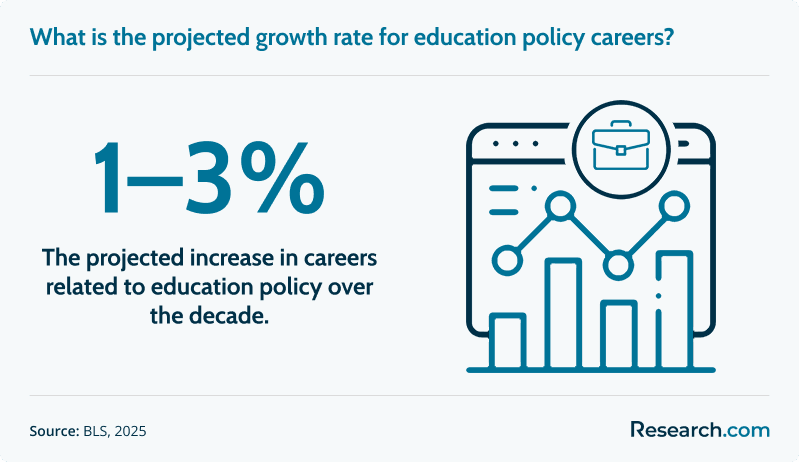
The labor market for educational policy professionals is best described as steady rather than uniformly fast-growing. Demand is shaped by retirements, policy changes, accountability requirements, school funding debates, higher education pressures, and the ongoing need for evidence-based reform.
- Instructional Coordinators: Employment is projected to grow 2% from 2023 to 2033. Even with growth slightly below the average for all occupations, about 20,100 openings are expected each year, largely because of retirements and turnover.
- Postsecondary Education Administrators: Employment is projected to grow 3% over the same period, which is in line with national job growth. About 15,200 openings are expected annually.
- Elementary, Middle, and High School Principals: Employment is projected to decline 1%, but about 20,800 openings are expected each year as schools replace retiring or transitioning leaders.
For students evaluating return on investment, these numbers suggest a realistic outlook: educational policy credentials can support leadership and analysis roles, but graduates should build practical experience, research skills, communication ability, and sector-specific expertise to remain competitive.
Accreditation and Quality Checks for Accelerated Online Programs
Accreditation is one of the most important filters when reviewing fast online educational policy programs. It affects institutional credibility, financial aid eligibility, credit transfer, employer recognition, and future academic options. Before enrolling, confirm that the university is accredited by a recognized accrediting body and that the program’s structure is appropriate for your professional goal.
Quality also depends on factors beyond accreditation. Review faculty credentials, dissertation support, graduation expectations, student services, online learning technology, and alumni outcomes where available. Students considering broader fast-track leadership degrees can compare options through Research.com’s guide to the shortest online EdD programs.
Challenges of Fast Online Educational Policy Programs
Accelerated doctoral programs can be efficient, but they are demanding. Students often manage intensive reading, research assignments, statistics or methods coursework, group discussions, and dissertation development while continuing full-time work. The compressed format can create stress if the student underestimates the weekly workload.
| Common challenge | Why it matters | How to reduce the risk |
| Compressed coursework | Shorter terms can mean faster deadlines and less recovery time | Build a weekly study schedule before classes begin |
| Limited live interaction | Asynchronous study can feel isolating | Choose programs with cohorts, live sessions, mentoring, or virtual residencies |
| Dissertation delays | The research phase often determines the real completion timeline | Ask about advisor availability, proposal timelines, and dissertation completion support |
| Technology barriers | Online learning depends on stable platforms, library access, and digital research tools | Test platforms early and confirm technical support hours |
| Burnout | Working professionals may overcommit | Consider part-time pacing if work or family obligations are substantial |
Cost pressure can add to these challenges. Students looking for a balance between affordability and doctoral quality may want to compare programs in Research.com’s guide to the most affordable online doctoral programs in educational leadership.
Support Services and Digital Tools That Matter
Strong online support can make the difference between finishing on time and losing momentum. Before enrolling, verify that online doctoral students receive the same level of access to academic, research, and career resources as campus-based students.
- Online library access: Doctoral students need databases, journals, interlibrary loan services, and research consultations.
- Writing and dissertation support: Virtual writing centers, dissertation workshops, and proposal review services can help students stay on schedule.
- Faculty mentoring: Regular advisor contact is especially important during the dissertation or capstone phase.
- Research tools: Students may need software, data platforms, citation tools, and training in qualitative or quantitative methods.
- Career services: Resume support, virtual job fairs, alumni networks, and interview preparation can help students translate the degree into advancement.
- Technical support: Reliable learning platforms and responsive help desks are essential in accelerated formats.
Technology-supported learning is not limited to education policy. Students who want to see how accelerated online delivery works in another humanities-focused field can review Research.com’s guide to the fastest online philosophy degrees.
Current Trends Affecting Educational Policy Programs
Educational policy programs are evolving as schools, colleges, and public agencies confront new pressures. Students should look for curricula that address current problems rather than relying only on traditional leadership theory.
- Data-informed decision-making: Education leaders are increasingly expected to interpret performance data, evaluate programs, and explain policy outcomes clearly.
- AI and digital learning: Policy professionals must understand issues such as academic integrity, student privacy, digital access, learning analytics, and technology procurement.
- Equity and access: Many policy debates now center on funding fairness, student support, achievement gaps, disability access, rural education, and postsecondary affordability.
- Accountability and regulation: Education leaders must navigate changing rules around institutional performance, compliance, accreditation, and public reporting.
- Interdisciplinary policy work: Education policy increasingly overlaps with information systems, public administration, workforce development, and community services. Students interested in information access and public-service systems may find useful comparisons in Research.com’s guide to inexpensive online MLIS degree programs.
What Graduates Say About Fast Online Educational Policy Programs
- Carlos: "I completed my doctorate in just under three years while keeping my full-time job and raising two children. The online structure gave me room to manage my schedule, but the academic expectations were still serious. Faculty support during the dissertation stage was especially valuable, and the degree helped me move into a policy advisory position with my state education department."
- Maya: "Studying online allowed me to examine education reform more deeply without moving or stepping away from my career. The program used practical case studies and policy problems that connected directly to my work. My cohort included professionals from different states and education settings, which made the discussions stronger. Finishing at an accelerated pace felt like a major career milestone."
- Jordan: "The flexible format let me focus on education finance while still meeting regularly with my faculty mentor. I was unsure whether a doctorate would fit into my life, but the online model made it possible. I now use the budgeting, research design, and policy evaluation skills from the program in my daily work. Being able to finish in about three years was a major advantage."
Common Mistakes to Avoid When Choosing a Fast Online Educational Policy Degree
- Choosing only by speed: A three-year timeline is useful only if the program has strong advising, clear milestones, and a manageable dissertation process.
- Ignoring accreditation: Always verify institutional accreditation before applying or accepting admission.
- Looking only at per-credit tuition: Total cost depends on required credits, fees, transfer policies, and how long the dissertation takes.
- Assuming all credits transfer: Ask for a formal transfer review. Do not rely on general statements from marketing materials.
- Overlooking career fit: A program focused on K–12 leadership may not be the best choice for someone seeking higher education policy roles, and vice versa.
- Underestimating workload: Accelerated doctoral programs require consistent weekly writing, reading, research, and discussion.
- Failing to ask about dissertation support: Many students finish coursework on time but slow down during the research phase.
Questions to Ask Before Applying
- Is the university accredited by a recognized accreditor?
- How many credits will I need after transfer evaluation?
- Can the program truly be completed in three years while working full-time?
- How are dissertation or capstone advisors assigned?
- What percentage of students finish within the advertised timeline?
- Are courses fully asynchronous, or are live sessions required?
- Are there residencies, campus visits, or synchronous research meetings?
- What student support services are available to online doctoral learners?
- Does the curriculum match my intended role in K–12 policy, higher education, nonprofit leadership, or government?
- What is the total estimated cost, including fees and continuation terms?
Key Insights
- Fast online educational policy doctorates commonly take about three years for full-time students, but transfer credits, dissertation progress, and enrollment pace can change the timeline.
- The fastest program is not automatically the best program. Accreditation, total cost, faculty fit, research support, and career alignment should drive the decision.
- Online programs are often ideal for working educators and administrators, but they require strong self-discipline and comfort with independent learning.
- Costs vary substantially. Compare total program cost rather than focusing only on advertised tuition per credit.
- Educational policy graduates may pursue roles in instructional coordination, postsecondary administration, school leadership, policy analysis, consulting, nonprofit leadership, and government work.
- The job market is steady, with projected openings driven by both growth and replacement needs, but salary and career outcomes depend heavily on experience, location, employer, and specialization.
- Before applying, verify accreditation, ask about transfer credits, review dissertation support, and confirm that the curriculum matches the policy problems you want to solve.
References:
- BLS. (2025, August 28). Elementary, middle, and high school principals. bls.gov.
- BLS. (2025, August 28). Instructional coordinators. bls.gov.
- BLS. (2025, August 28). Postsecondary education administrators. bls.gov.
- Data USA. (2024). Education Policy Analysis. datausa.io.
- ZipRecruiter. (2025). Salary: Education Policy Analyst (Jul, 2025) United States. ziprecruiter.com.
Other Things You Should Know About the Fastest Online Educational Policy Degree Programs
Some of the fastest online educational policy degree programs for 2027 include options from institutions like the University of Pennsylvania, Arizona State University, and the University of Northern Colorado, which offer accelerated coursework that can be completed in as little as 12 months.
Completing a fast online educational policy degree in 2027 may present challenges like managing a condensed curriculum, balancing work and study obligations, and limited networking opportunities. Additionally, accelerated programs may require strong self-discipline and time management skills to meet rigorous academic demands.
Yes, some accelerated EdD programs in education policy offer alternatives to the traditional dissertation. These may include capstone projects, applied research reports, or problems-of-practice studies that are directly tied to a student’s current job role. These non-dissertation pathways are typically more practice-oriented, making them ideal for working professionals who want to implement policy changes in real time.
It's important to verify this detail when researching programs, as not all institutions offer such options. These alternatives can also shorten the time needed to graduate.