2027 Most Affordable Online Philosophy Degree Programs

Co-Founder and Chief Data Scientist
Choosing an online philosophy degree is usually a cost-and-fit decision, not just an academic one. You may want the intellectual training philosophy provides—clear reasoning, ethical judgment, careful reading, and persuasive writing—but you also need a program that works with your budget, schedule, transfer credits, and career plans.
This guide is for students comparing affordable online philosophy bachelor’s programs, including working adults, transfer students, military learners, parents, and students who cannot relocate for college. You will find program options, tuition details, completion timelines, financial aid considerations, course expectations, career paths, and practical questions to ask before enrolling.
Quick answer: Is an online philosophy degree worth considering?
An online philosophy degree can be a practical choice if you want a flexible humanities degree that builds transferable skills for law, policy, education, nonprofit work, communications, ethics-related roles, and graduate study. It is less career-specific than degrees in nursing, accounting, or engineering, so the best return usually comes when students pair philosophy with internships, writing samples, research experience, a minor, a certificate, or a clear post-graduation plan.
What are the benefits of getting an online philosophy degree?
- Flexible study: Online programs can make it easier to complete readings, write papers, and participate in discussions while managing work, caregiving, military service, or other responsibilities.
- Potential cost savings: Students may reduce expenses tied to commuting, housing, relocation, and campus-based fees, although tuition and aid policies vary by school.
- Transferable skills: Philosophy coursework strengthens critical thinking, ethical analysis, argument construction, close reading, and written communication—skills used in many professional settings.
What can I expect from an online philosophy degree?
An online philosophy degree studies major questions about knowledge, reality, morality, identity, justice, religion, language, and human reasoning. Instead of memorizing fixed answers, students learn how to evaluate arguments, identify assumptions, compare competing viewpoints, and write clearly about complex ideas.
Most programs combine classic philosophical texts with contemporary issues. You may read Plato, Aristotle, Kant, Mill, Descartes, Rawls, or contemporary ethicists while also discussing topics such as artificial intelligence, medical decision-making, social media, political conflict, environmental responsibility, and human rights.
Online delivery usually includes recorded lectures, digital readings, discussion boards, written assignments, faculty feedback, quizzes, and sometimes live seminars. Philosophy can work well online because much of the learning depends on reading, reflection, writing, and structured debate. However, students must be comfortable managing deadlines and engaging actively in written discussion.
| What you will study | Why it matters | How it is usually assessed online |
| Logic and argumentation | Helps you evaluate claims, evidence, and reasoning | Problem sets, argument analyses, quizzes, short essays |
| Ethics and applied ethics | Builds frameworks for evaluating moral dilemmas in work and society | Case studies, discussion posts, policy-style papers |
| History of philosophy | Provides context for major intellectual traditions and debates | Reading responses, exams, comparative essays |
| Political philosophy | Explores justice, rights, law, power, and public institutions | Research papers, debates, textual analysis |
| Metaphysics and epistemology | Develops abstract reasoning about reality, knowledge, and belief | Analytical essays, seminar participation, final projects |
Where can I work with an online philosophy degree?
Philosophy is not a single-track professional degree, so graduates often move into fields where reasoning, ethics, research, and communication are central. Common destinations include law-related work, public policy, education, nonprofit administration, communications, human resources, business ethics, technology ethics, and graduate or professional school.
Some roles may require additional credentials. For example, becoming a lawyer requires law school and licensure; teaching in public high schools may require state teacher certification; and postsecondary teaching generally requires graduate education. The degree can provide a strong foundation, but students should verify the requirements for their target role early.
How much can I make with an online philosophy degree?
Earnings vary widely because philosophy graduates enter many occupations. The degree itself does not guarantee a specific salary. Pay depends on the industry, location, experience, advanced education, internships, professional certifications, and the role you pursue after graduation.
Entry-level roles such as paralegal or nonprofit program coordinator commonly fall between $45,000 and $60,000 annually. Mid-level roles such as policy analyst or human resources specialist may reach around $70,000 to $85,000. Graduates who continue into law, academia, or other advanced fields may pursue positions paying $90,000 to over $120,000 per year.
- Best online philosophy degree programs for 2027
- How long does an online philosophy degree take?
- Online vs. on-campus philosophy degree comparison
- Average cost of an online philosophy degree
- Financial aid options for online philosophy students
- Admissions requirements and prerequisites
- Common online philosophy degree courses
- Available philosophy specializations
- Return on investment of an online philosophy degree
- How to choose the right online philosophy program
- How online philosophy programs are changing in the digital age
- Technology and design careers for philosophy graduates
- Career paths for online philosophy graduates
- Job market for philosophy degree holders
- Creative writing skills and philosophy careers with job market context
List of the Best Online Philosophy Degree Programs for 2027
How do we rank schools?
Research.com evaluates online philosophy degree programs with a focus on affordability, academic credibility, and usefulness for students comparing real enrollment options. Our ranking process uses our methodology and draws from established education data resources, including:
- IPEDS database
- Peterson's database, including the Distance Learning Licensed Data Set
- College Scorecard database
- National Center for Education Statistics
Use the list as a starting point, not as your only decision tool. Before applying, confirm current tuition, transfer policies, residency rules, online course availability, scholarship eligibility, and whether the program’s curriculum matches your goals.
| School | Online philosophy program | Program length | Listed tuition or cost | Accreditation |
| Oregon State University | Bachelor of Arts or Science in Philosophy | 3 to 4 years | $384 per credit | Northwest Commission on Colleges and Universities (NWCCU) |
| American Public University | Bachelor of Arts in Philosophy | 4 years | $350 per credit and $250 with preferred military rate | Higher Learning Commission (HLC) |
| Arizona State University | Bachelor of Arts in Philosophy | 4 years | $663 | HLC |
| University of New Orleans | Bachelor of Arts in Philosophy | 4 years | $9,454 per year | Southern Association of Colleges and Schools Commission on Colleges (SACSCOC) |
| Liberty University | Bachelor of Science in Philosophy, Politics, and Economics | 4 years | $390 per credit full-time and $455 per credit part-time | SACSCOC |
| University of Arizona | Bachelor of Arts in Philosophy with an Ethics Specialization | 4 years | $525 per credit | WASC Senior College and University Commission (WSCUC) |
| University of Colorado at Colorado Springs | Bachelor of Arts in Philosophy | 4 years | $435 per credit in-state and $636 per credit out-of-state | HLC |
| Franciscan University of Steubenville | Bachelor of Arts in Philosophy | 4 years | $35,000 per year | HLC |
| Holy Apostles College and Seminary | Bachelor of Arts in Philosophy | 2 to 3 years | $395 per credit | New England Commission on Higher Education |
1. Oregon State University Bachelor of Arts or Science in Philosophy
Oregon State University offers an online Bachelor of Arts or Science in Philosophy through Ecampus. The program emphasizes engaged philosophy, connecting long-standing philosophical questions with current issues such as social media, artificial intelligence, and politics. Students complete 180 quarter credits, equivalent to 120 semester credits, and the degree is available entirely online with four annual start terms.
Students can also shape the degree with additional minors or certificates, including Medical Humanities, which may be useful for learners interested in healthcare ethics, public health, or interdisciplinary humanities study.
- Program Length: 3 to 4 years
- Tracks/concentrations: N/A
- Cost per Credit/Tuition: $384 per credit
- Accreditation: Northwest Commission on Colleges and Universities (NWCCU)
2. American Public University Bachelor of Arts in Philosophy
American Public University (APU) provides a fully online Bachelor of Arts in Philosophy centered on Western philosophical traditions. The 120-credit curriculum covers logic, ethics, metaphysics, epistemology, and the philosophy of science while building analytical reasoning and structured writing skills.
Students may choose concentrations in Ethics, the History of Philosophy, or Social Justice. This makes the program a fit for learners who want to connect philosophical study to education, business, advocacy, ethics, or social issues.
- Program Length: 4 years
- Tracks/concentrations: Ethics, history of philosophy, and social justice.
- Cost per Credit/Tuition: $350 per credit and $250 with preferred military rate
- Accreditation: Higher Learning Commission (HLC)
3. Arizona State University Bachelor of Arts in Philosophy
Arizona State University’s online Bachelor of Arts in Philosophy introduces students to major areas of philosophical inquiry while emphasizing critical thinking, logical reasoning, and communication. The 120-credit degree includes study in metaphysics, epistemology, ethics, and electives focused on the social relevance of philosophy.
Courses run in 7.5-week sessions, giving students several start opportunities throughout the year. The program also includes a second-language proficiency requirement, which supports broader cultural and global perspectives.
- Program Length: 4 years
- Tracks/concentrations: Metaphysics, epistemology, and ethics.
- Cost per Credit/Tuition: $663
- Accreditation: HLC
4. University of New Orleans Bachelor of Arts in Philosophy
The University of New Orleans offers a fully online Bachelor of Arts in Philosophy for students who need a flexible format because of work, family, location, or other commitments. Online courses are taught by the same faculty who teach on campus, helping maintain consistency across delivery formats.
The curriculum includes logic, ethics, metaphysics, and epistemology. Courses are delivered asynchronously through Canvas and Panopto, allowing students to manage coursework around their schedules. Online students receive in-state tuition rates regardless of location, and eligible students nearing graduation may benefit from awards such as the Carl Muckley Award and the Norton Nelkin Scholarship.
- Program Length: 4 years
- Tracks/concentrations: N/A
- Cost per Credit/Tuition: $9,454 per year
- Accreditation: Southern Association of Colleges and Schools Commission on Colleges (SACSCOC)
5. Liberty University Bachelor of Science in Philosophy, Politics, and Economics
Liberty University offers an online Bachelor of Science in Philosophy, Politics, and Economics, often called PPE. The program combines philosophical inquiry, political theory, and economic analysis through a Christian perspective.
The 120-credit curriculum includes topics such as the growth of the American economy, ethical questions connected to socialism, and relationships among government, business, and labor. Courses include Forecasting and Predictive Analytics, Constitutional Government and Free Enterprise, and Dilemmas in Socialism and Marxism, with a capstone project at the end of the program.
- Program Length: 4 years
- Tracks/concentrations: American economy, ethics, and politics.
- Cost per Credit/Tuition: $390 per credit (full-time), and $455 per credit (part-time).
- Accreditation: SACSCOC
7. University of Arizona Bachelor of Arts in Philosophy with an Ethics Specialization
The University of Arizona offers a fully online Bachelor of Arts in Philosophy with an Ethics Specialization for students who want to focus on moral reasoning and contemporary ethical problems. The 120-credit program includes topics such as medical ethics, law and morality, and the philosophy of happiness.
Courses such as PHIL 321: Medical Ethics and PHIL 324: Law and Morality ask students to analyze real-world dilemmas in healthcare, legal systems, and public life. Graduates may apply their training to law, public policy, healthcare-related fields, education, or further study.
- Program Length: 4 years
- Tracks/concentrations: Ethics
- Cost per Credit/Tuition: $525 per credit
- Accreditation: WASC Senior College and University Commission (WSCUC)
8. University of Colorado at Colorado Springs Bachelor of Arts in Philosophy
The University of Colorado Colorado Springs (UCCS) offers a fully online Bachelor of Arts in Philosophy through the College of Letters, Arts & Sciences. The 120-credit program has no campus attendance requirement and uses 16-week fall and spring semesters, along with 8-week summer courses.
Students study subjects such as cosmology, world religions, virtue ethics, epistemology, and political philosophy. They may also add minors in Religious Studies, Asian Studies, Classics, or Pre-Law. A senior thesis gives students an opportunity to conduct focused philosophical research under faculty guidance.
- Program Length: 4 years
- Tracks/concentrations: Religious studies, asian studies, and pre-law.
- Cost per Credit/Tuition: $435 per credit (in-state), and $636 per credit (out-of-state).
- Accreditation: HLC
9. Franciscan University of Steubenville Bachelor of Arts in Philosophy
Franciscan University of Steubenville offers a fully online Bachelor of Arts in Philosophy grounded in a Catholic intellectual framework. Students explore questions about human nature, God, meaning, truth, and moral life through courses taught by faculty who have pledged fidelity to the Catholic magisterium.
The curriculum includes metaphysics, ethics, logic, and epistemology, and students complete a senior thesis. The degree also satisfies the philosophy requirements established by the United States Conference of Catholic Bishops for entrance into a major seminary, making it especially relevant for students considering Church-related vocations.
- Program Length: 4 years
- Tracks/concentrations: Catholic worldview
- Cost per Credit/Tuition: $35,000 per year
- Accreditation: HLC
10. Holy Apostles College and Seminary Bachelor of Arts in Philosophy
Holy Apostles College & Seminary offers a fully online Bachelor of Arts in Philosophy shaped by the Catholic intellectual tradition and Thomistic philosophy. The 120-credit program can be completed in as little as 2.6 years, depending on student pace and applicable credits.
Coursework includes logic, metaphysics, epistemology, and the philosophy of God. The program is designed to deepen students’ understanding of Christian belief while strengthening their ability to explain, defend, and analyze ideas in writing and discussion.
- Program Length: 2 to 3 years
- Tracks/concentrations: Thomistic philosophy
- Cost per Credit/Tuition: $395 per credit
- Accreditation: New England Commission on Higher Education
How long does it take to complete an online philosophy degree program?
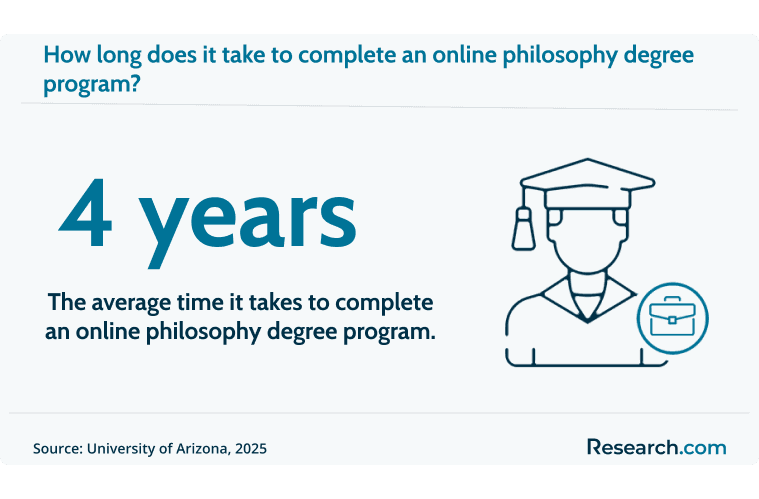
Most online bachelor’s degrees in philosophy take about four years of full-time study. A typical program requires around 120 semester credit hours, usually divided among general education courses, philosophy major requirements, electives, and a capstone or senior project.
Part-time students often need more than four years, depending on how many courses they take each term. Students with transfer credits, prior college coursework, summer enrollment, or accelerated terms may be able to finish sooner. Before enrolling, ask the school for a degree plan that shows exactly how your transfer credits apply and how many remaining credits you must complete.
| Student type | Typical pace | What to check before enrolling |
| First-time full-time student | About four years | Major requirements, general education sequence, language requirements, and course rotation |
| Part-time working adult | Often more than four years | Maximum time to degree, course availability, and support for online learners |
| Transfer student | May finish faster | Transfer credit acceptance, residency credit requirements, and upper-division philosophy credits |
| Accelerated learner | Depends on school format | Short-term courses, summer options, workload expectations, and tuition impact |
How does an online philosophy degree program compare to an on-campus program?
Online and on-campus philosophy degrees can cover the same academic content, especially when they are offered by accredited institutions. The bigger differences involve schedule structure, classroom interaction, learning style, and access to campus resources.
| Factor | Online philosophy degree | On-campus philosophy degree | Best fit |
| Academic content | Usually includes the same core subjects: logic, ethics, metaphysics, epistemology, and political philosophy | Also covers the same foundational areas, often with more in-person seminars | Either format can work if the program is accredited and academically rigorous |
| Flexibility | Often allows asynchronous study and fewer location constraints | Requires attendance at scheduled class times and campus locations | Online is often better for working adults, parents, and learners comparing online degree programs for adults |
| Interaction | Uses discussion boards, video meetings, email, and digital feedback | Offers face-to-face discussion, office hours, and campus events | Campus may suit students who value spontaneous seminar discussion |
| Learning style | Requires self-direction, strong time management, and comfort with reading and writing independently | Provides more built-in structure and in-person accountability | Online works best for disciplined learners; campus may help students who need more routine |
| Access | Removes relocation and commuting barriers | May provide easier access to libraries, clubs, faculty events, and campus networks | Students should compare support services, not just delivery mode |
What is the average cost of an online philosophy degree program?
The cost of an online philosophy degree depends on tuition structure, transfer credits, residency rules, enrollment status, military benefits, grants, fees, and textbook costs. Looking only at the advertised per-credit price can be misleading because your final cost depends on how many credits you must complete through that school.
The following examples show how tuition totals can change based on the per-credit rates provided:
- Full-Time ($42,000): At $350 per credit hour for 120 credits, tuition totals $42,000 before fees, books, and aid.
- Preferred Military Rate ($30,000): A $250 per credit hour military rate lowers the full 120-credit tuition total to $30,000.
- Part-Time ($54,600): A $455 per credit hour rate produces a 120-credit tuition total of $54,600, which may be worthwhile for flexibility but raises the overall tuition amount.
- Veteran Grant or APUS Opportunity Grant ($37,800): A reduced $315 per credit hour rate brings 120-credit tuition to $37,800 for eligible students.
Students comparing humanities programs with other budget-conscious online options, such as the most affordable online bachelor's in management, should compare total degree cost rather than only program reputation or per-credit tuition. A philosophy degree may be affordable on paper, but transfer credit limits, required upper-division courses, and fees can change the final price.
| Cost scenario | Per-credit rate | Credits used in example | Estimated tuition total | Who may qualify |
| Full-time standard rate | $350 | 120 | $42,000 | Students paying the regular listed rate |
| Preferred military rate | $250 | 120 | $30,000 | Eligible military students |
| Part-time rate | $455 | 120 | $54,600 | Students choosing a lighter course load under this pricing model |
| Veteran Grant or APUS Opportunity Grant | $315 | 120 | $37,800 | Eligible veterans or qualifying students |
The chart below provides another view of how these tuition scenarios compare.
What are the financial aid options for students enrolling in an online philosophy degree program?
Online philosophy students may qualify for many of the same financial aid options available to campus-based students, provided the school and program meet eligibility requirements. Always confirm that your program is eligible for federal aid before you enroll.
- Federal and State Grants: Grants may reduce out-of-pocket costs and typically do not need to be repaid. Students should submit the Free Application for Federal Student Aid (FAFSA) to determine eligibility for federal aid programs.
- Federal Student Loans: Federal loans can help spread costs over time, but they must be repaid with interest. Borrow only what you need and review repayment terms before accepting loan funds.
- Scholarships: Colleges, departments, foundations, and outside organizations may offer scholarships for online students, transfer students, humanities majors, adult learners, military students, or students with financial need.
- Employer Tuition Reimbursement and Work-Study: Some employers help pay for approved degree programs, especially when the degree supports communication, ethics, management, policy, or leadership skills. Eligible students may also explore work-study opportunities.
- Military and Veteran Benefits: Active-duty service members, veterans, and eligible family members may qualify for tuition discounts or education benefits. Students can review official benefit information through the U.S. Department of Veterans Affairs GI Bill website.
Financial aid rules can also apply to online certificates and career-focused programs, including options such as the most affordable online sterile processing technician certificate programs. The key is to verify program eligibility, accreditation, aid deadlines, and whether your enrollment status affects award amounts.
What are the prerequisites for enrolling in an online philosophy degree program?
Most online bachelor’s programs in philosophy are accessible to first-time college students and transfer students. Requirements vary by institution, but applicants generally need proof that they are ready for college-level reading, writing, and research.
- High School Diploma or Equivalent: Most programs require a high school diploma or GED for bachelor’s-level admission.
- Minimum GPA: Some schools use a minimum GPA, often around 2.5 to 3.0 on a 4.0 scale, although requirements differ by institution and applicant type.
- Standardized Test Scores: Many online programs no longer require SAT or ACT scores, but some may still consider them. Check each school’s test policy before applying.
- English Proficiency: Students whose first language is not English may need TOEFL, IELTS, or another approved proof of English proficiency because philosophy programs require extensive reading and writing.
- Technical Requirements: Online students need dependable internet access, a suitable computer, basic digital literacy, and the ability to use learning management systems, video tools, and online library resources.
Compared with more specialized graduate pathways, such as programs with detailed SLP grad school requirements, undergraduate philosophy programs often have broader admission access. Still, students should not underestimate the reading and writing workload.
What courses are typically in an online philosophy degree program?
An online philosophy curriculum usually combines broad introductory study with advanced electives and writing-intensive seminars. The exact course names vary by school, but most programs cover several core areas.
- Introduction to Philosophy: Surveys major questions about reality, knowledge, ethics, meaning, and human nature while introducing influential thinkers and methods of philosophical analysis.
- Logic and Critical Thinking: Teaches students to identify valid and invalid reasoning, evaluate arguments, recognize fallacies, and present ideas with precision.
- Ethics: Examines moral theories and applies them to issues such as business conduct, healthcare decisions, social justice, and personal responsibility.
- History of Philosophy: Covers major periods such as Ancient, Medieval, Modern, or Contemporary philosophy and shows how earlier debates continue to shape current questions.
- Political Philosophy: Studies justice, rights, liberty, authority, law, and government through thinkers such as Plato, Locke, and Rawls.
- Philosophy of Mind or Metaphysics: Investigates consciousness, identity, reality, existence, free will, time, causality, and related abstract questions.
Students may also choose electives such as Philosophy of Religion, Environmental Ethics, Philosophy of Science, Bioethics, Technology Ethics, or Applied Ethics. Many programs end with a seminar, senior thesis, or capstone project that requires independent research and sustained argumentation. Students considering doctoral study may later compare pathways such as the doctor of education vs doctor of philosophy, since both involve advanced research but serve different professional goals.
What types of specializations are available in an online philosophy degree program?
Specializations help students connect philosophy to career goals, graduate study, or personal interests. Not every program offers formal concentrations, so check whether the school provides a named track, a minor, a certificate, or simply elective clusters.
| Specialization | What it focuses on | Good fit for students interested in |
| Ethics | Moral theories and applied dilemmas in healthcare, business, technology, and public life | Law, healthcare ethics, compliance, nonprofit work, public policy |
| Political Philosophy | Justice, rights, authority, democracy, law, and political institutions | Government, advocacy, law school, policy research |
| Philosophy of Mind | Consciousness, cognition, identity, perception, and mind-body questions | Psychology, cognitive science, AI ethics, human-centered technology |
| Metaphysics | Reality, existence, causality, time, free will, and the structure of the world | Graduate study, theology, theoretical research, advanced philosophy |
| Philosophy of Religion | Faith, reason, arguments about God, religious language, and comparative belief systems | Theology, ministry, seminary preparation, religious education |
| Applied Philosophy | Practical ethical issues in medicine, environment, business, law, and technology | Students exploring fields such as the environmental lawyer career path or sustainability-related policy work |
What is the return on investment of an online philosophy degree?
The ROI of an online philosophy degree depends heavily on cost control and career strategy. Philosophy can be valuable because it builds durable skills—reasoning, writing, ethical judgment, research, and communication—but it does not automatically lead to one fixed occupation. Students who get the strongest value usually graduate with a clear plan for applying those skills.
To evaluate ROI, compare total tuition after aid, expected time to completion, lost income if you reduce work hours, loan repayment, transfer credit acceptance, and the credentials required for your target field. A low-cost program with generous transfer credit may offer a better return than a higher-priced program if both meet your academic and career needs.
Students can also strengthen ROI by adding complementary skills. For example, philosophy students interested in publishing, communications, public scholarship, or content strategy may compare options such as writing degrees online to develop stronger narrative and professional writing abilities.
How do I choose the best online philosophy degree program?
The best online philosophy degree is the one that is accredited, affordable for your situation, academically appropriate, and aligned with your next step after graduation. A low tuition rate matters, but it should not be the only deciding factor.
- Confirm accreditation: Choose a school accredited by a recognized agency such as the Higher Learning Commission or another regional accreditor. Accreditation affects credit transfer, graduate school admission, employer recognition, and federal aid eligibility.
- Review the curriculum: Make sure the program includes the areas you care about, such as ethics, political philosophy, law and morality, religion, logic, or technology ethics.
- Check faculty expertise: Look for faculty whose research and teaching interests match your goals. This matters if you plan to write a thesis, apply to graduate school, or seek strong recommendations.
- Compare flexibility: Ask whether courses are asynchronous, how often required courses are offered, and whether online students receive academic advising and library support. Many best online colleges for working adults emphasize flexible scheduling because course timing can determine whether students persist.
- Calculate total cost: Compare tuition, fees, books, transfer credits, aid, scholarships, military rates, and time to completion. Do not choose based only on the cheapest advertised credit hour.
Questions to ask before applying
- Is the institution accredited, and is the online program covered by that accreditation?
- How many of my transfer credits will apply directly to the degree?
- Are all required philosophy courses available online often enough for me to graduate on time?
- Are courses asynchronous, synchronous, or mixed?
- Does the program require a second language, senior thesis, capstone, internship, or proctored exams?
- What scholarships or tuition discounts are available for online students?
- What career advising, writing support, library access, and faculty mentoring do online students receive?
- Will this degree support my intended next step, such as law school, graduate study, teaching, policy work, or nonprofit employment?
How are online philosophy programs adapting to the digital age?
Online philosophy programs are increasingly shaped by digital learning tools, contemporary ethical questions, and interdisciplinary study. Many courses now use video discussions, collaborative documents, online library databases, discussion forums, and structured peer review to support close reading and argument development.
The content is also changing. Students may examine artificial intelligence, data privacy, platform ethics, misinformation, digital identity, and technology’s impact on social life. Some learners combine philosophical training with creative or professional fields; for example, students interested in interdisciplinary writing and analysis may explore options such as affordable online MFA creative writing programs after or alongside humanities study.
Can an online philosophy degree open doors to technology and design careers?
A philosophy degree can support technology and design careers when students deliberately add technical, research, product, or design skills. Philosophy alone is usually not enough for a UX, product, or technology role, but it can provide a strong foundation for ethical reasoning, user-centered thinking, problem framing, and clear communication.
Students interested in technology should build a portfolio, learn relevant tools, complete projects, and consider additional training. For example, an online BS in UX degree may help philosophy students translate human-centered reasoning into practical design, research, and product development skills.
What career paths are available for graduates of online philosophy degree programs?
Philosophy graduates enter many fields because the degree develops skills used across occupations. The roles below show common options and listed average salary data, but actual pay depends on location, employer, experience, education level, and additional credentials.
| Career path | Listed salary | How philosophy helps | Additional preparation to consider |
| Paralegal | $61,010 | Legal research, argument analysis, attention to wording, and ethical awareness | Paralegal certificate, legal internship, document management skills |
| Policy Analyst | $100,949 | Evaluation of public problems, policy arguments, evidence, and social consequences | Statistics, public policy coursework, internship, graduate study |
| Ethics Consultant | $85,000 | Applied ethics, decision frameworks, stakeholder analysis, and communication | Industry experience, compliance knowledge, healthcare or business ethics training |
| Postsecondary Philosophy Instructor | $83,980 | Advanced philosophical knowledge, teaching, research, and academic writing | Graduate degree, teaching experience, publications or research |
| Nonprofit Program Coordinator | $54,198 | Mission-driven reasoning, communication, advocacy, and project coordination | Grant writing, volunteer management, budgeting, community engagement |
Philosophy can also support work in human resources, organizational ethics, and consulting. Students interested in organizational roles may find that ethical analysis connects with topics covered in an HR consultant career guide. Others may move into finance, law, or analytics after additional training, similar to students researching masters in finance careers, where reasoning and problem-solving are also important.
The chart below summarizes several philosophy-related career options and average salary figures.
What is the job market for graduates with an online philosophy degree?
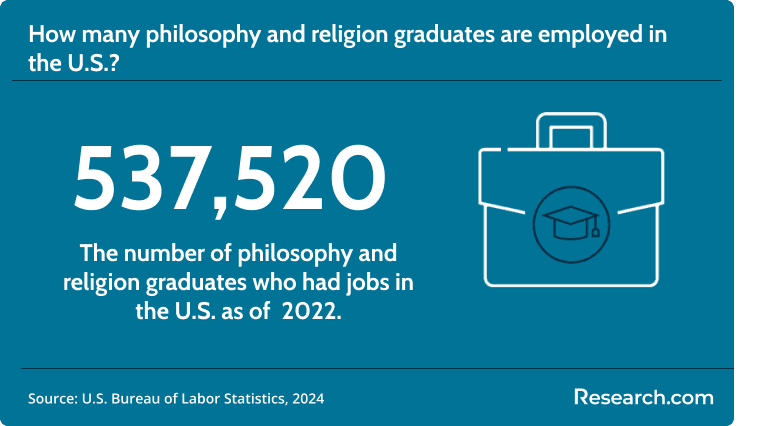
The job market for philosophy graduates is broad rather than narrowly defined. According to the U.S. Bureau of Labor Statistics, people with degrees in philosophy and religion held approximately 537,520 jobs in 2022 and had a median annual wage of $60,000. The same BLS field-of-degree data reported that 65% worked in jobs requiring at least a bachelor's degree and 58% held advanced degrees.
These figures show an important reality: many philosophy graduates use the degree as a foundation and then specialize through work experience, graduate education, professional school, or industry-specific skills. Employers in education, law, public policy, ethics, business, nonprofit organizations, and technology may value philosophy graduates when they can show strong writing, research, judgment, and communication abilities.
Students comparing philosophy with more directly job-aligned fields, such as a HR degree, should consider how much structure they want from the major itself. Philosophy offers flexibility, but students must be proactive about internships, networking, professional writing samples, and targeted skill development.
Can creative writing skills boost my philosophy career opportunities?
Creative writing can make a philosophy background more marketable by improving storytelling, audience awareness, public communication, and persuasive expression. This combination can be useful in publishing, nonprofit communications, policy writing, education, media, grant writing, and public-facing research.
Students interested in writing-intensive careers should build a portfolio that includes analytical essays, opinion pieces, policy briefs, research summaries, scripts, articles, or long-form narrative work. Those considering graduate creative writing pathways can review jobs for MFA creative writing to understand how writing credentials may connect with teaching, editing, communications, and content careers.
Common mistakes to avoid when choosing an online philosophy degree
- Choosing only by tuition: A low per-credit rate is helpful, but total cost depends on transfer credits, fees, course availability, and time to graduation.
- Ignoring accreditation: Accreditation affects financial aid, transferability, graduate admission, and employer confidence.
- Assuming online means easier: Philosophy requires heavy reading, careful writing, and abstract reasoning. Online students need discipline and time management.
- Skipping career planning: Because philosophy is flexible, students should identify target roles early and add internships, certificates, minors, or work samples.
- Not checking course rotation: If required upper-level philosophy courses are offered infrequently, graduation may take longer than expected.
- Overlooking graduate or licensure requirements: Careers in law, public school teaching, counseling, and academia may require additional education or credentials.
Here’s what graduates have to say about their online philosophy degrees:
Studying philosophy online made it possible for me to keep my full-time job while working through ideas that changed how I think and write. The flexible format helped me stay engaged with the material without stepping away from my personal responsibilities. — Lena
I worried that philosophy would lose something online, but the discussions were more thoughtful than I expected. Having time to read, reflect, and respond carefully helped me grow, and I learned from classmates with very different experiences. — Carlos
My online philosophy degree strengthened the reasoning and communication skills I now use as a policy analyst. The program was convenient, but more importantly, it taught me how to work through difficult questions with clarity. — Mira
Key Insights
- Online philosophy degrees are best for students who want flexible study and broad analytical training, but they work best when paired with a clear career or graduate-school plan.
- Most online philosophy bachelor’s programs require about 120 credit hours and take around four years for full-time students, though transfer credits and accelerated formats can change the timeline.
- Listed online philosophy tuition examples range from $250 to $455 per credit, producing total tuition examples from approximately $30,000 to $54,600 for 120 credits.
- Philosophy graduates held around 537,520 jobs in 2022, with a median annual wage of about $60,000, according to the U.S. Bureau of Labor Statistics.
- Accreditation, transfer credit policy, course availability, faculty expertise, and total net cost matter more than rankings alone.
- Career outcomes are strongest when students build applied experience through internships, writing portfolios, research projects, policy work, technical skills, or graduate preparation.
- Financial aid options such as FAFSA-based aid, scholarships, military benefits, and employer tuition reimbursement can significantly reduce out-of-pocket cost for eligible students.
References:
- American Public University. (2025). Online Bachelor of Arts in Philosophy (BA). American Public University program page
- Liberty University. (2025). Liberty University Online Tuition and Fees. Liberty University tuition information
- U.S. Bureau of Labor Statistics. (2024). OOH: Postsecondary Teachers. BLS Postsecondary Teachers profile
- U.S. Bureau of Labor Statistics. (2023). Field of degree: Philosophy and religion. BLS philosophy and religion field-of-degree data
- University of Arizona. (2025). Philosophy: Ethics Specialization: Bachelor of Arts. University of Arizona online program page
- ZipRecruiter. (2025). Policy Analyst Salary. ZipRecruiter salary data
Other Things You Should Know About Online Philosophy Degree Programs
Yes. Regionally accredited philosophy degrees are the most widely accepted for graduate admissions and transfer credit review. Many master’s programs require at least a 3.0 GPA, official transcripts, and 30 to 36 credit hours of upper-division philosophy coursework.
In 2027, some of the most affordable online philosophy degree programs include those offered by the University of the People, Fort Hays State University, and the University of North Dakota. These programs might offer specializations like ethics, logic, or the philosophy of religion, depending on the institution's curriculum.