
2027 Best Online Cinematography Degree Programs

Co-Founder and Chief Data Scientist
The language of cinema starts with the shot. Since the inception of silent films, the only constant has been visual storytelling through light, chiaroscuro, and mise en scène: the art of cinematography. It’s not just about capturing images; it's about crafting emotion, tone, and perspective through the camera lens.
Today, the craft has expanded beyond studio lots and film reels. Aspiring cinematographers can now train with top-tier instructors, collaborate with peers, and develop professional portfolios at the comfort of their homes. Online cinematography degree programs offer the flexibility to learn both the art and the tech behind the camera without pressing pause on your life.
The first critical step? Choosing the right program. In this guide, we’ll spotlight the most compelling programs available, and help you find the one that fits your vision.
What are the benefits of getting an online cinematography degree?
- Online cinematography degree graduates earn a median annual salary of $58,100, with potential for growth as they gain experience and build reel credits (ZipRecruiter, n.d.).
- The job outlook for camera operators and cinematographers is projected to grow 3% from 2023 to 2033, keeping pace with the broader creative industry (BLS, 2024).
- Online cinematography degree programs offer unmatched flexibility, allowing students to build strong portfolios and technical skills without relocating or pausing their careers.
What can I expect from an online cinematography degree?
Online cinematography degree programs are built for learners who want to sharpen their visual storytelling skills without relocating or stepping away from home. Here's what you can typically expect:
- Foundations of Visual Storytelling: Learn how composition, lighting, and movement shape emotion through virtual lectures and interactive feedback sessions.
- Hands-On Camera Practice at Home: Master DSLR, mirrorless, or even smartphone cinematography with guided remote assignments that simulate on-set challenges.
- Mentorship from Working Cinematographers: Get real-world feedback from industry professionals through scheduled video critiques and one-on-one sessions.
- Flexible Production Projects: Create short films and reels on your own schedule—perfect for building a portfolio while balancing other commitments.
- Virtual Peer Collaboration: Join online film crews and team up with classmates across the globe to plan, shoot, and edit projects together.
- Remote Equipment Guidance: Learn how to get the most from the gear you already own, with tailored advice on setups, lighting rigs, and audio.
Where can I work with an online cinematography degree?
With a strong portfolio and technical skillset, online cinematography degree graduates find opportunities in industries where visual storytelling is in high demand. Here are some of the most dynamic and creative environments where your training can lead:
- Streaming Platforms and Original Content Studios: Work on digital and branded content for services like Netflix, Hulu, or YouTube Originals.
- Advertising and Creative Agencies: Craft cinematic campaigns for global brands, blending storytelling with product marketing.
- Music and Live Event Production: Capture performances, behind-the-scenes footage, and tour content for artists and venues, often with hybrid remote/on-site setups.
- Independent and Remote Film Collaboratives: Join digital production networks that co-create short films, experimental work, and micro-budget features from anywhere in the world.
- Digital Journalism and Media Outlets: Shoot and edit visual reports for online publications or news organizations that rely on video-first storytelling.
How much can I make with an online cinematography degree?
Your salary as a cinematographer can vary widely depending on your experience, location, and the type of projects you work on. While entry-level roles may start modestly, skilled cinematographers with strong portfolios and industry connections can command high rates, especially in commercial, streaming, or branded content work.
Here's a snapshot of potential salaries according to ZipRecruiter (n.d.):
- Top Earners: $107,500 or more per year, often working in major markets or on high-profile productions.
- 75th Percentile: Around $67,500 annually, reflecting experienced professionals with steady freelance or full-time gigs.
- Average: $58,100 per year, typical for those building a consistent client base or working in mid-sized markets.
- 25th Percentile: About $34,500 per year, common for those just starting out or working part-time while growing their reel.
- List of the Best Universities for Online Cinematography Degree Programs List of Programs
- How long does it take to complete an online cinematography degree? Completion Time
- How does an online cinematography degree compare to an on-campus program? How does an online cinematography degree compare to an on-campus program?
- What is the average cost of an online cinematography degree program? Average Cost
- What are the financial aid options for students enrolling in an online cinematography degree program? Financial Aid
- What are the prerequisites for enrolling in an online cinematography degree program? Prerequisites
- What courses are typically in an online cinematography degree program? What courses are typically in an online cinematography degree program?
- What types of specializations are available in online cinematography degree programs? Specializations
- How to choose the best online cinematography degree program? How to choose the best online cinematography degree program?
- What career paths are available for graduates of online cinematography degree programs? What career paths are available for graduates of online cinematography degree programs?
- What is the job outlook for graduates with an online cinematography degree? Job Outlook
- Are online cinematography degrees accredited and industry recognized? Are online cinematography degrees accredited and industry recognized?
- How do online cinematography degree programs facilitate industry networking? How do online cinematography degree programs facilitate industry networking?
- Can obtaining additional certifications enhance my cinematography career? Can obtaining additional certifications enhance my cinematography career?
Best Online Cinematography Degree Programs for 2027
Choosing an online cinematography degree is not just a question of convenience. It is a decision about how you will build a reel, learn camera and lighting craft, receive critique, collaborate with other creatives, and enter a competitive production field without necessarily relocating to a film hub.
This guide is designed for students comparing online film, digital filmmaking, media arts, cinematography, and film studies programs. You will find a ranked list of online options, side-by-side program details, cost and financial aid information, admissions expectations, course examples, career paths, and practical criteria for deciding whether an online cinematography program fits your goals.
Quick answer: What is the best online cinematography degree path?
The best online cinematography program depends on your career stage. A bachelor’s degree is usually the better fit if you need a broad undergraduate credential and portfolio development, while an MFA may suit students who already have a degree and want advanced cinematography training. Shorter certificates can help students test the field, strengthen film school applications, or add film studies knowledge without committing to a full degree.
For most students, the strongest choice is an accredited program that includes camera technique, lighting, editing, production workflow, instructor feedback, and portfolio or reel development. Cost, time to completion, access to equipment, and the amount of hands-on production work should matter as much as the school name.
How Research.com ranked these schools
Research.com evaluates online cinematography-related programs with a focus on academic quality, affordability, learning flexibility, and available outcome indicators. The goal is to help prospective students compare programs using more than marketing claims.
Our ranking process follows the Research.com methodology and draws from established education data sources, including the IPEDS database, Peterson’s database and its Distance Learning Licensed Data Set, the College Scorecard database, and the National Center for Education Statistics.
| Rank | School | Online program | Best fit | Key published details |
| 1 | New York Film Academy | Online MFA in Cinematography | Graduate students seeking intensive cinematography training | 2 years; approximately $110,380; minimum of 45 credits; WSCUC accreditation |
| 2 | Los Angeles Film School | Online B.S. in Digital Filmmaking | Undergraduate students focused on digital production and multi-platform content | 29 months; approximately $76,500; 120 credits; ACCSC accreditation |
| 3 | Grand Canyon University | Online B.A. in Digital Film with an Emphasis in Production | Students who want production training with business and distribution context | 7 weeks; $8,250 per semester; 120 credits; HLC accreditation |
| 4 | University of Massachusetts - Amherst | Online Undergraduate Certificate in Film Studies | Students seeking a shorter film studies credential or film school preparation | 7 weeks; approximately $9,550; 18 credits; NECHE accreditation |
| 5 | University of Montana | Online B.A. in Media Arts | Students interested in cinematography, digital storytelling, sound, animation, and interactive media | 3 years; approximately $37,588; 120 credits; NWCCU accreditation |
1. New York Film Academy
New York Film Academy offers an online MFA in Cinematography for students who want graduate-level training in visual storytelling. The program emphasizes practical work in film and digital camera systems, lighting, camera movement, and image-based narrative choices through collaborative workshops and critique-driven instruction.
- Program Length: 2 years
- Tracks/Concentrations: Cinematography
- Estimated Total Cost: Approximately $110,380
- Required Credits to Graduate: Minimum of 45 credits
- Accreditation: WASC Senior College and University Commission (WSCUC)
2. Los Angeles Film School
The Los Angeles Film School’s online B.S. in Digital Filmmaking is built for students who want a bachelor’s-level production education in a flexible format. Coursework combines film theory, production planning, digital content creation, and collaborative online learning for students preparing for work across digital media, independent film, and related production environments.
- Program Length: 29 months
- Tracks/Concentrations: Digital Filmmaking
- Estimated Total Cost: Approximately $76,500
- Required Credits to Graduate: 120 credits
- Accreditation: Accrediting Commission of Career Schools and Colleges (ACCSC)
3. Grand Canyon University
Grand Canyon University’s online B.A. in Digital Film with an Emphasis in Production covers camera work, lighting, narrative development, production planning, budgeting, and distribution. The program is appropriate for students who want a broader filmmaking degree that connects creative production with the practical realities of producing documentaries, music videos, feature projects, and other screen-based work.
- Program Length: 7 weeks
- Tracks/Concentrations: Digital Film, Video Production, and Cinematography
- Estimated Total Cost: $8,250 per semester
- Required Credits to Graduate: 120 credits
- Accreditation: Higher Learning Commission (HLC)
4. University of Massachusetts - Amherst
The University of Massachusetts - Amherst offers a fully online Undergraduate Certificate in Film Studies for students who want a compact program focused on film history, criticism, theory, and production. Because it requires six courses, it may be a practical option for students exploring film school, media work, or a more analytical understanding of cinema before pursuing a longer degree.
- Program Length: 7 weeks
- Tracks/Concentrations: Film Studies, Criticism, and Cinematography
- Estimated Total Cost: Approximately $9,550
- Required Credits to Graduate: 18 credits
- Accreditation: New England Commission of Higher Education (NECHE)
5. University of Montana
The University of Montana’s fully online B.A. in Media Arts offers a broad creative media education with attention to cinematography, digital storytelling, videography, sound design, animation, and interactive media. It may appeal to students who want a bachelor’s degree that supports film production careers while also leaving room for work in newer digital and immersive content formats.
- Program Length: 3 years
- Tracks/Concentrations: Media Arts, Videography, Video Production
- Estimated Total Cost: Approximately $37,588
- Required Credits to Graduate: 120 credits
- Accreditation: Northwest Commission on Colleges and Universities (NWCCU)
How long does it take to complete an online cinematography degree?
Online cinematography-related programs vary widely in length. Some certificate options can be completed in 7 weeks, while bachelor’s programs may take about 3 years. A graduate cinematography program, such as an MFA, may take 2 years.
When comparing timelines, look carefully at what the school means by “program length.” In some cases, 7 weeks may refer to an individual online course term rather than the full degree. For example, Grand Canyon University lists on-campus courses as 15 weeks and online courses as 7 weeks, which can help students move through one course at a time in a compressed format.
| Credential type | Typical use | Time details stated in this guide | Best for |
| Certificate | Shorter academic credential in film studies or related skills | 7 weeks; 18 credits for the University of Massachusetts - Amherst certificate listed above | Students testing the field, preparing for further study, or adding film knowledge to another major |
| Bachelor’s degree | Undergraduate preparation for production, media arts, or digital filmmaking roles | 29 months, 3 years, or 120 credits depending on the program | Students who need a full degree and want portfolio-building coursework |
| MFA | Advanced graduate study in cinematography | 2 years; minimum of 45 credits for the New York Film Academy program listed above | Students with prior undergraduate preparation who want specialized cinematography training |
Students who want the shortest available route should compare programs by total credits, course length, transfer credit policy, and required production projects. If speed is your main priority, you can also review Research.com’s guide to fast-track cinematography programs online.
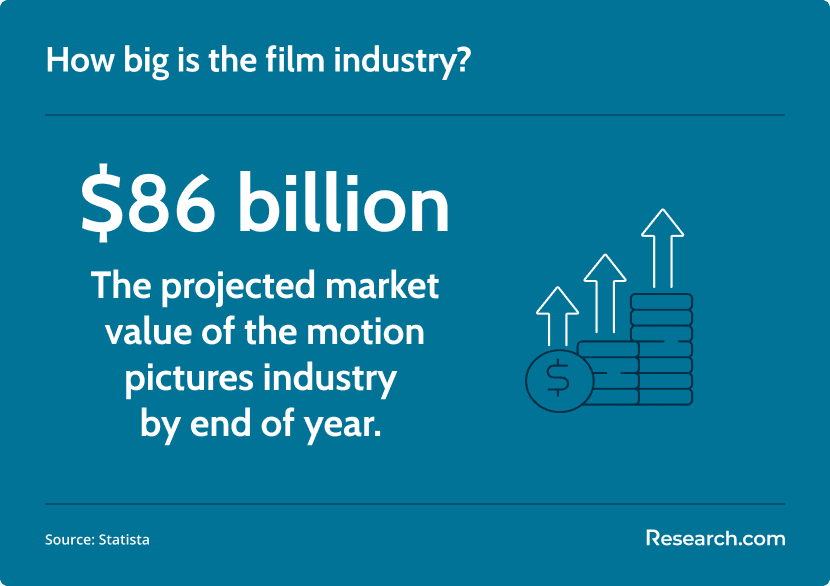
Statista has projected the film industry to reach over $86 billion in revenue by end of the year, but students should not assume that market size automatically translates into easy employment. A strong reel, professional network, and adaptable technical skills remain central to building a career.
How does an online cinematography degree compare to an on-campus program?
An online cinematography degree can work well for students who need flexibility, already have access to basic equipment, or want to build projects in their own location. An on-campus program may be better for students who want immediate access to studios, physical production spaces, school-owned gear, and face-to-face crew collaboration.
The format matters because cinematography is a hands-on field. Online programs must replace some in-person set experience with remote critique, local production assignments, peer collaboration, downloadable footage, and digital workflow training. Students interested in combining visual storytelling with product, interface, and digital experience design may also compare UX design degrees online as a complementary creative technology path.
| Factor | Online cinematography degree | On-campus cinematography degree |
| Schedule | Often more flexible for working adults, parents, and students outside major film cities | Usually follows fixed class times, studio sessions, and campus production schedules |
| Equipment | May require students to use or obtain their own camera, audio, and editing tools | Often provides access to school studios, labs, lighting kits, and higher-end gear |
| Collaboration | Relies on remote teams, local shoots, online critiques, and virtual production planning | Supports in-person crew work, set practice, campus screenings, and informal networking |
| Feedback | Delivered through video reviews, online critiques, live sessions, and instructor comments | Can happen immediately on set, in labs, or during face-to-face workshops |
| Best fit | Self-directed students who can manage local production logistics | Students who learn best through physical presence and structured studio access |
Students who want a broader media skill set may also pair image-making with sound, scoring, or post-production training. Research.com’s list of accelerated audio and music degrees online can help students compare programs that strengthen the audio side of screen storytelling.
What is the average cost of an online cinematography degree program?
The online cinematography programs in this guide show a wide cost range. New York Film Academy’s 2-year MFA is listed at approximately $110,380. The University of Arizona’s 4-year BA in Film is cited at $63,000 total. Based on the figures provided, the average cost is $86,690.
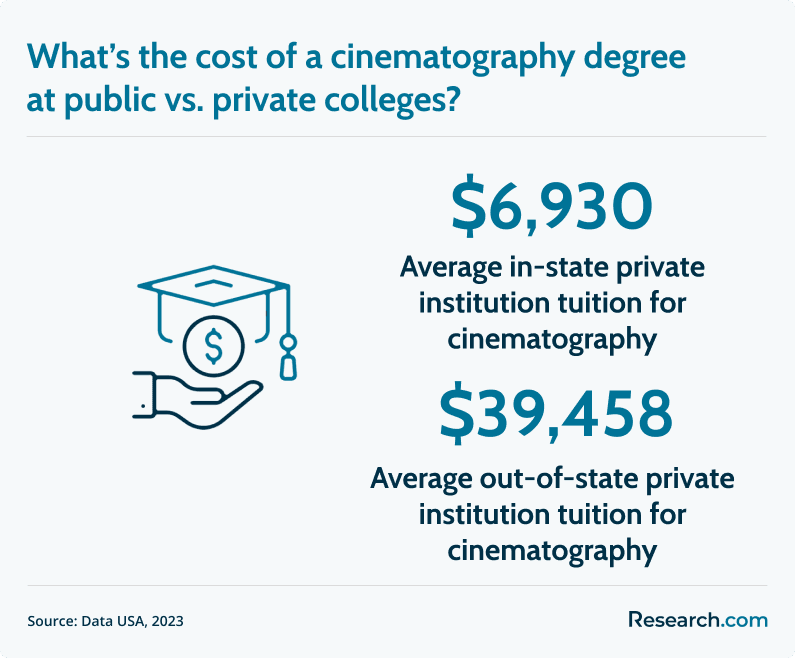
Broader program pricing can differ significantly by institution type, residency status, credential level, and whether equipment, software, and production fees are included. Data USA reports that an in-state public degree for cinematography majors has a median cost of $6,930 per year, while private out-of-state programs average $39,458 annually.
| Cost item | Why it matters | Question to ask before enrolling |
| Tuition | This is the headline price, but it may not include all program expenses | Is tuition charged per credit, per semester, or as a total program cost? |
| Camera and lighting equipment | Online students may need to complete projects using their own gear or rentals | What exact equipment does the program require or recommend? |
| Software | Editing, color, and production tools may carry separate costs | Are software licenses included in tuition or paid separately? |
| Production expenses | Short films and portfolio projects can require locations, props, crew support, or travel | How many production assignments require out-of-pocket spending? |
| Transfer credits | Accepted transfer credits can reduce both time and cost | How many credits can I transfer, and how will they apply to major requirements? |
The lowest tuition is not always the best value, and the most expensive school is not automatically the strongest career investment. Compare total cost against the curriculum, faculty feedback, portfolio support, production opportunities, accreditation, and your likely ability to complete the program without unnecessary debt.
What are the financial aid options for students enrolling in an online cinematography degree program?
Online cinematography students may qualify for federal aid, institutional aid, state aid, private scholarships, and film- or arts-specific awards, depending on the school and the student’s eligibility. The key is to verify whether the program is eligible for the type of aid you plan to use before enrolling.
Film students should also search beyond general scholarships. Some awards are aimed at visual arts, broadcasting, television, media production, and filmmaking. The following examples can be useful starting points, but students should confirm current deadlines, eligibility rules, and application requirements directly with each provider.
| Scholarship or fellowship | Who it is designed for | Stated award amount |
| Betty Harlan Memorial Art Scholarship | Students from specific Illinois counties pursuing visual arts degrees, with visual art involvement and an essay requirement | Scholarship amount varies |
| Austin Alliance for Women in Media Scholarship | Students in or from the Austin area majoring in film, broadcasting, or related media fields | $5,000 |
| Francis D. Lyon Graduate Fellowship | Graduate students in filmmaking or related fields in the U.S. or Canada, evaluated by talent, academic excellence, and financial need | $2,500 |
| National Academy of Television Arts and Sciences (NATAS) Scholarships | High school seniors entering communications and television-focused programs, including awards such as Jim McKay, Douglas W. Mummert, and Mike Wallace | $10,000 |
| Doan Foundation Scholarship for the Arts | Southern California high school seniors pursuing art-related degrees, with emphasis on financial need, citizenship, FAFSA, and California Aid Reports | $500-$1,000 |
Students building a visual portfolio may also strengthen their skills through photography training. Research.com’s guide to the shortest digital photography online programs can help students find compact options that support composition, lighting, and image-making fundamentals.
What are the prerequisites for enrolling in an online cinematography degree program?
Admissions requirements depend on the credential level. Undergraduate programs usually require proof of secondary education, while graduate programs commonly require a bachelor’s degree and may ask for stronger creative evidence. Some programs are open to beginners; others expect a portfolio, reel, writing sample, interview, or prior media experience.
Students considering a full online visual arts pathway can also compare admissions expectations in a top digital photography degree online, especially if they are still deciding between still photography, cinematography, and broader media production.
- High School Diploma or GED: Undergraduate applicants typically need proof that they completed secondary education.
- Portfolio or Creative Sample: Some programs may request a reel, short film, photography project, storyboard, or other visual work.
- Familiarity with Cinematic Language: Essays or interviews may ask students to discuss framing, composition, camera movement, or visual storytelling.
- Basic Script or Storyboard Experience: Prior exposure to scripts, shot lists, or storyboards can make an application stronger, even when it is not mandatory.
- Letters of Recommendation: Competitive programs may ask teachers, mentors, or creative supervisors to comment on the student’s readiness.
- Technical Comfort: Applicants do not always need advanced gear knowledge, but comfort with cameras, editing tools, and digital media workflows is helpful.
Cinematography students who want to understand the business side of production may also consider accelerated online entertainment business degree programs. Business knowledge can be useful for freelancers, producers, and filmmakers who need to budget, pitch, distribute, or market their work.
What courses are typically in an online cinematography degree program?
Online cinematography coursework usually combines artistic decision-making with technical production skills. Students learn how cameras, lenses, light, movement, editing, and color shape the audience’s experience of a story.
| Course area | What students learn | Why it matters professionally |
| Technical Introduction to Camera | Camera systems, lens choices, exposure, frame rates, and digital workflows | Builds the technical foundation needed to execute shots consistently |
| Color Theory | How color affects tone, mood, continuity, and visual meaning | Supports better lighting choices, production design collaboration, and color grading decisions |
| Lighting | Natural light, key light, fill light, backlight, contrast, and scene atmosphere | Helps cinematographers shape mood, depth, and visual style |
| Camera Movement and Placement | How framing, blocking, movement, and perspective direct attention | Connects camera choices to emotion, pacing, and story clarity |
| Screenwriting | Story structure, scene construction, character, and visual storytelling on the page | Helps cinematographers understand narrative purpose before planning shots |
| Film Editing | Continuity, rhythm, pacing, scene transitions, and post-production storytelling | Improves collaboration with editors and helps students shoot with the final cut in mind |
| Digital Cinematography | RAW formats, dynamic range, LUTs, digital pipelines, and virtual production concepts | Prepares students for contemporary digital production environments |
Because cinematography relies heavily on story sense, students who want stronger narrative skills can compare the fastest online creative writing degree programs. Writing training can help filmmakers make more intentional choices about scene purpose, character, and visual subtext.
Coursework is only one part of preparation. The best online programs also require students to create work, receive critique, revise projects, and build a reel that demonstrates their strongest visual decisions.
What types of specializations are available in online cinematography degree programs?
Specializations allow students to align cinematography training with a more specific career direction. Some tracks lean toward production leadership, while others focus on documentary, narrative film, editing, VFX, or animation.
| Specialization | Focus | Best suited for students who want to |
| Creative Producing | Project development, budgets, scheduling, teams, and production execution | Manage films from concept to completion |
| Directing Non-Fiction | Documentary storytelling, real subjects, interviews, observation, and ethical representation | Create documentary and factual media with strong visual intent |
| Directing Fiction | Scripted scenes, actor collaboration, visual continuity, and narrative style | Work on short films, features, episodic content, or scripted digital media |
| Editing | Post-production structure, pacing, continuity, emotion, and story refinement | Shape raw footage into a coherent and compelling finished piece |
| Visual Effects (VFX) Cinematography | Green screen, motion tracking, CGI integration, plates, and digital compositing needs | Work on productions that blend live action with digital elements |
| Cinematography in Animation | Lighting, framing, movement, and camera language in animated environments | Apply cinematic principles to animation and digital production |
Students interested in animated storytelling can review accelerated online animation degree programs to compare pathways that emphasize motion, design, and digital production. Students whose goals include church media, nonprofit storytelling, or faith-based community communication may also find relevant flexible options among the shortest online Christian ministry degree programs.
The right specialization should connect directly to the kind of reel you want to build. If your goal is commercial work, prioritize fast-paced visual production and client-ready projects. If your goal is documentary, look for ethics, interviewing, field production, and non-fiction storytelling.
How to choose the best online cinematography degree program?
The best online cinematography program is the one that matches your career goal, budget, learning style, and access to equipment. A program may be highly regarded, but it is not a good fit if it does not help you produce strong work, receive meaningful critique, and graduate with a portfolio that supports your next step.
Key factors to compare before applying
- Accreditation: Confirm that the institution is accredited by a recognized accreditor, especially if you plan to use financial aid, transfer credits, or pursue graduate study later.
- Hands-on production requirements: Look for actual shooting, lighting, editing, and portfolio assignments rather than a curriculum that only studies film theory.
- Cinematography depth: Some film programs focus broadly on media production. Check whether lighting, lenses, camera movement, color, and digital cinematography are central parts of the curriculum.
- Faculty experience: Review instructor backgrounds for professional production, festival, commercial, documentary, or digital media experience.
- Reel and portfolio support: Ask how many finished projects students complete and whether faculty help students refine work for professional presentation.
- Equipment expectations: Confirm whether you need your own camera, lighting kit, audio tools, editing software, or subscriptions.
- Online collaboration: Film is team-based. Strong online programs should create opportunities for peer work, instructor critique, virtual screenings, and industry conversations.
- Cost and completion risk: Compare total tuition, fees, equipment costs, transfer credits, course load, and your ability to finish while managing work or family responsibilities.
Students who enjoy the science of light, optics, motion, and imaging technology may also be interested in the fastest online physics degree programs. While physics is a different academic path, the underlying concepts can support technical understanding in imaging, lenses, and light behavior.
Common mistakes when choosing an online cinematography program
| Mistake | Why it can hurt you | Better approach |
| Choosing only by school reputation | A well-known name does not guarantee that the online format fits your needs | Review curriculum, student work, faculty feedback, equipment requirements, and completion support |
| Looking only at tuition | Gear, software, production costs, and lost time can change the real price | Build a full budget before enrolling |
| Assuming online means less hands-on work | Some online programs require substantial production work, while others are more theory-based | Ask for sample assignments and portfolio expectations |
| Ignoring accreditation | Accreditation can affect aid eligibility, transfer options, and institutional credibility | Verify the school’s accreditor before applying |
| Graduating without a focused reel | Employers and collaborators often need to see what you can actually produce | Use each course to create, revise, and organize portfolio-quality work |
What career paths are available for graduates of online cinematography degree programs?
Graduates of online cinematography programs may work in film, television, commercials, music videos, documentaries, corporate video, social content, education, live events, or independent production. Entry into these roles often depends less on the delivery format of the degree and more on demonstrated skills, a strong reel, reliability, collaboration, and technical fluency.
| Career path | Core responsibility | What to build while in school |
| Director of Photography (DP) | Leads the visual approach to a production, including lighting, composition, camera choices, and shot execution | A reel showing controlled lighting, consistent style, and strong collaboration with directors |
| Camera Operator | Captures shots according to the DP’s or director’s plan | Examples of stable framing, movement, focus control, and coverage |
| Gaffer or Lighting Technician | Builds and manages lighting setups that support mood, depth, and exposure | Lighting breakdowns, before-and-after setups, and scene tests |
| Video Editor | Shapes footage into a finished story through pacing, continuity, rhythm, and structure | Edited shorts, documentary scenes, trailers, and commercial-style cuts |
| Colorist | Adjusts and stylizes footage to create visual consistency and mood | Color grading samples, LUT experiments, and scene matching examples |
| Documentary Filmmaker | Creates non-fiction work using interviews, observational footage, archival material, and field production | Short documentaries, interview reels, and field production samples |
| Visual Effects (VFX) Camera Specialist | Captures footage for digital integration, green screen work, motion tracking, or compositing | Test shots that show clean plates, tracking markers, and VFX-aware camera planning |
| Music Video or Commercial Cinematographer | Creates high-impact visuals for short-form branded, musical, or promotional content | Fast-paced reels with varied lighting, movement, product shots, and mood shifts |
Many graduates begin with assistant, freelance, internship, editing, or production support roles before moving into higher-responsibility cinematography work. Building relationships and completing real projects during school can be just as important as the credential itself.
What is the job outlook for graduates with an online cinematography degree?
The career market for cinematography-related roles is competitive, but it continues to include opportunities for people who can shoot, edit, light, collaborate, and adapt to digital workflows. Graduates should expect to compete through portfolios, credits, referrals, freelance experience, and technical range.
- Employment growth: Employment for film and video editors and camera operators is projected to grow 3% from 2023 to 2033, which is in line with the national average.
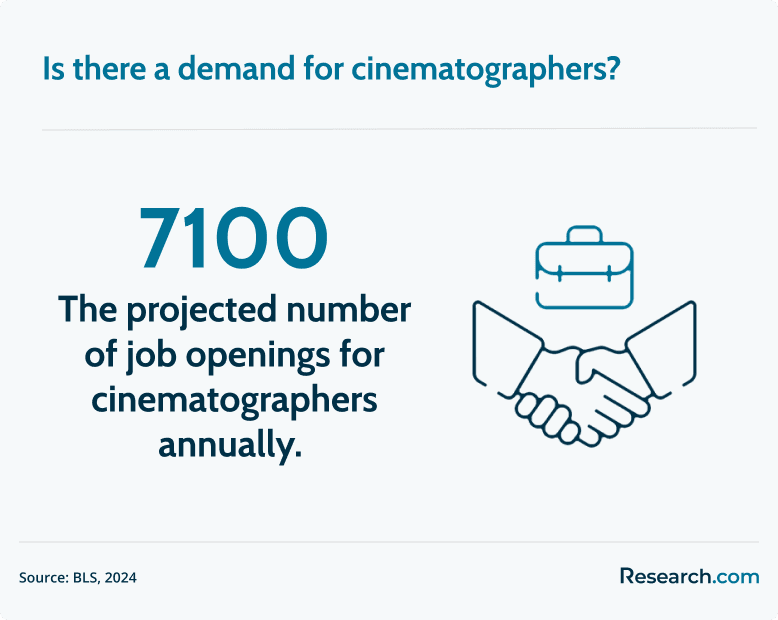
- Openings: The U.S. Bureau of Labor Statistics reports around 7,100 positions open each year, largely because workers retire or move into other occupations.
- Major employing industry: The Motion Picture and Video Industries employ the highest number of professionals in this category, with about 9,540 out of a total 23,940.
- Digital production needs: Streaming, social video, remote collaboration, and branded content have expanded the types of employers that need camera and editing skills, although competition remains strong.
- Career flexibility: Cinematography training can also support work in advertising, education, corporate communications, live events, independent media, and online content production.
Are online cinematography degrees accredited and industry recognized?
Accreditation matters because it helps verify that a school meets institutional quality standards. It can also affect financial aid eligibility, transfer credit decisions, and whether another school recognizes your coursework. Industry recognition is different: it comes from the program’s reputation, faculty connections, student work, festival presence, internship access, and graduate outcomes.
Before enrolling, check the school’s accreditor, ask whether credits transfer, review student reels, and confirm how the program helps students connect with professional opportunities. Students interested in expanding from visual storytelling into writing, screenwriting, or literary careers can also review Research.com’s guide on what can you do with a masters in writing.
How do online cinematography degree programs facilitate industry networking?
Online cinematography programs can support networking through virtual mentorship, live workshops, online critique sessions, peer production groups, portfolio reviews, guest speakers, and industry panels. These opportunities are especially important for students who are not located near Los Angeles, New York, Atlanta, or other production centers.
When evaluating networking support, ask whether students interact with working professionals, whether faculty provide portfolio feedback, whether alumni are active, and whether the program has internship or production partner relationships. Students interested in cross-disciplinary creative networks may also compare options among the cheapest online MFA creative writing programs, particularly if they want to collaborate with writers, screenwriters, and narrative creators.
Can obtaining additional certifications enhance my cinematography career?
Additional certifications can help when they document a specific production skill that employers, clients, or collaborators can recognize quickly. They are not a replacement for a strong reel, but they can strengthen a resume in areas such as editing software, color grading, VFX workflows, project management, sound, or digital production tools.
The best certificates are targeted. A student interested in post-production should prioritize editing or color credentials; a freelancer may benefit from business, project management, or software training. Research.com’s guide to what certificate programs pay well can help students think through which short credentials may add marketable value without requiring another full degree.
References
- Community Foundation of Northern Illinois. (n.d.). Betty Harlan Memorial Art Scholarship. Cfnil.org. Retrieved 17 July 2025.
- Data USA. (n.d.). Cinematography and Film/Video Production. Datausa.io. Retrieved 17 July 2025.
- Doan Foundation. (n.d.). Scholarships We Offer. Doan-foundation.org. Retrieved 17 July 2025.
- Grand Canyon University. (n.d.). Bachelor of Arts in Digital Film Production. Gcu.edu. Retrieved 17 July 2025.
- Los Angeles Film School. (n.d.). Digital Filmmaking Degree – Online. Lafilm.edu. Retrieved 17 July 2025.
- New York Film Academy. (n.d.). Cinematography School. Nyfa.edu. Retrieved 17 July 2025.
- Statista. (n.d.). Worldwide Cinema Industry – Statistics & Facts. Statista.com. Retrieved 17 July 2025.
- Television Academy Foundation. (n.d.). Scholarships. Theemmys.tv. Retrieved 17 July 2025.
- U.S. Bureau of Labor Statistics. (n.d.). Film and Video Editors and Camera Operators. Bls.gov. Retrieved 17 July 2025.
- University of Massachusetts Amherst. (n.d.). Online Film Studies. Umass.edu. Retrieved 17 July 2025.
- University of Montana. (n.d.). Media Arts – B.A. Umt.edu. Retrieved 17 July 2025.
- ZipRecruiter. (n.d.). Cinematographer Salary. Ziprecruiter.com. Retrieved 17 July 2025.
- Zippia. (n.d.). Cinematographer Education Requirements and College Majors. Zippia.com. Retrieved 17 July 2025.
- Zippia. (n.d.). Cinematographer Skills For Your Resume And Career. Zippia.com. Retrieved 17 July 2025.
Key Insights
- The best online cinematography degree is the one that helps you create strong work, not just earn a credential. Prioritize programs with camera, lighting, editing, critique, and reel-building requirements.
- Program length varies sharply. Options in this guide range from 7 weeks for shorter formats to 2 years for an MFA and 3 years for a bachelor’s degree.
- Costs can be substantial. Published examples include approximately $110,380 for a 2-year MFA, approximately $76,500 for an online B.S., and approximately $37,588 for an online B.A. in Media Arts.
- Online study is best for self-directed students who can manage equipment, local production work, and remote collaboration. Campus programs may be stronger for students who need studio access and in-person crew experience.
- Accreditation should be verified before enrollment. It can affect aid, transfer credits, institutional credibility, and future education options.
- Career outcomes depend heavily on portfolio quality, networking, technical skill, and persistence. The degree can help, but a focused reel and real project experience are essential.
Other Things You Need to Know About Online Cinematography Degree Programs
Students should know basic editing and image-management software before enrollment. Common tools include Adobe Premiere Pro, DaVinci Resolve, and Adobe After Effects, plus file-transfer and cloud-storage systems such as Frame.io and Google Drive. Most programs require a laptop that can run video-editing software smoothly.
In 2027, leading online cinematography degree programs offer specialized coursework in areas like digital cinematography, lighting techniques, and post-production editing. Students can expect in-depth modules on visual storytelling and advanced camera operations. Programs often include interactive workshops and projects to enhance practical skills.
In 2027, students in top online cinematography programs should have access to high-speed internet, a computer capable of handling video editing software like Adobe Premiere Pro, and possibly VR equipment for virtual workshops. Specific requirements vary by program, so reviewing each program's technology guidelines is essential.


