2027 Fastest Online Game Art and Design Degree Programs

Co-Founder and Chief Data Scientist
Choosing an online game art and design degree is really a decision about time, cost, portfolio quality, and career fit. The fastest programs can help students move through a bachelor’s degree more efficiently, but speed only helps if the curriculum builds the visual, technical, and production skills employers actually review in portfolios.
This guide is designed for students comparing accelerated online game art and design degree programs for 2026, especially those who want a practical route into game art, animation, UI/UX, simulation, XR, or related creative technology roles. You will learn how these programs work, how long they take, what they cost, what to look for in accreditation and transfer policies, and how to judge whether a program is likely to help you build job-ready work.
The goal is not just to list schools. It is to help you decide which type of online program makes sense for your background, schedule, budget, and career target.
Quick answer: Are online game art and design degree programs worth considering?
Online game art and design degree programs can be worthwhile for students who need flexible study, want structured portfolio development, and are prepared to practice heavily outside class. The strongest programs combine drawing, 3D modeling, animation, game-engine workflows, UI/UX principles, and capstone production into a clear sequence of projects.
- Graduates may pursue roles in game studios, animation companies, XR teams, simulation firms, e-learning companies, and digital media groups as character artists, environment artists, UI/UX designers, technical artists, animators, or interactive media specialists.
- Reported median salaries for related roles include $99,800 for special effects artists and animators, $98,090 for web and interface designers, and $56,260 for craft and fine artists, while top-tier special effects and animation professionals earn over $174,000.
- Many schools allow students to transfer up to 90 credits, which can significantly reduce both tuition and time to graduation if previous coursework applies to the degree plan.
What can I expect from online game art and design degree programs?
An online game art and design degree teaches students how to create visual assets and interactive experiences for games and related digital media. Unlike a general art degree, this field usually connects artistic fundamentals with software workflows, real-time engines, file optimization, team critique, and portfolio production.
Most programs begin with drawing, design, composition, color, and visual storytelling. Students then move into 3D modeling, digital sculpting, texturing, rigging, animation, level design, UI/UX, and game-engine integration. In practical terms, you should expect to spend more time making, revising, exporting, testing, and presenting work than memorizing theory.
Common features of online game art and design programs include:
- Flexible course delivery: Many courses are asynchronous, but strong programs still include critiques, instructor feedback, peer review, and milestone deadlines.
- Professional software exposure: Students often work with tools such as Unity, Blender, Adobe Creative Suite, Maya, Unreal Engine, ZBrush, or related production platforms, depending on the curriculum.
- Portfolio-centered assessment: Instead of relying only on exams, programs often evaluate models, environments, animations, interface designs, prototypes, and capstone projects.
- Accelerated scheduling options: Eight-week, nine-week, 10-week, five-week, year-round, or transfer-friendly formats can shorten the path for students who can handle a heavier pace.
- Production-style workflows: Assignments may mirror studio briefs, with iterations, asset constraints, feedback cycles, and final presentation requirements.
The best fit is usually a program that helps you produce polished, reviewable work in the specific area you want to enter, whether that is character art, environment art, technical art, animation, UI/UX, or game design.
Where can I work with an online game art and design degree?
A game art and design degree can lead to work in more than traditional video game studios. The same skills used to build characters, worlds, interfaces, animations, and real-time assets can apply to training simulations, virtual production, educational media, advertising, product visualization, and immersive technology.
Common employer types include:
- Game development companies: Graduates may support character creation, environment art, level design, UI/UX, animation, technical art, or asset production for indie, mobile, console, PC, or AAA projects.
- Animation and film teams: Artists may contribute concept art, previsualization, 3D assets, motion graphics, lighting, or effects using workflows that overlap with game production.
- Simulation and training firms: Healthcare, aviation, defense, industrial training, and education companies use interactive environments to teach procedures and decision-making.
- XR and immersive media companies: AR and VR teams need artists who understand scale, optimization, interaction design, and real-time performance limits.
- Freelance and contract markets: Some graduates start with commissions, asset packs, prototype support, UI kits, environment builds, or short-term production contracts.
Because hiring in creative technology is highly portfolio-driven, the degree matters most when it helps you show relevant, polished, and technically sound work.
How much can I make with an online game art and design degree?
Pay in game art and design depends on role, location, employer type, experience, specialization, and portfolio strength. Technical roles that combine art with scripting, shaders, optimization, engine implementation, or UI systems often command stronger compensation than purely entry-level art production roles.
| Related role category | Reported pay information | What affects earning potential |
| Special Effects Artists and Animators | Median salary is approximately $99,800, with top-tier professionals earning over $174,000. | Shipped projects, animation quality, effects skill, software fluency, and specialization in real-time production. |
| Web and Interface Designers | Median pay is $98,090 for professionals working on in-game UI, digital overlays, and related interfaces. | UX research ability, interaction design, motion design, accessibility awareness, and front-end or engine implementation skills. |
| Craft and Fine Artists | Median income is $56,260, though contract-based creators may earn more through specialization and volume. | Portfolio niche, commission pipeline, licensing, freelance business skills, and repeat client relationships. |
Students should treat salary figures as broad benchmarks rather than promises. In this field, stronger portfolios, current tools, finished projects, and evidence of collaboration often matter as much as the credential itself.
- Online Game Art and Design Degree Programs for 2027
- How long does it take to complete an online game art and design degree?
- Online vs. on-campus game art and design programs
- Average cost of online game art and design degree programs
- Financial aid options for online game art and design students
- Admissions requirements and prerequisites
- Accreditation and industry recognition
- Networking, internships, and career support
- How programs keep up with industry trends
- How UX design fits into game art programs
- Typical courses in online game art and design degrees
- Available specializations
- How to choose the right online game art and design program
- Career paths after graduation
- Job market outlook for graduates
List of Online Game Art and Design Degree Programs for 2027
How do we rank schools?
The programs below are intended for students who want a faster, online path into game art, game design, animation, simulation, or interactive media without ignoring accreditation, cost, and portfolio development.
Using our methodology, these selections emphasize practical curriculum design, accelerated or flexible scheduling, transfer-friendly policies, transparent tuition information, and recognized institutional accreditation. The purpose is to help readers compare programs by the factors most likely to affect completion time, affordability, and career preparation.
Program details are based on current, verifiable sources such as the National Center for Education Statistics, the U.S. Department of Education’s College Scorecard, Peterson’s Distance Learning Database, and the Integrated Postsecondary Education Data System.
| School | Online program focus | Best fit | Cost per credit |
| Southern New Hampshire University | B.A. in Game Art and Development | Students seeking eight-week terms and broad transfer credit options. | $330 |
| Savannah College of Art and Design | B.A. in Game Development | Students who want an art-school environment with game art, technical art, and narrative/level design options. | $937 |
| University of Advancing Technology | B.A. in Game Art & Animation | Students who want short intensive courses tied to real-time game art workflows. | $772 |
| Rocky Mountain College of Art + Design | B.F.A. in Game Art | Students prioritizing studio art feedback and character, environment, or technical art development. | $640 |
| Bellevue University | B.S. in Game Design | Students who have completed general education requirements and want an accelerated major sequence. | $335 |
| Liberty University | B.S. in Information Technology with Gaming Design cognate | Students who want game design inside a broader IT degree. | $390 |
| Lewis University | B.S. in Computer Science with Game and Simulation Programming concentration | Students who want programming depth with game and simulation projects. | $625 |
| Lindenwood University | B.A. in Game Design | Students seeking asynchronous coursework and Game Art or Game Design focus areas. | $525 |
| Davenport University | B.S. in Computer Science with Gaming and Simulation focus | Students interested in C++, C#, Unity, and interactive prototype development. | $815 |
| Middle Georgia State University | B.S. in Information Technology with Integrated Digital Media and Game Design concentration | Students seeking a lower listed per-credit rate and IT-based game design curriculum. | $199 |
1. Southern New Hampshire University
Southern New Hampshire University offers a fully online B.A. in Game Art and Development built around accelerated eight-week terms and six yearly start dates. The program moves from core visual foundations into advanced production and engine workflows, giving students a structured path from basic design skills to portfolio-ready assets. Learners may transfer up to 90 previously earned credits, which can reduce upper-division study to roughly 18 months for students who qualify. Courses emphasize tools such as Adobe Creative Cloud and Autodesk Maya, and the curriculum includes career preparation for presenting engine-ready work across platforms.
- Program length: 4 years full-time, or as few as 18 months with maximum transfer credit
- Tracks/concentrations: No formal tracks, but electives in 3D modeling, digital sculpting, animation, and environment art are available
- Cost per credit: $330
- Required credits to graduate: 120
- Accreditation: New England Commission of Higher Education (NECHE)
2. Savannah College of Art and Design (SCAD)
Savannah College of Art and Design delivers its B.A. in Game Development through SCADnow using 10-week quarters and six annual start dates. The curriculum blends foundational art training with game development, engine deployment, and portfolio production. Students may transfer up to 90 quarter hours and can work with industry mentors while using cloud-based workflows that resemble professional production environments.
- Program length: 4 years full-time, or as few as 3 years with maximum transfer credit
- Tracks/concentrations: Game Art, Technical Art, Narrative/Level Design with flexible elective paths
- Cost per credit: $937
- Required credits to graduate: 180 quarter credit hours
- Accreditation: Southern Association of Colleges and Schools Commission on Colleges (SACSCOC)
3. University of Advancing Technology
The University of Advancing Technology offers an online B.A. in Game Art & Animation through intensive five-week courses. Full-time students can complete four courses during each 15-week semester, which supports continuous progress throughout the year. The degree combines traditional art training with real-time engine workflows, and transfer policies may allow qualified students to complete upper-division requirements in about three years.
- Program length: 4 years full-time, or as few as 3 years with maximum transfer credit
- Tracks/concentrations: Core focus in Game Art & Animation with elective options in character, environment, and technical art
- Cost per credit: $772 (online modality)
- Required credits to graduate: 120
- Accreditation: Higher Learning Commission (HLC)
4. Rocky Mountain College of Art + Design (RMCAD)
Rocky Mountain College of Art + Design provides a fully online B.F.A. in Game Art with studio courses offered in eight-week sessions. Students can complete four terms per year and develop portfolio projects with feedback from industry mentors. The program accepts up to 90 transfer credits, allowing eligible learners to finish upper-division coursework in roughly three years while studying character, environment, and technical-art pipelines.
- Program length: 4 years full-time, or about 3 years with maximum transfer credit
- Tracks/concentrations: Elective focus areas in Character Design, Environment Art, and Technical Art
- Cost per credit: $640 (online undergraduate rate)
- Required credits to graduate: 123
- Accreditation: HLC and National Association of Schools of Art and Design (NASAD)
5. Bellevue University
Bellevue University offers a fully online B.S. in Game Design using nine-week accelerated courses. After students complete general education requirements, the 60-credit major sequence can be finished in approximately 18 months. The curriculum focuses on rapid prototyping, narrative design, and user experience testing, making it a practical option for students who want to create playable projects and production-ready builds efficiently.
- Program length: 4 years full-time but major sequence can be completed in 18 months within an accelerated cohort
- Tracks/concentrations: No formal tracks, but electives in narrative design, UI/UX, and simulation are available
- Cost per credit: $335
- Required credits to graduate: 127
- Accreditation: HLC
6. Liberty University
Liberty University provides a fully online B.S. in Information Technology with a Gaming Design cognate. Courses run in eight-week terms, and students may transfer up to 90 credits, making completion in as few as 18 months possible for eligible learners. The program combines Unity development, interactive storytelling, C# scripting, and IT foundations for students who want game design within a broader technology degree.
- Program length: 4 years full-time, or as few as 18 months with maximum transfer credit
- Tracks/concentrations: Gaming Design cognate within Information Technology
- Cost per credit: $390 (full-time online undergraduate rate)
- Required credits to graduate: 120
- Accreditation: SACSCOC
7. Lewis University
Lewis University offers an accelerated online B.S. in Computer Science for adult undergraduates, with courses organized in five- and eight-week blocks. Students who choose the Game and Simulation Programming concentration add Unity and Unreal engine projects to a computer science foundation. Transfer acceptance of up to 90 credits may allow qualified students to reach upper-division game and simulation projects in roughly two years.
- Program length: 4 years full-time, or about 24 months with maximum transfer credit
- Tracks/concentrations: Game and Simulation Programming (plus five other optional concentrations)
- Cost per credit: $625 (accelerated undergraduate rate)
- Required credits to graduate: 120
- Accreditation: HLC
8. Lindenwood University
Lindenwood University delivers a fully online B.A. in Game Design with 100% asynchronous coursework and year-round enrollment. Students may transfer up to 90 credits and complete remaining requirements in as little as one year if they qualify. The program offers Game Art and Game Design focus areas, supports portfolio development with Unity and Unreal, and includes textbooks, lab fees, and software access in tuition.
- Program length: 3–4 years full-time, or as fast as 1 year with maximum transfer credit
- Tracks/concentrations: Game Art or Game Design
- Cost per credit: $525
- Required credits to graduate: 120
- Accreditation: HLC
9. Davenport University
Davenport University offers a fully online B.S. in Computer Science with a Gaming and Simulation focus. Seven-week sessions are available across six terms per year, creating multiple opportunities to advance through requirements. Eligible students can transfer up to 90 credits and may finish degree requirements in roughly two years. Coursework includes C++ and C# programming along with Unity-based development for interactive portfolio projects.
- Program length: 4 years full-time, or as few as 2 years with maximum transfer credit
- Tracks/concentrations: Gaming and Simulation specialization within Computer Science
- Cost per credit: $815 (online undergraduate rate)
- Required credits to graduate: 120
- Accreditation: HLC
10. Middle Georgia State University
Middle Georgia State University offers a fully online B.S. in Information Technology with an Integrated Digital Media and Game Design concentration. The program uses accelerated eight-week eMajor terms and covers Unity workflows, C# scripting, and digital storytelling. With a transfer policy allowing up to 90 credits, qualified students may complete upper-division requirements in roughly two years while building a game-focused portfolio.
- Program length: 4 years full-time, or about 2 years with maximum transfer credit
- Tracks/concentrations: Integrated Digital Media and Game Design concentration within Information Technology
- Cost per credit: $199 (eTuition for online undergraduate courses)
- Required credits to graduate: 120
- Accreditation: SACSCOC; Computing Accreditation Commission of ABET for the B.S. in Information Technology
How long does it take to complete an online game art and design degree?
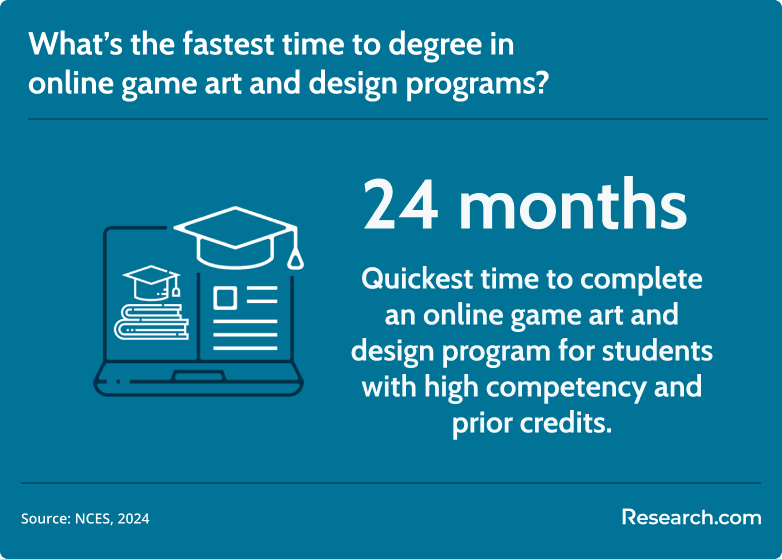
Most online bachelor’s degrees in game art and design require about 120 credits, though quarter-based programs may use a different credit structure. The actual timeline depends on transfer credits, course load, term length, whether the school operates year-round, and whether you study full time or part time.
Students comparing creative and entertainment-focused programs may also want to review the fastest online entertainment business degree programs, especially if they are interested in production management, media business, digital content strategy, or cross-disciplinary career options.
| Path | Typical timeline | Best for | Important trade-off |
| Standard full-time bachelor’s plan | 4 years full-time | Students who want a manageable pace with time for portfolio practice. | Slower than accelerated routes but often easier to balance with work. |
| Accelerated online track | 30-36 months | Students who can handle continuous eight-week sessions, including summer study. | Fast pacing can leave less time for deep portfolio revision. |
| Competency-based format | 24-30 months for students who move quickly | Learners with strong prior art, design, or coding experience. | Requires discipline and the ability to prove mastery quickly. |
| Part-time sequence | Five to six years | Full-time workers, caregivers, and students with limited weekly study time. | Longer enrollment may increase total fees and delay career transition. |
| Transfer-heavy plan | Can trim a full year or more | Students with community college credits, AP credit, certifications, or previous college coursework. | Credits must match degree requirements; not every prior course will apply. |
Transfer evaluation matters. Some schools accept many general education credits but fewer major-specific art, design, or programming credits. If you are moving between IT, computer science, and game design pathways, review how the school treats the difference between IT vs computer science coursework before assuming credits will count.
Before enrolling, ask for a written transfer evaluation, a term-by-term degree plan, and confirmation of how many credits you must complete at the institution. This is the clearest way to estimate your real graduation date.
How does an online game art and design degree program compare to an on-campus program?
Online and campus-based game art and design programs may cover similar topics, but the student experience can differ substantially. The right choice depends on how you learn, what equipment you need, whether you can relocate, and how much schedule flexibility you require.
| Factor | Online program | On-campus program | Decision tip |
| Schedule | Often asynchronous, with optional live sessions, critiques, or check-ins. | Usually follows fixed class, studio, and lab schedules. | Choose online if flexibility is essential; choose campus if structure keeps you accountable. |
| Equipment | Requires a capable home setup and may include software discounts or cloud resources. | May offer labs, render farms, motion-capture facilities, and studio equipment. | Compare required hardware costs before assuming online is cheaper. |
| Collaboration | Uses virtual critique boards, team projects, remote production sprints, and online game jams. | Supports in-person critique, studio work, clubs, and informal peer feedback. | Online students should verify how team projects and critiques are handled. |
| Cost and location | Can reduce commuting and housing costs and allows students to study without moving. | May require relocation, transportation, housing, and campus fees. | Compare total cost of attendance, not tuition alone. |
| Pacing | Frequently offers eight-week terms or accelerated formats. | Often follows 15-week semesters. | Accelerated terms work best for disciplined students with enough weekly production time. |
The National Center for Education Statistics (NCES) reports that 61% of U.S. undergraduates take at least one online course, showing that distance learning is now a common part of higher education. Creative students may see similar flexibility in the fastest online graphic design degree programs, where portfolio development and accelerated study also overlap.
The strongest online programs compensate for the lack of physical studio access through detailed demonstrations, regular critiques, clear software requirements, and structured portfolio milestones. The weakest ones leave students isolated. That difference should carry more weight than the delivery format alone.
The chart below shows the percentage of undergraduate students at degree-granting postsecondary institutions who participated exclusively in distance education courses.
What is the average cost of online game art and design degree programs?
Online game art and design tuition varies by school type, residency rules, art-school pricing, included software, and whether the program charges per credit or by term. Students should calculate the full cost of attendance, including fees, hardware, software, textbooks, and portfolio expenses.
| Program type | Typical tuition structure stated | Estimated tuition impact | What to verify |
| Public universities using in-state rates | $250 to $310 per credit | $30,000–38,000 for a 120-credit degree before fees | Residency rules, online course fees, and whether all required courses qualify for the lower rate. |
| Public universities with flat online rates | $350 to $430 per credit | $42,000–$52,000 in tuition | Whether out-of-state students pay the same rate and whether software is included. |
| Private or art-focused institutions | $550 and $600 per credit | $66,000–$72,000 in total tuition | Portfolio support, mentor access, included tools, and graduation requirements. |
| Subscription-based models | Six-month terms average around $4,200 | About $25,200 for students completing in three years | Whether you can realistically complete enough courses per term to save money. |
Cost comparisons can resemble those used for the most affordable online web development degree options, especially when programs include accelerated formats, bundled software, or project-based technical training.
Additional expenses can include $200–$400 per lab course for rendering credits and software access. Students may also need a drawing tablet and a computer with a capable GPU, which can add $1,000–$1,500 over the course of the degree. Some schools include or discount licenses for programs such as Adobe Creative Cloud, Maya, and ZBrush.
To compare costs accurately, request an itemized estimate showing tuition, mandatory fees, course fees, software, hardware, transfer-credit impact, and expected aid. A lower advertised tuition rate may not be the cheapest option if fees and equipment requirements are high.
What are the financial aid options for students enrolling in online game art and design degree programs?
Most students fund an online game art and design degree with a combination of federal aid, institutional scholarships, grants, employer benefits, military education benefits, savings, and loans. The smartest approach is to use gift aid first, then work-based or employer support, and borrow only what is necessary.
- Federal aid: Completing the Free Application for Federal Student Aid (FAFSA) can make students eligible for Pell Grants of up to $7,395 for 2025–26. Direct Subsidized and Unsubsidized Loans may help cover remaining costs, and some students may qualify for Federal Work-Study roles such as tutoring, lab assistance, or digital support work.
- Institutional scholarships: Schools and art departments may award merit aid for academic performance, strong portfolios, or creative promise. These awards may reduce annual tuition by $2,500–$10,000.
- Private and industry grants: Groups such as the Academy of Interactive Arts and Sciences Foundation offer $2,500–$5,000 stipends for students with strong submissions, such as character models, prototypes, or concept art.
- Employer and military benefits: Employers can reimburse up to $5,250 per year in tax-free tuition assistance. Veterans and active-duty personnel may be able to apply Post-9/11 GI Bill benefits to accredited online programs, potentially covering full tuition plus a housing allowance.
- Alternative funding: Freelance work, commissions, crowdfunding for equipment, and part-time creative contracts can help reduce borrowing for hardware or software.
Students exploring adjacent creative fields, including a fast-track bachelor's in audio and music degree online, may find overlapping scholarship opportunities in multimedia, entertainment arts, and digital production.
Before accepting loans, ask the school for the net price after grants and scholarships, not just the published tuition. Also confirm whether your aid applies during summer or accelerated terms, since fast schedules can affect disbursement timing.
The chart below shows how cost and aid are distributed in typical 4-year degree programs, based on family income levels.
What are the prerequisites for enrolling in online game art and design degree programs?
Admissions requirements for online game art and design degrees are usually accessible, but students still need enough academic preparation, creative readiness, and technology access to complete project-heavy coursework.
| Requirement | What schools may ask for | How to prepare |
| High school completion | A high school diploma or GED, often with a minimum GPA of 2.5 to 3.0. | Collect official transcripts early and ask whether test scores or placement exams are required. |
| Art readiness | Prior art, design, or visual communication coursework may be recommended. | Practice drawing, composition, digital illustration, and basic 3D modeling before the first term. |
| Portfolio | Some schools request 8–15 samples of original work, such as drawings, digital pieces, or 3D assets. | Show process, variety, and finished work rather than only polished fan art or copied pieces. |
| Math and writing placement | Schools may evaluate algebra and college-level writing readiness through transcripts, placement exams, or standardized test scores. | Review placement policies early, especially if switching from another major. Some math placement expectations resemble processes used for math teacher requirements. |
| Technology setup | A laptop or desktop with at least 16GB RAM, a mid-range GPU, broadband internet, and a drawing tablet is typically expected. | Ask for a program-specific hardware list before buying a computer. |
| Software access | Students may need tools such as Adobe Creative Cloud, Blender, Unity, Maya, Unreal Engine, or ZBrush. | Confirm which licenses are included in tuition and which are out-of-pocket. |
| English proficiency | Non-native speakers may need a TOEFL iBT score of 79 or an IELTS score of 6.0. | Check whether conditional admission or English support is available. |
Some programs also require online orientation modules covering academic integrity, digital ethics, software safety, or learning platform navigation. These are usually short but important for students new to remote study.
Are online game art and design degree programs accredited and recognized by industry leaders?
Accreditation is one of the first items to verify before applying. Institutional accreditation affects credit transfer, federal financial aid eligibility, graduate school options, and employer confidence. Some art and design programs may also hold specialized recognition, but students should distinguish between institutional accreditation, programmatic accreditation, and informal industry partnerships.
Do not rely only on a school website. Confirm accreditation through recognized databases and independent sources. You can also compare affordability patterns across other creative programs, such as the cheapest online creative writing degree, to understand how pricing and accreditation vary in online arts education.
- Check institutional accreditation: Make sure the college or university is accredited by a recognized accreditor.
- Review transfer policies: Accreditation does not guarantee all credits will transfer, but non-accredited coursework can create serious barriers.
- Ask about faculty experience: Instructors with shipped games, studio experience, or relevant production credits can provide more realistic feedback.
- Look for industry-connected coursework: Studio briefs, client-style projects, internships, and capstones are more useful than vague claims about “industry alignment.”
- Inspect student outcomes carefully: Portfolio quality, graduate work samples, and internship access often tell you more than marketing language.
How do online game art and design programs support industry networking and internships?
Online students need intentional networking support because they do not automatically get the informal studio access of an on-campus cohort. Strong programs build career connections into the curriculum through virtual critiques, alumni panels, online career fairs, guest lectures, mentorship, portfolio reviews, team projects, and internship support.
When comparing schools, ask how many internships are available to online students, whether remote internships count for credit, how students are matched with employers, and whether the career office understands game art and interactive media hiring. Students interested in broader creative storytelling careers can also explore what can I do with an MFA in creative writing to understand how narrative skills may support interdisciplinary work.
| Career support feature | Why it matters | Question to ask |
| Portfolio reviews | Hiring managers often evaluate work samples before transcripts. | Who reviews portfolios: faculty, alumni, studio professionals, or peers? |
| Internship support | Internships can provide production experience and professional references. | Are online students eligible for the same internship help as campus students? |
| Virtual networking | Remote learners need structured ways to meet professionals and collaborators. | How often are guest talks, career fairs, or industry panels offered? |
| Team projects | Game production is collaborative, and employers value evidence of teamwork. | Do students complete playable prototypes or collaborative capstones? |
| Alumni access | Graduates can provide advice, referrals, and realistic insight into hiring. | Can current students connect with alumni in game art or related fields? |
How do online game art and design programs stay current with industry trends?
Game art and design changes quickly because tools, engines, pipelines, and employer expectations continue to evolve. Current programs should address real-time rendering, virtual and augmented reality, procedural content generation, AI-assisted workflows, optimization, accessibility, cross-platform design, and collaborative production.
AI is an especially important topic. Students should learn how AI tools may support ideation, reference gathering, iteration, or workflow efficiency while also understanding copyright, ethics, originality, and disclosure expectations. A program that ignores these issues may leave students underprepared for modern creative workplaces.
Students comparing broader creative graduate or interdisciplinary options can review the cheapest MFA degree programs online to see how other creative fields are adapting to digital production, affordability pressures, and online delivery.
- Curriculum refreshes: Ask how often courses are updated and who approves tool changes.
- Engine training: Look for Unity, Unreal Engine, or comparable real-time production experience.
- Optimization skills: Artists should understand polygon budgets, texture efficiency, lighting performance, and runtime constraints.
- Ethics and AI policies: Programs should clearly explain acceptable AI use in assignments and portfolios.
- Cross-disciplinary collaboration: Game artists often work with programmers, writers, designers, producers, sound designers, and UX teams.
How do online game art and design degree programs integrate user experience design?
UX design matters in game art because beautiful assets still need to support clear interaction, readable interfaces, player goals, accessibility, and smooth navigation. Many online programs now include UI/UX coursework that connects visual design with user behavior and gameplay feedback.
Students may study interface layout, HUD design, menu systems, motion graphics, usability testing, accessibility, player research, information hierarchy, and interactive prototyping. Those who want a deeper UX pathway can compare user experience degree programs with game art programs to decide whether they prefer a game-focused or broader product design route.
| UX concept | How it appears in game art | Portfolio evidence |
| Usability | Menus, HUDs, inventory screens, and navigation must be understandable. | Before-and-after interface revisions based on testing. |
| Accessibility | Color, contrast, readability, input options, and motion effects affect player access. | UI samples with accessibility notes and design rationale. |
| Player feedback | Visual cues help players understand success, danger, progress, and available actions. | Interactive prototypes showing feedback states and animations. |
| Information hierarchy | Important information must stand out during fast gameplay. | Annotated HUD or menu layouts explaining priority decisions. |
What courses are typically in online game art and design degree programs?
Many online game art and design programs align with the Classification of Instructional Programs standard for 50.0411, Game and Interactive Media Design. This framework helps students evaluate whether a program covers the necessary mix of visual, technical, and interactive design skills. It can also help distinguish credible gaming schools online from programs with only a limited game-related course selection.
- Drawing and composition: Builds perspective, figure drawing, shape language, visual storytelling, and design fundamentals.
- 3D modeling and sculpting: Covers hard-surface modeling, organic modeling, topology, UV layout, and asset preparation in tools such as Blender or Maya.
- Texturing and materials: Teaches procedural textures, physically based materials, surface detail, and asset optimization for game engines.
- Digital illustration: Develops concept art, color theory, key art, and digital painting workflows in software such as Photoshop.
- Character design and rigging: Combines anatomy, costume design, character modeling, skeletal setup, and animation-ready asset preparation.
- Animation principles: Applies timing, weight, posing, body mechanics, and performance in 3D space. These skills also overlap with fast-track online animation degrees, where students focus heavily on motion, acting, and production tools.
- Game engine integration: Teaches students to import assets, create materials, light scenes, test performance, and prepare work in Unity or Unreal Engine.
- Level and environment design: Focuses on modular construction, scene layout, lighting, scale, navigation, and visual storytelling in spaces.
- User interface and user experience: Covers interface layout, motion design, interaction patterns, menus, HUD elements, and player usability.
- Capstone or team project: Requires students to collaborate on a playable prototype or polished portfolio project that demonstrates production workflow.
Useful electives may include shader development, technical art, narrative design, XR design, visual effects, or advanced portfolio production. Choose electives that match the role you want, not just the courses that look easiest.
What types of specializations are available in an online game art and design degree?
Specializations help students focus their portfolio. In many programs, a concentration may require 12–18 credits and end with a capstone, portfolio review, or advanced project. The right specialization should align with the job titles you plan to pursue.
| Specialization | What students learn | Best for students targeting |
| Character Art | Anatomy, sculpting, costume design, stylization, rig-ready models, and character presentation. | Character artist, creature artist, digital sculptor, concept-to-model artist. |
| Technical Art | Scripting, shaders, tools, optimization, pipelines, and communication between artists and programmers. | Technical artist, shader artist, tools artist, optimization specialist. |
| Animation and Rigging | Character rigs, body mechanics, acting, motion, gameplay animation, and cinematic sequences. | Animator, rigger, gameplay animator, cinematic animator. |
| UI/UX Design | Interface layout, motion graphics, usability testing, player flows, HUDs, and menu systems. | Game UI artist, UX designer, interaction designer. Students seeking speed may compare an accelerated user experience design degree online. |
| Environment and Level Art | Modular building, scene composition, lighting, scale, worldbuilding, and performance optimization. | Environment artist, level artist, world artist, lighting artist. |
| Visual Effects (VFX) | Particle systems, simulations, weather effects, spells, explosions, and post-processing techniques. | VFX artist, real-time effects artist, cinematic effects artist. |
| Concept Art and Illustration | Visual development, thumbnails, color scripts, character sheets, props, and preproduction art. | Concept artist, illustrator, visual development artist. |
| Extended Reality (XR) Art | AR/VR asset creation, interaction, scale, comfort, and performance-sensitive design. | XR content creator, immersive media artist, simulation artist. |
If your goal is the video game designer career path, choose a specialization that helps you build relevant proof of skill. A designer portfolio may need playable prototypes and systems thinking, while an artist portfolio should show visual quality, technical execution, and production readiness.
How to choose the best online game art and design degree programs?
The best online game art and design program is not automatically the fastest, cheapest, or best-known option. It is the one that fits your timeline, budget, learning style, technical needs, and target role while helping you graduate with a credible portfolio.
Key factors to compare before applying
- Accreditation: Verify the institution through the U.S. Department of Education’s Database of Accredited Postsecondary Institutions and Programs so you understand aid eligibility and credit-transfer implications.
- Curriculum match: Compare required courses with game and interactive media expectations, including drawing, 3D modeling, texturing, animation, engine integration, UI/UX, and capstone work.
- Instructor background: Faculty with shipped titles, production credits, or current industry experience can provide more useful critique.
- Software and hardware support: Ask whether licenses for Adobe Creative Cloud, Maya, Unity, Unreal Engine, or other tools are included.
- Portfolio development: Review student galleries and ask how many finished pieces students create before graduation.
- Student support: Use College Navigator and school disclosures to review retention, graduation, advising, and technical support quality.
- Cost and pacing: Compare per-credit tuition, fees, term lengths, transfer policies, and the workload required to finish quickly. Similar logic applies when comparing the shortest online professional writing programs, where speed should not come at the expense of quality feedback.
- Industry access: Look for internships, guest critiques, alumni connections, virtual career fairs, and employer-facing capstone opportunities.
Common mistakes to avoid
| Mistake | Why it can hurt you | Better approach |
| Choosing based only on speed | A fast degree with weak portfolio development may not improve job prospects. | Ask to see student work and capstone examples before enrolling. |
| Ignoring accreditation | Credits may not transfer, and federal aid eligibility may be affected. | Verify accreditation independently before applying. |
| Comparing tuition but not fees | Software, hardware, lab, and rendering costs can change the real price. | Request a full cost breakdown for the entire program. |
| Assuming all online programs provide strong critique | Creative growth depends on feedback and revision. | Ask how often instructors review work and whether critiques are live, recorded, or written. |
| Picking a specialization too late | A scattered portfolio can make it harder to compete for focused roles. | Choose a target role early and use electives to build evidence for it. |
| Relying only on rankings | Rankings cannot capture every student’s goals, budget, or learning needs. | Use rankings as a starting point, then compare curriculum, cost, support, and portfolio outcomes. |
Questions to ask admissions or program advisors
- How many credits will transfer into my exact degree plan?
- Can I receive a written graduation timeline before enrolling?
- Which software licenses are included, and which must I buy?
- What computer specifications are required for upper-level courses?
- How many portfolio pieces will I complete in required courses?
- Are online students eligible for internships, career fairs, and alumni networking?
- Who teaches upper-level studio courses, and what production experience do they have?
- How are team projects managed for remote students in different time zones?
What career paths are available for graduates of online game art and design degree programs?
Graduates can pursue several creative and technical roles across games, animation, simulation, XR, web interfaces, and digital media. Entry-level hiring is often competitive, so students should graduate with a targeted portfolio rather than a general collection of unrelated assignments.
| Career path | Main responsibilities | Portfolio should show |
| Character or Environment Artist | Creates characters, props, textures, environments, lighting, and visual scenes for interactive projects. | Finished models, topology, textures, lighting, turntables, breakdowns, and in-engine presentation. |
| Technical Artist | Connects art and engineering through shaders, tools, scripting, optimization, and pipeline problem-solving. | Shader samples, tools, before-and-after optimizations, engine workflows, and technical documentation. |
| VFX Artist | Builds visual effects such as explosions, spells, weather, energy, impacts, and cinematic effects. | Particle systems, simulations, timing studies, engine captures, and performance-aware effects. |
| Animator or Rigger | Creates rigs and animations for gameplay, cinematics, motion tests, and character performance. | Walk cycles, combat actions, acting shots, rig demonstrations, and engine implementation. |
| UI/UX Designer | Designs menus, HUDs, icons, screen flows, and interaction systems for players. | Wireframes, interface mockups, user flows, usability revisions, motion samples, and prototypes. |
| Simulation Artist | Creates interactive assets and environments for healthcare, defense, aviation, education, or industrial training. | Realistic environments, task-based scenarios, optimized models, and clear instructional visuals. |
| XR Content Creator | Builds assets and environments for augmented and virtual reality experiences. | Scale-aware assets, comfort-conscious interaction design, performance testing, and immersive scenes. |
Students with interests in cinematics, framing, and visual storytelling may also benefit from the shortest cinematography programs online, especially if they want to strengthen cutscene design, camera language, or VR narrative composition.
Most graduates start in junior, assistant, contract, freelance, or production-support roles. Advancement to senior, lead, or supervisory positions usually depends on shipped work, collaboration skills, portfolio growth, and specialization.
What is the job market for graduates of online game art and design degree programs?
The job market for game art and design graduates is competitive but not limited to entertainment games. Demand also comes from simulation, digital design, XR, training, media production, advertising, and interface design. Students asking, “What qualifications do I need to be a video game designer?” should understand that employers usually evaluate a mix of degree, portfolio, software skills, teamwork, and evidence of finished projects.
| Occupation category | Projected growth | Annual openings | Relevance to game art and design graduates |
| Special Effects Artists and Animators | Employment is projected to grow 4% from 2023 to 2033. | Estimated 6,700 openings per year. | Relevant for animation, cinematic content, effects, and real-time visual production. |
| Web Developers and Digital Designers | Positions related to UI and UX design are expected to grow 8% over the same period. | About 16,500 openings annually. | Relevant for interface design, player flows, digital overlays, and interactive screen experiences. |
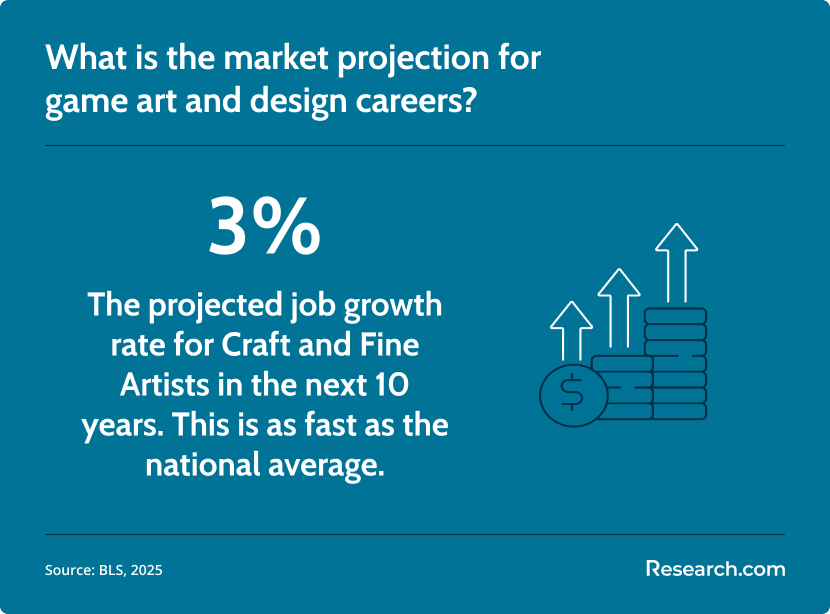
| Craft and Fine Artists | These roles are projected to grow 3%. | Approximately 4,900 openings each year. | Relevant for concept art, illustration, asset creation, and freelance creative production. |
Graduates may also find work in healthcare simulation, military training, extended reality development, e-learning, and remote contract production. A portfolio that demonstrates current engine workflows, collaboration, and technical fluency can help graduates compete more effectively than a degree alone.
Creative students who want additional income pathways may also compare an accelerated digital photography online degree, since photography, composition, lighting, and digital editing can overlap with marketing, media production, and visual asset creation.
Key Insights
- Fast is only valuable if the portfolio is strong. Accelerated online game art and design programs can shorten completion time, but employers still need to see polished, role-specific work.
- Transfer credit can change the value equation. Programs that accept up to 90 credits may reduce both time and cost, but students should request a written transfer evaluation before enrolling.
- Accreditation should be verified independently. Institutional accreditation affects federal aid, transfer options, and long-term academic credibility.
- Online programs vary widely in support. Strong programs offer critiques, team projects, career events, portfolio reviews, and software guidance; weak programs leave students to build everything alone.
- Specialization matters. Character art, technical art, animation, UI/UX, environment art, VFX, concept art, and XR require different portfolios and course choices.
- Total cost is more than tuition. Software, hardware, lab fees, rendering credits, and course materials can significantly affect affordability.
- The job market rewards practical proof. Degrees can help, but shipped projects, prototypes, engine-ready assets, and collaboration experience often determine how competitive a graduate is.
References:
- Bureau of Labor Statistics. (2025). Craft and fine artists. Occupational Outlook Handbook. BLS craft and fine artists data
- Bureau of Labor Statistics. (2025). Special effects artists and animators. Occupational Outlook Handbook. BLS special effects artists and animators data
- Bureau of Labor Statistics. (2025). Web developers and digital designers. Occupational Outlook Handbook. BLS web developers and digital designers data
- International Game Developers Association. (2024) Developer Satisfaction Survey (DSS) – IGDA. Retrieved 17 June 2025 from IGDA Developer Satisfaction Survey results
- National Center for Education Statistics. (2024). Classification of Instructional Programs: 50.0411 – Game and Interactive Media Design. NCES CIP 50.0411 details
- National Center for Education Statistics. (2024). Distance Education in IPEDS. Retrieved June 2025, from NCES distance education in IPEDS
- National Center for Education Statistics. (2024). Distance learning. NCES distance learning facts
- National Center for Education Statistics. (2024). Tuition and fees for distance education students. NCES tuition and fees for distance education students
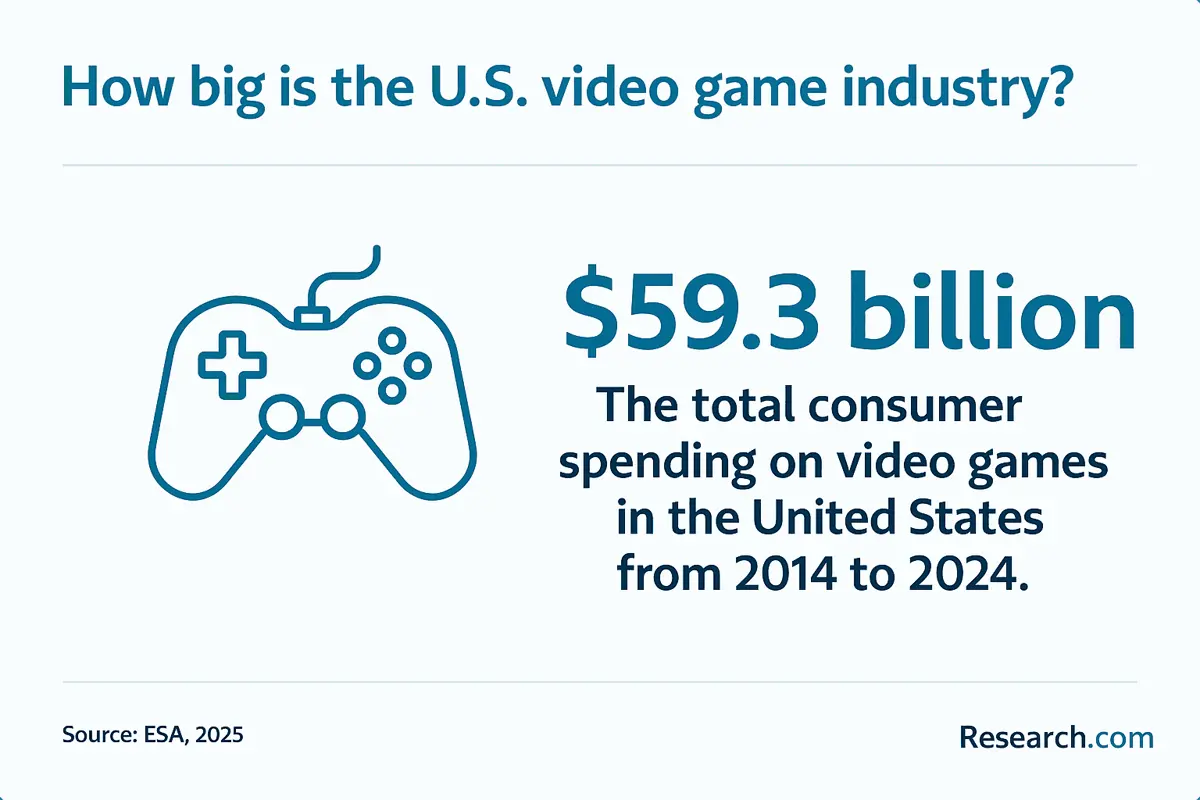
- The Entertainment Software Association. (2025, June 3). 2025 Essential facts about the U.S. Video Game Industry. The ESA. ESA 2025 video game industry data
Other Things You Should Know About Online Game Art and Design Degree Programs
Yes. Many accelerated online game art and design programs require a portfolio of 8 to 15 original pieces, such as drawings, digital paintings, 3D models, or animation samples. Some schools also ask for a statement of purpose and minimum GPA, often around 2.5.
For 2027 online Game Art and Design programs, students typically need a high-performance computer with a strong graphics card, stable internet, and design software like Autodesk Maya or Adobe Creative Suite. Specific technology requirements are listed on each program's website.