
2027 What is a Video Game Designer: Salary & Career Paths

Co-Founder and Chief Data Scientist
Choosing video game design as a career usually starts with a love of games, but the job itself is much more technical than imagining characters or pitching story ideas. Designers turn concepts into systems players can actually interact with: rules, levels, feedback loops, controls, progression, user interfaces, and narrative moments. To do that well, they need creative judgment, technical fluency, collaboration skills, and a portfolio that proves they can build playable work.
This guide explains what video game designers do, how much they can earn, what education and training paths are available, and how to build the skills employers look for. It is designed for students, career changers, self-taught developers, and creative professionals who want a realistic view of the field before investing time or money in a degree, bootcamp, or portfolio project.
Gaming is a major global entertainment business. Global gaming revenue surpassed $200 billion in 2022—twice that of the film industry. In the U.S., the median salary for video game designers was $79,890 in 2021, and job growth was expected to rise 10-15% by 2030. Those figures help explain why the field attracts so many applicants, but they also highlight the need to compete with strong technical skills and finished work.
Quick Answer: What Is the Best Way to Become a Video Game Designer?
The most reliable path is to learn game design fundamentals, build small playable projects, develop technical skills in game engines and scripting, and create a focused portfolio. A degree in game design, computer science, animation, or graphic design can help, but employers often weigh demonstrable work heavily. Candidates who can show finished prototypes, explain design decisions, and collaborate with programmers, artists, and producers usually have a stronger chance than those who only have ideas.
Key Things You Should Know About Video Game Designing
- Game design is not one job function. Designers may work on mechanics, levels, narrative, characters, progression systems, UI, monetization, accessibility, tutorials, or player experience, depending on the studio and project.
- Pay can be competitive, but it varies widely. In 2025, video game designers earn an average salary of $95,185, with top professionals specializing in programming and animation making up to $120,000 per year. Location, experience, specialization, and portfolio quality can all affect compensation.
- Demand exists, but competition is real. The U.S. game designer job market is expected to grow by 2.28% annually, with 32,090 new jobs projected by 2029. The broader digital design field, including game design, is also set to expand by 8% from 2023 to 2033.
- Career paths are flexible. Designers may move into level design, production, technical project management, programming, animation, interactive media, simulations, education technology, or broader digital design roles.
- Education helps most when it produces skills and projects. A formal degree is not always mandatory, but many designers study game design, computer science, graphic design, animation, or a related field. Bootcamps such as the Deep Dive Intro to Game Design and Development offer intensive training, with costs ranging from $7,500 to $13,500.
- What does a video game designer do?
- How much do video game designers earn for 2027?
- What are the career paths for video game designers?
- What education do you need to become a video game designer?
- How do you get a job as a video game designer?
- What industries hire video game designers?
- What skills do you need to be a successful game designer?
- Is game design a good career for 2027?
- How Can Interdisciplinary Studies Boost Your Game Design Creativity?
- Should Advanced Academic Studies Enhance a Game Design Career?
- What ethical considerations should video game designers keep in mind?
- How Do Emerging Technologies Influence Game Design?
- What Lessons from Other Disciplines Can Enhance Game Design Innovation?
- How do you start learning game design today?
- What are the biggest challenges video game designers face?
- How Can Continuous Learning and Networking Enhance Your Game Design Career?
- How can I build a standout game design portfolio?
What does a video game designer do?
A video game designer plans and refines the systems that shape how a game works and how players experience it. Designers translate a creative vision into playable mechanics, progression, challenges, environments, stories, interfaces, and feedback. They rarely work alone; most collaborate with artists, engineers, audio teams, writers, producers, QA testers, and product leads.
Core responsibilities of a video game designer
The exact role depends on the studio size and game type. At a small indie studio, one designer may handle systems, levels, UI, and scripting. At a large studio, design work is often divided among specialists.
- Gameplay mechanics: Creating the rules, interactions, rewards, constraints, and feedback loops that make the game playable and engaging.
- Worldbuilding: Defining environments, lore, factions, settings, and the internal logic of the game world.
- Level design: Building maps, missions, encounters, puzzles, checkpoints, difficulty curves, and pacing.
- Characters and dialogue: Developing personalities, backstories, choices, interactions, and narrative roles.
- Story structure: Designing quests, conflicts, branching paths, cutscenes, and narrative progression.
- User interface and controls: Making menus, HUD elements, inputs, tutorials, and navigation clear for players.
- Audio direction: Coordinating sound effects, music cues, environmental audio, and feedback sounds that support immersion.
- Playtesting and iteration: Observing how players behave, identifying friction points, and adjusting systems based on evidence rather than assumptions.
Students who want structured training in engines, scripting, interactive storytelling, and production may compare programs such as an online game development degree. The strongest programs typically help students create portfolio projects, not just study theory.
| Design area | What the designer decides | What employers want to see |
| Systems design | Rules, progression, rewards, player choices, balance | Clear design documents, prototypes, and playtest changes |
| Level design | Map layout, pacing, enemy placement, objectives, routes | Playable levels with before-and-after iteration notes |
| Narrative design | Story arcs, dialogue, quests, branching choices | Interactive scripts, quest samples, and player-choice examples |
| UI/UX design | Menus, HUDs, controls, tutorials, accessibility cues | Wireframes, usability reasoning, and implemented interfaces |
| Technical design | Scripting, engine logic, tools, implementation support | Working prototypes in Unity, Unreal Engine, Godot, or a similar tool |
How much do video game designers earn for 2027?
The average salary for a video game designer in the United States in 2025 is $95,185 per year, with salaries typically ranging from $56,000 to $160,000. On an hourly basis, that equals around $45.76 per hour. Pay depends on location, experience, education, technical specialization, studio size, and the type of game being developed.
Nevada ranks as the highest-paying state for game designers. Designers with specialized ability in programming languages such as C++ and in game design engines can command salaries of up to $120,000 per year. Professionals with animation and visual design skills generally earn between $90,000 and $100,000 annually, while entry-level designers and candidates without formal training are more likely to start near the lower end of the range.
Education can influence earning potential, although it does not guarantee a salary. Game designers without a high school diploma can earn up to $72,000 per year, while those with a bachelor’s degree in animation see earnings rise to $96,000. A focused video game design degree may improve access to internships, portfolio support, and technical training. Master’s and doctoral graduates often earn $120,000 or more annually, particularly when their advanced training aligns with technical or leadership roles.
| Salary factor | How it can affect earnings | What to do before making a decision |
| Experience level | Entry-level roles usually pay less than senior, lead, or director-level roles. | Look for internships, QA roles, game jams, and freelance projects that create shipped or playable work. |
| Technical skill | C++, engine scripting, tools development, and technical design can raise marketability. | Build at least one portfolio project that proves you can implement mechanics, not only describe them. |
| Creative specialization | Animation, visual design, systems design, and level design may lead to different salary bands. | Choose a specialization based on the type of work you want to do daily, not only on salary potential. |
| Education | Degrees can support credibility, internships, and structured skill development. | Compare cost, portfolio outcomes, faculty experience, software access, and alumni results. |
| Location | Pay can differ by state and by studio concentration. | Check whether remote, hybrid, or relocation-based roles dominate your target studios. |
What are the career paths for video game designers?
Video game design can lead to several creative, technical, and production-focused careers. Some designers begin in junior design roles and specialize in levels, systems, quests, UI, or narrative. Others enter through QA testing, programming, modding, animation, or freelance development and later move into formal design positions.
Common career paths in game design
- Game designer: Builds gameplay systems, player rules, challenges, rewards, and narrative structures.
- Level designer: Creates environments, missions, encounter layouts, exploration routes, and difficulty progression.
- Technical project manager: Coordinates development teams, schedules, production workflows, and delivery milestones.
- Video game producer: Manages scope, timelines, team communication, and production priorities.
- Computer programmer: Writes and maintains code for gameplay, physics, AI behavior, tools, and systems.
- Web developer: Builds and supports online game platforms, community sites, storefront integrations, and digital services.
Many aspiring designers strengthen their employment options by learning software development first. Starting with computer coding jobs can help build the C++, Python, C#, or Java experience needed for technical design and gameplay implementation.
| Path | Best fit for | Typical proof employers expect |
| Junior game designer | Applicants with strong design thinking and small playable projects | Design documents, prototypes, playtest notes, and clear explanations of choices |
| QA tester to designer | People who want studio experience and understand how games break | Bug reports, test plans, analytical thinking, and internal design contributions |
| Programmer to technical designer | Candidates who enjoy coding and implementation | Scripts, tools, gameplay systems, and working builds |
| Artist or animator to designer | Visual creators interested in interactivity and player experience | Character, environment, UI, animation, or visual storytelling projects |
| Producer or project manager | Organized communicators who like schedules, scope, and team coordination | Production plans, shipped projects, and cross-functional leadership examples |
What education do you need to become a video game designer?
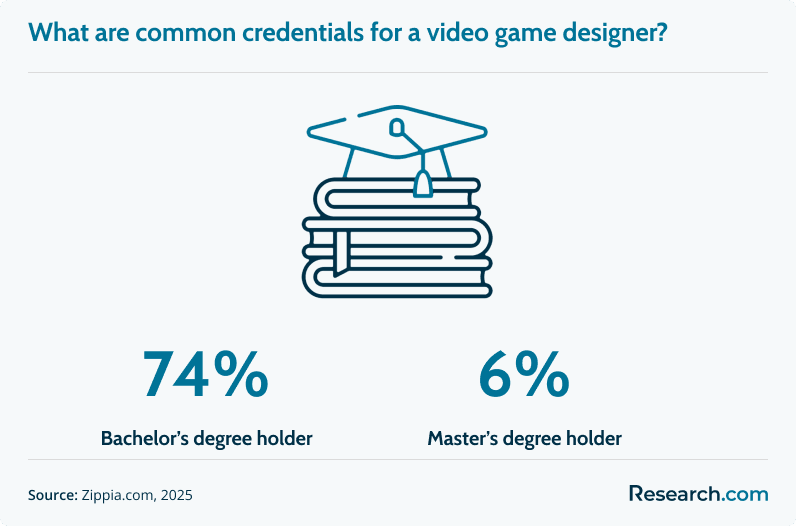
A college degree is not a universal requirement for video game design, but formal education can make the learning path clearer. Many designers study game design, computer science, graphic design, animation, communication, multimedia arts, or related fields. Industry data shows that 14% of video game designers major in photography, 12% study graphic design, and 14% focus on computer science.
The best education path depends on the type of designer you want to become. A student aiming for technical design may benefit from computer science and engine-based projects. A future narrative designer may need interactive writing, quest design, and systems thinking. A visual designer may prefer animation, illustration, user interface, or digital art training. An online graphic design degree can be useful for students who want stronger visual design, UX, typography, digital art, or animation skills.
Bootcamps and certificate programs can be a faster option for learners who want concentrated practice in game engines, coding, and animation. Bootcamp cost varies by format, length, and curriculum. As of 2019, full-time programs had a median cost of $13,500, while part-time options were around $7,500. One example is the Deep Dive Intro to Game Design and Development by CNM, which introduces core game design and development skills.
| Training option | When it makes sense | Potential drawback |
| Game design degree | You want structured instruction, faculty feedback, studio-style projects, and a portfolio timeline. | Cost and quality vary, and a degree alone will not replace a strong portfolio. |
| Computer science degree | You want to become a technical designer, gameplay programmer, tools developer, or systems-heavy designer. | It may not cover narrative design, level design, art direction, or player psychology in depth. |
| Graphic design or animation degree | You want to focus on UI, visual storytelling, characters, motion graphics, or production art. | You may need extra practice in engines, scripting, and playable implementation. |
| Bootcamp or certificate | You want shorter, skills-focused training and already know what area you need to improve. | Some programs are expensive, and employer recognition can vary. |
| Self-directed learning | You are disciplined, budget-conscious, and willing to build projects independently. | Without deadlines and feedback, it can be harder to finish polished work. |
How do you get a job as a video game designer?
Getting hired in game design usually requires more than a resume. Studios want evidence that you can design, test, revise, communicate, and finish work. A strong application combines a targeted portfolio, technical familiarity, practical experience, and enough industry awareness to discuss design trade-offs clearly.
Steps to enter the video game industry
- Study real games closely. Break down why mechanics work, how levels guide players, how tutorials reduce confusion, and where player frustration appears. Do not just review games as a fan; analyze them as a designer.
- Join game development communities. Participate in forums, Discord groups, game jams, local meetups, and online critique spaces. Sharing prototypes and giving thoughtful feedback can help you build visibility.
- Create small playable games. Use Unity, Unreal Engine, Godot, or another accessible engine to make focused projects. A finished two-minute experience is usually more useful than an unfinished “dream game.”
- Build a professional online presence. Publish your portfolio, explain your process, and include short videos or playable builds. A blog, YouTube channel, or design breakdown can help demonstrate how you think.
- Consider formal education when it fills a real gap. A degree in game design, computer science, animation, or a related field can support learning, but the value depends on curriculum quality, project work, and career support.
- Use entry-level roles strategically. QA testing, junior level design, production assistant work, freelance scripting, and modding can all help you learn studio workflows. As with the requirements for a hiring manager career, many people advance after proving they understand both day-to-day execution and broader team goals.
- Apply with tailored materials. Match your portfolio to the role. A level design job needs playable levels; a systems design job needs mechanics and balance examples; a narrative design job needs interactive writing samples.
Questions to ask before choosing a program or bootcamp
- Will I graduate with completed, playable projects?
- Does the curriculum include the engines and tools used in the roles I want?
- Are instructors experienced in game development or interactive media?
- How much direct feedback will I receive on my portfolio?
- Does the program help with internships, game jams, studio connections, or career coaching?
- What is the total cost, including software, hardware, fees, and time away from work?
What industries hire video game designers?
The traditional video game industry remains the most obvious employer, but it is not the only one. The U.S. video game industry generated $106 billion in revenue in 2023 and includes indie studios, mid-sized developers, publishers, and major companies such as Electronic Arts, Activision Blizzard, and Riot Games. The sector employs over 104,000 professionals in the U.S. alone.
Game designers may also work in animation, graphic design, special effects, education, healthcare, corporate training, simulations, marketing, and interactive media. A designer who understands storytelling, digital environments, user feedback, and player motivation can apply those skills to serious games, training tools, learning platforms, and immersive simulations. Designers with strong visual storytelling skills may also pursue a career in animation.
Hiring in large studios and fast-growing startups also depends on strong recruiting and HR systems. Professionals who meet HR coordinator career requirements often support the screening, onboarding, and retention processes that help creative teams grow effectively.
Average annual salaries for video game designers can vary by industry in the U.S.:
- Information Technology: $76,163
- Arts and Entertainment: $70,639
- Media and Communication: $73,169
- Education: $67,454
- Retail and Wholesale: $70,639
| Industry | How game design skills are used | Best-fit designer profile |
| Game studios | Entertainment games, live-service content, console, PC, mobile, and indie titles | Portfolio-driven designers with playable projects and team experience |
| Education | Learning games, simulations, interactive lessons, and assessment tools | Designers who understand motivation, progression, feedback, and accessibility |
| Healthcare | Training simulations, patient education tools, rehabilitation games, and serious games | Designers comfortable working with subject-matter experts and constraints |
| Corporate training | Scenario-based learning, onboarding simulations, compliance games, and skill practice | Designers who can turn business goals into measurable interactive experiences |
| Media and entertainment | Interactive campaigns, virtual events, animation, and immersive storytelling | Designers with strong visual, narrative, and user experience skills |
What skills do you need to be a successful game designer?
Successful game designers combine creativity with practical implementation. They need to understand what feels fun, why players behave a certain way, how systems interact, and what technical limits the team must respect. Many employers prefer candidates with a bachelor’s degree in game design or computer science and familiarity with coding languages such as Java, C, or C++. Experience with game engines such as Unity 3D can also improve job prospects.
Key skills for game designers
- Game mechanics and systems thinking: Understanding rules, incentives, balance, pacing, and player choices.
- Level design: Creating spaces that guide attention, support challenge, encourage exploration, and teach mechanics naturally.
- Scripting and coding: Using C++, Java, C#, Python, or similar languages to prototype and refine gameplay.
- Game engine fluency: Building and testing work in Unity 3D, Unreal Engine, Godot, or similar tools.
- Motion graphics and animation: Supporting cinematics, cutscenes, UI animation, character movement, and player feedback.
- Video production: Creating trailers, gameplay captures, in-game sequences, and promotional materials.
- Adobe Photoshop and visual design: Producing concept art, textures, UI elements, mockups, and presentation assets.
- Communication: Writing clear design documents, giving feedback, receiving criticism, and explaining trade-offs to artists and engineers.
- Playtesting and data interpretation: Observing player behavior and improving designs based on evidence.
Is game design a good career for 2027?
Game design can be a good career for 2027 if you want creative work that also demands technical skill, persistence, and constant learning. It is not an easy field to enter, and applicants should expect competition. Still, the market data suggests continuing opportunities for people who can produce strong work.
Demand for video game designers has been rising since 2019, with job openings increasing by 5.31% annually. By 2029, an estimated 32,090 new jobs are expected to be filled, reflecting a 2.28% annual growth rate. Approximately 287,200 game designers are currently employed in the U.S.
The broader field of web development and digital design, which includes game design, is projected to grow by 8% from 2023 to 2033, faster than the average for all occupations. The game design job market is also expected to expand by 9.3% between 2016 and 2026. These figures point to opportunity, but not guaranteed employment. Candidates still need a portfolio, practical experience, and a clear specialization.
Unlike careers with more standardized advancement requirements, such as the requirements for an executive recruiter career, game design is often portfolio-led. Formal credentials can help, but employers frequently look for evidence that you can design, implement, test, and revise interactive systems.
Who should consider game design?
- You enjoy solving creative problems within technical limits.
- You are willing to build and revise prototypes, not just write ideas.
- You can accept feedback without taking it personally.
- You like collaborating across art, engineering, writing, production, and audio.
- You are comfortable learning new tools throughout your career.
Who may want a different path?
- You want a job focused only on story ideas without implementation work.
- You dislike testing, iteration, documentation, or technical constraints.
- You want predictable tasks and a slower-changing toolset.
- You are not prepared for a competitive portfolio-based hiring process.

How Can Interdisciplinary Studies Boost Your Game Design Creativity?
Game design improves when designers borrow ideas from psychology, architecture, education, data science, ethics, engineering, art, music, and storytelling. Interdisciplinary study can help designers think more clearly about systems, player motivation, accessibility, simulation, and decision-making. For example, fields such as bioinformatics master's programs emphasize data, modeling, and complex systems—skills that can sharpen how designers approach balancing, simulation, and adaptive gameplay.
Should Advanced Academic Studies Enhance a Game Design Career?
Advanced study can be useful for designers who want to move into research-driven design, simulation, technical design, leadership, or specialized interactive systems. It is less useful if the goal is simply to collect credentials without building better work. Programs and certifications should be evaluated by how they improve your portfolio, technical fluency, design judgment, and professional network.
For some designers, interdisciplinary graduate study can provide new ways to analyze complex systems. For instance, online masters in bioinformatics may expose students to modeling, data interpretation, and computational thinking that can transfer to simulation design, procedural systems, and interactive decision frameworks.
What ethical considerations should video game designers keep in mind?
Game designers make choices that affect how players spend time, money, attention, and emotional energy. Ethical design requires more than avoiding offensive content. Designers should consider representation, accessibility, data privacy, monetization, player well-being, age-appropriate design, and whether mechanics encourage unhealthy behavior.
- Representation: Avoid stereotypes and design characters, cultures, and stories with care.
- Accessibility: Consider color contrast, input options, subtitles, difficulty settings, readable UI, and cognitive load.
- Player well-being: Evaluate whether reward loops, time gates, or social pressure create harmful patterns.
- Privacy: Be transparent about data collection, personalization, and analytics where relevant.
- Monetization: Make purchases, odds, and progression systems clear, especially in games used by younger audiences.
Disciplines that emphasize structured problem-solving can support ethical design. For example, students comparing affordable online colleges for engineering may encounter frameworks for safety, accountability, constraints, and responsible system design that also apply to interactive media.
How Do Emerging Technologies Influence Game Design?
Artificial intelligence, virtual reality, augmented reality, machine learning, procedural generation, cloud gaming, and advanced simulation tools are changing how games are designed and built. These technologies can support more adaptive enemies, responsive environments, personalized experiences, faster prototyping, and richer immersive worlds. They can also introduce new ethical and production challenges.
Designers do not need to become AI researchers, but they should understand what these tools can and cannot do. An AI online degree program can help technically oriented designers study how algorithms, models, and data-driven systems may be used for NPC behavior, dynamic difficulty, content generation, and responsive game environments.
What Lessons from Other Disciplines Can Enhance Game Design Innovation?
Game design benefits from fields that study systems, behavior, information, and experience. Architecture can improve spatial design. Psychology can strengthen motivation and feedback loops. Education can improve tutorials and learning curves. Health informatics can show how complex data systems support better decisions. A health informatics bachelor degree, for example, may help designers think about data flows, user needs, decision support, and system usability.
How do you start learning game design today?
The fastest way to start is to make small games, study why they work, and improve them through feedback. Beginners often spend too long planning large projects. A better approach is to build tiny, finished prototypes that teach one skill at a time: movement, combat, puzzle logic, dialogue, inventory, UI, or level pacing.
Practical steps for beginners
- Learn the fundamentals. Study mechanics, feedback loops, player motivation, level structure, pacing, and storytelling. Jesse Schell’s The Art of Game Design is a widely used starting point.
- Choose one beginner-friendly engine. Unity, Unreal Engine, and Godot all offer ways to build playable work. Do not switch tools every week; finish a small project first.
- Learn enough code to prototype. C++, C#, and Python can help you understand how gameplay systems function, even if you do not plan to become a full-time programmer.
- Take structured courses when you need accountability. Coursera, Udemy, GameDev.tv, bootcamps, and college courses can help if you struggle to organize your learning.
- Join game jams. Short deadlines force you to make decisions, solve problems, collaborate, and finish.
- Document your process. Save screenshots, design notes, playtest feedback, and revision explanations for your portfolio.
Structured design education in other fields follows a similar pattern. The best online degree programs for becoming an architect, for example, combine theory, software, critique, and portfolio development. Game design students should look for the same balance between conceptual training and hands-on production.
What are the biggest challenges video game designers face?
Game design can be rewarding, but it also comes with pressure. Designers often work within tight technical, budget, platform, and schedule constraints. They must satisfy players, producers, publishers, stakeholders, and teammates while making hard decisions about what to cut, revise, or rebuild.
Common challenges in game design
- Deadlines and crunch culture: Game development can involve intense workloads, particularly near release dates.
- Balancing originality and market demand: Designers need fresh ideas, but games also need audiences, revenue models, and production feasibility.
- Technical limits: Hardware, performance, engine constraints, bugs, and optimization issues can change what is possible.
- Rapid industry change: New platforms, player expectations, tools, business models, and technologies require ongoing learning.
- Player criticism: Games are public, interactive products, and feedback from communities can be intense.
- Scope creep: Adding too many features can damage schedules, budgets, quality, and team morale.
Common mistakes aspiring game designers should avoid
| Mistake | Why it hurts | Better approach |
| Building only huge unfinished projects | Employers cannot evaluate ideas that never become playable. | Create small, complete games that show specific design skills. |
| Choosing a school based only on tuition | The cheapest option may not provide portfolio support, software access, or industry feedback. | Compare total cost, curriculum, projects, faculty, and career services. |
| Assuming a degree guarantees a job | Game design hiring is competitive and portfolio-driven. | Use education to build stronger projects, internships, and connections. |
| Ignoring technical skills | Design ideas are harder to communicate if you cannot prototype or understand implementation limits. | Learn basic scripting, engine workflows, and collaboration with programmers. |
| Making a portfolio too broad | Employers may not understand what role you are targeting. | Tailor your portfolio to systems, levels, narrative, UI, technical design, or another clear focus. |
| Relying only on rankings or brand names | A recognizable program is not automatically the best fit for your goals. | Ask about student work, portfolio reviews, internships, alumni outcomes, and tool training. |
How Can Continuous Learning and Networking Enhance Your Game Design Career?
Game design changes quickly, so professional growth does not stop after a first course, bootcamp, or degree. Designers should keep learning engines, scripting methods, accessibility practices, production workflows, analytics tools, and emerging technologies. Conferences, game jams, developer communities, portfolio reviews, workshops, and online critique groups can also lead to collaboration and job referrals.
Short, targeted programs may help experienced designers close a specific skill gap. A computer science fast-track degree, for example, may be useful for designers who want stronger programming, systems, or technical design skills without choosing a traditional long-form route.
How can I build a standout game design portfolio?
A strong game design portfolio should prove that you can make decisions, implement them, test them, and improve them. It should not be a gallery of vague ideas. Employers need to see playable work, concise explanations, and evidence that you understand the role you are applying for.
What to include in a game design portfolio
- Three to five strong projects: Quality matters more than quantity.
- Playable builds or clear videos: Make it easy for reviewers to understand the project quickly.
- Your role: Explain exactly what you designed, built, wrote, balanced, scripted, or tested.
- Design documents: Include short samples that show your thinking without overwhelming the reader.
- Iteration evidence: Show what changed after playtesting and why.
- Role-specific samples: Use levels for level design, systems breakdowns for systems design, dialogue or quest samples for narrative design, and scripts or tools for technical design.
Professionals moving from another field should show how their prior skills transfer. For example, reviewing a health informatics careers list can highlight how data analysis, systems thinking, user needs, and decision support can be reframed for simulation, serious games, and interactive tools.
Here’s What Practitioners Have to Say about Video Game Designing
Studying mechanics, level flow, and story structure can turn a rough creative idea into something players can actually experience. The most satisfying part is seeing people engage with a world or system you built. – Alex
Game design sits between art and technology, which means the work keeps changing. Collaboration with other designers, artists, and programmers is often where the strongest ideas emerge. – Maya
Entering the field can be difficult, but finished projects and practical experience matter. Each new game teaches problem-solving, communication, and iteration. – Jordan
Key Insights
- Game design is implementation-driven. Ideas matter, but employers want candidates who can turn ideas into playable systems, levels, stories, and interfaces.
- A portfolio is often more persuasive than credentials alone. Degrees and bootcamps can help, but finished projects, design reasoning, and iteration notes are essential.
- Technical skills expand your options. C++, Java, C#, Python, Unity 3D, Unreal Engine, Godot, scripting, and systems thinking can make a designer more competitive.
- Salary potential is real but variable. The average salary for a video game designer in the United States in 2025 is $95,185, but pay depends on location, experience, specialization, and education.
- The field rewards specialization. Level design, systems design, narrative design, technical design, UI/UX, animation, production, and programming each require different proof of skill.
- Game design careers extend beyond entertainment studios. Education, healthcare, corporate training, animation, simulations, and interactive media also use game design skills.
- The best first step is small and practical. Pick an engine, build a simple playable project, test it with users, revise it, and document what you learned.
References:
- Zippia. (n.d.). Video game designer jobs.
- Emeritus. (n.d.). Video game designer salary.
- Nuclino. (n.d.). Video game design.
- U.S. Department of Education. (2019). Exploring digital game-based learning in the classroom (ED594152). ERIC.
- Statista. (n.d.). Video game industry in the United States - Statistics & facts.
- Recruiter.com. (n.d.). Video game designers outlook.
- U.S. Bureau of Labor Statistics. (2024). Web developers and digital designers. Occupational Outlook Handbook.
- CareerExplorer. (n.d.). Game designer job market.
Other Things You Should Know About Video Game Designing
In 2027, essential skills for a video game designer include proficiency in programming languages like C++ and Python, strong artistic abilities, and a deep understanding of game mechanics. Familiarity with platforms such as Unity or Unreal Engine is also crucial for creating engaging player experiences.
C++, C#, and Python are the most useful languages for video game designers. C++ is common in Unreal Engine projects, C# is widely used in Unity, and Python helps with scripting and tools. Many studios expect designers to read code, even if they do not write it full-time.


