
2027 How to Become an Executive Recruiter

Co-Founder and Chief Data Scientist
Becoming an executive recruiter is a serious career choice for people who enjoy high-level relationship building, business strategy, sales conversations, and talent evaluation. Executive recruiters do not usually fill entry-level jobs. They help companies identify and hire senior leaders—often C-suite executives, vice presidents, board-level talent, and specialized leaders whose decisions can shape an organization’s direction.
This guide explains how to become an executive recruiter, what the job actually involves, which education and skills matter, how compensation works, where recruiters work, and what challenges to expect. It is designed for career changers, HR professionals, sales professionals, consultants, and students who want to understand whether executive search is a realistic and worthwhile career path.
Quick answer: How do you become an executive recruiter?
Most executive recruiters enter the field by building experience in recruiting, sales, human resources, consulting, business development, or a specific industry such as finance, healthcare, or technology. A bachelor’s degree is common, but the bigger differentiators are business judgment, industry knowledge, networking ability, candidate assessment skills, and the ability to manage confidential, high-stakes hiring processes.
- Executive recruiters work on senior leadership searches. Their assignments usually involve executives, senior managers, or specialized leaders rather than broad-volume hiring.
- Relationships drive the career. Strong recruiters maintain long-term trust with hiring executives, boards, investors, and passive candidates.
- Industry focus often matters. Recruiters who specialize in finance, healthcare, technology, private equity, or another sector can build stronger market credibility.
- Sales and negotiation are central to the job. Executive recruiters must persuade busy leaders to consider opportunities and help clients close competitive offers.
- Pay can be strong but variable. Compensation often depends on base salary, commission, placement fees, retainers, industry, location, and search volume.
- Recruiters must keep learning. Salary expectations, remote leadership norms, AI sourcing tools, diversity hiring, and legal compliance continue to influence executive search.
- What does an executive recruiter do for 2027?
- What are the steps to becoming an executive recruiter?
- What are the educational requirements for becoming an executive recruiter?
- What skills do I need to become a good executive recruiter?
- Where can you work as an executive recruiter?
- How much do executive recruiters make?
- What are the benefits of becoming an executive recruiter?
- What future trends are influencing executive recruitment?
- How Can Executive Recruiters Uphold Ethical and Legal Standards?
- How Can Executive Recruiters Leverage Technology and Analytics?
- Can advanced education and certifications boost an executive recruiter's success?
- What role does personal branding play in executive recruitment?
- How Can Executive Recruiters Foster Diversity and Inclusion in Leadership Hiring?
- What are the common challenges of being an executive recruiter?
- What metrics help evaluate an executive recruiter’s performance?Common recruiting challenges
- What is the difference between an executive recruiter and an HR specialist?
- What alternative career options are available for executive recruiters?
What does an executive recruiter do for 2027?
An executive recruiter identifies, evaluates, attracts, and helps place senior leaders in organizations. The role is sometimes called executive search, leadership hiring, senior talent acquisition, or headhunting. Unlike general recruiters, executive recruiters usually work on confidential or strategically important searches where the wrong hire can be expensive, disruptive, or highly visible.
Typical searches may involve CEOs, CFOs, COOs, chief technology officers, presidents, vice presidents, partners, directors, and other senior professionals. Some candidates may have advanced leadership preparation, such as an executive master’s degree, while others build credibility through years of operational, technical, or industry-specific experience.
Executive recruiters usually handle these responsibilities:
- Clarifying the hiring mandate. They work with company leaders, boards, investors, or HR executives to define the role, business priorities, reporting structure, leadership style, and must-have experience.
- Mapping the market. They research competitors, industry leaders, compensation patterns, succession gaps, and passive candidates who may not be applying for jobs.
- Sourcing and outreach. They contact high-performing leaders discreetly, explain the opportunity, and assess whether the role aligns with the candidate’s goals.
- Screening and assessment. They evaluate career history, leadership behavior, business results, communication style, cultural fit, and potential risks before presenting candidates to the client.
- Managing confidentiality. Executive searches often involve replacement planning, mergers, succession issues, or sensitive organizational changes, so discretion is essential.
- Coordinating interviews and feedback. They guide both sides through interviews, references, concerns, compensation conversations, and final decision-making.
- Supporting offer negotiation and transition. They help align expectations around salary, equity, bonus, relocation, notice periods, and onboarding so the placement does not collapse late in the process.
Executive search can also intersect with highly specialized leadership needs. For example, a firm may look for senior talent in design, construction, technology, or creative industries where candidates have uncommon academic or technical backgrounds, including credentials discussed in resources such as the best online degree in architectural design.
If you are new to the broader talent function, it can help to compare executive search with earlier-stage HR roles. Research.com’s HR coordinator career guide explains how entry-level HR responsibilities differ from specialized leadership recruiting.
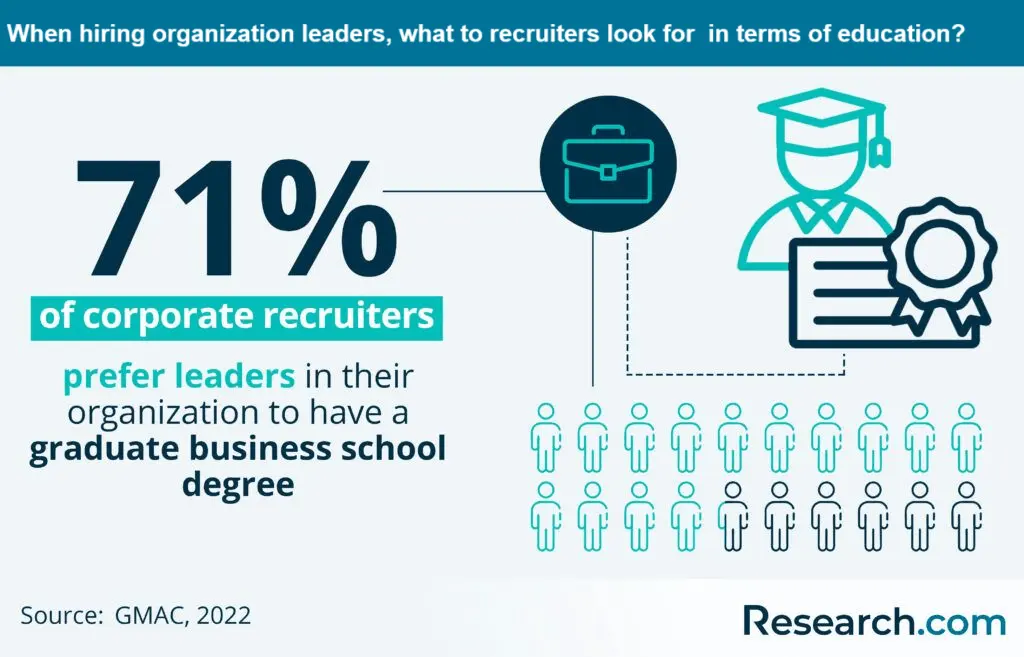
The image below shows what executive recruiters look for when hiring people to take on leadership roles in an organization.
What are the steps to becoming an executive recruiter?
There is no single required route into executive recruiting. Many professionals start in agency recruiting, corporate talent acquisition, HR, sales, consulting, business development, or an industry role before moving into executive search. The strongest candidates usually combine people skills with commercial judgment and deep knowledge of the market they recruit in.
Step 1: Build a relevant professional foundation
Start by gaining experience that teaches you how organizations hire, sell, negotiate, or make leadership decisions. Helpful backgrounds include recruiting, HR, sales, account management, consulting, management, finance, healthcare, technology, legal services, and operations.
Step 2: Learn how businesses evaluate leaders
Executive recruiters must understand more than job descriptions. They need to know how leadership teams are structured, what problems a role is meant to solve, how business models work, and what makes an executive successful in a specific context.
Step 3: Choose an industry or function to understand deeply
General recruiting experience is useful, but executive search rewards specialization. You may focus on technology leadership, private equity portfolio companies, healthcare executives, finance leaders, legal talent, human resources executives, or another niche where clients value market knowledge.
Step 4: Learn sourcing, research, and headhunting methods
Executive candidates are often not actively applying. You will need to learn talent mapping, Boolean search, LinkedIn Recruiter, CRM management, referral sourcing, competitor research, and discreet outreach to passive candidates.
Step 5: Get hands-on recruiting experience
Many future executive recruiters begin by filling mid-level, technical, professional, or manager-level positions. This builds interviewing discipline, client management habits, process control, and confidence before moving into higher-stakes searches.
Step 6: Strengthen sales and negotiation ability
Executive recruiting is partly advisory work and partly sales. You must win client trust, persuade candidates to explore opportunities, manage objections, and help both sides negotiate without damaging the relationship.
Step 7: Consider professional certification
Certifications are not always required, but they can help demonstrate seriousness, especially if you are moving from another field. Common options include Certified Personnel Consultant (CPC), Certified Executive Search Consultant (CESC), and SHRM Certified Professional (SHRM-CP).
Step 8: Decide between firm, corporate, boutique, or independent work
You can join a large executive search firm, work in-house for a corporation, specialize at a boutique firm, or eventually launch your own search practice. Large firms can provide training and brand recognition; independent recruiting can offer autonomy but requires strong business development.
Step 9: Keep expanding your network and market knowledge
Executive search is not a static career. Recruiters need to monitor leadership trends, compensation expectations, industry disruption, succession planning, and candidate availability. Joining professional communities such as the Association of Executive Search and Leadership Consultants can support continuing development.
Executive recruiter career path at a glance
| Career stage | What to focus on | Why it matters |
| Early career | Recruiting, HR, sales, consulting, or industry experience | Builds the communication, research, and business skills needed for search work |
| Developing recruiter | Mid-level searches, sourcing, interviewing, and client updates | Creates process discipline before handling senior leadership mandates |
| Executive search specialist | Industry mapping, passive candidate outreach, assessment, and confidential searches | Positions you as a credible advisor for strategic hiring decisions |
| Senior recruiter or partner | Client development, retained searches, team leadership, and market reputation | Expands earning potential and influence within a niche |
| Independent consultant or firm owner | Business development, client retention, fees, operations, and brand building | Offers autonomy but requires a strong network and consistent deal flow |
Exploring related career progressions
Professionals who enjoy recruiting sometimes move into broader hiring leadership. Reviewing a career path to hiring manager can help you compare executive search with internal hiring management, talent strategy, and HR leadership roles.
What are the educational requirements for becoming an executive recruiter?
Executive recruiting does not have a universal degree requirement. Employers and clients typically care most about judgment, credibility, market knowledge, communication ability, and a track record of successful searches. Still, many executive recruiters hold at least a bachelor’s degree, and the right academic background can make it easier to understand business problems and senior-level hiring needs.
Common degree backgrounds
- Business administration. A business administration degree can help recruiters understand organizational structure, management, operations, and corporate decision-making.
- Human resources. HR coursework can provide a foundation in talent acquisition, employment law, workforce planning, employee relations, and compensation.
- Marketing or communications. These fields support persuasive writing, stakeholder communication, candidate outreach, employer branding, and relationship management.
- Psychology. A business psychology degree or psychology-related background can be useful for understanding motivation, behavior, leadership style, and assessment methods.
- Industry-specific degrees. Recruiters who serve finance, healthcare, technology, law, architecture, or engineering clients may benefit from academic or professional experience in those fields.
Certifications and professional training
Certification can be helpful, particularly if you want to signal knowledge of recruiting ethics, employment law, search process, or HR standards. Options include:
- Certified Personnel Consultant (CPC). This credential covers recruitment practices, legal issues, and ethics.
- Certified Executive Search Consultant (CESC). This option is designed specifically for professionals working in executive search.
- SHRM Certified Professional (SHRM-CP). SHRM credentials can be useful for recruiters with broader HR responsibilities or in-house talent roles.
- LinkedIn Recruiter and AI-based sourcing training. Tool-specific training can help recruiters improve search efficiency, outreach quality, and candidate pipeline management.
Do you need a master’s degree?
A master’s degree is not mandatory for executive search. However, an MBA or graduate HR degree may help if you recruit for senior corporate, finance, consulting, or HR leadership roles. Graduate study can strengthen your understanding of strategy, leadership, organizational behavior, and executive decision-making. Some professionals compare MBA specializations when deciding whether a business graduate degree fits their recruiting niche.
Education options compared
| Option | Best for | Limitations |
| Bachelor’s degree | Building credibility and a broad foundation in business, HR, psychology, or communications | Usually not enough by itself; experience and network still matter heavily |
| Industry-specific degree | Recruiters who want to specialize in fields such as finance, healthcare, technology, law, or design | May be less flexible if you later move into another search niche |
| Certification | Professionals who want structured recruiting knowledge and a credibility signal | Does not replace a successful search record or client relationships |
| MBA or graduate HR degree | Recruiters targeting senior business, HR, consulting, or corporate leadership roles | Requires time and cost; ROI depends on your career goals and market position |
The chart below shows the distribution of executive recruiters by gender:
What skills do I need to become a good executive recruiter?
Strong executive recruiters combine consultative selling, research discipline, emotional intelligence, and commercial awareness. They must be credible with senior executives while also being organized enough to manage a long, complex hiring process.
- Relationship building. Executive search depends on long-term trust with executives, investors, founders, board members, HR leaders, and referral sources.
- Market intelligence. Recruiters need to understand competitors, leadership structures, compensation movement, hiring cycles, and business risks in their niche.
- Passive candidate sourcing. Many target candidates are not applying for jobs, so recruiters must know how to identify and approach hidden talent.
- Sales ability. Recruiters sell opportunities to candidates, sell candidate value to clients, and sell their own credibility when competing for search assignments.
- Executive communication. Clear writing, confident calls, polished presentations, and concise updates are essential when dealing with senior stakeholders.
- Negotiation judgment. Executive offers can include salary, bonus, equity, severance, relocation, reporting lines, and title. Recruiters need to manage these details carefully. Understanding compensation patterns across different fields—including specialized career guides such as video game designer salary—can also sharpen market awareness.
- Confidentiality. A careless disclosure can damage a candidate’s current job, a company’s succession plan, or a recruiter’s reputation.
- Business acumen. Recruiters must connect hiring needs to revenue, growth, turnaround work, culture change, investor expectations, or operational goals.
- Resilience. Searches can take months, and candidates may withdraw, clients may change requirements, and offers may fail late in the process.
- Technology fluency. Applicant Tracking Systems, CRMs, LinkedIn Recruiter, analytics dashboards, AI-assisted sourcing, and scheduling tools are now part of modern recruiting workflows.
How to build these skills
- Work in sales, recruiting, HR, consulting, or an industry role where you interact with decision-makers.
- Practice structured interviewing, candidate calibration, market mapping, and compensation conversations.
- Study leadership profiles, organizational charts, annual reports, funding activity, mergers, and hiring signals in your target sector.
- Build a referral network before you need it. Executive search rewards recruiters who maintain relationships over years, not days.
Where can you work as an executive recruiter?
Executive recruiters can work in several settings. The right environment depends on whether you prefer brand support, entrepreneurial independence, internal influence, or niche specialization.
| Work setting | What it looks like | Best fit for |
| Large executive search firm | Search firms are hired by companies to identify senior leaders, often through retained or high-value search assignments. | Recruiters who want training, brand credibility, research support, and exposure to major clients |
| In-house executive recruiting team | Large corporations may hire senior talent directly through internal leadership recruiting teams. | Recruiters who prefer one employer, deeper company knowledge, and close partnership with HR and executives |
| Boutique or niche search firm | Smaller firms often specialize in sectors such as tech startups, private equity and venture capital, healthcare and life sciences, or legal and compliance. | Recruiters who want specialization, closer client relationships, and a focused market reputation |
| Independent executive recruiter | Experienced recruiters may run their own search practice and work through retainers, contracts, or placement fees. | Professionals with strong networks, business development skills, and tolerance for income variability |
| RPO or consulting firm | Recruitment process outsourcing providers and consulting firms may support executive hiring or talent strategy for client organizations. | Recruiters who want project-based work, broader talent consulting, or exposure to multiple company environments |
Examples of companies and industries with in-house executive recruiting needs include technology companies such as Google, Microsoft, and Apple; finance and banking employers such as Goldman Sachs and JPMorgan Chase; healthcare and pharmaceutical companies such as Johnson & Johnson and Pfizer; and retail or consumer goods companies such as Nike, Amazon, and Coca-Cola.
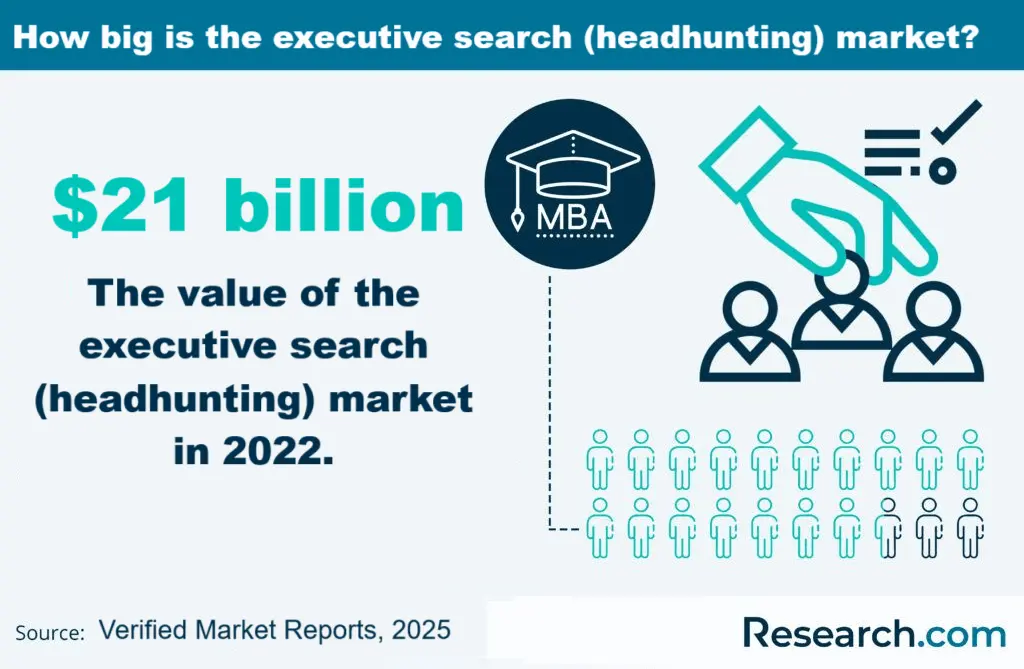
The image below shows the value of the global executive search market in 2022.
How much do executive recruiters make?
Executive recruiter pay varies widely because compensation may include salary, commission, bonuses, placement fees, retained search revenue, or independent consulting income. Industry, geography, search level, client base, and business development ability can all influence earnings.
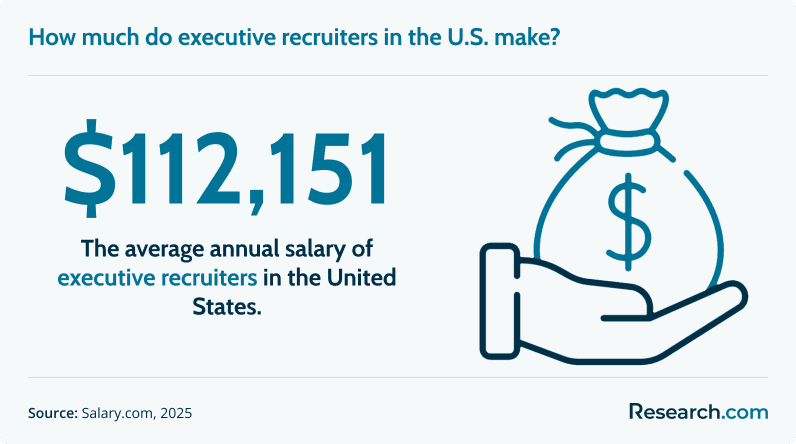
According to Salary.com, the average annual salary for executive recruiters in the United States is $112,151. Pay typically ranges from $87,623 to $127,097.
Glassdoor reports that the median total pay for executive recruiters is $154,000 per year. The base pay is $65,000 to $115,000 per year. Additional pay could include cash bonuses, commission, tips, and profit sharing. The average salary is $86,018 per year.
In contingency search, some recruiters are paid only when a candidate is placed successfully. For this model, typical fees range from 20% to 35% of the candidate’s first-year salary.
Independent executive recruiters may negotiate their own fees and keep 100% of earnings after expenses. Successful independent recruiters in high-demand areas such as tech, finance, and healthcare can earn more than $500,000 per year.
| Pay source or model | Reported figure | What to consider |
| Salary.com average annual salary | $112,151 | Reflects one salary benchmark and may vary by location, experience, and employer |
| Salary.com typical range | $87,623 to $127,097 | Useful for comparing base compensation expectations |
| Glassdoor median total pay | $154,000 per year | Includes total compensation, not only base pay |
| Glassdoor base pay range | $65,000 to $115,000 per year | Additional pay may include cash bonuses, commission, tips, and profit sharing |
| Glassdoor average salary | $86,018 per year | Another benchmark to compare with employer-specific offers |
| Contingency search fee | 20% to 35% of the candidate’s first-year salary | Recruiter income depends on successful placement |
| Successful independent recruiters in high-demand industries | More than $500,000 per year | Possible for top performers, but income is not guaranteed and expenses must be managed |
What are the benefits of becoming an executive recruiter?
Executive recruiting can be rewarding for professionals who like strategic selling, market research, negotiation, and relationship-based work. The upside is meaningful, but it is tied to performance, credibility, and consistency.
- Strong income potential. Recruiters who handle retained searches, high-value roles, or independent placements can earn substantial compensation when they build a strong client base.
- Access to senior networks. The role creates regular interaction with executives, founders, investors, board members, and HR leaders.
- Influence on business outcomes. A successful leadership placement can affect growth, culture, succession planning, transformation, and investor confidence.
- Career flexibility. Recruiters may work for firms, corporations, consulting groups, or their own search businesses.
- Continuous learning. The job requires constant exposure to market changes, compensation trends, leadership models, and industry disruption.
- Global reach. Executive search can cross regions and borders, especially for multinational companies and leadership roles with international responsibilities.
- Entrepreneurial path. Experienced recruiters can build a specialized practice if they have client relationships, a defined niche, and the discipline to manage revenue cycles.
Who is this career best for?
- People who enjoy relationship-based selling and long hiring cycles
- Professionals who are comfortable speaking with senior leaders
- Recruiters who like research, persuasion, and negotiation
- Career changers from sales, consulting, HR, or specialized industries
- Entrepreneurial professionals who can tolerate variable income
Who may want a different path?
- People who prefer predictable tasks and short hiring processes
- Professionals who dislike cold outreach or business development
- Workers who are uncomfortable with commission or performance pressure
- People who do not want to handle confidential or politically sensitive information
- Recruiters who prefer high-volume hiring over senior relationship management
The image below demonstrates the high earning potential of executive recruiters in the country through their average annual salary.
What future trends are influencing executive recruitment?
Executive search is changing as employers rethink leadership requirements, remote work, data use, diversity goals, and technology-enabled sourcing. Recruiters who rely only on a personal contact list may struggle against firms and professionals that combine relationships with analytics, structured assessment, and stronger candidate engagement.
- AI-assisted sourcing. Artificial intelligence can help recruiters identify profiles, organize candidate data, automate outreach steps, and reduce repetitive work. However, recruiters still need human judgment to assess leadership, motivation, cultural context, and risk.
- Data-driven search strategy. Recruiters increasingly use talent mapping, compensation intelligence, response rates, pipeline analytics, and retention outcomes to refine search strategy.
- Remote and hybrid leadership hiring. Virtual interviews and distributed teams have expanded candidate pools, but recruiters must assess whether leaders can manage culture, accountability, and communication across locations.
- Greater attention to diversity hiring. Clients are paying closer attention to candidate slate composition, structured evaluation, bias reduction, and leadership representation.
- Rising expectations for advisory value. Clients may expect executive recruiters to advise on compensation, market availability, succession risk, candidate perception, and employer reputation—not just provide resumes.
- Continued professional education. Some recruiters strengthen their HR and leadership knowledge through programs such as a 1 year online master’s in human resources, especially if they want to move into HR strategy or talent leadership.
How Can Executive Recruiters Uphold Ethical and Legal Standards?
Executive recruiters handle sensitive information about companies, compensation, leadership changes, candidate motivation, and career risk. Ethical failures can harm candidates and clients quickly. Recruiters must understand confidentiality, anti-discrimination rules, privacy expectations, reference-checking boundaries, and conflicts of interest.
- Protect confidential information. Do not disclose a candidate’s interest in a role, a client’s succession plan, or sensitive compensation details without proper authorization.
- Use consistent evaluation methods. Structured interviews and clear criteria reduce bias and improve defensibility.
- Avoid discriminatory screening. Candidate evaluation should focus on job-related qualifications, leadership evidence, and business requirements.
- Be transparent about the process. Candidates and clients should understand timelines, decision points, compensation expectations, and potential conflicts.
- Document search activity. Accurate records help recruiters manage compliance, client communication, and search quality.
Recruiters who want deeper HR compliance knowledge may consider advanced study, including an MBA in human resource management online, particularly if they plan to move into senior HR or talent strategy roles.
What metrics help evaluate an executive recruiter’s performance?
Executive recruiter performance should not be measured only by how many candidates are submitted. Better evaluation looks at placement quality, client satisfaction, process efficiency, diversity of candidate pipelines, and long-term fit.
| Metric | What it measures | Why it matters |
| Placement rate | How often searches lead to successful hires | Shows whether sourcing, assessment, and client alignment are effective |
| Time-to-fill | How long it takes to complete a search | Helps identify process delays, market difficulty, or unclear requirements |
| Candidate retention after placement | Whether placed executives remain successful after hiring | Connects recruiter performance to long-term fit, not just signed offers |
| Client satisfaction | Feedback from hiring leaders and repeat business | Reflects communication quality, trust, and advisory value |
| Cost-per-hire | Total search cost relative to the hire made | Helps clients evaluate efficiency and ROI |
| Negotiation success rate | How often accepted offers follow final-stage negotiations | Shows whether expectations were managed throughout the process |
Professionals who want a broader view of HR career paths can explore What can you do with an HR management degree? to understand how recruiting metrics connect to larger workforce goals.
How Can Executive Recruiters Leverage Technology and Analytics?
Technology can improve executive search when it supports better judgment rather than replacing it. Recruiters can use digital tools to organize contacts, identify patterns, improve outreach, track search progress, and analyze which sourcing channels produce high-quality candidates.
- Use CRM systems to manage long-term relationships. Executive search depends on contacts that may become relevant months or years later.
- Apply analytics to search funnels. Tracking outreach response, interview conversion, shortlist quality, and offer acceptance can reveal where a process is weak.
- Use AI carefully. AI can support sourcing and workflow, but recruiters should audit outputs for relevance, bias, and accuracy.
- Improve candidate engagement. Scheduling tools, personalized outreach templates, and structured follow-ups can make the process smoother without making it impersonal.
- Protect data. Executive search files often include sensitive career, compensation, and business information, so secure systems and access controls matter.
For professionals building a foundation in HR tools and processes, an associate’s degree in human resources online can introduce core concepts before moving into more specialized talent acquisition work.
Can advanced education and certifications boost an executive recruiter's success?
Advanced education and certification can help, but they are not shortcuts. Executive search clients usually want evidence that you understand their market and can deliver qualified leaders. Education is most valuable when it strengthens your credibility in a specific niche or gives you practical knowledge you can use in search strategy.
- Certifications can support credibility. They may show knowledge of recruiting standards, ethics, HR practices, or executive search methods.
- Graduate education can support advisory work. Business and HR graduate programs may help recruiters understand strategy, leadership, finance, organizational design, and workforce planning.
- Industry-specific learning can be more valuable than generic credentials. If you recruit healthcare executives, finance leaders, or technology officers, sector knowledge can improve candidate assessment and client trust.
- ROI depends on your career goal. A degree or certification may be worthwhile if it helps you access better clients, move into HR leadership, or specialize in higher-value searches.
If you are comparing graduate HR options, Research.com’s guide on what jobs can you get with a master’s degree in human resources can help connect education choices to career outcomes.
What role does personal branding play in executive recruitment?
Personal branding matters because executive recruiting is built on trust before a formal search ever begins. A clear professional brand helps clients and candidates understand your niche, judgment, network, and track record.
- Define your market. A recruiter known for healthcare CEOs, private equity CFOs, or technology product leaders is easier to remember and refer.
- Share useful insight. Thoughtful posts, salary commentary, leadership hiring observations, and market updates can attract candidates and clients.
- Make outreach credible. Senior leaders are more likely to respond when your profile, track record, and message show relevance.
- Align education with positioning. Recruiters focused on HR leadership or people strategy may strengthen their brand by exploring options such as Why earn MBA in HR?
- Protect reputation carefully. Overpromising, careless confidentiality, or poor candidate communication can weaken a brand quickly.
How Can Executive Recruiters Foster Diversity and Inclusion in Leadership Hiring?
Executive recruiters can influence who gets considered for leadership roles. Diversity and inclusion in executive search require more than a statement of intent; they require structured sourcing, fair evaluation, and accountability throughout the process.
- Build broader candidate pools. Recruiters should look beyond familiar networks and referral circles that may reproduce the same leadership profiles.
- Use structured evaluation criteria. Clear role requirements reduce the risk of subjective “fit” judgments that can hide bias.
- Track slate composition and outcomes. Data can show whether diverse candidates are entering the process and whether they are advancing fairly.
- Challenge unnecessary requirements. Some criteria may exclude qualified leaders without being truly essential to the role.
- Partner with relevant professional groups. Relationships with organizations that support underrepresented executives can expand market reach.
Recruiters who want broader business training may compare flexible degree options such as an accelerated business degree online, especially if they plan to advise clients on leadership, strategy, and organizational growth.
What are the common challenges of being an executive recruiter?
Executive search can be profitable and meaningful, but it is also demanding. Recruiters work with senior stakeholders, confidential information, unpredictable timelines, and candidates who may have little urgency to change roles.
- Intense competition. Search firms and independent recruiters often compete for the same clients, candidates, and niche markets.
- Long hiring cycles. Executive roles may require multiple interviews, board approval, compensation modeling, references, and extended negotiations.
- Hard-to-reach candidates. The best leaders are often busy, well-compensated, and not openly looking for a new role.
- Misaligned expectations. Clients may want unrealistic qualifications, while candidates may have compensation, title, location, or flexibility requirements that are difficult to meet.
- High pressure to perform. Retained searches, commission plans, and client relationships can create significant pressure to deliver.
- Reputation risk. A failed placement, poor communication, or breach of confidentiality can damage future business.
Common mistakes to avoid
| Mistake | Why it hurts | Better approach |
| Entering executive search without a niche | Clients may not see why they should trust your market knowledge | Choose an industry, function, or leadership level to understand deeply |
| Relying only on job boards | Senior candidates are often passive and may never apply | Use market mapping, referrals, direct outreach, and long-term relationship building |
| Submitting candidates too quickly | Poorly matched shortlists weaken client confidence | Clarify success criteria and assess candidates against the role’s business problem |
| Ignoring confidentiality | Leaks can harm candidates, clients, and your reputation | Set clear communication rules and protect sensitive information |
| Focusing only on compensation | Executives also weigh mission, autonomy, board dynamics, equity, culture, and risk | Understand the full career decision from the candidate’s perspective |
| Assuming a degree or certification guarantees success | Credentials alone do not create placements or client trust | Combine education with search experience, market insight, and proven execution |
What is the difference between an executive recruiter and an HR specialist?
Executive recruiters and HR specialists both work with talent, but their responsibilities, client relationships, and hiring scope are different. Executive recruiters usually focus on senior leadership searches, while HR specialists often manage broader workforce processes inside one organization.
| Comparison point | Executive recruiter | HR specialist |
| Hiring focus | Senior executives, C-suite leaders, vice presidents, directors, and specialized leadership roles | Entry-level, professional, mid-management, and sometimes broader company hiring needs |
| Work setting | Search firm, boutique firm, consulting firm, independent practice, or in-house executive recruiting team | Usually inside an organization’s HR department |
| Sourcing style | Proactive headhunting, referrals, market mapping, and passive candidate outreach | Job postings, applicant screening, internal processes, and general recruitment workflows |
| Other responsibilities | Search strategy, candidate assessment, confidential outreach, offer negotiation, client advising | Employee relations, onboarding, benefits support, compliance, HR administration, and workforce programs |
| Primary success measure | Quality and completion of senior-level placements | Effective support of HR operations and hiring needs across the organization |
The table below shows the industries with the highest levels of employment in HR specialists in the United States, according to the Bureau of Labor Statistics:
| Industry | Employment |
| Employment Services | 101,080 |
| Management of Companies and Enterprises | 50,380 |
| Federal Executive Branch (OES Designation) | 28,140 |
| Management, Scientific, and Technical Consulting Services | 27,900 |
| Computer Systems Design and Related Services | 24,880 |
What alternative career options are available for executive recruiters?
Executive recruiters build transferable skills in interviewing, sales, negotiation, market analysis, relationship management, and leadership assessment. These skills can support several career moves inside and outside recruiting.
- Human resources manager. Recruiters with broad talent experience and a degree in human resources may move into HR leadership, employee relations, workforce planning, or organizational development.
- Talent acquisition specialist or leader. This role focuses on recruitment strategy, employer branding, hiring operations, and workforce planning for an organization.
- Career coach or consultant. Recruiters understand hiring decisions, executive resumes, interviewing, and market positioning, which can translate into advisory work for professionals.
- Business development manager. Executive search builds prospecting, persuasion, account management, and relationship skills that can transfer to sales leadership.
- Entrepreneur or independent recruiter. Experienced recruiters may open a search firm or consulting practice if they have a strong niche and client pipeline.
- Corporate trainer. Recruiters with strong presentation and coaching ability can design training in interviewing, leadership communication, hiring practices, or career development. A communications degree can support this direction.
Questions to ask before pursuing executive recruiting
- Do I enjoy building relationships before there is an immediate transaction?
- Am I comfortable contacting senior professionals who may not be looking for a job?
- Can I handle rejection, stalled searches, changing client expectations, and long sales cycles?
- Which industry or function can I credibly specialize in?
- Do I prefer a large search firm, boutique firm, corporate recruiting team, or independent practice?
- How much income variability am I willing to accept if compensation includes commission or fees?
- What training, mentorship, or certification would help me close my current skill gaps?
- How will I protect confidentiality and build a reputation for ethical search work?
Key Insights
- Executive recruiting is best suited for people who combine relationship-building, business judgment, research skill, and persuasive communication.
- A bachelor’s degree is common, but there is no single required major. Business, HR, communications, psychology, and industry-specific degrees can all be useful depending on your niche.
- Experience matters more than credentials alone. Sales, HR, consulting, corporate recruiting, and industry expertise can all lead into executive search.
- Compensation can be attractive, but it varies significantly by employer, market, fee model, performance, and whether you work independently.
- Executive search is moving toward more technology-enabled, data-informed, and diversity-conscious hiring practices, but human judgment remains central.
- The strongest recruiters specialize, protect confidentiality, communicate clearly, and build long-term trust with both clients and candidates.
- Before choosing this path, compare the trade-offs: high earning potential and influence on one side; pressure, long cycles, and unpredictable outcomes on the other.
References:
- Belyh, A. (2025, February 14). 27 Executive Recruitment Statistics for 2025. Keevee.
- Glassdoor. (2024, June 6). How much does an Executive Recruiter make? Glassdoor.
- Kelly, J. (2023, December 29). Human Resources And Recruitment Trends For 2024. Forbes.
- Raji, N. et al. (2024, January). Revolutionizing Recruitment: The Role of Artificial Intelligence in Talent Acquisition. ResearchGate.
- Salary.com. (2025, March 1). Executive Recruiter Salary in the United States. Salary.com.
- United States Bureau of Labor Statistics. (2020, July 6). Occupational Employment and Wage Statistics: 13-1071 Human Resources Specialists. BLS.
- Verified Market Reports. (2025, February). Executive Search (Headhunting) Market Insights. verifiedmarketreports.com.
Other Things You Should Know About Becoming an Executive Recruiter
Executive recruiters are in high demand across industries like technology, healthcare, finance, and manufacturing. Companies in these sectors frequently need specialized leadership talent to manage rapid growth, regulatory challenges, and digital transformation. Additionally, private equity firms and multinational corporations rely heavily on executive search firms for leadership hires.
While prior HR experience can be helpful, it is not a strict requirement. Many successful executive recruiters come from sales, consulting, or industry-specific backgrounds where they’ve developed strong networking and negotiation skills. However, understanding talent acquisition principles and labor laws can provide an advantage in the field.


