
2027 How To Become A Financial Analyst

Co-Founder and Chief Data Scientist
Becoming a financial analyst is a strong option if you like working with numbers, business strategy, markets, and data-driven decisions. The role matters because companies, investors, lenders, and executives rely on analysts to understand performance, forecast risks, compare opportunities, and decide where money should go next. Even though financial projections are never perfect, and some estimates place analyst projection accuracy at around 53% to 57%, modern software, better datasets, and stronger modeling practices can improve the quality of financial analysis.
This guide explains how to become a financial analyst, what the job involves, how long the path can take, which degrees and certifications are worth considering, what skills employers look for, and how salary and job outlook compare across industries and states. It is designed for students, career changers, and early-career professionals who want a practical roadmap rather than a vague overview.
Quick Answer: How Do You Become a Financial Analyst?
Most financial analysts start with a bachelor’s degree in finance, accounting, economics, business, statistics, or a related quantitative field. From there, they build experience through internships, entry-level finance jobs, financial modeling projects, and industry tools such as Excel, Power BI, Tableau, Bloomberg, and FP&A platforms. Certifications such as the CFA, FRM, CPA, CMA, CFP, or CIMA can strengthen career prospects, especially for specialized roles in investment analysis, risk management, accounting, wealth planning, and portfolio management.
| Step | What to Do | Why It Matters |
| 1. Earn a relevant degree | Choose finance, accounting, economics, business, statistics, or another analytical major. | Most employers expect formal training in financial statements, markets, valuation, and data analysis. |
| 2. Build technical skills | Practice Excel modeling, forecasting, variance analysis, visualization, and financial reporting. | Analysts are hired for their ability to turn financial data into usable decisions. |
| 3. Get practical experience | Complete internships, entry-level analyst roles, accounting work, or finance projects. | Employers value evidence that you can apply classroom knowledge to real business problems. |
| 4. Consider certification | Pursue credentials such as CFA, FRM, CPA, CMA, CFP, or CIMA when they match your target role. | Certifications can signal specialized expertise and commitment to the profession. |
| 5. Target the right analyst path | Compare corporate finance, investment research, FP&A, risk, credit, treasury, and consulting roles. | Different analyst jobs require different skills, credentials, tools, and career strategies. |
Key Things You Should Know About Becoming a Financial Analyst
- A financial analyst studies financial information, builds models, prepares reports, and explains findings so organizations can make better business, investment, and budgeting decisions.
- The full path often takes four to eight years, or more, depending on your degree level, work experience, certification goals, and target specialization.
- The most common skills found on financial analyst resumes in the United States are financial analysis (9.4%), financial models (4.6%), financial data (4.6%), strong analytical skills (4.1%), variance analysis (3.8%), hyperion (3.4%), and customer service (3.3%).
- Employment for financial analysts is projected to grow by 9% from 2023 to 2033.
- Financial analysts earn an average annual salary of $112,950 and a median annual salary of $99,010.
- The highest-paying industries by average annual salary are web search portals and other information services ($154,850), other investment pools and funds ($146,640), securities, other financial investment, and related activities ($139,750), pipeline transportation of crude oil ($130,520), and accounting, tax preparation, bookkeeping, and payroll services ($129,790).
- What does a financial analyst do?
- How to become a financial analyst
- Types of financial analysts
- How long the financial analyst path takes
- Best certifications for financial analysts
- Skills financial analysts need
- Challenges in financial analysis
- Should financial analysts earn an advanced degree?
- Can an online MBA help financial analysts move up?
- Why continuous learning matters in financial analysis
- How financial analysts manage regulatory challenges
- How business administration education can support analyst careers
- How mentorship and networking support career growth
- Can an affordable executive MBA help financial analysts progress?
- How entrepreneurial thinking improves financial analysis
- Can accelerated online business degrees shorten the path?
- Career paths for financial analysts
- Financial analyst job outlook
- Financial analyst salary
- Software financial analysts use
What does a financial analyst do?
A financial analyst reviews financial records, market information, operating data, and business trends to help an organization understand where it stands and what it should do next. The work may involve evaluating financial statements, forecasting revenue and expenses, building valuation models, preparing dashboards, researching investments, identifying risks, and presenting recommendations to managers, executives, investors, or clients.
Financial analysts do not simply “look at numbers.” They connect financial data to business decisions. For example, an analyst may help a company decide whether to expand into a new market, cut costs, acquire another business, issue debt, adjust pricing, increase capital spending, or change an investment strategy.
Core responsibilities of financial analysts
- Financial statement review: Analysts examine balance sheets, income statements, cash flow statements, budgets, and operating reports to assess profitability, liquidity, debt, margins, and performance trends.
- Financial modeling: They create models that estimate future performance, test assumptions, compare scenarios, and support decisions involving investments, budgets, acquisitions, pricing, or capital projects.
- Forecasting and planning: Analysts use historical data, current market conditions, and business assumptions to prepare forecasts that guide spending, hiring, investment, and strategy.
- Reporting and presentations: They turn complex financial findings into clear reports, dashboards, slide decks, and executive summaries for decision-makers.
- Investment research: Some analysts study industries, companies, securities, economic trends, depreciation, capital expenditures, and market conditions to identify investment opportunities.
- Recommendations: Analysts may advise whether to buy, sell, hold, fund, reduce, expand, or restructure based on risk, expected return, business goals, and available capital.
- Ongoing market monitoring: Strong analysts keep learning because markets, software, reporting rules, economic conditions, and employer expectations change quickly.
| Analyst Task | Typical Output | Who Uses It |
| Budget analysis | Variance reports and spending recommendations | Department leaders, finance managers, executives |
| Investment analysis | Valuation models, investment memos, risk-return comparisons | Portfolio managers, investors, corporate development teams |
| Forecasting | Revenue, expense, cash flow, and scenario projections | Executives, FP&A leaders, operations teams |
| Risk analysis | Risk assessments, sensitivity models, mitigation plans | Risk teams, compliance leaders, lenders, investment committees |
| Performance reporting | Dashboards, KPI reports, board presentations | Senior leaders, business units, shareholders, clients |
The chart below shows the US states that employ the most financial analysts.
How to Become a Financial Analyst
The most reliable route into financial analysis combines education, technical skill-building, work experience, and role-specific credentials. A degree can open the door, but employers usually look for proof that you can interpret financial information, communicate clearly, and use software to solve business problems.
- Choose the right undergraduate foundation. A bachelor’s degree is commonly the starting point. Finance is the most direct major, but accounting, economics, business, statistics, mathematics, engineering, and other analytical fields can also prepare you for the role. Students who want a shorter degree timeline may compare accelerated finance degree online programs.
- Learn financial statements and accounting basics. Analysts need to understand revenue, expenses, margins, cash flow, assets, liabilities, equity, depreciation, working capital, and debt. Even investment-focused roles require accounting fluency.
- Practice financial modeling. Build models for budgeting, forecasting, discounted cash flow, comparable company analysis, scenario analysis, and variance analysis. A portfolio of sample models can help entry-level candidates show job-ready skills.
- Gain experience before graduation if possible. Internships, finance clubs, student-managed funds, accounting assistant roles, business analytics projects, and case competitions can make your resume stronger.
- Apply for entry-level analyst or adjacent roles. Search for titles such as junior financial analyst, FP&A analyst, credit analyst, investment analyst, accounting analyst, business analyst, treasury analyst, and reporting analyst.
- Earn certifications strategically. Certifications are useful when they match your target path. The CFA is relevant for investment roles, the FRM for risk, the CPA for accounting-heavy work, the CMA for corporate finance and management accounting, the CFP for planning, and the CIMA for investment consulting and wealth management.
- Keep improving your technical toolkit. Excel remains important, but analysts increasingly benefit from data visualization, database querying, automation, and financial software experience.
- Build a resume around outcomes. Instead of listing only coursework, describe models built, reports created, savings identified, forecasts improved, processes automated, or business decisions supported.
Financial analyst preparation checklist
| Area | Beginner Goal | Competitive Goal |
| Education | Complete a bachelor’s degree in a relevant field. | Add advanced coursework in valuation, accounting, data analytics, statistics, or corporate finance. |
| Experience | Secure an internship or entry-level finance role. | Show measurable work on budgets, forecasts, models, dashboards, or investment research. |
| Technical skills | Use Excel, financial statements, and basic charts confidently. | Build advanced models and use visualization, BI, or database tools. |
| Credentials | Understand which certifications fit your career path. | Pursue a certification only when it supports your target role and timeline. |
| Communication | Explain financial results in plain language. | Present recommendations, trade-offs, assumptions, and risks to non-finance stakeholders. |
What are the different types of financial analysts?
Financial analyst is a broad job category. Some analysts work inside companies and support budgets, forecasts, and operations. Others work for investment firms, banks, funds, rating agencies, lenders, or advisory firms. A useful way to understand the field is to separate roles into buy-side, sell-side, corporate, risk, credit, and advisory paths.
Many finance degree programs introduce these specializations through electives or concentrations. Students comparing cost-conscious options can review the most affordable online finance degrees while checking whether each program includes courses aligned with their preferred analyst path.
| Type of Financial Analyst | Main Focus | Best Fit For |
| Investment Analyst | Researching investment opportunities, building valuation models, and supporting portfolio or deal decisions. | People interested in capital markets, valuation, investing, and due diligence. |
| Equity Research Analyst | Analyzing public companies and producing reports, projections, and stock recommendations. | Professionals who like industry research, company analysis, and market-facing work. |
| FP&A Analyst | Budgeting, forecasting, performance analysis, revenue planning, and internal decision support. | Candidates who want to work inside companies and partner with business units. |
| Risk Analyst | Identifying financial, market, credit, operational, and investment risks. | Analysts who enjoy modeling downside scenarios and protecting organizations from losses. |
| Ratings Analyst | Evaluating whether companies or government agencies can repay debt obligations. | People interested in bonds, creditworthiness, and debt markets. |
| Financial Quantitative Analyst | Using advanced mathematics, statistics, and models to evaluate investments and market behavior. | Professionals with strong quantitative, programming, and statistical skills. |
| Budget Analyst | Monitoring spending, preparing budget reports, and advising on resource allocation. | Those who prefer public sector, nonprofit, education, healthcare, or corporate budgeting roles. |
| Treasury Analyst | Managing cash flow, liquidity, banking relationships, assets, liabilities, and financial risk. | Analysts interested in cash management, corporate finance, and financial stability. |
| Credit Analyst | Reviewing financial statements and credit data to evaluate lending risk. | People interested in banking, lending, underwriting, and risk assessment. |
| Accounting Analyst | Collecting, standardizing, and interpreting financial and industry data for reporting and peer comparison. | Candidates who like accounting, ratios, financial reporting, and structured analysis. |
Buy-side vs. sell-side vs. corporate analyst roles
| Category | Typical Employer | Primary Question |
| Buy-side | Asset managers, hedge funds, pension funds, private equity firms | Should we invest capital in this opportunity? |
| Sell-side | Investment banks, brokerages, research firms | What should clients or markets know about this company, security, or deal? |
| Corporate finance | Companies across industries | How should the business allocate money, manage performance, and plan for growth? |
How long does it take to become a financial analyst?
Becoming a financial analyst usually takes four to eight years, or more. The timeline depends on whether you stop after a bachelor’s degree, pursue a master’s degree, complete certifications, and how quickly you gain relevant experience.
A bachelor’s degree often takes about four years. A master’s degree can add one to two years, although it is not always required for entry-level roles. Certifications can add additional time because many require exams, experience, or both. The CFA, for example, involves a degree, 4,000 hours of work experience, and three exams, with all three levels typically taking about four years to complete.
| Path | Estimated Timeline | When It Makes Sense |
| Bachelor’s degree plus internship | About four years | Best for students targeting entry-level corporate finance, credit, accounting analyst, or junior FP&A roles. |
| Bachelor’s degree plus early career experience | Four to eight years | Common for analysts who build skills through entry-level roles before moving into specialized or senior positions. |
| Bachelor’s degree plus master’s degree | Often adds one to two years | Useful for candidates seeking advanced business knowledge, career switching, or leadership preparation. |
| Certification-focused route | Varies by credential | Appropriate when a designation is strongly aligned with investment, risk, accounting, planning, or advisory work. |
What are the best certifications for financial analysts?
The best certification depends on the analyst role you want. A credential can help, but it is not automatically necessary for every financial analyst position. Before committing time and money, compare the certification’s requirements with your target jobs, employer expectations, and long-term goals.
| Certification | Best For | Requirements Stated |
| Chartered Financial Analyst (CFA) | Investment analysis, portfolio management, capital markets research, securities analysis | Bachelor’s degree, 4,000 hours of work experience, and three exams; all three levels typically take about four years. |
| Certified Public Accountant (CPA) | Accounting-heavy financial analysis, reporting, tax-related finance work | Requirements vary by state and typically include 150 semester/credit hours of accounting coursework and a four-part exam. |
| Financial Risk Manager (FRM) | Risk management, financial risk assessment, market and credit risk roles | Two years of professional experience in financial risk management and a two-part exam. |
| Certified Management Accountant (CMA) | Corporate finance, management accounting, budgeting, and internal decision support | Bachelor’s degree or professional accounting certification, two years of work experience, and both parts of the CMA exam. |
| Certified Financial Planner (CFP) | Financial planning, advisory work, wealth planning | 6,000 hours of professional experience or 4,000 hours of apprenticeship experience, a bachelor’s degree, and a background check. |
| Certified Investment Management Analyst (CIMA) | Investment consulting, wealth management, financial planning, analyst-advisor roles | At least three years of experience in financial services or a related field, completion of the CIMA education program, and a background check. |
How to choose the right certification
- Choose CFA if you want investment research, portfolio management, asset management, or capital markets roles.
- Choose FRM if your target work involves risk modeling, risk governance, or financial risk controls.
- Choose CPA if you want roles that depend heavily on accounting, tax, audit, reporting, or regulatory financial statements.
- Choose CMA if you plan to work in corporate finance, FP&A, budgeting, cost analysis, or management accounting.
- Choose CFP if your goal is personal financial planning or client advisory work.
- Choose CIMA if you want to combine investment analysis with consulting or wealth management.
What skills make a financial analyst successful?
Strong financial analysts combine technical accuracy, business judgment, communication, and curiosity. Employers want analysts who can work with data, question assumptions, explain trade-offs, and help leaders make decisions under uncertainty.
- Financial analysis and modeling: Analysts need to interpret financial statements, evaluate cash flow, analyze KPIs, and build models using methods such as DCF, CCA, and precedent transactions.
- Data analysis and interpretation: The job often requires reviewing large datasets, spotting patterns, testing assumptions, and translating findings into business recommendations.
- Accounting and reporting knowledge: Understanding GAAP, IFRS, financial statements, accruals, and variance analysis helps analysts avoid flawed conclusions. Students who prefer accounting-centered work may compare the best and cheapest online accounting masters degree programs.
- Business and industry awareness: Analysts must understand economic conditions, competitive dynamics, regulation, pricing, customer behavior, and industry-specific drivers.
- Technical fluency: Excel remains central, including advanced functions and VBA. Familiarity with platforms such as Bloomberg and FactSet can also be important in investment-focused roles.
- Communication and presentation: Analysts must explain numbers to people who may not have a finance background. Clear writing and confident presentation skills are essential.
- Attention to detail: Small formula errors, inconsistent assumptions, or incorrect source data can lead to poor recommendations.
- Problem-solving: Good analysts do more than report what happened; they diagnose why it happened and what decision-makers should consider next.
- Time management: Deadlines can be tight during reporting cycles, budget season, earnings periods, transactions, or market events.
- Relationship management: Analysts often depend on data and context from accounting, operations, sales, product, compliance, and executive teams.
According to Zippia, the most common skills listed on financial analyst resumes in the United States are financial analysis (9.4%), financial models (4.6%), financial data (4.6%), strong analytical skills (4.1%), variance analysis (3.8%), hyperion (3.4%), and customer service (3.3%).
What are the biggest challenges financial analysts face?
Financial analysis is becoming more technical, more regulated, and more dependent on data quality. Analysts still need judgment, but they also need to understand automation, market volatility, regulatory expectations, and the limits of models.
- Complex markets and products: New financial instruments, business models, and investment structures can make analysis harder, especially when historical data is limited.
- Artificial intelligence and automation: AI and machine learning can automate repetitive tasks and support new investment strategies, but analysts must learn how to validate outputs, interpret results, and apply human judgment. Professionals who want to move toward AI-focused work can explore online masters in artificial intelligence programs.
- Transparency and accountability: Analysts are expected to explain assumptions, disclose limitations, and defend recommendations clearly. Additional accounting training, such as an accelerated accounting degree, can help professionals better understand financial rules, reporting language, and transaction effects.
- Regulatory change: Compliance requirements, data privacy expectations, ESG-related rules, and reporting standards can affect models, disclosures, and business decisions.
- Risk management: Analysts must identify downside scenarios, stress-test assumptions, and help organizations avoid decisions based on overly optimistic forecasts.
- Market volatility and geopolitical uncertainty: Shifting economic growth, interest rates, supply chains, and global tensions can make forecasting more difficult.
- Changing investor and stakeholder expectations: Decision-makers increasingly want faster reporting, clearer dashboards, and more transparent explanations of uncertainty.
Common mistakes aspiring financial analysts should avoid
| Mistake | Why It Hurts | Better Approach |
| Choosing a degree only by name | A finance degree can vary widely in rigor, tools, electives, and career support. | Review the curriculum, accreditation, internship support, faculty background, and employer connections. |
| Ignoring accounting fundamentals | Weak accounting knowledge leads to poor interpretation of financial statements. | Take accounting, financial reporting, and statement analysis seriously, even if you prefer investments. |
| Learning software without learning finance | Tools cannot replace judgment, assumptions, or business understanding. | Pair Excel, BI, and automation skills with valuation, forecasting, and accounting knowledge. |
| Pursuing certifications too early | A credential may not help if it does not match your role or career stage. | Use job postings to identify which credentials employers actually request. |
| Relying only on salary averages | Salary varies by industry, state, experience, credentials, and employer type. | Compare salary data with cost of living, role expectations, growth potential, and workload. |
Is pursuing an advanced degree beneficial for financial analysts?
An advanced degree can help financial analysts when it supports a clear career goal. It may be useful for moving into leadership, switching into finance from another field, building broader business knowledge, or qualifying for roles that prefer graduate-level training. However, it is not automatically required for every analyst job, so the decision should be based on cost, time, employer expectations, and expected career benefit.
An affordable online MBA may be worth considering for analysts who want management training, cross-functional business knowledge, and a flexible format. Before enrolling, compare accreditation, tuition, employer tuition assistance, finance electives, analytics coursework, alumni outcomes, and scheduling demands.
Can a top online MBA Accelerate Career Advancement in Financial Analysis?
A top online MBA can support advancement when it adds skills the analyst does not already have, such as leadership, strategy, operations, negotiation, and executive communication. It can be especially relevant for professionals who want to move from individual contributor work into finance manager, director, consulting, corporate strategy, or executive-track roles.
The degree is less likely to pay off if a candidate chooses a program only for reputation without checking cost, curriculum fit, flexibility, and employer recognition. Analysts should look for programs with finance, analytics, strategy, and leadership coursework that connects directly to their target roles.
How crucial is continuous learning for career success in financial analysis?
Continuous learning is essential because financial analysis changes with markets, technology, regulation, and employer expectations. Analysts who keep using only the tools and methods they learned early in their careers may fall behind peers who understand automation, visualization, advanced modeling, and current reporting practices.
Learning does not always require a full degree. Short courses, software training, certifications, internal projects, mentorship, and industry reading can all help. For analysts who want a structured graduate pathway with a shorter completion format, the fastest MBA programs online may be worth comparing carefully against workload, accreditation, and career goals.
How do financial analysts address regulatory challenges?
Financial analysts manage regulatory challenges by staying current on reporting standards, compliance requirements, data privacy expectations, and industry-specific rules that affect forecasts, disclosures, and risk assessments. They also document assumptions, update models when rules change, and work closely with accounting, legal, compliance, and risk teams.
For experienced professionals working with complex organizational strategy or high-level research questions, a doctoral business pathway such as the cheapest online DBA may support deeper study of governance, regulation, risk, and executive decision-making. This option is most relevant for senior professionals, consultants, or those interested in advanced applied business research.
How does an online business administration degree enhance career prospects for financial analysts?
Business administration coursework can help financial analysts understand how finance connects with operations, marketing, strategy, human resources, supply chains, and leadership. This broader perspective is valuable because financial recommendations often affect departments beyond finance.
The fastest business administration degree online options may interest students or career changers who want a broader business foundation in a shorter format. When comparing programs, check whether the curriculum includes accounting, finance, statistics, analytics, economics, and decision-making courses rather than only general management topics.
How can mentorship and networking accelerate career advancement?
Mentorship and networking can help financial analysts learn which skills matter in specific roles, how hiring works inside different firms, and what mistakes to avoid. A mentor can also review models, resumes, interview answers, and career plans. Networking can uncover roles that are not obvious from job boards and can help analysts understand employer expectations before applying.
Formal education can support this process when it includes peer interaction, alumni access, and leadership development. An MBA accelerated program may be useful for professionals who want graduate business training and a faster completion structure, but the value depends on program quality, networking access, and fit with the analyst’s goals.
Can a cheap executive MBA online accelerate career progression for financial analysts?
A cheap executive MBA online can support career progression for experienced analysts who are preparing for senior management, finance leadership, consulting, or cross-functional strategy roles. Executive MBA coursework may strengthen decision-making, leadership, financial strategy, and organizational management skills.
This pathway is usually not the best fit for someone seeking their first analyst job. It is more appropriate for professionals who already have substantial experience and need executive-level business training without leaving the workforce.
How can an entrepreneurial mindset enhance financial analysis?
An entrepreneurial mindset helps financial analysts look beyond historical reporting and ask sharper business questions: Where is the opportunity? What is the risk? Which resources are constrained? What assumptions must be true for this plan to work? This mindset is especially useful in startups, corporate development, product finance, venture capital, private equity, and growth strategy roles.
Analysts who want to understand business creation, market testing, funding, and innovation can review what can you do with an entrepreneurship degree to see how entrepreneurial training may complement financial modeling and strategic analysis.
Can accelerated online business degrees fast-track a financial analyst career?
Accelerated online business degrees can shorten the education timeline for some students, especially those who already have transfer credits or can study year-round. They may help aspiring analysts build core knowledge in finance, accounting, analytics, management, and strategy more quickly than a traditional schedule.
Speed should not be the only factor. Before choosing online business degrees fast completion options, compare accreditation, course intensity, faculty support, transfer policies, internship access, analytics coursework, and whether the program prepares students for financial analyst roles.
What are the potential career paths of aspiring financial analysts?
Financial analysis can lead to many career directions because the core skills are useful across companies, banks, funds, consulting firms, insurers, government agencies, and technology businesses. The best path depends on whether you prefer investing, corporate planning, risk, credit, accounting, advisory work, or leadership.
| Career Path | What the Role Emphasizes | Possible Advancement |
| Investment Analyst | Investment research, financial modeling, due diligence, M&A, capital raising, and portfolio support. | Associate, vice president, managing director, or portfolio-related leadership roles. |
| Corporate Financial Analyst | Budgeting, forecasting, KPI tracking, performance reporting, and strategic decision support inside companies. | Senior financial analyst, finance manager, director of finance, CFO. |
| Equity Research Analyst | Public company analysis, valuation, industry research, and stock recommendations. | Senior equity analyst, portfolio manager, research leadership roles. |
| Portfolio Manager | Investment selection, fund oversight, market research, and risk-return decisions. | Senior portfolio manager, investment committee leader, fund executive. |
| Risk Analyst | Financial, market, credit, and operational risk identification and mitigation. | Senior risk manager, chief risk officer, financial risk consultant. |
| FP&A Analyst | Planning, budgeting, forecasting, operational finance, and executive reporting. | Finance manager, director of FP&A, CFO. |
| Credit Analyst | Creditworthiness, lending risk, borrower financial statements, and economic conditions. | Senior credit analyst, credit risk manager, chief credit officer. |
| Hedge Fund Analyst | Research and modeling for high-return investment opportunities, often by asset class. | Hedge fund portfolio manager or partner. |
| Private Equity Analyst | Valuation, due diligence, deal structuring, and business acquisition analysis. | Associate, principal, partner. |
| Financial Consultant or Advisor | Financial recommendations for individuals or businesses, including investments, planning, or tax strategies. | Senior consultant, wealth manager, independent financial advisor. |
Which financial analyst path should you choose?
- Choose corporate finance or FP&A if you want to work closely with business units and help companies plan, budget, and improve performance.
- Choose investment analysis or equity research if you enjoy markets, valuation, securities, and company research.
- Choose credit analysis if you want to assess lending risk and borrower financial strength.
- Choose risk analysis if you like stress-testing scenarios and helping organizations avoid financial losses.
- Choose treasury or corporate finance leadership if you are interested in liquidity, cash management, banking relationships, and capital structure.
What is the job outlook for financial analysts?
The United States Bureau of Labor Statistics projects that employment for financial analysts will grow by 9% from 2023 to 2033, which is faster than the national average of 4%. The number of financial analysts is expected to rise from 404,800 in 2023 to 442,800 by 2033.
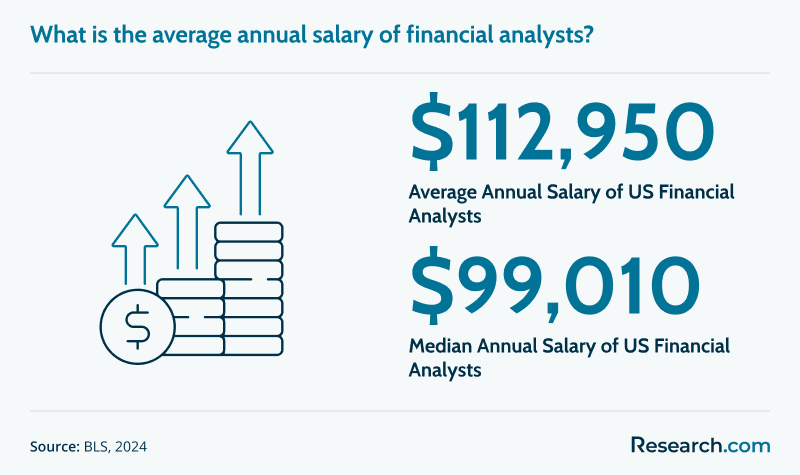
The BLS also reports 30,700 openings for financial analyst roles annually during that period. Indeed currently lists over 11,000 financial analyst job listings in the United States. Job availability will still vary by location, industry, experience level, and qualifications, so candidates should not treat national demand as a guarantee of employment.
The sectors with the highest employment levels for financial analysts are securities, other financial investment, and related activities (84,550); management of companies and enterprises (44,590); credit intermediation and related activities (29,780); management, scientific, and technical consulting services (15,020); and insurance carriers (14,320).
What is the average salary of financial analysts?
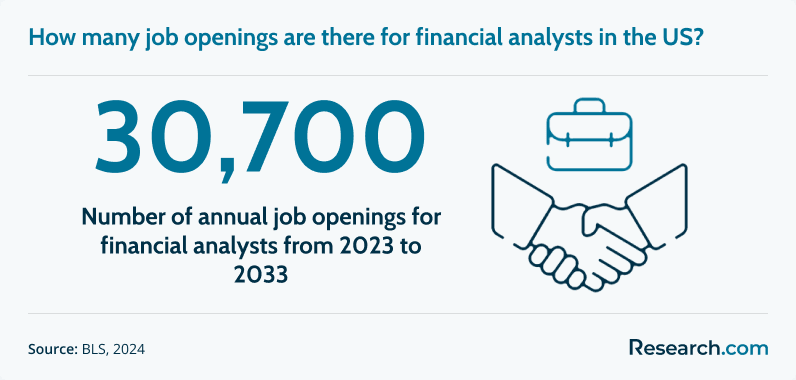
BLS data shows that financial analysts earn an average annual salary of $112,950 and a median annual salary of $99,010. This is more than double the collective median annual wage for all occupations in the United States, which is $48,060. It is also among the stronger finance major salary outcomes, although individual earnings depend on industry, state, employer, experience, credentials, performance, and job responsibilities.
The states with the highest average annual salaries for financial analysts are New York ($143,330), Montana ($128,720), New Jersey ($128,280), Massachusetts ($127,760), and California ($125,220). Many other states also report six-figure average salaries.
The highest-paying industries by average annual salary are web search portals and other information services ($154,850), other investment pools and funds ($146,640), securities, other financial investment, and related activities ($139,750), pipeline transportation of crude oil ($130,520), and accounting, tax preparation, bookkeeping, and payroll services ($129,790).
| Salary Factor | How It Can Affect Pay |
| Industry | Investment, information services, funds, and specialized finance sectors may pay more than some general business roles. |
| Location | States and metro areas with major financial centers or high-cost labor markets may offer higher salaries. |
| Experience | Senior analysts, managers, and specialized analysts generally have stronger earning potential than entry-level analysts. |
| Certification | Credentials may improve competitiveness when they match the role, such as CFA for investment analysis or FRM for risk. |
| Technical skill | Advanced modeling, automation, BI tools, and data analysis can help analysts qualify for more complex roles. |
What types of software do financial analysts use?
Financial analysts use software to organize data, build models, automate reporting, visualize trends, and communicate findings. The exact tools vary by employer and role, but analysts should expect to work with spreadsheets, reporting systems, databases, dashboards, accounting platforms, and specialized finance tools.
- Spreadsheets: Spreadsheet software remains a core tool for calculations, modeling, scenario analysis, reconciliations, and ad hoc reporting.
- Data visualization tools: Platforms such as dashboards and BI tools help analysts present trends, KPIs, and financial performance in a format stakeholders can understand quickly.
- Financial Planning & Analysis platforms: FP&A systems support budgeting, forecasting, consolidation, reporting, and workflow automation.
- Database management systems: Analysts may use database and business intelligence systems for multidimensional analysis, large datasets, and recurring reporting needs.
- Statistical analysis tools: These tools support forecasting, predictive modeling, scenario testing, and more advanced quantitative work.
- Accounting software: Accounting platforms help analysts access general ledger data, financial statements, transaction details, and reporting outputs.
| Software Category | Common Analyst Use | Skill Priority |
| Spreadsheets | Modeling, formulas, sensitivity analysis, budgeting, reconciliations | Essential |
| Visualization and BI tools | Dashboards, KPI tracking, stakeholder reporting | High |
| FP&A platforms | Forecasting, consolidation, planning workflows | High for corporate finance roles |
| Databases | Large-scale data access, business intelligence, structured analysis | Useful and increasingly valuable |
| Statistical tools | Forecasting, quantitative modeling, predictive analysis | Important for advanced analytics roles |
| Accounting systems | Financial statement data, transaction review, reporting support | Important for corporate and accounting-focused roles |
Questions to Ask Before Choosing a Financial Analyst Path
- Do I want to work inside a company, for an investment firm, for a bank, for a fund, or as an advisor?
- Am I more interested in corporate planning, investment research, credit risk, treasury, accounting analysis, or portfolio management?
- Which certifications appear most often in job postings for the roles I want?
- Does my degree program teach financial modeling, accounting, statistics, economics, and data visualization?
- Can I build experience through internships, projects, student investment groups, or entry-level finance roles?
- Am I prepared to keep learning software, regulations, market trends, and analytical methods throughout my career?
- How do salary, workload, competition, and advancement differ across the analyst paths I am considering?
Key Insights
- Financial analyst careers are broad: corporate FP&A, investment research, risk, credit, treasury, accounting analysis, and advisory roles all require different preparation.
- A bachelor’s degree is the usual starting point, but experience, modeling ability, software skills, and communication often determine how competitive a candidate becomes.
- The typical path takes four to eight years, or more, especially for analysts who add graduate education, certifications, or specialized experience.
- Certifications should be chosen by career goal: CFA for investment roles, FRM for risk, CPA for accounting-heavy work, CMA for corporate finance, CFP for planning, and CIMA for investment consulting.
- The field has a favorable outlook, with employment projected to grow by 9% from 2023 to 2033 and 30,700 openings expected annually.
- Salary can be strong, with an average annual salary of $112,950 and a median annual salary of $99,010, but pay varies significantly by industry, state, role, and experience.
- AI and automation are changing the work, but they do not eliminate the need for financial judgment, clear assumptions, risk awareness, and strong communication.
- The best next step is to choose a target analyst path, compare degree or training options, build practical modeling skills, and pursue credentials only when they clearly support your career goal.
References:
- BLS (2024, April 3). 13-2051 Financial and Investment Analysts. BLS occupational employment and wage data
- BLS (2024, August 29). Financial Analysts. BLS Occupational Outlook Handbook
- Kumar, A. (2024, June 13). The Future of Financial Analysis: How GPT-4 Outperforms Human Analysts. LinkedIn article
- Zippia (2025, January 8). Finance Analyst Education Requirements. Zippia education requirements
- Zippia (2025, January 8). Finance Analyst skills for your resume and career. Zippia financial analyst skills
Other Things You Should Know About Becoming a Financial Analyst
To become a financial analyst in 2027, a bachelor's degree in finance, economics, or a related field is essential. Additionally, certifications like the Chartered Financial Analyst (CFA) can enhance career prospects. The CFA credential involves passing three exams and meeting work experience requirements.
The CFA charter is not required for every financial analyst role, but it is a strong credential for investment research, portfolio analysis, and asset management. The CFA Program has three exam levels, and candidates usually need about 4,000 hours of qualifying work experience to earn the charter.


