
2027 Best Degrees and Career Paths for Working with Animals

Co-Founder and Chief Data Scientist
The love for pets and other animals can be turned into a profitable venture, as aspirants look at an array of career opportunities across various fields. With American pet spending projected to reach $157 billion in 2025 and nearly $200 billion by the end of 2030, career sustainability is not much of a concern. In fact, some animal work career paths are high-paying and have considerable market demand.
This guide takes a look at the best degrees, certifications, and jobs for working with animals in the country. It also explores facts surrounding animal degrees and careers, such as market demand, relevant skills, internship sources, and the types of software used by various animal-based professionals.
Key Things You Should Know About the Best Degrees and Career Paths for Working with Animals
- The best degrees for working with animals include programs for veterinary medicine and technology, animal science, zoology, animal behavior, and conservation biology.
- Veterinarians experienced a notable 124% increase in job share from 2021 to 2024.
- The number of insured pets increased from 2,517,122 in 2019 to 6,405,541 in 2024.
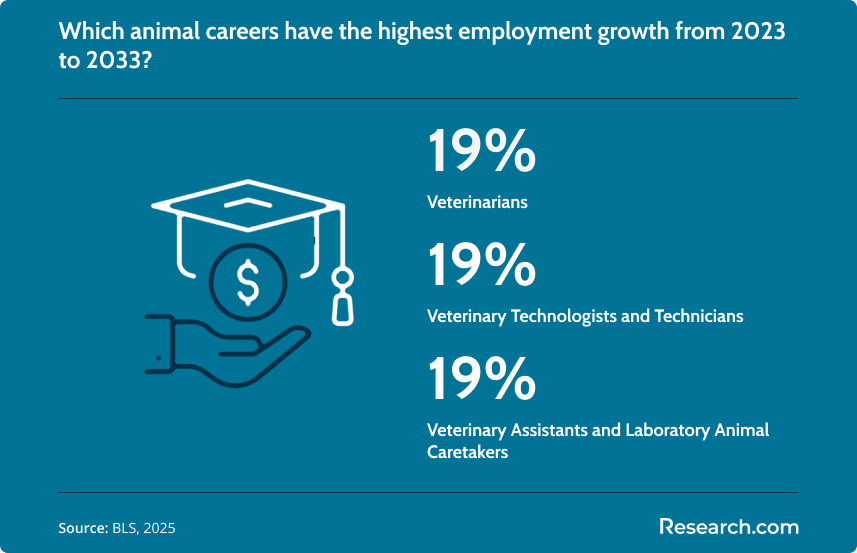
- The animal careers that show the largest employment growth from 2023 to 2033 are veterinarians (19%), veterinary technologists and technicians (19%), and veterinary assistants and laboratory animal caretakers (19%).
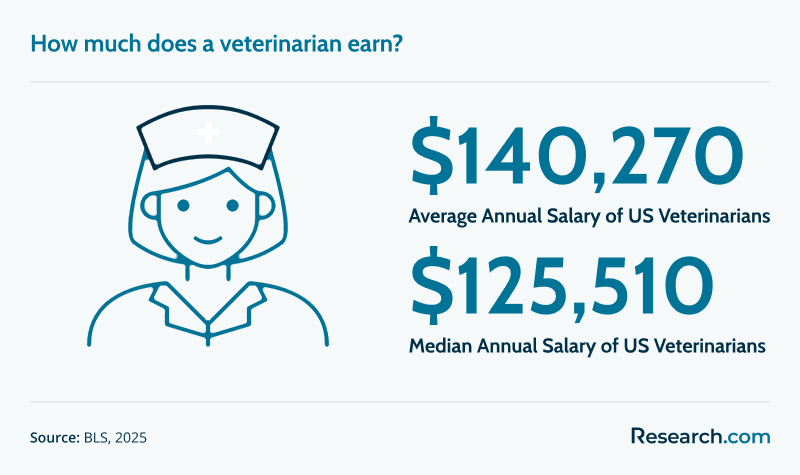
- The animal careers with the highest average annual salaries are veterinarians ($140,270), animal scientists ($97,240), and farmers, ranchers, and other agricultural managers ($97,240).
- There are over 45,000 job openings for "animal jobs."
- What are the best degrees and certifications for working with animals? List of Degrees
- What are the common career paths for working with animals? Career Paths
- What are the common work settings for animal careers? Work Settings
- What skills are essential for working with animals professionally? Core Skills
- What are the best internships or volunteer opportunities for animal careers? Internships
- Are animal-related careers in demand for 2027? Job Outlook
- What are the highest-paying animal careers? High-Paying Careers
- Which professional organizations provide resources and support for graduates with animal-related degrees? Which professional organizations provide resources and support for graduates with animal-related degrees?
- What types of software are often used in animal-related professions? What types of software are often used in animal-related professions?
- What emerging trends are shaping animal-related careers? What emerging trends are shaping animal-related careers?
- How can a prospective student choose the best degree for working with animals? How can a prospective student choose the best degree for working with animals?
Working With Animals in 2026: Best Degrees, Certifications, and Career Paths
If you want a career with animals, the right education depends on the kind of work you want to do. Treating sick pets, managing livestock, rehabilitating wildlife, studying animal behavior, and protecting habitats all require different levels of training. Some roles are accessible with certificates or an associate-level pathway, while others require graduate study, licensure, or a Doctor of Veterinary Medicine degree.
This guide explains the most useful animal-related degrees and certifications, where they can lead, how to compare career paths, what skills employers look for, and how to choose a program without wasting time or money. It is designed for students, career changers, veterinary assistants, shelter workers, conservation volunteers, and anyone deciding whether an animal-focused education is worth the investment.
Quick answer: What degree is best for working with animals?
The best degree for working with animals depends on the role. A Doctor of Veterinary Medicine is required to become a veterinarian. Veterinary technology programs are the standard route for veterinary technicians and technologists. Animal science is a strong fit for livestock, agriculture, research, and animal health careers. Zoology, wildlife biology, and conservation biology are better choices for students interested in wildlife, ecology, habitats, and field research. Animal behavior degrees are useful for training, behavior consulting, welfare, and research-focused roles.
| Career goal | Best-fit degree or credential | Why it makes sense |
| Become a veterinarian | Doctor of Veterinary Medicine (DVM) | Required for diagnosing disease, performing surgery, prescribing medication, and practicing veterinary medicine. |
| Work as a vet tech | Bachelor’s or Master’s in Veterinary Technology | Prepares students for clinical support duties such as lab testing, anesthesia support, imaging, and surgical assistance. |
| Work with livestock or agricultural animals | Bachelor’s Degree in Animal Science | Covers nutrition, genetics, reproduction, physiology, and production systems. |
| Study wildlife or ecosystems | Bachelor’s Degree in Zoology or Wildlife Biology | Focuses on animal behavior, ecology, species management, and conservation science. |
| Specialize in behavior or training | Master’s Degree in Animal Behavior or Applied Animal Behavior | Builds advanced knowledge of learning, welfare, behavior modification, and research methods. |
| Work in conservation leadership or research | Master’s or PhD in Conservation Biology | Supports careers in biodiversity research, ecosystem management, policy, and species protection. |
Students who need a more accessible starting point may compare flexible admission options through resources such as online colleges that accept lower GPA applicants, especially when planning to complete prerequisites before moving into a more competitive animal science, biology, or veterinary pathway.
Popular degrees for animal careers
- Bachelor’s Degree in Animal Science: This degree is usually the most practical undergraduate option for students interested in livestock, animal nutrition, breeding, genetics, physiology, and agricultural systems. Graduates may work in farm management, feed and nutrition companies, research support, animal health sales, or related agricultural industries.
- Bachelor’s Degree in Zoology or Wildlife Biology: These programs emphasize ecology, animal behavior, evolution, conservation, and population biology. They are better suited for students who want to work with wildlife, government agencies, research teams, rehabilitation programs, zoos, aquariums, or environmental organizations.
- Bachelor’s or Master’s in Veterinary Technology: Veterinary technology degrees prepare students for hands-on clinical work under the supervision of veterinarians. Coursework often includes animal nursing, diagnostic testing, anesthesia, pharmacology, imaging, and surgical support.
- Doctor of Veterinary Medicine (DVM): The DVM is the required professional degree for veterinarians. It qualifies graduates to diagnose and treat animal illnesses, perform surgeries, prescribe medication, and provide preventive care for companion animals, livestock, exotic animals, or wildlife, depending on training and practice setting.
- Master’s Degree in Animal Behavior or Applied Animal Behavior: This option is useful for students who want to understand why animals behave as they do and how to improve welfare, training outcomes, and human-animal relationships. It can support work in training, behavior consulting, shelters, research, or animal welfare programs.
- Master’s or PhD in Conservation Biology: Graduate-level conservation biology is designed for students pursuing advanced work in biodiversity, ecosystem management, endangered species protection, habitat restoration, nonprofit leadership, government service, or academic research.
Popular certifications for animal professionals
Certifications are most valuable when they match the job you want. A certificate in grooming will not substitute for veterinary licensure, and a behavior credential will not qualify someone to practice medicine. The best credentials document a specific skill set, professional standard, or specialization.
| Certification | Best for | What it signals to employers or clients |
| Certification as a Veterinary Technician Specialist (VTS) | Experienced veterinary technicians | Advanced specialization in areas such as emergency care, anesthesia, dentistry, or zoological medicine. |
| Certification from the Animal Behavior Society (ABS) | Behavior professionals with advanced graduate training | The Certified Applied Animal Behaviorist (CAAB) credential is widely respected in behavior consulting and animal behavior research. |
| Certification in Pet Grooming | Professional groomers and pet care entrepreneurs | Credentials such as those from the National Dog Groomers Association of America (NDGAA) demonstrate grooming technique, safe handling, and sanitation knowledge. |
| Certification in Animal Training | Dog trainers, equine trainers, and behavior-focused professionals | Organizations such as the International Association of Animal Behavior Consultants (IAABC) and the Certification Council for Professional Dog Trainers (CCPDT) provide recognized credentials for trainers. |
| Wildlife Rehabilitation Certification | Wildlife rehabilitators and rescue volunteers | State and organizational credentials, including those associated with the National Wildlife Rehabilitators Association (NWRA), show training in animal first aid, handling, and rehabilitation practices. |
Education and credentials can open many routes into animal work. One sign of employer demand is that veterinarians saw a 124% increase in job share from 2021 to 2024, while other animal-related occupations also showed strong growth.
What are the common career paths for working with animals?
Animal careers fall into several broad categories: medical care, direct care, behavior and training, conservation, agriculture, research, public safety, education, and advocacy. The right path depends on whether you prefer clinical work, outdoor fieldwork, scientific research, hands-on animal care, policy, or public-facing roles.
| Career path | Common roles | Typical focus | Best fit for |
| Veterinary medicine | Veterinarian, veterinary technologist, veterinary technician, veterinary assistant | Animal health, diagnostics, treatment, surgery support, preventive care | Students comfortable with science, clinical environments, and client communication. |
| Animal training and behavior | Animal trainer, behavior consultant, equine specialist, shelter behavior staff | Training plans, behavior modification, enrichment, safety, human-animal relationships | People who enjoy observing behavior and working patiently with animals and owners. |
| Wildlife and conservation | Zoologist, wildlife biologist, marine biologist, conservation technician | Animal populations, habitats, ecosystems, species protection | Students interested in science, outdoor work, data collection, and environmental protection. |
| Animal care and welfare | Shelter worker, animal control officer, welfare advocate, rescue coordinator | Rescue, adoption, humane treatment, public safety, community education | People who want direct service roles and can handle emotionally difficult situations. |
| Agriculture and livestock management | Livestock manager, animal breeder, ranch manager, agricultural technician | Herd health, nutrition, breeding, production, farm operations | Students interested in food systems, farm management, and animal production. |
| Research and science | Animal scientist, laboratory technician, behavioral researcher | Genetics, nutrition, cognition, biomedical or agricultural research | Students who like laboratory work, data, controlled studies, and scientific problem-solving. |
| Education and therapy | Outreach educator, therapy animal coordinator, program specialist | Public education, animal-assisted programs, community engagement | People who want to combine animal knowledge with teaching, communication, or support services. |
Some animal-adjacent careers focus less on direct care and more on habitat protection, enforcement, or public policy. For example, the fish and game warden career path is centered on enforcing laws that protect wildlife and aquatic habitats.
Job boards also show broad employer interest in animal-related work. Indeed lists over 45,000 job openings for “animal jobs.” That number is useful as a broad signal, but it should not be treated as a complete count of every veterinary, conservation, agriculture, research, or animal welfare position.
What are the common work settings for animal careers?
Animal professionals work in clinics, shelters, farms, laboratories, field sites, government offices, classrooms, and nonprofit organizations. The setting matters because it affects your schedule, stress level, physical demands, pay potential, and the type of animals you handle.
Students who already have college credits should check whether those credits can reduce the time and cost of a new degree. A resource such as online colleges that accept transfer credits can help prospective students think through flexible options before enrolling in an animal science, biology, or veterinary-related program.
| Work setting | What professionals do there | Important trade-off |
| Veterinary clinics and hospitals | Provide medical care, assist with procedures, educate pet owners, and support preventive health. | Fast-paced clinical work can be rewarding but emotionally and physically demanding. |
| Zoos and aquariums | Support animal care, conservation, enrichment, research, and public education. | Competition can be strong, especially for roles involving rare or endangered species. |
| Wildlife rehabilitation centers | Care for injured, sick, or orphaned wildlife and prepare animals for release when possible. | Work may be seasonal, volunteer-heavy, or subject to state rules and permits. |
| Animal shelters and humane societies | Handle intake, feeding, cleaning, adoption support, rescue coordination, and welfare advocacy. | These roles offer direct impact but may involve compassion fatigue and limited resources. |
| Farms and agricultural operations | Manage livestock care, feeding, breeding, health monitoring, and sustainable production practices. | Schedules may be tied to animal needs, weather, production cycles, and farm operations. |
| Research laboratories | Assist with animal science, biomedical, behavioral, or agricultural research while following ethical care standards. | Strong attention to protocols, documentation, and animal welfare rules is essential. |
| Government agencies | Manage wildlife, enforce animal welfare standards, inspect facilities, or administer conservation programs. | Roles may require regulatory knowledge, fieldwork, and public communication. |
| Educational institutions | Teach, conduct research, supervise labs, and mentor students in animal-related fields. | Advanced degrees may be needed for teaching or research leadership. |
| Nonprofit and conservation organizations | Run advocacy campaigns, habitat programs, endangered species initiatives, and community projects. | Grant funding and project-based work can affect job stability. |
| Private industry | Develop pet nutrition, animal health products, pharmaceuticals, equipment, or welfare-focused technologies. | Business, data, sales, or product knowledge may be as important as animal expertise. |
What skills are essential for working with animals professionally?
Successful animal workers combine technical ability with judgment, patience, and communication. You need to understand animals, but you also need to work well with owners, colleagues, clients, regulators, and the public.
- Animal handling and care: Professionals must know how to feed, groom, restrain, transport, and monitor animals safely while reducing fear, stress, and injury risk.
- Observation and attention to detail: Small changes in appetite, posture, vocalization, energy, coat condition, or behavior can signal pain, illness, anxiety, or environmental stress.
- Knowledge of animal behavior: Species-specific body language and behavior patterns help workers prevent bites, reduce fear, improve training outcomes, and identify welfare concerns. Professionals interested in combining behavior with data may find related analytical training through an accelerated online bachelor’s in analytics.
- Communication skills: Animal work often involves explaining care instructions, discussing difficult outcomes, educating the public, documenting findings, or coordinating with a team.
- Problem-solving and critical thinking: Professionals may need to adjust a care plan, respond to sudden health concerns, modify a training strategy, or make decisions under pressure.
- Compassion and patience: Animals may be frightened, reactive, sick, untrained, or in pain. Calm, humane handling is a professional requirement, not just a personal quality.
- Physical stamina and safety awareness: Many roles involve lifting, cleaning, walking, bending, restraining, outdoor work, or long hours on your feet.
- Technical and scientific knowledge: Depending on the job, workers may apply biology, veterinary medicine, nutrition, genetics, ecology, pharmacology, or conservation science.
- Teamwork and collaboration: Animal care is rarely isolated. Veterinarians, technicians, trainers, researchers, shelter staff, volunteers, and agency workers often coordinate care or projects.
- Digital communication and outreach: Trainers, groomers, shelters, rescues, and independent consultants often need to promote services, educate audiences, and communicate responsibly online. Students who lack this background may explore a fast-track online social media management degree as a business-support skill rather than a substitute for animal training.
The rising number of insured pets suggests that more owners are budgeting for animal health and protection. Naphia data cited in this guide show that insured pets increased from 2,517,122 in 2019 to 6,405,541 in 2024.
What are the best internships or volunteer opportunities for animal careers?
Internships and volunteer roles matter because many animal employers want evidence that you can work safely, reliably, and calmly around animals. Classroom knowledge helps, but real experience shows whether you can handle cleaning, feeding, observation, documentation, client interaction, and unpredictable behavior.
| Opportunity | What you may learn | Best for students pursuing |
| Veterinary clinics and hospitals | Shadowing, patient handling, exam-room flow, client communication, basic clinical support, and professional standards. | Veterinary medicine, veterinary technology, veterinary assisting, animal health sales. |
| Animal shelters and rescue organizations | Feeding, cleaning, socialization, adoption support, intake procedures, behavior observation, and welfare advocacy. | Shelter medicine, animal welfare, behavior, training, nonprofit work. |
| Zoos and aquariums | Animal husbandry, enrichment, conservation education, species-specific care, and public outreach. | Zoology, wildlife biology, education, conservation, exotic animal care. |
| Wildlife rehabilitation centers | Wildlife handling, feeding protocols, recovery support, medical assistance, and release preparation. | Wildlife rehabilitation, conservation biology, ecology, veterinary medicine. |
| Farms and animal sanctuaries | Livestock care, feeding routines, facility maintenance, herd observation, ethical care practices, and sustainable operations. | Animal science, agriculture, livestock management, sanctuary work. |
Animal careers can also connect with complementary skills. Photography, for example, is useful in biology, conservation communication, animal documentation, and birdwatching. Students who want to build that capability quickly may compare fast-track online digital photography degrees.
Are animal-related careers in demand for 2026?
Many animal-related occupations are positioned for growth because of expanded pet healthcare, ongoing demand for veterinary services, public interest in animal welfare, and continued conservation and agricultural needs. The 12.7% increase in the number of insured pets from 2023 to 2024 in the United States is one indicator that more owners are investing in animal health coverage.
According to the United States Bureau of Labor Statistics sources cited for this guide, several animal-related or adjacent occupations have projected employment growth above the national average of 4%:
| Occupation | Employment growth |
| Veterinarians | 19% |
| Veterinary Technologists and Technicians | 19% |
| Veterinary Assistants and Laboratory Animal Caretakers | 19% |
| Animal Caretakers | 17% |
| Agricultural & Food Scientists | 8% |
| Agricultural and Food Science Technicians | 7% |
| Environmental Scientists and Specialists | 7% |
Demand is especially visible in veterinary healthcare and animal care roles, but students should still compare local job markets, licensure rules, wages, and required credentials. Behavior-related careers can also have formal training expectations; students comparing behavior credentials may find it helpful to understand standards such as BCBA fieldwork hours requirements, even though BCBA requirements apply to a different credentialing pathway.
What are the highest-paying animal careers?
The highest-paying animal careers usually require advanced education, specialized technical knowledge, business responsibility, or scientific expertise. Veterinary medicine and animal science tend to offer stronger earning potential than many direct-care roles, although income varies by employer, location, experience, credentials, and industry.
| Career | Average annual salary | What the role involves |
| Veterinarian | $140,270 | Diagnoses, treats, and prevents disease in pets, livestock, and other animals; may perform surgery, prescribe medication, and provide preventive care. |
| Animal Scientist | $104,970 | Studies genetics, nutrition, reproduction, growth, and management of domestic farm animals. Students interested in related biotechnology training may explore a fast track master’s in biotechnology online. |
| Farmers, Ranchers, and Other Agricultural Managers | $97,240 | Oversee farms, ranches, breeding programs, animal care, staff, production systems, and business operations. |
| Environmental Scientist and Specialist | $88,640 | Works on environmental protection, habitat preservation, ecosystem management, and policies that may affect wildlife and biodiversity. |
| Zoologist or Wildlife Biologist | $77,920 | Studies animals in natural or controlled settings, tracks populations, analyzes behavior, and supports conservation efforts. |
| Conservation Scientist | $74,310 | Manages natural resources and habitats that support wildlife. The median annual conservationist salary is higher than the collective median yearly salary of all US professions ($49,500). |
| First-Line Supervisors of Farming, Fishing, and Forestry Workers | $63,360 | Supervise workers in farming, aquaculture, forestry, and related operations, including animal resource management in some settings. |
| Animal Breeders | $56,150 | Select and breed animals for desired traits such as health, temperament, productivity, appearance, or genetic quality. |
| Animal Control Worker | $49,240 | Protects public safety and animal welfare by handling stray, lost, dangerous, or mistreated animals and enforcing local animal laws. |
| Veterinary Technologist or Technician | $46,280 | Supports veterinarians with diagnostic testing, lab work, imaging, anesthesia monitoring, nursing care, and postoperative support. |
The chart below compares high-paying animal-related occupations while excluding senior roles.
Which professional organizations support graduates with animal-related degrees?
Professional organizations can help animal-care graduates stay current, build credibility, find continuing education, prepare for licensure, access job boards, and connect with peers. The best organization to join depends on whether you work in veterinary medicine, laboratory animal science, agriculture, zoos and aquariums, animal welfare, or conservation.
Animal-related careers can also intersect with education and community programming. For example, students who understand courses in a bachelor’s in early childhood education program may later apply child-development knowledge to animal-assisted learning, humane education, or outreach roles.
- American Association of Veterinary State Boards (AAVSB): Supports veterinarians and veterinary technicians with licensure-related resources, renewal guidance, and training information.
- American Association for Laboratory Animal Science (AALAS): Provides certifications, conferences, and continuing education for professionals who work with laboratory animals.
- American Farm Bureau Federation (AFBF): Offers advocacy, policy support, leadership development, and sustainability resources for farmers and ranchers.
- American Veterinary Medical Association (AVMA): Provides continuing education, professional resources, leadership opportunities, advocacy, and job information for veterinarians.
- Association of Zoos & Aquariums (AZA): Supports zoo and aquarium professionals through conservation work, conferences, accreditation-related standards, and professional development.
- Humane Society of the United States (HSUS): Focuses on ending animal cruelty and offers advocacy resources, grants, and volunteer opportunities connected to animal welfare.
- U.S. Department of Agriculture (USDA): Provides agricultural programs, grants, loans, disaster relief, and career resources relevant to animal agriculture and related fields.
What types of software are used in animal-related professions?
Animal professionals increasingly use software to manage records, track behavior, monitor livestock, map wildlife populations, coordinate adoptions, analyze research data, and communicate with clients or the public. Digital fluency is no longer limited to office roles; it now affects clinical care, fieldwork, research, and operations.
| Software category | Examples | Common use |
| Veterinary practice management software | AVImark, Cornerstone, eVetPractice | Appointments, medical records, billing, inventory, reminders, and client communication. |
| Animal health and research software | LabChart, EthoVision, Visiopharm | Health data tracking, behavior studies, biomedical analysis, and veterinary research documentation. |
| Animal shelter and rescue management software | Shelterluv, PetPoint, RescueGroups | Adoptions, intake records, outcomes, volunteer coordination, and rescue operations. |
| Livestock and farm management software | CattleMax, FarmWizard, PigCHAMP | Livestock health, breeding records, nutrition, production tracking, and farm performance. |
| Wildlife and conservation software | ArcGIS, SMART (Spatial Monitoring and Reporting Tool), Wildbook | Habitat mapping, wildlife monitoring, population tracking, and endangered species data management. |
| Training and behavior tracking software | Clicker Training apps, DogBizPro, EquiLab | Training plans, progress tracking, client management, and behavior documentation. |
| Educational and outreach software | ZIMS (Zoological Information Management System), interactive e-learning tools | Animal records, zoo and aquarium education, public learning, and student engagement. |
What emerging trends are shaping animal-related careers?
Animal careers are being reshaped by technology, consumer expectations, veterinary workforce demand, conservation data tools, and more formal credentialing. Telemedicine platforms, digital medical records, data analytics, remote sensors, mapping tools, and artificial intelligence are changing how professionals monitor animal health, study behavior, manage populations, and communicate findings.
AI and automation are unlikely to replace hands-on animal care, but they can change how work is documented, scheduled, analyzed, and reported. Veterinary teams may rely more on digital workflow tools. Conservation professionals may use mapping, camera-trap data, and species-tracking systems. Shelters may use software to improve adoption matching and outcome reporting. Animal trainers and behavior consultants may use digital logs to track progress and share plans with clients.
Professionals who already have a degree may not need another full program to keep up. Targeted training through affordable online graduate certificate programs can be a practical option for adding specialized knowledge in data, management, animal behavior, conservation, or related fields.
How can a prospective student choose the best degree for working with animals?
Choosing an animal-related degree should start with the job, not the major title. A program is only a good fit if it prepares you for the credential, licensure, field experience, and employment market connected to your target role.
Step-by-step checklist for choosing a program
- Choose the career outcome first. Decide whether you want veterinary medicine, veterinary technology, animal behavior, wildlife biology, animal science, shelter work, agriculture, or conservation.
- Check required credentials. Some roles require licensure, state approval, graduate training, supervised hours, or a specific accredited program.
- Verify accreditation. Accreditation matters for transfer credits, graduate school, financial aid eligibility, licensure, and employer confidence.
- Review the curriculum closely. Look for courses aligned with your goal, such as anatomy, physiology, ecology, nutrition, genetics, behavior, clinical procedures, or research methods.
- Confirm hands-on learning. Labs, practicums, internships, fieldwork, clinical rotations, and supervised volunteer experience are especially important in animal careers.
- Compare online, hybrid, and campus formats. Online coursework can be flexible, but animal careers often still require in-person labs, fieldwork, clinical hours, or local placements.
- Calculate the full cost. Include tuition, fees, books, equipment, travel, lab costs, background checks, uniforms, exam fees, and lost work time.
- Ask about transfer credits. Students with previous coursework may shorten the path if the school accepts relevant credits.
- Review job outcomes carefully. Ask where graduates work, what credentials they earn, and how often students move into the field they intended to enter.
- Compare salary potential with debt. A high-cost program may be reasonable for some veterinary or advanced science paths, but not every animal-care role can support large debt.
Questions to ask before enrolling
- Does this program meet the education requirements for my target role in my state?
- Is the program accredited by the appropriate institutional or professional accreditor?
- What hands-on experience is required, and who helps students find placements?
- Can online students complete labs, practicums, or clinical requirements near home?
- How many credits can I transfer, and will transfer credits apply to major requirements or only electives?
- What are the total costs beyond tuition?
- What percentage of graduates enter animal-related work, veterinary school, graduate school, or certification pathways?
- Does the program have relationships with clinics, shelters, farms, zoos, labs, agencies, or conservation groups?
Common mistakes to avoid
| Mistake | Why it can hurt you | Better approach |
| Choosing a major because it sounds animal-focused | Some programs are broad and may not prepare students for specific licenses or jobs. | Start with the job requirements, then choose the degree. |
| Ignoring accreditation | Non-accredited or poorly matched programs can create problems with licensure, transfer, and graduate admission. | Confirm institutional and programmatic accreditation before applying. |
| Assuming online means fully remote | Animal programs often require labs, fieldwork, clinical rotations, or in-person assessments. | Ask exactly where and how hands-on requirements are completed. |
| Looking only at tuition | Equipment, travel, clinical fees, exam fees, and lost wages can change the real cost. | Compare total cost of attendance and financial aid options. |
| Relying only on rankings | A highly ranked program may not match your state, schedule, budget, or career goal. | Use rankings as one input, not the final decision. |
| Assuming salary outcomes are guaranteed | Pay depends on location, role, employer, experience, credentials, and market conditions. | Use salary data as a planning tool and compare it with expected debt. |
Pet-related spending trends can support demand for animal services, but students should not base an education decision on spending trends alone. The chart below shows a considerable increase in pet expenditures each year from 2018 to 2025.
What graduates say about animal-related online degrees
- : "My online wildlife biology program let me study conservation without moving away. Because the schedule was flexible, I could keep volunteering in my area while completing coursework and research assignments. That mix of academic work and field experience helped me build a career direction I cared about. — Olivia"
- : "Studying animal science online made it possible to balance school with work and family. The virtual labs and field assignments connected the science to real animal healthcare situations, which made the degree feel practical rather than abstract. — Bea"
- : "The online animal behavior program connected me with classmates in different regions and work settings. Hearing how others approached training, welfare, and behavior cases gave me a broader view of animal psychology and helped me prepare for certification. — Gracie"
Key Insights
- The best animal degree depends on the job. Veterinary medicine, veterinary technology, animal science, wildlife biology, conservation biology, and animal behavior lead to different roles and credential requirements.
- Hands-on experience is essential. Internships, clinical placements, shelter work, wildlife rehabilitation, farm experience, and field research often matter as much as coursework.
- Demand is strongest in veterinary and animal care roles. BLS-cited growth rates include 19% for veterinarians, 19% for veterinary technologists and technicians, 19% for veterinary assistants and laboratory animal caretakers, and 17% for animal caretakers, compared with a 4% national average.
- Higher pay usually requires more training or responsibility. Veterinarians, animal scientists, agricultural managers, environmental scientists, zoologists, and conservation scientists are among the higher-paying animal-related careers listed in this guide.
- Accreditation and licensure can determine whether a degree is usable. Before enrolling, confirm that the program meets state, employer, graduate school, or certification expectations.
- Online programs can work, but they may not be entirely online. Many animal-related degrees still require labs, fieldwork, practicums, or clinical experience.
- Technology skills are becoming more valuable. Veterinary software, GIS tools, research platforms, shelter databases, livestock systems, and behavior-tracking apps are now common in animal professions.
- Do not choose based on passion alone. Compare total cost, career requirements, salary potential, job availability, hands-on training, and long-term advancement before committing to a degree.
References:
- American Pet Products Association (2025). Industry Trends and Stats. American Pet Products Association
- American Veterinary Medical Association (2025, March 14). Indeed names veterinarians as top job for 2025. American Veterinary Medical Association
- BLS (2025, April 18). Agricultural and Food Scientists. BLS
- BLS (2025, April 18). Animal Care and Service Workers. BLS
- BLS (2025, April 18). Fastest Growing Occupations. BLS; related animal care outlook: BLS animal care and service workers
- BLS (2025, August 27). Industry: Cross-industry, Private, Federal, State, and Local Government Period: May 2024. BLS
- BLS (2025, April 18). Veterinarians. BLS
- BLS (2025, April 18). Veterinary Technologists and Technicians. BLS; occupational wage data: BLS wage database
- Capital One Shopping (2025, May 13). Pet Spending Statistics. Capital One Shopping
Other Things You Should Know About the Best Degrees and Career Paths for Working with Animals
Veterinarians must pass the NAVLE and hold a state license to practice. Veterinary technicians usually need graduation from an AVMA-accredited program and, in most states, the VTNE exam. Wildlife rehabilitators, groomers, and trainers usually follow state or local permit rules, not a single national license.
In 2027, top universities known for animal-related degrees include the University of California, Davis for veterinary medicine, Cornell University for animal science, and Colorado State University for zoology. These institutions stand out for their comprehensive curricula, experienced faculty, and research opportunities.


