
2027 Fastest Online Associate's in Surgical Tech Programs

Co-Founder and Chief Data Scientist
As surgical procedures become more advanced and widespread, the need for trained surgical technologists continues to grow. The U.S. Bureau of Labor Statistics projects a 6% increase in surgical tech jobs between 2023 and 2033. However, the path to entering this field can feel unclear without proper guidance, especially for students seeking a fast, flexible educational option.
This article, prepared by experts in career planning, offers a detailed overview of the fastest online associate’s programs in surgical technology. It’s designed to help students find programs that prepare them for certification in the shortest time possible.
What are the benefits of getting an online surgical tech associate program?
- Completing an online associate’s degree in surgical technology prepares graduates for essential roles in operating rooms, assisting surgeons, managing sterile fields, and supporting patient safety.
- The average annual salary for surgical technologists is approximately $97,880, with higher earnings possible for those in specialized roles or high-cost regions.
- Online surgical tech programs offer flexible learning, allowing students to complete coursework remotely while gaining clinical experience locally and preparing for certification.
What can I expect from an online surgical tech associate program?
Online surgical tech associate programs combine foundational coursework with immersive, hands-on experiences. Students typically complete core classes in surgical instrumentation, sterile technique, anatomy, and pharmacology, followed by capstone projects and over 500 hours of supervised clinical internships. Most programs use a hybrid model, blending asynchronous online lectures with in-person labs and local hospital placements.
Tuition varies widely, ranging from $138 to $623 per credit. Online components are designed for flexibility, often using virtual simulations and video-based instruction to reinforce concepts. These programs prepare graduates for CST certification and entry-level roles in hospitals, outpatient centers, and surgical clinics.
Where can I work with an online surgical tech associate program?
An online associate’s degree in surgical technology equips graduates with the clinical skills and foundational knowledge to support surgical teams in operating rooms, ambulatory centers, and other healthcare settings.
Surgical technologists work in a variety of industries, with the majority employed in direct healthcare roles:
- Health Care (84%): Most graduates work in hospitals, outpatient surgery centers, and specialty clinics, assisting in surgeries, preparing sterile equipment, and ensuring patient safety.
- Education (4%): Some become surgical tech instructors or lab assistants in allied health training programs, helping train the next generation of surgical technologists.
- Professional Services (4%): A small number work with staffing agencies or consulting firms that supply surgical support professionals to healthcare systems.
- Government (2%): Opportunities exist in VA hospitals, military medical facilities, or public health departments where surgical support is needed for veterans, service members, or underserved communities.
- Nonprofits (2%): Surgical techs may assist in charitable hospitals or international missions, providing essential surgical care in low-resource settings.
- Others (6%): A small percentage work in industries such as pharmaceuticals, finance, technology, the internet, and manufacturing.
How much can I make with an online surgical tech associate program?
Completing an online associate’s degree in surgical technology can lead to stable and well-paying careers in hospitals, outpatient centers, and surgical clinics. Salaries vary depending on location, experience, workplace setting, and certifications.
Below is an overview of potential earnings:
- Average Salary: Surgical technologists earn an average annual salary of approximately $97,880, which equates to about $47.06 per hour.
- Location-Based Earnings: In high-cost areas like New York City, surgical techs can earn around $107,000 annually. In states like California, Massachusetts, and Washington, the median salaries are between $78,000 and $83,000.
- Experience Levels: Entry-level surgical techs typically start at $45,000 to $50,000 per year, while experienced or certified technologists can earn over $77,000 annually.
- Industry Variations: Those employed in outpatient care centers tend to earn more, averaging $61,000 annually, compared to those in physician offices, where salaries are typically lower.
- Certifications and Specializations: Holding certifications or specializing in areas like cardiovascular surgery can significantly boost earning potential, often exceeding $80,000 annually.
- List of the Best Online Associate's in Surgical Tech Programs for 2027 Best Programs
- How long does it take to complete an online associate's degree in surgical tech programs? Program Length
- How does an online associate's degree in surgical tech program compare to an on-campus program? How does an online associate's degree in surgical tech program compare to an on-campus program?
- What is the average cost of an online associate's in surgical tech program? Program Cost
- What are the financial aid options for students enrolling in an online associate's degree in surgical tech program? Financial Aid
- What are the prerequisites for enrolling in an online associate's degree in surgical tech program? Admission Requirements
- What courses are typically in an online associate's degree in surgical tech program? What courses are typically in an online associate's degree in surgical tech program?
- What types of specializations are available in an online associate's degree in surgical tech program? What types of specializations are available in an online associate's degree in surgical tech program?
- How to Choose the Best Online Associate's Degree in Surgical Tech Program How to Choose the Best Online Associate's Degree in Surgical Tech Program
- What career paths are available for graduates of an online associate's degree in surgical tech program? What career paths are available for graduates of an online associate's degree in surgical tech program?
- What is the job market for graduates with an online associate's degree in surgical tech program? Job Outlook
- What student support services are available to enhance your online surgical tech program experience? What student support services are available to enhance your online surgical tech program experience?
Best Online Associate’s in Surgical Tech Programs for 2027
An online associate’s degree in surgical technology is usually not fully online. The classroom portion may be delivered remotely, but students still need in-person labs, clinical rotations, and supervised operating-room experience before they can graduate and qualify for certification. That makes program selection especially important: the wrong school may cost more, delay your clinical placement, or fail to meet certification expectations.
This guide is for students who want a practical path into surgical technology without giving up the flexibility of online coursework. You will learn which programs stand out, how long they take, what they cost, what accreditation matters, how clinical training works, and how to compare programs before enrolling.
Quick answer: What is the best online associate’s in surgical tech program?
The best online associate’s in surgical tech program is typically a CAAHEP-accredited hybrid associate degree that combines online coursework with required hands-on labs and clinical rotations. Strong programs clearly disclose tuition, credits, clinical case requirements, certification eligibility, and placement support. Students should prioritize accreditation and clinical access over convenience alone.
How we rank these programs
Research.com evaluates surgical technology programs using verified education data and program-level information. Sources include the IPEDS database, the College Scorecard database, Peterson’s database, and The National Center for Education Statistics. Our review considers accreditation, program structure, affordability, academic quality, and career relevance. You can read more about the ranking process on Research.com’s methodology page.
1. Pennsylvania College of Technology
The Pennsylvania College of Technology offers an associate of applied science in surgical technology for students who want structured technical training with substantial clinical exposure. The hybrid program combines online or classroom instruction with intensive lab practice and operating-room placements. Students complete 200+ hours of simulated labs and 500+ hours in clinical settings, where they develop skills in sterile technique, instrumentation, patient safety, and intraoperative support under professional supervision.
- Program Length: 2 years
- Cost: $623 per credit hour
- Total Credits: 75
- Accreditation: Commission on Accreditation of Allied Health Education Programs (CAAHEP)
2. Berkeley College
The surgical technology associate in applied science program at Berkeley College prepares students to work as part of a surgical team in hospitals and outpatient facilities. The curriculum focuses on sterile field maintenance, surgical instruments, operating-room communication, and team-based patient care. Students complete laboratory simulations and a clinical practicum with at least 120 surgical cases, helping them prepare for CST certification and entry-level surgical technology roles.
- Program Length: 2 years
- Cost: $323 per credit hour
- Total Credits: 72
- Accreditation: Commission on Accreditation of Allied Health Education Programs (CAAHEP)
3. Rasmussen University
Rasmussen University offers an associate’s degree in surgical technology through a hybrid format that pairs online general education classes with campus-based labs and clinical practice. Students study aseptic technique, draping, equipment handling, robotic assistance, and operating-room procedures. The clinical component includes over 120 scrub cases across varied healthcare settings, supporting preparation for the CST exam and entry-level employment in surgical environments.
- Program Length: 21 months
- Cost: $385 per credit hour
- Total Credits: 60
- Accreditation: Commission on Accreditation of Allied Health Education Programs (CAAHEP)
4. Madison College
Madison College provides a hybrid surgical technology program designed around progressive skill development. Students move from foundational coursework into advanced lab and clinical training across four semesters. The program includes performance labs, approximately 12 weeks of hands-on clinical placements, background checks, immunization requirements, and CPR certification. Graduates are prepared to sit for the NBSTSA CST exam.
- Program Length: 2 years
- Cost: $247 per credit hour
- Total Credits: 61
- Accreditation: Commission on Accreditation of Allied Health Education Programs (CAAHEP)
5. Nashville State Community College
Nashville State Community College offers a hybrid surgical technology program that trains students to prepare equipment, maintain sterile fields, and support surgeons and nurses during procedures. Coursework covers anatomy, microbiology, pharmacology, asepsis, and surgical practice. Students complete clinical practicum experiences across three semesters, building the practical background needed for national certification and employment in hospital or outpatient surgery settings.
- Program Length: 2 years
- Cost: $155 per credit hour
- Total Credits: 61
- Accreditation: Commission on Accreditation of Allied Health Education Programs (CAAHEP)
6. Southern Maine Community College
The surgical technology associate degree at Southern Maine Community College combines general education, allied health coursework, surgical theory, and supervised clinical rotations. Students learn patient safety practices, aseptic technique, surgical teamwork, and operating-room responsibilities. The program is designed to prepare graduates for NBSTSA certification and surgical technologist roles.
- Program Length: 2 years
- Cost: $138 per credit hour
- Total Credits: 64
- Accreditation: Commission on Accreditation of Allied Health Education Programs (CAAHEP)
7. Houston Community College
The surgical technology associate of applied science at Houston Community College prepares students for operating-room support roles through a hybrid model that includes classroom learning, lab practice, and extensive clinical rotations. The curriculum emphasizes sterile technique, surgical equipment use, perioperative patient care, and procedural readiness. Students complete over 700 clinical hours and prepare for the NBSTSA national certification exam.
- Program Length: 2 years
- Cost: $180.50 per credit hour
- Total Credits: 70
- Accreditation: Commission on Accreditation of Allied Health Education Programs (CAAHEP)
8. Midlands Technical College
Midlands Technical College offers surgical technology associate of applied science programs that combine classroom instruction, laboratory learning, virtual course options, and clinical rotations. Students study aseptic technique, instrumentation, surgical procedures, and operating-room workflow. Clinical training takes place in local hospital settings under experienced surgical staff, and graduates are eligible to pursue CST certification.
- Program Length: 2 years
- Cost: $204 per credit hour
- Total Credits: 64
- Accreditation: Commission on Accreditation of Allied Health Education Programs (CAAHEP)
9. Durham Technical Community College
Durham Technical Community College offers a surgical technology associate in applied science for students seeking hands-on preparation for operating-room work. The hybrid program covers sterile practice, surgical instruments, perioperative patient care, and clinical procedures. Students complete supervised practicums at local surgical sites and become eligible to sit for NBSTSA certification after completing program requirements.
- Program Length: 20–21 months
- Cost: $128 per credit hour
- Total Credits: 68
- Accreditation: Commission on Accreditation of Allied Health Education Programs (CAAHEP)
10. Keiser University
The associate of science in surgical technology at Keiser University prepares students for entry-level surgical support roles through hybrid learning, lab sessions, and local clinical externships. Coursework includes surgical procedures, anatomy, pharmacology, medical terminology, instrumentation, and patient care. Students complete four sequential externships in healthcare settings, giving them repeated exposure to real surgical environments.
- Program Length: 2 years
- Cost: $450 per credit hour
- Total Credits: 74
- Accreditation: Commission on Accreditation of Allied Health Education Programs (CAAHEP)
How Long Does It Take to Complete an Online Associate’s Degree in Surgical Tech?
Most online associate’s in surgical technology programs take 18 to 24 months of full-time study. Program length depends on credit requirements, course sequencing, clinical site availability, transfer credits, and whether the school offers summer terms. Most programs require 60 to 72 credit hours, although some listed programs require up to 75 credits.
Students who want to enter healthcare sooner but are not yet ready for surgical technology may compare shorter options such as a fast track online home health aide certification. That type of credential can lead to quicker workforce entry, but it does not replace the surgical labs, clinical cases, and certification preparation required for surgical technologist roles.
Part-time study can make the program easier to manage for working students, but it usually extends the graduation timeline. Clinical rotations can also affect completion speed because students must be available for hospital or surgical center schedules, which may not match typical online-course flexibility.
| Enrollment Situation | Likely Timeline | What Can Affect Completion |
| Full-time student | 18 to 24 months | Course load, clinical scheduling, and prerequisites |
| Student with transfer credits | Potentially shorter | Transfer policy and whether credits match program requirements |
| Part-time student | Longer than 24 months | Limited course availability and delayed clinical placement |
| Student waiting for a clinical site | May be delayed | Local hospital capacity and program placement support |
Online vs. On-Campus Associate’s in Surgical Tech: Which Format Is Better?
Online and on-campus surgical technology programs can lead to the same career goal, but the learning experience is different. Online programs are best understood as hybrid programs because surgical technology cannot be learned through lectures alone. You still need lab checkoffs, clinical cases, and direct supervision in real or simulated surgical environments.
Students comparing allied health options may also look at the shortest dental assistant associates online, since dental assisting programs also combine remote coursework with practical skill development. For surgical technology, however, the operating-room clinical component is especially central to certification readiness.
| Aspect | Online or Hybrid Surgical Tech Program | On-Campus Surgical Tech Program |
| Course delivery | General education and theory courses may be completed through online modules or virtual class sessions | Most lectures and discussions take place in person on a scheduled campus timetable |
| Hands-on learning | Labs may require campus visits, intensives, or local skills assessments | Labs are usually built into the weekly campus schedule |
| Clinical rotations | Students may need a local placement approved by the program | Schools often use established hospital or surgical center partners near campus |
| Flexibility | Better for students balancing work, family, or commuting limitations | Better for students who prefer fixed structure and face-to-face instruction |
| Support access | Advising, tutoring, and technical help are commonly delivered online | Students can access faculty, labs, and campus services in person |
| Main risk | Clinical placement may be harder if the school has limited partners near the student | Less schedule flexibility and possible commuting or housing costs |
How Much Does an Online Associate’s in Surgical Tech Cost?
Based on the programs listed here, tuition ranges from $138 to $623 per credit. Since most programs require 60 to 75 credits, tuition can range from $9,000 to $46,000. The final amount may be higher after fees, textbooks, scrubs, instruments, background checks, immunizations, CPR certification, transportation, parking, and clinical travel.
Students comparing costs across fast healthcare pathways may also review the fastest medical assistant associate's degree online. Medical assisting may offer a different mix of clinical and administrative training, but surgical technology generally requires more focused operating-room preparation.
Most surgical tech programs include anatomy, pharmacology, aseptic technique, surgical instrumentation, clinical rotations, and a capstone or final practicum. Some programs require 120+ surgical cases, while others specify 500–700 hours of hands-on practice. These in-person requirements can affect both cost and schedule.
| Cost Item | Why It Matters |
| Tuition per credit | This is the largest published cost, but it is not the only expense |
| Program fees | Health science programs may charge lab, simulation, testing, or clinical fees |
| Clinical expenses | Students may pay for travel, parking, immunizations, screenings, and required supplies |
| Certification preparation | Exam preparation materials and application costs should be included in your budget planning |
| Lost work time | Clinical rotations may require daytime availability, which can reduce work hours |
Financial Aid Options for Online Surgical Tech Associate Degree Students
Many students use financial aid to lower the upfront cost of a surgical technology associate degree. Eligibility depends on the school, the student’s financial profile, enrollment status, and whether the program participates in aid programs. Always confirm aid availability with the financial aid office before applying.
Students considering related healthcare training may also compare accelerated online pharmacy technician certificate programs, which can provide a faster route into pharmacy support roles and may have different cost and aid structures.
- Federal Pell Grants: These need-based grants are available to eligible undergraduate students who complete the FAFSA and do not need to be repaid.
- Federal Direct Subsidized and Unsubsidized Loans: Eligible students may borrow through federal loan programs. Subsidized loans are based on financial need, while unsubsidized loans begin accruing interest immediately.
- State grants and scholarships: Some states support students entering allied health fields. Award amounts and deadlines vary, so early FAFSA submission can matter.
- Institutional scholarships and payment plans: Colleges may offer awards for healthcare students or allow tuition to be paid over several installments.
- Work-study programs: Eligible students may earn part-time income through approved jobs while enrolled.
- Private scholarships and healthcare grants: Hospitals, nonprofits, and professional groups may offer aid for allied health students.
Admission Requirements for Online Associate’s in Surgical Tech Programs
Admissions requirements vary, but surgical technology programs often include both academic and health-related requirements because students train in clinical environments. Competitive programs may also require prerequisite courses or minimum grades before a student can enter the surgical technology sequence.
- High school diploma or GED: Applicants generally need proof of high school completion or an equivalent credential.
- Minimum GPA: Many programs expect a cumulative GPA around 2.0 to 2.5, although requirements differ by school.
- Prerequisite coursework: Biology, anatomy, medical terminology, or health science courses may be required or recommended.
- Immunizations and health clearance: Clinical sites usually require documentation of immunizations and health screenings.
- Background check and drug screening: Hospitals and surgical centers commonly require clearance before students can begin clinical training.
- CPR or BLS certification: Many schools require Basic Life Support or CPR for healthcare providers before clinical rotations. Students with experience in patient-facing roles may already have some of the skills needed to be a medical assistant, such as communication, infection control awareness, and attention to patient safety.
- English language proficiency: Applicants whose first language is not English may need TOEFL or IELTS scores to show they can understand medical terminology and follow clinical instructions.
Common Courses in an Online Associate’s in Surgical Tech Program
Surgical technology coursework blends science, technical procedures, infection control, and supervised practice. The goal is to prepare students to anticipate surgical team needs, protect sterile fields, and handle instruments safely during procedures.
- Introduction to Surgical Technology: Explains the surgical technologist’s role, professional expectations, ethics, legal responsibilities, and operating-room team structure.
- Medical Terminology: Builds vocabulary related to anatomy, procedures, diagnoses, instruments, and surgical documentation.
- Anatomy and Physiology: Covers body systems and functions so students understand the clinical context of surgical procedures.
- Surgical Procedures: Reviews common procedures by specialty, including required instruments, patient preparation, procedural steps, and room setup.
- Aseptic Technique and Sterilization: Teaches sterile field creation, contamination prevention, instrument cleaning, and infection control standards.
- Pharmacology for Surgical Technologists: Introduces medications commonly encountered in surgical settings, including anesthesia-related drugs, antibiotics, and emergency medications. Students who want deeper medication-handling knowledge may also explore pharmacy technician certification online free options.
- Clinical Practicum or Externship: Places students in supervised surgical settings where they complete required cases, demonstrate skills, and prepare for certification eligibility.
Specializations and Practice Areas for Surgical Tech Students
Most associate programs train students as general surgical technologists rather than offering formal majors within the degree. However, clinical rotations and electives may expose students to different surgical specialties. These experiences can shape future job interests and help graduates identify the settings where they want to build expertise.
- Cardiovascular surgery: Focuses on heart and vascular procedures, specialized instruments, graft preparation, and team coordination in high-acuity cases.
- Neurosurgery: Requires careful attention to positioning, microsurgical instruments, and procedures involving the brain and spine.
- Orthopedic surgery: Involves joint, bone, and trauma procedures, including orthopedic hardware, powered instruments, and fracture repair workflows.
- Obstetric and gynecologic surgery: Includes procedures such as C-sections and hysterectomies. Students interested in women’s health may also review OBGYN medical assistant requirements to understand related patient preparation and care support duties.
- Pediatric surgery: Emphasizes age-appropriate safety protocols, smaller instruments, pediatric anatomy, and communication with child-focused care teams.
- Transplant surgery: Introduces time-sensitive coordination, sterile handling of donor organs, and multi-specialty surgical teamwork.
- General surgery: Provides broad preparation for abdominal, soft-tissue, vascular, and common hospital-based procedures.
How to Choose the Best Online Associate’s Degree in Surgical Tech Program
The best program is not automatically the cheapest, fastest, or most convenient. A strong surgical technology program must meet certification standards, provide meaningful clinical training, and support students through a demanding mix of online coursework and in-person requirements.
- Confirm CAAHEP accreditation: Look for accreditation by the Commission on Accreditation of Allied Health Education Programs or another recognized accreditor accepted for certification eligibility.
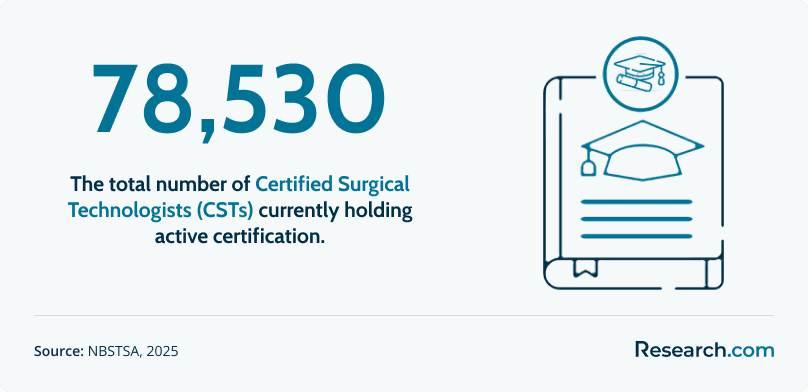
- Check CST exam eligibility: Verify that graduates can apply for the CST exam through the NBSTSA. The current CST pass rate is 71.8%, so exam preparation quality should be part of your decision.
- Ask how clinical placements work: Do not assume an online program will automatically find a site near you. Ask whether the school arranges placements, approves student-found sites, or limits clinical options by state or region.
- Compare the real schedule: Online lectures may be flexible, but labs and clinical shifts may not be. Ask about required campus visits, evening or weekend options, and attendance policies.
- Calculate total cost: Include tuition, fees, supplies, background checks, health screenings, exam preparation, travel, and lost work time.
- Review outcomes: Ask for CST pass rates, graduation rates, job placement information, and employer relationships when available.
- Speak with an advisor before enrolling: Confirm prerequisites, transfer credit rules, clinical requirements, and whether the program accepts students from your location.
Questions to ask before you apply
| Question | Why It Matters |
| Is the program CAAHEP-accredited? | Accreditation can affect certification eligibility and employer confidence |
| Will the school help secure my clinical site? | Clinical delays can postpone graduation |
| How many campus visits are required? | Hybrid programs may still require travel |
| What are the CST pass and job placement outcomes? | Outcomes help you evaluate program effectiveness |
| Are there state restrictions for online students? | Some programs may not accept students from every location |
| What costs are not included in tuition? | Supplies, screenings, and travel can change affordability |
Career Paths for Graduates of Online Associate’s in Surgical Tech Programs
Graduates are prepared for surgical support roles that involve sterile technique, equipment preparation, instrument handling, and patient safety. Job titles and responsibilities vary by employer, experience, certification, and state requirements.
1. Surgical Technologist
Surgical technologists prepare operating rooms, organize sterile instruments, help maintain sterile fields, and pass instruments to surgeons during procedures. Those working in orthopedic operating rooms may benefit from understanding orthopedic nurse education requirements, especially when collaborating on trauma, fracture repair, or joint replacement cases.
Median salary: $97,880 per year.
2. Surgical First Assistant
Surgical first assistants provide more advanced intraoperative support, such as holding retractors, assisting with suturing, and helping control bleeding. This role usually requires additional experience, training, and certification beyond an entry-level surgical technology degree.
Median salary: $78,315 per year.
3. Sterile Processing Technician
Sterile processing technicians clean, assemble, inspect, and distribute surgical instruments and equipment. Their work supports infection control and keeps surgical departments supplied and ready for procedures.
Median salary: $57,186 per year.
4. Surgical Scrub Technician
Surgical scrub technicians concentrate on sterile field management and instrument handling during procedures. They anticipate the surgeon’s needs, pass tools efficiently, and follow strict infection prevention protocols.
Median salary: $63,849 per year.
5. Operating Room Technician
Operating room technicians support surgical flow by preparing instruments, assisting with room setup, helping prepare patients, and coordinating with members of the surgical team. Because they work closely with perioperative nurses, it can be useful to understand operating room nurse requirements, including sterile practice, patient safety standards, and surgical protocols.
Median salary: $88,193 per year.
Common Challenges in Online Surgical Tech Programs
Online surgical technology students often discover that the remote coursework is only one part of the commitment. The bigger challenge is coordinating labs, clinical shifts, transportation, study time, and personal responsibilities. Clinical schedules may be set by hospitals rather than by the student, which can make planning difficult for working adults.
- Clinical placement delays: Students may need to wait for approved surgical sites with available preceptors.
- Limited schedule control: Clinical rotations may occur during daytime hours or specific blocks set by the facility.
- Technology requirements: Virtual simulations, learning platforms, and remote exams require reliable internet and compatible devices.
- High skill expectations: Surgical technology demands precision, professional behavior, and consistent sterile technique.
- Financial pressure: Travel, supplies, and reduced work hours can add stress beyond tuition.
Students who want healthcare management knowledge in addition to clinical training may compare low cost online programs in health care administration, though that path leads to different roles than surgical technology.
How Additional Certifications Can Support a Surgical Tech Career
Additional credentials can help surgical technologists broaden their skills, but they should be chosen strategically. The most useful add-ons are those that match a student’s career goal, such as sterile processing, surgical assisting, CPR/BLS renewal, or healthcare administration. Administrative credentials may be helpful for workers who want hybrid clinical-office roles.
For example, students interested in revenue cycle, documentation, or healthcare office operations may explore the most affordable online medical billing and coding programs. These programs do not replace surgical technology training, but they can support broader employability in healthcare settings.
Job Market for Online Associate’s in Surgical Tech Graduates
The surgical technology field offers steady demand for trained workers. Employment for surgical technologists is projected to grow by 6% between 2023 and 2033, which is about as fast as the average for all occupations. Demand is connected to surgical volume, medical technology, and the healthcare needs of an aging population.
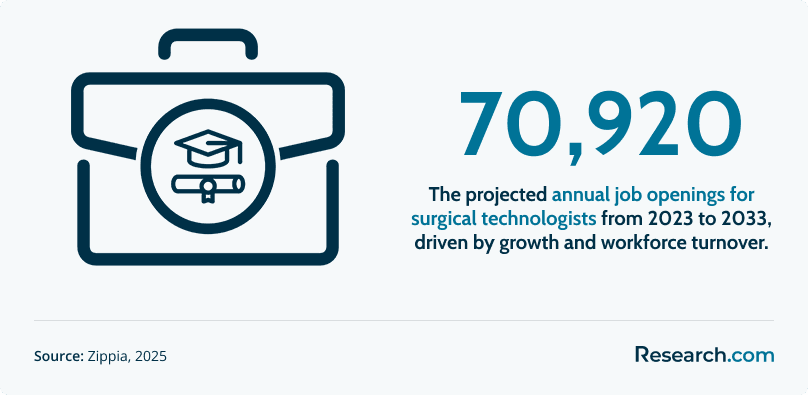
There are over 102,000 surgical technicians employed across the United States. Salaries in this field have risen by 10% over the past five years, and there are approximately 70,920 active job openings nationwide. These figures suggest a stable employment market, but individual outcomes still depend on location, certification, experience, employer type, and clinical performance.
What Graduates Say About Online Surgical Tech Associate Programs
- : "The online format made it possible for me to keep working while completing the academic part of the program. The clinical training was the part that made everything real, and it helped me feel more prepared to step into the operating room. — Aubrey"
- : "I liked being able to study theory online, but the labs and clinical cases were where I gained confidence. Learning sterile technique, instruments, and procedure flow in a structured way helped me feel ready for certification. — Arjan"
- : "The program moved quickly, so staying organized was essential. The combination of anatomy, instrumentation, and supervised clinical experience gave me a clearer path into surgical support work. — Lucy"
How Accreditation and Quality Standards Affect Your Program Choice
Accreditation is one of the most important filters when comparing surgical technology programs. It helps confirm that the curriculum, lab instruction, clinical training, and faculty qualifications meet recognized standards. For students, accreditation can affect certification eligibility, transfer options, employer acceptance, and access to financial aid.
Do not rely on a school’s marketing language alone. Search the accreditor’s database, ask admissions staff to confirm the exact accreditation status, and request written information about CST exam eligibility. This level of review is similar to comparing value and quality in related healthcare programs, such as the cheapest online health information management degree, where accreditation and outcomes should matter as much as price.
Student Support Services to Look for in an Online Surgical Tech Program
Support services can make a major difference in a hybrid surgical technology program because students must manage online coursework, lab requirements, and clinical placements. Before enrolling, ask whether support is available during evenings or weekends if you plan to study outside normal business hours.
- Academic advising: Helps students plan prerequisites, course sequencing, and graduation timelines.
- Clinical coordination: Assists with site approvals, documentation, schedules, and communication with clinical partners.
- Technical support: Helps students use online platforms, simulations, exam systems, and digital resources.
- Tutoring: Supports difficult subjects such as anatomy, pharmacology, medical terminology, and surgical procedures.
- Career services: Provides resume support, interview preparation, job search guidance, and employer connections.
- Certification preparation: Offers review resources, practice questions, and guidance for CST exam applications.
Students who want an administrative healthcare backup plan can also explore accredited medical billing and coding schools online, especially if they are interested in non-clinical healthcare roles.
Common Mistakes to Avoid When Choosing an Online Surgical Tech Program
| Mistake | Better Approach |
| Assuming the program is fully online | Confirm all lab, campus, and clinical attendance requirements before applying |
| Choosing based only on tuition | Compare total cost, including supplies, fees, screenings, travel, and exam preparation |
| Skipping accreditation verification | Check CAAHEP status and CST eligibility directly with the program |
| Ignoring clinical placement logistics | Ask who secures the site, how far students travel, and what happens if placements are full |
| Assuming salary outcomes are guaranteed | Review local job postings and understand that pay depends on location, experience, and employer |
| Overlooking prerequisite timing | Map required courses before the surgical technology sequence begins |
Key Insights
- Most “online” surgical tech associate degrees are hybrid. You may complete theory courses online, but labs and clinical rotations must be done in person.
- Accreditation should be your first filter. CAAHEP accreditation and CST exam eligibility are more important than convenience or speed.
- Clinical placement can determine your timeline. Ask how the school secures sites and whether placements are available near you.
- Costs go beyond tuition. Budget for fees, screenings, immunizations, scrubs, supplies, transportation, and certification preparation.
- The field shows stable demand. Surgical technologist employment is projected to grow by 6% between 2023 and 2033, but job outcomes depend on certification, location, experience, and employer needs.
- The best program is the one that matches your life and meets professional standards. Choose a school that combines flexibility with strong clinical training, transparent costs, and clear graduate outcomes.
References:
- Association of Surgical Technologists. (n.d.). 2-step. Retrieved from AST.
- Association of Surgical Technologists. (n.d.). CE online catalog. Retrieved from AST.
- Association of Surgical Technologists. (n.d.). Members submit credits. Retrieved from AST.
- Association of Surgical Technologists. (n.d.). Homepage. Retrieved from AST.
- Bureau of Labor Statistics. (2019, May). Occupational employment and wages, May 2019: Surgical technologists. Retrieved from BLS.
- Market Research Future. (n.d.). Surgical equipment market. Retrieved from Market Research Future.
- National Board of Surgical Technology and Surgical Assisting. (n.d.). CST certification. Retrieved from NBSTSA.
- National Board of Surgical Technology and Surgical Assisting. (n.d.). CST exam prep. Retrieved from NBSTSA.
- National Board of Surgical Technology and Surgical Assisting. (n.d.). CST first-time retake applicants. Retrieved from NBSTSA.
- National Board of Surgical Technology and Surgical Assisting. (n.d.). Policies. Retrieved from NBSTSA.
- National Board of Surgical Technology and Surgical Assisting. (n.d.). Renewals and recertification. Retrieved from NBSTSA.
- Nurse.org. (n.d.). Surgical tech salary. Retrieved from Nurse.org.
- Preppy.org. (n.d.). Surgical tech certificate program. Retrieved from Preppy.
- Simi Institute. (n.d.). Medical careers: Surgical technologist. Retrieved from Simi Institute.
- Surgical Tech.net. (n.d.). Certification. Retrieved from Surgical Tech.net.
- Surgical Tech.net. (n.d.). Salary by state. Retrieved from Surgical Tech.net.
- ZipRecruiter. (n.d.). Operating room equipment technician salary. Retrieved from ZipRecruiter.
- ZipRecruiter. (n.d.). Sterile processing technician salary. Retrieved from ZipRecruiter.
- ZipRecruiter. (n.d.). Surgical first assistant salary. Retrieved from ZipRecruiter.
- ZipRecruiter. (n.d.). Surgical scrub technician salary. Retrieved from ZipRecruiter.
- ZipRecruiter. (n.d.). Surgical technologist salary. Retrieved from ZipRecruiter.
Other Things You Should Know About Online Associate's in Surgical Tech Programs
The fastest online surgical tech associate programs usually require about 60 to 70 semester credits. Students often take 12 to 18 credits per term to finish in roughly 18 to 24 months, including general education, surgical technology theory, and supervised clinical practice.
After completing an accredited online surgical tech associate program, students can qualify to sit for the Certified Surgical Technologist (CST) exam offered by the NBSTSA. This certification is widely recognized and often required by employers. Some graduates may also pursue the Tech in Surgery-Certified (TS-C) credential from the NCCT. Earning certification enhances job prospects and demonstrates professional competence in surgical procedures, sterile techniques, and patient safety.
The fastest online associate's in surgical tech programs in 2027 generally require a high school diploma or GED, completion of basic science courses such as biology and chemistry, and sometimes relevant healthcare experience. Specifics vary by program, so it's crucial to check individual requirements.
Online surgical tech programs often require clinical hours to be completed at an approved healthcare facility. In 2027, these may include internships or externships, coordinated by the program, to provide hands-on experience necessary for certification and job readiness.








